Carmine Market Size, Share, Growth, Trends, Industry Analysis & Forecast 2026–2034
Buy NowCarmine Market Analysis: Global Valuation, Grade Segments, and Long-Term Outlook
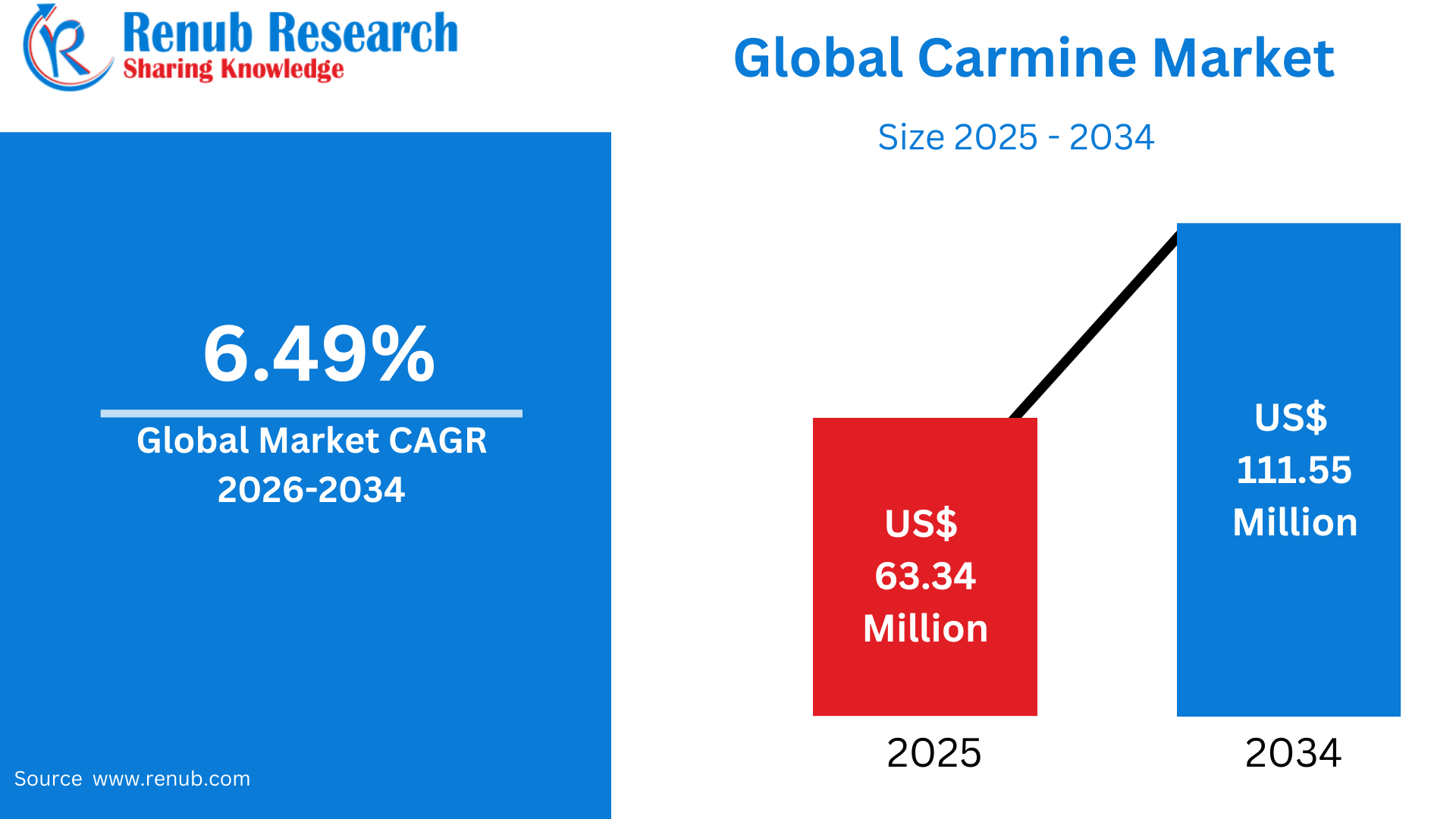
Carmine Market is projected to expand from US$ 63.34 million in 2025 to US$ 111.55 million by 2034, registering a compound annual growth rate (CAGR) of 6.49% during 2026–2034. Market growth is being driven by the rising demand for natural colorants across the food & beverage, cosmetics, and pharmaceutical industries. Increasing consumer preference for clean-label products and naturally derived ingredients, coupled with supportive regulatory policies promoting the use of natural additives over synthetic colorants, is accelerating market adoption.
Global Carmine Market Overview
Carmine is a natural red food dye that is extracted from cochineal insects, which are normally found in abundance on cactus plants in regions such as Latin America. The dye is extracted after processing carminic acid from the insects to produce a stable and bright red dye. Carmine is widely used as a food dye in the food, beverage, cosmetic, and pharmaceutical industries due to its excellent color stability, safety, and natural origin. The dye produces a variety of colors ranging from pink to deep red and is normally used in products such as yogurt, candies, juices, lipsticks, and blushes.
Globally, carmine has become popular due to the rising demand for natural and clean-label ingredients. As the hazards associated with synthetic dyes become widely known, industries are increasingly adopting natural dyes such as carmine. Its approval by governments and safety for use have also contributed to its popularity. In addition, the rising food and cosmetic industries, as well as the rising preference for sustainable and natural additives, have also contributed to the rising popularity of carmine globally.
What is Carmine and its Uses & Popularity Worldwide
Carmine is a natural red pigment derived from carminic acid, which is extracted from dried female cochineal insects (Dactylopius coccus). It is one of the oldest natural colorants and has been used for centuries due to its vibrant red color, excellent stability, and compatibility with a wide range of products. Carmine is widely utilized as a coloring agent in the food and beverage industry, including confectionery, dairy products, yogurt, beverages, bakery products, processed meats, jams, and desserts. It is also extensively used in cosmetics such as lipsticks, blushes, eyeshadows, and personal care products because of its long-lasting color and resistance to heat, light, and oxidation. In the pharmaceutical industry, carmine is used to color tablets, capsules, syrups, and other medicinal formulations, improving product appearance and identification.
Worldwide, the popularity of carmine continues to grow as manufacturers increasingly replace synthetic dyes with naturally derived colorants to meet consumer demand for clean-label products. Rising awareness regarding food safety, stricter regulations on artificial additives, and increasing demand for natural ingredients are supporting market expansion across developed and emerging economies. Carmine is particularly valued for its superior color intensity, excellent stability under varying pH conditions, and long shelf life, making it a preferred natural coloring solution for numerous industrial applications. Continuous growth in the processed food, cosmetics, and pharmaceutical sectors, along with expanding demand for premium natural ingredients, is expected to further enhance the global adoption of carmine over the coming years.
Growth Driver
Rising Consumer Demand for Natural and Clean-Label Food Ingredients
The increasing global preference for natural, clean-label food products is a major driver of the carmine market. Consumers are becoming more conscious of ingredient transparency and are actively avoiding synthetic food colorants due to concerns regarding potential health risks and artificial additives. According to industry estimates, more than 60% of consumers worldwide prefer products containing natural ingredients, while clean-label food and beverage launches continue to grow annually across developed markets. Carmine is widely used in dairy products, confectionery, bakery products, beverages, meat products, and desserts because it delivers a vibrant red color while maintaining excellent stability under heat, light, and varying pH conditions. Food manufacturers are increasingly reformulating existing products to replace synthetic dyes such as Red 40 and Allura Red with naturally derived alternatives. Growing demand for organic, minimally processed, and premium food products is further strengthening the market. As regulatory agencies continue encouraging the use of naturally sourced additives, demand for carmine is expected to expand steadily across the global food and beverage industry.
Expanding Cosmetics and Personal Care Industry
The rapid expansion of the global cosmetics and personal care industry is significantly driving demand for carmine as a premium natural pigment. The global beauty and personal care industry generates annual revenues exceeding US$600 billion, creating strong demand for high-quality natural colorants in cosmetic formulations. Carmine is widely utilized in lipsticks, blushes, eyeshadows, facial powders, nail products, and premium skincare formulations due to its bright color intensity, long-lasting performance, and resistance to fading. Consumers increasingly prefer cosmetics formulated with naturally derived ingredients, encouraging manufacturers to replace synthetic pigments with natural alternatives. Premium beauty brands are expanding their clean beauty portfolios, while growing awareness regarding sustainable ingredient sourcing continues supporting market demand. Emerging economies in Asia-Pacific, Latin America, and the Middle East are also experiencing rising cosmetic consumption driven by increasing disposable incomes and urbanization. Continuous product innovation, expanding premium cosmetic brands, and growing demand for naturally colored formulations are expected to support sustained growth in the global carmine market.
Growing Pharmaceutical Applications and Regulatory Preference for Natural Additives
The pharmaceutical industry is increasingly adopting natural colorants such as carmine to improve product identification, appearance, and consumer acceptance. Carmine is commonly used in tablets, capsules, syrups, topical formulations, lozenges, and nutritional supplements because of its high stability and compatibility with pharmaceutical ingredients. The global pharmaceutical industry now exceeds US$1.6 trillion in annual value, providing significant opportunities for natural excipients and coloring agents. Regulatory authorities in many countries are encouraging manufacturers to reduce the use of certain synthetic dyes while improving labeling transparency for pharmaceutical products. Carmine offers superior stability during manufacturing, storage, and transportation compared with several alternative natural pigments, making it attractive for pharmaceutical applications. Increasing production of over-the-counter medicines, dietary supplements, pediatric formulations, and nutraceutical products is further expanding demand. Rising healthcare expenditure, aging populations, and continuous pharmaceutical innovation are expected to strengthen long-term growth opportunities for carmine manufacturers worldwide.
Challenges
Ethical, Religious, and Vegan Consumer Concerns
One of the major challenges facing the global carmine market is its insect-derived origin, which limits acceptance among certain consumer groups. Carmine is extracted from female cochineal insects, making it unsuitable for vegan, vegetarian, and some religious dietary preferences. The global vegan population continues to expand rapidly, with millions of consumers actively seeking products that avoid animal-derived ingredients. Food manufacturers, cosmetic companies, and pharmaceutical producers increasingly face pressure to disclose ingredient sources through transparent labeling requirements. As consumer awareness grows, many multinational brands are replacing insect-derived colorants with plant-based alternatives such as beetroot extract, anthocyanins, paprika extract, and lycopene. Ethical sourcing concerns and changing purchasing behavior are encouraging manufacturers to invest in alternative natural pigments. Maintaining market growth while addressing evolving consumer preferences remains a significant challenge for producers relying on insect-derived carmine.
Supply Chain Dependence and Raw Material Price Volatility
The global carmine market is highly dependent on cochineal insect cultivation, making raw material availability vulnerable to environmental and agricultural factors. Cochineal insects are primarily cultivated in countries such as Peru, Mexico, Chile, and the Canary Islands, where production can be affected by climate variability, drought, pests, and changing agricultural conditions. Limited geographical production increases supply chain risks and contributes to fluctuations in raw material prices. Harvesting cochineal insects is labor-intensive and requires specialized cultivation methods, resulting in relatively high production costs compared with synthetic colorants. Supply disruptions may impact manufacturers in the food, cosmetics, and pharmaceutical industries that rely on stable deliveries of natural pigments. Additionally, increasing demand for natural colorants worldwide has intensified competition for available raw materials, placing further pressure on prices. Improving cultivation efficiency, expanding production regions, and developing more resilient supply chains will be essential for ensuring long-term stability in the global carmine market.
Carmine Product Launches Worldwide
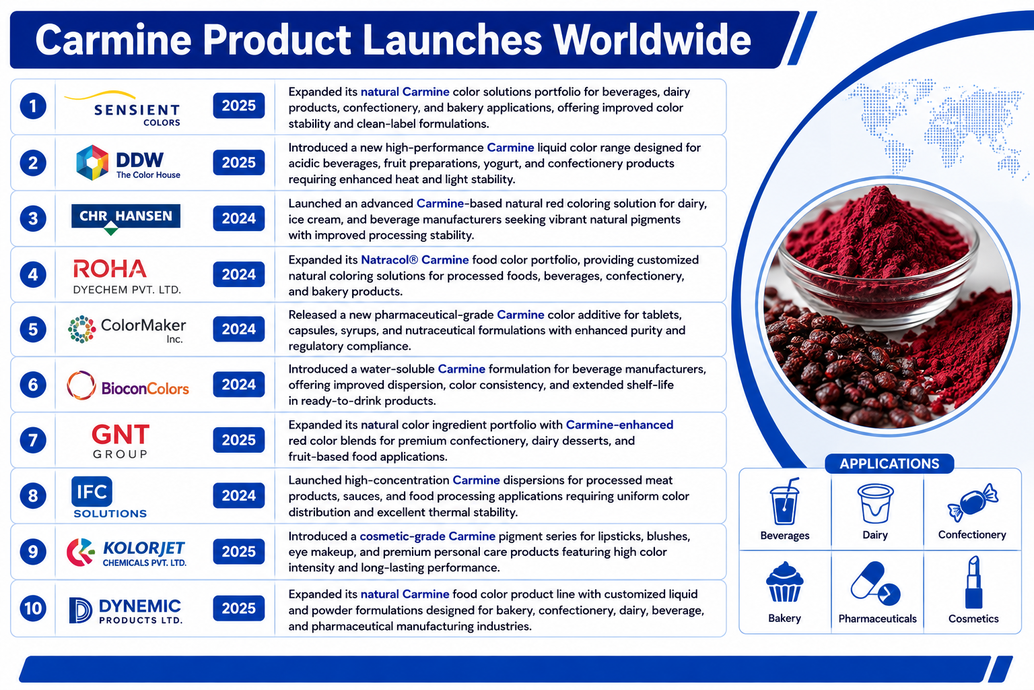
- Sensient Colors (2025) – Expanded its natural Carmine color solutions portfolio for beverages, dairy products, confectionery, and bakery applications, offering improved color stability and clean-label formulations.
- DDW, The Color House (2025) – Introduced a new high-performance Carmine liquid color range designed for acidic beverages, fruit preparations, yogurt, and confectionery products requiring enhanced heat and light stability.
- Chr. Hansen (2024) – Launched an advanced Carmine-based natural red coloring solution for dairy, ice cream, and beverage manufacturers seeking vibrant natural pigments with improved processing stability.
- Roha Dyechem Pvt. Ltd. (2024) – Expanded its Natracol® Carmine food color portfolio, providing customized natural coloring solutions for processed foods, beverages, confectionery, and bakery products.
- ColorMaker Inc. (2024) – Released a new pharmaceutical-grade Carmine color additive for tablets, capsules, syrups, and nutraceutical formulations with enhanced purity and regulatory compliance.
- BioconColors (2024) – Introduced a water-soluble Carmine formulation for beverage manufacturers, offering improved dispersion, color consistency, and extended shelf-life in ready-to-drink products.
- GNT Group (2025) – Expanded its natural color ingredient portfolio with Carmine-enhanced red color blends for premium confectionery, dairy desserts, and fruit-based food applications.
- IFC Solutions (2024) – Launched high-concentration Carmine dispersions for processed meat products, sauces, and food processing applications requiring uniform color distribution and excellent thermal stability.
- KolorJet Chemicals Pvt. Ltd. (2025) – Introduced a cosmetic-grade Carmine pigment series for lipsticks, blushes, eye makeup, and premium personal care products featuring high color intensity and long-lasting performance.
- Dynemic Products Ltd. (2025) – Expanded its natural Carmine food color product line with customized liquid and powder formulations designed for bakery, confectionery, dairy, beverage, and pharmaceutical manufacturing industries.
Growing Preference for Natural Food Colorants in Beverages
The beverages carmine market is expanding steadily as beverage manufacturers increasingly replace synthetic colorants with naturally derived alternatives. Carmine is widely used in fruit beverages, flavored milk, yogurt drinks, energy drinks, alcoholic beverages, soft drinks, and functional beverages because it provides a vibrant red to pink color with excellent stability under varying pH, heat, and light conditions. Industry estimates indicate that the global beverage industry generates annual revenues exceeding US$2 trillion, creating substantial demand for high-performance natural colorants. Carmine maintains color consistency during processing and storage, making it suitable for pasteurized and shelf-stable beverages. Growing consumer demand for clean-label beverages and products formulated with natural ingredients continues to encourage manufacturers to reformulate existing product lines. Premium beverage brands are increasingly highlighting natural coloring on product labels to strengthen consumer confidence. Expansion of functional beverages, sports drinks, and premium fruit-based beverages is expected to further increase demand for carmine across the global beverage industry.
Cosmetics Carmine Premium Beauty Products Driving Natural Pigment Demand
The cosmetics carmine market continues to grow as beauty manufacturers increasingly adopt naturally sourced pigments in premium cosmetic formulations. Carmine is extensively used in lipsticks, lip glosses, blushes, eyeshadows, foundations, facial powders, nail products, and specialty skincare cosmetics due to its rich color intensity, excellent stability, and long-lasting performance. The global beauty and personal care industry is valued at more than US$600 billion annually, providing a significant customer base for natural cosmetic ingredients. Carmine offers superior resistance to heat, oxidation, and ultraviolet light compared with many plant-derived pigments, making it highly desirable in premium cosmetic applications. Increasing consumer awareness regarding ingredient transparency and demand for naturally formulated beauty products continues supporting market growth. Luxury cosmetic brands are investing heavily in clean beauty product development while maintaining product performance and color consistency. Expanding cosmetic consumption across Asia-Pacific, Latin America, and the Middle East is expected to further accelerate growth of the global cosmetics carmine market.
Liquid Carmine Expanding Applications Across Food and Pharmaceutical Manufacturing
The liquid carmine market is witnessing steady expansion because of its ease of incorporation into liquid and semi-liquid formulations across multiple industries. Liquid carmine is widely used in beverages, dairy products, confectionery, syrups, sauces, pharmaceutical formulations, and cosmetic emulsions where rapid blending and uniform color distribution are essential. Compared to powdered forms, liquid carmine simplifies manufacturing processes by reducing preparation time and improving dosing accuracy in automated production systems. Food manufacturers increasingly prefer liquid formulations for high-volume production lines that require consistent color quality. Pharmaceutical companies also utilize liquid carmine in oral syrups and liquid medicines due to its excellent stability and compatibility with aqueous formulations. Growing production of ready-to-drink beverages, flavored dairy products, liquid nutritional supplements, and premium cosmetic formulations continues supporting market demand. Continuous improvements in formulation technology and packaging solutions are expected to strengthen the long-term outlook of the global liquid carmine market.
Global Carmine Food Processing Processed Food Industry Supporting Market Expansion
The global carmine food processing market represents one of the largest application segments for natural colorants due to growing demand for visually appealing and clean-label food products. Carmine is extensively utilized in processed meats, confectionery, bakery products, dairy products, desserts, ice cream, jams, sauces, yogurt, fruit preparations, and ready-to-eat foods. The global processed food industry exceeds US$3 trillion in annual value, creating substantial opportunities for natural food coloring ingredients. Carmine is preferred because it provides excellent color stability during thermal processing, freezing, pasteurization, and long-term storage while maintaining product appearance throughout shelf life. Food manufacturers are increasingly replacing synthetic dyes with natural alternatives to comply with evolving consumer preferences and regulatory requirements. Premium food brands are emphasizing natural ingredient labeling to strengthen product differentiation. Rising urbanization, growing consumption of packaged foods, and increasing demand for premium processed food products continue to support long-term growth of the global carmine food processing market.
Global Carmine Cosmetics & Pharmaceutical Industries Expanding Demand for High-Quality Natural Pigments
The global carmine cosmetics & pharmaceutical industries market is experiencing sustained growth due to increasing adoption of natural pigments in healthcare and personal care products. Carmine is widely used to color tablets, capsules, syrups, ointments, nutritional supplements, lipsticks, blushes, and skincare formulations because of its excellent chemical stability, high color strength, and compatibility with numerous formulations. The global pharmaceutical industry exceeds US$1.6 trillion annually, while the cosmetics industry generates more than US$600 billion, together creating strong long-term demand for premium natural colorants. Regulatory emphasis on ingredient transparency and growing consumer preference for naturally derived additives continue encouraging manufacturers to reduce dependence on synthetic dyes. Pharmaceutical companies also utilize carmine to improve product identification and patient acceptance. Continuous innovation in premium cosmetics, expanding nutraceutical production, rising healthcare expenditure, and increasing demand for clean-label formulations are expected to sustain steady growth across the global carmine cosmetics and pharmaceutical industries market.
Carmine Strong Demand for Natural Food and Cosmetic Colorants in United States
United States carmine market is witnessing steady growth due to increasing consumer preference for natural ingredients across the food, beverage, cosmetics, and pharmaceutical industries. The U.S. food and beverage industry generates more than US$2 trillion annually, creating substantial demand for naturally derived colorants that can replace synthetic additives. Carmine is widely used in dairy products, confectionery, fruit beverages, processed foods, bakery products, yogurts, and premium beverages because of its excellent color stability and heat resistance. The cosmetics sector, valued at over US$100 billion, also utilizes carmine extensively in lipsticks, blushes, and eye makeup due to its vibrant red pigmentation and long-lasting performance. Pharmaceutical manufacturers incorporate carmine into tablets, capsules, and syrups to improve product identification and visual appeal. Rising clean-label trends, increasing demand for premium natural ingredients, and stricter labeling requirements continue encouraging manufacturers to reformulate products using naturally sourced colorants, supporting sustained expansion of the United States carmine market.
Carmine Clean-Label Food Trends Supporting United Kingdom Market Growth
United Kingdom carmine market is expanding as manufacturers increasingly adopt natural food colorants to satisfy evolving consumer preferences and regulatory expectations. The UK’s food and beverage sector contributes more than £140 billion annually to the national economy, making it one of Europe’s largest markets for natural ingredients. Carmine is widely used in confectionery, dairy products, beverages, bakery products, processed foods, and premium desserts due to its strong color intensity and excellent stability under various processing conditions. The country’s cosmetics industry also increasingly utilizes naturally derived pigments in lipsticks, facial cosmetics, and personal care products as demand for clean beauty products continues to rise. Pharmaceutical companies use carmine in medicinal formulations to enhance product differentiation and patient acceptance. Increasing demand for transparent ingredient labeling, sustainable sourcing practices, and premium natural formulations continues driving product reformulation across multiple industries. Continuous innovation in food manufacturing and cosmetics is expected to support long-term growth of the United Kingdom carmine market.
Expanding Processed Food and Pharmaceutical Industries Driving Demand in India
India’s carmine market is experiencing robust growth due to the rapid expansion of the processed food, pharmaceutical, and cosmetics industries. India’s food processing sector contributes approximately 8–9% of manufacturing Gross Value Added (GVA) and continues to expand alongside rising urbanization and changing consumer lifestyles. Carmine is increasingly used in confectionery, dairy products, flavored beverages, bakery products, processed meats, and premium packaged foods that require stable natural coloring agents. India’s pharmaceutical industry, valued at more than US$50 billion, also utilizes carmine in tablets, capsules, syrups, and nutraceutical products because of its stability and compatibility with pharmaceutical formulations. The cosmetics and personal care industry is further increasing demand for natural pigments as consumers shift toward premium beauty products with naturally derived ingredients. Rising disposable incomes, expanding retail distribution, increasing awareness regarding clean-label products, and strong growth in domestic manufacturing continue to create favorable conditions for sustained expansion of India’s carmine market.
Saudi Arabia Growing Food Manufacturing and Premium Cosmetics Supporting Expansion
Saudi Arabia’s carmine market is steadily developing due to increasing demand for natural ingredients across food manufacturing, pharmaceuticals, and cosmetics. The country’s expanding food processing industry is benefiting from population growth, urbanization, and higher consumption of packaged foods, dairy products, confectionery, beverages, and bakery items where natural colorants are increasingly preferred. Carmine offers superior heat stability and vibrant coloration, making it suitable for premium food applications manufactured under challenging climatic conditions. Saudi Arabia’s growing cosmetics sector is also contributing to market expansion, with rising demand for luxury beauty products, lip cosmetics, and personal care formulations containing naturally sourced pigments. Pharmaceutical manufacturers utilize carmine in tablets, capsules, syrups, and healthcare products to improve product appearance and identification. Government initiatives supporting domestic manufacturing, food security, and industrial diversification under Vision 2030 are encouraging investments in food processing and consumer goods industries. Increasing demand for clean-label products and premium-quality formulations is expected to support continued growth of the Saudi Arabia carmine market.
Market Segments
Application
- Bakery & Confectionery
- Beverages
- Dairy & Frozen Products
- Meat Products
- Fruits & Vegetables
- Oil & Fat
- Cosmetics
- Other Food Products
Form
- Liquid
- Powder
- Crystal
End-Users
- Food Processing
- Beverage
- Catering
- Cosmetics & Pharmaceutical Industries
Countries- Industry is divided into 25 viewpoints:
North America
- United States
- Canada
Europe
- France
- Germany
- Italy
- Spain
- United Kingdom
- Belgium
- Netherlands
- Turkey
Asia Pacific
- China
- Japan
- India
- Australia
- South Korea
- Thailand
- Malaysia
- Indonesia
- New Zealand
Latin America
- Brazil
- Mexico
- Argentina
Middle East & Africa
- South Africa
- Saudi Arabia
- United Arab Emirates
All the Key players have been covered
- Overviews
- Key Person
- Recent Developments
- SWOT Analysis
- Revenue Analysis
Competitive Landscape
- Clariant AG
- Chr. Hansen Holding A/S
- Naturex (Givaudan)
- Sensient Technologies Corporation
- The Hershey Company
- Biocon
- Amerilure
- DDW Color House
Report Details:
| Report Features | Details |
| Base Year |
2025 |
| Historical Period |
2022 - 2025 |
| Forecast Period |
2026 - 2034 |
| Market |
US$ Billion |
| Segment Covered |
Application, Form, End-Users and Countries |
| Countries Covered |
|
| Companies Covered |
|
| Customization Scope |
20% Free Customization |
| Post-Sale Analyst Support |
1 Year (52 Weeks) |
| Delivery Format |
PDF and Excel through Email (We can also provide the editable version of the report in PPT/Word format on request) |
Customization Services available
- Analysis of Market Size and Its Segments
- More Company Profiles (Upto 10 without any additional cost):
- Additional Countries (Other than mentioned Countries):
- Region/Country Specific Reports:
- Market Entry Strategy:
- Region-Specific Market Dynamics:
- Regional Market Share Analysis:
- Trade Analysis:
- Production Insights:
- Others Customized Requests:
For more information contact our analysts.
Need More Assistance?
- Talk to our analysts to get more precious information on the current market trends.
- Include more countries and segments and customize the report based on the final requirement.
- Get a competitive advantage in your industry by knowing the report findings and making a positive impact on your revenues and operations.
- Our analysts are always ready to provide more help and pertinent information if you need any additional assistance.