Frozen Food Market Report by Product Category, Product Type, Distribution Channel, Country and Company Analysis 2026-2034
Buy NowFrozen Food Market Size and Forecast
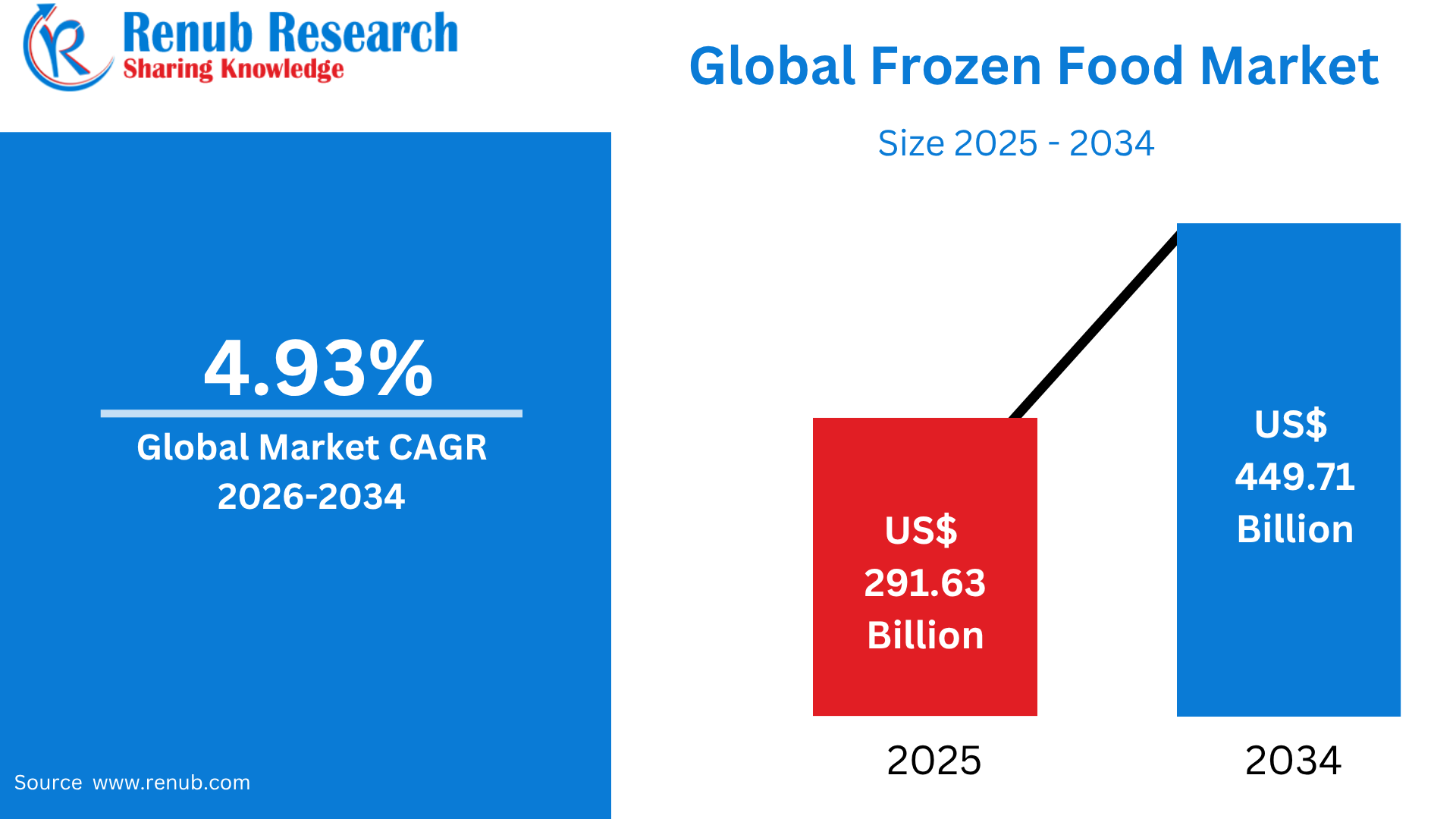
Frozen Food Market is projected to grow from US$ 291.63 billion in 2025 to US$ 449.71 billion by 2034, registering a CAGR of 4.93% during 2026–2034. Market expansion is being supported by increasing consumer preference for convenient, ready-to-eat foods, longer product shelf life, broader availability of frozen products through modern retail channels, and advancements in freezing and preservation technologies. Rising urbanization, busy lifestyles, and growing demand for quick meal solutions are further encouraging the adoption of frozen food products worldwide.
What is Frozen Food and Its Uses & Popularity Worldwide
Frozen food refers to food products that are preserved by freezing at low temperatures to slow microbial growth and enzymatic activity, helping maintain their quality and extending shelf life. The category includes frozen vegetables, fruits, meat, poultry, seafood, dairy products, pizzas, ready-to-eat meals, snacks, and desserts. Frozen foods are widely used by households, restaurants, hotels, catering businesses, and foodservice operators because they offer convenience, consistent quality, and easier inventory management. They reduce preparation time and can help minimize food waste by allowing products to be stored for extended periods.
Worldwide popularity is increasing as urbanization, busy lifestyles, smaller households, and demand for quick meal solutions influence consumer purchasing habits. Improvements in freezing technologies, cold-chain logistics, packaging, and product formulation have also expanded the variety and quality of frozen products available. Supermarkets, hypermarkets, convenience stores, and online grocery platforms have improved accessibility across developed and emerging markets. Growing consumer interest in portion-controlled meals, frozen fruits and vegetables, and convenient ready-to-cook products is further strengthening the global appeal of frozen foods.
Top Frozen Food Products Imported into the US
* Frozen Shrimp: US$ 5.22 billion
* Frozen French Fries: US$ 2.12 billion
* Frozen Berries: US$ 1.45 billion
* Frozen Pizza and Ready Meals: US$ 275.65 million
* Frozen Mixed Vegetables: US$ 262.35 million
* Frozen Salmon: US$ 51.35 million
Source: USImportData.com
Growth Drivers of the Frozen Food Market
Rising Demand for Convenience and Ready-to-Eat Foods
Changing lifestyles, urbanization, and increasing time constraints are strengthening demand for frozen foods that require minimal preparation. Frozen meals, pizzas, snacks, vegetables, seafood, and meat products provide consumers with convenient options while reducing cooking and preparation time. Earlier UNEP/IIR analysis noted that convenient and ready meals had become a dominant part of the global frozen food market, particularly in response to busy urban lifestyles. In addition, frozen products can remain usable for considerably longer periods than many fresh alternatives, allowing households and foodservice operators to purchase products in larger quantities and reduce frequent shopping. The growing popularity of online grocery platforms, supermarkets, hypermarkets, and convenience stores is further improving access to frozen products. Frozen foods are also increasingly being incorporated into restaurant and foodservice menus because they offer standardized portions and easier inventory management. As consumers continue to prioritize convenience, affordability, and quick meal preparation, demand for frozen food is expected to remain an important market-growth driver.
Expansion of Cold-Chain Infrastructure and Retail Distribution
The development of cold-chain infrastructure is supporting the production, transportation, storage, and distribution of frozen foods across international markets. Reliable temperature-controlled logistics help preserve food quality and safety while allowing manufacturers to distribute products over longer distances. According to UNEP and FAO, inadequate refrigeration contributes to the loss of approximately 526 million tonnes of food annually, equivalent to around 12% of global food production. Developing countries could potentially save about 144 million tonnes of food each year by reaching cold-chain infrastructure levels comparable with developed economies. These figures demonstrate the substantial opportunity created by investment in refrigeration, cold storage, refrigerated transport, and temperature monitoring. As retailers expand freezer capacity and modern grocery networks grow, consumers in emerging markets are gaining access to broader frozen-food portfolios. Improvements in cold-chain efficiency also enable manufacturers to introduce products into new geographic markets, strengthening distribution reach and supporting long-term frozen food market expansion.
Longer Shelf Life and Food-Waste Reduction Benefits
Frozen food is gaining attention because freezing can extend product usability and provide consumers with greater flexibility in purchasing and consumption. This characteristic is particularly valuable as food waste remains a major global issue. UNEP estimates that 1.05 billion tonnes of food were wasted in 2022, representing approximately 19% of food available to consumers at the retail, foodservice, and household levels. Households accounted for about 631 million tonnes, or 60% of total consumer-level food waste. Frozen products can help households manage portions and store food for longer periods, while foodservice operators can maintain inventory without relying entirely on highly perishable fresh ingredients. The ability to preserve seasonal fruits, vegetables, meat, seafood, and prepared foods also allows manufacturers and retailers to maintain product availability throughout the year. FAO notes that reliable cold chains can reduce food loss and improve operational efficiency throughout the food supply chain. Consequently, the combination of extended storage, inventory flexibility, and potential food-waste reduction is supporting broader adoption of frozen products.
Challenges of the Frozen Food Market
High Cold-Chain Energy Requirements and Infrastructure Costs
Maintaining frozen foods at appropriate temperatures requires continuous refrigeration across processing, storage, transportation, retail, and sometimes household stages. This creates substantial infrastructure and operating requirements, particularly in countries with unreliable electricity networks or limited refrigerated logistics. UNEP and FAO estimate that the global food cold chain contributes approximately 4% of global greenhouse-gas emissions, including emissions associated with refrigeration technologies and food loss and waste caused by inadequate cooling. Developing economies can face additional barriers because refrigerated warehouses, freezer equipment, reefer vehicles, backup power, and temperature-monitoring systems require significant investment. Higher electricity and transportation costs can also increase the final price of frozen products. Temperature fluctuations during transportation or storage may negatively affect quality and food safety, creating additional losses for manufacturers and retailers. The industry therefore needs continued investment in energy-efficient refrigeration, sustainable refrigerants, renewable-powered cold storage, and better temperature-control technologies. Improving cold-chain efficiency is essential for expanding frozen-food distribution while controlling operational costs and environmental impacts.
Environmental Concerns and Consumer Perception
Environmental considerations present another challenge for the frozen food industry because freezing, refrigerated transportation, and cold storage require energy throughout the supply chain. Packaging is also an important consideration, particularly where frozen products rely on multilayer plastics or materials that are difficult to recycle. Food loss and waste collectively generate approximately 8–10% of global greenhouse-gas emissions, increasing pressure on food manufacturers to improve sustainability across their operations. Consumers are increasingly interested in products with sustainable packaging, lower environmental footprints, and transparent sourcing. At the same time, some consumers may perceive frozen foods as less fresh or less natural than fresh alternatives, despite the ability of freezing technologies to preserve nutritional and sensory characteristics. Manufacturers are responding through recyclable or reduced-material packaging, energy-efficient freezing systems, improved cold-chain management, and clearer nutritional communication. Addressing these environmental concerns while maintaining affordability, quality, and convenience will be important for sustaining consumer confidence and supporting future frozen-food market growth.
Frozen Food Launches Worldwide
1. Shana Foods – Paratha Toasties (UK, 2026)
Launched a toaster-ready frozen paratha designed to cook directly from frozen in about three minutes, targeting consumers seeking convenient South Asian food.
2. Saffron Road – Crossroads™ (US, 2026)
Introduced a new frozen meal line combining global flavors, including birria rigatoni and butter chicken cavatappi, with an emphasis on protein and clean-label positioning.
3. NISSIN FOODS – KANZEN MEAL (US, 2025)
Entered the frozen-meal category with three single-serve, nutrient-dense comfort meals designed around modern nutritional needs.
4. Ming Tsai – Mings Frozen Meals (US, 2025)
Chef Ming Tsai launched a frozen meal range featuring Asian-inspired dishes and bold flavors, initially making the products available nationwide through Walmart.
5. Dolly Parton & Conagra – Frozen Meals (US, 2025)
Introduced four single-serve frozen meals based on Southern-inspired comfort foods, offering convenient heat-and-eat options.
6. Conagra Brands – New Frozen Food Portfolio (US, 2025)
Conagra launched more than 50 new frozen products, including single-serve and multi-serve meals, vegetable sides, gluten-free products, and plant-based meals.
7. GOLO Foods – Protein-Packed Frozen Meals (US, 2025)
GOLO introduced fully cooked frozen meals in single-serving formats, targeting consumers looking for convenient, protein-focused meal options.
8. PuraVida Foods – KidsLife Disney & Pixar Frozen Meals (US, 2026)
Launched chef-crafted frozen meals featuring characters from Disney and Pixar, combining family-oriented branding with nutrition-focused formulations.
9. Tai Pei – Shrimp & Vegetable Chow Mein (US, 2026)
Introduced two frozen Asian-inspired meals—Shrimp Chow Mein and Vegetable Chow Mein—designed to deliver restaurant-style flavors in a convenient frozen format.
10. JK Foods – Expanded Asian Frozen Food Range (UK, 2026)
Expanded its frozen portfolio with Asian meals, snacks, vegetables, seafood, meat products, and specialty ingredients for retail, wholesale, hospitality, and foodservice customers.
RTE Frozen Food Convenience and Time-Saving Meal Solutions
Ready-to-eat (RTE) frozen foods are gaining popularity because they combine the convenience of prepared meals with the extended shelf life of frozen products. The category includes frozen meals, pizzas, snacks, prepared meat and poultry, and vegetable-based meals that require minimal preparation before consumption. Frozen products are particularly attractive to urban consumers, working professionals, students, and smaller households seeking quick meal options. In the United States, USDA research found that consumers averaged 2.4 eating occasions of frozen meals or pizzas during a 30-day period in 2017–March 2020, compared with 2.7 occasions in 2007–2008. Product innovation is increasingly focused on high-protein, low-sodium, plant-based, gluten-free, and portion-controlled formulations. Improvements in freezing, packaging, and distribution technologies are also helping manufacturers maintain taste and texture. As convenience remains a major purchasing consideration, RTE frozen foods are expected to remain an important category within the global frozen food industry.
Expanding Demand for Convenient Vegetable-Based Snacks
Frozen vegetable snacks include products such as vegetable bites, nuggets, patties, wedges, and other ready-to-cook snack formats. The category is benefiting from growing consumer interest in convenient foods that can be prepared quickly while incorporating vegetables into everyday diets. Industry segmentation identifies French fries, bites, wedges and smileys, aloo tikki, nuggets, and other products as important frozen vegetable snack categories. Demand is particularly strong among younger consumers and families looking for easy-to-prepare snacks for home consumption. Foodservice operators also use frozen vegetable snacks because standardized portions and longer storage periods simplify inventory management. Product manufacturers are increasingly introducing plant-based, reduced-oil, high-fiber, and clean-label formulations to appeal to health-conscious consumers. Frozen processing allows products to be stored for extended periods while maintaining convenience and consistent preparation. Expanding supermarket freezer sections, quick-commerce platforms, and food-delivery channels are improving product availability. As snacking occasions increase and consumers seek alternatives to traditional meat-based snacks, frozen vegetable snacks are gaining a broader role in household and foodservice consumption.
Strong Frozen Chicken Demand for Convenient Protein Products
Frozen chicken is an important segment of the frozen meat category and includes chicken breasts, strips, nuggets, wings, fillets, diced chicken, and prepared chicken products. Its popularity is supported by chicken’s widespread consumption as an affordable and versatile protein source. Frozen formats allow consumers and foodservice operators to store chicken for longer periods while maintaining convenient access to portioned products. The category also benefits from growing demand for ready-to-cook and prepared protein products. USDA food-program data illustrate the breadth of frozen chicken offerings, including 6.12 million pounds of cooked frozen chicken fajita strips, 4.03 million pounds of oven-roasted frozen chicken, and 4.08 million pounds of frozen unseasoned chicken strips listed in its 2025 explanatory data. Food manufacturers are increasingly developing breaded, seasoned, marinated, and portion-controlled products for households and restaurants. Improvements in freezing technology and cold-chain logistics are further supporting product quality and distribution. Growing demand for convenient protein-rich meals, combined with the expansion of supermarkets, foodservice outlets, and online grocery channels, is expected to sustain the frozen chicken segment.
Year-Round Availability and Meal Preparation Convenience
Frozen mixed vegetables consist of combinations of vegetables such as peas, carrots, corn, beans, and other produce that are cleaned, processed, portioned, and frozen for convenient use. The segment benefits from consumers seeking quick ways to incorporate vegetables into meals without extensive washing, cutting, or preparation. Global frozen vegetable consumption was estimated at approximately 37 million tonnes in 2024, demonstrating the significant scale of frozen vegetable consumption worldwide. Mixed vegetable products are particularly useful for households, restaurants, institutional kitchens, and prepared-meal manufacturers because standardized combinations simplify meal preparation and inventory management. Freezing also enables vegetables to remain available beyond their normal harvesting seasons. USDA data list 3.33 million pounds of frozen mixed vegetables without added salt in its 2025 food-program explanatory data, illustrating institutional demand for the category. Manufacturers are increasingly focusing on no-added-salt, organic, non-GMO, and preservative-free formulations. The growth of quick meal preparation, health-conscious eating, and modern retail freezer infrastructure is expected to support continued demand for frozen mixed vegetables worldwide.
Growing Use in Smoothies, Desserts, and Healthy Foods demands Frozen Strawberries
Frozen strawberries are becoming increasingly popular because they provide year-round access to fruit while offering convenience for households, restaurants, beverage manufacturers, and foodservice businesses. Freezing helps preserve strawberries after harvesting, allowing them to be used in smoothies, desserts, bakery products, yogurt, sauces, breakfast preparations, and ready-to-eat foods. Frozen strawberries are particularly attractive to consumers interested in smoothies and healthy snacks because they can be used directly from the freezer without washing, trimming, or cutting. USDA 2025 explanatory data included approximately 27.1 million pounds of frozen strawberry cups, 2.18 million pounds of sliced frozen strawberries, and 5.19 million pounds of unsweetened frozen strawberries. Product development is increasingly emphasizing unsweetened, organic, individually quick-frozen, and portion-controlled formats. Growth in smoothie consumption, bakery applications, foodservice, and online grocery distribution is supporting the continued expansion of frozen strawberry demand.
Convenient Access to Frozen Products
Convenience stores are an important distribution channel for frozen food because they provide consumers with quick access to ready-to-cook meals, frozen snacks, ice cream, frozen meat, vegetables, and other products. The channel is particularly relevant for consumers seeking immediate meal or snack solutions without visiting larger supermarkets. Industry segmentation identifies convenience stores alongside supermarkets and hypermarkets, specialty stores, and online retail as key frozen-food distribution channels. Convenience stores are increasingly expanding freezer capacity and product variety to respond to demand for smaller portions, single-serve meals, and quick-preparation products. Longer shelf life allows retailers to maintain inventory while reducing the frequency of replenishment compared with highly perishable fresh products. Frozen snacks and ready-to-eat or ready-to-cook meals are especially suitable for locations with high foot traffic. The expansion of urban convenience retail, extended operating hours, delivery services, and quick-commerce platforms is further increasing accessibility. As consumers prioritize speed and convenience, frozen food products are expected to remain an important category within convenience-store retailing.
Strong Convenience Demand and Advanced Distribution in USA
United States frozen food market is well established, supported by strong consumer demand for convenient, affordable, and easy-to-prepare food products. Frozen meals, snacks, vegetables, meat, seafood, and ready-to-cook products are widely available through supermarkets, hypermarkets, convenience stores, warehouse clubs, and online grocery platforms. The country’s advanced cold-chain infrastructure enables frozen products to be transported and stored efficiently across long distances while maintaining quality. Busy lifestyles and the growing number of dual-income households are encouraging consumers to choose products that reduce meal preparation time. At the same time, manufacturers are expanding healthier offerings, including organic, plant-based, low-calorie, high-protein, and clean-label frozen products. The rapid development of e-commerce and grocery-delivery services has further increased consumer access to frozen foods. Retailers are also expanding freezer space and private-label selections to provide affordable alternatives. Continuous innovation in freezing technology, packaging, product formulations, and distribution is helping manufacturers respond to changing consumer preferences and sustain the development of the U.S. frozen food market.
Affordability, Convenience, and Reduced Food Waste in UK
United Kingdom frozen food market is expanding steadily as consumers increasingly seek affordable and convenient meal solutions. Frozen products offer longer storage periods, easy preparation, and greater flexibility, making them suitable for households managing busy schedules. Demand extends across frozen vegetables, ready meals, potatoes, meat, seafood, desserts, and plant-based products. Health-conscious consumers are also encouraging manufacturers to introduce products with improved nutritional profiles, including lower-calorie, vegetarian, vegan, and higher-protein options. Supermarkets and discount retailers play an important role by expanding freezer ranges and private-label offerings, helping consumers manage food budgets. Online grocery shopping and home delivery have further improved accessibility to frozen products. Frozen food also supports efforts to reduce household food waste because products can be stored and consumed when needed rather than immediately after purchase. Retailers and manufacturers are increasingly focusing on packaging improvements, energy efficiency, and sustainable sourcing in response to environmental concerns. These factors, combined with changing lifestyles and strong retail infrastructure, continue to support the UK’s frozen food market.
Urbanization and Rapid Expansion of Cold-Chain Infrastructure in China
China’s frozen food market is experiencing strong development as urbanization, rising household incomes, and changing consumption habits increase demand for convenient food products. Consumers, particularly in urban areas, are increasingly purchasing frozen dumplings, seafood, meat, vegetables, prepared meals, and other ready-to-cook products. The expansion of modern supermarkets, convenience stores, food-delivery platforms, and e-commerce has significantly improved access to frozen products. Improvements in cold-chain logistics are also strengthening the industry’s ability to maintain product quality during transportation and storage. China’s large urban population and expanding middle-income consumer base create significant opportunities for premium, branded, and innovative frozen food products. Food safety remains an important consideration, encouraging greater emphasis on traceability, temperature control, packaging, and quality management. Manufacturers are responding with products tailored to regional tastes and increasingly diverse dietary preferences. Technological improvements in freezing, warehouse management, refrigerated transportation, and online distribution are further improving supply-chain efficiency. Together, urbanization, rising purchasing power, modern retail expansion, and cold-chain development are supporting continued growth of China’s frozen food market.
Food Imports, Premium Demand, and Food-Security Initiatives in UAE
UAE frozen food market is expanding as consumers increasingly prefer convenient, ready-to-cook, and ready-to-eat food products. The country’s substantial dependence on food imports and highly diverse population supports the availability of frozen products from numerous international cuisines and food categories. Frozen meat, poultry, seafood, vegetables, prepared meals, bakery products, and snacks are widely distributed through supermarkets, hypermarkets, convenience stores, hotels, restaurants, and foodservice businesses. Rising disposable incomes and busy urban lifestyles are supporting demand for premium and international frozen products. The UAE’s modern logistics infrastructure and expanding cold-chain capabilities help maintain product quality during storage and transportation. E-commerce and online grocery platforms are also making frozen products more accessible to consumers. In addition, national food-security initiatives are encouraging investment in domestic food production, storage, processing, and logistics infrastructure. Retailers and food manufacturers are increasingly focusing on product quality, packaging, nutritional value, and sustainability. The combination of a diverse consumer base, modern retail infrastructure, food-security investments, and strong logistics capabilities is supporting the long-term development of the UAE frozen food market.
Recent Developments in Frozen Food Market
- In May 2025: HyFun Foods added Indian street-style flavors to their line of ready-to-cook frozen snacks. In response to urban Indian consumers' increasing need for a variety of frozen food options, the firm introduced Mumbai Aloo Vada and intends to offer Spicy Paneer Patty.
- January 2025: Kitchen Joy, a ready-meal brand with a focus on Thai cuisine, was introduced at Tesco by Westbridge goods, a UK importer and manufacturer of Asian goods. Six rice and noodle-based frozen dinners, including fusion recipes like Spicy Sesame Chicken Noodles and Thai staples like Chicken Panang, Tom Yum, and Green Curry, were offered by the company at more than 580 Tesco stores.
-
January 2025: The meat processing business Siniora Foods is investing USD 40 million to build a new production facility in Saudi Arabia. Siniora will be able to produce more frozen goods and cold cuts thanks to the new plant in Jeddah.
Frozen Food Market Segments
Product Category
- Ready-to-eat
- Ready-to-cook
Product Type
- Frozen Vegetable Snacks
- French Fries
- Bites, Wedges and Smileys
- Aloo Tikki
- Nuggets
- Others
Frozen Meat Products
- Chicken
- Fish
- Pork
- Mutton
- Others
Frozen Vegetables
- Green Peas
- Corn
- Mixed Vegetables
- Carrot
- Cauliflower
- Others
Fruits
- Strawberries
- Berries (Raspberries, Blueberries and Blackberries)
- Cherries
- Others
Distribution Channel
- Supermarkets and Hypermarkets
- Convenience Stores
- Online Channels
- Others
Countries
North America
- United States
- Canada
Europe
- France
- Germany
- Italy
- Spain
- United Kingdom
- Belgium
- Netherlands
- Turkey
Asia Pacific
- China
- Japan
- India
- Australia
- South Korea
- Thailand
- Malaysia
- Indonesia
- New Zealand
Latin America
- Brazil
- Mexico
- Argentina
Middle East & Africa
- South Africa
- Saudi Arabia
- UAE
All the Key players have been covered from 4 Viewpoints:
- Overview
- Key Person
- Recent Development
- Revenue
Key Players Analysis
- General Mills Inc.
- Unilever PLC
- Nestle SA
- Tyson Foods Inc.
- Nomad Foods Ltd
- Ajinomoto Co. Inc.
- Conagra Brands Inc.
- The Kraft Heinz Company
- McCain Foods Limited
- Hormel Foods Corporation
Report Details:
| Report Features | Details |
| Base Year |
2024 |
| Historical Period |
2020 - 2024 |
| Forecast Period |
2025 - 2033 |
| Market |
US$ Billion |
| Segment Covered |
By Product Category, By Product Type, By Distribution Channel and By Countries |
| Countries Covered |
|
| Companies Covered |
|
| Customization Scope |
20% Free Customization |
| Post-Sale Analyst Support |
1 Year (52 Weeks) |
| Delivery Format |
PDF and Excel through Email (We can also provide the editable version of the report in PPT/Word format on request) |
Customization Services available
- Analysis of Market Size and Its Segments
- More Company Profiles (Upto 10 without any additional cost):
- Additional Countries (Other than mentioned Countries):
- Region/Country Specific Reports:
- Market Entry Strategy:
- Region-Specific Market Dynamics:
- Regional Market Share Analysis:
- Trade Analysis:
- Production Insights:
- Others Customized Requests:
For more information contact our analysts.
Need More Assistance?
- Talk to our analysts to get more precious information on the current market trends.
- Include more countries and segments and customize the report based on the final requirement.
- Get a competitive advantage in your industry by knowing the report findings and making a positive impact on your revenues and operations.
- Our analysts are always ready to provide more help and pertinent information if you need any additional assistance.