Cosmetics Market Report by Product Type, Gender, Distribution Channel, Countries and Company Analysis 2026–2034
Buy NowGlobal Beauty and Cosmetics Industry Overview: Revenue Projections, Channel Dynamics, and Growth Trajectory
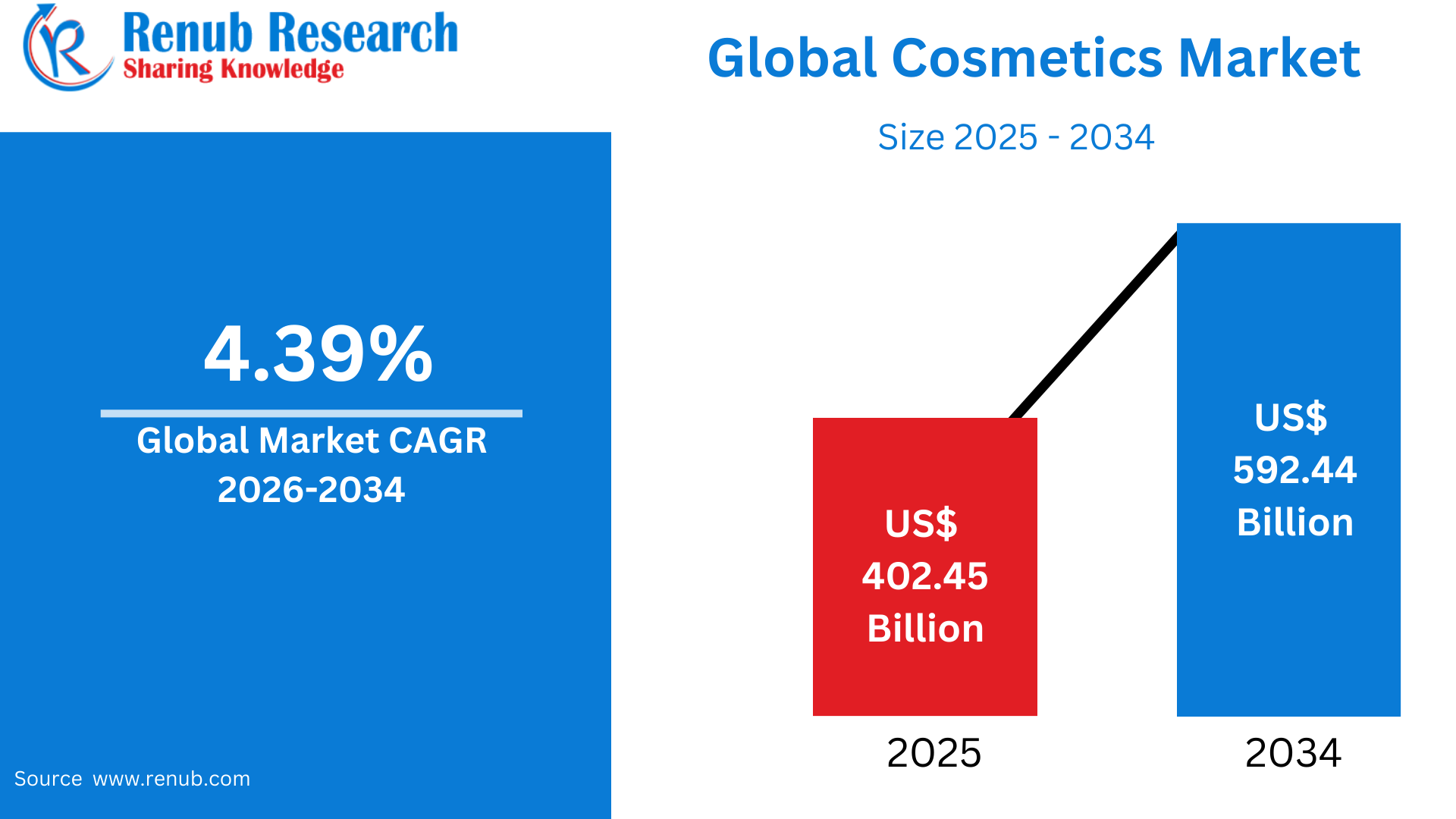
Global Cosmetics Market is projected to grow from US$ 402.45 billion in 2025 to US$ 592.44 billion by 2034, with a CAGR of 4.39 % from 2025 to 2033. Market expansion is being driven by rising consumer spending on personal care and beauty products, increasing demand for premium and clean-label cosmetics, and continuous product innovation. The rapid growth of e-commerce, social media influence, and demand for organic, vegan, and sustainable beauty products are further accelerating market development.
Cosmetics and their Uses & Popularity Worldwide
Cosmetics are personal care products designed to cleanse, protect, enhance, or improve the appearance of the skin, hair, nails, lips, and face. They include a wide variety of products such as skincare creams, lotions, serums, sunscreens, makeup, lipsticks, foundations, mascaras, perfumes, deodorants, shampoos, conditioners, hair colorants, and nail care products. Modern cosmetics are formulated using natural ingredients, botanical extracts, vitamins, minerals, peptides, and advanced active compounds to provide benefits such as hydration, anti-aging, sun protection, skin brightening, acne control, and hair nourishment. In addition to enhancing physical appearance, cosmetics contribute to personal hygiene, self-confidence, and overall well-being. Many products now combine beauty with functional benefits, including UV protection, moisturizing properties, and antioxidant-rich formulations.
Globally, cosmetics have become an integral part of everyday consumer lifestyles, supported by rising disposable incomes, urbanization, and growing awareness of personal grooming. The beauty industry serves billions of consumers worldwide, with skincare representing the largest product category. The increasing popularity of clean-label, organic, vegan, cruelty-free, and sustainable cosmetics has significantly transformed product development and purchasing behavior. E-commerce platforms, social media influencers, celebrity endorsements, and personalized beauty solutions have accelerated market growth across both developed and emerging economies. Continuous innovation in biotechnology, dermatological research, and AI-powered beauty diagnostics is further expanding the global cosmetics industry, making it one of the fastest-evolving sectors within the consumer goods market.
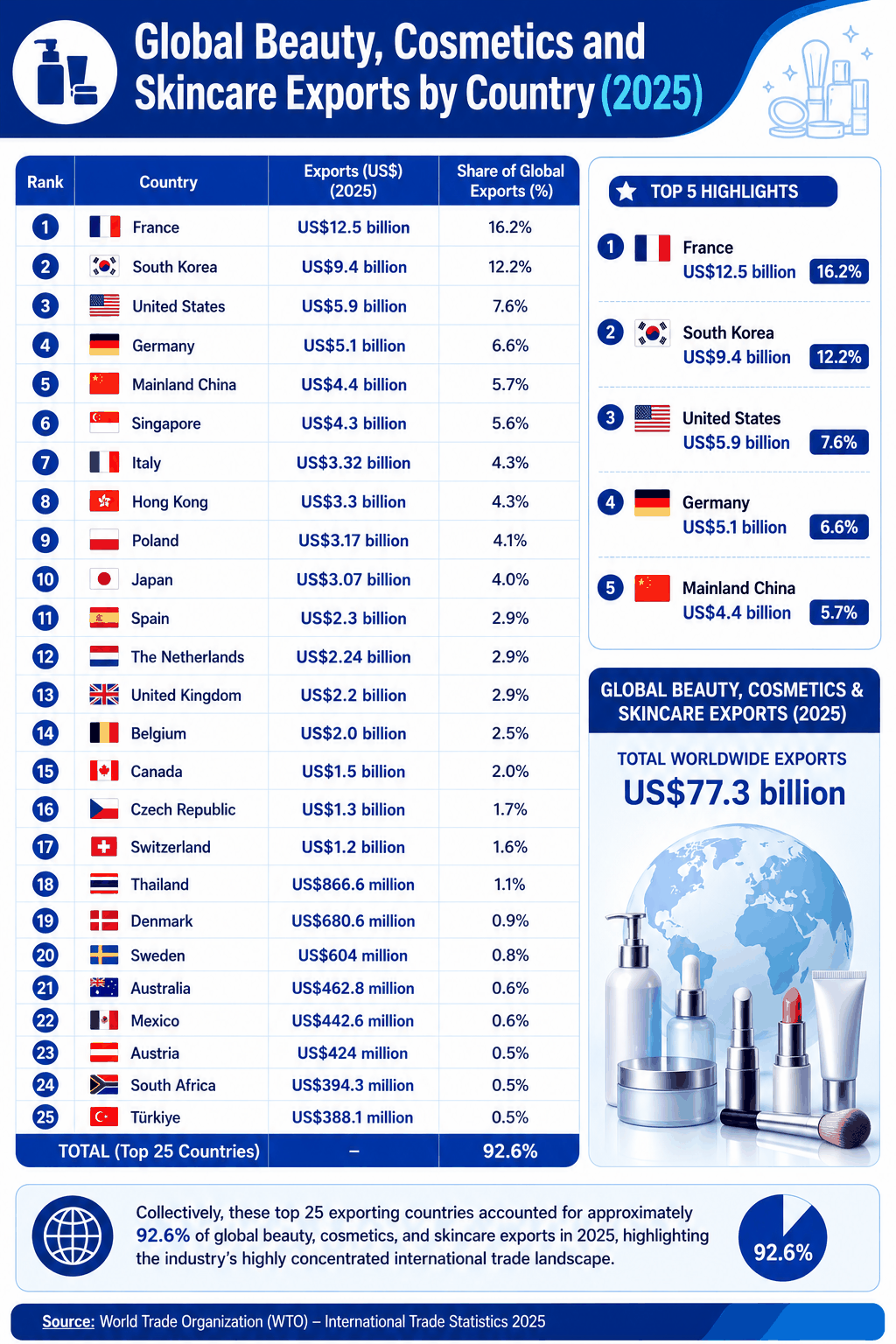
Global Beauty, Cosmetics and Skincare Exports by Country (2025)
- France led global beauty, cosmetics, and skincare exports with US$12.5 billion, representing 16.2% of worldwide exports.
- South Korea ranked second, exporting products worth US$9.4 billion, accounting for 12.2% of the global market.
- The United States secured third place with exports totaling US$5.9 billion, contributing 7.6% of global exports.
- Germany exported US$5.1 billion, representing 6.6% of worldwide beauty and cosmetics exports.
- Mainland China recorded exports of US$4.4 billion, capturing a 5.7% global market share.
- Singapore exported US$4.3 billion, accounting for 5.6% of total global exports.
- Italy contributed US$3.32 billion, representing 4.3% of worldwide exports.
- Hong Kong exported US$3.3 billion, also accounting for 4.3% of global beauty and skincare exports.
- Poland recorded exports valued at US$3.17 billion, representing 4.1% of the global market.
- Japan exported US$3.07 billion, contributing 4.0% of worldwide exports.
- Spain generated US$2.3 billion in exports, accounting for 2.9% of the global total.
- The Netherlands exported US$2.24 billion, representing 2.9% of worldwide beauty exports.
- The United Kingdom recorded exports of US$2.2 billion, contributing 2.9% to the global market.
- Belgium exported US$2.0 billion, accounting for 2.5% of global beauty and skincare exports.
- Canada contributed US$1.5 billion, representing 2.0% of worldwide exports.
- The Czech Republic exported US$1.3 billion, accounting for 1.7% of global exports.
- Switzerland recorded exports worth US$1.2 billion, representing 1.6% of the global market.
- Thailand exported US$866.6 million, contributing 1.1% of worldwide beauty exports.
- Denmark generated US$680.6 million in exports, representing 0.9% of the global total.
- Sweden exported US$604 million, accounting for 0.8% of worldwide exports.
- Australia recorded beauty and skincare exports valued at US$462.8 million, representing 0.6% of the global market.
- Mexico exported US$442.6 million, also contributing 0.6% of worldwide exports.
- Austria generated US$424 million in exports, accounting for 0.5% of the global total.
- South Africa exported US$394.3 million, representing 0.5% of global beauty exports.
- Türkiye recorded exports worth US$388.1 million, contributing 0.5% of worldwide exports.
Collectively, these top 25 exporting countries accounted for approximately 92.6% of global beauty, cosmetics, and skincare exports in 2025, highlighting the industry’s highly concentrated international trade landscape.
Growth Driver
Rising Consumer Spending on Beauty and Personal Care Products
Growing disposable incomes and increasing consumer expenditure on beauty and personal care products are major drivers of the global cosmetics market. Global beauty and personal care spending continues to rise, supported by expanding middle-class populations and higher purchasing power in emerging economies. Worldwide, consumers spend hundreds of billions of dollars annually on skincare, haircare, makeup, fragrances, and personal hygiene products. Skincare remains the largest segment, accounting for approximately 40% of the global cosmetics industry. Increasing urbanization, improved living standards, and greater awareness of personal grooming have encouraged consumers to purchase premium and multifunctional cosmetic products. Male grooming products and anti-aging skincare solutions are also experiencing robust demand, expanding the overall consumer base. Additionally, frequent product launches, celebrity endorsements, and premium product positioning have encouraged repeat purchases. The growing popularity of personalized skincare routines and scientifically formulated cosmetics further supports market expansion. As beauty consciousness continues increasing across all age groups, consumer spending is expected to remain a significant growth driver for the global cosmetics market.
Expansion of E-commerce, Digital Marketing, and Social Media Influence
The rapid growth of e-commerce platforms and digital marketing has transformed the global cosmetics industry by making products more accessible to consumers worldwide. Online beauty sales continue to expand rapidly, supported by smartphone penetration, secure digital payment systems, and improved logistics infrastructure. Social media platforms such as Instagram, TikTok, and YouTube significantly influence purchasing decisions through beauty influencers, makeup tutorials, product reviews, and live-stream shopping events. Consumers increasingly discover new brands through digital channels before making purchases. Direct-to-consumer business models allow cosmetic companies to reach customers without relying solely on traditional retail stores. Artificial intelligence-powered virtual makeup trials, personalized skincare recommendations, and augmented reality applications have further enhanced the online shopping experience. Subscription beauty boxes and customized skincare solutions are also gaining popularity among younger consumers. The combination of digital engagement, influencer marketing, and online retail expansion continues driving product visibility, customer acquisition, and global cosmetics market growth.
Increasing Demand for Clean-Label, Natural, and Sustainable Cosmetics
Consumer preference for natural, organic, vegan, and environmentally friendly cosmetic products has become a significant driver of global market growth. Increasing awareness regarding ingredient safety, environmental sustainability, and ethical sourcing has encouraged manufacturers to develop clean-label formulations free from parabens, sulfates, silicones, and artificial fragrances. Surveys indicate that a growing proportion of beauty consumers actively review ingredient labels before purchasing cosmetic products. Demand for cruelty-free, plant-based, biodegradable, and refillable cosmetic packaging has also increased substantially, particularly among younger consumers. Manufacturers are investing heavily in botanical extracts, biotechnology-derived ingredients, and recyclable packaging materials to meet evolving market expectations. Regulatory support for ingredient transparency and sustainable manufacturing practices further encourages product innovation. Large multinational beauty companies are expanding their portfolios through acquisitions of natural beauty brands and increased research into eco-friendly formulations. These sustainability trends are expected to continue driving long-term growth and differentiation across the global cosmetics industry.
Challenges
Stringent Regulatory Requirements and Product Safety Compliance
The cosmetics industry operates under increasingly stringent regulatory frameworks governing product safety, ingredient approvals, labeling requirements, manufacturing quality, and environmental compliance. Cosmetic manufacturers must comply with regulations across multiple international markets, often requiring separate testing, documentation, and certification before products can be commercialized. Ingredient restrictions continue expanding as authorities review the safety of preservatives, fragrances, colorants, and active compounds. Companies also face increasing pressure to ensure product traceability, transparent labeling, and sustainable sourcing practices. Compliance costs continue rising as manufacturers invest in laboratory testing, quality assurance systems, regulatory expertise, and manufacturing upgrades. Smaller cosmetic companies often face greater financial challenges in meeting evolving international standards. Delays in regulatory approvals can also slow product launches and increase development costs. Successfully navigating diverse regulatory environments while maintaining innovation remains a significant challenge for companies operating in the global cosmetics market.
Intense Market Competition and Counterfeit Products
The global cosmetics market is highly competitive, with multinational corporations, regional manufacturers, direct-to-consumer brands, and independent beauty startups continuously introducing new products. Thousands of cosmetic products are launched every year, making brand differentiation increasingly difficult. Companies must invest heavily in research and development, product innovation, digital marketing, influencer partnerships, and premium packaging to maintain market share. At the same time, counterfeit cosmetics remain a major concern in many international markets. Fake beauty products often imitate premium brands while using substandard or potentially unsafe ingredients, posing health risks to consumers and damaging brand reputations. The expansion of online marketplaces has made monitoring counterfeit products more challenging. Additionally, rapidly changing beauty trends shorten product life cycles, requiring companies to innovate continuously. Maintaining consumer trust, protecting intellectual property, and sustaining profitability amid rising marketing expenses and intense competition remain ongoing challenges for cosmetic manufacturers worldwide.
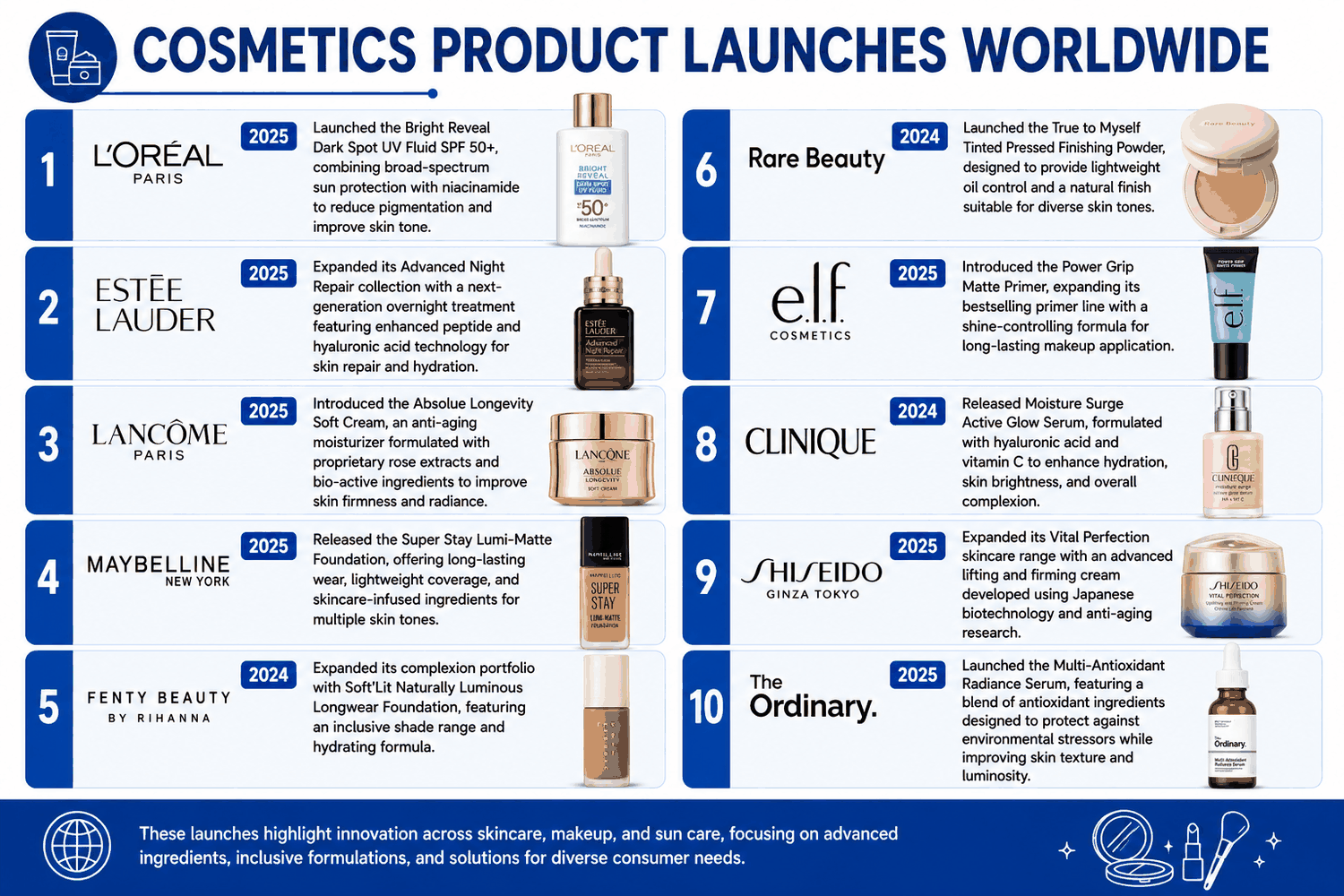
Cosmetics Product Launches Worldwide
- L’Oréal Paris (2025) – Launched the Bright Reveal Dark Spot UV Fluid SPF 50+, combining broad-spectrum sun protection with niacinamide to reduce pigmentation and improve skin tone.
- Estée Lauder (2025) – Expanded its Advanced Night Repair collection with a next-generation overnight treatment featuring enhanced peptide and hyaluronic acid technology for skin repair and hydration.
- Lancôme (2025) – Introduced the Absolue Longevity Soft Cream, an anti-aging moisturizer formulated with proprietary rose extracts and bio-active ingredients to improve skin firmness and radiance.
- Maybelline New York (2025) – Released the Super Stay Lumi-Matte Foundation, offering long-lasting wear, lightweight coverage, and skincare-infused ingredients for multiple skin tones.
- Fenty Beauty by Rihanna (2024) – Expanded its complexion portfolio with Soft’Lit Naturally Luminous Longwear Foundation, featuring an inclusive shade range and hydrating formula.
- Rare Beauty (2024) – Launched the True to Myself Tinted Pressed Finishing Powder, designed to provide lightweight oil control and a natural finish suitable for diverse skin tones.
- e.l.f. Cosmetics (2025) – Introduced the Power Grip Matte Primer, expanding its bestselling primer line with a shine-controlling formula for long-lasting makeup application.
- Clinique (2024) – Released Moisture Surge Active Glow Serum, formulated with hyaluronic acid and vitamin C to enhance hydration, skin brightness, and overall complexion.
- Shiseido (2025) – Expanded its Vital Perfection skincare range with an advanced lifting and firming cream developed using Japanese biotechnology and anti-aging research.
- The Ordinary (2025) – Launched the Multi-Antioxidant Radiance Serum, featuring a blend of antioxidant ingredients designed to protect against environmental stressors while improving skin texture and luminosity.
Rising Skincare Awareness Driving Global Demand in Skin and Sun Care Cosmetics
The skin and sun care cosmetics market represents the largest segment of the global cosmetics industry, supported by growing consumer awareness of skincare, anti-aging, and UV protection. Skincare products account for approximately 40% of the global cosmetics market, making them the industry’s leading revenue contributor. Products including moisturizers, cleansers, serums, sunscreens, facial masks, anti-aging creams, and acne treatments continue experiencing strong demand across all age groups. Rising awareness of skin cancer prevention and photoaging has significantly increased sunscreen adoption, particularly in North America, Europe, Australia, and Asia-Pacific. Consumers increasingly seek multifunctional products offering hydration, SPF protection, antioxidants, and skin-repair benefits within a single formulation. The growing popularity of dermatologically tested, organic, vegan, and clean-label skincare products is encouraging continuous product innovation. Biotechnology-based ingredients, peptides, hyaluronic acid, vitamin C, and retinol formulations continue expanding premium skincare offerings. Increasing disposable incomes, aging populations, and expanding beauty consciousness are expected to sustain long-term growth within the global skin and sun care cosmetics market.
Premium Beauty Trends Fueling Expansion in Makeup and Color Cosmetics
The makeup and color cosmetics market continues to grow steadily due to increasing beauty awareness, fashion trends, and product innovation. This segment includes foundations, concealers, lipsticks, mascaras, eyeliners, eye shadows, blushes, primers, nail products, and cosmetic accessories. Facial makeup products account for nearly 30–35% of global color cosmetics sales, reflecting strong consumer demand for complexion-enhancing products. Social media platforms, beauty influencers, celebrity collaborations, and online tutorials have transformed purchasing behavior, encouraging consumers to experiment with premium cosmetic brands and personalized makeup routines. Long-lasting formulations, waterproof cosmetics, lightweight foundations, and multifunctional beauty products continue gaining popularity among consumers seeking convenience and performance. Manufacturers are expanding shade ranges to serve increasingly diverse consumer populations while investing in cruelty-free, vegan, and sustainable formulations. Rapid product launches, seasonal collections, and luxury beauty offerings continue supporting premiumization across the industry. Increasing beauty spending, particularly among younger consumers, is expected to sustain long-term growth of the global makeup and color cosmetics market.
Supermarkets/Hypermarkets Modern Retail Maintaining Strong Distribution Leadership in Cosmetics
Supermarkets and hypermarkets remain one of the largest distribution channels for cosmetics due to their extensive product selection, competitive pricing, and widespread consumer accessibility. Large retail chains offer skincare, haircare, makeup, fragrances, oral care, and personal hygiene products from both multinational and regional brands under one location. In many developed economies, supermarkets and hypermarkets account for a substantial share of mass-market cosmetics sales because consumers prefer combining beauty purchases with routine grocery shopping. Promotional discounts, loyalty programs, bundled offers, and private-label cosmetic products continue attracting price-sensitive consumers. Shelf visibility allows customers to compare products, ingredients, and prices before purchasing, encouraging impulse buying and cross-category sales. Retailers are also expanding premium beauty sections and introducing exclusive product launches to strengthen customer engagement. Investments in omnichannel retailing, click-and-collect services, and digital shopping integration further enhance the consumer experience. Strong retail infrastructure and expanding organized retail continue supporting steady growth of the cosmetics supermarkets and hypermarkets market.
Cosmetics Sale Digital Commerce Transforming Beauty Retail
The online cosmetics sale market has become one of the fastest-growing segments of the beauty industry as consumers increasingly purchase products through e-commerce platforms, brand websites, and mobile applications. Online beauty sales account for a rapidly expanding share of global cosmetics revenue, supported by increasing internet penetration, smartphone usage, and digital payment adoption. Consumers benefit from greater product variety, competitive pricing, customer reviews, subscription services, and convenient home delivery. Artificial intelligence-powered skin analysis, virtual makeup try-on technologies, and personalized product recommendations have significantly improved the online shopping experience. Beauty influencers, social commerce, live-stream shopping, and targeted digital advertising continue accelerating product discovery and consumer engagement. Direct-to-consumer business models enable brands to launch products faster while strengthening customer relationships. Subscription beauty boxes and customized skincare solutions further increase repeat purchases. Continued expansion of e-commerce infrastructure, logistics networks, and digital marketing strategies is expected to support sustained long-term growth in the global online cosmetics sale market.
Men Cosmetics Expanding Grooming Culture Supporting Market Growth
The men’s cosmetics market is experiencing rapid expansion as male consumers increasingly prioritize personal grooming, skincare, haircare, and appearance enhancement. Men currently account for a growing share of global beauty product consumption, with demand rising across facial cleansers, moisturizers, beard care products, sunscreens, anti-aging creams, deodorants, hair styling products, and color cosmetics. Younger consumers, particularly millennials and Generation Z, are driving market growth by adopting comprehensive skincare routines and premium grooming products. Increasing workplace professionalism, social media influence, celebrity endorsements, and greater awareness of skin health have significantly contributed to market expansion. Manufacturers are introducing specialized formulations designed specifically for men’s skin physiology and grooming needs, including multifunctional products combining cleansing, moisturizing, and UV protection. Premium barbershops, men’s salons, and online retail platforms have further improved product accessibility. Continuous innovation in natural ingredients, sustainable packaging, and personalized grooming solutions is expected to maintain strong long-term growth across the global men’s cosmetics market.
United States Premium Beauty Innovation Driving Market Leadership
United States cosmetics market is one of the largest and most innovative globally, supported by high consumer spending, continuous product innovation, and strong demand for premium beauty products. The U.S. beauty and personal care industry generates well over US$100 billion in annual retail sales, while skincare represents the fastest-growing product category. Consumers increasingly demand multifunctional products incorporating anti-aging ingredients, SPF protection, hydration, and clean-label formulations. Growing interest in organic, vegan, cruelty-free, and dermatologist-tested cosmetics has encouraged manufacturers to invest heavily in research and product development. E-commerce platforms, beauty subscription services, celebrity beauty brands, and social media marketing continue expanding product accessibility nationwide. The United States also serves as a global center for cosmetic innovation, with significant investments in biotechnology, AI-powered skin analysis, and personalized skincare solutions. Premiumization, increasing male grooming product adoption, and expanding multicultural beauty offerings are expected to support continued market growth. Strong retail infrastructure, high disposable income, and continuous product launches will sustain the long-term expansion of the United States cosmetics market.
United Kingdom Sustainable Beauty Trends Supporting Cosmetics Market Growth
United Kingdom cosmetics market continues to grow steadily due to increasing consumer awareness of skincare, premium beauty products, and sustainable cosmetics. The UK beauty and personal care sector contributes billions of pounds annually to the national economy and serves a highly mature consumer market. Skincare, premium makeup, haircare, fragrances, and personal grooming products remain the leading product categories. Consumers increasingly prefer clean-label formulations, refillable packaging, cruelty-free certification, and vegan cosmetic products. Online beauty retail continues expanding rapidly alongside specialty beauty stores and omnichannel retail strategies. Social media influencers, beauty subscription services, and personalized skincare recommendations have significantly influenced purchasing behavior, particularly among younger consumers. Manufacturers continue investing in innovative active ingredients, biotechnology-based skincare, and environmentally friendly packaging solutions to meet evolving consumer preferences. Rising demand for luxury beauty products, anti-aging solutions, and sustainable cosmetics is expected to maintain steady market expansion. Continuous product innovation and growing consumer focus on wellness and self-care further strengthen the long-term outlook for the United Kingdom cosmetics market.
India Cosmetics Market: Rising Disposable Income and Urbanization Fueling Demand
India’s cosmetics market is witnessing rapid expansion due to increasing disposable incomes, urbanization, growing beauty awareness, and a young consumer population. India has a population exceeding 1.4 billion people, providing one of the world’s largest consumer bases for beauty and personal care products. Skincare, haircare, herbal cosmetics, fragrances, and color cosmetics continue experiencing strong demand across both urban and semi-urban markets. The country’s rapidly growing middle class, increasing female workforce participation, and higher spending on personal grooming have significantly expanded cosmetic consumption. Traditional Ayurvedic and herbal formulations remain highly popular alongside premium international beauty brands. E-commerce platforms, digital payment systems, and social media marketing have improved product accessibility throughout the country. Consumers increasingly seek natural ingredients, chemical-free formulations, and dermatologically tested skincare products. Government initiatives supporting domestic manufacturing and expanding organized retail continue encouraging industry investment. Continuous innovation in herbal cosmetics, premium skincare, and personalized beauty products is expected to drive long-term growth in India’s cosmetics market.
Premium Beauty and Personal Care Driving Saudi Arabia Cosmetics Expansion
Saudi Arabia represents one of the Middle East’s fastest-growing cosmetics markets, supported by rising disposable incomes, increasing beauty consciousness, and expanding retail infrastructure. The Kingdom has one of the highest per capita expenditures on beauty and personal care products within the Gulf region. Skincare, fragrances, luxury makeup, halal-certified cosmetics, haircare, and premium personal care products continue dominating consumer demand. A predominantly young population, increasing social engagement, and growing interest in premium international beauty brands are driving market expansion. Vision 2030 initiatives promoting retail diversification, tourism, and private-sector investment have further strengthened the beauty industry. Online beauty retail, specialty cosmetic stores, and luxury shopping malls continue expanding product availability across the country. Consumers increasingly demand organic, halal-certified, dermatologist-tested, and clean-label cosmetic products. International beauty companies continue introducing localized product ranges specifically designed for regional climate conditions and consumer preferences. Growing investments in digital retail, premium skincare, and luxury fragrances are expected to sustain long-term growth in the Saudi Arabia cosmetics market.
Segment Analysis
Product Type
- Skin and Sun Care Products
- Hair Care Products
- Deodorants and Fragrances
- Makeup and Color Cosmetics
- Others
Gender
- Men
- Women
- Unisex
Distribution Channel
- Supermarkets/hypermarkets
- Specialty Stores
- Pharmacies
- Online Sales
- Others
Regional Outlook and Opportunities
North America
- United States
- Canada
Europe
- France
- Germany
- Italy
- Spain
- United Kingdom
- Belgium
- Netherlands
- Turkey
Asia Pacific
- China
- Japan
- India
- South Korea
- Thailand
- Malaysia
- Indonesia
- Australia
- New Zealand
Latin America
- Brazil
- Mexico
- Argentina
Middle East & Africa
- Saudi Arabia
- United Arab Emirates
- South Africa
All the Key players have been covered
- Overviews
- Key Person
- Recent Developments
- SWOT Analysis
- Revenue Analysis
Company Analysis:
- Coty Inc.
- Procter & Gamble
- The Estee Lauder Companies Inc.
- Colgate-Palmolive Company
- Johnson & Johnson Services Inc.
- Revlon, Inc.
- Beiersdorf Group
- Kao Corporation
- LVMH
- Mary Kay Inc.
Report Details:
| Report Features | Details |
| Base Year |
2025 |
| Historical Period |
2022 - 2025 |
| Forecast Period |
2026 - 2034 |
| Market |
US$ Billion |
| Segment Covered |
Product Type, Gender, Distribution Channel and Countries |
| Countries Covered |
|
| Companies Covered |
|
| Customization Scope |
20% Free Customization |
| Post-Sale Analyst Support |
1 Year (52 Weeks) |
| Delivery Format |
PDF and Excel through Email (We can also provide the editable version of the report in PPT/Word format on request) |
Customization Services available
- Analysis of Market Size and Its Segments
- More Company Profiles (Upto 10 without any additional cost):
- Additional Countries (Other than mentioned Countries):
- Region/Country Specific Reports:
- Market Entry Strategy:
- Region-Specific Market Dynamics:
- Regional Market Share Analysis:
- Trade Analysis:
- Production Insights:
- Others Customized Requests:
For more information contact our analysts.
Need More Assistance?
- Talk to our analysts to get more precious information on the current market trends.
- Include more countries and segments and customize the report based on the final requirement.
- Get a competitive advantage in your industry by knowing the report findings and making a positive impact on your revenues and operations.
- Our analysts are always ready to provide more help and pertinent information if you need any additional assistance.