GCC Liquid Biopsy Market Report by Product, Application, Circulating Biomarkers, End-User, Countries and Companies Analysis 2026-2034
Buy NowGCC Liquid Biopsy Market Size and Forecast 2026-2034
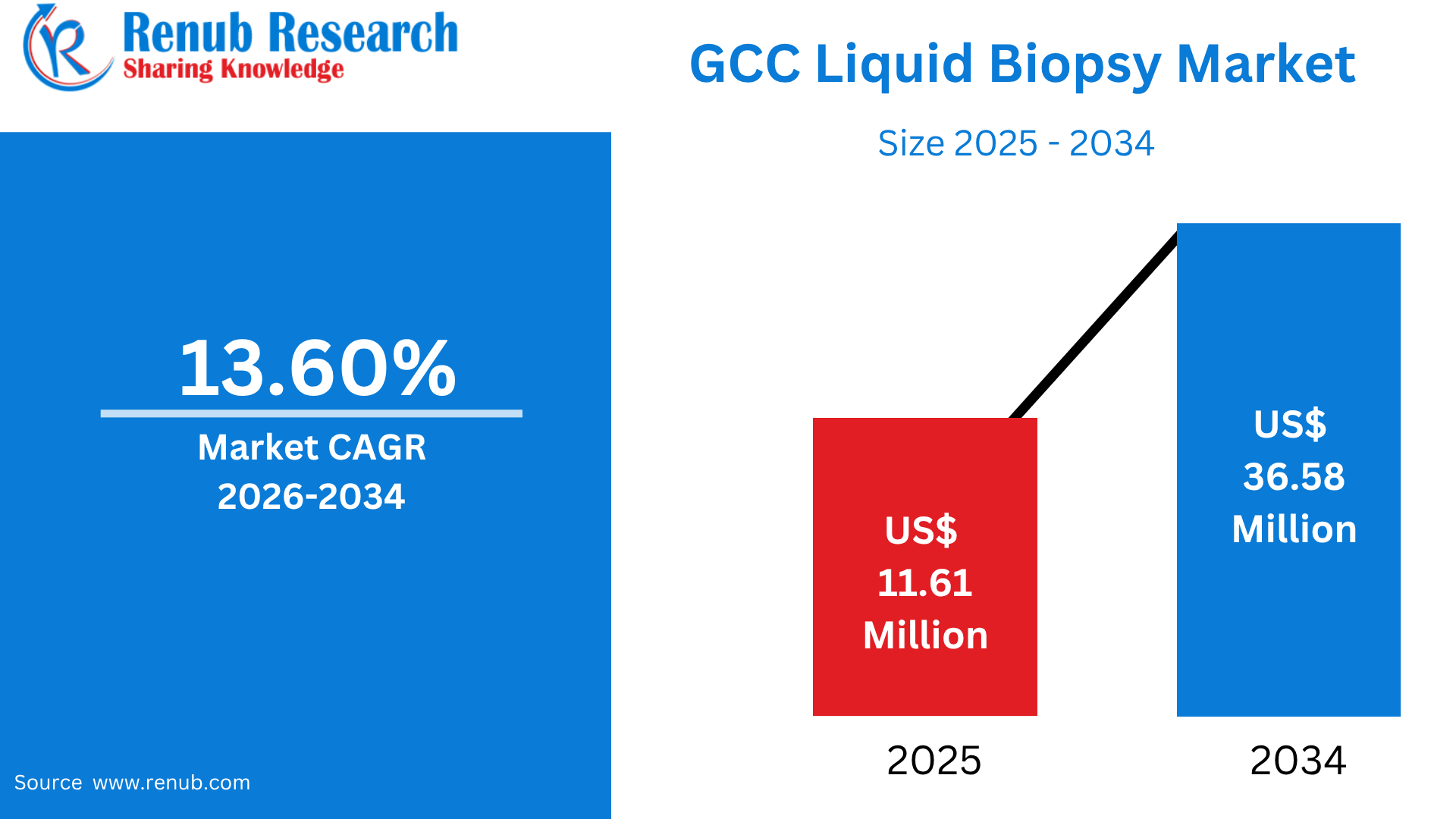
GCC Liquid Biopsy Market is expected to reach US$ 36.58 Million by 2034 from US$ 11.61 Million in 2025, with a CAGR of 13.6% from 2026 to 2034. Rapid growth in cancer incidence, increasing demand for minimally invasive diagnostics, and rising healthcare investment in GCC countries are driving adoption of liquid biopsy technologies. Integration of advanced genomic profiling into precision medicine programs further accelerates market expansion.
GCC Liquid Biopsy Industry Overview
Liquid biopsy is a minimally invasive diagnostic technique that detects and analyzes tumor-derived biomarkers—such as circulating tumor DNA (ctDNA), circulating tumor cells (CTCs), and exosomes—in body fluids like blood, urine, or saliva. Unlike traditional tissue biopsy, liquid biopsy requires a simple blood draw and can capture real-time genomic information about cancer progression, genetic mutations, and treatment response without surgical procedures. It enables early detection, ongoing treatment monitoring, and assessment of minimal residual disease. Liquid biopsy supports personalized oncology care by guiding therapy decisions, tracking therapeutic resistance, and reducing patient risk and discomfort. Its rapid turnaround and ability to reflect tumor heterogeneity make it increasingly valuable in modern cancer management.
The GCC liquid biopsy market is expanding due to rising cancer prevalence, increased government healthcare spending, and growing emphasis on precision medicine. GCC health systems are actively investing in advanced diagnostic infrastructure and genomic testing capabilities to enhance early cancer detection and personalized treatment protocols. Public and private healthcare providers are integrating liquid biopsy platforms into oncology care pathways to improve treatment outcomes and reduce dependency on invasive tissue biopsies. Strategic collaborations between local institutions and global diagnostics firms are facilitating technology transfer and training. Patient awareness of non-invasive options and regulatory support for innovative diagnostics further support market growth, positioning liquid biopsy as a key tool in the region’s evolving cancer care ecosystem.
Recent Developments in GCC Liquid Biopsy Market
- In October 2024, Helio Genomics announced a strategic partnership with Halub Medical Co. to commercialize HelioLiver Dx—an AI-enabled liver cancer liquid biopsy test—in Saudi Arabia and wider GCC markets. This collaboration aims to make high-sensitivity, non-invasive cancer detection available locally, expanding test availability across regional oncology clinics.
Growth Drivers for the GCC Liquid Biopsy Market
Strategic Partnerships & UAE Liquid Biopsy Initiatives
Collaborations between global diagnostics firms and regional healthcare organizations are strengthening liquid biopsy adoption in the GCC. In June 2025, M42 partnered with AstraZeneca and SOPHiA GENETICS to launch an advanced liquid biopsy initiative in the United Arab Emirates aimed at transforming cancer diagnostics. The partnership integrates SOPHiA’s MSK-ACCESS® platform, enabling AI-enhanced genomic profiling from blood samples to inform treatment decisions and monitor disease progression.
This collaboration expands local testing infrastructure and accelerates clinical adoption by improving access to precision oncology diagnostics within UAE hospitals and labs. By building regional capacity and validation studies, such alliances reduce reliance on overseas services and strengthen local expertise. As other GCC nations observe similar success, these initiatives help embed liquid biopsy tests into standard oncology care pathways, expanding market growth across the region.
Expansion of Blood-Based Screening Tests in the Region
Product launches and commercial rollouts of new blood-based cancer screening tests are driving liquid biopsy market growth across the GCC. In August 2025, SehaMed Global Ltd partnered with New Day Diagnostics to introduce ColoHealth™, the first FDA-approved non-invasive blood test for colorectal cancer screening, to populations in Saudi Arabia and UAE.
This launch represents an important regional milestone in early detection, offering patients an accessible alternative to traditional invasive methods. As colorectal cancer is a major health burden in the Middle East, demand for screening tools that are simpler and more patient-friendly grows rapidly. Broader commercial distribution agreements and increased test availability help increase uptake among healthcare providers, improve early diagnosis rates, and strengthen patient monitoring programs. By enhancing screening infrastructure through locally accessible products, such initiatives directly support the region’s move toward precision health and non-invasive cancer care.
Regional Access Expansion & Patient-Focused Liquid Biopsy Initiatives
Advancements in access programs and country-specific initiatives are driving broader liquid biopsy adoption across the GCC, particularly in the UAE where healthcare stakeholders are expanding patient access to cutting-edge diagnostics. A compelling recent development comes from April 2026, when Johnson & Johnson launched a national access initiative in the UAE to help eligible patients diagnosed with advanced non-small cell lung cancer receive liquid biopsy testing at reduced or no cost, bridging gaps in insurance coverage and affordability for non-invasive cancer diagnostics.
This program supports early detection and personalized care by reducing financial barriers that often limit uptake of advanced tests. By improving affordability and patient reach, such initiatives accelerate market growth, encourage broader clinical acceptance, and strengthen liquid biopsy integration into existing oncology care pathways throughout the GCC. As similar access schemes emerge in other member states, they reinforce the shift toward personalized, patient-centric cancer diagnostics.
Challenges in the GCC Liquid Biopsy Market
High Cost & Reimbursement Barriers
A key challenge limiting liquid biopsy adoption in the GCC is the high cost of tests relative to conventional diagnostics. Advanced technologies like next-generation sequencing and digital PCR require expensive equipment, reagents, and specialised laboratory infrastructure. Many private and public payers lack well-defined reimbursement frameworks for liquid biopsy, leaving patients to bear out-of-pocket expenses. Limited reimbursement reduces test accessibility and slows clinician uptake, particularly in countries without comprehensive national coverage policies. Additionally, variation in insurance coverage across the region creates inequities in access. Efforts to expand health insurance benefits and align test valuation with clinical utility are ongoing, but cost pressures persist. Without robust reimbursement pathways and strategic pricing models, adoption may be constrained despite demonstrated clinical benefits, particularly among lower-income patient populations.
Regulatory & Clinical Validation Hurdles
Regulatory approval and clinical validation present significant barriers in the GCC liquid biopsy market. Each country has distinct regulatory processes for diagnostic devices and in-vitro tests, complicating regional market entry for manufacturers. Obtaining local approvals often requires extensive evidence of clinical utility, sensitivity, and specificity in diverse populations. Additionally, limited region-specific validation studies reduce clinician confidence and delay integration into clinical practice. Access to high-quality reference laboratories capable of conducting robust validation and proficiency testing is uneven across the GCC. Variability in laboratory accreditation and quality assurance standards further complicates adoption. To overcome these hurdles, stakeholders must invest in local research, harmonize regulatory requirements, and develop tailored clinical guidelines that reflect regional epidemiology and healthcare practices.
United Arab Emirates Liquid Biopsy Market
Maharashtra remains India’s largest cashew-producing state, with output around 1.99 lakh tonnes in 2025, contributing roughly one-fourth of national production. The Konkan belt—Sindhudurg, Ratnagiri, and Raigad—forms the core cultivation zone due to favourable coastal climate and red laterite soils. According to recent horticulture estimates, the state continues to lead despite climate variability and labour constraints. Maharashtra also has a strong cashew processing ecosystem with export-oriented units linked to Mumbai and nearby ports. Government initiatives focus on orchard rejuvenation, high-yield variety plantation, and farmer support under horticulture missions. However, productivity remains dependent on monsoon stability, and ageing plantations reduce long-term yield efficiency. The state is also exploring value-added cashew processing to strengthen rural income and improve export competitiveness in global markets like the Middle East and Europe.
Bahrain Liquid Biopsy Market
Bahrain’s liquid biopsy market is gaining traction as healthcare stakeholders prioritize early cancer detection and precision diagnostics. In 2024, the Bahrain National Cancer Registry reported 1,401 new cancer cases across the kingdom, with 1,230 cases among Bahraini nationals and 171 among non-Bahrainis. Over half of patients were diagnosed at localized stages, while about 12.7% were metastatic at initial diagnosis, underscoring the ongoing need for improved early detection tools such as liquid biopsy. Clinical labs and oncology centres are beginning to incorporate circulating tumor DNA (ctDNA) tests to support personalized therapy decisions and monitor treatment response. Physician awareness and public initiatives to promote minimally invasive diagnostics are increasing, helping liquid biopsy services transition from tertiary hospitals to mainstream oncology care. Continued investment in molecular infrastructure and training will further support adoption across both public and private sectors.
Saudi Arabia Liquid Biopsy Market
Saudi Arabia is rapidly scaling precision oncology services, guided by the Saudi Health Council’s 2025 cancer surveillance brief, which noted growing incidence in breast and hematologic cancers. This has increased demand for molecular profiling solutions that reduce invasive procedures. A key milestone was the 2023 adoption of liquid biopsy technology at King Faisal Specialist Hospital & Research Centre (KFSH&RC), enabling mutation detection from blood samples for early diagnosis and treatment monitoring. Expansions in Riyadh and Jeddah oncology centres now include ctDNA-based monitoring for therapy response. Vision 2030 initiatives are accelerating genomic-lab accreditation and strengthening national registries, supporting broader clinic-level adoption. As molecular medicine becomes central to cancer care, Saudi Arabia’s liquid biopsy market is entering a high-growth phase.
Kuwait Liquid Biopsy Market
The Kuwait liquid biopsy market is expanding as the country intensifies its focus on early cancer detection, personalized oncology, and minimally invasive diagnostics. Rising cancer prevalence—especially among women—continues to drive adoption. In Kuwait, one in nine women is at risk of developing breast cancer in her lifetime, highlighting the urgent need for advanced screening and monitoring tools. Liquid biopsy technologies, including circulating tumor DNA (ctDNA) and circulating tumor cell (CTC) tests, are increasingly being used to complement mammography and tissue-based diagnostics. Hospitals and private oncology centres are integrating liquid biopsy for early diagnosis, treatment planning, and real-time therapy monitoring. Government-backed cancer awareness programs and ongoing investments in molecular labs further support market growth and accelerate clinical adoption of these emerging tools.
GCC Kits & Reagents Market
The GCC kits and reagents market within liquid biopsy is expanding rapidly as oncology centres and molecular laboratories scale up their testing capabilities. Demand is rising for high-sensitivity reagents used in circulating tumor DNA (ctDNA) detection, cell-free DNA extraction, mutation profiling, and next-generation sequencing (NGS) library preparation. Hospitals across Saudi Arabia, the UAE, and Qatar are increasing procurement of PCR-based mutation panels, ctDNA stabilization tubes, and sequencing-ready reagent kits to support early cancer detection and real-time treatment monitoring. Recent partnerships between diagnostics manufacturers and GCC lab networks have further improved access to validated, clinical-grade kits. As cancer prevalence grows and precision oncology becomes a clinical priority, reagent consumption is expected to rise steadily across public and private laboratories.
GCC Reproductive Health Market
In the GCC, liquid biopsy technologies are increasingly influencing the reproductive health market, particularly through non-invasive prenatal testing (NIPT), carrier screening, and maternal-fetal risk assessment. ctDNA-based prenatal tests are gaining strong traction in the UAE, Qatar, and Saudi Arabia as families seek safer, non-invasive alternatives to amniocentesis. Hospitals and fertility centres are adopting cfDNA assays for early chromosomal anomaly detection, fetal sex determination, and congenital disorder screening. Improved laboratory infrastructure and regulatory support have accelerated test availability through accredited maternal health programs. Rising maternal age, population-wide screening initiatives, and expanded insurance coverage are further boosting adoption. As GCC countries prioritize family health and genetic wellness, liquid biopsy–enabled reproductive diagnostics are becoming a core part of routine prenatal care.
GCC Circulating Tumor DNA (ctDNA) Market
The GCC circulating tumor DNA (ctDNA) market is experiencing rapid expansion as oncology departments adopt non-invasive blood-based cancer profiling. ctDNA tests are increasingly used for detecting actionable mutations, monitoring minimal residual disease, and assessing treatment response in real time. Saudi Arabia, supported by major cancer centres like KFSH&RC, is leading regional adoption, while the UAE and Qatar continue to strengthen their genomic oncology infrastructure. Pharmaceutical companies are integrating ctDNA assays into clinical trial workflows to accelerate precision-therapy selection. Growing availability of commercial ctDNA platforms—combined with regional investments in NGS-enabled laboratories—is improving test turnaround times and clinical reliability. As cancer rates rise and personalized oncology gains momentum, ctDNA testing is becoming a central diagnostic tool across GCC healthcare systems.
GCC Liquid Biopsy Market Segments:
Product
- Kits & Reagents
- Platforms & Instruments
- Services
Application
- Cancer Therapeutic Application
- Reproductive Health
- Other Therapeutic
Circulating Biomakers
- Circulating Tumor Cell
- Circulating Tumor DNA
- Cell-free DNA (cfDNA)
- Extracellular Vesicles
- Other Biomarkers
End User
- Hospitals
- Diagnostic Laboratories
- Point-of-care Testing
- Academic Institutes
- Others
Countries
- Saudi Arabia
- UAE
- Kuwait
- Qatar
- Oman
- Bahrain
- Rest of GCC
All companies have been covered with 5 Viewpoints
- Overviews
- Key Person
- Recent Developments
- SWOT Analysis
- Revenue Analysis
Key Players Analysis
- F. Hoffmann-La Roche Ltd.
- Bio-Rad Laboratories
- Thermo Fisher Scientific Inc.
- Johnson & Johnson
- Guardant Health Inc
- Guardant Health
- QIAGEN N.V
- Sysmex
Report Details:
| Report Features | Details |
| Base Year |
2025 |
| Historical Period |
2022 - 2025 |
| Forecast Period |
2026 - 2034 |
| Market |
US$ Million |
| Segment Covered |
Product, Application, Circulating Biomaker, End User and Countries |
| Countries Covered |
|
| Companies Covered |
|
| Customization Scope |
20% Free Customization |
| Post-Sale Analyst Support |
1 Year (52 Weeks) |
| Delivery Format |
PDF and Excel through Email (We can also provide the editable version of the report in PPT/Word format on request) |
Customization Services available
- Analysis of Market Size and Its Segments
- More Company Profiles (Upto 10 without any additional cost):
- Additional Countries (Other than mentioned Countries):
- Region/Country Specific Reports:
- Market Entry Strategy:
- Region-Specific Market Dynamics:
- Regional Market Share Analysis:
- Trade Analysis:
- Production Insights:
- Others Customized Requests:
For more information contact our analysts.
Need More Assistance?
- Talk to our analysts to get more precious information on the current market trends.
- Include more countries and segments and customize the report based on the final requirement.
- Get a competitive advantage in your industry by knowing the report findings and making a positive impact on your revenues and operations.
- Our analysts are always ready to provide more help and pertinent information if you need any additional assistance.