In-Vitro Diagnostics Market Report by Test Type, Product, Usability, Application, End User, Countries and Company Analysis 2026-2034
Buy NowGlobal In-Vitro Diagnostics Market Size & Forecast
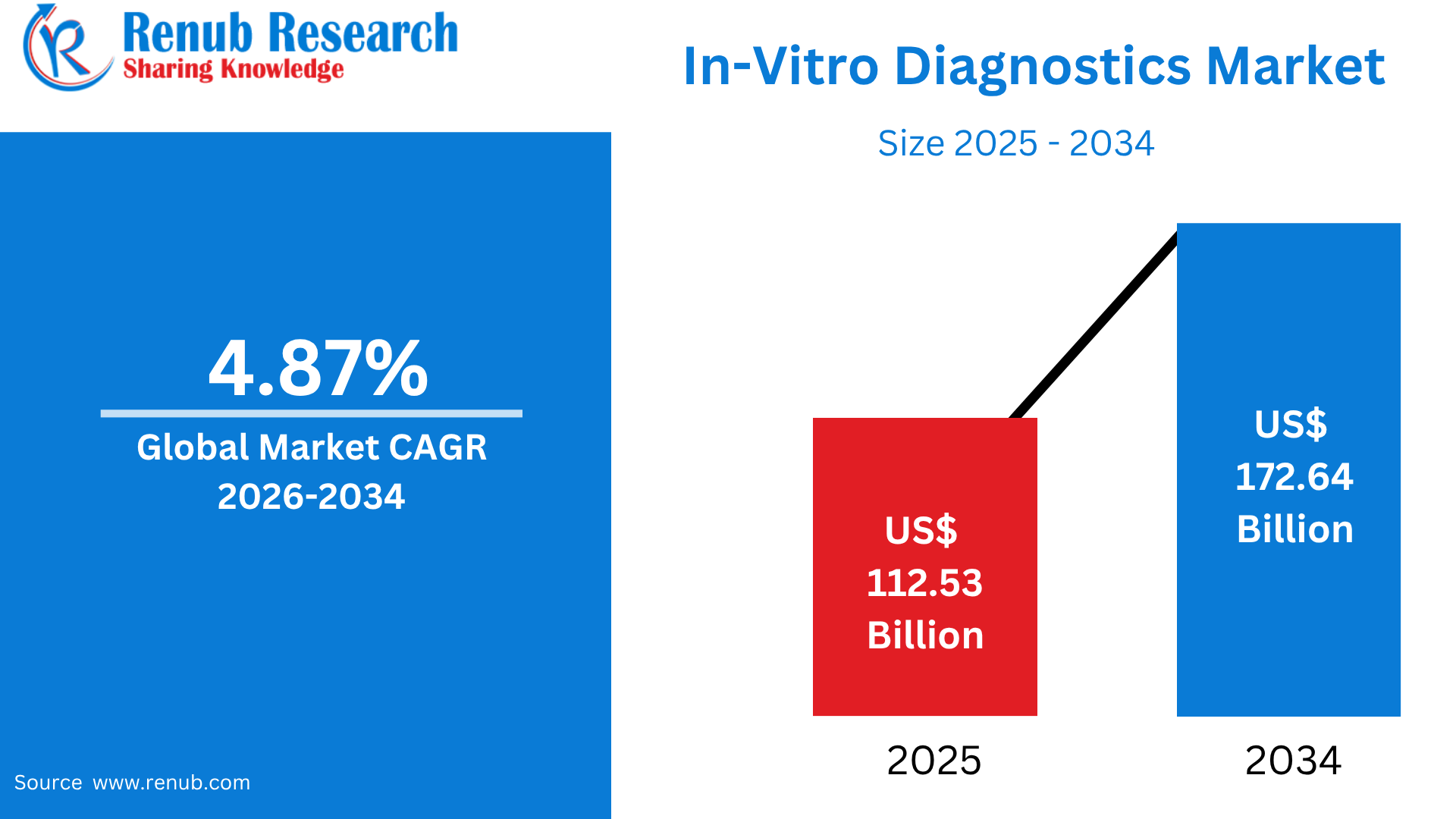
The global In-Vitro Diagnostics (IVD) market is projected to reach US$ 172.64 billion by 2034, rising from US$ 112.53 billion in 2025 and registering a CAGR of 4.87% during 2026–2034. Market growth is being supported by the increasing prevalence of chronic and infectious diseases, growing demand for early and accurate disease detection, and continuous advancements in diagnostic technologies. Rising investments in healthcare infrastructure and the expanding geriatric population are further increasing the need for reliable diagnostic testing. In addition, the growing adoption of personalized medicine and point-of-care diagnostics is creating new opportunities by enabling faster, more targeted, and patient-centric testing.
What is In-Vitro Diagnostics (IVD) and Its Uses & Popularity Worldwide
In-vitro diagnostics (IVD) refers to medical tests performed on biological samples such as blood, urine, saliva, tissue, and other body fluids outside the human body to detect, diagnose, monitor, or manage diseases and health conditions. IVD includes laboratory tests, molecular diagnostics, immunoassays, clinical chemistry, hematology, microbiology, and point-of-care testing. These technologies are widely used to identify infectious diseases, monitor diabetes and cardiovascular conditions, detect cancer-related biomarkers, assess organ function, and support treatment decisions.
IVD is particularly important for early disease detection, enabling healthcare professionals to identify health problems before symptoms become severe and select appropriate treatment strategies. The popularity of IVD is increasing worldwide because of the rising burden of chronic and infectious diseases, growing healthcare expenditure, ageing populations, and greater emphasis on preventive healthcare. Technological advancements such as molecular testing, automation, artificial intelligence, and rapid point-of-care diagnostics are further improving testing speed, accuracy, and accessibility. The growing adoption of personalized medicine is also increasing demand for advanced diagnostic solutions, making IVD an essential component of modern healthcare systems globally.
Production Linked Incentive (PLI) Scheme for Medical Devices in India
- Objective: Promotes domestic manufacturing of medical devices by attracting large investments and creating local manufacturing capacity.
- Total Budget: The scheme has a total budgetary outlay of ₹3,420 crore.
- Incentive Period: Provides performance-linked incentives for five years, from FY2022-23 to FY2026-27.
- Target Segments: Selected companies receive financial incentives based on incremental sales of domestically manufactured medical devices across four identified target segments.
- Approved Applicants: A total of 28 applicants have been approved under the scheme.
- Disbursement: As of December 2025, incentives totaling ₹157.15 crore had been disbursed to 7 applicants.
- Manufacturing Projects: 24 greenfield projects have been commissioned, with production started for 57 medical device products.
- Key Products: Manufacturing includes high-end medical devices such as:
- Linear accelerators
- MRI systems
- Ultrasound equipment
- CT scan systems
- Mammography equipment
- C-arm systems
- X-ray machines
- Import Substitution: The scheme supports domestic production of high-end medical devices on which India has historically been dependent on imports.
- Cumulative Eligible Sales: By December 2025, cumulative eligible sales reached ₹13,624.52 crore.
- Export Sales: Of the cumulative eligible sales, ₹6,425.48 crore came from exports, demonstrating the scheme’s contribution to strengthening India’s medical-device manufacturing and export capabilities.
Growth Drivers of the Global In-Vitro Diagnostics Market
Rising Burden of Chronic and Infectious Diseases
The increasing prevalence of chronic and infectious diseases is a major driver of the global in-vitro diagnostics (IVD) market. According to the World Health Organization (WHO), noncommunicable diseases caused at least 43 million deaths in 2021, representing approximately 75% of non-pandemic-related deaths globally. Cardiovascular diseases accounted for around 17.9 million deaths, followed by cancers at approximately 9.3 million. The continued burden of diabetes, cancer, cardiovascular disorders, kidney disease, and respiratory conditions is increasing demand for routine laboratory testing and disease monitoring. Infectious diseases also support demand for molecular diagnostics, microbiology testing, and rapid diagnostic kits. For example, WHO estimated that 10.8 million people developed tuberculosis in 2023, demonstrating the continuing need for reliable diagnostic testing. IVD technologies enable healthcare professionals to detect diseases, assess disease progression, monitor treatment response, and identify infection at an early stage. As healthcare systems increasingly emphasize prevention and early intervention, the demand for accurate and efficient diagnostic testing is expected to support market expansion.
Growing Adoption of Point-of-Care and Rapid Diagnostics
The increasing adoption of point-of-care (POC) diagnostics is transforming disease testing by bringing diagnostic capabilities closer to patients. POC tests can deliver results within minutes or hours rather than requiring patients to wait for conventional laboratory processing. This is particularly valuable in emergency departments, physician offices, pharmacies, rural healthcare facilities, and home-care settings. The growing burden of diseases requiring frequent monitoring is strengthening demand for convenient diagnostic technologies. Diabetes is a significant example: the International Diabetes Federation (IDF) estimated that 589 million adults aged 20–79 were living with diabetes in 2024, with the number projected to reach approximately 853 million by 2050 if current trends continue. Glucose meters and other decentralized testing technologies support regular monitoring and treatment decisions. Advances in molecular diagnostics, biosensors, digital connectivity, and miniaturized testing platforms are further improving POC capabilities. The expansion of decentralized healthcare and demand for faster clinical decisions are therefore creating significant opportunities for IVD manufacturers worldwide.
Increasing Demand for Personalized Medicine and Molecular Diagnostics
The shift toward personalized and precision medicine is creating strong opportunities for advanced IVD technologies, particularly molecular diagnostics and companion diagnostics. These tests can identify genetic, molecular, or biological characteristics that help physicians determine which treatment may be most appropriate for an individual patient. This approach is particularly important in oncology, where biomarker testing can help identify patients who may benefit from targeted therapies. The increasing number of targeted medicines and biologic treatments is consequently encouraging pharmaceutical companies and diagnostic manufacturers to develop complementary testing solutions. Molecular technologies such as PCR, next-generation sequencing, and other genomic platforms are also becoming increasingly important for identifying pathogens and genetic variations. The ageing global population further increases demand for disease screening and personalized disease management. According to the United Nations, the global population aged 65 years and older is projected to rise from 761 million in 2021 to 1.6 billion by 2050. This demographic shift is expected to increase demand for diagnostic testing, chronic disease monitoring, and personalized healthcare solutions, supporting long-term IVD market growth.
Challenges of the Global In-Vitro Diagnostics Market
High Cost of Advanced Diagnostic Technologies
The high cost associated with sophisticated IVD technologies remains a significant challenge, particularly in developing and low-income healthcare systems. Advanced molecular diagnostics, next-generation sequencing, automated laboratory platforms, and specialized analyzers often require substantial investment in equipment, reagents, software, maintenance, and skilled personnel. These expenses can limit adoption in hospitals and laboratories with restricted healthcare budgets. The challenge is particularly important because access to diagnostic services remains unequal worldwide. According to the World Health Organization, billions of people still lack access to essential health services, while out-of-pocket healthcare spending can create significant financial barriers for patients. Advanced diagnostic tests may therefore remain concentrated in large urban hospitals and specialized laboratories. In addition, ongoing expenses for consumables and reagent supplies can increase the total cost of operating diagnostic platforms. Manufacturers are responding by developing smaller analyzers, automated systems, multiplex tests, and lower-cost platforms. However, achieving affordability while maintaining high sensitivity, specificity, and reliability remains an important challenge for the worldwide IVD industry.
Regulatory Complexity and Diagnostic Accuracy Concerns
Stringent regulatory requirements and the need to maintain consistently high diagnostic accuracy can create challenges for IVD manufacturers. Diagnostic products must demonstrate appropriate analytical performance, clinical validity, safety, and reliability before gaining approval in many major markets. Regulatory requirements can differ substantially between countries, increasing development costs and extending commercialization timelines. The transition toward more advanced molecular and companion diagnostics also adds complexity because tests may need to demonstrate their ability to identify specific biomarkers or guide treatment decisions. Accuracy is particularly important because false-positive or false-negative results can lead to unnecessary treatment, delayed diagnosis, or inappropriate clinical decisions. According to WHO, approximately 1 in 6 people globally are affected by infertility, illustrating the broad need for reliable diagnostic services across healthcare applications. At the same time, laboratories must maintain quality-control procedures, calibration, staff competency, and appropriate sample handling. As diagnostic technologies become increasingly complex and personalized, manufacturers and healthcare providers must balance innovation with rigorous regulatory compliance and dependable clinical performance.
In-Vitro Diagnostics Product Launches Worldwide
- Archer FUSIONPlex™-HT Dx – Integrated DNA Technologies (IDT), 2026: Launched as an IVD-grade NGS assay for detecting gene fusions in oncology diagnostics. It is designed for standardized molecular pathology workflows in the U.S. and select European markets.
- Archer VARIANTPlex™-HT Dx – IDT, 2026: Introduced alongside FUSIONPlex-HT Dx, this IVD assay supports targeted DNA/RNA sequencing and detection of clinically relevant genetic variants for oncology applications.
- Third-Generation GeneXpert® System – Cepheid, 2026: Cepheid announced its next-generation GeneXpert platform, designed to expand PCR-based molecular diagnostics while maintaining existing workflows and enabling faster, high-plex testing.
- FW500 Clinical Chemistry Analyzer – FUJIFILM India, 2025: Launched as part of Fujifilm India’s IVD portfolio, the analyzer combines dry-chemistry technology with Wako reagents for clinical biochemistry testing.
- Mimix™ IVD Reference Standards – Revvity, 2025: Revvity launched three reference standards designed to support monitoring of NGS and ddPCR assays targeting somatic mutations in genomic DNA.
- Idylla™ CDx MSI – Biocartis, 2025: This molecular IVD was among the notable U.S. regulatory authorizations in 2025 and is designed for microsatellite-instability testing in oncology workflows.
- Tempus xR IVD – Tempus, 2025: A molecular IVD highlighted among the FDA’s 2025 authorizations, supporting advanced genomic testing applications.
- GENESEEQPRIME – Geneseeq, 2025: A molecular IVD recognized among FDA-authorized diagnostic products in 2025, expanding the availability of genomic testing technologies.
- Galen Second Read – Ibex Medical Analytics, 2025: An AI-powered digital pathology solution that received FDA authorization and represents the growing integration of artificial intelligence into IVD and pathology workflows.
- ArteraAI Prostate – ArteraAI, 2025: A prognostic whole-slide-image diagnostic technology that received FDA De Novo authorization, representing an important development in AI-supported oncology diagnostics.
In-Vitro Molecular Diagnostics Market
In-vitro molecular diagnostics represent a rapidly advancing segment of the broader IVD industry, focusing on the detection and analysis of DNA, RNA, and other genetic materials. These tests enable precise identification of infectious pathogens, genetic mutations, and hereditary disorders, supporting accurate diagnosis and treatment selection. Key technologies include polymerase chain reaction (PCR), next-generation sequencing (NGS), and microarrays. The COVID-19 pandemic significantly increased global awareness and adoption of molecular diagnostics, highlighting their importance in infectious-disease detection, surveillance, and outbreak management. Beyond infectious diseases, molecular diagnostics are increasingly used in oncology, prenatal testing, and pharmacogenomics, supporting the transition toward personalized medicine. Growing demand for rapid and highly accurate testing, increased healthcare investment, and continuous technological innovation are supporting market expansion. The growing emphasis on precision medicine is further increasing the importance of molecular diagnostics, as these technologies enable healthcare providers to identify disease-specific biomarkers and genetic characteristics. As testing platforms become faster, more sensitive, and accessible, molecular diagnostics are expected to remain an important component of modern healthcare.
In-Vitro Diagnostics Reagents and Kits Market
In-vitro diagnostic reagents and kits form a fundamental component of the global IVD industry because they are essential for performing a wide range of diagnostic tests. These products are extensively used in clinical chemistry, immunoassays, hematology, microbiology, and molecular diagnostics. Their recurring consumption and replacement requirements provide a continuous source of demand for manufacturers and laboratories. The increasing prevalence of both communicable and non-communicable diseases is strengthening the need for reliable diagnostic testing and supporting demand for reagents and kits. Technological advancements are also resulting in the development of rapid, sensitive, easy-to-use, and portable testing solutions, expanding their application in point-of-care settings and home-based testing. Growing awareness of preventive healthcare and routine screening is another factor supporting adoption. As healthcare systems place greater emphasis on early diagnosis and regular disease monitoring, laboratories and healthcare providers require consistent supplies of high-quality reagents and testing kits. Automation and multiplex testing are further improving laboratory efficiency, accuracy, and testing capacity, creating additional opportunities for this segment.
Reusable In-Vitro Diagnostics Market
The reusable in-vitro diagnostics segment includes diagnostic equipment and platforms designed for repeated use in testing and laboratory applications. Examples include clinical analyzers, spectrometers, automated laboratory systems, robotic platforms, and imaging equipment used across hospitals, diagnostic laboratories, and research facilities. These systems offer advantages such as durability, high throughput, operational efficiency, and cost savings over repeated testing cycles. Reusable IVD equipment is widely applied in clinical chemistry, hematology, immunology, and molecular diagnostics, where laboratories require reliable systems capable of processing large numbers of samples. Advances in automation, robotics, artificial intelligence, and connected technologies are improving workflow efficiency while reducing manual intervention and the potential for human error. Increasing demand for diagnostic testing and laboratory automation is supporting adoption of these systems. Cloud-based data management can also facilitate monitoring, reporting, and analysis of diagnostic results. Although initial investment in advanced reusable equipment can be substantial, the ability to process large testing volumes and support long-term laboratory operations provides significant value. Growing laboratory capacity and healthcare infrastructure are therefore creating opportunities for reusable IVD technologies.
Cancer/Oncology In-Vitro Diagnostics Market
Cancer and oncology in-vitro diagnostics represent an important segment of the IVD industry, supporting the screening, detection, diagnosis, classification, and monitoring of cancer. These diagnostic approaches include immunoassays, molecular testing, biomarker analysis, liquid biopsy, genomic profiling, and companion diagnostics. Early and accurate detection is increasingly important because identifying cancer at an earlier stage can support more timely clinical intervention. The growing global cancer burden is consequently increasing demand for advanced oncology diagnostics. According to the World Health Organization, cancer caused nearly 10 million deaths in 2022, demonstrating the significant global need for improved detection and management. Advances in genomic profiling and biomarker testing are also supporting personalized oncology by helping physicians identify molecular characteristics that may influence treatment selection. Companion diagnostics can assist in determining whether patients are likely to benefit from specific targeted therapies. Government screening programs, increasing investment in cancer research, and technological developments are further supporting the segment. In addition, artificial intelligence, digital pathology, and liquid biopsy technologies are creating new opportunities for more precise and potentially less invasive cancer diagnosis and monitoring.
In-Vitro Diagnostics Clinical Laboratories Market
Clinical laboratories represent a major end-user segment of the global IVD market and perform a broad range of diagnostic procedures used for disease detection, treatment decisions, and preventive healthcare. Their services include routine blood testing, clinical chemistry, hematology, microbiology, pathology, genetic testing, and specialized molecular diagnostics. The increasing prevalence of chronic and infectious diseases and growing emphasis on early detection are driving demand for laboratory-based testing. Technological developments in automation, artificial intelligence, laboratory information systems, and high-throughput analyzers are helping laboratories process larger testing volumes while improving efficiency and consistency. Centralized and reference laboratories are also gaining importance because they can consolidate specialized testing and achieve economies of scale. At the same time, telemedicine, home-based sample collection, and at-home testing are expanding access to diagnostic services beyond traditional laboratory settings. Rising healthcare expenditure, expanding healthcare infrastructure, and increasing demand for preventive screening are supporting laboratory service growth worldwide. As healthcare systems increasingly rely on data-driven diagnosis and personalized treatment, clinical laboratories are expected to remain a critical component of the IVD ecosystem.
Advanced Healthcare Infrastructure and High Diagnostic Adoption in United States
United States represents one of the most advanced IVD markets globally, supported by sophisticated healthcare infrastructure, high healthcare expenditure, and rapid adoption of innovative diagnostic technologies. Strong demand is generated by the prevalence of chronic diseases, including cancer, diabetes, and cardiovascular conditions, which require regular screening and monitoring. The country also has significant activity in molecular diagnostics, genetic testing, personalized medicine, and laboratory automation. The growing adoption of point-of-care and at-home diagnostic testing is further expanding access to testing outside conventional laboratories. Leading biotechnology and diagnostic companies continue to invest heavily in research and development, supporting product innovation and commercialization. Telemedicine, preventive healthcare initiatives, and advanced laboratory systems are also strengthening market opportunities. In February 2025, Revvity, Inc. launched three Mimix™ reference standards for IVD, designed to support monitoring of NGS and ddPCR assays targeting somatic mutations in genomic DNA extracted from human samples. These developments reinforce the United States’ position as a major center for diagnostic innovation.
NHS Support and Expansion of Innovative Diagnostics in the United Kingdom
The United Kingdom IVD market is supported by its established public healthcare system, growing emphasis on early diagnosis, and continued investment in medical innovation. The National Health Service (NHS) plays an important role in the adoption and use of diagnostic technologies, while screening programs and preventive-care initiatives generate demand for IVD products and services. The country’s ageing population and burden of chronic and infectious diseases further contribute to diagnostic testing requirements. Advances in genomics, molecular diagnostics, digital pathology, artificial intelligence, and laboratory automation are improving diagnostic efficiency and supporting precision medicine. Collaboration between healthcare institutions, researchers, and technology companies is also encouraging innovation. Regulatory developments are expected to further influence the market. In January 2026, the UK’s Medicines and Healthcare products Regulatory Agency (MHRA) published its first roadmap for improving the development and availability of innovative IVDs. The roadmap is intended to be implemented during 2026 and 2027 and aligns with the country’s broader 10-Year Health Plan and Life Sciences Sector Plan.
Rising Disease Burden and Expansion of Diagnostic Infrastructure in India
India’s IVD market is expanding as healthcare infrastructure develops, disease awareness increases, and demand for early diagnosis grows. The rising prevalence of diabetes, cardiovascular diseases, cancer, and infectious diseases is creating greater demand for laboratory and point-of-care testing. Government efforts to improve healthcare accessibility and affordability are supporting wider use of diagnostic services, while the expansion of private hospitals, diagnostic laboratories, and organized diagnostic chains is increasing testing capacity. Technological development in molecular diagnostics, automation, and point-of-care testing is further strengthening the market. Preventive healthcare and routine health check-ups are becoming increasingly important, encouraging consumers to undergo regular diagnostic screening. Digital healthcare adoption and home-based sample collection are also improving convenience and accessibility. In October 2025, FUJIFILM India launched the FW500 Clinical Chemistry Analyzer, expanding its IVD portfolio. The system combines the company’s experience in dry chemistry with Fujifilm Wako reagents for biochemistry, supporting the growing demand for clinical laboratory testing in India.
Vision 2030 and Healthcare Technology Modernization in Saudi Arabia
Saudi Arabia’s IVD market is developing steadily, supported by healthcare investment, modernization initiatives, and the adoption of advanced medical technologies under Vision 2030. The growing burden of chronic conditions such as diabetes, obesity, and cardiovascular diseases is increasing the need for diagnostic screening and disease monitoring. Greater emphasis on preventive healthcare and early disease detection is also encouraging higher testing volumes. Expansion of private hospitals, diagnostic laboratories, and specialized healthcare facilities is strengthening the country’s diagnostic infrastructure. Advanced technologies, including molecular diagnostics, automated laboratory systems, and digital health solutions, are increasingly being adopted, particularly in major urban centers. Investments in medical research and healthcare digitalization are creating additional opportunities for IVD companies. In February 2026, Insulet announced the release of its Omnipod 5 automated insulin delivery system and Omnipod Discover data-management platform in Saudi Arabia and neighboring markets, with compatibility involving Abbott Libre 2 Plus and Dexcom G7 continuous glucose monitoring systems. Such connected healthcare technologies demonstrate the country’s growing adoption of digitally integrated disease-management solutions.
Global In-Vitro Diagnostics Market Segments
Test Type
- Clinical Chemistry
- Molecular Diagnostics
- Immunodiagnostics
- Hematology
- Others
Product
- Reagents and Kits
- Instruments
- Other
Usability
- Disposable IVD Devices
- Reusable IVD Devices
Application
- Infectious Disease
- Diabetes
- Cancer/Oncology
- Cardiology
- Autoimmune Disease
- Nephrology
- Others
End User
- Clinical Laboratories
- Point-of-care Testing Centers
- Academic Institutes
- Patients
- Others
Countries
North America
- United States
- Canada
Europe
- France
- Germany
- Italy
- Spain
- United Kingdom
- Belgium
- Netherlands
- Turkey
Asia Pacific
- China
- Japan
- India
- South Korea
- Thailand
- Malaysia
- Indonesia
- Australia
- New Zealand
Latin America
- Brazil
- Mexico
- Argentina
Middle East & Africa
- Saudi Arabia
- UAE
- South Africa
All companies have been covered from 5 viewpoints:
- Overviews
- Key Person
- Recent Developments
- SWOT Analysis
- Revenue Analysis
Key Players Analysis
- Abbott Laboratories
- Agilent Technologies Inc.
- Biomerieux SA
- Bio-Rad Laboratories Inc.
- F. Hoffmann-La Roche Ltd
- Fujifilm Holdings Corporation
- Illumina Inc.
- Qiagen NV
- Quest Diagnostics
- Sysmex Corporation
Report Details:
| Report Features | Details |
| Base Year |
2024 |
| Historical Period |
2020 - 2024 |
| Forecast Period |
2025 - 2033 |
| Market |
US$ Billion |
| Segment Covered |
By Test Type, By Product, By Usability, By Application, By End User and By Countries |
| Countries Covered |
|
| Companies Covered |
|
| Customization Scope |
20% Free Customization |
| Post-Sale Analyst Support |
1 Year (52 Weeks) |
| Delivery Format |
PDF and Excel through Email (We can also provide the editable version of the report in PPT/Word format on request) |
Key Questions Answered in This Report:
-
What is the projected market size of the global in-vitro diagnostics market by 2033?
-
What is the expected CAGR of the in-vitro diagnostics market from 2025 to 2033?
-
Which factors are driving the growth of the in-vitro diagnostics market?
-
What are the main types of tests covered in the report?
-
How is the aging population contributing to the market's expansion?
-
What role does personalized medicine play in the growth of the in-vitro diagnostics market?
-
Which technological advancements are enhancing in-vitro diagnostics testing?
-
What are the key challenges faced by the in-vitro diagnostics market?
-
Which countries are covered in the market analysis?
-
Who are some of the key players in the in-vitro diagnostics industry?
Customization Services available
- Analysis of Market Size and Its Segments
- More Company Profiles (Upto 10 without any additional cost):
- Additional Countries (Other than mentioned Countries):
- Region/Country Specific Reports:
- Market Entry Strategy:
- Region-Specific Market Dynamics:
- Regional Market Share Analysis:
- Trade Analysis:
- Production Insights:
- Others Customized Requests:
For more information contact our analysts.
Need More Assistance?
- Talk to our analysts to get more precious information on the current market trends.
- Include more countries and segments and customize the report based on the final requirement.
- Get a competitive advantage in your industry by knowing the report findings and making a positive impact on your revenues and operations.
- Our analysts are always ready to provide more help and pertinent information if you need any additional assistance.