IBD Treatment Market Report by Drug Class, Disease Indication, Distribution Channel, Countries and Company Analysis 2026-2034
Buy NowAssisted Reproductive Technology Market Size and Forecast 2026-2034
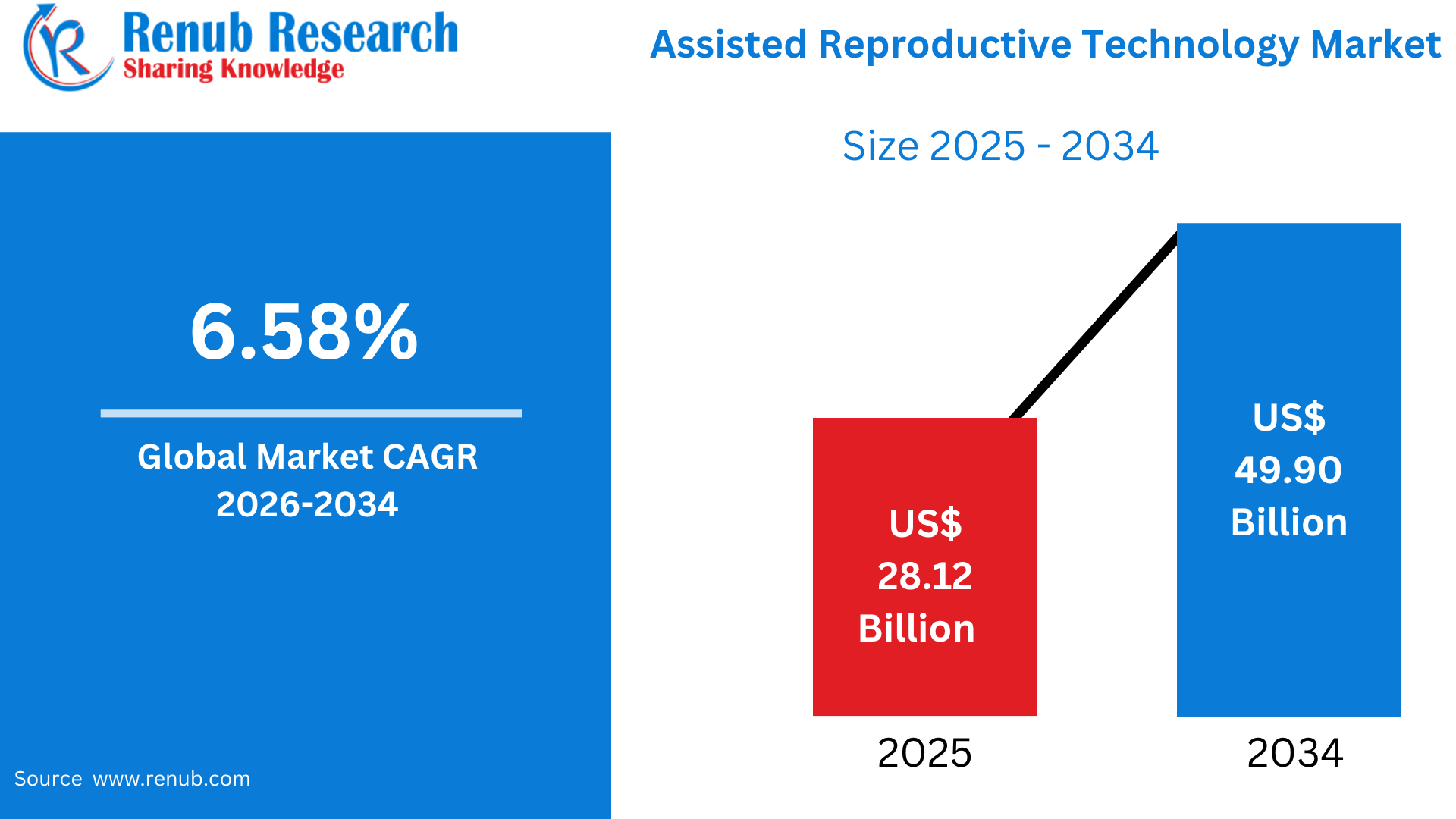
The Assisted Reproductive Technology Market is expected to witness a high growth rate owing to increased rates of infertility and delayed age of parenthood. The Assisted Reproductive Technology Market is forecasted to rise from US$ 28.12 Billion in 2025 to US$ 49.9 Billion in 2034, with a Compound Annual Growth Rate (CAGR) of 6.58% from 2026-2034. There is increased awareness about fertility treatments and technological advancements in reproductive medicine that will fuel the Assisted Reproductive Technology Market globally.
Assisted Reproductive Technology Market Outlooks
The term Assisted Reproductive Technology (ART) is defined as “medical interventions intended to help an individual or couple conceive when they have difficulty with fertility.” ART involves the manipulation of eggs, sperm, or embryos outside the human body for the purpose of increasing the chances for successful conception. One of the best-known ART technologies is In Vitro Fertilization (IVF), whereby human eggs are exposed to sperm in a laboratory and then inserted into the uterus. Other ART technologies include Intracytoplasmic Sperm Injection (ICSI), Gamete Intrafallopian Transfer (GIFT), and Embryo Cryopreservation.
ART is primarily employed for the treatment of infertility problems, which may be caused by hormonal imbalances, problems with the fallopian tubes, a low sperm count, or unexplained reasons. These technologies are a source of hope for people who cannot reproduce by conventional means. The demand for Assisted Reproductive Technology is rising across the globe owing to a variety of reasons, which include rising rates of infertility, delayed conception, and growing awareness of the treatments available for the same. The success rates of the treatments available for solving problems of infertility can be attributed to the advancements in medical technology.
Growth Driver of the Assisted Reproductive Technology Market
Rising Global Infertility Rates
A large number of people face the challenge of infertility in their lifetime, as indicated in a new report by WHO. About 17.5% of the adult population worldwide, or about 1 in 6 people, face the challenge of infertility. This is an indication of the need for increasing access to affordable and high-quality fertility care for those in need. One of the major growth drivers for the Assisted Reproductive Technology (ART) market is the increasing rate of infertility in the world’s population. Infertility is caused by a number of factors, such as lifestyle changes, stress, hormonal disorders, delayed parenthood, and environmental factors. Many couples today are delaying their parenthood due to career plans or financial plans, among other reasons. This is leading to reduced fertility as people age. Medical problems such as polycystic ovary syndrome, low sperm count, and disorders in reproductive health also lead to infertility. With increasing awareness about fertility issues, many individuals and couples are seeking help from medical professionals to conceive a child. Assisted reproductive technologies such as In Vitro Fertilization (IVF) and Intracytoplasmic Sperm Injection (ICSI) have provided solutions to many fertility problems. The increasing number of infertility cases, whether in developed or developing countries, is creating a market for fertility treatments, thus boosting the global ART market.
Technological Advancements in Fertility Treatments
Another factor that is crucial for the growth of the ART market is the technological innovation in reproductive medicine. Continuous research and development in the field of reproductive medicine have improved fertility treatments, laboratory equipment, and embryo storage technologies. Today, fertility clinics use advanced technology, such as imaging technologies, genetic tests, and improved embryo culture media, which provide greater opportunities for a successful pregnancy. For example, Preimplantation Genetic Testing (PGT) is a procedure by which a healthy embryo is selected for implantation, resulting in a successful pregnancy. Similarly, cryopreservation technologies allow for the storage of eggs, sperm, and embryos for later use. These technologies have improved the safety, efficacy, and success rates of fertility treatments. Thus, more and more people are becoming confident about undergoing ART treatments as success rates are increasing. Therefore, the availability of advanced technologies for fertility treatments is an important factor for the growth of the global ART market. September 2025, The FIGO Fertility Passport is a novel, all-inclusive tool that is set to change the face of how patients, as well as practitioners, deal with fertility investigations and treatments across the world. This passport, created by the FIGO Committee for Reproductive Endocrinology and Infertility, is set to bridge a major gap in fertility services, where patients have had to undergo multiple, expensive investigations, as well as delayed treatments, while moving between clinics and healthcare services.
Increasing Awareness and Expanding Fertility Clinics
Another factor that is important in propelling the ART market is the growing awareness of ART procedures and the availability of specialized ART clinics. In the past, infertility has been viewed as a taboo, which has led to a lack of understanding of infertility issues. This has resulted in a lack of appropriate intervention to help those affected by infertility. However, due to growing awareness of ART procedures through campaigns and education, more people are now willing to seek treatment for infertility. In addition, there has been an increase in specialized ART clinics that offer a wide range of ART procedures to those affected by infertility. This has ensured that more people are now aware of ART procedures, which has led to an increase in the use of ART to overcome infertility challenges. This factor is likely to propel the ART market as more people become aware of ART procedures and more ART clinics are opened globally. March 2023, London IVF and GeneTech are pleased to announce that they have signed an MOU to offer GeneTech’s latest genomics testing based Genomic Fertility Analysis technology to all infertility patients at London IVF. Genomic Fertility Analysis is a new technology that is revolutionizing the practice of Fertility Medicine globally.
Challenges of the Assisted Reproductive Technology Market
High Cost of Fertility Treatments
One of the biggest challenges facing the Assisted Reproductive Technology market is the cost factor involved in the treatment process. In Vitro Fertilization, as well as other advanced forms of reproductive technology, require sophisticated medical technology, healthcare professionals, and specialized facilities, which increases the cost of the procedure. In addition, the process may require several attempts before the patient is successful, which adds to the cost of the procedure. In several countries, the cost of the procedure is not covered by insurance, which makes the process costly for the patient. The cost factor acts as a deterrent for patients seeking the services of ART, as the procedure is costly, especially in the case of advanced forms of technology, which makes the process difficult in low- and middle-income countries. The financial constraint is one of the biggest challenges facing the market, which needs to be overcome with effective healthcare measures, insurance, and cost-effective measures in the process.
Ethical, Legal, and Social Concerns
Ethical, legal, and social issues are also another major challenge faced by the ART market. There are various ethical issues associated with ART. For instance, the decisions made during the process of ART are quite complex. Decisions are made regarding the creation, storage, and selection of embryos. There are ethical issues associated with the decisions made during the process of ART. Cultural and religious issues may also affect the ART market. For instance, the decisions made during the process of ART may not be acceptable in all cultures and religions. The legal issues associated with fertility treatments also vary across countries. This is a major challenge faced by the ART market. For instance, some countries have stringent laws regarding the use of reproductive technologies. These issues are quite complex and may affect the ART market. Social issues are also associated with the ART market. For instance, people may avoid the use of ART services due to the stigma associated with the use of reproductive technologies.
IVF Market
In Vitro Fertilization (IVF) is a process by which a fertilized egg cell is placed in the uterus to help a woman become pregnant. This process is commonly used to overcome various types of infertility problems such as blocked fallopian tubes, low sperm count, ovulation disorders, and unexplained infertility. The rise in infertility problems and delayed conception, coupled with changing lifestyles and increased awareness about IVF procedures, is resulting in increased adoption of IVF techniques across various regions around the world. The success rate of In Vitro Fertilization has increased due to improvements in laboratory technologies and techniques. In addition to this, various fertility clinics are increasingly using modern techniques in cryopreservation that help in freezing eggs and embryos for future use. With increased awareness about fertility treatments and advancements in medical technologies, In Vitro Fertilization has become one of the most commonly used techniques for infertility treatment across various regions around the world.
Assisted Reproductive Artificial Insemination Market
The Assisted Reproductive Artificial Insemination Market is growing due to this treatment being a simpler and minimally invasive method of assisted reproduction treatment. **Artificial Insemination is a method of assisted reproduction where sperm is placed inside the female reproductive system to increase the chances of fertilization. One such method of Artificial Insemination is Intrauterine Insemination, where sperm is placed inside the uterus to increase the chances of conception during ovulation. Artificial Insemination is advised to those couples who are facing mild male infertility, cervical problems, or unexplained infertility. Artificial Insemination is a simpler method of assisted reproduction compared to other complicated procedures such as IVF, as it involves fewer procedures and is more cost-effective. This has helped Artificial Insemination become a widely available treatment for infertility, as more people are seeking assisted reproduction treatment at an early stage.
Assisted Reproductive Technology Fertility Clinics Market
The Assisted Reproductive Technology fertility clinics market is witnessing growth with the increasing availability of specialized reproductive health centers across the world. Fertility clinics are specialized medical facilities that offer a range of services related to the diagnosis and treatment of infertility. These services may include a variety of assisted reproductive technologies, including in vitro fertilization, artificial insemination, fertility testing, and the preservation of embryos. The increasing availability of fertility clinics is helping to improve the availability of reproductive health services for people suffering from infertility. Fertility clinics offer specialized services with the aid of advanced technologies and specialized health practitioners who concentrate their practice on the field of reproductive health. Fertility clinics also offer individualized treatment services that cater to the specific requirements of the patient. The increasing awareness of fertility treatment services, the increasing rates of infertility, and the improving infrastructure of the healthcare sector are motivating factors for the development of more fertility clinics in the world. Fertility clinics play an important role in the Assisted Reproductive Technology market.
Assisted Reproductive Technology Hospitals Market
The role of the Assisted Reproductive Technology hospitals market is significant in the delivery of advanced forms of assisted reproductive technology services in well-established healthcare setups. There are several hospitals that offer the facility of a specialized reproductive medicine department, which helps in the diagnosis and treatment of infertility issues, among others. The assisted reproductive technology services provided in these hospitals include IVF services, artificial insemination, fertility preservation, and hormonal therapy, among others. The hospitals offer support in terms of medical services for patients, as they may require surgical support during the process of infertility treatment. The availability of medical professionals in these hospitals helps in the effective management of infertility issues, as they are equipped with the latest technology in the medical field, which helps in the delivery of effective healthcare services. The preference for medical services in well-equipped hospitals is driving the growth of the market, as patients are showing a preference for seeking medical services in such setups.
United States Assisted Reproductive Technology Market
The United States of America’s Assisted Reproductive Technology market is one of the largest and most technologically advanced markets in the world, with high growth potential. Assisted reproductive technologies such as IVF, ICSI, and fertility preservation services are available across various fertility clinics and hospitals. Factors such as increasing rates of infertility, delayed conception, and increasing receptivity towards fertility treatments among couples and individuals are driving factors for the growth of the market. Furthermore, the availability of technologically advanced facilities and highly skilled fertility experts is enhancing the market growth of ART services. Various fertility clinics are adopting technologically advanced techniques such as genetic testing, embryo banking, and laboratory services, thus enhancing the chances of conception through ART services. Increasing support services, awareness about fertility, and availability of personalized fertility treatments are further driving factors for the growth of the market. March 2025, Alife Health (Alife), the industry leader in delivering AI-powered solutions that help improve the in-vitro fertilization (IVF) process, is thrilled to expand its relationship with US Fertility, the largest network of physician-owned fertility practices in the United States. In a move that is poised to revolutionize the industry, US Fertility and Alife are working together to give each patient her own personal IVF laboratory summary report, powered by AI technology. This represents a major milestone in the integration of AI technology and reproductive healthcare. It also reinforces US Fertility's commitment as the industry leader in innovation and Alife as the go-to solution for AI-powered IVF solutions.
United Kingdom Assisted Reproductive Technology Market
The United Kingdom Assisted Reproductive Technology market is experiencing steady growth due to an increase in awareness about fertility and the need for medical assistance in conception. ART treatments such as IVF, fertility preservation, and donor-assisted conception are widely practiced in the United Kingdom. Delayed childbearing, lifestyles, and an increase in infertility cases are major drivers for ART in the United Kingdom. The United Kingdom also boasts a robust legal framework that ensures high standards in medical practice in ART clinics. Furthermore, the United Kingdom is experiencing an increase in the social acceptability of ART treatments, especially for single parents and same-sex couples. This is increasing the customer pool for ART clinics. Moreover, advancements in technology in embryo testing, fertility testing, and cryopreservation are also contributing to the growth of the ART market in the United Kingdom. With the increase in the number of people seeking fertility treatments, the assisted reproductive technology market in the United Kingdom is expected to continue growing in the future. The new MSc in IVF and Assisted Reproductive Technology with AI is the first of its kind, with the aim of training the next generation of embryologists in the tools and techniques that are rapidly shaping the future of fertility treatments. This is a significant development in the legacy of innovation in IVF, which Dundee has established in the past.
India Assisted Reproductive Technology Market
The Indian Assisted Reproductive Technology market is growing rapidly due to the increasing awareness of infertility issues and the improvement in healthcare infrastructure. Many couples are seeking medical help for infertility issues such as IVF, ICSI, and fertility preservation. Various factors such as lifestyle changes, stress levels, and delayed ages of marriage are increasing the demand for fertility services in the country. India has also become a hub for fertility tourism because of the low cost of medical services and the presence of skilled fertility specialists. Many private healthcare centers and hospitals are investing in the latest reproductive technologies and modern laboratory equipment for higher success rates. Moreover, the increasing awareness and willingness of people to talk about fertility issues are also increasing the demand for medical help. With the improvement in healthcare infrastructure and increasing awareness, the Assisted Reproductive Technology market in India is expected to grow in the coming years. NOV 2025, The All India Institute of Medical Sciences (AIIMS) Nagpur achieved a significant milestone in the development of healthcare by inaugurating its patient care facilities and services, Assisted Reproductive Technology Centre, Individual Donor-Nucleic Acid Testing Laboratory, and Blood Irradiator Unit by Chief Minister of Maharashtra and Executive Director and CEO, AIIMS Nagpur.
Saudi Arabia Assisted Reproductive Technology Market
The Saudi Arabia Assisted Reproductive Technology market is witnessing a gradual rise due to increased awareness about fertility and availability of specialized healthcare facilities in the country. Today, infertility is a major concern for many couples in the country, which has led to a rise in the adoption of high-tech fertility treatments such as IVF, ICSI, and fertility diagnosis. Many healthcare facilities and fertility clinics are incorporating high-tech medical technologies and techniques to ensure high success rates for fertility treatments. In addition, investments in healthcare infrastructure by the government and development of high-tech medical facilities have also contributed to the growth of fertility clinics in the country. Over time, society has become more open to fertility treatments and has started to embrace such technologies to a greater degree, which has increased the number of couples seeking fertility treatments for planning and having a family. Moreover, healthcare facilities are also educating and counseling patients about reproductive health and fertility treatments. With the rise in healthcare facilities and technologies in the country, the Assisted Reproductive Technology market in Saudi Arabia is witnessing a steady rise. July 2025, IVI RMA Global, the world’s leading platform in reproductive medicine, based in Spain, has announced its acquisition of ART Fertility Clinics’ business in the United Arab Emirates (UAE) and Saudi Arabia from Gulf Capital, a leading alternative investment company focused on the Gulf Cooperation Council (GCC) region, and majority shareholder of ART Fertility Clinics.
Market Segments
By Type
- In-Vitro Fertilization (IVF)
- Artificial Insemination
End Users
- Hospitals
- Fertility Clinics
- Other End Users
Countries
North America
- United States
- Canada
Europe
- France
- Germany
- Italy
- Spain
- United Kingdom
- Belgium
- Netherlands
- Turkey
Asia Pacific
- China
- Japan
- India
- Australia
- South Korea
- Thailand
- Malaysia
- Indonesia
- New Zealand
Latin America
- Brazil
- Mexico
- Argentina
Middle East & Africa
- South Africa
- Saudi Arabia
- UAE
All the Key players have been covered from 5 Viewpoints:
- Overviews
- Key Person
- Recent Developments
- SWOT Analysis
- Revenue Analysis
Competitive Landscape
- Thermo Fisher Scientific Inc.
- Sumitomo Mitsui Financial Group, Inc.
- CooperSurgical, Inc.
- Fujifilm Holdings Corporation
- Merck KGaA
- Progyny Inc.
- Cosmos Biomedical Ltd.
Report Details:
| Report Features | Details |
| Base Year |
2025 |
| Historical Period |
2022 - 2025 |
| Forecast Period |
2026 - 2034 |
| Market |
US$ Billion |
| Segment Covered |
Type, End User and Countries |
| Countries Covered |
|
| Companies Covered |
|
| Customization Scope |
20% Free Customization |
| Post-Sale Analyst Support |
1 Year (52 Weeks) |
| Delivery Format |
PDF and Excel through Email (We can also provide the editable version of the report in PPT/Word format on request) |
Customization Services available
- Analysis of Market Size and Its Segments
- More Company Profiles (Upto 10 without any additional cost):
- Additional Countries (Other than mentioned Countries):
- Region/Country Specific Reports:
- Market Entry Strategy:
- Region-Specific Market Dynamics:
- Regional Market Share Analysis:
- Trade Analysis:
- Production Insights:
- Others Customized Requests:
For more information contact our analysts.
Need More Assistance?
- Talk to our analysts to get more precious information on the current market trends.
- Include more countries and segments and customize the report based on the final requirement.
- Get a competitive advantage in your industry by knowing the report findings and making a positive impact on your revenues and operations.
- Our analysts are always ready to provide more help and pertinent information if you need any additional assistance.