Europe Neonatal Intensive Care Market Report by Product, End-User, Countries and Companies Analysis 2026-2034
Buy NowEurope Neonatal Intensive Care Market Size and Forecast 2026-2034
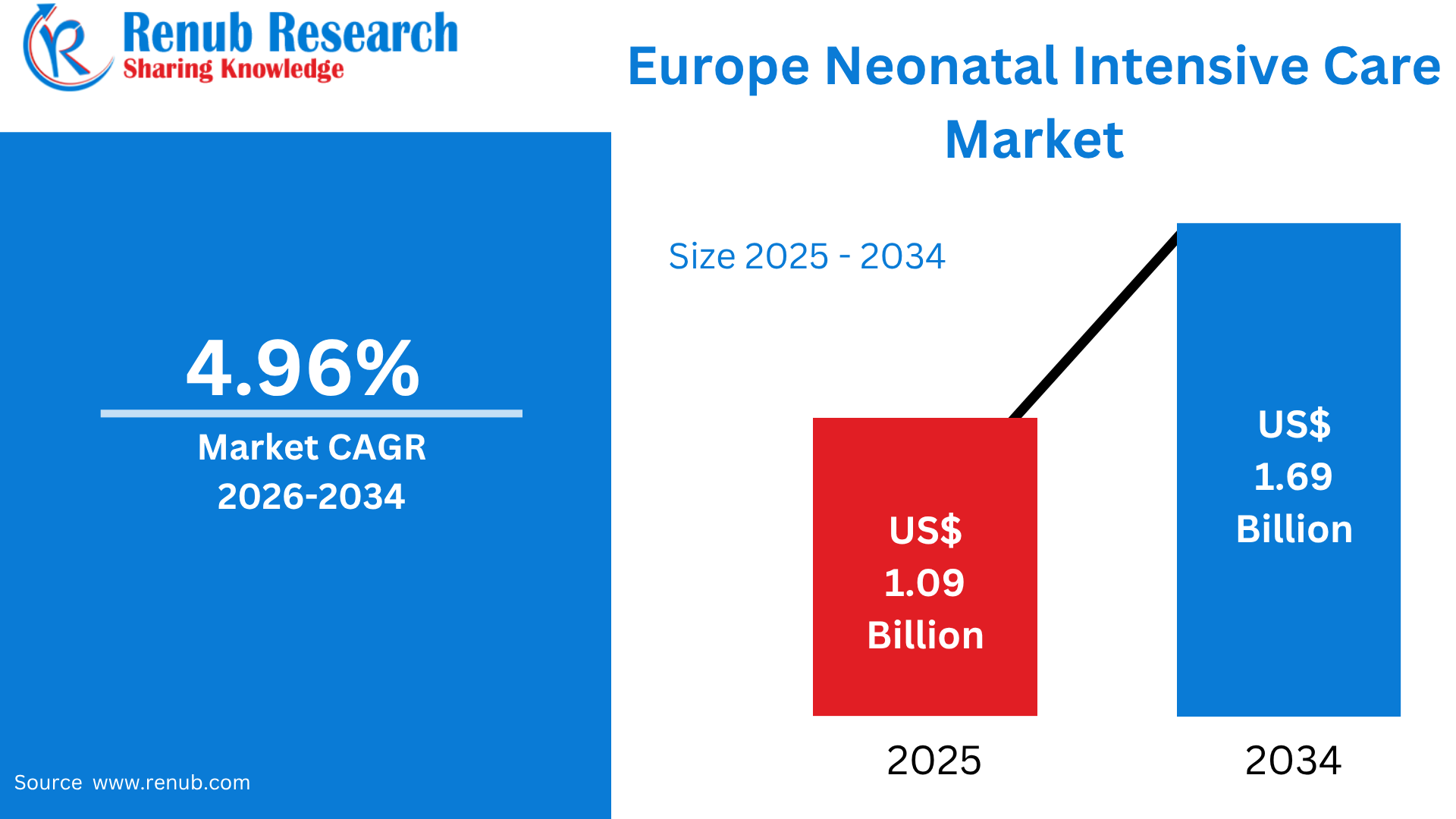
Europe Neonatal Intensive Care Market is expected to reach US$ 1.69 billion by 2034 from US$ 1.09 billion in 2025, with a CAGR of 4.96% from 2026 to 2034. The Europe neonatal intensive care market is anticipated to expand steadily during the forecast period, supported by advancements in neonatal technologies, rising preterm birth management, and increasing investments in specialized infant healthcare infrastructure.
Europe Neonatal Intensive Care Industry Overview
The Europe neonatal intensive care industry plays a crucial role in supporting the survival and treatment of premature and critically ill newborns across the region. Neonatal intensive care units (NICUs) are specialized hospital departments equipped with advanced medical technologies designed to provide intensive monitoring, respiratory support, nutritional care, and life-saving treatment for newborn infants with serious health conditions. The market includes incubators, ventilators, phototherapy equipment, patient monitoring systems, neonatal warmers, infusion pumps, and other specialized neonatal care devices. Rising awareness regarding infant healthcare, improvements in neonatal medicine, and advancements in hospital infrastructure are significantly contributing to the development of neonatal intensive care services across Europe. Increasing focus on reducing infant mortality rates and improving neonatal outcomes is encouraging healthcare systems to strengthen neonatal healthcare capabilities.
Technological innovation continues to transform the neonatal intensive care landscape in Europe. Hospitals and healthcare providers are increasingly adopting advanced monitoring systems, non-invasive respiratory support technologies, and digitally integrated neonatal care solutions to improve patient safety and clinical efficiency. Improvements in prenatal diagnostics and maternal healthcare are also supporting early detection and management of neonatal complications. In addition, increasing investments in pediatric hospitals, maternity care centers, and specialized neonatal units are driving demand for modern neonatal intensive care equipment. European healthcare systems are focusing on improving access to high-quality neonatal services while promoting family-centered care models that encourage parental involvement during infant treatment. Research activities related to neonatal diseases, infant respiratory conditions, and developmental disorders are further contributing to innovation within the market.
Despite significant progress, the Europe neonatal intensive care market faces several operational and healthcare-related challenges. High equipment costs, workforce shortages, and unequal access to advanced neonatal services across different regions continue to affect market development. Maintaining highly specialized neonatal care infrastructure requires substantial investment in medical technology, training, and hospital resources. In addition, increasing regulatory requirements and strict medical device approval processes may extend product development timelines for manufacturers. Healthcare providers also face growing pressure to improve treatment outcomes while controlling operational expenses. However, rising healthcare expenditure, technological advancements, and increasing emphasis on infant health management are expected to support long-term market growth. Expansion of digital healthcare technologies and improvements in neonatal care standards are likely to further strengthen the European neonatal intensive care industry.
Growth Drivers for the Europe Neonatal Intensive Care Market
Transport Programs, Tele-NICU, and Perinatal Regionalization
In Europe, coordinated networks that route high-risk deliveries to qualified facilities and provide tele-assistance to remote hospitals are encouraged by policy and payer support. Catchment is expanded while stability is maintained by specialized transport teams outfitted with portable incubators and ventilators. By standardizing procedures and increasing the use of cutting-edge equipment, this system approach improves results. The need for mobile devices and interoperable platforms is created over several years by funding for network infrastructure and training. Thus, regionalization increases equipment cycles and access throughout Europe.
Emphasis on Family Engagement and Developmental Outcomes
Long-term neurodevelopment and growth measurements are becoming more important in quality dashboards, encouraging investments in KMC-friendly equipment, noise/light management, and single-family rooms. Platforms for parent involvement and discharge procedures lower readmission rates and promote feeding success. Spending on milk handling traceability and lactation assistance is encouraged by the correlation between outcomes and the availability of human milk and safe fortification. Hospitals in Europe give priority to technology that quantifiably improve these endpoints as quality programs tie reimbursement to developmental measures.
High-Risk Pregnancy Burden and Persistent Preterm Birth
In Europe, preterm rates are maintained and NICU demand is driven by maternal age, metabolic illness, hypertension, and repeated gestations. Extremely low birth weight babies survive longer thanks to improved obstetric triage and steroid treatments, but they require more support. Prenatal diagnostics enable scheduled deliveries at facilities with the necessary equipment by detecting abnormalities early. Equipment with accurate thermoregulation, ventilation, and micro-dosing becomes essential as survival increases at lower gestational ages. The consistent use of procedures and devices in NICUs throughout Europe is anchored by this epidemiologic baseline.
Challenges in the Europe Neonatal Intensive Care Market
High Cost of Advanced Neonatal Care Equipment
One of the major challenges affecting the Europe neonatal intensive care market is the high cost associated with advanced neonatal medical equipment and specialized healthcare infrastructure. Modern incubators, ventilators, monitoring systems, and neonatal respiratory devices require significant investment from hospitals and healthcare institutions. Maintaining NICUs also involves ongoing operational expenses related to equipment maintenance, software integration, specialized staffing, and infection control measures. Smaller healthcare facilities and rural hospitals may face financial limitations when upgrading neonatal care capabilities or adopting advanced technologies. In addition, rapid technological advancements can increase replacement and training costs for healthcare providers. Budget constraints within public healthcare systems may further delay procurement and modernization projects. Managing these financial pressures while ensuring high-quality neonatal care remains a key challenge for healthcare providers and industry participants across Europe.
Shortage of Skilled Neonatal Healthcare Professionals
The shortage of highly trained neonatal healthcare professionals is another significant challenge for the Europe neonatal intensive care market. Neonatal intensive care requires specialized expertise in infant respiratory management, emergency care, monitoring systems, and developmental support for critically ill newborns. Many healthcare systems across Europe face staffing shortages involving neonatologists, neonatal nurses, respiratory therapists, and pediatric specialists. Increasing patient demand and rising pressure on hospital systems are further intensifying workforce challenges within NICUs. Recruiting and retaining experienced neonatal healthcare professionals can be difficult due to high workload demands, emotional stress, and long training requirements. In addition, continuous technological advancements require ongoing education and technical training for healthcare staff. Workforce shortages may affect patient management efficiency, treatment quality, and healthcare accessibility in certain regions. Addressing these staffing challenges remains essential for supporting sustainable growth and high-quality neonatal intensive care services across Europe.
United Kingdom Neonatal Intensive Care Market
The neonatal intensive care market is witnessing significant transformation due to technological advancements, rising healthcare investments, and increasing emphasis on improving infant survival outcomes. Hospitals are increasingly integrating advanced monitoring systems, respiratory support devices, and smart neonatal equipment to enhance treatment quality for critically ill and premature newborns. The growing adoption of family-centered care models is also reshaping neonatal practices by encouraging parental involvement, which supports infant recovery and emotional well-being. In addition, healthcare providers, researchers, and policymakers are strengthening collaborations to address workforce shortages, infrastructure limitations, and resource management challenges within neonatal care units. Government support continues to play an important role in market development. In the United Kingdom, authorities have increased funding for neonatal healthcare services, infrastructure modernization, and healthcare professional training programs. Recent reports indicate that the government allocated over £100 million to support neonatal care improvements in the last fiscal year. These initiatives aim to reduce infant mortality rates, improve treatment quality, and expand access to specialized neonatal intensive care services, supporting long-term market growth across Europe.
Germany Neonatal Intensive Care Market
The rising incidence of premature births in Germany is a major factor driving growth in the neonatal intensive care market. Approximately 8% of births in the country are reported as preterm, increasing the demand for specialized neonatal treatment and intensive care services. Premature infants often require advanced respiratory support, continuous monitoring, temperature regulation, and specialized nutritional management, which is encouraging hospitals to expand neonatal intensive care unit (NICU) capacity. Healthcare providers across Germany are increasingly investing in advanced incubators, ventilators, patient monitoring systems, and digital neonatal care technologies to improve survival rates and long-term health outcomes for vulnerable newborns. In addition, rising focus on early intervention and infant healthcare quality is supporting greater investment in neonatal training programs and specialized pediatric healthcare infrastructure. As hospitals continue strengthening neonatal care capabilities, the Germany neonatal intensive care market is expected to witness sustained growth and technological advancement in the coming years.
France Neonatal Intensive Care Market
The France neonatal intensive care market is experiencing steady growth due to increasing healthcare investments, modernization of pediatric hospitals, and growing focus on neonatal health management. French healthcare providers are emphasizing advanced neonatal treatment capabilities to improve survival outcomes for premature infants and newborns with critical health conditions. Hospitals are increasingly integrating advanced incubators, respiratory support systems, and neonatal monitoring technologies into NICUs to strengthen patient care quality. In addition, the country’s strong public healthcare system and healthcare accessibility support widespread neonatal treatment services across urban and regional areas. Research activities related to neonatal diseases, infant nutrition, and developmental healthcare are further contributing to industry advancement. France is also promoting family-centered neonatal care approaches that encourage parental involvement during treatment processes. Continued healthcare infrastructure development and increasing adoption of innovative neonatal technologies are expected to support long-term market growth across the country.
Italy Neonatal Intensive Care Market
Rising healthcare expenditure in Italy is significantly supporting the growth of the neonatal intensive care market. The government continues to increase investments in healthcare infrastructure, maternal health services, and neonatal treatment facilities, with healthcare spending rising by approximately 4% annually in recent years. This financial support is enabling hospitals to modernize neonatal intensive care units (NICUs), adopt advanced monitoring and respiratory support technologies, and strengthen healthcare professional training programs. In addition, the increasing incidence of premature births, accounting for nearly 6.5% of live births in Italy, is further driving demand for specialized neonatal care services. Premature infants often require intensive monitoring, respiratory assistance, and long-term medical support, encouraging hospitals to expand NICU capacity and improve treatment quality. Growing focus on reducing infant mortality rates and improving long-term neonatal health outcomes is expected to continue driving investments and technological advancements across Italy’s neonatal intensive care market.
Europe Neonatal Intensive Care Market Segmentation:
Product
- Warmers
- Incubators
- Monitoring Devices
- Respiratory Devices
- Phototherapy Equipment
- Others
End User
- Hospital & Neonatal Pediatric Hospital
- Pediatric Clinics & Childcare
- Others
Countries
- France
- Germany
- Italy
- Spain
- United Kingdom
- Belgium
- Netherlands
- Russia
- Poland
- Greece
- Norway
- Romania
- Portugal
- Rest of Europe
All companies have been covered with 5 Viewpoints
- Overviews
- Key Person
- Recent Developments
- SWOT Analysis
- Revenue Analysis
Competitive Landscape
- Masimo Corporation
- 3M Company
- Medtronic PLC
- Koninklijke Philips N.V
- Siemens Healthcare Gmbh
- Terumo Corporation
- AngioDynamics
- Drägerwerk AG & Co. KGaA
Report Details:
| Report Features | Details |
| Base Year |
2025 |
| Historical Period |
2022 - 2025 |
| Forecast Period |
2026 - 2034 |
| Market |
US$ Billion |
| Segment Covered |
Product, End User and Countries |
| Countries Covered |
|
| Companies Covered |
|
| Customization Scope |
20% Free Customization |
| Post-Sale Analyst Support |
1 Year (52 Weeks) |
| Delivery Format |
PDF and Excel through Email (We can also provide the editable version of the report in PPT/Word format on request) |
Customization Services available
- Analysis of Market Size and Its Segments
- More Company Profiles (Upto 10 without any additional cost):
- Additional Countries (Other than mentioned Countries):
- Region/Country Specific Reports:
- Market Entry Strategy:
- Region-Specific Market Dynamics:
- Regional Market Share Analysis:
- Trade Analysis:
- Production Insights:
- Others Customized Requests:
For more information contact our analysts.
Need More Assistance?
- Talk to our analysts to get more precious information on the current market trends.
- Include more countries and segments and customize the report based on the final requirement.
- Get a competitive advantage in your industry by knowing the report findings and making a positive impact on your revenues and operations.
- Our analysts are always ready to provide more help and pertinent information if you need any additional assistance.