United States Cosmetics Market Report by Product Type, Gender, Distribution Channel, State and Company Analysis 2026-2034
Buy NowUnited States Cosmetics Market Size and Forecast
United States Cosmetics Market is projected to expand from US$97.89 billion in 2025 to US$149.66 billion by 2034, registering a CAGR of 4.83% during 2026–2034. Market expansion is being supported by rising consumer expenditure on personal care, growing emphasis on grooming and appearance, and increasing preference for premium, clean-label, organic, and sustainable beauty products. Consumers are also showing greater interest in multifunctional cosmetics that combine beauty benefits with skincare, sun protection, hydration, and anti-aging properties.

What Are Cosmetics? Uses and Popularity in the USA
Cosmetics are products used to enhance, maintain, or improve a person’s appearance and personal grooming. They include a broad range of products such as makeup, foundations, concealers, lipsticks, mascara, eyeliners, blushes, nail products, fragrances, and hair-coloring products. Cosmetics are widely used for everyday grooming as well as special occasions, professional appearances, and beauty routines. In the United States, cosmetics have become an important part of the personal-care and beauty industry, supported by strong consumer spending and continuous product innovation. Consumers increasingly seek products with additional benefits, including moisturizing, sun protection, anti-aging, skin brightening, and long-lasting performance.
The popularity of clean beauty, vegan, cruelty-free, organic, and sustainable cosmetics is also increasing as consumers become more conscious of ingredients and environmental impact. Social media platforms, beauty influencers, celebrity brands, and online tutorials strongly influence purchasing behavior, particularly among younger consumers. Meanwhile, e-commerce and direct-to-consumer channels provide convenient access to a wide range of domestic and international brands. Personalized beauty products, inclusive shade ranges, multifunctional formulations, and premium cosmetics are further strengthening demand across the U.S. market.
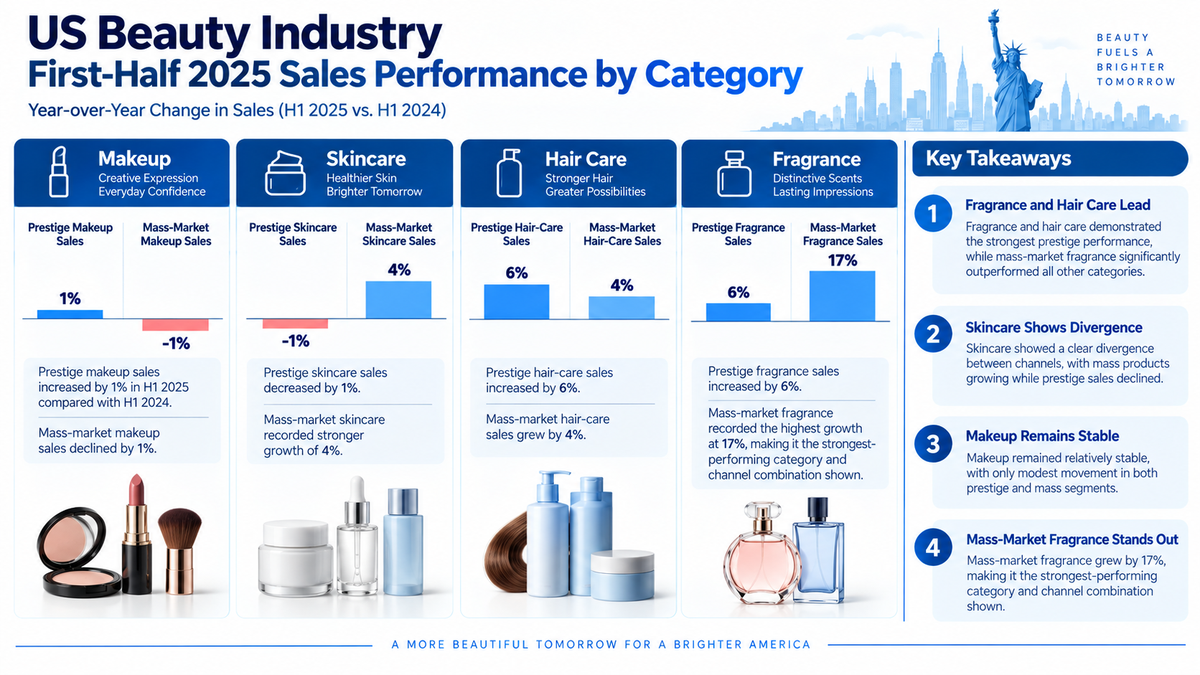
US Beauty Industry: First-Half 2025 Sales Performance by Category
- Makeup
- Prestige makeup sales increased by 1% in H1 2025 compared with H1 2024.
- Mass-market makeup sales declined by 1%.
- Skincare
- Prestige skincare sales decreased by 1%.
- Mass-market skincare recorded stronger growth of 4%.
- Hair Care
- Prestige hair-care sales increased by 6%.
- Mass-market hair-care sales grew by 4%.
- Fragrance
- Prestige fragrance sales increased by 6%.
- Mass-market fragrance recorded the highest growth at 17%, making it the strongest-performing category and channel combination shown.
- Overall Trend
- Fragrance and hair care demonstrated the strongest prestige performance, while mass-market fragrance significantly outperformed all other categories.
- Skincare showed a clear divergence between channels, with mass products growing while prestige sales declined.
- Makeup remained relatively stable, with only modest movement in both prestige and mass segments.
Growth Drivers of the United States Cosmetics Market
Rising Focus on Personal Grooming and Beauty Expenditure
Increasing consumer focus on personal grooming, appearance, and self-care is a major growth driver for the U.S. cosmetics market. Cosmetics have moved beyond occasional-use products and have become part of everyday beauty routines for a broad consumer base. According to industry estimates, U.S. consumers spend tens of billions of dollars annually on beauty and personal-care products, supported by demand for makeup, fragrances, color cosmetics, and multifunctional beauty products. The growing popularity of skincare-makeup hybrids, long-wear formulations, and products offering moisturizing or sun-protection benefits is encouraging consumers to purchase higher-value products. Men are also becoming a more important consumer group as grooming and skincare routines become increasingly mainstream. In addition, younger consumers are experimenting with new makeup styles influenced by social media and beauty creators. Premiumization is another important trend, with consumers willing to pay more for products featuring innovative formulations, high-quality ingredients, sustainable packaging, and recognizable brands. As beauty increasingly becomes associated with wellness, self-expression, and lifestyle, continued spending on cosmetics is expected to support market expansion across the United States.
Social Media, Influencer Culture, and Rapid Beauty Trends
The rapid expansion of social media and influencer-driven beauty culture has significantly transformed cosmetics purchasing behavior in the United States. Platforms such as TikTok, Instagram, and YouTube allow brands to introduce products directly to millions of potential customers, while tutorials, reviews, livestreams, and viral trends can rapidly increase demand for specific cosmetic products. The United States has more than 300 million internet users, providing a massive digital audience for beauty companies. Younger consumers are particularly influenced by short-form videos, creator recommendations, celebrity collaborations, and user-generated content when discovering cosmetics. Viral beauty trends can shorten product lifecycles while encouraging brands to continuously launch new colors, textures, packaging formats, and limited-edition collections. Social commerce is also reducing the gap between product discovery and purchase, as consumers can move from watching a beauty video to buying the featured product within minutes. Brands increasingly use influencer partnerships and digital campaigns to target specific demographic groups and beauty preferences. This highly dynamic digital environment is accelerating product awareness, consumer engagement, and sales, making social media an important long-term growth engine for the U.S. cosmetics industry.
E-Commerce Expansion and Demand for Innovative Beauty Products
The continued growth of e-commerce and direct-to-consumer (DTC) beauty brands is expanding access to cosmetics throughout the United States. U.S. retail e-commerce sales reached approximately US$1.23 trillion in 2025, demonstrating the country’s highly developed online shopping ecosystem. Beauty brands are leveraging this infrastructure to sell makeup, fragrances, professional cosmetics, and specialty products directly to consumers without relying entirely on traditional retail stores. Online channels also allow smaller and emerging brands to compete with established companies by using targeted advertising, social media, subscription models, and personalized recommendations. At the same time, consumers are increasingly interested in innovative formulations, including clean beauty, vegan, cruelty-free, organic, multifunctional, and personalized cosmetics. Brands are investing in artificial intelligence, virtual try-on tools, skin analysis, and customized product recommendations to enhance the digital shopping experience. Sustainable packaging and environmentally conscious formulations are also gaining attention among consumers. The combination of digital retail expansion and continuous product innovation is increasing consumer choice while encouraging frequent product discovery and trial. As online beauty shopping becomes increasingly integrated with social media and personalized technology, e-commerce is expected to remain a powerful contributor to U.S. cosmetics market growth.
Challenges of the United States Cosmetics Market
Regulatory Compliance, Product Safety, and Ingredient Concerns
Regulatory compliance and product safety represent significant challenges for cosmetics manufacturers operating in the United States. Companies must comply with federal requirements governing cosmetic safety, labeling, manufacturing, and marketing. The Modernization of Cosmetics Regulation Act (MoCRA) of 2022 introduced important changes to the U.S. cosmetics regulatory framework, including requirements related to facility registration, product listing, adverse-event reporting, and safety substantiation. These requirements can increase compliance costs, particularly for smaller and emerging brands. Consumers are also becoming increasingly attentive to ingredient transparency and potential concerns surrounding allergens, fragrances, preservatives, and other cosmetic ingredients. Brands therefore face greater pressure to provide clear labeling and demonstrate product safety. In addition, companies must carefully manage marketing claims because unsupported claims can create regulatory and reputational risks. The growing popularity of clean, natural, vegan, and “free-from” cosmetics is encouraging manufacturers to reformulate products and invest in alternative ingredients. Maintaining consistent quality across large product portfolios can also be challenging. As regulatory expectations and consumer scrutiny increase, cosmetics companies must invest in testing, documentation, quality control, and transparent communication, which can place additional pressure on operating costs.
Intense Competition, Product Saturation, and Changing Consumer Preferences
U.S. cosmetics market faces intense competition and rapid changes in consumer preferences, creating challenges for both established companies and emerging brands. Consumers have access to thousands of products across department stores, specialty beauty retailers, pharmacies, supermarkets, online marketplaces, and DTC websites. The expansion of independent and digitally native beauty brands has increased competition for consumer attention and shelf space. At the same time, beauty trends can change rapidly, making it difficult for manufacturers to accurately forecast demand and maintain product relevance. Social media can create sudden demand for viral products, but interest may decline just as quickly. Rising demand for clean, sustainable, vegan, cruelty-free, and ethically sourced products is also requiring companies to reconsider ingredients, packaging, and supply chains. Inflation and household budget pressures can further encourage consumers to compare prices or shift from premium cosmetics toward affordable alternatives. Meanwhile, established brands must continuously invest in research, marketing, packaging, influencer partnerships, and product launches to maintain market share. This combination of intense competition, short product cycles, pricing pressure, and rapidly evolving consumer expectations makes innovation and brand differentiation essential for sustained growth in the U.S. cosmetics industry.
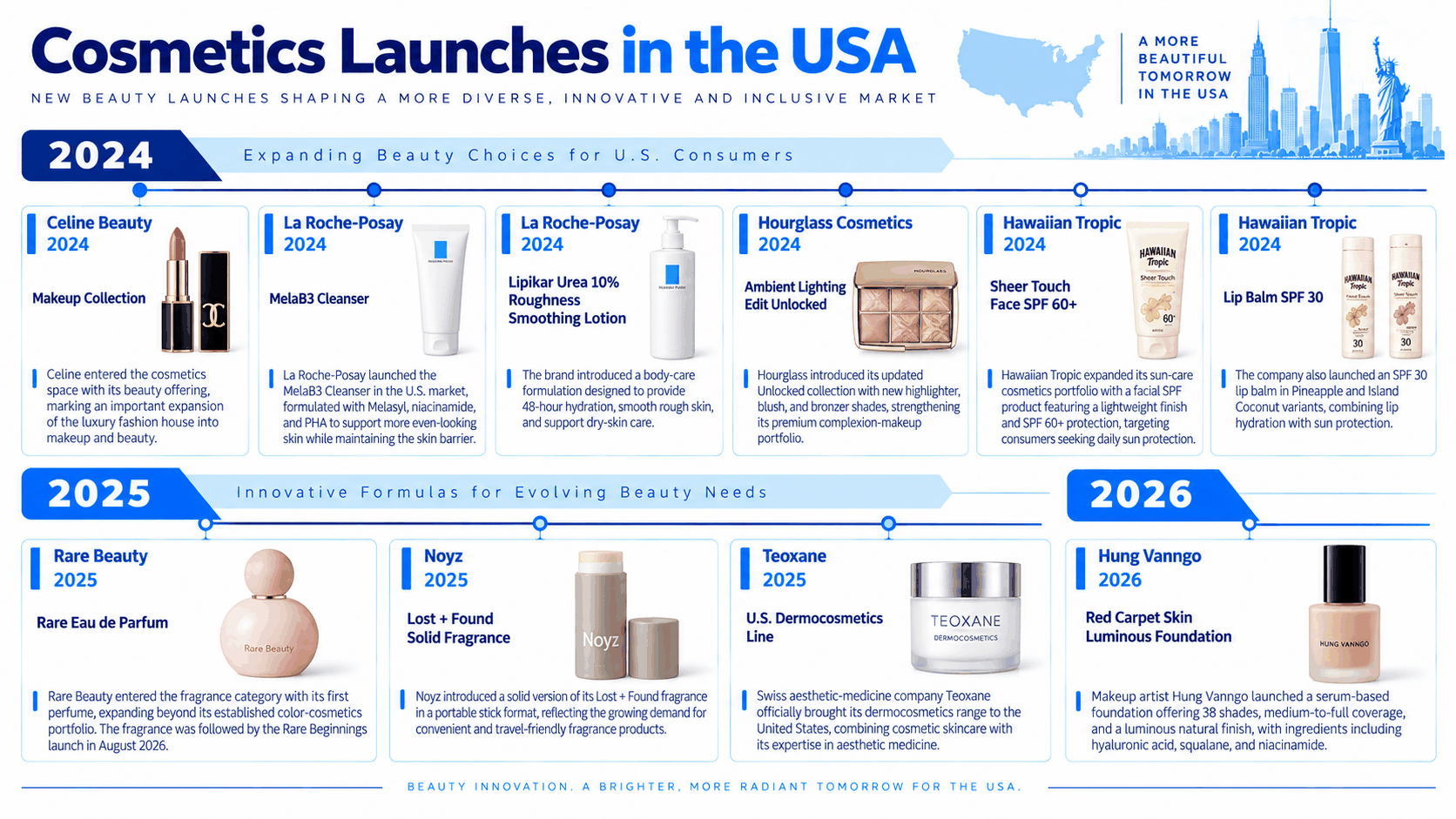
Cosmetics Launches in the USA
- Rare Beauty – Rare Eau de Parfum (2025): Rare Beauty entered the fragrance category with its first perfume, expanding beyond its established color-cosmetics portfolio. The fragrance was followed by the Rare Beginnings launch in August 2026.
- Celine Beauty – Makeup Collection (2024): Celine entered the cosmetics space with its beauty offering, marking an important expansion of the luxury fashion house into makeup and beauty.
- La Roche-Posay – MelaB3 Cleanser (2024): La Roche-Posay launched the MelaB3 Cleanser in the U.S. market, formulated with Melasyl, niacinamide, and PHA to support more even-looking skin while maintaining the skin barrier.
- La Roche-Posay – Lipikar Urea 10% Roughness Smoothing Lotion (2024): The brand introduced a body-care formulation designed to provide 48-hour hydration, smooth rough skin, and support dry-skin care.
- Hourglass Cosmetics – Ambient Lighting Edit Unlocked (2024): Hourglass introduced its updated Unlocked collection with new highlighter, blush, and bronzer shades, strengthening its premium complexion-makeup portfolio.
- Hawaiian Tropic – Sheer Touch Face SPF 60+ (2024): Hawaiian Tropic expanded its sun-care cosmetics portfolio with a facial SPF product featuring a lightweight finish and SPF 60+ protection, targeting consumers seeking daily sun protection.
- Hawaiian Tropic – Lip Balm SPF 30 (2024): The company also launched an SPF 30 lip balm in Pineapple and Island Coconut variants, combining lip hydration with sun protection.
- Noyz – Lost + Found Solid Fragrance (2025): Noyz introduced a solid version of its Lost + Found fragrance in a portable stick format, reflecting the growing demand for convenient and travel-friendly fragrance products.
- Teoxane – U.S. Dermocosmetics Line (2025): Swiss aesthetic-medicine company Teoxane officially brought its dermocosmetics range to the United States, combining cosmetic skincare with its expertise in aesthetic medicine.
- Hung Vanngo – Red Carpet Skin Luminous Foundation (2026): Makeup artist Hung Vanngo launched a serum-based foundation offering 38 shades, medium-to-full coverage, and a luminous natural finish, with ingredients including hyaluronic acid, squalane, and niacinamide.
United States Rising Demand for Protection and Healthy Skin
United States Skin and Sun Care Cosmetics Market is expanding as consumers increasingly prioritize skin health, preventive care, and daily grooming. Sunscreen, moisturizers, cleansers, serums, anti-aging products, and after-sun formulations are becoming important components of everyday routines. The United States receives substantial ultraviolet exposure across many regions, supporting continued demand for broad-spectrum SPF products. Growing awareness of premature skin aging and the importance of UV protection is encouraging consumers to use sunscreen beyond traditional beach or vacation settings. The market is also benefiting from the popularity of multifunctional products combining hydration, anti-aging benefits, antioxidants, and sun protection. Consumers are increasingly interested in clean-label, mineral, fragrance-free, vegan, and dermatologist-tested formulations. The U.S. population aged 65 years and older exceeded 61 million in 2024, creating additional demand for products addressing wrinkles, dryness, pigmentation, and other signs associated with aging. E-commerce, dermatology clinics, pharmacies, specialty beauty stores, and social media are expanding product awareness and accessibility. These trends are supporting premiumization and continuous innovation in the U.S. skin and sun care cosmetics segment.
United States Innovation and Premium Grooming Trends Drive Hair Care Cosmetics Growth
United States Hair Care Cosmetics Market benefits from strong consumer spending on shampoos, conditioners, hair color, styling products, treatments, and specialized scalp-care formulations. Hair care has become increasingly connected with broader beauty and wellness routines, encouraging consumers to seek products addressing specific concerns such as hair loss, dryness, damage, frizz, dandruff, and scalp health. The U.S. market is also supported by substantial demand for professional and premium hair-care products, with consumers increasingly purchasing salon-quality formulations for home use. Growing interest in natural, clean-label, sulfate-free, paraben-free, vegan, and cruelty-free products is influencing product development. Hair-coloring products remain important as consumers seek new shades and convenient at-home solutions. Social media and beauty influencers are also accelerating awareness of styling techniques and emerging products. In addition, consumers are increasingly interested in multifunctional products that combine cleansing, conditioning, protection, and repair benefits. Online retail has expanded access to specialized and international brands, while salons, pharmacies, supermarkets, and specialty beauty stores continue to provide strong distribution. Continuous formulation innovation and growing emphasis on scalp and hair health are expected to support sustained market development.
United States Strong Beauty Culture and Product Innovation Support Women’s Cosmetics Demand
United States Women’s Cosmetics Market represents a major segment of the country’s broader beauty industry, supported by established makeup routines, premiumization, social media influence, and continuous product innovation. Women consumers purchase a broad range of products, including foundation, concealer, lipstick, mascara, eyeliner, blush, highlighter, nail cosmetics, fragrances, and multifunctional makeup. Increasing demand for skincare-infused cosmetics is creating opportunities for products that provide hydration, sun protection, anti-aging benefits, and other skin-care functions alongside color enhancement. The United States has a population of more than 340 million, providing a large potential consumer base, while women account for approximately half of the population. Younger consumers are particularly influenced by TikTok, Instagram, YouTube, influencers, celebrities, and online beauty communities. At the same time, consumers are increasingly seeking inclusive shade ranges suitable for diverse skin tones and preferences. Clean, vegan, cruelty-free, organic, and sustainable products are also gaining attention. E-commerce and direct-to-consumer brands have made niche and premium cosmetics more accessible. Product personalization, virtual try-on technology, and AI-powered beauty recommendations are further enhancing consumer engagement and supporting continued growth.
United States Mass Retail Provides Broad Cosmetics Supermarkets/Hypermarkets Consumer Access
United States Cosmetics Supermarkets and Hypermarkets Market is supported by the country’s extensive modern retail infrastructure and strong consumer demand for affordable and convenient beauty products. Large-format retailers provide consumers with access to cosmetics, skincare, hair care, fragrances, personal grooming products, and beauty accessories under one roof. These stores attract shoppers through competitive pricing, promotional campaigns, private-label products, loyalty programs, and extensive product assortments. Mass retailers are increasingly expanding their beauty sections to include premium, clean-label, natural, vegan, and specialty brands alongside traditional mass-market offerings. The growing popularity of affordable beauty products is particularly important as consumers become more price-conscious while still seeking innovative formulations. Supermarkets and hypermarkets also benefit from frequent household shopping trips, which create opportunities for impulse purchases and cross-selling. Online grocery and retail platforms are increasingly integrated with physical stores through delivery and pickup services, strengthening the omnichannel shopping experience. Product launches, seasonal promotions, influencer-driven trends, and exclusive retailer partnerships further stimulate sales. The combination of convenience, competitive pricing, broad selection, and expanding online capabilities is expected to maintain the importance of supermarkets and hypermarkets in U.S. cosmetics distribution.
United States Premiumization and Personalized Beauty Experiences
United States Cosmetics Specialty Store Market is growing as consumers increasingly seek expert guidance, premium formulations, exclusive brands, and personalized shopping experiences. Specialty beauty retailers focus heavily on cosmetics, skincare, fragrances, hair care, and related beauty products, allowing them to offer a broader and more curated assortment than many general retailers. The U.S. market benefits from strong consumer interest in premium and prestige beauty, with shoppers increasingly willing to spend on products featuring advanced formulations, clinically supported ingredients, sustainable packaging, and exclusive brand positioning. Specialty stores also provide opportunities for product demonstrations, consultations, sampling, shade matching, and personalized recommendations, which can encourage consumers to purchase higher-value products. Younger consumers are particularly attracted to experiential retail and emerging brands discovered through social media. Specialty retailers are also expanding online platforms, enabling consumers to combine in-store experiences with digital purchasing, reviews, loyalty programs, and personalized recommendations. Demand for clean beauty, indie brands, vegan products, and limited-edition collections further supports specialty retail. As consumers increasingly value product quality, personalization, and discovery, specialty stores are expected to remain an important channel for premium cosmetics and innovative beauty products in the United States.
Innovation, Premium Beauty, and Clean Beauty Drive California Demand
California remains one of the largest and most influential cosmetics markets in the United States, supported by its population of nearly 39 million people and strong consumer spending on beauty, wellness, and personal care. The state is particularly influential in setting national beauty trends because of its entertainment, fashion, technology, and social-media ecosystems. Los Angeles and San Francisco are major centers for beauty innovation, celebrity brands, influencers, and direct-to-consumer companies. California consumers also demonstrate strong demand for vegan, cruelty-free, organic, clean-label, and environmentally responsible cosmetics, aligning with the state’s emphasis on sustainability and wellness. The presence of numerous beauty startups, technology companies, and established manufacturers encourages continuous development of innovative formulations and personalized beauty solutions. California’s ethnically diverse population also creates substantial demand for inclusive cosmetics, broader foundation shades, specialized hair-care products, and products designed for different skin types. In addition, the state’s strong e-commerce adoption enables emerging brands to reach consumers rapidly. High purchasing power, trend-conscious consumers, product innovation, and sustainability-oriented preferences are expected to keep California at the forefront of the U.S. cosmetics industry.
Texas Population Growth and Expanding Beauty Consumption Support Cosmetics Expansion
Texas Cosmetics Market is benefiting from its rapidly growing population, expanding urban centers, and increasing consumer interest in personal grooming and beauty products. Texas has a population of more than 31 million, making it one of the largest consumer markets in the United States. Major metropolitan areas such as Houston, Dallas–Fort Worth, Austin, and San Antonio provide significant demand for skincare, makeup, hair care, fragrances, and personal-care products. The state’s diverse population supports demand for a broad range of cosmetics, including products formulated for different skin tones, hair textures, and beauty preferences. Rising disposable incomes and increasing awareness of premium and specialized products are encouraging consumers to trade up toward higher-quality formulations. Social media, beauty influencers, celebrity brands, and online reviews are also influencing purchasing decisions and accelerating product discovery. In addition, busy lifestyles are increasing demand for multifunctional cosmetics, such as makeup containing skincare ingredients, long-lasting formulations, and products combining hydration and sun protection. The expansion of specialty beauty retailers, supermarkets, pharmacies, salons, and e-commerce platforms is improving product accessibility. These demographic, lifestyle, and retail trends are expected to support continued growth in Texas.
New York Fashion Influence and Premium Beauty Trends Accelerate Cosmetics Growth
New York Cosmetics Market is one of the most trend-sensitive beauty markets in the United States, supported by the state’s large population, high urban concentration, and global influence in fashion and entertainment. New York has approximately 20 million residents, while New York City serves as an international center for fashion, luxury retail, media, and beauty innovation. Consumers are highly exposed to runway trends, celebrity launches, influencers, beauty events, and social media campaigns, encouraging experimentation with new cosmetic products. The state also has strong demand for premium, prestige, clean, vegan, cruelty-free, and sustainable beauty products. Manhattan and other major urban areas provide extensive access to department stores, specialty beauty retailers, luxury boutiques, pharmacies, and independent beauty brands. The diverse population creates opportunities for inclusive cosmetics offering wider shade ranges and products addressing different skin and hair needs. E-commerce and social commerce are further expanding access to emerging brands and niche formulations. New York’s sophisticated consumer base is particularly receptive to innovative packaging, personalized beauty solutions, multifunctional products, and clinically positioned formulations. Its combination of purchasing power, fashion influence, retail density, and trend adoption is expected to maintain its importance within the U.S. cosmetics industry.
Florida Sun Care, Tourism, and Anti-Aging Demand Drive Cosmetics Market Growth
Florida Cosmetics Market is strongly influenced by its warm, humid climate, large population, tourism industry, and outdoor-oriented lifestyle. Florida has a population of more than 23 million, creating a substantial consumer base for cosmetics and personal-care products. High levels of sunshine and outdoor activity generate strong demand for sunscreens, SPF-infused makeup, moisturizers, after-sun products, and water-resistant cosmetics. Consumers often prefer long-lasting formulations that can withstand heat, humidity, and outdoor conditions. Florida’s large tourism industry further supports demand for travel-size cosmetics, fragrances, skincare products, and premium beauty items through hotels, resorts, airports, specialty stores, and retail destinations. The state also has a comparatively large older population, creating opportunities for anti-aging skincare, moisturizers, serums, and products targeting mature skin. Social media and beauty influencers continue to shape purchasing preferences, while consumers increasingly seek clean, natural, vegan, and multifunctional formulations. E-commerce and modern retail channels are improving access to domestic and international beauty brands. The combination of year-round warm weather, tourism, outdoor lifestyles, aging demographics, and growing skincare awareness is expected to sustain demand for cosmetics in Florida.
Market Segments
Product Types
- Skin and Sun Care Products
- Hair Care Products
- Deodorants and Fragrances
- Makeup and Color Cosmetics
- Others
Gender
- Men
- Women
- Unisex
Type
- Supermarkets/hypermarkets
- Specialty Store
- Pharmacies
- Online Sales
- Others
Top States
- California
- Texas
- New York
- Florida
- Illinois
- Pennsylvania
- Ohio
- Georgia
- New Jersey
- Washington
- North Carolina
- Massachusetts
- Virginia
- Michigan
- Maryland
- Colorado
- Tennessee
- Indiana
- Arizona
- Minnesota
- Wisconsin
- Missouri
- Connecticut
- South Carolina
- Oregon
- Louisiana
- Alabama
- Kentucky
- Rest of United States
All companies have been covered with 5 Viewpoints
- Overviews
- Key Person
- Recent Developments
- SWOT Analysis
- Revenue Analysis
Company Analysis:
- Coty Inc.
- Procter & Gamble
- The Estee Lauder Companies Inc.
- Colgate-Palmolive Company
- Johnson & Johnson Services Inc.
- Revlon Inc.
- Mary Kay Inc.
Report Details:
| Report Features | Details |
| Base Year |
2025 |
| Historical Period |
2022 - 2025 |
| Forecast Period |
2026 - 2034 |
| Market |
US$ Billion |
| Segment Covered |
Products Type, Gender, and Distribution Channel and States |
| States Covered |
|
| Companies Covered |
1. Coty Inc. |
| Customization Scope |
20% Free Customization |
| Post-Sale Analyst Support |
1 Year (52 Weeks) |
| Delivery Format |
PDF and Excel through Email (We can also provide the editable version of the report in PPT/Word format on request) |
Key Questions Answered in This Report:
-
What is the projected market size of the United States Cosmetics Market by 2033?
-
What is the expected compound annual growth rate (CAGR) for the market from 2025 to 2033?
-
How has the demand for clean beauty products influenced the U.S. cosmetics market?
-
What are the major growth drivers in the United States Cosmetics Market?
-
How has social media and e-commerce influenced consumer behavior in the cosmetics market?
-
What challenges are companies in the U.S. cosmetics market facing in terms of regulatory compliance?
-
Which product types are included in the United States Cosmetics Market analysis?
-
What impact has the rise of personalization and inclusivity had on the cosmetics market?
-
Which companies are leading the U.S. cosmetics market, and what are their contributions?
-
How are U.S. pharmacies influencing the cosmetics market, particularly with premium and dermatologist-approved products?
Customization Services available
- Analysis of Market Size and Its Segments
- More Company Profiles (Upto 10 without any additional cost):
- Additional Countries (Other than mentioned Countries):
- Region/Country Specific Reports:
- Market Entry Strategy:
- Region-Specific Market Dynamics:
- Regional Market Share Analysis:
- Trade Analysis:
- Production Insights:
- Others Customized Requests:
For more information contact our analysts.
Need More Assistance?
- Talk to our analysts to get more precious information on the current market trends.
- Include more countries and segments and customize the report based on the final requirement.
- Get a competitive advantage in your industry by knowing the report findings and making a positive impact on your revenues and operations.
- Our analysts are always ready to provide more help and pertinent information if you need any additional assistance.