Online Gaming Market Size, Share, Growth, Trends, Industry Analysis & Forecast 2026–2034
Buy NowOnline Gaming Market Size and Forecast
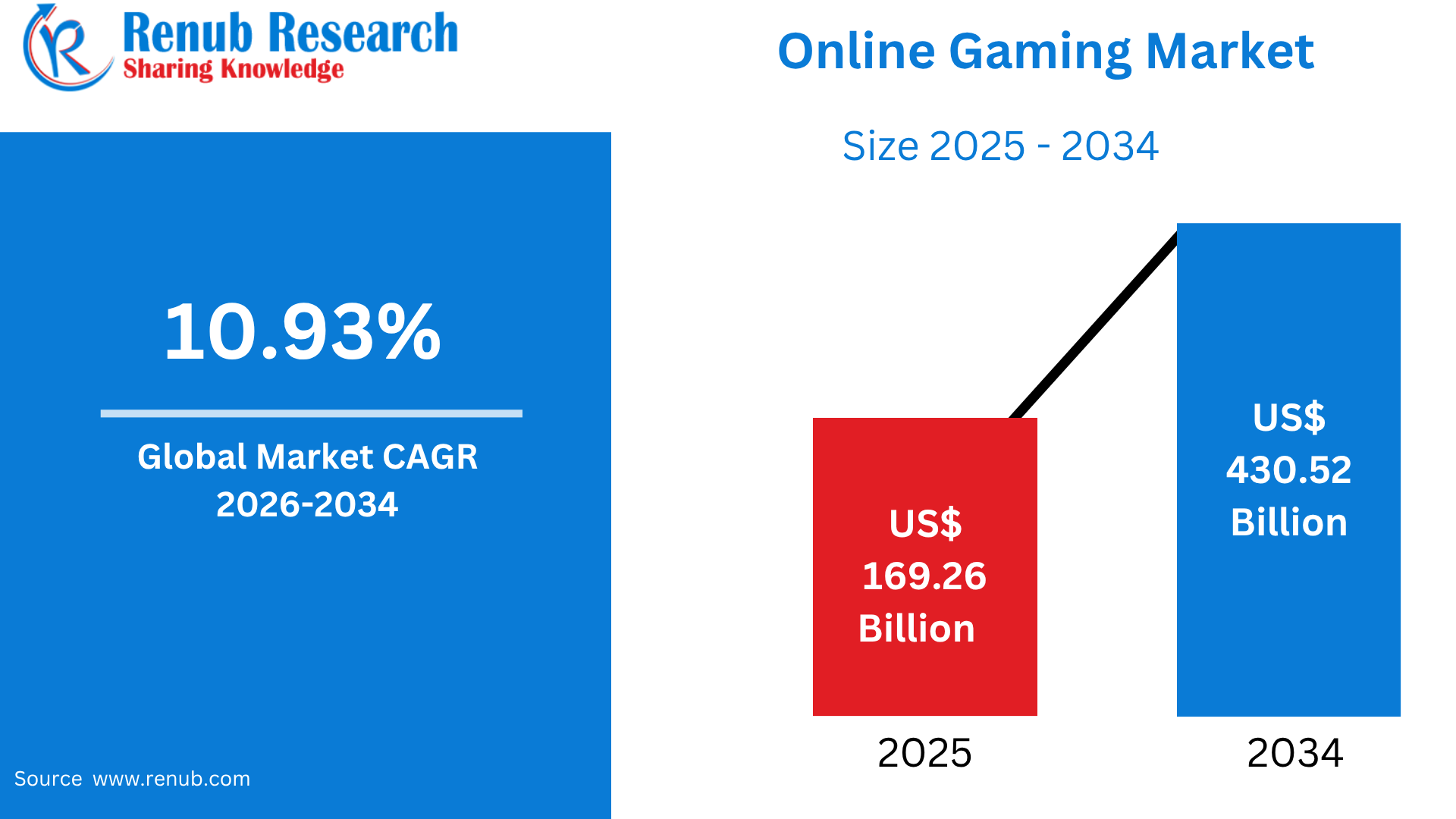
online gaming industry is projected to grow from US$ 169.26 billion in 2025 to US$ 430.52 billion by 2034, expanding at a compound annual growth rate (CAGR) of 10.93% during 2026–2034. Market growth is being fueled by increasing internet penetration, widespread smartphone adoption, and the rapid evolution of cloud gaming technologies. Additionally, the rising popularity of multiplayer and interactive gaming experiences, coupled with advancements in digital infrastructure and online connectivity, is expected to further accelerate industry expansion over the forecast period.
What is Online Gaming and its uses & popularity worldwide?
Online gaming refers to playing video games over the internet, allowing players to interact with others in real time through computers, gaming consoles, smartphones, tablets, and cloud gaming platforms. It encompasses various genres, including multiplayer online battle arena (MOBA), first-person shooter (FPS), role-playing games (RPG), battle royale, sports, racing, strategy, simulation, and casual mobile games. Online gaming uses internet connectivity to support multiplayer gameplay, in-game communication, digital purchases, cloud-based game streaming, and competitive esports tournaments. Modern gaming platforms also integrate artificial intelligence, virtual reality (VR), augmented reality (AR), and cross-platform functionality to enhance user engagement and immersive experiences.
Worldwide, online gaming has become one of the fastest-growing segments of the digital entertainment industry, driven by increasing smartphone adoption, expanding broadband and 5G connectivity, and the widespread availability of affordable gaming devices. The popularity of esports competitions, live game streaming, subscription-based gaming services, and social gaming communities has significantly expanded the global player base across all age groups. Online gaming is also increasingly used for education, cognitive skill development, teamwork, strategic thinking, and social interaction through gamified learning and collaborative virtual environments. Continuous technological advancements in cloud gaming, artificial intelligence, blockchain integration, and immersive digital experiences are expected to further strengthen the popularity and global adoption of online gaming over the coming years.
Smartphone Ownership Statistics
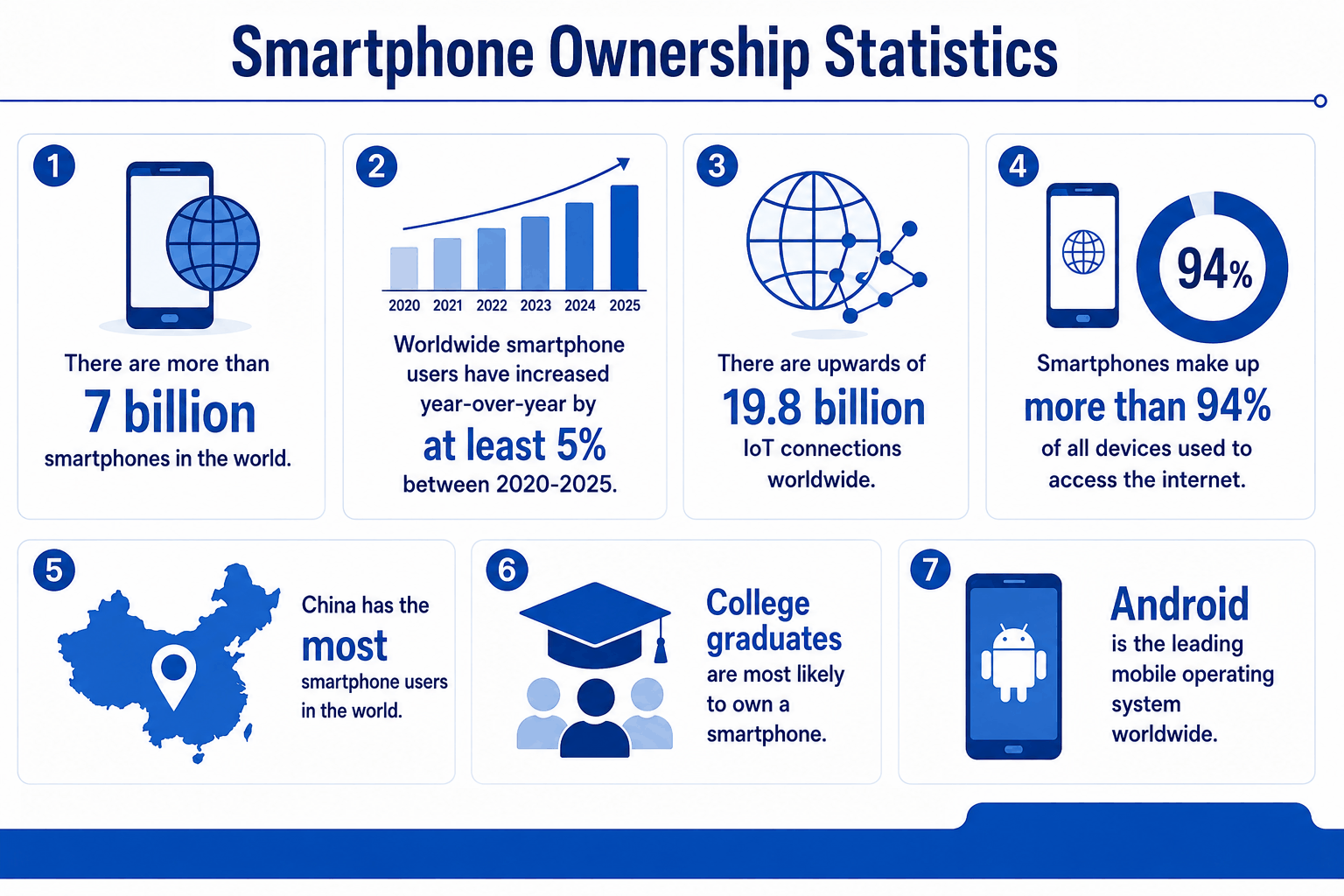
- There are more than 7 billion smartphones in the world.
- Worldwide smartphone users have increased year-over-year by at least 5% between 2020-2025.
- There are upwards of 19.8 billion IoT connections worldwide
- Smartphones make up more than 94% of all devices used to access the internet
- China has the most smartphone users in the world
- College graduates are most likely to own a smartphone
- Android is the leading mobile operating system worldwide
Individuals using the Internet
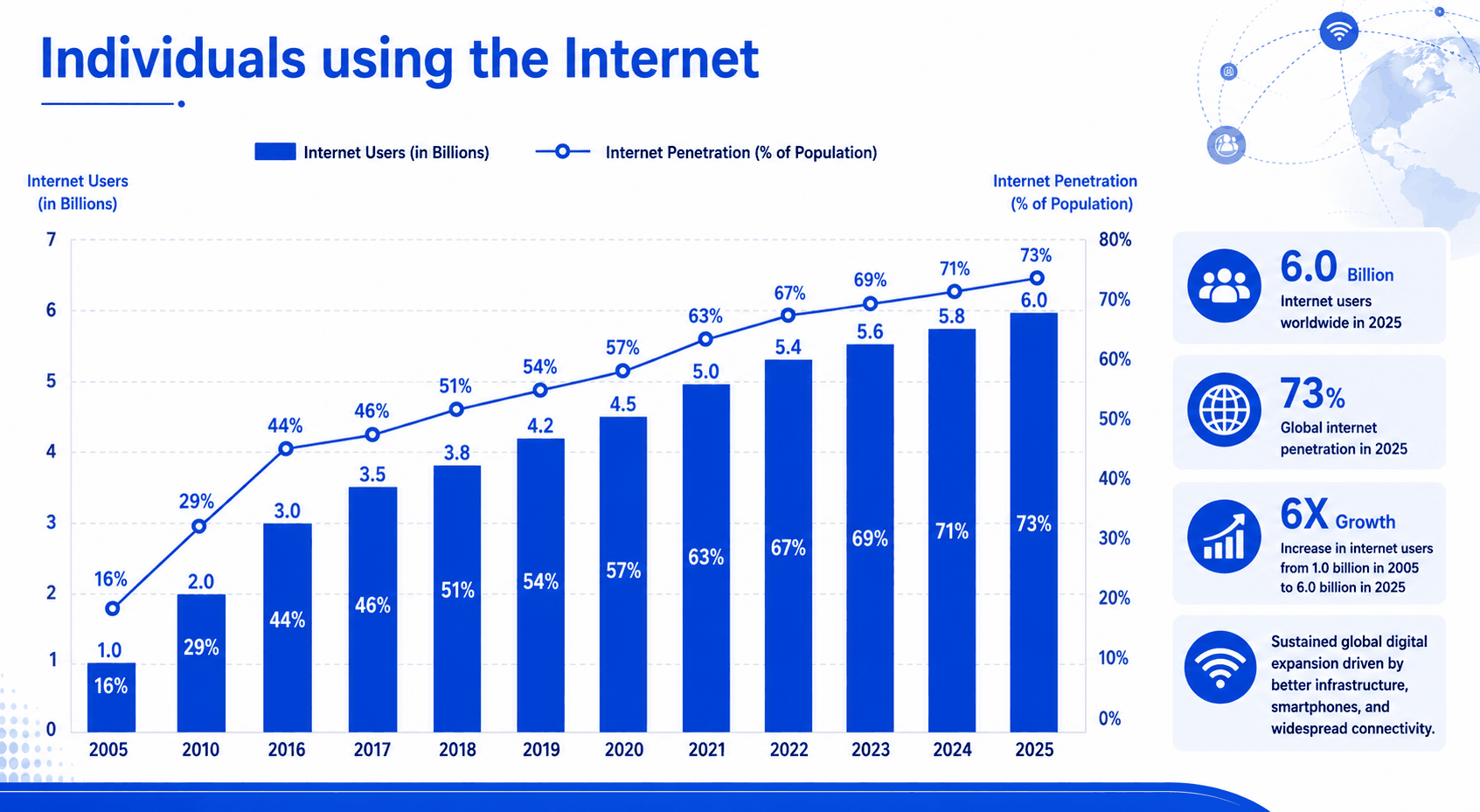
- Internet users worldwide increased from approximately 1.0 billion in 2005 to 6.0 billion in 2025.
- Global internet penetration rose from around 16% of the world’s population in 2005 to approximately 73% in 2025.
- The number of internet users surpassed 2 billion in 2010, reflecting rapid global digital adoption.
- Internet users exceeded 3 billion in 2016, while global internet penetration reached around 44%.
- In 2017, internet users increased to approximately 3.5 billion, representing about 46% of the global population.
- The period from 2018 to 2021 experienced accelerated growth, with internet users rising from 3.8 billion to over 5.0 billion.
- Global internet penetration crossed the 50% mark in 2018, indicating that more than half of the world’s population was online.
- By 2022, the global internet user base reached approximately 5.4 billion, corresponding to nearly 67% population penetration.
- Between 2023 and 2025, internet adoption continued steadily, increasing from 5.6 billion to 6.0 billion users.
- Overall, the chart highlights sustained global digital expansion, driven by improved broadband infrastructure, widespread smartphone adoption, and increasing digital connectivity across both developed and emerging economies.
Growth Driver
Expanding Digital Access Accelerating Online Gaming Adoption
The Online Gaming Market is experiencing robust growth due to the rapid expansion of internet connectivity and smartphone usage worldwide. Today, there are more than 5.8 billion internet users globally, representing approximately 68% of the world’s population, while smartphone subscriptions have exceeded 7 billion. High-speed 4G and 5G networks have significantly improved game accessibility, enabling seamless multiplayer experiences and cloud-based gaming across mobile devices. The affordability of smartphones has also expanded gaming participation in emerging economies across Asia-Pacific, Latin America, and Africa. Mobile gaming now accounts for over half of global gaming revenue, reflecting strong consumer preference for portable entertainment. Additionally, app stores provide instant access to thousands of free-to-play and premium games, encouraging user engagement across all age groups. Improved broadband infrastructure, lower data costs, and increasing digital literacy continue to attract new gamers globally. These technological advancements are expected to remain one of the strongest long-term growth drivers for the worldwide online gaming market.
Competitive Gaming Creating New Revenue Opportunities
The rapid rise of esports and multiplayer gaming has become a major catalyst for the Online Gaming Market. Global online gaming communities now include more than 3.5 billion active gamers, with multiplayer titles attracting hundreds of millions of monthly users. Competitive esports tournaments offer prize pools worth millions of U.S. dollars, drawing large audiences through live streaming platforms and digital broadcasting services. Popular multiplayer games encourage teamwork, communication, and social interaction, making gaming an important form of digital entertainment and community engagement. Streaming platforms, influencer marketing, and content creators further enhance player participation by broadcasting gameplay to millions of viewers worldwide. In-game voice chat, live events, seasonal updates, and virtual communities help retain players for extended periods. Subscription services, battle passes, downloadable content (DLC), and cosmetic microtransactions generate recurring revenue for game publishers. As esports leagues expand and multiplayer experiences become increasingly immersive, the demand for online gaming platforms is expected to continue growing across both developed and emerging markets.
Innovation Enhancing Gaming Experiences Worldwide
Continuous technological innovation is transforming the Online Gaming Market through cloud gaming, artificial intelligence (AI), virtual reality (VR), augmented reality (AR), and high-performance graphics. Cloud gaming platforms eliminate the need for expensive gaming hardware by allowing users to stream games directly through internet-connected devices. The commercial rollout of 5G networks in more than 100 countries has significantly reduced latency, enabling smoother real-time multiplayer experiences and high-quality cloud gaming. Artificial intelligence enhances gameplay through intelligent non-player characters (NPCs), personalized recommendations, adaptive difficulty levels, and advanced fraud detection. VR and AR technologies create immersive gaming environments that improve user engagement and realism. Cross-platform compatibility allows players using PCs, consoles, smartphones, and tablets to participate in the same online games, expanding the addressable market. Continuous improvements in graphics processing, game engines, cybersecurity, and digital payment systems are further strengthening consumer confidence. These technological advancements are expected to drive sustained innovation and long-term expansion of the global online gaming market.
Online Gaming Launches Worldwide
- Counter-Strike 2 (Valve, 2023): Valve officially launched Counter-Strike 2 as a free upgrade to CS:GO, introducing the Source 2 engine, improved matchmaking, enhanced graphics, and dynamic smoke mechanics.
- The Finals (Embark Studios, 2023): Embark Studios released this free-to-play multiplayer first-person shooter featuring destructible environments and team-based competitive gameplay across PC and consoles.
- XDefiant (Ubisoft, 2024): Ubisoft launched XDefiant globally, offering fast-paced 6v6 arena shooter gameplay with cross-platform multiplayer and factions inspired by Ubisoft franchises.
- Once Human (Starry Studio, 2024): Starry Studio launched this multiplayer open-world survival game featuring cooperative gameplay, crafting, exploration, and supernatural enemies for PC players worldwide.
- Delta Force (TiMi Studio Group, 2024): TiMi Studio Group revived the Delta Force franchise with large-scale online multiplayer battles, tactical combat, and cross-platform support.
- Marvel Rivals (NetEase Games, 2024): NetEase Games introduced this free-to-play 6v6 hero shooter featuring iconic Marvel superheroes and villains with destructible environments and team-based objectives.
- Throne and Liberty (NCSoft & Amazon Games, 2024): NCSoft and Amazon Games launched this MMORPG globally, featuring large-scale PvP battles, dynamic weather systems, and seamless open-world exploration.
- Arena Breakout: Infinite (MoreFun Studios, 2024): MoreFun Studios released the PC version of its tactical extraction shooter, emphasizing realistic combat, loot extraction, and competitive online gameplay.
- FragPunk (Bad Guitar Studio, 2025): FragPunk launched globally as a free-to-play 5v5 hero shooter that introduces unique Shard Cards to dynamically alter match rules and strategies.
- Splitgate 2 (1047 Games, 2025): 1047 Games launched the sequel to Splitgate, combining portal-based movement mechanics with arena shooter gameplay, enhanced multiplayer modes, and new progression systems.
Challenge
Increasing Digital Threats Affecting Player Trust
One of the major challenges facing the Online Gaming Market is the growing risk of cybersecurity attacks and online fraud. The global gaming industry serves billions of connected users, making gaming platforms attractive targets for hackers seeking financial information, user credentials, and valuable digital assets. Cyberattacks such as account hacking, phishing, malware distribution, distributed denial-of-service (DDoS) attacks, and identity theft continue to affect both players and gaming companies. Online games with in-game purchases and digital currencies are particularly vulnerable to payment fraud and unauthorized transactions. Data breaches can expose millions of user accounts, damaging company reputations and reducing player confidence. In addition, cheating software, bots, and account manipulation negatively impact fair gameplay and competitive integrity. Gaming companies must invest heavily in encryption technologies, multi-factor authentication, AI-powered fraud detection, and advanced cybersecurity infrastructure to protect users. Rising compliance requirements related to data privacy and digital security continue increasing operational costs across the online gaming ecosystem.
Government Policies and Responsible Gaming Requirements
Online Gaming also faces challenges from evolving regulations and increasing concerns regarding excessive gaming behavior. Governments across multiple countries continue introducing new rules covering online gaming, digital payments, age verification, consumer protection, loot boxes, gambling-like mechanics, and data privacy. Regulatory differences between countries create compliance complexities for international gaming publishers operating across multiple jurisdictions. At the same time, healthcare organizations have raised awareness regarding gaming addiction, excessive screen time, sleep disorders, and mental health concerns, particularly among adolescents. Some countries have introduced restrictions on gaming hours for minors, parental control requirements, and stricter content regulations. These measures may reduce player engagement and affect revenue growth for certain game categories. Developers must balance monetization strategies with responsible gaming practices while maintaining user satisfaction. Continued investment in parental controls, player well-being tools, content moderation, and regulatory compliance will remain essential for sustaining long-term growth and public trust in the global online gaming market.
Competitive Multiplayer Titles Driving Global Action Revenue Growth
Online Action Gaming represents one of the largest segments of the global gaming industry, driven by the popularity of fast-paced multiplayer experiences, battle royale games, first-person shooters (FPS), fighting games, and action-adventure titles. Action games account for an estimated 25–30% of global online gaming revenue, making them one of the highest-grossing gaming categories. Hundreds of millions of players participate in online action games every month across PC, console, and mobile platforms. The expansion of esports tournaments, live-streaming platforms, and professional gaming leagues has significantly increased player engagement and global audience reach. Technological advancements, including 5G connectivity, cloud gaming, advanced graphics engines, artificial intelligence, and cross-platform gameplay, have further improved user experience. Continuous content updates, seasonal events, downloadable content (DLC), and in-game purchases generate recurring revenue for publishers. Growing internet penetration, expanding gaming communities, and increasing demand for competitive entertainment are expected to sustain long-term growth of the Online Action Gaming Market worldwide.
Smartphone Adoption Fueling Mass Market Expansion
Mobile Online Gaming has become the largest segment of the global gaming industry due to widespread smartphone ownership and affordable mobile internet access. Globally, smartphone subscriptions exceed 7 billion, while mobile gaming contributes more than 50% of total gaming industry revenue. The availability of free-to-play games, cloud gaming services, digital payment systems, and app store distribution has made mobile gaming accessible to users across developed and emerging economies. Multiplayer mobile games, strategy titles, casual games, sports simulations, and role-playing games continue attracting millions of daily active users. Improvements in smartphone processors, high-refresh-rate displays, cloud synchronization, and 5G networks have significantly enhanced gaming performance. In-app purchases, subscriptions, battle passes, and advertising remain major revenue sources for developers. Mobile esports competitions and social gaming communities further strengthen user engagement. Rising urbanization, increasing digital literacy, and expanding internet connectivity are expected to maintain strong long-term growth in the global Mobile Online Gaming Market.
High Engagement and Premium Spending Supporting Industry Growth
Online Core Gamers consist of highly engaged players who dedicate substantial time to competitive, multiplayer, strategy, role-playing, simulation, and action games across PC, console, and high-performance mobile devices. Core gamers represent approximately 15–20% of the global gaming population, yet they contribute a disproportionately high share of total gaming revenue through premium game purchases, downloadable content (DLC), subscriptions, virtual items, and gaming hardware. These players actively participate in esports tournaments, online communities, live streaming, and competitive ranked gameplay. Advances in graphics processing units (GPUs), cloud gaming, artificial intelligence, virtual reality, and cross-platform functionality have enhanced gameplay quality and immersion. Core gamers also influence purchasing decisions through social media, online reviews, and content creation, making them an important customer segment for publishers. Increasing investments in AAA game development, subscription-based gaming platforms, and competitive multiplayer ecosystems are expected to support continued expansion of the Online Core Gamers Market globally.
Young Digital Consumers Driving Player Growth Worldwide
Online Gaming Age 11–24 Years represents one of the most influential consumer groups in the global gaming industry. Individuals within this age category account for an estimated 40–45% of the worldwide online gaming population, making them the primary audience for multiplayer, esports, mobile, and social gaming platforms. High smartphone ownership, internet accessibility, and digital literacy have significantly increased gaming participation among students and young professionals. This demographic spends considerable time on multiplayer games, live streaming platforms, gaming communities, and virtual social environments. Game developers increasingly design titles featuring cross-platform compatibility, seasonal content, virtual currencies, and personalized in-game experiences to maximize engagement among younger players. Educational gamification, collaborative gameplay, and cognitive skill development have also expanded gaming applications beyond entertainment. Rising adoption of cloud gaming, artificial intelligence, virtual reality, and augmented reality technologies is expected to further strengthen market demand, making the 11–24-year age group the largest driver of future online gaming industry growth.
High Consumer Spending and Advanced Gaming Ecosystem Driving United States Market Growth
United States Online Gaming Market is among the largest globally, supported by a technologically advanced digital infrastructure, high consumer spending, and a mature gaming ecosystem. The U.S. has a population of approximately 342 million, with internet penetration exceeding 90%, providing a strong foundation for online gaming. More than 220 million Americans play video games, and a significant proportion participate in online multiplayer, cloud, and mobile gaming. The country hosts many leading game developers, esports organizations, cloud gaming providers, and streaming platforms, contributing to continuous market innovation. Mobile gaming, PC gaming, and console gaming all generate substantial revenue through subscriptions, downloadable content (DLC), battle passes, and in-game purchases. The widespread deployment of 5G networks, increasing adoption of artificial intelligence, and growth of cloud gaming services have further enhanced gaming accessibility and user engagement. Rising esports viewership, expanding digital payment adoption, and continuous investment in next-generation gaming technologies are expected to sustain long-term growth in the United States Online Gaming Market.
Strong Digital Infrastructure and Esports Growth Supporting United Kingdom Market Expansion
United Kingdom Online Gaming Market continues to expand due to widespread broadband availability, high smartphone penetration, and one of Europe’s most established gaming industries. The UK has a population of approximately 69 million, with internet usage exceeding 95%, making digital gaming highly accessible across all age groups. Online gaming has become a mainstream entertainment activity, with millions of players regularly participating in multiplayer, mobile, console, and PC games. The country has a thriving game development sector, internationally recognized esports tournaments, and a rapidly growing game streaming community. Subscription services, cloud gaming, digital game downloads, and microtransactions continue to increase industry revenues. The rollout of advanced fiber broadband and nationwide 5G connectivity has significantly improved online gaming performance and reduced latency. Growing demand for cross-platform gaming, virtual reality experiences, and competitive esports, combined with strong consumer spending on digital entertainment, is expected to support sustained growth of the United Kingdom Online Gaming Market throughout the forecast period.
Massive Smartphone User Base Accelerating India Industry Growth
India Online Gaming Market is one of the fastest-growing globally, driven by its large population, affordable smartphones, and expanding digital infrastructure. India has a population exceeding 1.4 billion, with over 950 million internet users and more than 750 million smartphone users, creating one of the world’s largest gaming audiences. Mobile gaming dominates the market due to affordable data plans and widespread availability of Android devices. Multiplayer games, battle royale titles, esports competitions, fantasy sports, and casual mobile games continue attracting hundreds of millions of active users. The rapid expansion of 4G and 5G networks, digital payment platforms, and app-based distribution has significantly increased game accessibility and monetization opportunities. Young consumers aged below 35 years account for the majority of online gamers, supporting long-term market growth. Increasing investment from domestic and international game developers, expansion of esports tournaments, and growth in regional-language gaming content are expected to further strengthen India’s online gaming industry over the coming years.
Vision 2030 and Digital Transformation Fueling Saudi Arabia Gaming Industry Development
Saudi Arabia Online Gaming Market is experiencing rapid growth as digital entertainment becomes a strategic component of the Kingdom’s economic diversification initiatives under Vision 2030. Saudi Arabia has a population of approximately 38 million, while internet penetration exceeds 99%, providing one of the Middle East’s strongest digital consumer markets. The country has a predominantly young population, with a significant share under the age of 35, supporting strong demand for online multiplayer, mobile, console, and esports gaming. Government investments in esports infrastructure, gaming events, digital innovation, and technology parks are attracting international game publishers and investors. Mobile gaming remains the dominant platform due to high smartphone adoption, while cloud gaming and console gaming continue expanding with improved broadband and 5G coverage. Rising disposable incomes, increasing digital payment adoption, and growing interest in competitive gaming tournaments are expected to accelerate market growth. Continued public and private sector investment in gaming ecosystems, esports, and digital content creation will support sustained expansion of the Saudi Arabia Online Gaming Market.
Market Segments
By Type
- Action
- Adventure
- Puzzle
- Arcade
- Others
By Platform
- Mobile Phone
- PCs
- Console
- Others
Gamer Type
- Social Gamers
- Serious Gamers
- Core Gamers
Age-group
- Below 10 Years
- 11-24 Years
- 25-44 Years
- 45 and Above Years
Countries
North America
- United States
- Canada
Europe
- France
- Germany
- Italy
- Spain
- United Kingdom
- Belgium
- Netherlands
- Turkey
Asia Pacific
- China
- Japan
- India
- Australia
- South Korea
- Thailand
- Malaysia
- Indonesia
- New Zealand
Latin America
- Brazil
- Mexico
- Argentina
Middle East & Africa
- South Africa
- Saudi Arabia
- United Arab Emirates
All companies have been covered with 5 Viewpoints
- Overviews
- Key Person
- Recent Developments
- SWOT Analysis
- Revenue Analysis
Competitive Landscape
- Activision Blizzard, Inc.
- Apple Inc.
- Capcom Co., Ltd.
- Electronic Arts Inc.
- Microsoft Corporation
- Nintendo Co., Ltd.
- Sony Interactive Entertainment Inc.
- Tencent Holdings Ltd.
Report Details:
| Report Features | Details |
| Base Year |
2025 |
| Historical Period |
2022 - 2025 |
| Forecast Period |
2026 - 2034 |
| Market |
US$ Billion |
| Segment Covered |
Type, Platform, Gamer Type, Age Group and Countries |
| Countries Covered |
|
| Companies Covered |
|
| Customization Scope |
20% Free Customization |
| Post-Sale Analyst Support |
1 Year (52 Weeks) |
| Delivery Format |
PDF and Excel through Email (We can also provide the editable version of the report in PPT/Word format on request) |
Customization Services available
- Analysis of Market Size and Its Segments
- More Company Profiles (Upto 10 without any additional cost):
- Additional Countries (Other than mentioned Countries):
- Region/Country Specific Reports:
- Market Entry Strategy:
- Region-Specific Market Dynamics:
- Regional Market Share Analysis:
- Trade Analysis:
- Production Insights:
- Others Customized Requests:
For more information contact our analysts.
Need More Assistance?
- Talk to our analysts to get more precious information on the current market trends.
- Include more countries and segments and customize the report based on the final requirement.
- Get a competitive advantage in your industry by knowing the report findings and making a positive impact on your revenues and operations.
- Our analysts are always ready to provide more help and pertinent information if you need any additional assistance.