Video Game Market Size, Share, Growth, Trends, Industry Analysis & Forecast 2026–2034
Buy NowVideo Game Market Size
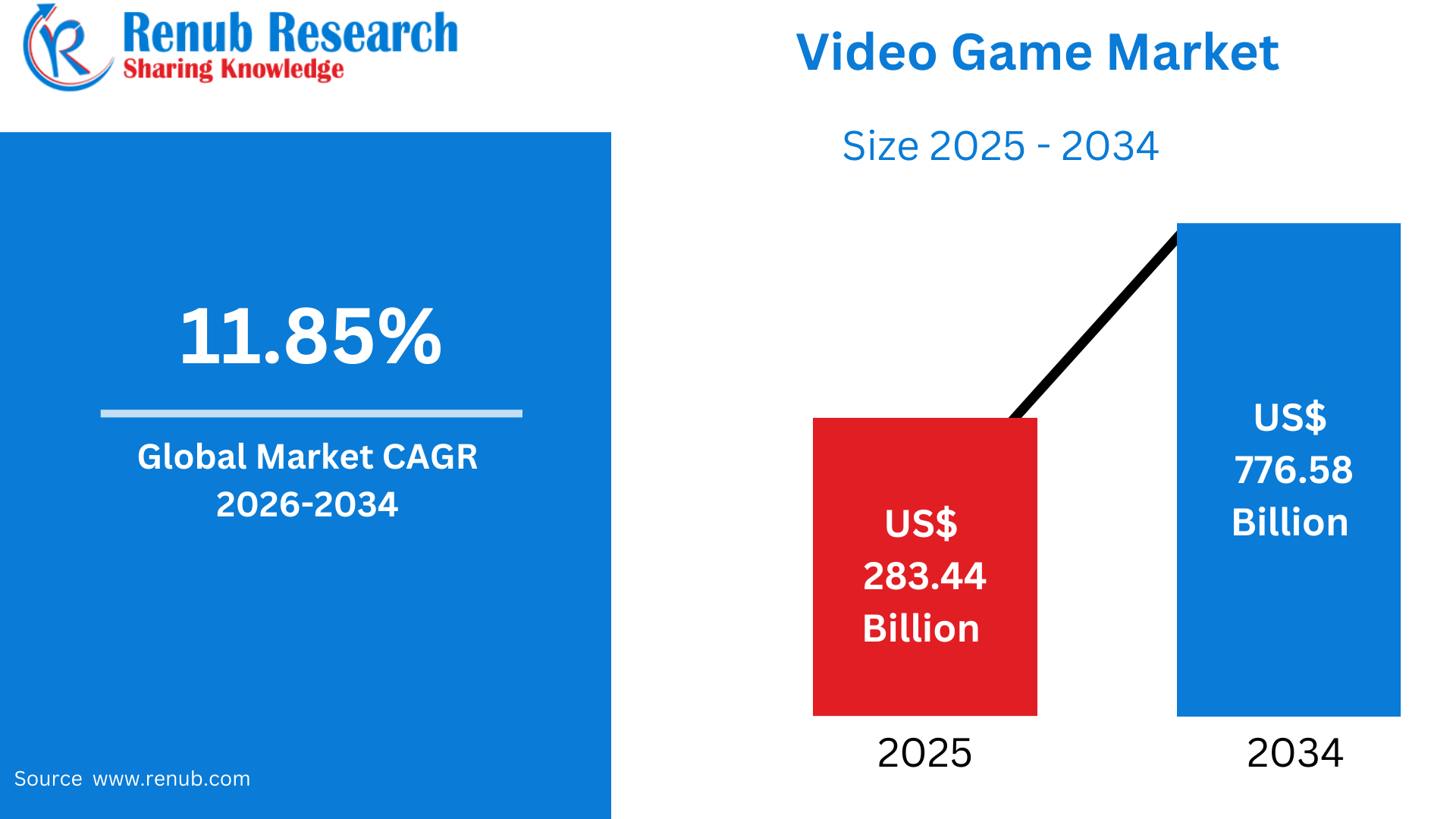
The global Video Game Market is projected to witness robust growth, expanding from US$ 283.44 Billion in 2025 to US$ 776.58 Billion by 2034, registering a Compound Annual Growth Rate (CAGR) of 11.85% during the forecast period from 2026 to 2034. Market growth is being driven by the expanding global gaming population, continuous technological advancements, the rapid adoption of cloud gaming platforms, the increasing popularity of esports, and ongoing innovation in gaming content and experiences.
Video Game Popularity Worldwide
Video games are digital entertainment products designed to provide interactive experiences across a wide range of electronic devices, including gaming consoles, personal computers, smartphones, and tablets. These games immerse players in virtual environments through engaging storylines, competitive gameplay, strategic challenges, and social interactions. The industry encompasses numerous genres, such as action, adventure, role-playing, sports, racing, simulation, strategy, and casual games, catering to diverse consumer preferences. Modern video games leverage advanced graphics, realistic physics engines, artificial intelligence, and immersive technologies to deliver increasingly engaging and lifelike gaming experiences.
The global video game industry has experienced remarkable expansion, supported by rapid technological progress, widespread internet connectivity, and the growing accessibility of digital gaming platforms. Mobile gaming has significantly broadened the industry's consumer base by making games accessible to millions of users worldwide, while dedicated gamers continue to drive demand for high-performance gaming consoles and PCs. The rise of online multiplayer gaming and competitive esports has transformed gaming into a highly interactive and community-driven form of entertainment. Furthermore, cloud gaming services are enabling users to stream high-quality games without requiring expensive hardware, making premium gaming experiences more accessible. Together, these trends are expected to sustain strong growth in the global video game market throughout the forecast period.
Global Video Game Player Demographics by Age Group (2025)
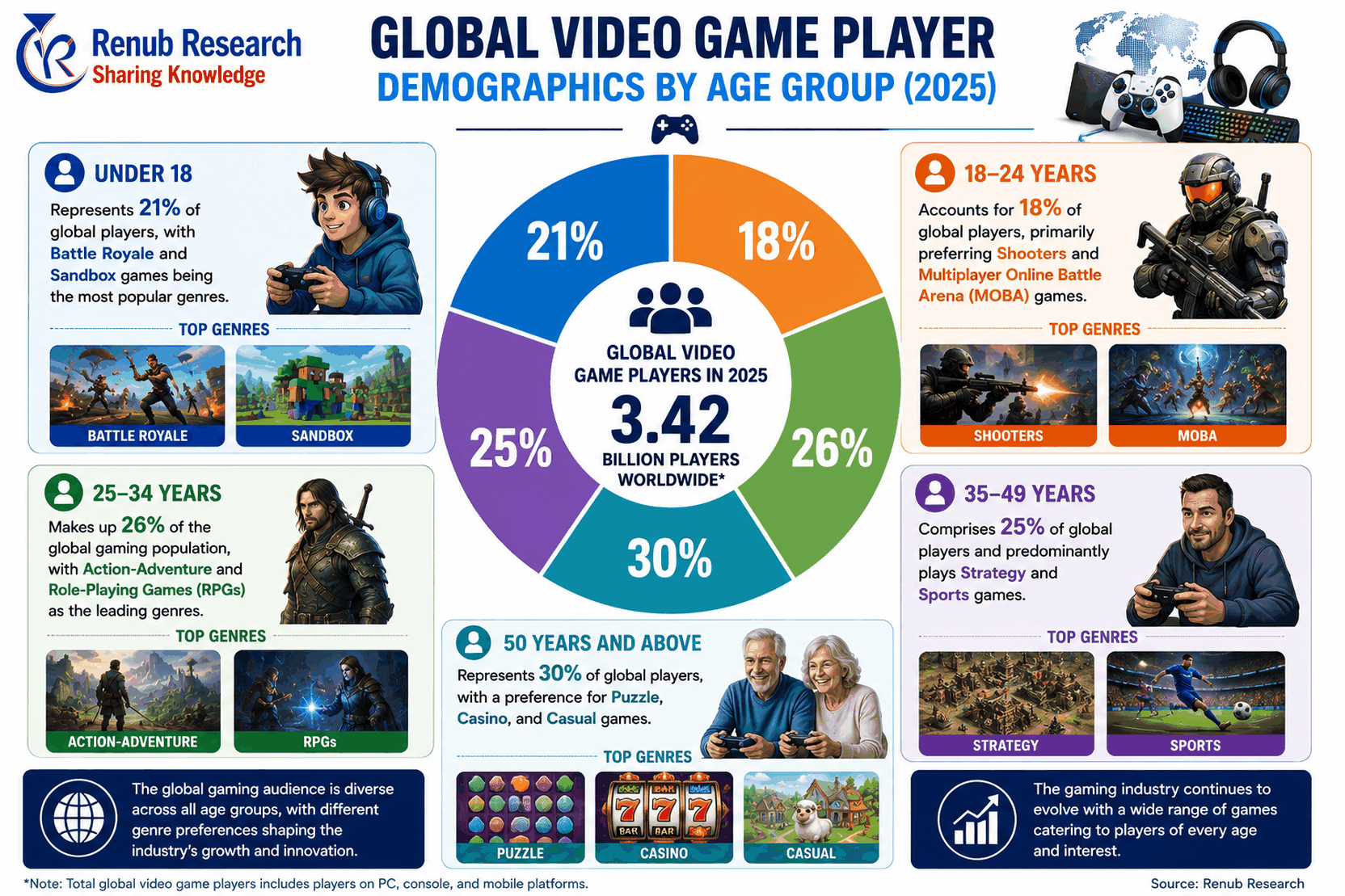
- Under 18 – Represents 21% of global players, with Battle Royale and Sandbox games being the most popular genres.
- 18–24 years – Accounts for 18% of global players, primarily preferring Shooters and Multiplayer Online Battle Arena (MOBA) games.
- 25–34 years – Makes up 26% of the global gaming population, with Action-Adventure and Role-Playing Games (RPGs) as the leading genres.
- 35–49 years – Comprises 25% of global players and predominantly plays Strategy and Sports games.
- 50 years and above – Represents 30% of global players, with a preference for Puzzle, Casino, and Casual games.
Global Gaming Player Base by Region (2025)
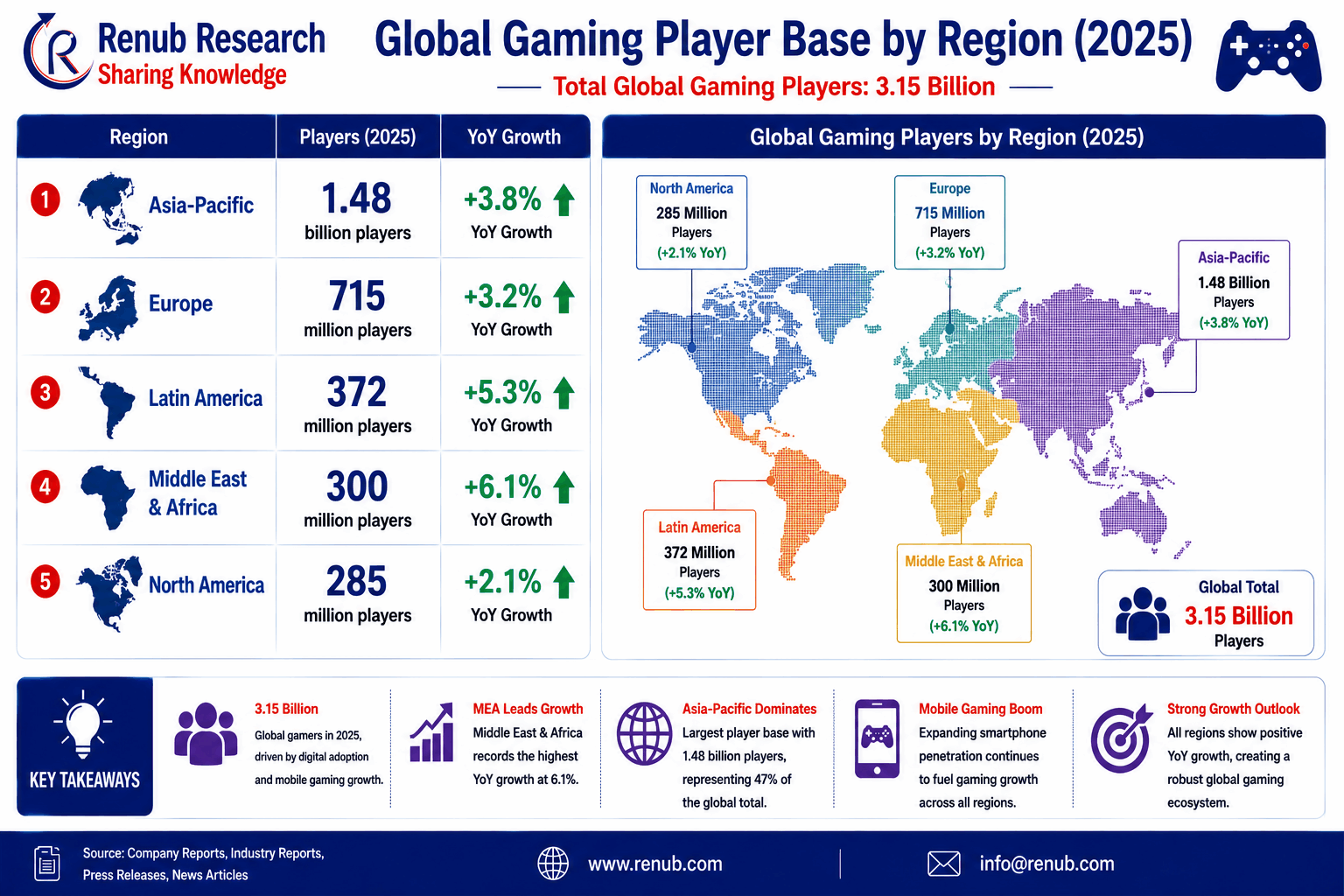
- Asia-Pacific – 1.48 billion players, recording 3.8% year-over-year (YoY) growth.
- Europe – 715 million players, with 3.2% YoY growth.
- Latin America – 372 million players, registering 5.3% YoY growth.
- Middle East & Africa – 300 million players, achieving the highest growth rate of 6.1% YoY.
- North America – 285 million players, growing by 2.1% YoY.
Most Played Video Games Worldwide by Daily/Monthly Active Users (2025)
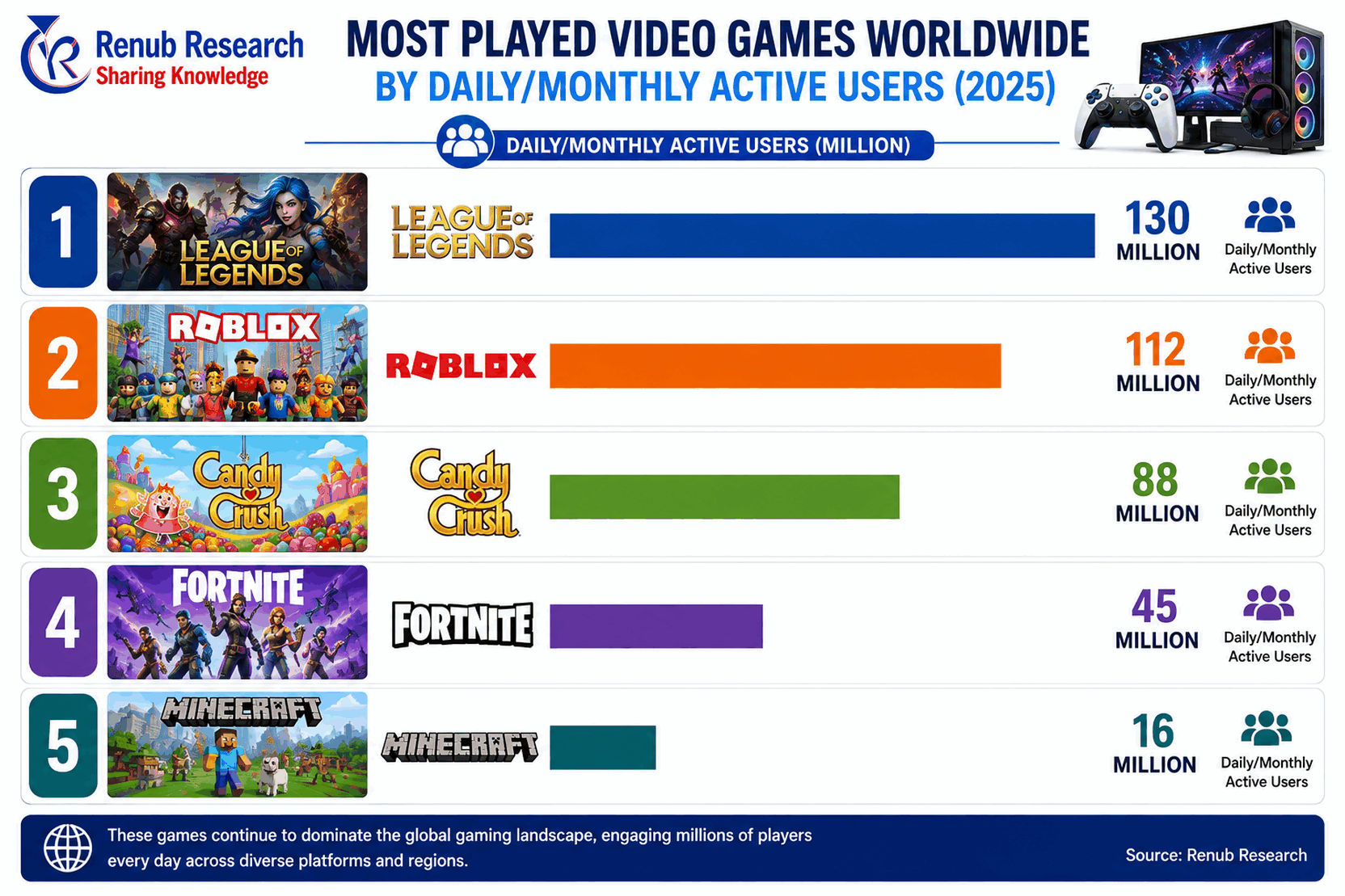
League of Legends – Approximately 130 million daily/monthly active users.
- Roblox – Approximately 112 million daily/monthly active users.
- Candy Crush – Approximately 88 million daily/monthly active users.
- Fortnite – Approximately 45 million daily/monthly active users.
- Minecraft – Approximately 16 million daily/monthly active users.
Market Catalysts
Rapid Expansion of Mobile and Casual Gaming
The rapid growth of mobile gaming and the increasing popularity of casual games are among the most significant factors driving the global video game market. The widespread availability of smartphones and tablets has made gaming accessible to a much broader audience, attracting players across different age groups and demographics beyond traditional gaming communities. The availability of free-to-play titles, low entry barriers, and convenient digital distribution through app stores has further accelerated user adoption. Additionally, continuous improvements in mobile processors, graphics capabilities, battery performance, and network connectivity have significantly enhanced the overall gaming experience. Game developers are increasingly investing in mobile-first strategies to capitalize on this expanding consumer base. Reflecting this trend, NCSOFT strengthened its long-term growth strategy by focusing on portfolio globalization and AI-driven innovation. In August 2025, the company established its Mobile Casual Center and appointed industry veteran Anel Ceman, recognized for his leadership at Tripledot Studios and Outfit7, to accelerate the development and global expansion of its mobile gaming business.
Rising Popularity of Online Multiplayer Gaming and Esports
The continued expansion of online multiplayer gaming and esports has transformed the video game industry into a highly interactive and globally connected entertainment ecosystem. Modern multiplayer games enable players to collaborate and compete with others worldwide in real time, fostering strong gaming communities and long-term user engagement. Meanwhile, professional esports tournaments attract millions of viewers through live streaming platforms, creating significant revenue opportunities from sponsorships, advertising, media rights, ticket sales, and merchandise. To maintain player engagement, game developers increasingly adopt live-service models that include seasonal updates, ranked competitions, downloadable content (DLC), and regular in-game events. In addition, game streaming platforms play an important role in increasing game visibility and influencing purchasing decisions. In August 2023, ESL FACEIT Group, a leading esports and gaming entertainment company, announced the integration of PUBG MOBILE into the FACEIT competitive gaming platform, further expanding opportunities for mobile esports participation.
Technological Advancements and Growth of Cloud Gaming
Continuous technological innovation remains a major catalyst for growth in the global video game market. Advances in graphics processing, artificial intelligence (AI), virtual reality (VR), augmented reality (AR), and game development engines are enabling increasingly immersive, realistic, and interactive gaming experiences. At the same time, cloud gaming technology is reshaping game accessibility by allowing users to stream high-quality games without investing in expensive gaming consoles or high-performance PCs. Cloud infrastructure provides improved scalability, lower hardware dependency, wider global accessibility, and reduced software piracy risks. Furthermore, subscription-based gaming services offer players affordable access to extensive game libraries while providing developers with recurring revenue opportunities. Demonstrating this trend, Microsoft expanded Xbox Cloud Gaming into India in November 2025, enabling subscribers to stream Xbox games across PCs, smart TVs, smartphones, tablets, Mac devices, and Amazon Fire TV through the Xbox Game Pass ecosystem.
Video Game Launches in Worldwide
- February 11, 2025 – Sid Meier’s Civilization VII launched globally for PlayStation 5, Xbox Series X|S, Nintendo Switch, and PC, introducing enhanced strategy mechanics, new civilizations, and cross-platform multiplayer.
- February 28, 2025 – Monster Hunter Wilds released worldwide on PlayStation 5, Xbox Series X|S, and PC, featuring expansive open environments, dynamic weather systems, and cooperative multiplayer gameplay.
- March 20, 2025 – Assassin’s Creed Shadows launched globally for PlayStation 5, Xbox Series X|S, and PC, bringing players to feudal Japan with dual protagonists and advanced stealth mechanics.
- June 5, 2025 – Mario Kart World debuted as a flagship launch title for the Nintendo Switch 2, introducing open-world racing, dynamic weather effects, and expanded multiplayer modes.
- June 26, 2025 – Death Stranding 2: On the Beach launched worldwide for PlayStation 5, continuing Hideo Kojima’s action-adventure franchise with an expanded narrative and enhanced gameplay.
- September 6, 2024 – Astro Bot released globally for PlayStation 5, offering innovative platforming gameplay while showcasing the advanced capabilities of the DualSense controller.
- October 11, 2024 – Metaphor: ReFantazio launched worldwide on PlayStation, Xbox Series X|S, and PC, delivering a fantasy role-playing experience developed by Studio Zero and Atlus.
- November 20, 2024 – S.T.A.L.K.E.R. 2: Heart of Chornobyl released globally for Xbox Series X|S and PC, combining open-world survival gameplay with an immersive post-apocalyptic setting.
- December 9, 2024 – Indiana Jones and the Great Circle launched worldwide on Xbox Series X|S and PC, blending cinematic storytelling, exploration, puzzle-solving, and action-adventure gameplay.
- October 26, 2024 – Call of Duty: Black Ops 6 launched globally for PlayStation, Xbox, and PC, introducing a new campaign, multiplayer modes, Zombies experience, and day-one availability through Xbox Game Pass.
Challenges
Rising Game Development Costs and Intensifying Market Competition
Escalating game development costs remain one of the most significant challenges facing the global video game industry. Developing modern, high-quality games requires substantial investments in skilled development teams, advanced technologies, sophisticated graphics, and increasingly lengthy production cycles, significantly increasing financial risk. At the same time, intense market competition and content saturation—particularly in the mobile and free-to-play segments—make it increasingly difficult for new titles to gain visibility and attract users. Rising marketing expenses and customer acquisition costs further pressure profit margins. Independent studios and smaller developers often struggle to compete with established publishers that possess well-known intellectual property (IP), larger development budgets, and extensive marketing resources. Consequently, unsuccessful product launches or weak market reception can result in considerable financial losses, making efficient budget management and continuous innovation essential for long-term success.
Regulatory Challenges and Growing Focus on Player Well-Being
The global video game industry is facing increasing regulatory scrutiny and heightened concerns regarding player well-being. Governments and regulatory authorities are implementing stricter oversight on issues such as gaming addiction, excessive screen time, loot box mechanics, in-game purchases, and child protection. Compliance with varying regulatory frameworks across multiple countries adds complexity for publishers seeking global market expansion. In addition, developers must continuously invest in data privacy, cybersecurity, age-appropriate content moderation, and responsible gaming practices to meet evolving legal requirements and consumer expectations. Public concerns surrounding excessive gaming and digital well-being may also influence consumer behavior and encourage the introduction of additional regulations, creating ongoing compliance challenges for industry participants.
Platform Insights
Online Video Game
The online video game market continues to expand rapidly as connected gaming becomes the preferred mode of entertainment for players worldwide. Online games offer real-time multiplayer experiences, cooperative and competitive gameplay, global leaderboards, and live in-game events that encourage long-term player engagement. Business models such as free-to-play games, seasonal content updates, downloadable content (DLC), and in-game purchases generate recurring revenue while reducing barriers to entry for new users. In addition, streaming platforms, integrated social features, and online gaming communities have transformed video games into highly interactive social experiences. Continuous improvements in broadband connectivity, cloud infrastructure, and server technologies support seamless matchmaking, cross-platform play, and low-latency gaming across regions. As developers increasingly focus on persistent online worlds and live-service gaming models, the online gaming segment is expected to account for a growing share of global gaming time and consumer spending.
Next-Generation Video Game
The next-generation video game market is driven by the adoption of advanced gaming platforms and cutting-edge technologies that deliver superior performance, enhanced realism, and immersive gameplay experiences. Continuous innovations in graphics processing, ray tracing, lighting technologies, ultra-fast solid-state storage, and haptic feedback systems are enabling more realistic and interactive gaming environments. Console manufacturers are also emphasizing backward compatibility, allowing players to access titles from previous hardware generations while preserving their existing game libraries. Furthermore, next-generation gaming ecosystems increasingly integrate cloud gaming services, digital game subscriptions, and online content delivery, providing consumers with broader access to premium gaming experiences and continuously expanding content libraries.
Device Analysis
Smartphone Video Game
The smartphone video game market represents the largest segment of the global gaming industry in terms of active users, supported by the widespread adoption of smartphones and expanding mobile internet connectivity. Mobile gaming appeals to a broad consumer base by offering both casual games designed for short play sessions and sophisticated titles featuring high-quality graphics, multiplayer functionality, and competitive gameplay. Digital app stores enable developers to distribute games rapidly, deliver frequent updates, and reach global audiences with minimal barriers. Revenue generation is supported through diverse monetization models, including in-app purchases, advertising, premium downloads, and subscription services. Social gaming features, cross-platform compatibility, and cloud gaming capabilities are further enhancing user engagement. In addition, emerging economies continue to present significant growth opportunities due to increasing smartphone penetration, affordable internet access, and rising digital adoption.
Computer Video Game
The computer (PC) video game market remains a key segment of the global gaming industry, particularly among enthusiasts, esports players, and content creators seeking high-performance gaming experiences. PCs offer superior customization, advanced hardware configurations, and enhanced processing capabilities that support higher frame rates, improved graphics quality, and greater gameplay precision. The platform is especially popular for strategy games, simulation titles, massively multiplayer online (MMO) games, and competitive esports genres that require advanced controls and high responsiveness. A vibrant modding community also extends the lifespan of many PC games by creating user-generated content, gameplay modifications, and custom experiences. Furthermore, digital distribution platforms and subscription-based gaming services provide convenient access to extensive game libraries, while powerful PC hardware supports live streaming, video production, and other content creation activities, reinforcing the platform’s long-term market relevance.
Country Analysis
United States Video Game
The United States represents one of the world’s largest and most influential video game markets, supported by high consumer spending, advanced digital infrastructure, and a mature gaming ecosystem. The country maintains a strong presence across console, PC, and mobile gaming, while its well-established esports industry and game streaming community continue to drive player engagement. The U.S. is home to many leading game developers, publishers, and technology companies that consistently introduce innovations in game development, graphics, gameplay mechanics, cloud gaming, and monetization models. In addition, the rapid expansion of mobile gaming has broadened the industry’s consumer base by attracting casual and mid-core gamers. A significant industry milestone occurred in May 2025, when Microsoft completed its acquisition of Activision Blizzard, strengthening its portfolio of globally recognized gaming franchises while expanding its leadership in subscription-based gaming and cloud gaming services. The acquisition further reinforces Microsoft’s position as a leading innovator within the U.S. interactive entertainment industry.
United Kingdom Video Game
The United Kingdom video game market is highly developed, benefiting from widespread digital adoption, strong broadband infrastructure, and a well-established creative industry. Consumers actively participate across console, PC, and mobile gaming platforms, while the popularity of online multiplayer games and esports continues to grow steadily. The country also possesses a vibrant game development ecosystem, with numerous studios producing commercially successful titles across a variety of genres. Digital game distribution dominates the market, supported by increasing broadband penetration and strong demand for gaming consoles. Mobile gaming has also expanded significantly as smartphone adoption and casual gaming continue to increase. Furthermore, the United Kingdom serves as an important European hub for game publishing, development, quality assurance, and design. As gaming becomes increasingly integrated with digital entertainment and live-streaming platforms, the UK market continues to grow through technological innovation, creative content, and strong consumer engagement. In July 2023, Sony Interactive Entertainment announced that PlayStation VR2 surpassed one million unit sales within six months of its launch in the United Kingdom, highlighting strong consumer demand for immersive gaming technologies.
China Video Game
China represents the world’s largest video game market in terms of active gamers, supported by its vast population and widespread adoption of mobile internet services. Mobile gaming dominates the market due to extensive smartphone penetration and deep integration with social media platforms. Online multiplayer games, competitive esports, and live game streaming have become central components of China’s digital entertainment ecosystem. Domestic game developers continue to produce globally successful gaming titles, while digital gaming platforms facilitate large-scale player engagement and online social interaction. Esports enjoys exceptional popularity across the country, attracting millions of viewers to professional tournaments, leagues, and live-streaming events. Although the industry operates within a regulated environment, demand for interactive digital entertainment remains strong. In 2024, China’s National Press and Publication Administration (NPPA) approved more than 1,400 video games, including 1,306 domestic titles and 110 imported games, representing the highest annual approval level since 2019. During the same year, esports was officially recognized as part of China’s digital consumption strategy through a State Council policy, reinforcing its importance within the country’s broader digital economy and emerging technology initiatives.
Brazil Video Game
Brazil has emerged as one of the fastest-growing video game markets in Latin America, driven by its large young population, expanding internet connectivity, and rising smartphone adoption. Mobile gaming dominates the market because of its affordability and accessibility, enabling millions of consumers to participate in digital gaming. Meanwhile, console and PC gaming continue to gain momentum, supported by the increasing popularity of esports and online multiplayer experiences. Brazilian gamers are highly engaged with competitive gaming, live streaming, and gaming communities, contributing to strong audience growth across digital entertainment platforms. Interest in locally developed games and regionally relevant content is also increasing, creating new opportunities for domestic developers. As digital infrastructure continues to improve and disposable incomes gradually rise, Brazil is expected to remain a major growth market for the global gaming industry. In September 2024, Flutter Entertainment acquired a 56% stake in NSX Group, the operator of the Betnacional platform, for approximately USD 350 million, reflecting growing international investment in Brazil’s expanding online gaming and betting ecosystem.
Saudi Arabia Video Game
Saudi Arabia’s video game market is experiencing rapid expansion, supported by a young, digitally connected population and increasing investments in digital entertainment as part of the country’s economic diversification initiatives. Strong smartphone penetration, widespread internet access, and growing consumer interest in interactive entertainment have contributed to rising demand for both mobile and console gaming. Online multiplayer games, esports, and live game streaming are becoming increasingly popular, particularly among younger demographics. Government initiatives promoting gaming, esports, and digital content creation are further strengthening the country’s position as an emerging gaming hub in the Middle East. Continued investments in advanced telecommunications infrastructure are also supporting market growth. In 2025, Zain KSA launched 5G Standalone (5G SA) services using the 600 MHz spectrum across Riyadh and Jeddah, with nationwide commercial deployment planned later in the year. The network expansion is expected to improve connectivity and support next-generation gaming experiences, including cloud gaming and low-latency online multiplayer services.
Market Segmentations
Component
- LED
- Photodetector
- Microcontrollers
- Others
End User
- Healthcare
- Retail
- Education
- Aerospace & Defense
- Automotive
- Transportation
- Government
- Others
Country
North America
- United States
- Canada
Europe
- France
- Germany
- Italy
- Spain
- United Kingdom
- Belgium
- Netherlands
- Turkey
Asia Pacific
- China
- Japan
- India
- South Korea
- Thailand
- Malaysia
- Indonesia
- Australia
- New Zealand
Latin America
- Brazil
- Mexico
- Argentina
Middle East & Africa
- Saudi Arabia
- UAE
- South Africa
All companies have been covered with 5 Viewpoints
- Overviews
- Key Person
- Recent Developments
- SWOT Analysis
- Revenue Analysis
Key Players Analysis
- SActivision Blizzard
- Apple Inc.
- Disney
- Electronic Arts Inc.
- Lucid Games
- Microsoft
- Nintendo
- Rovio Entertainment Corp.
Report Details:
| Report Features | Details |
| Base Year |
2025 |
| Historical Period |
2022 - 2025 |
| Forecast Period |
2026 - 2034 |
| Market |
US$ Billion |
| Segment Covered |
Platform Type, Age Group, Devices and Countries |
| Countries Covered |
|
| Companies Covered |
|
| Customization Scope |
20% Free Customization |
| Post-Sale Analyst Support |
1 Year (52 Weeks) |
| Delivery Format |
PDF and Excel through Email (We can also provide the editable version of the report in PPT/Word format on request) |
Customization Services available
- Analysis of Market Size and Its Segments
- More Company Profiles (Upto 10 without any additional cost):
- Additional Countries (Other than mentioned Countries):
- Region/Country Specific Reports:
- Market Entry Strategy:
- Region-Specific Market Dynamics:
- Regional Market Share Analysis:
- Trade Analysis:
- Production Insights:
- Others Customized Requests:
For more information contact our analysts.
Need More Assistance?
- Talk to our analysts to get more precious information on the current market trends.
- Include more countries and segments and customize the report based on the final requirement.
- Get a competitive advantage in your industry by knowing the report findings and making a positive impact on your revenues and operations.
- Our analysts are always ready to provide more help and pertinent information if you need any additional assistance.