North America Automotive Paint Market Report by Vehicle Types, Technology, Paint Types, Countries and Companies Analysis 2026-2034
Buy NowNorth America Automotive Paint Market Size and Forecast
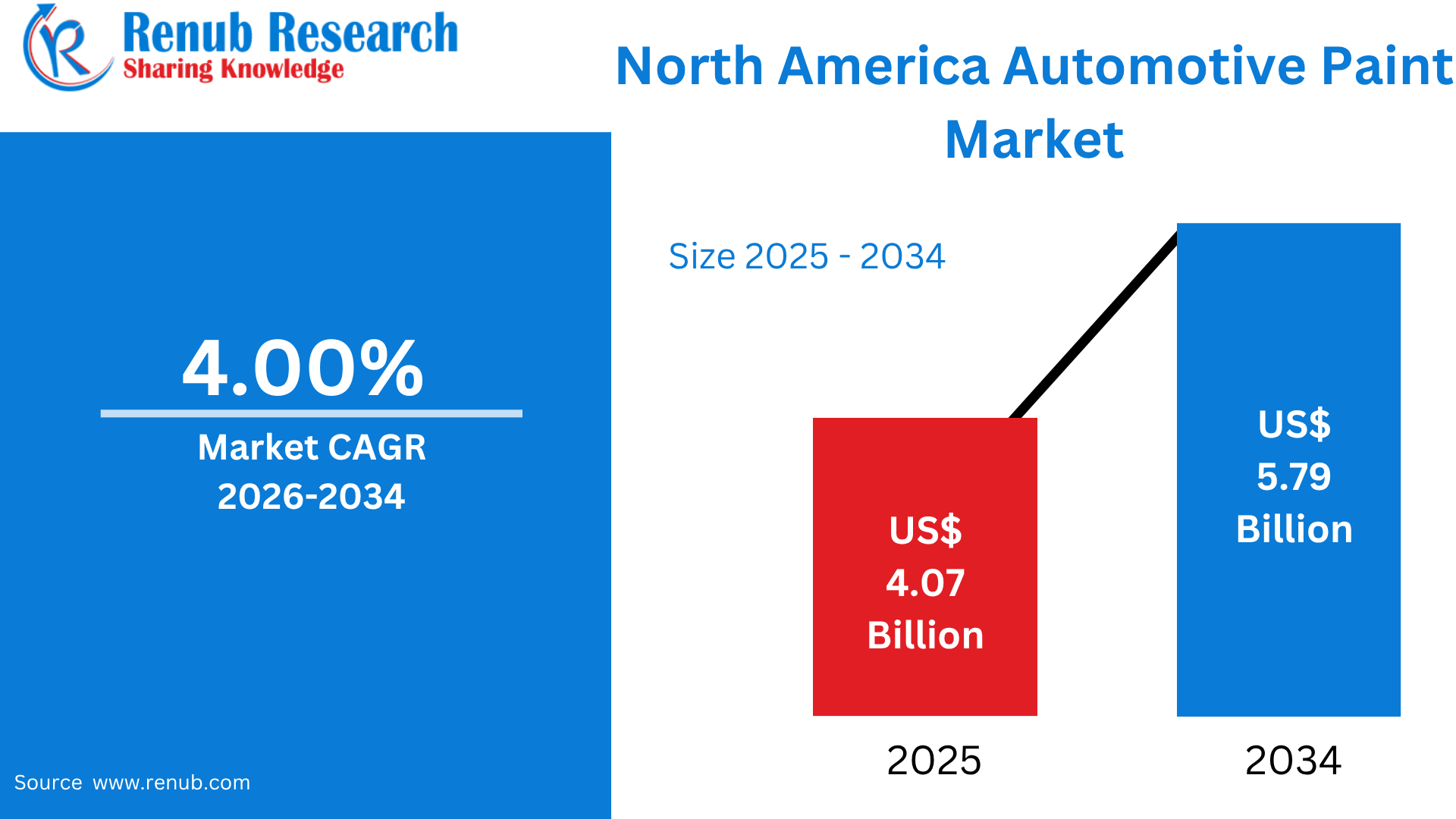
North America Automotive Paint Market is projected to increase from US$ 4.07 billion in 2025 to US$ 5.79 billion by 2034, registering a CAGR of 4.00% during 2026–2034. Market growth is supported by increasing vehicle production, rising demand for durable and high-performance coating solutions, and growing consumer preference for attractive, high-quality vehicle finishes. The adoption of advanced waterborne, low-VOC, and other environmentally sustainable coating technologies is further creating growth opportunities as manufacturers respond to environmental regulations and sustainability requirements.
What is Automotive Paint and Its Uses & Popularity in North America
Automotive paint refers to specialized coating systems applied to vehicle surfaces to provide color, gloss, corrosion protection, durability, chemical resistance, and aesthetic appeal. Modern automotive paint systems generally include primers, basecoats, and clearcoats, with formulations designed for both original equipment manufacturing (OEM) and vehicle refinishing. In North America, automotive paints are widely used on passenger cars, SUVs, pickup trucks, commercial vehicles, and automotive components. Demand is supported by the region’s large vehicle production and extensive vehicle parc. U.S. motor-vehicle assemblies averaged 10.16 million units in 2025, while the annualized production rate remained above 10 million units during several months of 2026. Increasing adoption of waterborne, high-solids, low-VOC, and durable coatings is further strengthening the market as manufacturers and repair businesses seek improved performance and environmental compliance.
Global Electric Car Sales, 2014–2024
- 2014: Global electric car sales reached approximately 0.3 million units.
- 2015: Sales increased to around 0.5 million units, indicating continued early-stage EV adoption.
- 2016: Global electric car sales rose to approximately 0.8 million units.
- 2017: Sales surpassed 1 million units, reaching about 1.2 million units.
- 2018: Electric car sales climbed significantly to approximately 2.1 million units.
- 2019: Sales remained strong at around 2.2 million units.
- 2020: Global sales increased to approximately 3.0 million units, despite disruptions to the automotive industry.
- 2021: Electric car sales more than doubled to approximately 6.6 million units.
- 2022: Global sales reached around 10.2 million units, reflecting accelerating EV adoption.
- 2023: Sales increased further to approximately 13.9 million units.
- 2024: Global electric car sales reached a record 17.3 million units, demonstrating the rapid expansion of the global EV market.
- Overall trend: Global electric car sales increased from 0.3 million units in 2014 to 17.3 million units in 2024, representing more than 57 times growth over the decade.
Source: International Energy Agency (IEA), Global electric car sales, 2014–2024.
Growth Drivers of the North America Automotive Paint Market
Stable Vehicle Production and Expanding Automotive Manufacturing
Stable vehicle manufacturing across North America is a major driver of automotive paint consumption because every newly manufactured vehicle requires multiple coating layers for protection and appearance. The U.S. Federal Reserve reported average motor-vehicle assemblies of 10.16 million units in 2025, with the annualized production rate reaching 10.71 million units in Q4 2025. The American Coatings Association also reported that U.S. motor-vehicle builds had risen to approximately 10.7 million units on a seasonally adjusted annualized basis by 2026, primarily supported by light trucks. SUVs, pickups, and commercial vehicles require extensive coating coverage for body panels, chassis, components, and protective applications. In addition, automotive OEM coating suppliers are developing formulations designed for lightweight materials, improved corrosion resistance, and faster manufacturing cycles. Continued vehicle production and investments in modern manufacturing facilities are therefore expected to sustain demand for automotive paints throughout North America.
Rising Demand for Advanced and Sustainable Coating Technologies
Technological innovation is transforming automotive paint demand in North America, particularly through waterborne, high-solids, low-VOC, powder, and energy-efficient coating technologies. Within automotive applications, waterborne technologies are increasingly used because they can reduce solvent emissions while maintaining high-quality finishes. Automotive OEM coating suppliers are also developing low-bake coatings, improved resin systems, and formulations suitable for electric vehicles and lightweight substrates. Environmental regulations are an important catalyst. The U.S. EPA’s automobile and light-duty truck surface-coating standards specifically limit VOC emissions from new and modified coating operations. These regulatory requirements, combined with automaker sustainability objectives, are encouraging paint manufacturers to invest in formulations that reduce emissions, improve application efficiency, lower energy consumption, and maintain durability.
Growth of Automotive Refinishing and Aftermarket Services
The large North American vehicle parc and continued demand for collision repair, restoration, customization, and cosmetic maintenance provide an important aftermarket opportunity for automotive paints. Refinish products are used for repairing scratches, dents, corrosion, collision damage, and worn finishes. Demand is also supported by premium vehicles, SUVs, and pickup trucks, where owners may place greater emphasis on maintaining exterior appearance. Modern repair shops increasingly require precise color matching, fast-curing formulations, waterborne basecoats, and high-performance clearcoats. Consequently, technological improvements in refinishing products are creating additional value opportunities beyond OEM vehicle production.
Challenges of the North American Automotive Paint Market
Stringent VOC Regulations and Environmental Compliance
Environmental regulations governing volatile organic compound (VOC) emissions create compliance challenges for automotive paint manufacturers, OEMs, and refinishing businesses. VOCs released during coating application can contribute to ground-level ozone formation, prompting regulators to impose limits on coating formulations and manufacturing operations. The U.S. EPA’s national automobile-refinish coating standards were designed to reduce VOC emissions by approximately 31,900 tons per year, equivalent to a 33% reduction from the 1995 baseline emissions estimate. Federal requirements also establish specific VOC-content limits for different automotive refinish products; for example, the limit for single- and two-stage topcoats is 600 grams of VOC per liter, while primer/primer-surfacer products are limited to 580 grams per liter. Such requirements increase formulation, testing, certification, and compliance costs. Manufacturers must continuously invest in waterborne, high-solids, and other low-emission technologies while maintaining color consistency, durability, drying performance, and application efficiency. Smaller refinishing businesses can face additional challenges adapting equipment and processes to changing environmental requirements.
Raw Material Price Volatility and Supply-Chain Pressure
Automotive paint manufacturers face pressure from fluctuations in the prices and availability of key raw materials, including resins, pigments, solvents, additives, and specialty chemicals. These materials are closely connected to petrochemical and industrial supply chains, making production costs sensitive to energy prices, transportation expenses, trade policies, and geopolitical disruptions. Automotive coating suppliers must therefore balance raw-material cost increases against price-sensitive OEM and aftermarket customers. Supply-chain disruptions can additionally affect the availability of specialized pigments, additives, and resins required for high-performance automotive formulations. At the same time, manufacturers are investing in automated production and color-matching technologies to improve productivity and reduce dependence on skilled labor. Managing cost volatility while maintaining consistent coating quality, regulatory compliance, and sustainable formulations remains an important challenge for automotive paint suppliers across North America.
Automotive Paint Launches and Developments in North America
- November 2025 – AkzoNobel and Axalta: AkzoNobel and Axalta Coating Systems entered into a definitive all-stock merger agreement valued at an implied enterprise value of more than US$25 billion, combining two major global coatings businesses. The proposed combination is expected to create a larger coatings platform spanning automotive refinish, industrial, and other coating applications.
- October 2025 – BASF and Xiaomi: BASF Coatings expanded its collaboration with Xiaomi to co-develop 100 exclusive automotive colors over three years. The program includes full-layer coating solutions from e-coat and primer through basecoat and clearcoat, supporting greater vehicle personalization and new automotive color trends.
- January 2025 – Axalta Evergreen Sprint: Axalta introduced Evergreen Sprint as its 2025 Global Automotive Color of the Year. The deep forest-green shade draws inspiration from British racing green and reflects growing interest in distinctive, performance-oriented automotive colors. Axalta noted that green accounted for approximately 2% of vehicles worldwide in its 2023 color popularity report.
- April 2023 – PPG Enviro-Prime: PPG Industries introduced its Enviro-Prime coating technology as part of its efforts to develop lower-emission automotive coating solutions. The technology was positioned around reducing environmental impact while maintaining coating performance.
- June 2023 – Axalta ChromaDyne: Axalta expanded its automotive coating portfolio with next-generation ChromaDyne basecoat technology, focusing on improved application efficiency, drying performance, and color consistency for automotive coating applications.
- August 2023 – BASF and Ford: BASF and Ford Motor Company collaborated on the development of more sustainable automotive coating solutions, reflecting increasing industry interest in bio-based materials and lower-carbon manufacturing.
- October 2023 – Sherwin-Williams Automotive Expansion: Sherwin-Williams expanded its automotive coatings capabilities and portfolio during 2023, supporting broader product availability across automotive OEM and refinishing applications.
- December 2023 – AkzoNobel R&D Investment: AkzoNobel continued investing in research and development for advanced coating technologies, with emphasis on waterborne and lower-emission formulations designed to address sustainability requirements in automotive and other industrial applications.
Strong Passenger Vehicle Production and Demand for Premium Finishes
North America Passenger Cars Paint Market is supported by steady vehicle production, demand for durable finishes, and increasing emphasis on vehicle aesthetics. In North America, paint systems are used across pretreatment, electrocoat, primer, basecoat, and clearcoat stages to provide corrosion protection, durability, color, gloss, and resistance to environmental exposure. Consumer interest in metallic, pearlescent, customized, and premium finishes is encouraging coating manufacturers to develop broader color portfolios and advanced surface effects. At the same time, the expansion of electric vehicles is creating demand for coatings compatible with lightweight materials and new vehicle architectures. Waterborne, low-bake, and low-VOC technologies are also gaining importance as automakers seek to improve sustainability and paint-shop efficiency.
Sustainability Regulations Accelerate Waterborne Coating Adoption
North America Automotive Waterborne Coatings Paint Market is benefiting from environmental regulations and automotive manufacturers’ efforts to reduce VOC emissions while maintaining high-quality finishes. Waterborne coatings use water as a major carrier and can provide lower-emission alternatives to conventional solvent-intensive systems. The automotive OEM coatings industry is increasingly focused on waterborne, powder, low-bake, and other advanced technologies, with water-borne coatings identified as the largest technology segment globally in 2025. Regulatory pressure is particularly important in the United States. The EPA’s automobile and light-duty truck surface-coating standards establish requirements for controlling VOC emissions from new, modified, and reconstructed coating operations. In addition, the EPA’s automobile-refinish VOC standards were estimated to reduce VOC emissions by approximately 31,900 tons annually, equivalent to a 33% reduction from the 1995 baseline. These requirements are encouraging OEMs and refinishing businesses to adopt waterborne basecoats, high-solids formulations, and other low-emission technologies, supporting continued market expansion across North America.
Rising Demand for Corrosion Protection and Advanced Surface Preparation
North America Automotive Primer Paint Market plays a critical role in automotive coating systems because primers provide adhesion between the vehicle substrate and subsequent coating layers while improving corrosion and environmental protection. Automotive OEM coating systems commonly include pretreatment, electrocoat, primer, basecoat, and clearcoat, highlighting the importance of primer technology within the overall paint process. Demand is supported by continued vehicle manufacturing and the need for long-lasting finishes capable of withstanding moisture, road salts, chemicals, temperature fluctuations, and mechanical exposure. Modern primer formulations increasingly emphasize rapid curing, improved substrate adhesion, lower VOC emissions, and compatibility with waterborne and other sustainable coating systems. Epoxy-based primers remain important for corrosion protection, while polyurethane and other advanced chemistries are being developed for specific performance requirements. Environmental regulations are also encouraging manufacturers to optimize primer formulations and reduce solvent emissions. EPA standards for automobile and light-duty truck surface-coating operations specifically target VOC emissions from coating processes. Growth in vehicle repair and refinishing activity additionally creates recurring demand for primer products across North American body shops.
E-Coating Gains Importance for Uniform Corrosion Protection
North America Automotive Electrocoat Paint Market is driven by the need for uniform corrosion protection, high coating efficiency, and durable vehicle structures. Electrocoating, or e-coat, uses an electrical current to deposit coating material uniformly over conductive metal surfaces, including areas that are difficult to reach through conventional spray painting. E-coat is an established layer within modern automotive OEM coating systems, alongside pretreatment, primer, basecoat, and clearcoat. Its ability to provide consistent coverage and strong corrosion resistance makes it particularly important for vehicle bodies and metal components exposed to moisture, road chemicals, and temperature changes. Automakers are also seeking coating processes that minimize material waste and improve manufacturing efficiency. Environmental considerations are strengthening the importance of advanced e-coat formulations as manufacturers seek lower-emission and more resource-efficient paint-shop operations. EPA regulations for automobile and light-duty truck coating facilities establish VOC emission standards for new, modified, and reconstructed operations. Continuous development in resin chemistry, curing systems, application equipment, and low-bake technologies is expected to create additional opportunities for electrocoat suppliers across North America.
United States Large Vehicle Production Base and Advanced Coating Technology Support Growth
United States represents a major automotive paint market in North America because of its substantial vehicle manufacturing base, large installed vehicle population, and extensive aftermarket refinishing industry. Demand comes from both vehicle assembly plants and repair and refinishing operations, creating opportunities across primers, electrocoats, basecoats, clearcoats, and specialty finishes. The country’s regulatory framework is also encouraging the transition toward lower-emission technologies. EPA standards for automobile and light-duty truck surface-coating operations are designed to limit VOC emissions, while national standards for automobile refinish coatings were estimated to reduce VOC emissions by 31,900 tons per year. Automotive paint suppliers are therefore investing in waterborne, high-solids, low-bake, and other compliant formulations. Demand for premium colors, metallic finishes, customized appearances, and durable clearcoats further supports market development. The combination of OEM manufacturing, aftermarket repair, environmental requirements, and coating innovation is expected to sustain the U.S. automotive paint market.
Canada Vehicle Manufacturing and Sustainability Requirements Drive Coating Demand
Canadian automotive paint market is supported by vehicle manufacturing, automotive repair and refinishing activity, and demand for durable coatings capable of protecting vehicles from challenging environmental conditions. Automotive paints are required to provide corrosion resistance, particularly because vehicles can experience moisture, temperature fluctuations, and exposure to road salt during winter conditions. Canada is also integrated into the broader North American automotive manufacturing and supply chain, creating demand for OEM coating technologies used across vehicle assembly operations. The shift toward sustainable coating technologies is becoming increasingly important as automotive manufacturers seek to reduce emissions and improve manufacturing efficiency. Waterborne and other low-VOC formulations provide opportunities for paint suppliers to address these requirements. Canadian demand is also supported by aftermarket refinishing, where primers, basecoats, clearcoats, and specialty products are required for collision repairs and cosmetic restoration. Continued advances in corrosion-resistant, low-emission, and high-durability formulations are expected to support long-term market development.
Mexico Automotive Manufacturing Hub Creates Strong OEM Coating Opportunities
Mexico’s automotive paint market is strongly linked to its position within the North American vehicle manufacturing supply chain. Automotive assembly plants require extensive coating systems covering pretreatment, electrocoat, primer, basecoat, and clearcoat applications, generating recurring demand for OEM paint technologies. Mexico’s growing role in automotive manufacturing also creates opportunities for suppliers of advanced waterborne, low-VOC, high-durability, and energy-efficient coating systems. At the regional level, North America’s automotive OEM coatings market is described as experiencing steady growth, supported by vehicle production and increasing adoption of low-VOC technologies. Environmental requirements are encouraging manufacturers to improve paint-shop efficiency and reduce emissions. EPA regulations in the United States similarly demonstrate the broader North American emphasis on controlling VOC emissions from automotive coating operations. Mexico additionally benefits from international automakers and suppliers operating integrated manufacturing facilities, supporting technology transfer and adoption of advanced coating processes. Growing aftermarket repair and refinishing activity provides another demand channel. Expansion of vehicle production, investment in modern manufacturing facilities, and the development of sustainable coating technologies are expected to support continued growth of Mexico’s automotive paint industry.
North America Automotive Paint Market Segments
Vehicle Type
- Passenger Cars
- Light Commercial Vehicle
- Heavy Commercial Vehicle
Technology
- Waterborne Coatings
- Solvent Borne Coatings
- Powder Coatings
Paint Type
- Primer
- Base Coat
- Clear Coat
- Electrocoat
Countries
- United States
- Canada
- Mexico
- Rest of North America
All companies have been covered with 5 Viewpoints
- Overviews
- Key Person
- Recent Developments
- SWOT Analysis
- Revenue Analysis
Key Players Analysis
- Nissan Motor Company
- PPG Industries
- DuPont de Nemours Inc.
- Akzo Nobel N.V.
- Axalta Coating Systems Ltd.
- The Sherwin Williams Company
- Cabot Corporation
- Volkswagen AG
Report Details:
| Report Features | Details |
| Base Year |
2025 |
| Historical Period |
2022 - 2025 |
| Forecast Period |
2026 - 2034 |
| Market |
US$ Billion |
| Segment Covered |
Vehicle Types, Technology, Paint Types and Countries |
| Countries Covered |
|
| Companies Covered |
|
| Customization Scope |
20% Free Customization |
| Post-Sale Analyst Support |
1 Year (52 Weeks) |
| Delivery Format |
PDF and Excel through Email (We can also provide the editable version of the report in PPT/Word format on request) |
Customization Services available
- Analysis of Market Size and Its Segments
- More Company Profiles (Upto 10 without any additional cost):
- Additional Countries (Other than mentioned Countries):
- Region/Country Specific Reports:
- Market Entry Strategy:
- Region-Specific Market Dynamics:
- Regional Market Share Analysis:
- Trade Analysis:
- Production Insights:
- Others Customized Requests:
For more information contact our analysts.
Need More Assistance?
- Talk to our analysts to get more precious information on the current market trends.
- Include more countries and segments and customize the report based on the final requirement.
- Get a competitive advantage in your industry by knowing the report findings and making a positive impact on your revenues and operations.
- Our analysts are always ready to provide more help and pertinent information if you need any additional assistance.