Interactive Whiteboard Market: AI-Powered Learning, Smart Classrooms and Digital Collaboration Growth 2026–2034
Buy NowInteractive Whiteboard Market Size and Forecast
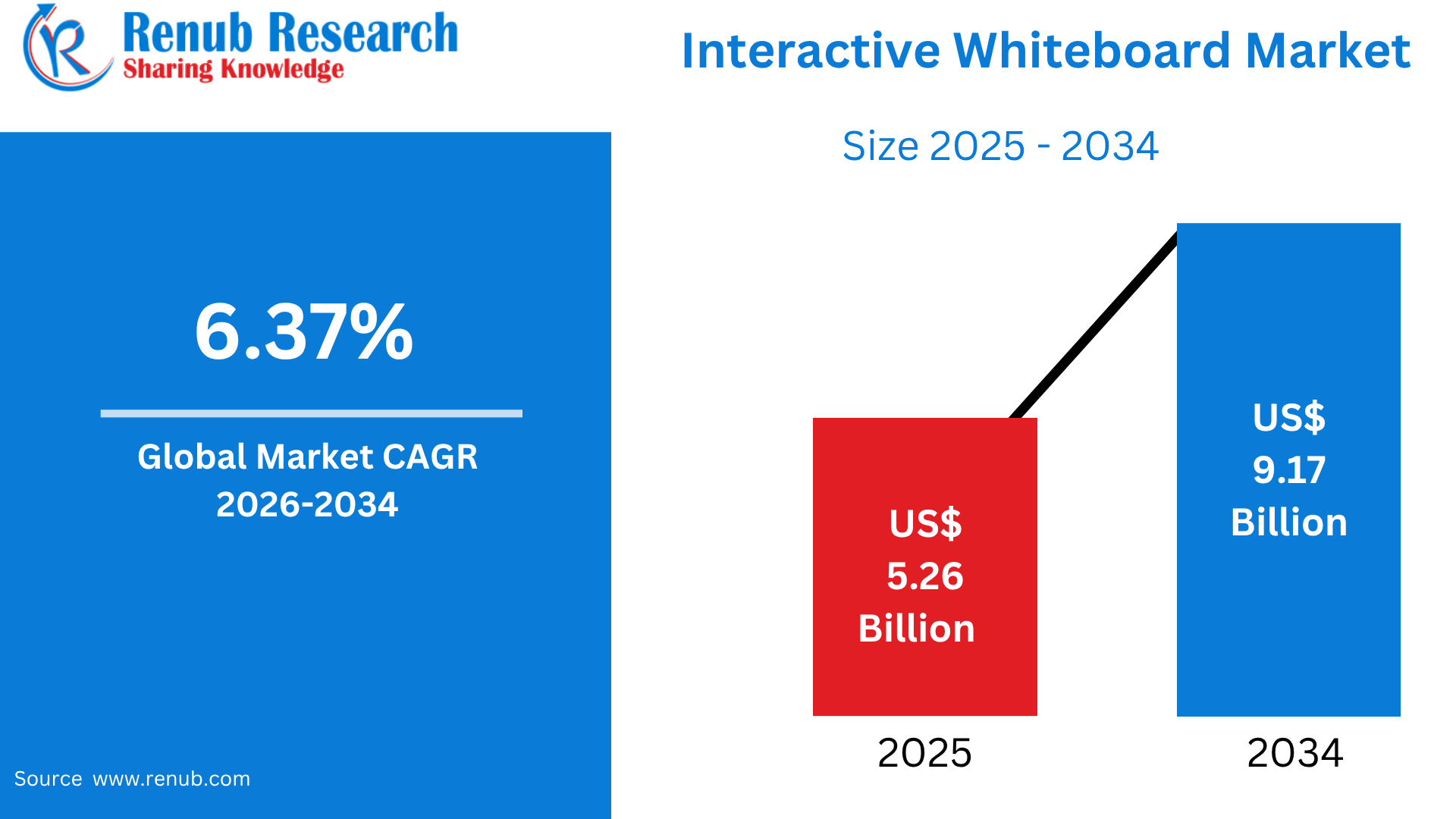
Interactive Whiteboard Market is projected to increase from US$ 5.26 billion in 2025 to US$ 9.17 billion by 2034, registering a CAGR of 6.37% during 2026–2034. Market growth is being driven by the increasing adoption of digital education solutions, the expansion of smart classrooms, and growing demand for interactive collaboration tools across corporate environments. The integration of advanced touch-screen technologies, cloud-based platforms, artificial intelligence, and wireless connectivity is further enhancing the functionality of interactive whiteboards.
What is an Interactive Whiteboard and Its Uses & Popularity Worldwide
An interactive whiteboard (IWB) is a large digital display that allows users to write, draw, present content, access applications, and interact with digital information using touch or specialized pens. It combines the functionality of a traditional whiteboard with computers, multimedia systems, and internet connectivity. Interactive whiteboards are widely used in schools, universities, corporate offices, training centers, government institutions, and healthcare organizations. In education, they support digital lessons, interactive presentations, multimedia demonstrations, quizzes, and collaborative learning, helping teachers engage students more effectively.
In corporate environments, IWBs are used for presentations, brainstorming, employee training, project planning, video conferences, and collaborative meetings. Advanced models offer wireless connectivity, cloud integration, screen sharing, multi-touch functionality, and compatibility with remote-learning platforms. Their popularity is increasing worldwide as institutions invest in digital transformation and smart learning environments. The expansion of smart classrooms, hybrid work, remote education, and collaborative technologies is further increasing adoption. Falling display costs and improvements in touch-screen, connectivity, and software technologies are also making interactive whiteboards more accessible across developed and emerging markets.
Growth Drivers of the Interactive Whiteboard Market
Digital Transformation and Smart Classroom Adoption
The rapid digitalization of education is a major growth driver for the interactive whiteboard market. Schools, universities, and training institutions are increasingly replacing traditional teaching tools with connected displays that support multimedia lessons, real-time annotation, collaborative activities, and digital content sharing. Government-backed digital education programs are also creating institutional demand for interactive classroom technologies. Interactive projectors, an adjacent technology reflecting increasing investment in interactive learning infrastructure. Interactive whiteboards are particularly valuable because teachers can combine videos, presentations, diagrams, online resources, and interactive exercises on one screen. As education systems prioritize technology-enabled and student-centered learning, schools are increasingly allocating budgets toward smart classrooms, supporting long-term market expansion.
Rising Demand for Corporate Collaboration and Hybrid Work
Increasing adoption of hybrid work, virtual meetings, and geographically distributed teams is creating new opportunities for interactive whiteboards in corporate environments. Businesses use interactive displays for brainstorming, presentations, project planning, employee training, video conferencing, and real-time content sharing. Corporate offices are identified as the leading application environment because collaboration displays enable presentation sharing, annotation, and engagement between on-site and remote participants. Conference-room modernization is another important factor: demand for conference-room solutions in the United States, India, and China highlights strong investment in collaborative workplace technologies. Interactive whiteboards allow employees to work on shared documents and visual concepts while maintaining connectivity with remote colleagues. As companies modernize meeting rooms and training facilities, demand for sophisticated interactive displays is expected to increase.
Advancements in Touch, Connectivity, and Display Technology
Technological innovation is significantly improving the functionality and attractiveness of interactive whiteboards. Modern systems increasingly incorporate 4K/UHD displays, multi-touch functionality, wireless screen sharing, cloud connectivity, integrated cameras, microphones, speakers, and AI-enabled collaboration features. In the collaboration display market, 4K/UHD displays are projected to represent more revenue in 2025, demonstrating strong demand for high-resolution interactive screens. Displays larger than 65 inches are also expected to account for a share, reflecting the importance of visibility and group interaction in classrooms and meeting spaces. Cloud-based collaboration enables users to save, share, and access presentations and notes across multiple locations, while wireless connectivity reduces dependence on cables and improves ease of installation. AI-based functions such as content recognition, automated transcription, translation, and intelligent meeting assistance can further enhance productivity. These improvements are expanding interactive whiteboards beyond basic teaching tools into comprehensive collaboration platforms, encouraging organizations to upgrade older systems and supporting continued market growth.
Challenges of the Interactive Whiteboard Market
High Initial Investment and Installation Costs
The relatively high upfront cost of interactive whiteboards remains a major barrier, particularly for schools, small businesses, and institutions operating under limited technology budgets. A complete deployment can involve the display itself, mounting equipment, computers or other connected devices, networking infrastructure, software subscriptions, installation, and staff training. Advanced models featuring large 4K panels, integrated cameras, microphones, and sophisticated collaboration software can significantly increase the total investment. Similar cost pressures are visible in the broader collaboration display market, where organizations must evaluate hardware expenditure alongside installation and long-term maintenance requirements. Cost is particularly important in developing economies, where large numbers of classrooms may require simultaneous technology upgrades. Institutions may therefore prioritize lower-cost projectors, conventional displays, or basic digital teaching equipment instead of premium interactive whiteboards. Although declining display prices and improved technology are gradually improving affordability, the initial capital requirement can still slow adoption. Vendors increasingly address this challenge through flexible financing, leasing, bundled software, and lower-cost interactive display models.
Technical Limitations, Maintenance, and Training Requirements
Interactive whiteboards require reliable electricity, connectivity, software compatibility, technical support, and trained users to deliver their full value. Poor internet connectivity, outdated hardware, software compatibility problems, calibration issues, or insufficient technical support can reduce system effectiveness. Educational institutions may also face challenges training teachers to integrate interactive displays effectively into lesson plans. Simply installing the technology does not guarantee improved learning outcomes unless educators understand how to use interactive tools effectively. In corporate environments, compatibility with existing video-conferencing platforms, enterprise networks, authentication systems, and cybersecurity requirements can similarly complicate deployment. The collaboration display market highlights the importance of interoperability with conferencing platforms and corporate IT infrastructure when organizations evaluate these systems. Maintenance and periodic software updates can also increase the total cost of ownership. Consequently, manufacturers need to provide user-friendly interfaces, comprehensive training, remote technical support, strong software compatibility, and reliable after-sales services to encourage sustained adoption of interactive whiteboards.
Interactive Whiteboard Product Launches Worldwide
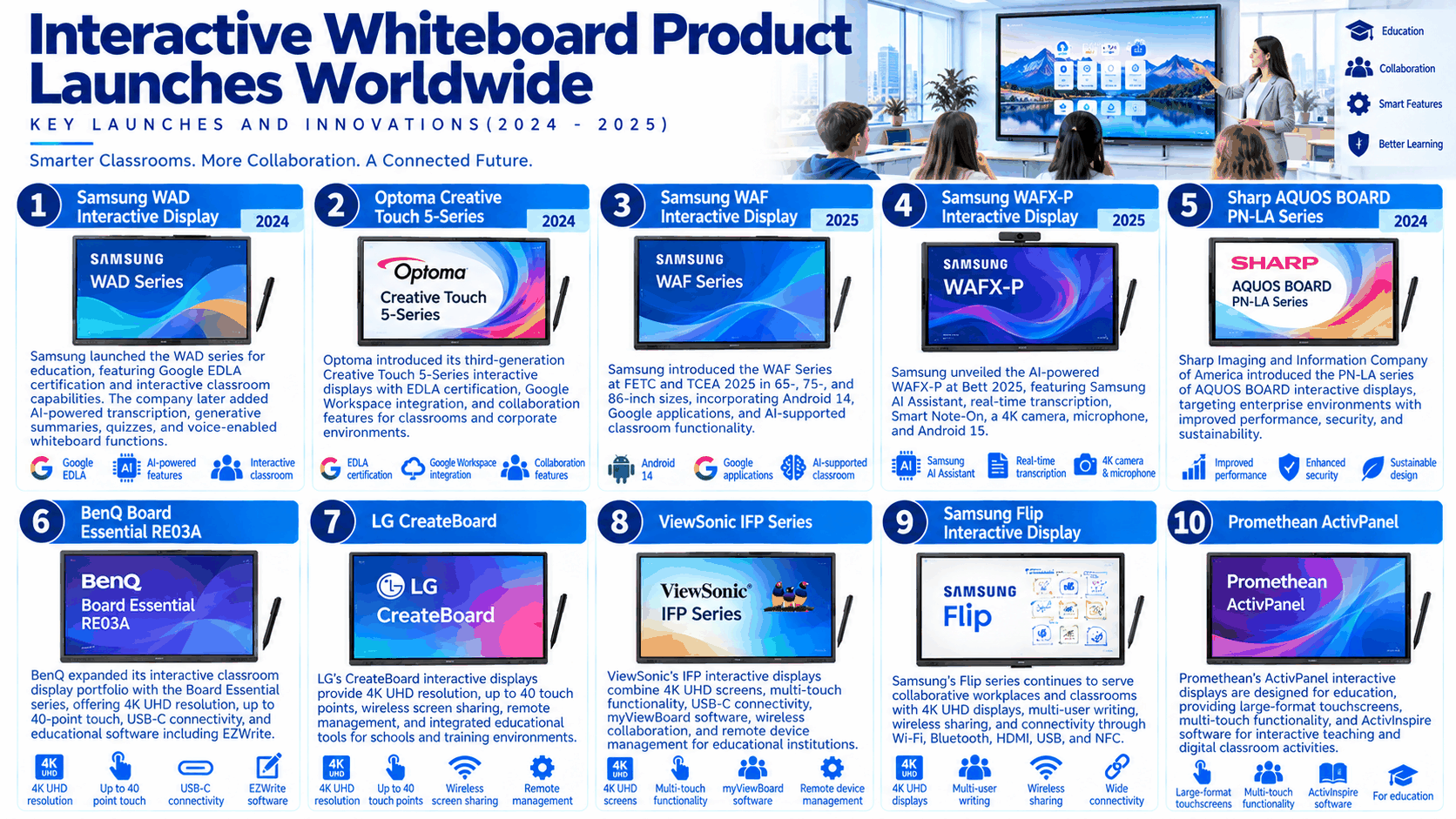
- Samsung WAD Interactive Display – 2024: Samsung launched the WAD series for education, featuring Google EDLA certification and interactive classroom capabilities. The company later added AI-powered transcription, generative summaries, quizzes, and voice-enabled whiteboard functions.
- Optoma Creative Touch 5-Series – 2024: Optoma introduced its third-generation Creative Touch 5-Series interactive displays with EDLA certification, Google Workspace integration, and collaboration features for classrooms and corporate environments.
- Samsung WAF Interactive Display – 2025: Samsung introduced the WAF Series at FETC and TCEA 2025 in 65-, 75-, and 86-inch sizes, incorporating Android 14, Google applications, and AI-supported classroom functionality.
- Samsung WAFX-P Interactive Display – 2025: Samsung unveiled the AI-powered WAFX-P at Bett 2025, featuring Samsung AI Assistant, real-time transcription, Smart Note-On, a 4K camera, microphone, and Android 15.
- Sharp AQUOS BOARD PN-LA Series – 2024: Sharp Imaging and Information Company of America introduced the PN-LA series of AQUOS BOARD interactive displays, targeting enterprise environments with improved performance, security, and sustainability.
- BenQ Board Essential RE03A: BenQ expanded its interactive classroom display portfolio with the Board Essential series, offering 4K UHD resolution, up to 40-point touch, USB-C connectivity, and educational software including EZWrite.
- LG CreateBoard: LG’s CreateBoard interactive displays provide 4K UHD resolution, up to 40 touch points, wireless screen sharing, remote management, and integrated educational tools for schools and training environments.
- ViewSonic IFP Series: ViewSonic’s IFP interactive displays combine 4K UHD screens, multi-touch functionality, USB-C connectivity, myViewBoard software, wireless collaboration, and remote device management for educational institutions.
- Samsung Flip Interactive Display: Samsung’s Flip series continues to serve collaborative workplaces and classrooms with 4K UHD displays, multi-user writing, wireless sharing, and connectivity through Wi-Fi, Bluetooth, HDMI, USB, and NFC.
- Promethean ActivPanel: Promethean’s ActivPanel interactive displays are designed for education, providing large-format touchscreens, multi-touch functionality, and ActivInspire software for interactive teaching and digital classroom activities.
Permanent Installation and Reliable Collaboration
Fixed Interactive Whiteboard Market comprises interactive display systems permanently installed in classrooms, conference rooms, training centers, and other dedicated spaces. These systems are generally wall-mounted or integrated into fixed room infrastructure, providing consistent access to digital presentation and collaboration capabilities. Fixed interactive whiteboards support touch interaction, digital annotation, multimedia presentations, screen sharing, and collaborative content creation. In educational institutions, they are increasingly used as core components of smart classrooms, enabling teachers to combine digital textbooks, videos, diagrams, online resources, and interactive exercises. In corporate environments, fixed systems are commonly installed in meeting and training rooms for presentations, brainstorming, employee development, and hybrid meetings. Their integration with audio systems, computers, networking equipment, and video-conferencing platforms can improve room functionality and reliability. The global shift toward digital education and hybrid workplaces continues to encourage organizations to invest in permanently installed interactive technologies.
Multi-Touch Interaction and Cost-Effective Technology
Infrared Interactive Whiteboard Market includes interactive systems that use infrared sensors to detect touch and writing activity. Infrared technology works through a network of infrared beams positioned across the display surface. When a finger, stylus, or another input object interrupts these beams, sensors identify the location and translate the interaction into digital commands. This enables users to write, draw, select objects, move content, and interact with multimedia applications. Infrared systems can support multiple touch points, making them suitable for collaborative activities involving teachers and students or several employees. They are widely used in schools, universities, corporate offices, training centers, and conference rooms. Their flexibility, durability, and ability to accommodate different input methods contribute to their popularity. Infrared technology can also offer a comparatively economical alternative to certain advanced interactive technologies. Growing investment in smart classrooms and collaborative workplace solutions is supporting demand. Increasing integration with computers, wireless connectivity, cloud platforms, and digital teaching applications is further expanding the usefulness of infrared interactive whiteboards in education and business environments.
High Precision for Writing and Technical Applications
Electromagnetic Interactive Whiteboard Market consists of systems that use an electromagnetic sensing grid to detect input from a compatible electronic pen or stylus. The technology provides precise tracking of writing, drawing, and annotation movements, making it suitable for applications where accuracy is important. Unlike touch-based systems, electromagnetic boards generally rely on specialized pens, which can help minimize unintended inputs. Educational institutions use these systems for detailed diagrams, mathematical equations, technical illustrations, and classroom demonstrations. They are also applicable in engineering training, professional education, corporate presentations, and specialized design environments. Another important advantage is the ability to digitally capture handwritten notes, save them, and distribute them through connected devices or cloud-based platforms. As organizations increasingly adopt digital collaboration tools, the ability to convert physical writing into shareable digital information is becoming more valuable. Improvements in stylus sensitivity, software integration, connectivity, and digital annotation are further enhancing the functionality of electromagnetic systems. Demand is expected to remain supported by institutions seeking accurate and interactive solutions for teaching, training, documentation, and collaborative content creation.
Balanced Display Size for Classrooms and Meeting Rooms
50-inch to 70-inch Interactive Whiteboard Market represents a practical display-size category for classrooms, corporate offices, training rooms, and medium-sized meeting spaces. Products within this range provide sufficient screen area for presentations, diagrams, videos, digital notes, and collaborative activities without requiring the wall space or installation requirements of very large displays. The segment is particularly suitable for environments where several users need to view and interact with content simultaneously. Modern models in this size range commonly incorporate high-definition or 4K resolution, multi-touch functionality, wireless screen sharing, USB connectivity, and compatibility with laptops, tablets, and smartphones. Educational institutions can use these displays to deliver interactive lessons, while businesses can employ them for meetings, brainstorming sessions, training, and presentations. The increasing adoption of hybrid work and digital learning is creating additional demand for connected displays. Furthermore, improvements in display quality and declining technology costs are making medium-sized interactive whiteboards more accessible to schools and businesses. Their combination of visibility, functionality, installation flexibility, and affordability supports continued demand worldwide.
Smart Classrooms and Technology-Enabled Learning
Education Interactive Whiteboard Market is one of the most important application segments within the global interactive display industry. Schools, colleges, universities, and training institutions are increasingly incorporating interactive whiteboards into classrooms to support technology-enabled teaching and student participation. Teachers can use these systems to display videos, animations, presentations, diagrams, digital textbooks, online resources, and interactive exercises on a single platform. Students can participate directly by answering questions, solving problems, annotating content, and contributing to collaborative activities. Interactive whiteboards also allow teachers to save and share lesson materials digitally, enabling students to review classroom content after lessons. Government investments in digital education, smart classrooms, and technology infrastructure are strengthening adoption across developed and emerging economies. As educational institutions modernize classroom infrastructure and prioritize interactive, student-centered learning, demand for interactive whiteboards is expected to continue increasing.
United States High Technology Adoption and Hybrid Workplace Demand
United States Interactive Whiteboard Market is well established, supported by strong technology adoption across education, corporate, and government environments. Schools, universities, training centers, and businesses increasingly use interactive displays to deliver multimedia presentations, facilitate digital annotation, and encourage real-time collaboration. The expansion of hybrid and remote work has further increased demand for connected presentation technologies that enable employees in different locations to participate in meetings and training sessions. Continuous improvements in touchscreen responsiveness, wireless connectivity, cloud integration, and video-conferencing capabilities are strengthening product functionality. The U.S. also benefits from substantial investment in educational technology and corporate digital infrastructure. In January 2024, Sharp Imaging and Information Company of America (SIICA) introduced its AQUOS BOARD® PN-LA series, targeting enterprise customers with enhanced performance, security, and sustainability features. The combination of mature digital infrastructure, high purchasing power, and increasing demand for collaborative workplace technologies positions the United States as a leading market for interactive whiteboards.
United Kingdom Digital Education and Flexible Working Supporting Adoption
United Kingdom Interactive Whiteboard Market is expanding steadily as educational institutions and businesses increasingly adopt digital collaboration technologies. Schools and universities use interactive displays to deliver multimedia-based lessons, digital presentations, and collaborative learning activities, helping educators create more engaging classroom environments. The corporate sector is also contributing to demand as organizations increasingly adopt hybrid and flexible working models that require advanced meeting and collaboration technologies. Interactive whiteboards can connect on-site and remote participants through screen sharing, video conferencing, cloud applications, and real-time annotation. Government efforts to modernize education infrastructure and increase the use of digital learning technologies are further supporting market development. Product innovation is also improving adoption. In January 2025, Samsung Electronics introduced its AI-enabled WAFX Interactive Display at Bett 2025, incorporating AI capabilities designed to enhance educational experiences. Growing investment in smart classrooms, workplace modernization, and AI-enabled learning technologies is expected to strengthen demand for interactive whiteboards across the United Kingdom.
India Smart Classroom Expansion and Digital Transformation
India Interactive Whiteboard Market is witnessing strong growth as the country accelerates digital education, smart classroom development, and technology-enabled learning. Schools, universities, coaching centers, and private educational institutions are increasingly adopting interactive displays to combine multimedia content, digital textbooks, presentations, videos, and interactive teaching tools. Government initiatives supporting digital education and improved internet connectivity are helping create a favorable environment for adoption. The expansion of private schools, universities, training centers, and corporate learning programs is further increasing demand. Businesses are also using interactive displays for presentations, employee training, brainstorming, and collaborative meetings. Falling technology costs and improving connectivity are making advanced display solutions increasingly accessible. In March 2026, iSLate introduced an Android 16 Interactive Flat Panel/Digital Board, positioning the product around smart classroom requirements, AI readiness, and collaborative learning. As India’s education sector increasingly moves toward digital and hybrid learning models, demand for interactive displays is expected to rise. Growing corporate digitalization and continued investment in education technology further strengthen India’s position as a high-potential market.
Saudi Arabia Vision-Led Education Modernization and Smart Infrastructure
Saudi Arabia Interactive Whiteboard Market is developing as the country invests in modern education infrastructure, digital transformation, and technology-enabled learning environments. Schools, universities, vocational institutions, and training centers are increasingly incorporating interactive displays to support multimedia lessons, digital presentations, collaborative activities, and technology-focused teaching. Interactive whiteboards allow educators to combine videos, digital content, online resources, and real-time annotation, creating more engaging learning environments. Government-led education modernization and broader digital transformation initiatives are supporting the development of smart schools and technology-enabled educational facilities. The corporate sector also represents an emerging opportunity, particularly as companies modernize meeting rooms, training centers, and collaboration spaces. Demand is expected to increase alongside investment in higher education, vocational training, and smart infrastructure. The country’s focus on technological advancement under Vision 2030 provides a supportive environment for digital learning technologies. As schools, universities, businesses, and training organizations continue upgrading their technological infrastructure, interactive whiteboards are expected to gain wider adoption across Saudi Arabia.
Interactive Whiteboard Market Segments
Type
- Fixed Projection
- Portable Projection
Technology
- Infrared
- Resistive
- Capacitive
- Electromagnetic
- Others
Screen Size
- Greater than 90 inches
- 71 inches to 90 inches
- 50 inches to 70 inches
- Less than 50 inches
Application
- Education
- Corporate
- Commercial
- Others
Country
North America
- United States
- Canada
Europe
- France
- Germany
- Italy
- Spain
- United Kingdom
- Belgium
- Netherlands
- Turkey
Asia Pacific
- China
- Japan
- India
- Australia
- South Korea
- Thailand
- Malaysia
- Indonesia
- New Zealand
Latin America
- Brazil
- Mexico
- Argentina
Middle East & Africa
- South Africa
- Saudi Arabia
- United Arab Emirates
All the Key players have been covered from 5 Viewpoints:
- Overview
- Key Persons
- Recent Development & Strategies
- Product Portfolio
- Financial Insights
Company Analysis
- Hitachi Ltd
- Panasonic Corporation
- LG Display
- Samsung Electronics
- Cisco Systems
- Alphabet
- Microsoft Corporation
Report Details:
| Report Features | Details |
| Base Year |
2025 |
| Historical Period |
2022 - 2026 |
| Forecast Period |
2026 - 2034 |
| Market |
US$ Billion |
| Segment Covered |
Type, Technology, Screen Size, Application and Countries |
| Countries Covered |
|
| Companies Covered |
|
| Customization Scope |
20% Free Customization |
| Post-Sale Analyst Support |
1 Year (52 Weeks) |
| Delivery Format |
PDF and Excel through Email (We can also provide the editable version of the report in PPT/Word format on request) |
Customization Services available
- Analysis of Market Size and Its Segments
- More Company Profiles (Upto 10 without any additional cost):
- Additional Countries (Other than mentioned Countries):
- Region/Country Specific Reports:
- Market Entry Strategy:
- Region-Specific Market Dynamics:
- Regional Market Share Analysis:
- Trade Analysis:
- Production Insights:
- Others Customized Requests:
For more information contact our analysts.
Need More Assistance?
- Talk to our analysts to get more precious information on the current market trends.
- Include more countries and segments and customize the report based on the final requirement.
- Get a competitive advantage in your industry by knowing the report findings and making a positive impact on your revenues and operations.
- Our analysts are always ready to provide more help and pertinent information if you need any additional assistance.