GCC Augmented Reality Market Report by Component, Device Types, Application, Countries and Companies Analysis 2026-2034
Buy NowGCC Augmented Reality Market Size and Forecast 2026-2034
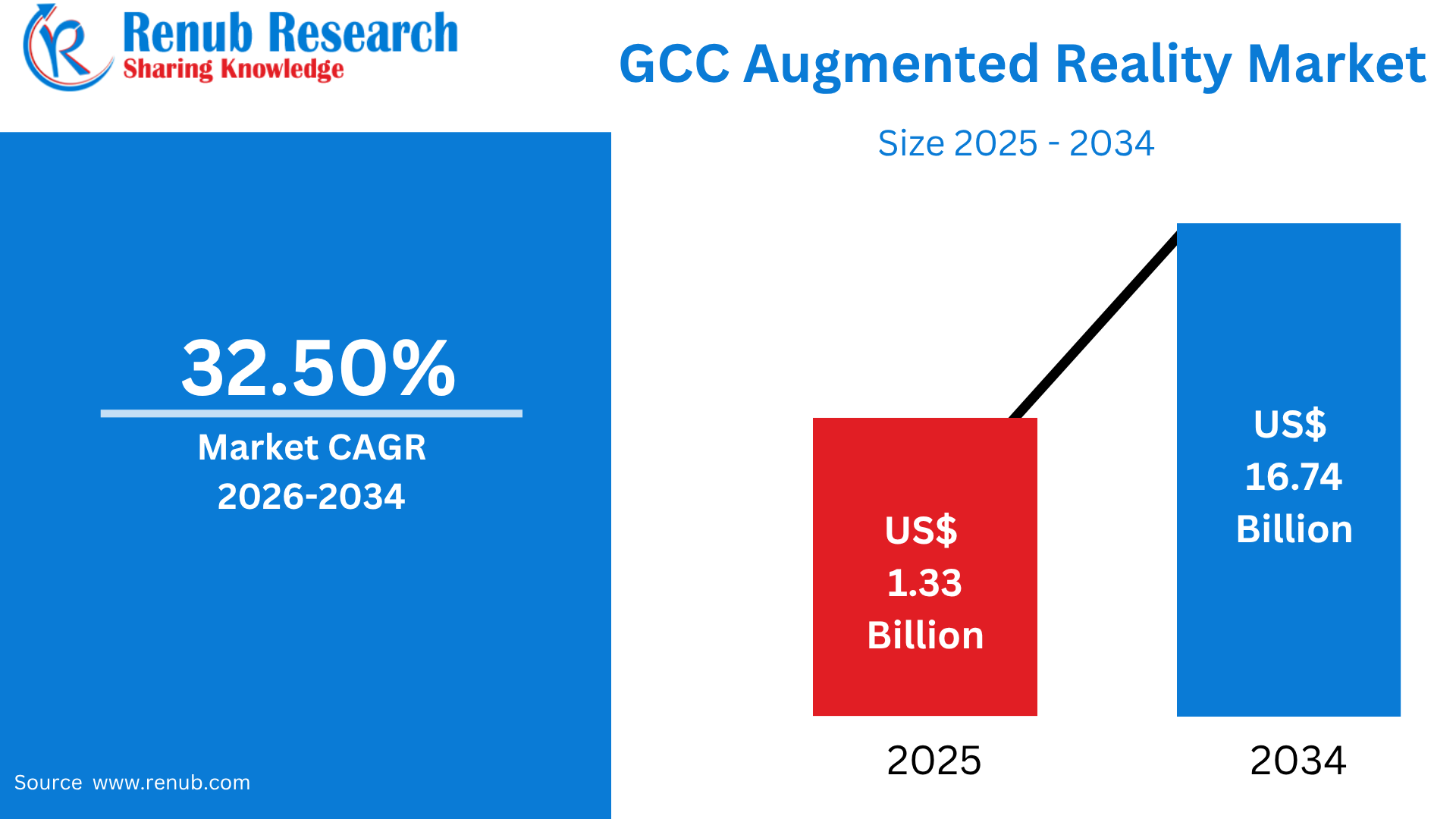
GCC Augmented Reality Market is expected to reach US$ 16.74 Billion by 2034 from US$ 1.33 Billion in 2025, with a CAGR of 32.5% from 2026 to 2034. Growing digital transformation programs, rapid 5G expansion, and rising enterprise investment in immersive training solutions are accelerating augmented reality adoption across the GCC. Government-backed smart city initiatives and expanding industrial automation further reinforce market momentum.
GCC Augmented Reality Industry Overview
Augmented reality (AR) is a technology that blends digital elements with the real world, allowing users to view computer-generated information layered over physical environments. These overlays can include graphics, text, 3D models, or interactive simulations. AR is accessed through smartphones, head-mounted displays, vehicle windshields, or specialized glasses. It enhances real-time decision-making, improves visualization, and provides immersive learning experiences. From workforce training and industrial maintenance to healthcare, retail, education, and entertainment, AR transforms processes by offering context-aware data directly in the user’s field of vision. Its ability to merge physical and digital worlds makes it a core component of modern spatial computing.
The GCC AR market is advancing rapidly due to the region’s strong focus on innovation, digital-first government strategies, and continual investment in smart infrastructure. Organizations in energy, aviation, logistics, and healthcare are adopting AR to improve safety, operational efficiency, and workforce capabilities. High 5G penetration, combined with government-led smart city initiatives in Saudi Arabia, the UAE, and Qatar, supports widespread implementation of immersive technologies. AR’s ability to enhance training, field maintenance, customer engagement, and virtual collaboration positions it as a strategic tool across public and private sectors, driving consistent market expansion throughout the GCC.
Recent Developments in GCC Augmented Reality Market
- In February 2024, global tech brand OPPO unveiled its next-generation assisted reality glasses, the OPPO Air Glass 3, at Mobile World Congress in Dubai, UAE. This lightweight AR wearable connects with smartphones and integrates generative AI features through OPPO’s AndesGPT model, providing voice and visual command interaction for tasks like navigation, translation, and hands-free information access. Designed for everyday use with a minimal form factor, the Air Glass 3 aims to make assisted reality experiences more seamless and practical for regional consumers and enterprises.
- In March 2025, Snap Inc. launched HAZAR FAZAR—a culturally tailored augmented reality experience for Ramadan across the GCC, especially in the UAE. The interactive AR activation blends regional traditions with immersive digital storytelling, enabling users to unlock a narrative-driven AR journey triggered by Snapchat camera interactions. This experience showcases how AR can fuse entertainment with cultural resonance, attracting significant local engagement from Snapchatters across the region.
Growth Drivers for the GCC Augmented Reality Market
Immersive AR Navigation & Spatial Experiences
One of the most significant drivers of augmented reality growth in the GCC is the rise of advanced AR navigation and spatial experiences tailored for events, retail, and infrastructure. Platforms that fuse AR with AI and real-world interaction are expanding how people explore physical spaces. A notable example is the partnership between ARway.ai and AVR Labs in the United Arab Emirates in April 2024, which introduced ARway’s generative AI-enhanced navigation with 3D avatars, enabling dynamic, conversational AR wayfinding at major events such as the World Future Energy Summit. This launch highlights how AR can enhance wayfinding, improve user engagement, and offer interactive guides in complex environments. As public events, smart venues, and large-scale exhibitions proliferate across the GCC, AR navigation tools help organizers deliver richer experiences while supporting digital transformation goals.
Cultural & Retail Engagement Through AR Experiences
Another core growth driver is how augmented reality is reshaping consumer engagement in culture, retail, and seasonal campaigns across the Gulf region. Immersive AR overlays are enabling brands and platforms to connect with users in culturally relevant, interactive ways. A prime recent example is Snap Inc.’s AR Ramadan Mall expansion in Saudi Arabia in Feb 2026, where interactive AR environments reimagined traditional markets for mobile users. Through this initiative, users explore virtual stalls, interact with products, and engage with branded content alongside culturally meaningful narratives. The success of the Ramadan Mall underscores AR’s ability to merge heritage with digital innovation, creating memorable experiences that resonate with local audiences. As retailers and entertainment providers seek deeper customer engagement, culturally tailored AR environments are becoming strategic tools to drive brand loyalty and digital adoption.
Enterprise AR Adoption & Next-Gen Workforce Tools
Enterprise adoption of AR is rapidly growing in the GCC as industries seek to modernize training, field service, and operational processes. Augmented reality tools enable hands-free access to digital instructions, remote expert collaboration, and real-time contextual insights, particularly valuable for sectors such as logistics, energy, and aviation. Regional AR solution deployments demonstrate this trend: in May 2024 ARway.ai signed multiple deals in Saudi Arabia and Oman to deploy its no-code AR navigation solutions with partners like Ershad Technologies and IOTrackers, integrating the technology into commercial and public spaces. These initiatives illustrate how scalable AR platforms are being used beyond entertainment, supporting digital transformation in enterprise setups. As businesses look to improve safety, reduce errors, and enhance workforce productivity, AR is becoming an essential component of industrial digitalization in the GCC.
Challenges in the GCC Augmented Reality Market
Limited Local AR Talent & High Skill Requirements
One of the key challenges facing the GCC AR market is the shortage of highly skilled developers, designers, and engineers specializing in spatial computing, computer vision, and 3D content creation. While the region is investing heavily in digital transformation, local talent pipelines have not yet grown at the same pace. Companies often rely on foreign expertise, increasing project costs and slowing deployment timelines. Developing custom AR applications requires deep technical knowledge, making it difficult for smaller firms to adopt advanced solutions. Although universities and government programs are expanding digital skills training, closing the talent gap remains a significant barrier.
High Deployment Costs & Integration Difficulties
Implementing AR systems often requires specialized hardware, software licensing, high-performance networks, and compatible enterprise systems. These costs pose challenges, particularly for small and mid-sized businesses. Integrating AR into legacy IT infrastructure—commonly found in manufacturing, logistics, and public services across the GCC—can be complex and time-consuming. Compatibility issues, cybersecurity risks, and the need for continuous software updates also increase operational burdens. While cloud-based AR tools and 5G networks are easing some constraints, overall deployment costs remain a major obstacle to broader adoption. Organizations must balance the benefits of AR against the financial and operational challenges of implementing it at scale.
United Arab Augmented Reality Market
The UAE leads AR adoption in the GCC due to its strong digital economy strategy and major focus on smart government. According to the UAE Ministry of Economy, the digital economy is targeted to contribute over 20% of GDP by 2031, encouraging deployment of immersive technologies across sectors. AR is used in aviation, tourism, healthcare, construction, and retail for training, visualization, and customer engagement. Dubai and Abu Dhabi integrate AR into smart city projects, public services, and digital education platforms. With high 5G penetration and advanced ICT infrastructure, the UAE continues to build one of the region’s most active AR ecosystems.
Bahrain Augmented Reality Market
Bahrain’s AR adoption is supported by its Digital Government Strategy 2022–2026 and strong ICT infrastructure. The Bahrain Telecommunications Regulatory Authority reports internet penetration exceeding 99%, making AR accessible to a large portion of the population. Enterprises in retail, financial services, and logistics are exploring AR for enhanced customer interaction and operational training. Tourism authorities use AR to enrich cultural and historical experiences. With growing digital transformation efforts and supportive government policies, Bahrain continues to build momentum in its AR ecosystem.
Saudi Arabia Augmented Reality Market
Saudi Arabia’s augmented reality market is strengthening as the Kingdom accelerates its broader digital transformation agenda under Vision 2030. According to the Saudi Vision 2030 Report, the nation’s digital economy has grown to nearly SAR 495 billion, accounting for 15% of national GDP, underscoring rapid technological advancement. The country’s ICT sector has also maintained strong momentum, exceeding SAR 180 billion in 2024, supported by rising private-sector investments, expanding innovation programs, and ongoing modernization of public services. These advancements reinforce Saudi Arabia’s position as the region’s largest technology hub and create a strong foundation for AR adoption across energy, construction, retail, tourism, and government applications.
Kuwait Augmented Reality Market
Kuwait’s AR market is growing as the country upgrades its digital infrastructure under "New Kuwait Vision 2035." The Communications and Information Technology Regulatory Authority (CITRA) reports internet penetration above 99%, enabling widespread access to mobile AR experiences. AR is used in retail for virtual try-ons, in education for interactive learning, and in healthcare for simulation-based training. Government digital initiatives and public-sector modernization encourage adoption of immersive technologies. Although smaller in scale, Kuwait’s market is steadily expanding as organizations explore AR-based customer engagement and workforce training tools.
GCC Augmented Reality Hardware Market
The GCC augmented reality hardware market is expanding rapidly as governments and enterprises integrate immersive technologies into digital transformation programs. Demand for devices such as smart glasses, head-mounted displays, AR headsets, and spatial sensors is rising across oil & gas, aviation, logistics, healthcare, retail, and education. Companies are adopting AR hardware to enhance training, streamline maintenance, support remote operations, and improve field accuracy. The rollout of nationwide 5G networks, coupled with strong investments in smart cities and automation, is improving device performance and enabling low-latency AR interactions. With large-scale projects in the UAE and Saudi Arabia driving adoption, AR hardware is becoming an essential infrastructure component for next-generation enterprise productivity across the GCC.
GCC Head-Mounted Displays Market
Head-mounted displays are gaining momentum in the GCC as organizations prioritize hands-free access to information, advanced training, and remote support. AR wearables enable technicians to visualize instructions, schematics, and real-time assistance without interrupting workflow, improving safety and operational accuracy. Industries such as aviation, energy, manufacturing, and healthcare deploy HMDs for mission-critical tasks. The rapid expansion of 5G networks and enterprise digitalization programs enhances device performance and adoption. Consumer applications—gaming, education, and virtual tourism—also contribute to growth. As immersive technologies evolve, HMDs are becoming essential interfaces for spatial computing across the GCC.
GCC Automotive Market
Augmented reality is becoming integral to the GCC automotive sector as drivers demand more advanced cockpit technologies. AR head-up displays project lane guidance, navigation cues, and hazard alerts directly on the windshield to enhance driving safety. Automotive service centers use AR for diagnostics, training, and guided maintenance. Rising adoption of electric vehicles and connected mobility solutions accelerates the integration of AR into infotainment systems. Government investments in intelligent transportation and smart mobility further support AR adoption across the region. As premium vehicles dominate the GCC market, AR-enhanced automotive systems continue to expand quickly.
GCC Augmented Reality Market Segments:
Component
- Hardware
- Software
Device Type
- Head-mounted Displays
- Head-up Displays
- Others
Application
- Automotive
- Healthcare
- Education
- E-commerce & Retail
- Entertainment & Gaming
- Industrial & Manufacturing
- Aerospace & Defense
- Others
Countries
- Saudi Arabia
- UAE
- Kuwait
- Qatar
- Oman
- Bahrain
- Rest of GCC
All companies have been covered with 5 Viewpoints
- Overviews
- Key Person
- Recent Developments
- SWOT Analysis
- Revenue Analysis
Key Players Analysis
- Seiko Epson Corporation
- Sony Corporation
- Lenovo Group Limited
- Samsung Electronics Co.
- Alphabet Inc.
- Apple Inc
- Microsoft Corporation
- Sysmex
Report Details:
| Report Features | Details |
| Base Year |
2025 |
| Historical Period |
2022 - 2025 |
| Forecast Period |
2026 - 2034 |
| Market |
US$ Billion |
| Segment Covered |
Component, Device Type, Application and Countries |
| Countries Covered |
|
| Companies Covered |
|
| Customization Scope |
20% Free Customization |
| Post-Sale Analyst Support |
1 Year (52 Weeks) |
| Delivery Format |
PDF and Excel through Email (We can also provide the editable version of the report in PPT/Word format on request) |
Customization Services available
- Analysis of Market Size and Its Segments
- More Company Profiles (Upto 10 without any additional cost):
- Additional Countries (Other than mentioned Countries):
- Region/Country Specific Reports:
- Market Entry Strategy:
- Region-Specific Market Dynamics:
- Regional Market Share Analysis:
- Trade Analysis:
- Production Insights:
- Others Customized Requests:
For more information contact our analysts.
Need More Assistance?
- Talk to our analysts to get more precious information on the current market trends.
- Include more countries and segments and customize the report based on the final requirement.
- Get a competitive advantage in your industry by knowing the report findings and making a positive impact on your revenues and operations.
- Our analysts are always ready to provide more help and pertinent information if you need any additional assistance.