India Solar Inverter Market Report by Invertor Type, Application, States and Companies Analysis 2026-2034
Buy NowIndia Solar Inverter Market Size and Forecast
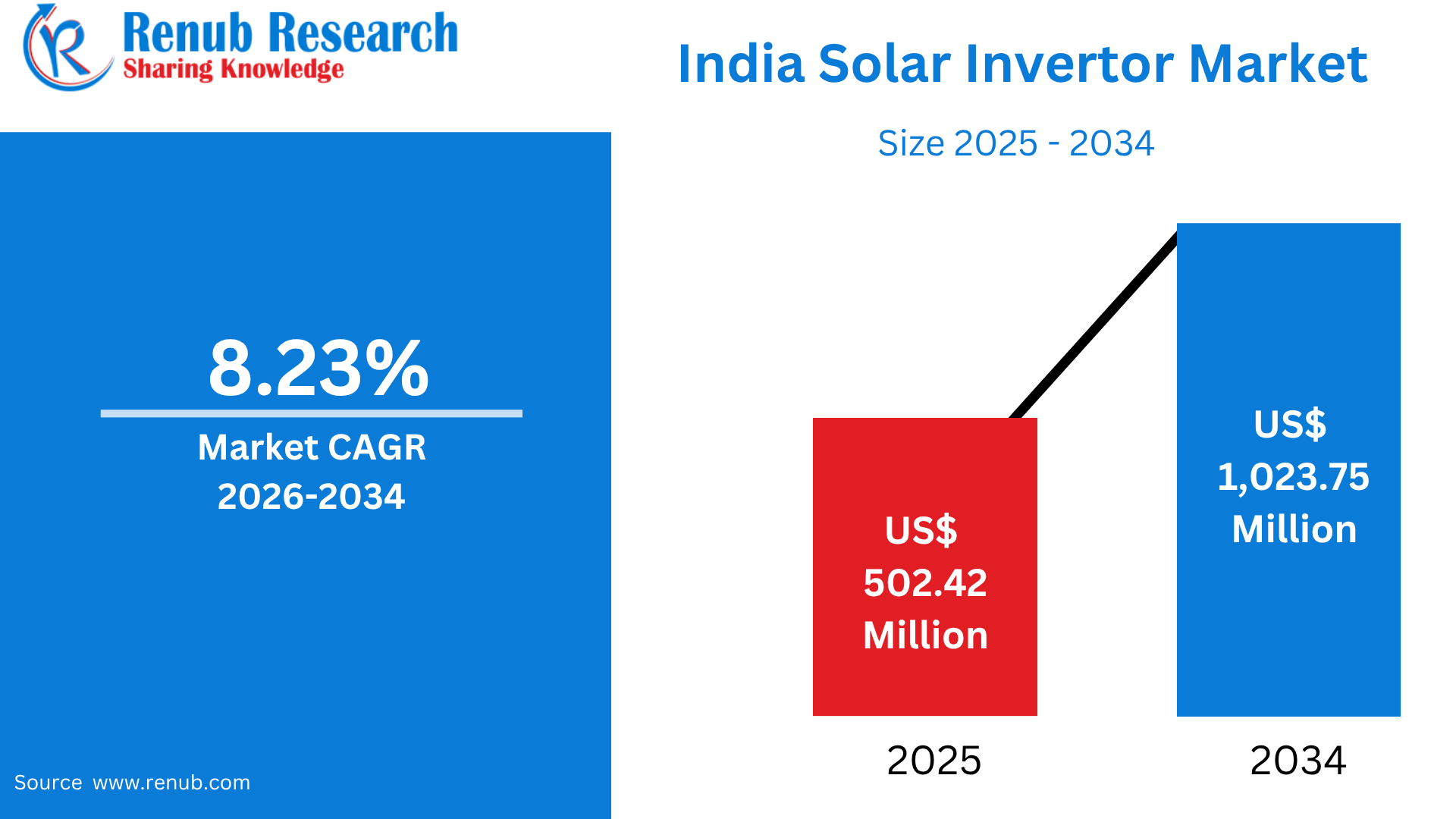
India Solar Inverter Market is projected to grow from US$ 502.42 million in 2025 to US$ 1,023.75 million by 2034, registering an 8.23% CAGR during 2026–2034. Market growth is supported by rising awareness of energy efficiency, declining solar photovoltaic panel costs, and growing adoption of renewable energy solutions across residential, commercial, and agricultural applications. The increasing adoption of advanced inverter technologies, including hybrid and microinverters, is further enhancing system efficiency, reliability, and flexibility.
What is a Solar Inverter and its Uses & Popularity in India
A solar inverter is an essential component of a solar photovoltaic (PV) system that converts the direct current (DC) electricity generated by solar panels into alternating current (AC) electricity used by homes, businesses, industries, and the power grid. Inverters also help monitor system performance, regulate voltage, maximize energy conversion, and provide protection against electrical faults. Depending on the application, India uses string inverters, central inverters, microinverters, and hybrid inverters for rooftop, utility-scale, commercial, agricultural, and off-grid solar installations.
Solar inverters are increasingly important as India expands renewable-energy generation and decentralized power systems. According to the Ministry of New and Renewable Energy (MNRE), India’s cumulative solar capacity reached 168.04 GW by August 31, 2026, including 32.59 GW of grid-connected rooftop solar, 123.99 GW of ground-mounted projects, 4.83 GW of hybrid projects, and 6.63 GW of off-grid solar. The country’s abundant solar resource, rising electricity demand, rooftop-solar adoption, and agricultural solarization are supporting the growing popularity of advanced inverter technologies.
India’s Solar Rise
Over the past decade, solar energy has transformed from a relatively small component of India’s electricity landscape into the largest contributor to the country’s renewable energy capacity. India’s installed solar capacity has expanded from approximately 3 GW in 2014 to 162.15 GW as of June 30, 2026, representing more than a fiftyfold increase. This remarkable expansion has been supported by strong government policies, investments in renewable-energy infrastructure, growth in domestic manufacturing, and increasing participation from households, businesses, farmers, and other consumers. Solar parks, rooftop photovoltaic systems, and solar-powered agricultural pumps have further accelerated deployment across different regions. The government is now seeking to expand this progress through the newly approved Pradhan Mantri Surya Sarovar Yojana (PM-SSY), which focuses on large-scale floating solar generation combined with energy storage.
Pradhan Mantri Surya Sarovar Yojana: Accelerating Floating Solar Deployment
Approved by the Government of India on July 31, 2026, the Pradhan Mantri Surya Sarovar Yojana (PM-SSY) is designed to support 5,000 MW of floating solar photovoltaic (FSPV) projects with co-located Energy Storage Systems (ESS). The scheme requires a minimum storage duration of two hours, equivalent to approximately 10,000 MWh, enabling participating states to better manage peak electricity demand and improve grid reliability. By utilizing reservoirs and industrial ponds, the initiative can reduce dependence on scarce land resources for large solar projects. The scheme carries a total financial outlay of ₹5,070 crore and is scheduled for implementation from FY 2026–27 through FY 2030–31.
Harnessing India’s Floating Solar Potential
The PM-SSY is supported by an assessment from the National Institute of Solar Energy (NISE), which estimates India’s floating solar potential at approximately 102.18 GWp across reservoirs and suitable inland water bodies. The initiative is expected to add 5,000 MW of floating solar capacity, increasing India’s existing floating solar capacity from approximately 700 MW. Beyond electricity generation, the program is projected to help avoid around 10 million tonnes of CO₂ emissions annually while creating approximately 16,000–17,000 full-time equivalent jobs. The scheme is also expected to encourage domestic manufacturing of floating structures, photovoltaic cells and modules, and energy-storage systems. All States and Union Territories will be eligible to participate, supporting wider deployment of floating solar and strengthening India’s renewable-energy infrastructure.
Growth Drivers in the Market
Rapid Expansion of Solar Power Capacity
India’s accelerating solar-power deployment is a major growth driver for the solar inverter market because every grid-connected or standalone PV installation requires suitable power-conversion equipment. MNRE data show that India’s cumulative solar capacity reached 168.04 GW as of August 31, 2026, demonstrating the scale of the country’s expanding solar ecosystem. Ground-mounted projects accounted for 123.99 GW, while grid-connected rooftop solar reached 32.59 GW. Hybrid solar projects contributed another 4.83 GW, with off-grid solar at 6.63 GW. This expanding installation base creates demand for utility-scale central and string inverters as well as smaller systems designed for residential and commercial applications. India’s solar potential also supports long-term deployment: MNRE estimates that about 5,000 trillion kWh of solar energy falls on India’s land area annually, with most regions receiving approximately 4–7 kWh per square meter per day. Continued solar capacity additions are therefore expected to sustain demand for efficient, reliable, and increasingly intelligent inverter systems.
Government Schemes and Rooftop Solar Expansion
Government initiatives are significantly increasing the addressable market for solar inverters across residential, agricultural, and decentralized applications. The PM Surya Ghar: Muft Bijli Yojana, launched in February 2024, targets rooftop solar installations for 1 crore households by FY2026–27, supported by an overall outlay of ₹75,021 crore. By December 22, 2025, approximately 14.43 lakh rooftop solar systems had been installed under the scheme, benefiting more than 18.14 lakh households. Agricultural solarization is another important source of demand. Under PM-KUSUM, the government has targeted 34,800 MW of solar capacity, including 14 lakh standalone solar agricultural pumps and solarization of 35 lakh grid-connected agricultural pumps. These programs require inverters for rooftop PV systems, solar pumps, decentralized plants, and grid-connected installations. As subsidies, financing support, and awareness encourage wider solar adoption, demand for cost-effective and high-efficiency inverter technologies is expected to increase.
Adoption of Hybrid, Smart, and Advanced Inverter Technologies
Technological development is creating additional opportunities for solar inverter manufacturers in India. Modern inverters increasingly incorporate intelligent monitoring, maximum power point tracking, remote diagnostics, energy-management capabilities, battery integration, and grid-support functions. Hybrid inverters are particularly relevant as consumers and businesses seek to combine solar generation with battery storage and backup power. Microinverters are also gaining attention for rooftop applications because they can optimize electricity generation at the individual-panel level, which can be beneficial where rooftops experience shading or have different panel orientations. India’s expanding rooftop market provides a broad application base for these technologies. MNRE reported 32.59 GW of grid-connected rooftop solar capacity by August 31, 2026, alongside substantial ground-mounted and off-grid deployment. Furthermore, the increasing integration of solar with storage and hybrid renewable-energy projects is encouraging manufacturers to develop more sophisticated power-conversion solutions. The shift toward smarter and more flexible energy systems is expected to support product innovation and market expansion.
Challenges in the Market
High Initial Costs and Price Competition
The relatively high upfront cost of solar inverter systems remains a challenge for market expansion, particularly among price-sensitive residential consumers, small businesses, farmers, and smaller solar developers. The overall investment includes not only the inverter but also solar modules, mounting structures, wiring, protection equipment, installation, monitoring systems, and, for hybrid systems, batteries. Strong price competition among manufacturers can also place pressure on margins and encourage purchasing decisions based primarily on initial cost rather than efficiency, reliability, or lifecycle performance. This is particularly relevant in India’s rapidly expanding solar market, where large volumes of installations are being developed under government-supported programs. PM-KUSUM, for example, provides central financial assistance for solar pumps and solarization of agricultural pumps, helping reduce adoption barriers but also making system economics and procurement costs important considerations. The scheme’s current dashboard reports more than 7.11 lakh standalone solar pumps installed as of August 31, 2026. Manufacturers therefore need to balance affordability with efficiency, durability, warranty coverage, and after-sales service.
Grid Integration, Reliability, and Technical Complexity
The increasing penetration of solar generation creates technical challenges related to grid stability, intermittency, power quality, and inverter-grid compatibility. Solar inverters must manage variable electricity generation while maintaining appropriate voltage, frequency, and power quality when connected to distribution networks. As India’s solar capacity expands, these requirements become increasingly important for utilities and system developers. MNRE reported 168.04 GW of cumulative solar capacity by August 31, 2026, highlighting the rapidly growing scale of solar generation that must be integrated into the electricity system. Advanced systems may require sophisticated grid-support functions, communication capabilities, cybersecurity protections, and compliance with evolving technical standards. Reliability is another concern because inverter failures can interrupt solar generation and increase maintenance costs, particularly in large utility-scale projects or remote agricultural installations. Harsh operating conditions, including high temperatures, dust, humidity, and voltage fluctuations in some regions, can further affect equipment performance. Consequently, manufacturers must invest in robust designs, testing, monitoring, and service networks to maintain long-term system reliability.
Solar Inverter Launches in India
- Solis Solarator Series Hybrid Inverters – February 2025: Solis introduced its first hybrid inverter range in India, comprising four model families covering 3 kW to 50 kW applications. The series supports residential, commercial, and off-grid applications and includes battery-management, UPS switching, multiple MPPT, and parallel-operation capabilities.
- Saatvik UDAY Series On-Grid Inverters – 2025: Saatvik Green Energy launched its UDAY Series, marking its entry into on-grid solar inverters. The portfolio includes 1.1–6 kW single-phase models and 6–50 kW three-phase models, with MPPT efficiency above 99% and IP65 protection.
- GoodWe UT350kW – February 2024: GoodWe introduced the UT350kW utility-scale solar inverter in India. The launch coincided with the company’s milestone of 3 GW of solar-product shipments in the Indian market, with the inverter targeted at large utility-scale photovoltaic projects.
- Solplanet ASW350K-HT – October 2024: Solplanet launched its 350 kW three-phase ASW350K-HT inverter for large-scale PV installations in India. It provides maximum efficiency of 99.01%, six independent MPPT inputs, string monitoring, anti-PID functionality, and IP66/C5-M protection.
- Servotech New Solar Inverter Series – October 2024: Servotech launched a broad portfolio covering 1–100 kW on-grid inverters, 2–7.5 kW single-phase hybrid inverters, and 10–22.5 kW three-phase hybrid inverters. The company also introduced 800 W and 1,600 W microinverters, alongside energy-storage systems and solar pump controllers.
- Statcon Energiaa-X Series – May 2024: Statcon Energiaa launched its Energiaa-X single-phase grid-tied inverter range in 3 kW and 5 kW versions. The 3 kW model offers up to 97.5% efficiency, advanced MPPT, Wi-Fi monitoring, anti-islanding protection, and a transformerless design for residential and small commercial applications.
- Enphase IQ8 Microinverters and IQ Battery 5P System – September 2024: Enphase launched its advanced IQ Energy System for Indian customers, combining IQ8 microinverters with the IQ Battery 5P. The battery starts at 5 kWh and can scale to 40 kWh, while IQ8 microinverters provide grid-forming capability and support solar panels up to 670 W DC.
- POM Hybrid Inverters – May 2025: Bengaluru-based POM Systems & Services introduced hybrid solar inverters rated at 3 kW, 5 kW, and 10 kW for residential applications. The systems combine solar and battery-inverter functions and support bidirectional energy flows with lithium-iron-phosphate battery storage.
- Sunora SUN-10HL-G4 – April 2025: Sunora Solar entered India’s solar inverter segment with the SUN-10HL-G4, a 15 kW three-phase grid-tied inverter unveiled at RenewX 2025. It supports up to 1,000 V DC input, an MPPT range of 200–850 V, and an IP66 enclosure for outdoor installations.
- Loom Solar Fusion 103H – September 2025: Loom Solar launched the Fusion 103H, a 10 kW/48 V three-phase hybrid inverter for residential, commercial, and industrial applications. It offers up to 97.6% DC-to-AC efficiency, dual MPPT, 13 kW maximum DC input, Wi-Fi monitoring, and compatibility with lead-acid, lithium-ion, and LiFePO4 batteries.
Growing Demand from Utility-Scale Solar Projects
India central solar inverter market is being supported by the rapid expansion of large-scale solar parks and utility projects, particularly in states such as Rajasthan and Gujarat. Central inverters are designed to convert electricity from large groups of solar panels and are well suited to projects requiring high power output and centralized control. India’s utility-scale solar capacity reached 110.43 GW as of March 31, 2026, highlighting the substantial installed base that requires high-capacity inverter solutions. Central inverters accounted for approximately 51% of solar inverter shipments in 2025, surpassing string inverters, according to industry estimates. Their ability to reduce balance-of-system costs, simplify project architecture, and provide efficient grid integration makes them attractive for large photovoltaic installations. The segment is also benefiting from increasing project standardization, higher DC voltage architectures, advanced cooling technologies, and improved grid-support capabilities. As India continues adding multi-gigawatt solar parks and hybrid renewable-energy projects, demand for high-capacity central inverter systems is expected to remain strong.
Strong Adoption in Rooftop and Commercial Solar Systems
String solar inverters are widely used in India’s residential, commercial, industrial, and medium-sized solar installations because of their modular architecture, relatively straightforward maintenance, and flexible system design. Industry estimates indicate that string inverters accounted for about 49% of India’s solar inverter shipments in 2025. Their popularity is particularly strong in rooftop installations, where individual strings of solar modules can be connected to separate inverter units, allowing easier expansion and maintenance. India’s rooftop solar segment has expanded rapidly, reaching approximately 18.4 GW of cumulative capacity by 2024, representing a 34% CAGR between 2020 and 2024. The growth of commercial and industrial rooftop systems is creating additional demand for three-phase string inverters with higher power ratings. Advanced string inverters increasingly incorporate maximum power point tracking, remote monitoring, rapid shutdown, and grid-support functions. The combination of rooftop expansion, decentralized generation, and modular installation requirements is expected to sustain strong demand for string inverter technology across India.
Rooftop Solar Programs Accelerate Household Adoption
India’s residential solar inverter market is expanding alongside government-supported rooftop solar deployment, declining solar equipment costs, and increasing household interest in reducing electricity expenses. The PM Surya Ghar: Muft Bijli Yojana is a major catalyst, with a target of installing rooftop solar systems in 1 crore households and an overall financial outlay of ₹75,021 crore. By August 2026, the program had reached approximately 5.46 million households, with installed residential rooftop capacity of around 16.18 GW. Residential systems generally use smaller string, hybrid, or microinverters, with 2–5 kW systems particularly suited to typical household electricity requirements. On-grid inverters remain important because they allow households to utilize solar generation while exporting surplus electricity to the grid under applicable net-metering arrangements. Hybrid inverters are also gaining attention as consumers seek battery backup and greater energy independence. Continued subsidies, rising awareness of rooftop solar, and the desire to lower household electricity bills are expected to support residential inverter demand across urban, semi-urban, and rural markets.
Large Solar Parks Drive High-Capacity Inverter Demand
The utility-scale solar inverter market represents a major part of India’s solar power equipment ecosystem, supported by large solar parks, competitive renewable-energy auctions, and increasing investments in grid-connected generation. India’s utility-scale solar capacity stood at approximately 110.43 GW as of March 31, 2026, accounting for the largest portion of the country’s installed solar base at that time. During FY2025, India added an estimated 17.4 GW of utility-scale solar capacity, while cumulative utility-scale capacity reached about 85.6 GW by March 2025. Central inverters are particularly important in these projects because their high-power architecture can simplify large installations and reduce certain balance-of-system requirements. At the same time, high-power string inverters are increasingly being deployed where modularity and distributed MPPT provide operational advantages. Rajasthan, Gujarat, and other high-solar-resource states remain important markets because of their large solar parks and extensive renewable-energy pipelines. Continued capacity additions, hybrid projects, energy-storage integration, and modernization of transmission infrastructure are expected to sustain demand for utility-scale inverter solutions.
Industrialization and Rooftop Solar Expansion Drive Maharashtra Demand
Maharashtra solar inverter market is expanding as industrialization, rising electricity consumption, and rooftop solar deployment increase across the state. Maharashtra has one of India’s largest electricity markets and is an important destination for manufacturing, commercial infrastructure, information technology, and large residential developments. The state had approximately 5.4 GW of installed solar power capacity by 2024, supported by utility-scale projects as well as distributed rooftop installations. Industrial and commercial consumers are increasingly adopting solar photovoltaic systems to reduce dependence on conventional grid electricity and manage long-term energy costs. Solar inverters are essential for these installations because they convert solar-generated DC electricity into usable AC power and provide monitoring and grid-management functions. Residential rooftop adoption is also receiving additional momentum from national initiatives such as the PM Surya Ghar scheme, which targets rooftop solar installations for 1 crore households nationally. Maharashtra’s substantial urban population, industrial base, renewable-energy investments, and growing focus on carbon reduction are expected to create sustained demand for string, hybrid, and central inverter technologies.
Renewable-Energy Leadership Supports Solar Inverter Adoption in Tamil Nadu
Tamil Nadu solar inverter market is benefiting from the state’s established renewable-energy ecosystem, high industrial electricity consumption, and expanding solar installations. Tamil Nadu has consistently ranked among India’s leading states in renewable-energy development, supported by its strong manufacturing base and favorable solar conditions. The state had more than 8 GW of installed solar capacity by 2023, with additional projects continuing across utility-scale and rooftop segments. Tamil Nadu’s Renewable Energy Policy has set an ambitious objective of developing 9,000 MW of additional solar power capacity by 2030, creating opportunities for inverter suppliers across utility, commercial, industrial, and residential applications. Textile manufacturing, automobile production, electronics, IT facilities, and commercial establishments are increasingly deploying rooftop solar to reduce electricity expenditure. Demand is also emerging for hybrid inverters that can integrate solar generation with battery storage and provide backup power. Continued solar-park development, distributed-generation programs, and government support for renewable-energy investments are expected to strengthen the state’s solar inverter market over the forecast period.
Solar Parks and Technology Industries Strengthen Karnataka Market Growth
Karnataka solar inverter market is witnessing significant development due to strong renewable-energy investments, urbanization, industrial expansion, and increasing demand for energy-efficient electricity solutions. Karnataka is one of India’s leading solar markets and had approximately 9.5 GW of installed solar capacity by 2024, supported by utility-scale projects, rooftop systems, and decentralized installations. The state’s large technology and industrial ecosystem provides a substantial customer base for commercial and industrial solar systems. IT companies, manufacturing facilities, educational institutions, residential communities, and commercial buildings are increasingly adopting rooftop photovoltaic systems to reduce electricity costs and improve environmental performance. Karnataka is also home to the 2 GW Pavagada Solar Park, one of India’s major solar developments, demonstrating the state’s strong utility-scale solar infrastructure. Solar inverter demand is expanding across central, string, and hybrid technologies, while battery-integrated systems are gaining attention where backup power and energy management are priorities. Continued renewable-energy investments, smart-grid development, and increasing sustainability commitments are expected to support long-term inverter demand.
Uttar Pradesh Large Population and Distributed Solar Projects Create Opportunities
Uttar Pradesh solar inverter market is expanding as the state’s large population, rising electricity requirements, rural development, and government-backed renewable-energy programs increase solar adoption. Uttar Pradesh had approximately 3.9 GW of installed solar capacity by 2024, with significant potential for further expansion across rooftop, utility-scale, agricultural, and decentralized applications. The state’s large residential base creates substantial opportunities for rooftop solar and associated inverter systems, particularly under the PM Surya Ghar: Muft Bijli Yojana, which aims to promote rooftop solar among households throughout India. Solar-powered irrigation is another important application, with programs such as PM-KUSUM supporting the deployment of solar pumps for agricultural users. Commercial establishments, schools, healthcare facilities, and small businesses are also adopting solar systems to reduce electricity expenditure and improve power availability. Demand is emerging for string and hybrid inverters that can support distributed generation and battery storage. Although grid infrastructure, financing, and technical-service availability remain considerations in rural areas, continued solarization and public investment are expected to strengthen Uttar Pradesh’s inverter market.
Recent Developments in India Solar Invertor Market
- May 2025: Juniper Green Energy and Sungrow have signed an agreement to supply 835 MW of inverters for Juniper Green Energy's solar projects in India. Sungrow will provide inverters for Juniper's solar projects in Rajasthan and Maharashtra as part of this agreement.
- April 2025: Bengaluru-based POM Systems & Services introduced its new POM hybrid inverters, which come in 3 kW, 5 kW, and 10 kW power ratings. These cutting-edge inverters combine the functions of battery inverters and conventional solar inverters into a single device.
- April 2025: A 10 MW solar project in Kutch, Gujarat, has been successfully commissioned by Kosol Energie in partnership with GoodWe, a world leader in solar inverters. GoodWe's 350 kW UT string inverters were a key aspect of the project, which was carried out for the Gujarat State Electricity Corporation Limited (GSECL).
India Solar Inverter Market Segmentation
Inverter Type
- Central Inverters
- String Inverters
- Micro Inverters
Application
- Residential
- Commercial & Industrial (C&I)
- Utility Scale
Top States
- Maharashtra
- Tamil Nadu
- Karnataka
- Gujarat
- Uttar Pradesh
- West Bengal
- Rajasthan
- Telangana
- Andhra Pradesh
- Madhya Pradesh
All companies have been covered with 5 Viewpoints
- Overviews
- Key Person
- Recent Developments
- SWOT Analysis
- Revenue Analysis
Key Players Analysis
- Schneider Electric SE
- Siemens AG
- Mitsubishi Electric Corporation
- ABB Ltd
- SMA
- Delta Electronics, Inc.
- Fronius International GmbH
- SUNGROW
Report Details:
| Report Features | Details |
| Base Year |
2025 |
| Historical Period |
2022 - 2025 |
| Forecast Period |
2026 - 2034 |
| Market |
US$ Million |
| Segment Covered |
Inverter Type, Application & States |
| States Covered |
|
| Companies Covered |
|
| Customization Scope |
20% Free Customization |
| Post-Sale Analyst Support |
1 Year (52 Weeks) |
| Delivery Format |
PDF and Excel through Email (We can also provide the editable version of the report in PPT/Word format on request) |
Customization Services available
- Analysis of Market Size and Its Segments
- More Company Profiles (Upto 10 without any additional cost):
- Additional Countries (Other than mentioned Countries):
- Region/Country Specific Reports:
- Market Entry Strategy:
- Region-Specific Market Dynamics:
- Regional Market Share Analysis:
- Trade Analysis:
- Production Insights:
- Others Customized Requests:
For more information contact our analysts.
Need More Assistance?
- Talk to our analysts to get more precious information on the current market trends.
- Include more countries and segments and customize the report based on the final requirement.
- Get a competitive advantage in your industry by knowing the report findings and making a positive impact on your revenues and operations.
- Our analysts are always ready to provide more help and pertinent information if you need any additional assistance.