Global Home Energy Management System Market Report by Product Type, Component, Deployment Type, Country and Company Analysis 2026-2034
Buy NowGlobal HEMS Market Outlook: Growth Trends, Valuation & Long-Term Projections
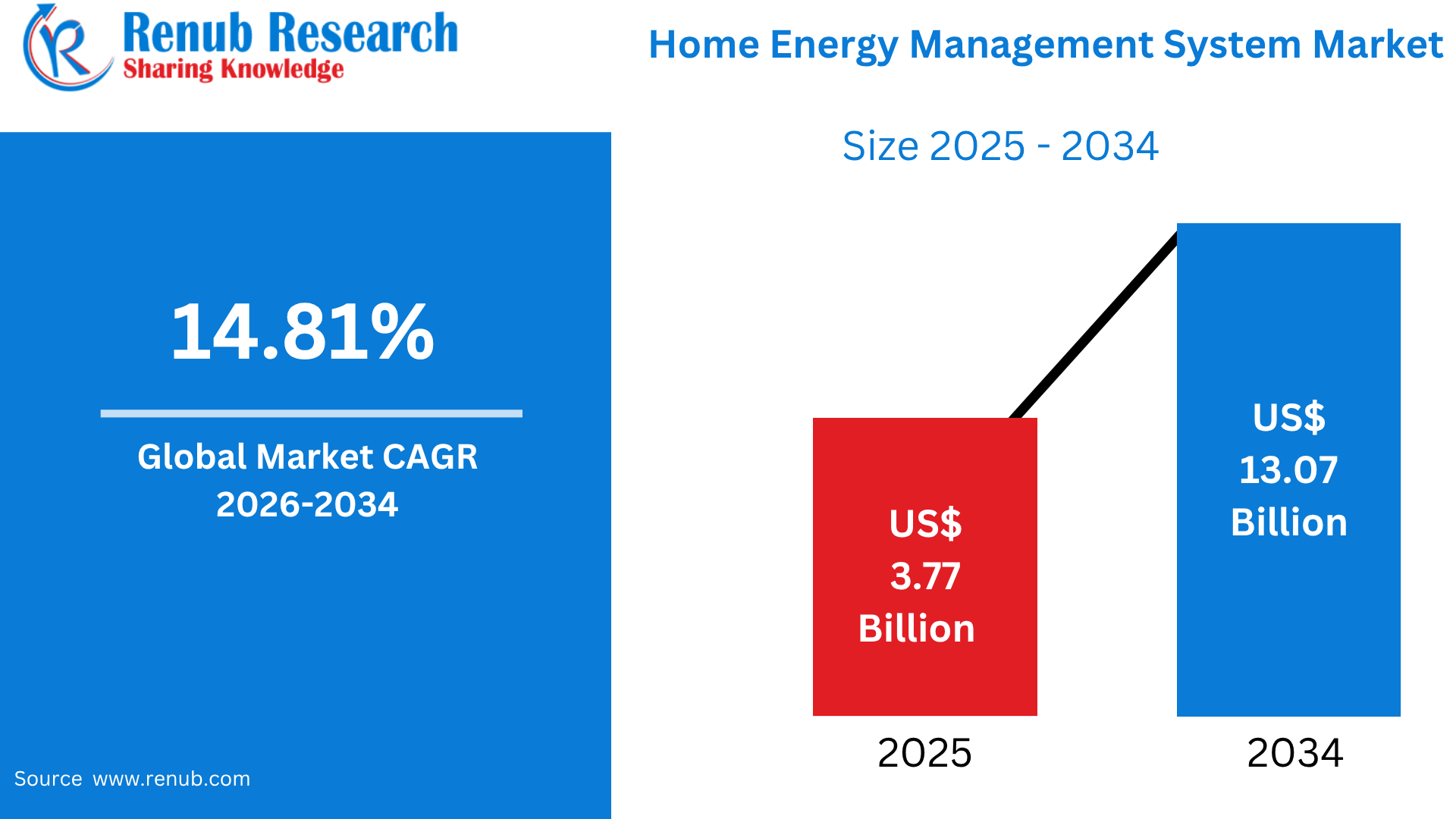
Home Energy Management System (HEMS) Market is projected to grow from US$3.77 billion in 2025 to US$13.07 billion by 2034, registering a compound annual growth rate (CAGR) of 14.81% during 2026–2034. Market growth is driven by increasing demand for energy-efficient solutions, rapid adoption of smart home technologies, and rising electricity costs. Home Energy Management Systems enable homeowners to monitor, control, and optimize household energy consumption through connected devices and intelligent automation. Growing investments in smart grids, renewable energy integration, and IoT-enabled home automation, along with supportive government initiatives promoting energy conservation, are further accelerating the expansion of the global HEMS market.
What is a Home Energy Management System (HEMS)? Uses and Global Popularity
A Home Energy Management System (HEMS) is an intelligent technology platform that enables homeowners to monitor, control, and optimize energy consumption within residential buildings. It integrates smart meters, sensors, connected appliances, thermostats, lighting systems, HVAC equipment, battery storage, and renewable energy sources such as rooftop solar panels into a centralized management system. Using Internet of Things (IoT), artificial intelligence (AI), and cloud-based analytics, HEMS provides real-time information on electricity usage, helping users reduce energy waste, lower electricity bills, and improve overall energy efficiency. The system can automatically schedule appliance operation during off-peak hours, regulate indoor temperature, manage electric vehicle charging, and optimize power generated from solar energy. HEMS also enhances household comfort, supports predictive maintenance, and contributes to lower carbon emissions by promoting efficient energy utilization.
Worldwide, the popularity of Home Energy Management Systems has increased significantly due to rising electricity prices, growing environmental awareness, and rapid adoption of smart home technologies. Governments across North America, Europe, and Asia-Pacific are promoting energy-efficient buildings through regulations, financial incentives, and smart grid modernization programs. Increasing deployment of smart meters, expansion of renewable energy installations, and rising ownership of electric vehicles are further accelerating HEMS adoption. Consumers are increasingly investing in connected home solutions that provide convenience, remote monitoring, and automated energy optimization through smartphone applications. Utilities are also encouraging residential demand-response programs that reward homeowners for reducing electricity consumption during peak demand periods. Continuous advancements in artificial intelligence, cloud computing, wireless communication, and IoT-enabled devices are making HEMS more affordable, efficient, and user-friendly, supporting its growing popularity and long-term expansion across the global residential energy management market.
Growth Drivers of the Home Energy Management System Market
Rising Adoption of Smart Homes and IoT-Connected Devices
The rapid adoption of smart home technologies is a major driver of the Home Energy Management System (HEMS) market. Industry estimates indicate that over 350 million smart homes are expected to be operational globally by the end of the decade, creating strong demand for intelligent energy management solutions. Homeowners are increasingly integrating smart thermostats, lighting controls, connected appliances, smart plugs, and voice assistants into their homes to improve convenience and reduce electricity consumption. HEMS platforms connect these devices through IoT technology, enabling real-time monitoring, automated scheduling, and remote control via smartphones or tablets. Growing internet penetration, expansion of broadband infrastructure, and declining prices of connected devices have accelerated smart home adoption across developed and emerging economies. Manufacturers continue introducing AI-powered energy optimization software capable of learning household energy consumption patterns and automatically reducing unnecessary electricity usage. The growing demand for connected living environments and energy-efficient residential buildings continues to support strong long-term growth of the global Home Energy Management System market.
Increasing Electricity Prices and Growing Focus on Energy Efficiency
Rising electricity costs across residential sectors worldwide are significantly increasing demand for Home Energy Management Systems. Industry estimates indicate that household electricity consumption accounts for nearly 25–30% of total global electricity demand, encouraging consumers to adopt technologies that reduce energy bills. HEMS enables homeowners to identify high-energy-consuming appliances, monitor real-time electricity usage, optimize HVAC operations, and schedule appliance usage during off-peak pricing periods. Governments and utility companies are also promoting energy-efficient homes through financial incentives, rebate programs, and energy conservation regulations. Smart energy management systems help reduce unnecessary electricity consumption while improving household comfort and operational efficiency. Consumers are increasingly investing in intelligent energy monitoring platforms that provide detailed analytics, automated control, and personalized energy-saving recommendations. Growing environmental awareness, increasing demand for sustainable housing, and stricter building energy efficiency standards continue driving residential investment in HEMS technologies worldwide.
Expansion of Renewable Energy, Smart Grids, and Electric Vehicle Integration
The rapid expansion of renewable energy installations and smart grid infrastructure is creating significant growth opportunities for the Home Energy Management System market. Industry estimates suggest that more than 300 million smart electricity meters have been deployed globally, enabling two-way communication between households and utility providers. HEMS plays a critical role in managing rooftop solar panels, residential battery storage systems, and electric vehicle charging stations while optimizing household electricity consumption. Homeowners can maximize self-consumption of solar energy, reduce dependence on grid electricity, and participate in demand-response programs offered by utility companies. The increasing adoption of electric vehicles has further increased the need for intelligent charging management to reduce charging costs and avoid peak electricity demand. Governments worldwide continue investing in renewable energy integration, smart grid modernization, and residential decarbonization initiatives. Continuous advancements in artificial intelligence, cloud computing, and predictive energy analytics are expected to further accelerate global HEMS adoption.
Home Energy Management System (HEMS) Launches Worldwide
Schneider Electric – Schneider Home Energy Management Solution
- Company: Schneider Electric
- Launch Year: 2023
- Region: United States / Global
- Key Features: Schneider Home integrates a smart electrical panel, home battery, solar inverter, EV charger, smart outlets, and connected switches through a single mobile application. The system enables homeowners to monitor energy consumption, optimize solar usage, manage backup power, and automate appliance operation. It was introduced at CES 2023 as an integrated solution for energy independence and sustainable homes.
Samsung SmartThings Energy Advanced Features
- Company: Samsung Electronics
- Launch Year: 2023
- Region: Global
- Key Features: Samsung expanded SmartThings Energy with AI-based energy monitoring, demand-response capabilities, and energy-saving automation. The platform allows users to track connected appliance consumption, reduce electricity bills, and participate in energy-saving programs. The system became one of the first smart home energy management platforms to receive ENERGY STAR Smart Home Energy Management System certification.
Schneider Home Pre-Order Commercial Launch
- Company: Schneider Electric
- Launch Year: 2023
- Region: North America
- Key Features: Schneider Electric started commercial availability of Schneider Home, enabling customers to purchase modular energy management solutions. The system combines solar power generation, battery storage, EV charging, and smart electrical distribution. It supports automated energy control, backup power optimization, and lower electricity costs through intelligent scheduling.
Schneider Electric Wiser Home AI Energy Management Feature
- Company: Schneider Electric
- Launch Year: 2024
- Region: Europe / Global Markets
- Key Features: The AI-powered Wiser Home platform introduced predictive energy optimization for major household loads such as water heaters and EV chargers. The system uses artificial intelligence to analyze consumption patterns and automatically schedule energy usage based on electricity prices and household behavior.
Schneider Home Full Energy Ecosystem Availability
- Company: Schneider Electric
- Launch Year: 2024
- Region: United States
- Key Features: Schneider Home became available as a complete residential energy management ecosystem combining solar, battery storage, EV charging, and utility electricity management. The platform provides homeowners with a single application to control energy production, storage, consumption, and backup power.
Homey Energy Management Platform & Energy Dongle
- Company: Homey (Athom/LG ecosystem)
- Launch Year: 2024
- Region: Europe
- Key Features: Homey introduced new energy management functions that allow households to monitor electricity, gas, water usage, solar generation, smart appliances, and EV charging. The Homey Energy Dongle connects directly with smart meters to provide real-time energy insights and automated control.
Generac ecobee Smart Thermostat Enhanced with HEMS Integration
- Company: Generac Holdings / ecobee
- Launch Year: 2025
- Region: United States
- Key Features: Generac launched an enhanced smart thermostat integrated with home energy management capabilities. The system connects smart thermostats with Generac standby generators and PWRcell battery storage solutions. It provides homeowners with improved visibility into energy usage, backup power availability, and household energy optimization.
GoodWe SEMS+ Smart Energy Management Platform
- Company: GoodWe
- Launch Year: 2026
- Region: Global
- Key Features: GoodWe launched SEMS+, a next-generation energy management platform designed for solar, storage, and smart home integration. The platform connects photovoltaic systems, batteries, household loads, and grid electricity into a unified energy ecosystem. It includes AI-supported operation, energy visualization, and intelligent import/export optimization.
Zendure PowerHub Plug-In HEMS Hub
- Company: Zendure
- Launch Year: 2026
- Region: Europe
- Key Features: Zendure introduced PowerHub as a plug-in home energy management hub for solar-powered homes. The system integrates solar generation, battery storage, backup power, EV chargers, heat pumps, and smart household devices. It transforms residential solar systems into complete energy ecosystems with centralized control.
SolarEdge Nexis Residential Energy Platform
- Company: SolarEdge Technologies
- Launch Year: 2026
- Region: United States
- Key Features: SolarEdge launched Nexis as a next-generation residential solar and storage platform. The system combines solar generation, battery storage, and intelligent energy management capabilities. It focuses on simplified installation, improved efficiency, and better control of household energy resources.
Challenges of the Home Energy Management System Market
High Initial Installation Costs and Limited Consumer Awareness
One of the primary challenges facing the Home Energy Management System market is the relatively high upfront investment required for installation. A complete HEMS solution—including smart meters, sensors, controllers, connected appliances, communication gateways, and software—can require substantial initial expenditure, particularly for existing homes requiring electrical upgrades. Industry estimates indicate that hardware components account for approximately 60–70% of total HEMS implementation costs, making adoption more difficult for price-sensitive consumers. Many homeowners remain unfamiliar with the long-term financial savings and operational benefits provided by intelligent energy management systems. Small residential property owners often delay investment because of uncertainty regarding return on investment and system compatibility with existing electrical infrastructure. Limited technical knowledge, installation complexity, and lack of skilled service providers in developing regions further slow market penetration. Expanding financial incentives, consumer education, and lower equipment costs will be essential for broader market adoption.
Cybersecurity Risks and Interoperability Challenges
As Home Energy Management Systems become increasingly connected through IoT networks, cybersecurity and system compatibility have emerged as significant industry challenges. Industry estimates indicate that more than 70% of smart home devices communicate through wireless networks, increasing exposure to cybersecurity threats, unauthorized access, and potential data privacy concerns. HEMS platforms collect detailed household energy usage information, making secure data storage and communication critical for consumer confidence. In addition, many households utilize devices from multiple manufacturers that operate using different communication protocols, creating interoperability challenges during system integration. Compatibility issues between smart appliances, energy storage systems, solar inverters, and utility communication platforms may reduce overall system efficiency and increase installation complexity. Manufacturers continue investing in advanced encryption, cloud security, standardized communication protocols, and software updates to strengthen system reliability. Improving cybersecurity frameworks and establishing universal interoperability standards will be crucial for supporting the long-term growth of the global Home Energy Management System market.
Smart Lighting Adoption Driving Residential Energy Efficiency
Home Lighting Control Market is witnessing significant growth as homeowners increasingly adopt smart lighting solutions to improve energy efficiency, convenience, and home automation. Industry estimates indicate that lighting accounts for approximately 10–15% of residential electricity consumption, making intelligent lighting control an effective solution for reducing household energy use. Home lighting control systems include smart switches, dimmers, occupancy sensors, daylight sensors, wireless controllers, and smartphone-enabled lighting applications. These systems allow users to remotely control lighting schedules, brightness levels, and occupancy-based automation, reducing unnecessary electricity consumption. Integration with voice assistants, smart home hubs, and IoT platforms has further enhanced consumer adoption. Governments promoting energy-efficient buildings and widespread deployment of LED lighting technologies continue supporting market expansion. Increasing demand for connected homes, growing residential construction, and rising consumer preference for automated living environments are expected to sustain long-term growth in the global home lighting control market.
Real-Time Energy Visibility Supporting Cost Savings
Home Energy Self-Monitoring Systems Market is expanding rapidly as consumers seek greater visibility into household electricity consumption. Industry estimates suggest that real-time energy monitoring can reduce residential electricity usage by approximately 5–15% through improved consumer awareness and behavioral changes. These systems collect real-time data from smart meters, sensors, and connected appliances, allowing homeowners to identify energy-intensive devices and optimize electricity usage. Mobile applications and cloud-based dashboards provide detailed consumption reports, historical usage trends, and personalized energy-saving recommendations. Rising electricity prices, increasing environmental awareness, and government energy conservation programs continue driving consumer demand. Integration with solar energy systems, battery storage, and electric vehicle charging infrastructure further enhances system functionality. Advances in artificial intelligence and predictive analytics enable homeowners to receive automated recommendations that improve household energy efficiency. Growing adoption of smart meters and connected residential infrastructure continues strengthening the long-term outlook for the home energy self-monitoring systems market.
Cloud Computing Enhancing Intelligent Energy Management
Home Energy Management System Cloud Market is experiencing strong growth due to increasing adoption of cloud-based platforms for residential energy optimization. Industry estimates indicate that over 65% of newly deployed smart home energy management platforms utilize cloud-based architectures for data storage, remote monitoring, and advanced analytics. Cloud-based HEMS enables homeowners to access real-time energy information from smartphones, tablets, and computers regardless of location. Utilities and service providers utilize cloud platforms to deliver software updates, predictive maintenance, demand-response services, and energy optimization algorithms without requiring on-site infrastructure upgrades. Cloud integration also facilitates seamless communication between smart meters, renewable energy systems, battery storage, HVAC equipment, and connected appliances. Growing investments in cloud infrastructure, artificial intelligence, and cybersecurity continue improving platform reliability and scalability. Expansion of subscription-based energy management services and increasing consumer demand for remote energy control are expected to drive sustained growth in the Home Energy Management System cloud market.
Artificial Intelligence Driving Smart Energy Optimization
Home Energy Management System Software Market plays a central role in enabling intelligent residential energy management through advanced analytics and automation. Industry estimates suggest that software solutions account for approximately 30–35% of total Home Energy Management System market value, reflecting their importance in system functionality. HEMS software continuously analyzes household electricity consumption, appliance performance, weather conditions, electricity tariffs, and occupancy patterns to optimize energy usage automatically. Artificial intelligence and machine learning algorithms enable predictive energy management, demand forecasting, and personalized energy-saving recommendations. Software platforms also integrate renewable energy generation, battery storage systems, smart thermostats, electric vehicle charging stations, and connected appliances into a unified user interface. Mobile applications provide homeowners with real-time alerts, remote device control, and detailed consumption analytics. Continuous software innovation, cybersecurity improvements, and expanding compatibility with third-party smart home ecosystems are expected to support long-term growth of the global Home Energy Management System software market.
Professional Installation and Managed Energy Solutions Supporting Market Expansion
Home Energy Management System Services Market is growing steadily as increasing numbers of homeowners require professional support for installation, system integration, maintenance, and energy consulting. Industry estimates indicate that services contribute approximately 20–25% of total Home Energy Management System revenues, supported by rising deployment of complex smart home ecosystems. Service providers assist homeowners with system design, device installation, software configuration, cloud connectivity, cybersecurity implementation, preventive maintenance, and technical support. Utilities also offer managed energy services, demand-response program enrollment, and energy efficiency consultations that help consumers maximize savings. As residential energy systems become increasingly integrated with rooftop solar panels, battery storage, electric vehicles, and smart appliances, demand for specialized technical expertise continues to rise. Subscription-based monitoring services, remote diagnostics, predictive maintenance, and software support agreements are generating recurring revenue opportunities. Continued investments in smart grid infrastructure and connected home technologies are expected to sustain long-term growth in the global Home Energy Management System services market.
Growing Demand for Smart Energy Optimization Solutions in USA
United States Home Energy Management System market is expanding rapidly due to rising electricity prices, increasing adoption of smart home technologies, and growing demand for energy efficiency. HEMS enables homeowners to monitor, control, and optimize electricity consumption through smart thermostats, energy monitoring devices, artificial intelligence (AI), and connected appliances. The U.S. residential sector accounts for nearly 16% of total U.S. energy consumption, creating significant opportunities for energy-saving technologies. The increasing installation of rooftop solar systems, battery storage, and electric vehicles (EVs) is further accelerating HEMS adoption. Virtual power plant (VPP) programs are also increasing, with U.S. VPP capacity reaching around 37.5 GW in 2025, driven by smart thermostats, batteries, and distributed energy resources. Consumers are increasingly using HEMS platforms to reduce peak electricity usage, lower utility bills, and participate in demand-response programs. The expansion of smart homes is a major growth driver for the U.S. HEMS market. Smart speakers, connected appliances, intelligent lighting systems, and automated HVAC controls are increasingly being integrated into residential energy management platforms. The U.S. smart home market has millions of connected households, creating a strong foundation for energy management solutions. Technologies such as machine learning, cloud-based analytics, and IoT sensors allow homeowners to analyze real-time energy consumption patterns and automatically adjust power usage. Smart thermostats alone can reduce heating and cooling energy consumption by approximately 10–15% in many households when properly optimized. Energy companies are also partnering with technology providers to develop AI-based solutions that forecast energy demand and improve grid stability. Growing consumer interest in sustainability and carbon reduction is expected to support continued HEMS adoption across residential buildings.
Net-Zero Goals Driving Residential Energy Efficiency in United Kingdom
The United Kingdom Home Energy Management System market is benefiting from one of Europe’s largest smart meter deployment programs. Smart meters provide households with real-time electricity consumption information, enabling better energy monitoring and automated energy management. The UK government has actively promoted smart meter adoption as part of its energy modernization strategy. By 2026, tens of millions of smart meters have been installed across Great Britain, supporting the development of connected energy management solutions. These systems allow consumers to understand consumption patterns, shift electricity usage to cheaper periods, and integrate renewable energy technologies. Energy suppliers are increasingly offering smart tariffs combined with intelligent heating controls and energy monitoring platforms, increasing demand for HEMS solutions.
The UK’s commitment to achieving net-zero carbon emissions by 2050 is a significant factor supporting HEMS market growth. Residential buildings contribute a considerable share of national energy demand, particularly through heating requirements. Home energy management systems help reduce emissions by optimizing heating, lighting, appliances, and renewable energy usage. Increasing adoption of heat pumps, solar panels, and battery storage is creating demand for integrated energy platforms. The UK government and energy providers are encouraging flexible energy consumption through smart tariffs, allowing households to use electricity during lower-cost periods. Heat pump installations and smart heating controls are expected to increase as the country transitions away from fossil fuel-based heating systems. HEMS technology will play an important role in managing household energy demand while supporting grid reliability.
India Rising Electricity Demand and Urbanization Supporting Market Growth
India’s Home Energy Management System market is developing rapidly due to government initiatives focused on electricity modernization and smart grid development. The nationwide smart meter rollout under programs such as the Revamped Distribution Sector Scheme (RDSS) is creating a strong foundation for residential energy management. India has more than 300 million electricity connections, representing one of the world’s largest potential markets for smart energy solutions. Smart meters, mobile applications, and digital monitoring platforms are enabling consumers to track electricity usage and improve efficiency. ([Reddit][5]) As electricity demand continues increasing due to urbanization, air conditioning adoption, and appliance penetration, HEMS solutions are becoming increasingly important for reducing consumption and improving grid management.
Rapid urbanization and increasing household appliance ownership are major factors driving India’s HEMS market. India is experiencing strong growth in residential electricity demand due to expanding middle-class households, rising disposable income, and increased adoption of air conditioners, smart appliances, and electronic devices. Home energy management systems help consumers identify inefficient energy usage and optimize appliance operation. Large metropolitan areas such as Delhi, Mumbai, Bengaluru, Hyderabad, and Pune are expected to become major adoption centers due to higher smart home penetration. Additionally, rising electricity tariffs are encouraging consumers to adopt energy monitoring technologies. Integration with solar rooftop systems and battery storage solutions will further increase demand for HEMS platforms.
Vision 2030 and Smart Home Development Driving Saudi Arabia Adoption
Saudi Arabia’s Home Energy Management System market is growing due to government initiatives focused on energy efficiency, smart cities, and sustainability under Vision 2030. The country is investing heavily in digital infrastructure, renewable energy, and intelligent residential solutions. HEMS adoption is increasing as households seek better control over electricity consumption, particularly due to high cooling demand caused by extreme temperatures. Air conditioning represents one of the largest electricity-consuming categories in Saudi Arabian households due to the country’s hot climate. Residential cooling can account for a significant portion of household electricity usage, especially during summer months when temperatures frequently exceed 40°C. HEMS solutions help optimize HVAC operation through smart thermostats, automated scheduling, and AI-based temperature management. These systems can reduce unnecessary energy consumption while maintaining indoor comfort. Growing awareness about electricity savings among consumers and businesses is encouraging adoption of smart energy technologies. Integration with advanced HVAC systems and IoT-based sensors will remain a key growth factor for Saudi Arabia’s residential energy management market.
Market Segments
Product Type
- Lighting Controls
- Thermostats
- Self-Monitoring Systems
- Advanced Central Controllers
- Intelligent HVAC Controllers
Component
- Hardware
- Software
- Services
Deployment Type
- On-premise
- Cloud
Countries
North America
- United States
- Canada
Europe
- France
- Germany
- Italy
- Spain
- United Kingdom
- Belgium
- Netherlands
- Turkey
Asia Pacific
- China
- Japan
- India
- South Korea
- Thailand
- Malaysia
- Indonesia
- Australia
- New Zealand
Latin America
- Brazil
- Mexico
- Argentina
Middle East & Africa
- Saudi Arabia
- UAE
- South Africa
All the Key players have been covered from 5 Viewpoints:
- Overviews
- Key Person
- Recent Developments
- SWOT Analysis
- Revenue Analysis
Company Analysis
- Honeywell International, Inc.
- General Electric Company
- Comcast Cable (Xfinity)
- Panasonic Corporation
- Johnson Controls
- Schneider Electric Se
- Robert Bosch Gmbh
Report Details:
| Report Features | Details |
| Base Year |
2025 |
| Historical Period |
2022 - 2025 |
| Forecast Period |
2026 - 2034 |
| Market |
US$ Billion |
| Segment Covered |
Product Type, Component, Deployment Type and Countries |
| Countries Covered |
|
| Companies Covered |
|
| Customization Scope |
20% Free Customization |
| Post-Sale Analyst Support |
1 Year (52 Weeks) |
| Delivery Format |
PDF and Excel through Email (We can also provide the editable version of the report in PPT/Word format on request) |
Customization Services available
- Analysis of Market Size and Its Segments
- More Company Profiles (Upto 10 without any additional cost):
- Additional Countries (Other than mentioned Countries):
- Region/Country Specific Reports:
- Market Entry Strategy:
- Region-Specific Market Dynamics:
- Regional Market Share Analysis:
- Trade Analysis:
- Production Insights:
- Others Customized Requests:
For more information contact our analysts.
Need More Assistance?
- Talk to our analysts to get more precious information on the current market trends.
- Include more countries and segments and customize the report based on the final requirement.
- Get a competitive advantage in your industry by knowing the report findings and making a positive impact on your revenues and operations.
- Our analysts are always ready to provide more help and pertinent information if you need any additional assistance.