India Solar Energy Market Report by Technology, Application, States and Companies Analysis 2026-2034
Buy NowIndia Solar Energy Market Size and Forecast
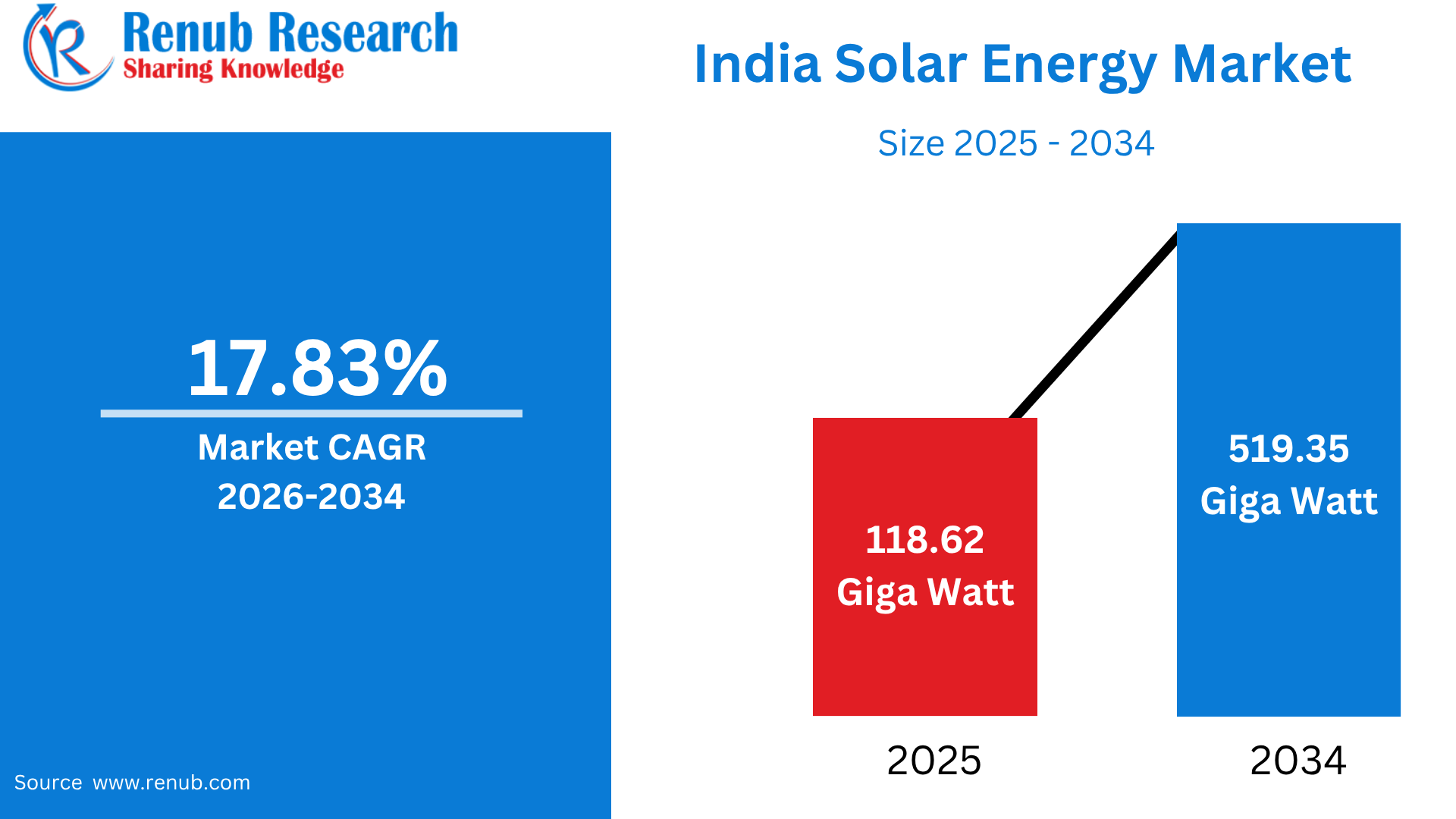
India Solar Energy Market is projected to grow from 118.62 Giga Watt in 2025 to 519.35 Giga Watt by 2034, expanding at a CAGR of 17.83% during 2026–2034. The market is poised for significant expansion, supported by India’s ambitious renewable energy targets, rapidly increasing electricity consumption, favorable government policies, financial incentives, and growing investments in clean-energy infrastructure. The declining cost of solar technologies, rising adoption of rooftop and utility-scale solar projects, and increasing emphasis on reducing carbon emissions are further strengthening market development.
Clean, Abundant Energy Source Supporting India’s Energy Transition
Solar energy is renewable energy generated by converting sunlight into electricity or heat through technologies such as solar photovoltaic (PV) panels and concentrated solar power systems. In India, solar energy has become an important component of the country’s strategy to reduce dependence on fossil fuels, improve energy security, and expand clean electricity generation. Solar power is used across utility-scale power plants, residential rooftops, commercial buildings, industrial facilities, agricultural irrigation, telecommunications, street lighting, and off-grid applications. Its popularity has increased significantly because India receives abundant sunlight across most regions and solar technology costs have declined over time.
India’s installed solar capacity reached approximately 164.59 GW by July 2026, compared with only 2.82 GW in 2014, demonstrating extraordinary long-term expansion. The residential segment is also gaining momentum through the PM Surya Ghar: Muft Bijli Yojana, which targets rooftop solar installations for 1 crore households. By March 2026, more than 26.19 lakh rooftop systems had been installed under the scheme. Solar energy is therefore becoming increasingly popular among households, businesses, industries, and government institutions seeking lower electricity costs and sustainable power.
India’s Solar Rise
- Rapid Capacity Expansion: A decade ago, solar power accounted for only a small portion of India’s electricity mix. Installed solar capacity increased from approximately 3 GW in 2014 to 162.15 GW by 30 June 2026, representing more than a 50-fold increase.
- Largest Renewable Energy Segment: Solar has emerged as the largest contributor to India’s renewable energy capacity, supported by large-scale utility projects, rooftop installations, solar parks, and decentralized applications.
- Strong Policy Support: Government initiatives focused on renewable-energy expansion, rooftop solar, solar parks, and agricultural solarization have accelerated investment and deployment across the country.
- New PM-SSY Initiative: The government approved the Pradhan Mantri Surya Sarovar Yojana (PM-SSY) on 31 July 2026 to accelerate floating solar development.
- 5,000 MW Floating Solar Target: PM-SSY aims to support 5,000 MW of Floating Solar Photovoltaic (FSPV) projects equipped with co-located Energy Storage Systems (ESS).
- 10,000 MWh Energy Storage: The scheme requires at least two hours of storage, equivalent to approximately 10,000 MWh, helping states manage peak electricity demand and improve grid flexibility.
- Reduced Land Requirements: Floating solar projects will utilize existing reservoirs and industrial ponds, reducing pressure on scarce land resources while expanding renewable-energy generation.
- ₹5,070 Crore Investment: PM-SSY has an approved financial outlay of ₹5,070 crore and will be implemented from FY2026–27 to FY2030–31.
- Significant Floating Solar Potential: According to an assessment by the National Institute of Solar Energy (NISE), India has approximately 102.18 GWp of floating solar potential across reservoirs and suitable inland water bodies.
- Environmental Benefits: The scheme is expected to help avoid approximately 10 million tonnes of CO₂ emissions annually, supporting India’s broader decarbonization objectives.
- Employment Generation: PM-SSY is projected to create approximately 16,000–17,000 full-time equivalent jobs across project development, manufacturing, installation, operations, and maintenance.
- Boost to Domestic Manufacturing: The initiative is expected to encourage domestic production of floating structures, PV cells, solar modules, and energy-storage systems, strengthening India’s renewable-energy supply chain.
- Nationwide Eligibility: All States and Union Territories will be eligible to benefit from PM-SSY, allowing floating solar deployment to expand across suitable water bodies.
- Fivefold Expansion in Floating Solar: The initiative is expected to increase India’s floating solar capacity by 5,000 MW, from the current level of around 700 MW, creating a major new segment within the country’s solar energy industry.
Growth Driver
Policy Support and Subsidies Accelerate Solar Deployment
Government initiatives and ambitious renewable-energy targets are among the strongest growth drivers of India’s solar energy market. India is working toward achieving 500 GW of non-fossil fuel capacity by 2030, encouraging large investments in solar generation, transmission infrastructure, storage, and distributed renewable energy. Solar capacity has expanded dramatically, reaching 164.59 GW by July 2026, compared with 2.82 GW in 2014. Government programs such as the PM Surya Ghar: Muft Bijli Yojana, PM-KUSUM, solar park programs, and rooftop-solar initiatives are creating demand across residential, agricultural, commercial, and industrial segments. PM Surya Ghar alone has a target of supporting rooftop solar installations in 1 crore households by FY2026–27. By March 2026, the scheme had facilitated more than 26.19 lakh rooftop solar installations, with approximately ₹17,967.53 crore in central financial assistance disbursed. These policies reduce upfront investment barriers, encourage private-sector participation, and improve consumer confidence, thereby accelerating solar adoption throughout India.
Businesses Seek Lower Energy Costs and Greater Power Security
Increasing electricity consumption from industries, commercial establishments, urban households, and infrastructure projects is creating substantial opportunities for solar energy deployment in India. Rapid industrialization, urbanization, data-center expansion, manufacturing investments, and electrification are increasing demand for reliable and affordable electricity. Businesses are increasingly adopting rooftop, captive, open-access, and utility-scale solar projects to reduce dependence on conventional grid electricity and manage long-term energy expenses. India added approximately 34.96 GW of solar generation capacity during FY2025–26 up to January 2026, demonstrating the strong pace of market expansion. Industrial and commercial consumers are particularly attracted to solar because electricity represents a significant operating expense for sectors such as manufacturing, textiles, automotive, pharmaceuticals, chemicals, food processing, and engineering. Solar power also supports corporate decarbonization and environmental, social, and governance objectives. In addition, large companies are increasingly entering long-term renewable power purchase agreements and developing captive renewable projects. Growing electricity requirements combined with declining solar generation costs and improvements in project financing are therefore expected to stimulate continued investment across India’s solar energy market.
Solar Energy Launches in India
- Tata Power – Integrated Rooftop Solar & Battery Storage Solutions – 2026
Tata Power launched integrated rooftop solar and battery energy-storage solutions for Indian households, shops, clinics, schools, and businesses. The battery systems are available from 5 kWh onward, supporting greater energy independence and reducing dependence on grid electricity and diesel generators. - Jakson Group – Rooftop Solar Kits & BESS – 2026
Jakson Group expanded its renewable-energy portfolio with rooftop solar kits and battery energy-storage systems. Its BESS range includes 3 kVA, 5 kVA, 10 kVA, and 15 kVA variants designed for residential and commercial applications. - Tata Power – GharGharSolar National Campaign – 2024
Tata Power Solar launched the #GharGharSolar, Tata Power ke Sangh campaign in June 2024 to accelerate residential rooftop-solar adoption across India. The initiative was designed to expand access to rooftop solar and encourage households to generate their own clean electricity. - Tata Power – GharGharSolar Tamil Nadu Expansion – 2024
Tata Power expanded its GharGharSolar initiative into Tamil Nadu in October 2024, covering all districts through 42 channel partners. The program supports rooftop solar adoption and provides households access to net-metering benefits for surplus electricity generation. - Tata Power – 4.3 GW Solar Cell & Module Manufacturing Facility – 2024/2025
TP Solar commenced commercial production of solar cells at its 4.3 GW integrated manufacturing facility in Tirunelveli, Tamil Nadu, in September 2024. The plant uses advanced TOPCon and Mono PERC technologies and is designed to strengthen India’s domestic solar-cell and module manufacturing capabilities. - Waaree Energies – Expanded Solar Module Manufacturing Capacity – 2024
Waaree Energies continued expanding its domestic solar manufacturing footprint, with 12 GW of existing solar-module capacity reported in June 2024. The company has also planned additional capacity to meet growing domestic and international demand for photovoltaic modules. - Adani Solar – Solar Module and Cell Capacity Expansion – 2024
Adani Solar was among India’s leading domestic solar manufacturers, with 4 GW of existing module and cell capacity reported in industry data and significant additional capacity planned. The expansion supports India’s objective of developing a stronger domestic solar manufacturing ecosystem. - Reliance New Energy Solar – Large-Scale Solar Cell Manufacturing Expansion – 2024
Reliance New Energy Solar was identified among major companies planning substantial domestic solar-cell manufacturing capacity, with 10 GW of planned solar-cell capacity in industry projections. The initiative reflects growing investment in India’s integrated solar manufacturing supply chain. - Vikram Solar – Solar Manufacturing Capacity Expansion – 2024
Vikram Solar continued strengthening its manufacturing presence in India, with approximately 3.5 GW of existing solar-module capacity reported in June 2024 and additional capacity planned. The expansion supports growing demand from India’s utility-scale, commercial, and rooftop solar markets. - India Rooftop Solar Expansion – 2024
India recorded approximately 4.59 GW of new rooftop solar installations in 2024, reflecting accelerating adoption of distributed solar systems. Major rooftop developers included Tata Power Solar, Mahindra Solarize, and Amplus, highlighting the growing importance of residential, commercial, and industrial rooftop applications.
Household Adoption and Decentralized Generation Create New Market Opportunities
The rapid expansion of rooftop and distributed solar systems is emerging as another important growth driver for India’s solar energy market. Rooftop solar allows households, housing societies, offices, schools, hospitals, shops, and small businesses to generate electricity close to the point of consumption, reducing dependence on grid power and potentially lowering electricity bills. India’s grid-connected rooftop solar capacity reached approximately 30.74 GW by July 2026, according to MNRE data. Government support is further increasing residential demand. Under PM Surya Ghar: Muft Bijli Yojana, more than 26.19 lakh rooftop solar systems had been installed by March 19, 2026, while the government aims to reach 1 crore households by FY2026–27. The scheme is also expected to encourage domestic employment across solar manufacturing, logistics, installation, financing, sales, and maintenance. Improvements in solar-panel efficiency, smart inverters, battery storage, and digital monitoring systems are making distributed solar increasingly attractive. Consequently, rooftop and decentralized systems are expected to broaden solar adoption beyond large utility-scale projects.
Challenge
Variable Solar Generation Requires Storage and Stronger Transmission Infrastructure
Solar energy generation depends on sunlight availability, creating intermittency challenges that can complicate grid management. Solar output declines during evenings and is unavailable at night, while cloud cover and seasonal variations can cause fluctuations in generation. As India adds larger volumes of solar capacity, electricity infrastructure must become more flexible to balance variable renewable generation with demand. India had approximately 164.59 GW of installed solar capacity by July 2026, including 122.57 GW of ground-mounted solar, 30.74 GW of grid-connected rooftop solar, 4.77 GW of hybrid-project solar components, and 6.51 GW of off-grid solar. Managing this growing generation base requires investment in transmission corridors, smart grids, battery energy storage, pumped storage, forecasting systems, and flexible generation resources. Renewable-energy projects located far from major consumption centers can also face transmission bottlenecks, creating delays or curtailment risks. Although hybrid solar-wind projects and energy-storage systems can improve reliability, their additional capital requirements can increase project costs. Strengthening grid infrastructure and expanding affordable energy-storage capacity will therefore remain critical for integrating India’s rapidly expanding solar generation.
Capital Requirements and Project Financing Can Slow Solar Adoption
Despite declining technology costs, the upfront capital requirement for solar installations remains a challenge, particularly for households, small businesses, farmers, and small industrial enterprises. Solar projects require investment in photovoltaic modules, inverters, mounting structures, electrical equipment, installation, land, transmission connections, and, increasingly, battery-storage systems. Financing costs can become significant when interest rates, currency fluctuations, equipment prices, or project-development timelines increase. Residential consumers may also face challenges related to initial system costs, awareness, vendor selection, installation quality, and access to affordable financing. Government subsidies are helping address these barriers, particularly through PM Surya Ghar. By March 2026, the scheme had supported more than 26.19 lakh rooftop solar installations and disbursed approximately ₹17,967.53 crore in central financial assistance. However, scaling adoption toward the scheme’s 1 crore-household target will require continued financing availability and efficient subsidy delivery. For commercial and industrial consumers, land availability, grid connectivity, regulatory approvals, and long project-development periods can further increase costs. Expanding green financing, easier credit access, standardized approvals, and innovative ownership models such as RESCO and leasing can help reduce these barriers.
Rapid Capacity Expansion and Strong Policy Support Accelerate Solar PV Adoption
India’s Solar Photovoltaic (PV) Energy Market is expanding rapidly as the country increases renewable-energy capacity to meet rising electricity demand and reduce dependence on fossil fuels. India’s cumulative solar power capacity reached approximately 164.6 GW by June 2026, according to Ministry of New and Renewable Energy data, highlighting the strong expansion of photovoltaic generation. Solar capacity additions have accelerated significantly, with approximately 23.8 GW added during FY2024–25 alone. Large-scale solar parks, utility-scale projects, rooftop installations, and distributed generation are contributing to market development. Government initiatives such as the National Solar Mission, PM-KUSUM, Solar Park Scheme, and PM Surya Ghar are supporting investment through subsidies, financing mechanisms, and capacity targets. Declining module and inverter costs, improvements in bifacial modules, trackers, energy-storage integration, and higher-efficiency photovoltaic technologies are further improving project economics. Increasing electricity requirements from manufacturing, infrastructure, data centers, transportation, and urban development are creating additional demand. Consequently, utility-scale and rooftop PV installations are expected to remain major components of India’s renewable-energy expansion.
Emerging Concentrated Solar Technologies Support Large-Scale Renewable Energy Integration
India’s Concentrated Solar Energy Market represents an emerging segment of the country’s renewable-energy industry, particularly for applications requiring high-temperature heat, thermal storage, and dispatchable renewable power. Unlike conventional photovoltaic systems, concentrated solar technologies use mirrors or reflective surfaces to concentrate sunlight and generate thermal energy, which can subsequently produce electricity or industrial process heat. India has substantial solar resources, with many regions receiving strong annual solar irradiation, creating favorable conditions for concentrated solar applications. The technology is particularly relevant to industries such as cement, chemicals, mining, food processing, textiles, and metals, where thermal energy represents a significant portion of energy consumption. The increasing emphasis on round-the-clock renewable power is also encouraging interest in technologies capable of integrating thermal energy storage. India’s broader solar capacity reached more than 164 GW by June 2026, providing a strong ecosystem for solar technology development. Government decarbonization targets, industrial net-zero commitments, and the need to reduce coal and natural-gas consumption for process heat could support future deployment of concentrated solar thermal systems.
Rooftop Subsidies and Rising Household Electricity Costs Drive Residential Adoption
India’s Residential Solar Energy Market is experiencing strong growth as households increasingly install rooftop photovoltaic systems to reduce electricity expenditure and improve energy independence. The PM Surya Ghar: Muft Bijli Yojana has become a major catalyst for residential solar adoption, with the government targeting rooftop solar installations across 1 crore households by March 2027. The program provides central financial assistance, including subsidies of up to ₹78,000 for systems of 3 kW or higher, substantially reducing the initial investment required from consumers. By March 2025, the scheme had already crossed 10 lakh rooftop installations, while more than 20.8 lakh systems had been installed under the program by December 2025. Residential consumers accounted for approximately 76% of India’s rooftop solar capacity additions in 2025, demonstrating the increasing importance of households in the distributed solar market. Falling solar-panel prices, net-metering opportunities, electricity-bill savings, financing options, and growing environmental awareness are encouraging adoption. Demand is expected to remain particularly strong in urban and semi-urban areas where electricity consumption and rooftop availability are relatively high.
Businesses Pursue Electricity Cost Reduction Through Rooftop and Distributed Solar Systems
India’s Commercial Solar Energy Market is expanding as offices, retail establishments, hotels, hospitals, educational institutions, warehouses, shopping centers, and other commercial facilities seek to lower electricity costs and improve sustainability performance. Commercial users generally have substantial daytime electricity demand, making rooftop solar particularly attractive because generation can coincide with operating hours. India installed approximately 7.1 GW of rooftop solar capacity during 2025, representing a 122% increase from 2024, with the commercial segment contributing more than 5% of annual rooftop additions. Although residential installations currently dominate rooftop growth, commercial projects remain strategically important because businesses typically have larger system sizes and higher electricity consumption. Companies are increasingly using CAPEX installations, third-party ownership, power purchase agreements, and open-access renewable power arrangements to improve project economics. Corporate sustainability commitments, renewable-energy procurement targets, increasing electricity tariffs, and pressure to reduce carbon emissions are further supporting adoption. Integration with battery storage and energy-management systems is expected to enhance the value of commercial solar by improving power reliability and enabling businesses to optimize electricity consumption.
High Industrial Power Consumption Creates Significant Opportunities for Solar Deployment
India’s Industrial Solar Energy Market is gaining momentum as manufacturing and processing industries seek to reduce energy costs, secure long-term electricity supply, and meet decarbonization objectives. Industrial facilities such as factories, cement plants, steel manufacturers, automotive plants, textile units, food-processing facilities, chemical plants, and engineering companies require large quantities of electricity, making solar generation an increasingly attractive source of renewable power. In 2025, the industrial segment represented more than 18% of India’s rooftop solar capacity additions, making it the largest non-residential contributor to rooftop installations. Industrial users are adopting both on-site rooftop systems and larger ground-mounted projects, while open-access solar and captive power arrangements are providing additional procurement options. Solar energy can reduce dependence on grid electricity and provide greater predictability in long-term energy costs. Increasing corporate net-zero commitments and renewable-energy targets are also encouraging manufacturers to increase the share of clean electricity in their operations. Furthermore, improvements in high-efficiency modules, solar trackers, inverters, battery storage, and energy-management systems are making solar solutions increasingly suitable for energy-intensive industrial applications.
Strong Industrial Base and Renewable Investments Drive Solar Adoption in Maharashtra
Maharashtra solar energy market is expanding rapidly, supported by rising electricity consumption, industrialization, urbanization, and increasing investments in renewable energy infrastructure. Maharashtra is among India’s leading states for renewable energy development, with solar power becoming increasingly important for meeting the electricity requirements of industries, businesses, and households. The state has significant potential for both utility-scale and distributed solar generation, while commercial and industrial consumers are increasingly deploying rooftop and captive solar systems to reduce electricity costs. Maharashtra also benefits from its large manufacturing base, with sectors such as automotive, pharmaceuticals, engineering, textiles, and food processing creating substantial demand for reliable and cost-efficient electricity. The state’s rooftop solar segment is gaining momentum as businesses, housing societies, institutions, and public facilities adopt decentralized generation. Growing participation in open-access renewable power and corporate sustainability programs is further supporting market development. Continued investment in solar parks, transmission networks, energy storage, and distributed generation is expected to strengthen Maharashtra’s position as a major solar energy market in India.
High Renewable Potential and Industrial Electricity Demand Support Tamil Nadu Market Growth
Tamil Nadu solar energy market is witnessing strong expansion due to favorable solar resources, supportive renewable energy policies, extensive industrial activity, and increasing demand for clean electricity. Tamil Nadu is one of India’s major renewable energy-producing states and has developed substantial solar and wind power capacity. The state’s industrial ecosystem—including textiles, automobiles, electronics, engineering, chemicals, and information technology—creates significant opportunities for commercial and industrial solar installations. Businesses are increasingly adopting rooftop solar, captive generation, and open-access renewable electricity to reduce dependence on conventional grid power and manage long-term energy expenses. Tamil Nadu also has a strong distributed renewable-energy ecosystem, supported by improvements in transmission and power infrastructure. According to government data, Tamil Nadu had more than 12 GW of installed solar power capacity by 2025, placing it among India’s leading solar states. Increasing investment in utility-scale solar projects, hybrid renewable systems, battery storage, and green-energy infrastructure is further improving market opportunities. Rising corporate sustainability commitments and declining solar technology costs are expected to sustain solar adoption across residential, commercial, and industrial applications.
Solar Parks, Technology Industries, and Distributed Generation Accelerate Karnataka Adoption
Karnataka solar energy market is experiencing significant growth due to strong solar irradiation, large-scale renewable energy projects, supportive policies, and increasing electricity requirements from residential and industrial consumers. Karnataka has established itself as a major renewable energy hub, particularly following the development of large solar projects such as the 2,050 MW Pavagada Solar Park, one of the world’s largest solar parks. The state has also attracted substantial private-sector investment in utility-scale solar, rooftop systems, and renewable-energy projects. Its strong IT and technology ecosystem in Bengaluru is creating additional demand for clean electricity as data centers, technology companies, office complexes, and commercial facilities pursue sustainability targets. Industrial consumers in manufacturing, engineering, food processing, and automotive sectors are increasingly utilizing captive and open-access solar power to lower electricity costs. Karnataka’s solar capacity has exceeded 10 GW, highlighting the state’s importance in India’s renewable-energy landscape. Growing adoption of rooftop systems, solar-plus-storage solutions, smart-grid technologies, and hybrid renewable projects is expected to further support market expansion.
Large Consumer Base and Government Programs Expand Solar Deployment in Uttar Pradesh
Uttar Pradesh solar energy market is growing steadily, driven by the state’s large population, rising electricity demand, rapid urbanization, agricultural requirements, and increasing government support for renewable energy. Uttar Pradesh has significant opportunities for solar development across utility-scale, residential, agricultural, commercial, and industrial applications. Government programs promoting rooftop solar and decentralized renewable energy are encouraging households and businesses to adopt solar systems, while solar-powered irrigation solutions are creating additional demand in the agricultural sector. Uttar Pradesh has also become an important market for large-scale solar investments, supported by the development of solar parks and renewable-energy transmission infrastructure. The state recorded approximately 6 GW of installed solar capacity by 2025, reflecting its rapidly expanding renewable-energy base. Residential consumers are increasingly benefiting from rooftop-solar subsidies, while commercial establishments, educational institutions, warehouses, and small and medium-sized enterprises are deploying systems to reduce electricity expenses. The combination of increasing power consumption, expanding solar infrastructure, improved financing availability, and ambitious renewable-energy targets is expected to accelerate solar adoption throughout Uttar Pradesh during the forecast period.
Recent Developments in India Solar Energy Market
- June 2025: Saatvik Solar, a division of Saatvik Green Energy Limited (SGEL), is building a 4.8GW solar cell and 4GW module manufacturing facility in the Ganjam region of Odisha. SSIPL, which SGEL owns in its whole, is developing the integrated facility.
- At its 5.4 GW solar cell manufacturing facility in Chikhli, Gujarat, Waaree Energies began commercial production in March 2025. With plans to commission an additional 4 GW of TOPCon capacity in the next phase, 1.4 GW of Mono PERC capacity is now operational.
India Solar Energy Segments
Technology Type
- Solar Photovoltaic
- Concentrated Solar Power
Application
- Residential
- Commercial
- Industrial
Top States
- Maharashtra
- Tamil Nadu
- Karnataka
- Gujarat
- Uttar Pradesh
- West Bengal
- Rajasthan
- Telangana
- Andhra Pradesh
- Madhya Pradesh
All companies have been covered with 5 Viewpoints
- Overviews
- Key Person
- Recent Developments
- SWOT Analysis
- Revenue Analysis
Company Analysis:
- Adani Solar
- Emmvee Solar
- Mahindra Susten Pvt. Ltd.
- Sterling and Wilson Pvt. Ltd.
- Tata Power Solar Systems Ltd.
- Vikram Solar Limited
- ReNew Power Pvt. Ltd.
- NTPC Ltd.
- Azure Power Global Ltd.
Report Details:
| Report Features | Details |
| Base Year |
2025 |
| Historical Period |
2022 - 2025 |
| Forecast Period |
2026 - 2034 |
| Market |
Giga Watt |
| Segment Covered |
Technology, Application and States |
| Region Covered |
|
| Companies Covered |
|
| Customization Scope |
20% Free Customization |
| Post-Sale Analyst Support |
1 Year (52 Weeks) |
| Delivery Format |
PDF and Excel through Email (We can also provide the editable version of the report in PPT/Word format on request) |
Customization Services available
- Analysis of Market Size and Its Segments
- More Company Profiles (Upto 10 without any additional cost):
- Additional Countries (Other than mentioned Countries):
- Region/Country Specific Reports:
- Market Entry Strategy:
- Region-Specific Market Dynamics:
- Regional Market Share Analysis:
- Trade Analysis:
- Production Insights:
- Others Customized Requests:
For more information contact our analysts.
Need More Assistance?
- Talk to our analysts to get more precious information on the current market trends.
- Include more countries and segments and customize the report based on the final requirement.
- Get a competitive advantage in your industry by knowing the report findings and making a positive impact on your revenues and operations.
- Our analysts are always ready to provide more help and pertinent information if you need any additional assistance.