Transformers Market Size, Share, Trends & Forecast by Power Rating, Cooling Type, Transformer Type, Phase and Country, 2026–2034
Buy NowTransformers Market Size and Forecast
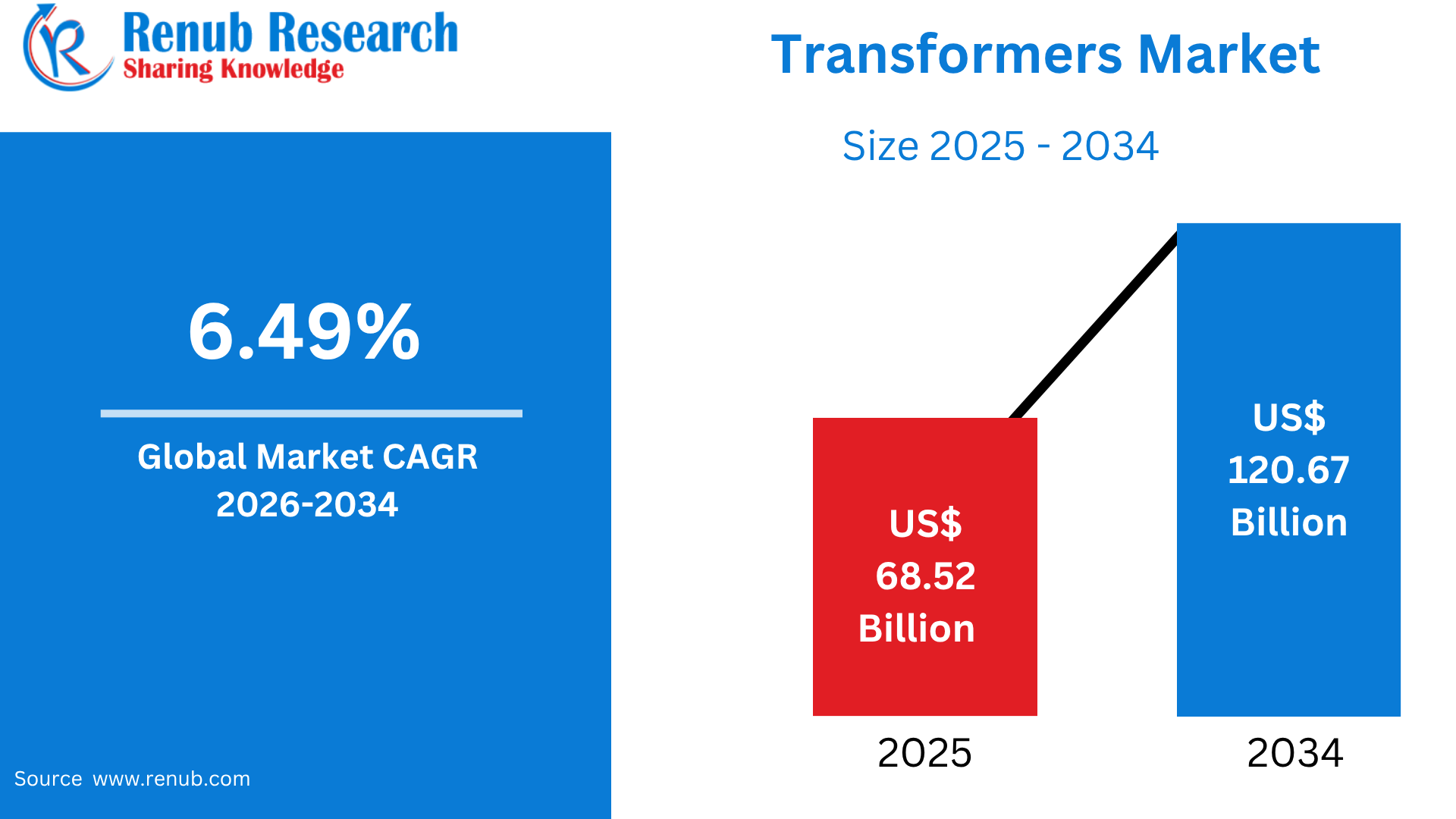
Global Transformers Market is projected to expand from US$ 68.52 billion in 2025 to US$ 120.67 billion by 2034, registering a CAGR of 6.49% during 2026–2034. Market growth is being supported by rising global electricity consumption, ongoing investments in power transmission and distribution infrastructure, and the modernization of aging electrical grids. In addition, the rapid expansion of renewable energy projects, including solar and wind power, is increasing demand for transformers capable of efficiently integrating variable renewable generation into electricity networks.
What is the Transformers Market? Uses and Popularity Worldwide
Transformers are essential electrical devices that transfer electrical energy between circuits while increasing or decreasing voltage levels through electromagnetic induction. They are fundamental components of electricity generation, transmission, and distribution networks, helping electricity move efficiently over long distances and reach homes, businesses, and industrial facilities at usable voltage levels. Transformers are widely used in power grids, renewable-energy projects, industrial plants, commercial buildings, railways, data centers, and residential electricity networks. Distribution transformers supply electricity to consumers, while power transformers are primarily used in high-voltage transmission systems. They are also increasingly deployed in solar and wind farms, battery-storage systems, electric-vehicle infrastructure, and smart-grid projects.
Global demand for transformers is rising as electricity consumption, electrification, renewable-energy deployment, and grid modernization accelerate. The IEA expects global electricity demand to grow by an average 3.6% annually from 2026 to 2030, while emerging economies are expected to account for nearly 80% of additional electricity consumption. Renewable sources accounted for 34% of global electricity generation in 2025, increasing the need for grid equipment capable of integrating variable renewable generation.
Global Energy Consumption Growth in 2025
Global energy consumption increased by 1.4% in 2025, broadly in line with the historical 2010–2019 average growth rate of 1.5% annually. The slowdown was influenced by several factors, including the rapid expansion of solar and wind power, milder weather conditions compared with the extreme temperatures recorded in 2024, and weaker energy demand from energy-intensive industries in China.
BRICS Countries Remain Major Energy Consumers
BRICS economies accounted for approximately 43% of global energy consumption in 2025, with energy demand increasing by 1.6%. Strong economic activity across several member countries continued to support overall consumption despite slower growth in major markets such as China and India.
China and India Drive Global Demand
China’s energy consumption increased by around 2%, while India recorded approximately 1% growth. Although both markets experienced slower consumption growth, they remained among the largest contributors to the global increase in energy demand.
North America Records Stronger Consumption
Energy consumption in the United States and Canada increased by approximately 2% each, supported by colder winter conditions and rising electricity demand. Meanwhile, energy consumption also increased by around 2% in the Middle East, driven partly by strong growth in Iran and the UAE.
Emerging Markets Continue to Expand
Energy demand accelerated in several emerging economies. Kazakhstan recorded particularly strong growth of approximately 14%, while Indonesia maintained growth of more than 5%. Brazil’s energy consumption increased by around 2%, while strong demand growth was also observed in Nigeria and Algeria.
Growth Drivers of the Transformers Market
Rising Global Electricity Demand and Electrification
Increasing electricity consumption is one of the strongest growth drivers for the transformers market. Rapid urbanization, industrial expansion, electrification of transportation, increasing air-conditioning use, and expanding data-center infrastructure are placing additional pressure on electricity networks. According to the IEA, global electricity demand increased by approximately 3% in 2025, adding around 800 TWh of consumption. The agency forecasts average annual electricity-demand growth of 3.6% between 2026 and 2030, substantially faster than the previous decade’s average. This increase requires utilities to expand transmission and distribution capacity and replace aging electrical equipment. Transformers are essential for stepping voltage up for efficient long-distance transmission and stepping it down for industrial, commercial, and residential users. Data centers are becoming an additional source of demand, with global data-center electricity consumption increasing by approximately 17% in 2025. The growth of electric vehicles, heat pumps, industrial electrification, and digital infrastructure is therefore creating new transformer requirements. Emerging economies, particularly China, India, and Southeast Asian countries, are expected to remain major contributors to electricity-demand growth, supporting long-term transformer procurement.
Renewable Energy Integration and Grid Expansion
The rapid deployment of renewable energy is significantly increasing demand for transformers because solar and wind projects require specialized electrical infrastructure to connect generation assets to transmission and distribution networks. The IEA estimates that renewables and nuclear power are expected to meet all additional global electricity demand through 2027, with renewables alone accounting for approximately 95% of demand growth during the period. Solar PV is particularly important: global solar generation increased by around 600 TWh in 2025, the largest annual increase ever recorded for any electricity source. Every large-scale renewable project requires transformers to raise voltage and efficiently transfer electricity into the grid. Renewable projects are also frequently located far from major consumption centers, increasing the need for transmission infrastructure and high-capacity transformers. In addition, battery-storage systems and distributed-generation projects require transformers for voltage management and grid interconnection. As governments continue expanding renewable-energy capacity and decarbonizing electricity systems, utilities are investing in modern transformers with higher efficiency, monitoring capabilities, and improved compatibility with variable power generation.
Grid Modernization and Replacement of Aging Infrastructure
Modernizing aging transmission and distribution networks is another major growth opportunity for transformer manufacturers. Many electricity grids contain transformers and other equipment that have been operating for decades, creating requirements for replacement, capacity upgrades, improved reliability, and greater resilience. Modern transformer systems increasingly incorporate digital monitoring, sensors, temperature monitoring, remote diagnostics, and predictive-maintenance capabilities, allowing utilities to identify potential failures before outages occur. Industry estimates indicate that transformer demand is structurally linked to grid modernization, renewable integration, aging infrastructure replacement, and energy-transition investments. North America and Europe are particularly focused on replacing older equipment, while Asia-Pacific is expanding transmission and distribution infrastructure alongside rapid electricity-demand growth. The modernization trend is also encouraging utilities to adopt energy-efficient and digitally connected transformers, creating opportunities for manufacturers offering advanced equipment.
Challenges of the Transformers Market
Supply-Chain Constraints and Long Transformer Lead Times
Supply-chain constraints remain a significant challenge for the transformers market because manufacturing depends on specialized materials and components, including copper, electrical steel, insulation materials, bushings, and other high-voltage components. Shortages or price fluctuations in these inputs can increase production costs and extend delivery schedules. Industry analysis identifies grain-oriented electrical steel and copper as particular supply-chain concerns that can lengthen transformer delivery cycles. The problem is especially significant for large power transformers, which require substantial manufacturing capacity, specialized testing, and transportation infrastructure. In the United States, industry participants have reported conventional transformer import wait times of up to four years, highlighting the scale of the supply challenge. Long lead times can delay grid-expansion projects, renewable-energy connections, and industrial developments. Manufacturers are therefore increasing production capacity, localizing supply chains, and investing in new facilities. However, expanding transformer manufacturing requires significant capital and skilled labor, meaning supply constraints may remain an important market limitation during periods of rapidly rising electricity infrastructure investment.
High Manufacturing Costs and Raw-Material Price Volatility
High manufacturing costs and fluctuations in raw-material prices can restrict transformer-market expansion, particularly for utilities and smaller industrial customers operating under tight capital budgets. Transformers require significant quantities of copper, electrical steel, aluminum, insulation materials, and specialized components, while large power transformers also involve complex engineering, testing, transportation, and installation requirements. Volatility in commodity prices can directly affect manufacturers’ margins and final equipment prices. At the same time, utilities must balance transformer purchases against broader investments in transmission lines, substations, renewable-energy projects, and grid-management technologies. The industry is also facing pressure to develop more efficient and environmentally sustainable transformer designs, which can require additional research and development spending. Supply-chain limitations compound these cost pressures; industry analysis specifically identifies high raw-material cost volatility and limited component suppliers among key transformer-market challenges. Consequently, manufacturers are focusing on improved material efficiency, localized production, automation, and advanced designs to control costs while meeting increasingly stringent performance and efficiency requirements.
Transformer Launches / New Transformer Products & Deployments Worldwide
- Hitachi Energy TXellence – 2025: Hitachi Energy introduced TXellence, a dedicated nuclear transformer portfolio covering power, distribution, dry-type, liquid-filled, conventional, and digitally enabled transformers for nuclear plants and small modular reactors.
- Hitachi Energy 765 kV Natural-Ester Transformer – 2025: The company successfully tested a 765 kV/400 kV, 250 MVA single-phase natural-ester-filled transformer, described as the first transformer at this voltage and power level using ester fluid.
- Hitachi Energy 400 kV Synthetic-Ester Transformer – July 2025: Hitachi Energy handed over India’s first 400 kV-class, 315 MVA three-phase synthetic-ester-filled power transformer to Power Grid Corporation of India.
- Hitachi Energy 765 kV Transformers – June 2025: Hitachi Energy India received an order for 30 units of 765 kV, 500 MVA single-phase transformers for India’s transmission-grid expansion.
- GE Vernova 765 kV Transformers – May 2025: GE Vernova announced an order to supply more than 70 units of 765 kV-class transformers and shunt reactors for renewable-energy transmission corridors in India.
- Hitachi Energy RESIBLOC Rail Transformers – January 2025: Hitachi Energy announced the supply of 360 RESIBLOC rail traction transformers to Siemens Mobility for Munich’s new S-Bahn trains, supporting energy-efficient rail transportation.
- Siemens Energy Large Power Transformer Expansion – February 2026: Siemens Energy India approved an investment of ₹2,060 crore to expand large power-transformer capacity by approximately 30,000 MVA, with operations planned between 2030 and 2032.
- Hitachi Energy Transformer Component Expansion – August 2025: Hitachi Energy India announced a ₹300 crore investment to expand its Mysuru facility and double production capacity for EHV-class transformer pressboard and laminated insulation materials.
- Hitachi Energy Global Transformer Production Expansion – March 2025: Hitachi Energy announced more than US$250 million in additional investments through 2027 to expand global production of critical transformer components amid increasing worldwide demand.
- GE Vernova Renewable-Energy Transformer Deployment – 2026–2027: GE Vernova’s new 765 kV transformer program for India is scheduled for deliveries beginning in 2026 and continuing through 2027, supporting high-capacity renewable-power evacuation across Rajasthan, Gujarat, Karnataka, Tamil Nadu, and Andhra Pradesh. (GE Vernova)
High-Capacity Transmission and Renewable Integration in Large Transformers
large transformers market is gaining momentum due to the growing requirement for high-capacity electricity transmission over long distances. Large transformers are essential at power-generation facilities and high-voltage transmission networks because they increase voltage for efficient long-distance transmission and subsequently support grid-level voltage management. The rapid expansion of solar and wind power projects is further strengthening demand, as renewable-generation facilities often require large transformers to connect substantial electricity output to transmission networks. The IEA projects that global electricity demand will grow by an average 3.6% annually from 2026 to 2030, increasing pressure on transmission infrastructure. Although large transformers involve high capital costs, complex manufacturing, specialized transportation, and lengthy installation processes, they remain indispensable for modernizing electricity grids and supporting large-scale power flows.
Distribution Networks and Electrification in Medium Transformers
Medium transformers represent an important segment of the global market because they support electricity distribution across commercial buildings, industrial facilities, infrastructure projects, and local networks. Their primary function is to reduce electricity voltage to levels suitable for practical consumption. Market demand is being supported by rapid urbanization, industrialization, infrastructure expansion, and increasing electrification in emerging economies. The continued development of residential and commercial construction is creating additional requirements for reliable distribution equipment. Furthermore, investments in grid modernization and renewable-energy connections are increasing the need for medium-voltage transformers. The IEA expects electricity consumption to continue expanding rapidly through 2030, particularly in emerging and developing economies, creating additional demand for distribution infrastructure. Their versatility and suitability for a broad range of applications make medium transformers an important component of expanding power-distribution systems.
Safety, Lower Maintenance, and Environmental Benefits in Air-Cooled Transformers
Air-cooled transformers market is expanding as industries and building operators seek safer, lower-maintenance, and environmentally preferable alternatives to oil-filled transformer systems. These transformers use air as the cooling medium, eliminating the need for transformer oil and reducing concerns associated with oil leakage and fire risks. This characteristic makes them particularly suitable for commercial buildings, hospitals, educational institutions, residential complexes, and indoor industrial facilities where safety is a major consideration. Air-cooled transformers can also simplify installation and maintenance because they do not require oil handling or leak-management systems. Growing emphasis on sustainable infrastructure and safer electrical equipment is supporting adoption. However, air-cooled designs can have limitations in certain high-capacity applications because their cooling performance can be lower than that of liquid-cooled systems. Nevertheless, technological improvements in insulation, ventilation, and thermal management are expanding their application across modern electrical infrastructure.
Grid Expansion and Rising Electricity Consumption in Power Transformers
Power transformers market is being driven by increasing electricity consumption, expansion of transmission networks, renewable-energy integration, and replacement of aging electrical infrastructure. Power transformers are critical components of high-voltage transmission systems, allowing electricity to be transferred efficiently between generation facilities and distribution networks while maintaining appropriate voltage levels. The IEA estimates that global electricity demand grew by around 3% in 2025, while demand is expected to increase at an average rate of 3.6% annually between 2026 and 2030. Renewable energy is another major demand generator because large solar and wind installations require transformers to connect generation capacity to the grid. In addition, aging transmission infrastructure in developed economies is creating replacement opportunities. Utilities are increasingly investing in higher-efficiency and digitally monitored transformers to improve grid reliability, reduce losses, and support changing electricity-generation patterns.
Industrialization and High-Power Applications in Three-Phase Transformers
The three-phase transformers market is supported by widespread use across industrial, commercial, utility, and renewable-energy applications. Three-phase transformers are designed to efficiently handle large electrical loads and provide balanced power distribution, making them particularly suitable for factories, manufacturing facilities, commercial buildings, data centers, and utility networks. Their ability to transmit and distribute electricity efficiently can help reduce energy losses and improve system performance. Rising industrialization and infrastructure development in emerging economies are therefore generating additional demand for three-phase equipment. Renewable-energy installations are another important growth area because solar and wind projects require efficient electrical conversion and grid-interconnection equipment. Increasing electricity consumption and grid investment are reinforcing this trend, with the IEA forecasting average global electricity-demand growth of 3.6% per year through 2030. Advances in transformer efficiency, monitoring, insulation, and digital technologies are further improving the performance and reliability of three-phase systems.
Grid Modernization and Rising Electricity Demand in USA
United States transformers market is benefiting from the need to modernize aging electrical infrastructure and accommodate growing electricity consumption. Although the country has an extensive transmission and distribution network, aging equipment is creating substantial replacement and upgrade requirements. Growing deployment of solar and wind power, electric vehicles, data centers, and industrial electrification is further increasing demand for high-capacity and technologically advanced transformers. Smart-grid development is also encouraging utilities to adopt digitally monitored transformers capable of supporting predictive maintenance and improved grid reliability. The IEA expects U.S. electricity demand to continue increasing through 2030, supported partly by data centers and industrial activity. Transformer supply-chain localization is becoming increasingly important. In September 2025, Hitachi Energy announced more than US$1 billion of investment in U.S. electrical-grid infrastructure manufacturing, including US$457 million for a new large power-transformer facility in South Boston, Virginia. These investments are expected to strengthen domestic production capacity and support long-term grid modernization. United Kingdom transformers market is experiencing positive growth as the country accelerates its transition toward renewable and low-carbon electricity generation. Offshore wind development is creating substantial requirements for power and distribution transformers that can efficiently transfer renewable electricity into the national grid. The increasing penetration of variable renewable generation is also encouraging investment in advanced transformer technologies that can support voltage regulation and grid stability. The UK’s focus on sustainable infrastructure and grid modernization is supporting demand for energy-efficient and digitally connected transformers. In February 2024, Schneider Electric expanded availability of its EcoStruxure Transformer Expert service to businesses across the UK and Ireland, providing digital monitoring and condition-based insights for transformer assets. However, high installation costs, long equipment lead times, and the complexity of upgrading existing infrastructure remain important market challenges.
Electrification and Power Infrastructure Development in India
India’s transformers market is expanding rapidly due to rising electricity demand, infrastructure development, rural electrification, and grid expansion. Government programs aimed at improving electricity access and strengthening transmission and distribution networks are generating demand for distribution and power transformers. Rapid urbanization and industrialization are also increasing electricity requirements across residential, commercial, and manufacturing facilities. India’s growing solar and wind capacity is creating additional demand for transformers required to connect renewable-generation projects to transmission networks. The expansion of commercial and industrial facilities is further supporting market growth. In May 2025, Supreme Power Equipment Limited secured an approximately US$7.1 million (₹60.9 crore) order from NLC India Limited for power distribution transformers. Continued investments in grid infrastructure, renewable energy, and electrification are expected to sustain transformer demand over the long term.
Power Infrastructure and Vision 2030 in Saudi Arabia
Saudi Arabia’s transformers market is being driven by significant investments in electricity infrastructure, urban development, industrial expansion, and renewable-energy projects. Rising electricity requirements associated with population growth, commercial construction, and large-scale infrastructure projects are encouraging utilities and developers to expand transmission and distribution capacity. The country’s Vision 2030 strategy is also supporting modernization and diversification of the energy sector. The expansion of solar power projects is creating additional demand for high-capacity transformers capable of integrating renewable generation into the national grid. Meanwhile, oil and gas facilities, manufacturing plants, and large infrastructure developments require reliable transformer systems for power distribution. The development of smart cities and large-scale projects is further increasing demand for advanced electrical equipment. Saudi Arabia’s ongoing investment in infrastructure and renewable energy is therefore expected to provide substantial opportunities for transformer manufacturers through 2030 and beyond.
Market Segments
Power Rating
- Large
- Medium
- Small
Cooling Type
- Air-cooled
- Oil-cooled
Transformer Type
- Power Transformer
- Distribution Transformer
Phase
- Three Phase
- Single Phase
Countries
North America
- United States
- Canada
Europe
- France
- Germany
- Italy
- Spain
- United Kingdom
- Belgium
- Netherlands
- Turkey
Asia Pacific
- China
- Japan
- India
- Australia
- South Korea
- Thailand
- Malaysia
- Indonesia
- New Zealand
Latin America
- Brazil
- Mexico
- Argentina
Middle East & Africa
- South Africa
- Saudi Arabia
- United Arab Emirates
All companies have been covered with 5 Viewpoints
- Overviews
- Key Person
- Recent Developments
- SWOT Analysis
- Revenue Analysis
Key Players Analysis
- Siemens AG
- ABB Ltd
- General Electric Company
- CG Power and Industrial Solutions Ltd
- Hyundai Electric & Energy Systems Co. Ltd
- Toshiba Corp.
- Hyosung Corp.
- Bharat Heavy Electricals Limited
- Schneider Electric SE
Report Details:
| Report Features | Details |
| Base Year |
2025 |
| Historical Period |
2022 - 2025 |
| Forecast Period |
2026 - 2034 |
| Market |
US$ Billion |
| Segment Covered |
Power Rating, Cooling Type, Transformer Type, Phase and Countries |
| Countries Covered |
|
| Companies Covered |
|
| Customization Scope |
20% Free Customization |
| Post-Sale Analyst Support |
1 Year (52 Weeks) |
| Delivery Format |
PDF and Excel through Email (We can also provide the editable version of the report in PPT/Word format on request) |
Customization Services available
- Analysis of Market Size and Its Segments
- More Company Profiles (Upto 10 without any additional cost):
- Additional Countries (Other than mentioned Countries):
- Region/Country Specific Reports:
- Market Entry Strategy:
- Region-Specific Market Dynamics:
- Regional Market Share Analysis:
- Trade Analysis:
- Production Insights:
- Others Customized Requests:
For more information contact our analysts.
Need More Assistance?
- Talk to our analysts to get more precious information on the current market trends.
- Include more countries and segments and customize the report based on the final requirement.
- Get a competitive advantage in your industry by knowing the report findings and making a positive impact on your revenues and operations.
- Our analysts are always ready to provide more help and pertinent information if you need any additional assistance.