GCC Chia Seed Market Report by Form, Application, Countries and Companies Analysis 2026-2034
Buy NowGCC Chia Seed Market Size and Forecast
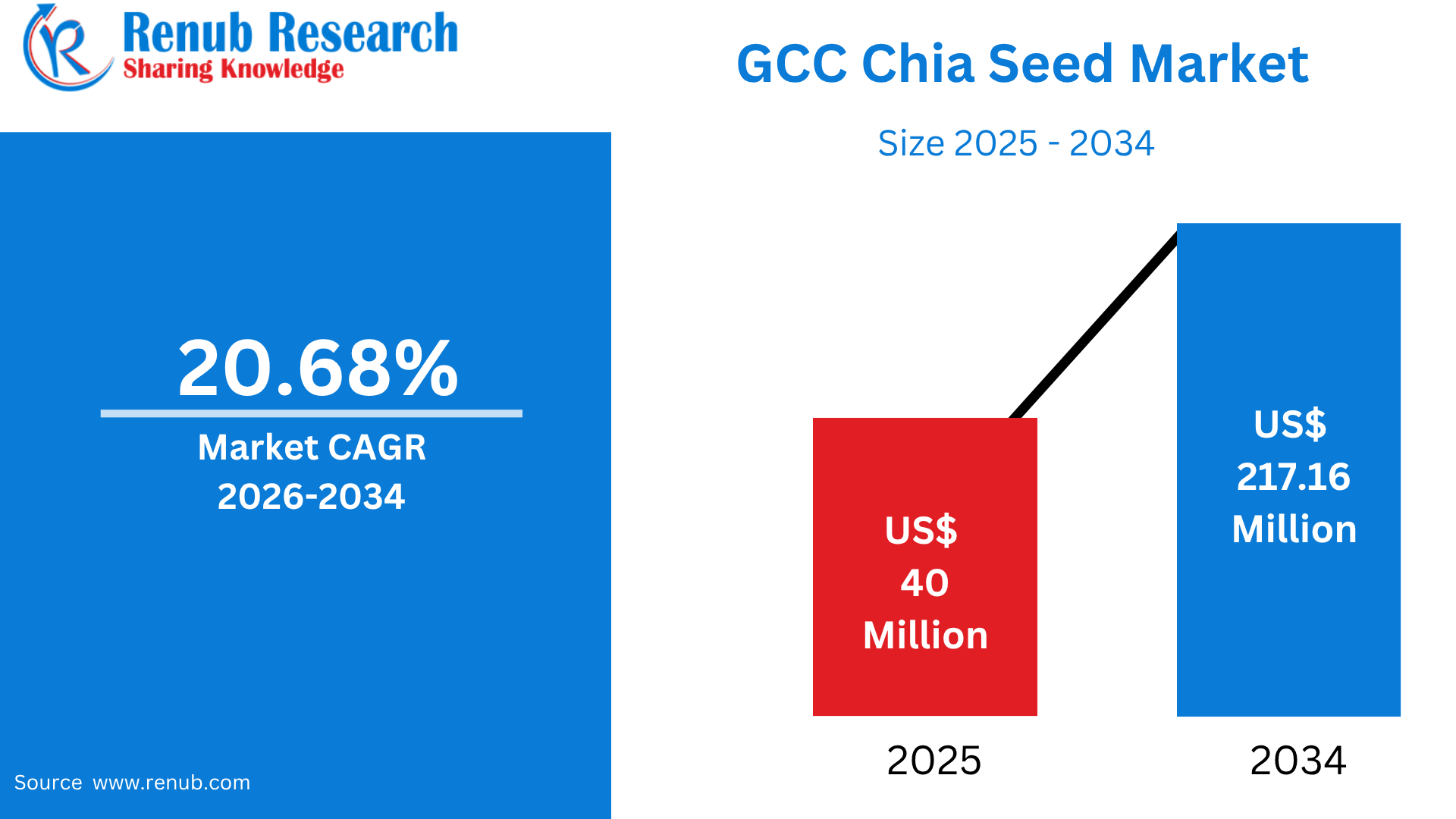
The GCC Chia Seed Market is projected to expand substantially, increasing from US$ 40 million in 2025 to US$ 217.16 million by 2034, reflecting a Compound Annual Growth Rate (CAGR) of 20.68% during 2026–2034. This strong growth is supported by rising health and wellness awareness, growing consumer preference for plant-based nutrition, and increasing demand for nutrient-rich superfoods across the Gulf Cooperation Council region. The growing emphasis on healthy lifestyles and nutrition-focused consumption is expected to further strengthen demand for chia seeds across GCC countries over the forecast period.
What is Chia Seed and its Uses & Popularity in GCC
Chia seeds are small, nutrient-dense edible seeds obtained from Salvia hispanica, a plant native to Central America. They are widely recognized as a superfood because they contain dietary fiber, plant-based protein, omega-3 fatty acids, antioxidants, and essential minerals. Chia seeds can absorb substantial amounts of liquid and develop a gel-like texture, making them suitable for smoothies, yogurt, breakfast bowls, puddings, cereals, bakery products, energy bars, beverages, and dietary supplements. They are also used in plant-based recipes as a natural thickening ingredient and egg substitute. In the GCC, chia seeds are becoming increasingly popular as consumers show greater interest in healthy, organic, plant-based, and functional foods. Saudi Arabia and the UAE are important consumption markets, supported by modern supermarkets, health-food stores, cafés, and online grocery platforms.
Obesity Prevalence by GCC Country in 2025
- Saudi Arabia: Adult obesity prevalence is approximately 35.4%, reflecting the impact of sedentary lifestyles, changing dietary patterns, and rapid urbanization.
- United Arab Emirates (UAE): The UAE records an obesity prevalence of around 31.7%, associated with reduced physical activity, urban lifestyles, and increased consumption of processed foods.
- Kuwait: Kuwait reports one of the highest obesity rates in the GCC at approximately 37.9%, placing it among countries with a particularly high adult obesity burden.
- Qatar: Adult obesity prevalence in Qatar is estimated at approximately 35.1%, with urbanization, dietary changes, and increasingly sedentary lifestyles contributing to the trend.
- Bahrain: Bahrain records an obesity prevalence of approximately 29.8%, which remains a significant public-health concern despite being lower than rates reported in several other GCC countries.
- Oman: Oman has an estimated obesity prevalence of approximately 27%–30%, representing the lowest range among the GCC countries listed, although increasing urbanization and lifestyle changes continue to influence obesity trends.
Source: DataPandas.org
Growth Drivers of the GCC Chia Seed Market
Rising Health Consciousness and Demand for Superfoods
Growing awareness of nutrition, preventive healthcare, weight management, and healthy lifestyles is increasing demand for nutrient-rich foods such as chia seeds across GCC countries. Chia seeds are particularly attractive because they combine fiber, plant-based protein, omega-3 fatty acids, and antioxidants in a convenient ingredient. This aligns with the region’s expanding interest in functional and natural foods. Saudi Arabia provides an important example of the underlying health opportunity: GASTAT reported in 2024 that 23.1% of Saudis aged 15 years and above were obese, while 45.1% were overweight. Only 10.2% reported consuming the recommended five or more daily servings of fruits and vegetables. These health-related trends are encouraging consumers to explore nutrient-dense food alternatives. Fitness culture, wellness programs, nutrition-focused social media content, and demand for plant-based diets are also increasing chia-seed visibility. Consequently, chia seeds are increasingly incorporated into smoothies, yogurt, cereals, salads, puddings, and health-oriented snacks.
Expansion of Plant-Based and Functional Food Consumption
The shift toward plant-based, natural, clean-label, and functional foods is creating new applications for chia seeds throughout the GCC food industry. Chia provides plant-based protein and fiber while also supplying omega-3 fatty acids, making it suitable for consumers seeking nutritional ingredients without animal-derived components. Market research identifies growing demand for chia seeds in food and beverages, pharmaceuticals and nutraceuticals, personal care and cosmetics, and other applications. Food manufacturers can incorporate chia into cereals, bakery products, nutrition bars, dairy alternatives, smoothies, juices, and functional beverages. Restaurants and cafés are also using chia-based ingredients in breakfast bowls, puddings, beverages, and wellness-oriented menus. As consumers increasingly seek convenient products that combine taste with nutritional benefits, manufacturers are expected to introduce more chia-fortified foods and beverages, supporting demand for both whole and processed chia ingredients.
Expanding Retail Channels and E-Commerce Penetration
The development of modern grocery retail, health-food stores, specialty outlets, and e-commerce platforms is significantly improving the availability of chia seeds across GCC markets. Consumers can increasingly purchase whole, ground, organic, and packaged chia seeds through supermarkets and online grocery platforms, making the ingredient more accessible beyond specialized health-food stores. The UAE and Saudi Arabia are particularly important digital grocery markets. According to McKinsey, online grocery sales increased at a 27% CAGR in the UAE and 25% CAGR in Saudi Arabia between 2021 and 2023. In 2023, online grocery penetration reached 6.4% in the UAE, while consumer intentions to increase online shopping in 2024 reached 33% in the UAE and 30% in Saudi Arabia. This expanding digital infrastructure provides chia-seed brands with additional channels to reach health-conscious consumers. Product reviews, social-media marketing, recipe content, subscription purchasing, and promotional campaigns can further increase awareness. Consequently, wider retail distribution and e-commerce accessibility are expected to support the GCC chia seed market’s rapid expansion.
Challenges of the GCC Chia Seed Market
Dependence on Imports and Higher Product Costs
A significant challenge for the GCC chia seed market is its dependence on imported raw materials because commercial chia cultivation is limited in the region. Chia seeds are primarily sourced from international producing markets, meaning GCC suppliers and consumers can be exposed to import costs, transportation expenses, currency fluctuations, and changes in international commodity prices. These factors can increase the retail price of chia seeds compared with locally available conventional food ingredients. The UAE chia seed market, for example, has been identified as facing challenges associated with high import costs and limited local production. Higher prices may restrict adoption among price-sensitive consumers and create challenges for manufacturers using chia as a functional ingredient at scale. Import-dependent supply chains can also increase exposure to shipping disruptions and changes in international trade conditions. Companies therefore need efficient sourcing strategies, reliable supplier networks, inventory planning, and competitive pricing to maintain availability. As the GCC market expands rapidly, managing procurement and logistics costs will remain important for sustaining consumer demand and protecting margins.
Limited Consumer Awareness and Product Familiarity
Although awareness of superfoods is increasing in major GCC cities, chia seeds remain a relatively specialized ingredient compared with established staples. Differences in consumer familiarity, dietary preferences, and purchasing behavior across Saudi Arabia, the UAE, Kuwait, Qatar, Oman, and Bahrain can make market expansion uneven. Chia seeds also compete with other seeds and functional ingredients, including flaxseed, sunflower seeds, pumpkin seeds, oats, and various nuts. Manufacturers therefore need to communicate the nutritional characteristics and practical applications of chia clearly without relying on unsupported health claims. Consumer education through recipes, product demonstrations, nutrition-focused marketing, and social-media campaigns can help increase familiarity. The versatility of chia—its use in smoothies, yogurt, cereals, bakery products, beverages, and puddings—provides opportunities to introduce the ingredient through familiar foods. Nevertheless, sustained market development requires broader consumer education and continued product innovation. This challenge is particularly relevant outside major urban centers, where access to specialty health foods and awareness of emerging functional ingredients may be comparatively lower.
Chia Seed Product Launches and Innovations Relevant to the GCC Market
- Nutiva – Glyphosate Residue-Free Organic Chia Seeds (August 2022): Nutiva, a plant-based organic superfood company, announced that its Organic Chia Seeds had received Glyphosate Residue Free certification from The Detox Project. The certification strengthened the product’s positioning around organic integrity, ingredient transparency, and cleaner-label consumption, trends that are increasingly relevant to health-conscious GCC consumers.
- Benexia – Encapsulated Chia Oil (November 2023): Chilean chia specialist Benexia introduced an encapsulated oil as part of its efforts to develop new applications for chia. The innovation demonstrates the expansion of chia beyond conventional whole-seed products into value-added ingredients and functional formulations, creating opportunities across food, beverage, nutraceutical, and supplement applications.
- Yanmar and Chia Tai – Agricultural Technology Collaboration (October 2024): Yanmar S.P. Company Limited and Chia Tai Company Limited signed a Memorandum of Understanding (MoU) to promote more advanced agricultural practices. The collaboration focuses on technologies such as drones and auto-steering systems to improve farming efficiency and yields. Such developments can support more efficient and traceable agricultural supply chains for crops including chia.
- Nature’s Path – Chia-Infused Regenerative Organic Oatmeal (September 2024): Nature’s Path Organic Foods expanded its portfolio in the United States with a Regenerative Organic Certified flavored oatmeal range. The Berries & Cream variety combines organic oats with freeze-dried raspberries, strawberries, blueberries, and chia seeds, illustrating the integration of chia into convenient, nutrient-dense breakfast products.
- Talia Group – Organic Chia Supply Chain Collaboration (February 2025): Talia Group Limited established a strategic collaboration with local cooperatives in Uganda’s Acholi Subregion to strengthen compliance with international organic standards. The initiative emphasizes traceability and organic integrity, responding to international buyers’ growing preference for direct producer relationships and transparent supply chains.
Natural Form and Strong Consumer Acceptance
Whole chia seeds represent a major form segment in the GCC market because they require minimal processing, offer convenient storage, and are easy to incorporate into everyday diets. Consumers increasingly use whole seeds in water, smoothies, yogurt, salads, cereals, puddings, and breakfast bowls. Chia seeds are valued for their fiber, omega-3 fatty acids, protein, antioxidants, and minerals, supporting their positioning as a nutrient-dense superfood. Their ability to absorb liquid and form a gel-like consistency also supports applications in weight-management and functional nutrition products. Demand is strengthened by growing interest in organic, clean-label, and plant-based foods across Saudi Arabia and the UAE. Retail consumers represent an important demand base, with supermarkets, health-food stores, and e-commerce platforms improving accessibility.
Growing Demand for Convenient Functional Ingredients
Milled or ground chia seeds are gaining traction in the GCC because their fine texture allows manufacturers and consumers to incorporate them easily into a wide range of foods and beverages. Ground chia can be blended into bakery products, cereals, smoothies, protein shakes, nutrition bars, fortified foods, and dietary formulations without the visible texture associated with whole seeds. The global chia market formally segments products into whole, milled/ground, pre-hydrated, and chia-oil forms, reflecting the expanding range of value-added applications. GCC demand is being supported by rising interest in ready-to-use functional ingredients and convenient nutrition. However, ground chia requires greater attention to packaging and storage because exposing the seed’s oils to oxygen can accelerate oxidation. This creates additional requirements for airtight packaging, temperature control, and inventory management.
Expanding Functional Food Applications
Food and beverages represent a key application area for chia seeds in the GCC, supported by rising health awareness and demand for convenient, nutrient-rich products. Chia can be incorporated into breakfast cereals, bakery products, energy bars, smoothies, juices, dairy alternatives, puddings, and functional beverages. Its fiber, protein, and omega-3 content enables manufacturers to strengthen the nutritional positioning of consumer products. The GCC is also benefiting from the growing popularity of plant-based and clean-label products. Supermarkets, cafés, restaurants, and online grocery platforms are increasing consumer access to chia-containing products. Saudi Arabia’s retail chia market is particularly significant, with retail consumers identified as the largest end-user group and food and beverage manufacturers representing another important demand category.
Rising Interest in Preventive Nutrition
The pharmaceuticals and nutraceuticals segment is gaining importance as GCC consumers increasingly seek natural ingredients for preventive nutrition, wellness, and active lifestyles. Chia seeds provide dietary fiber, plant-based protein, omega-3 fatty acids, antioxidants, and essential minerals, making them suitable for nutritional powders, dietary supplements, functional foods, and wellness formulations. In the GCC, Saudi Arabia, the UAE, and Qatar offer opportunities for chia-based wellness products because of increasing health awareness, fitness participation, and demand for convenient nutrition. Saudi Arabia’s chia market is already characterized by demand from nutraceutical and supplement companies, alongside retail and food manufacturers. Product developers are increasingly exploring powdered chia, chia oil, capsules, and fortified formulations.
Saudi Arabia: Largest GCC Consumer Market and Distribution Hub
Saudi Arabia represents a major market for chia seeds in the GCC, supported by its large consumer base, expanding health-and-wellness sector, and growing availability of functional foods. Riyadh, Jeddah, and Dammam are identified as important market centers, supported by retail, distribution, and import infrastructure. Retail consumers represent the largest end-user group, while food and beverage manufacturers and nutraceutical companies provide additional demand. The Kingdom’s focus on healthier lifestyles under Vision 2030 also provides a supportive environment for nutrition-oriented products. Chia seeds are increasingly available through supermarkets, health-food stores, and e-commerce channels, improving accessibility beyond specialist outlets. Organic and conventional varieties, as well as whole, ground, oil, and pre-hydrated formats, provide manufacturers with opportunities to target different consumer groups.
UAE Premium Wellness and E-Commerce Demand
UAE has developed into an important market for premium health foods and functional ingredients, including chia seeds. High consumer purchasing power, an internationally diverse population, established modern retail, and strong wellness trends support demand for superfoods. Chia seeds are available through supermarkets, health-food stores, specialty retailers, and online grocery platforms, allowing consumers to purchase whole, organic, ground, and other value-added formats. The country’s role as a regional trade and logistics hub also facilitates the import and distribution of international chia seed brands. Chia is increasingly incorporated into smoothies, breakfast bowls, health beverages, bakery products, and café menus, particularly in major urban markets such as Dubai and Abu Dhabi. The UAE’s demand also benefits from the broader shift toward plant-based and functional nutrition documented across the GCC. This rapid expansion creates opportunities for premium organic products, ready-to-use formulations, chia-based beverages, and nutraceutical applications. Continued retail diversification and digital commerce are expected to strengthen UAE market accessibility.
Kuwait Health Awareness and Premium Food Consumption
Kuwait’s chia seed market is developing as consumers increasingly focus on healthier diets, functional foods, and plant-based nutrition. Chia seeds are particularly suited to wellness-oriented consumption because they provide fiber, plant-based protein, omega-3 fatty acids, and antioxidants in a convenient ingredient. Modern supermarkets, health-food stores, and online retailers are expanding access to imported chia products, while social media and fitness-oriented lifestyles are increasing consumer awareness. Kuwait also has a substantial underlying health opportunity: WHO data report 38.3% adult obesity prevalence, with 73.7% of adults classified as overweight and 53.6% reporting physical inactivity in the cited national profile. These conditions can increase interest in nutrition-focused foods, although chia seeds should be viewed as one dietary ingredient rather than a treatment for obesity or related diseases. Premium purchasing power supports demand for organic and specialized health-food products. As GCC chia consumption expands, Kuwaiti retailers and food manufacturers can capitalize on whole seeds, ground chia, chia beverages, breakfast products, and nutraceutical formulations to broaden adoption.
Qatar Growing Wellness Culture and Functional Food Adoption
Qatar’s chia seed market is expanding alongside growing consumer interest in wellness, sports nutrition, functional foods, and healthier dietary choices. Chia seeds are increasingly suitable for products such as smoothies, breakfast bowls, nutrition bars, bakery products, functional beverages, and dietary supplements. Their nutritional profile—particularly fiber, plant-based protein, and omega-3 fatty acids—supports their positioning within the growing superfood category. Doha provides an important consumption center, supported by modern supermarkets, specialty food retailers, cafés, fitness-oriented businesses, and online shopping channels. Qatar’s internationally diverse population also creates exposure to global food trends, including plant-based diets and functional nutrition. Retailers and foodservice operators in Qatar can benefit from product diversification, including organic whole seeds, ground chia, chia-containing beverages, and ready-to-eat wellness foods. Continued consumer education and digital retail expansion are expected to support broader adoption.
GCC Chia Seed Market Segments
Form
- Whole Chia
- Milled/Ground Chia
- Pre-hydrate Chia
- Chia Oil
Application
- Food & Beverages
- Pharmaceuticals & Nutraceuticals
- Personal Care & Cosmetics
- Others
Countries
- Saudi Arabia
- UAE
- Kuwait
- Qatar
- Oman
- Bahrain
- Rest of GCC
All companies have been covered with 5 Viewpoints
- Overviews
- Key Person
- Recent Developments
- SWOT Analysis
- Revenue Analysis
Key Players Analysis
- Spectrum Organic Products LLC
- Bayer AG
- The Chia Co.
- Mamma Chia
- Benexia Chia
- Chiatrition Chia Seeds
- Glanbia Nutritionals
- Health Works Chia Seeds
Report Details:
| Report Features | Details |
| Base Year |
2025 |
| Historical Period |
2022 - 2025 |
| Forecast Period |
2026 - 2034 |
| Market |
US$ Billion |
| Segment Covered |
Form, Application and Countries |
| Countries Covered |
|
| Companies Covered |
|
| Customization Scope |
20% Free Customization |
| Post-Sale Analyst Support |
1 Year (52 Weeks) |
| Delivery Format |
PDF and Excel through Email (We can also provide the editable version of the report in PPT/Word format on request) |
Customization Services available
- Analysis of Market Size and Its Segments
- More Company Profiles (Upto 10 without any additional cost):
- Additional Countries (Other than mentioned Countries):
- Region/Country Specific Reports:
- Market Entry Strategy:
- Region-Specific Market Dynamics:
- Regional Market Share Analysis:
- Trade Analysis:
- Production Insights:
- Others Customized Requests:
For more information contact our analysts.
Need More Assistance?
- Talk to our analysts to get more precious information on the current market trends.
- Include more countries and segments and customize the report based on the final requirement.
- Get a competitive advantage in your industry by knowing the report findings and making a positive impact on your revenues and operations.
- Our analysts are always ready to provide more help and pertinent information if you need any additional assistance.