Commercial Greenhouse Market Size, Share, Trends & Forecast by Type, Product Type, Equipment Type, Greenhouse Type and Country, 2026–2034
Buy NowCommercial Greenhouse Market Size and Forecast
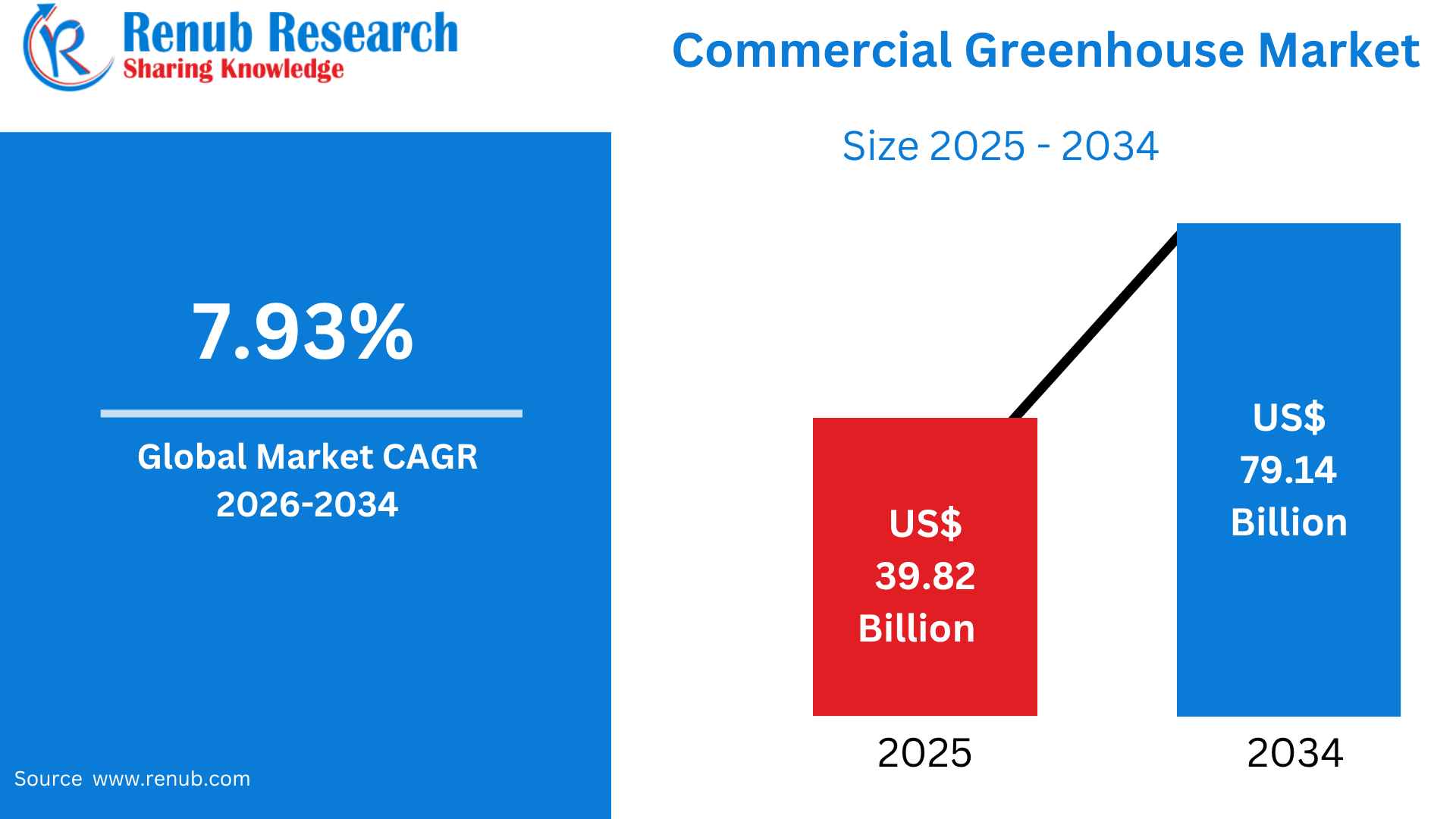
Commercial Greenhouse Market is projected to expand from US$ 39.82 billion in 2025 to US$ 79.14 billion by 2034, registering a CAGR of 7.93% between 2026 and 2034. Market growth is being supported by the increasing need for year-round crop production, improved food security, and efficient utilization of agricultural resources. Commercial greenhouses enable growers to maintain controlled environmental conditions, allowing crops to be cultivated beyond traditional growing seasons while improving productivity and quality. In addition, rapid advancements in greenhouse automation, climate-control systems, artificial intelligence, IoT-enabled monitoring, hydroponics, and precision agriculture technologies are improving operational efficiency and resource management.
What is a Commercial Greenhouse and Its Uses & Popularity Worldwide
A commercial greenhouse is a controlled agricultural structure designed for large-scale cultivation of crops under protected environmental conditions. Unlike traditional open-field farming, commercial greenhouses allow growers to regulate important factors such as temperature, humidity, light, irrigation, carbon dioxide, and nutrient levels, creating favorable conditions for crop growth throughout the year. They are widely used to produce vegetables, fruits, flowers, herbs, seedlings, and other high-value crops. Technologies such as automated climate control, hydroponics, fertigation, artificial lighting, sensors, and IoT-based monitoring are increasingly integrated into modern greenhouse operations to improve productivity and resource efficiency.
Commercial greenhouses are gaining popularity worldwide because they support year-round cultivation, higher crop yields, consistent quality, and efficient use of water and land. They are particularly valuable in regions facing harsh climates, limited arable land, water shortages, or unpredictable weather conditions. Growing populations and increasing demand for fresh produce are encouraging investments in protected agriculture. Furthermore, climate change and the need for reliable food production are accelerating adoption. North America, Europe, and Asia-Pacific are major markets, while developing agricultural economies are increasingly investing in advanced greenhouse infrastructure.
TOP 10 COUNTRIES account for the largest shares of greenhouse coverage:
- China (60.4%)
- Spain (5.6%)
- Italy (4.1%)
- Mexico (3.3%)
- Turkey (2.4%)
- Morocco (2.3%)
- South Korea (1.8%)
- Japan (1.7%)
- Netherlands (1.4%)
- France (1.3%)
Growth Drivers of the Commercial Greenhouse Market
Rising Demand for Year-Round Crop Production
The growing need for continuous, reliable, and predictable food production is a major driver of the commercial greenhouse market. Conventional agriculture remains highly dependent on seasonal conditions, rainfall, temperature, and soil quality, whereas greenhouses allow growers to control critical environmental factors and extend production beyond traditional growing seasons. FAO describes protected cultivation as a system that enables high-value crops to be produced on relatively small areas, including regions where conventional farming may be difficult because of water or land limitations. Greenhouse cultivation is particularly important for vegetables, fruits, herbs, flowers, and other high-value horticultural crops. Growing urban populations and increasing demand for fresh produce throughout the year are encouraging commercial growers to invest in controlled-environment agriculture. Greenhouses also help reduce exposure to extreme weather, allowing producers to maintain more consistent crop quality and supply. As retailers and foodservice companies increasingly require dependable year-round supplies, commercial growers are adopting protected cultivation technologies. This trend is expected to remain a strong growth catalyst as food-security concerns and climate variability increase globally.
Advancements in Greenhouse Automation and Smart Technologies
Rapid technological development is transforming traditional greenhouses into highly automated and data-driven production facilities, creating significant opportunities for market expansion. Modern commercial greenhouses increasingly incorporate sensors, automated irrigation, climate-control systems, artificial intelligence, IoT platforms, computer vision, and precision fertigation. These technologies enable growers to continuously monitor temperature, humidity, light, nutrient levels, and crop conditions, allowing faster adjustments to the growing environment. Image-based crop-monitoring technologies are also emerging as tools for tracking plant growth, health, and productivity while reducing the need for labor-intensive manual monitoring. Hydroponic and automated greenhouse systems can further improve fertilizer and resource management. Commercial greenhouse technologies are therefore becoming increasingly attractive to large-scale growers seeking higher productivity and more predictable production.
Increasing Focus on Water and Resource Efficiency
Growing pressure on water resources, agricultural land, and production efficiency is encouraging investment in commercial greenhouse systems. Greenhouses provide growers with greater control over irrigation and crop environments, helping reduce unnecessary water losses compared with many conventional farming practices. FAO research highlights that greenhouse production can improve water-use efficiency because protected environments reduce factors such as wind movement and excessive evaporation while allowing growers to manage irrigation more precisely. This advantage is particularly important in water-stressed agricultural regions where producers need to increase output without proportionally increasing water consumption. Modern greenhouses can combine drip irrigation, fertigation, water recycling, hydroponics, and automated moisture monitoring to optimize resource use. Protected cultivation can also generate higher productivity per unit of land, making it attractive where farmland is limited or expensive. As climate change increases concerns about drought, heat, and unpredictable weather, growers are placing greater emphasis on resilient production systems. Consequently, resource-efficient greenhouse technologies are expected to gain wider adoption across developed and emerging agricultural markets.
Challenges of the Commercial Greenhouse Market
High Initial Investment and Operating Costs
The substantial capital required to establish and operate commercial greenhouse facilities remains one of the primary barriers to market expansion. Modern commercial greenhouses require investment in structural systems, glazing or plastic coverings, heating and cooling equipment, ventilation, lighting, irrigation, fertigation, sensors, automation, and climate-control technologies. Advanced facilities incorporating hydroponics, artificial intelligence, robotics, and automated environmental management can require considerably higher upfront investment than conventional farming operations. Operating costs can also be significant because greenhouse facilities may require continuous electricity for heating, cooling, lighting, pumping, and automated systems. Energy costs are particularly important for growers operating in colder climates or facilities with intensive artificial lighting. Smaller agricultural producers may therefore find it difficult to finance technologically advanced greenhouse infrastructure. Although higher productivity and resource efficiency can improve long-term economics, the payback period can vary considerably depending on crop prices, energy costs, technology selection, and local climate. As a result, access to financing, government incentives, and affordable technologies will remain important for encouraging broader commercial greenhouse adoption, particularly among small and medium-sized growers.
Energy Dependence, Technical Complexity, and Skilled-Labor Requirements
Commercial greenhouses increasingly depend on sophisticated technologies and energy-intensive environmental-control systems, creating operational challenges for growers. Heating, cooling, ventilation, artificial lighting, irrigation pumps, and automated systems can significantly influence production costs. Energy price volatility can therefore affect greenhouse profitability, particularly in regions where climate control is required throughout the year. In addition, advanced greenhouse operations require specialized knowledge to manage sensors, automation platforms, hydroponic systems, crop-monitoring technologies, and climate-control equipment. A shortage of skilled workers can make it difficult for growers to operate and maintain sophisticated facilities effectively. Technology failures can also disrupt environmental conditions and potentially damage high-value crops if problems are not identified quickly. Nevertheless, automation and precision technologies are increasingly being developed to reduce manual workloads and improve monitoring. FAO notes that protected cultivation can improve water and resource efficiency, but achieving these benefits depends on appropriate management and infrastructure. Therefore, reducing energy consumption, improving renewable-energy integration, simplifying greenhouse technologies, and developing skilled technical workforces will be important for overcoming these challenges.
Commercial Greenhouse Product & Technology Launches Worldwide
- KUBO Carbon-Negative Greenhouse System – Netherlands (2024): KUBO Greenhouses introduced a carbon-negative cultivation concept designed to reduce fossil-energy consumption while maintaining commercial crop productivity.
- Canopii Autonomous Robotic Greenhouse – United States (2026): Oregon-based Canopii completed its first commercial harvest cycle from a fully autonomous robotic greenhouse, highlighting the growing use of robotics and automation in commercial cultivation.
- Albotherm Low-Emission Greenhouse Technology – United Kingdom (2026): Albotherm, together with CPI and agricultural partners, launched a £2 million development project focused on scaling low-emission greenhouse technology for UK growers.
- Ridder–RED Horticulture Integrated Greenhouse Solution – Europe (2026): Ridder and RED Horticulture announced a product-integration partnership combining greenhouse lighting and energy-management systems, enabling growers to manage major operating costs through a unified system.
- Gakon Netafim High-Tech Greenhouse – Canada (2025): Gakon Netafim developed a 10-acre high-tech greenhouse project with Vermillion Growers for year-round vine-tomato production in Central Canada.
- Topian High-Tech Greenhouse – Saudi Arabia (2024): NEOM food company Topian launched its first high-tech greenhouse in Oxagon, supporting controlled-environment food production in Saudi Arabia's challenging climate.
- Agriplast Technology Vision 2030 – India (2025): Agriplast Tech India introduced its Technology Vision 2030, emphasizing precision farming, innovative greenhouse systems, and soilless cultivation for commercial agriculture.
- AI-Based Smart Greenhouse Disease Detection System – 2025: Researchers developed an IoT- and AI-enabled aeroponic greenhouse system capable of continuously monitoring environmental conditions and detecting plant diseases. The VGG-19 model achieved 92% accuracy in identifying drought stress and rust symptoms.
- UAV Greenhouse Crop Monitoring Technology – 2025: Researchers introduced a greenhouse monitoring approach using UAVs equipped with RGB-D cameras, 3D LiDAR, and IMUs. The system achieved 94.4% accuracy in cherry-tomato counting and 87.5% accuracy in weight estimation in testing.
- Redwire Commercial Space Greenhouse – 2026: Redwire's commercial space greenhouse was selected for an International Space Station mission involving strawberry cultivation and testing of regenerative agricultural technologies, marking a new application of controlled-environment greenhouse technology beyond Earth.
Cost-Effective and Durable Growing Commercial Greenhouse Plastic Solutions
Commercial greenhouse plastics are an essential component of modern protected agriculture because they offer affordability, flexibility, lightweight construction, and durability compared with conventional glass coverings. Materials such as polyethylene (PE), polycarbonate, and polyvinyl chloride (PVC) are widely used for greenhouse structures. Their ability to transmit sunlight while providing insulation creates favorable conditions for crop growth. Plastic coverings can help maintain internal temperatures, retain heat, and protect crops from heavy rainfall, wind, pests, and temperature fluctuations. Advanced greenhouse films increasingly incorporate UV stabilization, anti-drip coatings, light-diffusion properties, and thermal additives, improving durability and crop performance. These materials are particularly attractive to small and medium-sized growers because installation and replacement costs can be lower than those associated with glass structures. Commercial greenhouse plastics are used extensively for cultivating vegetables, fruits, flowers, and nursery plants. As growers seek higher productivity, longer cultivation seasons, and improved resource efficiency, demand for technologically advanced greenhouse films is increasing. The growing adoption of protected agriculture and sustainable farming practices is expected to further support the commercial greenhouse plastics segment.
Growing Demand for Fresh Produce
Fruits and vegetables represent a major application area for commercial greenhouse farming because controlled environments enable growers to achieve consistent quality, higher productivity, and year-round production. Greenhouses allow producers to regulate temperature, humidity, irrigation, light, and nutrient levels according to crop requirements. High-value crops such as tomatoes, cucumbers, peppers, lettuce, and strawberries are particularly suited to protected cultivation. Controlled environments can reduce exposure to extreme weather, helping minimize crop losses caused by frost, excessive rainfall, heat, and strong winds. Greenhouse cultivation can also improve water-use efficiency through drip irrigation, fertigation, hydroponics, and automated monitoring systems. The growing demand for fresh and locally produced food is encouraging supermarkets, foodservice companies, and agricultural enterprises to invest in commercial greenhouse facilities. Increasing urbanization and limited availability of agricultural land are further supporting controlled cultivation near population centers. In addition, advances in automation and precision agriculture are enabling growers to improve yields and maintain consistent crop quality. As consumers increasingly prioritize freshness, food quality, availability, and sustainable production, greenhouse cultivation of fruits and vegetables is expected to remain a key growth area.
Expanding Controlled Plant Production
Commercial greenhouses for nursery crops are primarily used to produce seedlings, young plants, ornamental flowers, shrubs, and landscaping plants under controlled environmental conditions. These facilities provide protection from unfavorable weather, pests, and temperature fluctuations, allowing nursery operators to maintain healthier plants and improve seedling survival rates. Greenhouse environments are particularly beneficial for plants requiring specific temperature, humidity, light, and moisture conditions during their early growth stages. Commercial growers also use greenhouse nurseries to produce strong seedlings that can later be transplanted into open fields, improving crop establishment and uniformity. Rising interest in home gardening, landscaping, ornamental horticulture, and urban greening is contributing to demand for nursery-grown plants. Greenhouses also allow producers to extend production seasons and maintain a more consistent supply of plants throughout the year. Increasing adoption of automated irrigation, climate monitoring, propagation systems, and efficient growing media is further improving nursery productivity. As horticulture and landscaping activities expand globally, commercial greenhouse nursery operations are becoming increasingly important for supplying high-quality planting material to farmers, gardeners, retailers, and professional landscaping companies.
Tunnel Affordable Protected Cultivation for Growers
Tunnel greenhouses, commonly known as high tunnels or hoop houses, are gaining popularity because they provide an affordable and relatively simple approach to protected cultivation. These structures generally consist of curved metal or plastic frames covered with polyethylene film or other lightweight materials. Compared with technologically intensive greenhouse systems, tunnel structures typically require lower initial investment and can be installed relatively quickly, making them particularly attractive to small and medium-sized farmers. High tunnels help growers extend both the beginning and end of the growing season, allowing earlier planting and later harvesting. They also provide protection against frost, heavy rain, strong winds, and temperature fluctuations, helping reduce environmental stress on crops. Tunnel systems are commonly used for vegetables, berries, flowers, and other specialty crops. Their relatively simple design also allows farmers to adapt or relocate structures according to production requirements. Growing demand for locally produced food and the need to improve farm productivity without major infrastructure investments are encouraging adoption. As farmers seek cost-effective methods to increase crop availability and protect production from increasingly unpredictable weather conditions, tunnel greenhouse systems are expected to maintain strong demand.
Hybrid Integrating Multiple Growing Technologies
Hybrid commercial greenhouses combine different structural, cultivation, and environmental-control technologies to create optimized conditions for large-scale crop production. These systems can integrate conventional greenhouse structures with advanced technologies such as hydroponics, LED lighting, automated irrigation, sensors, climate-control systems, and precision environmental management. Some hybrid designs also combine glass or plastic covering materials to balance natural light transmission, insulation, durability, and operating costs. The integration of multiple technologies enables growers to adjust growing conditions according to crop requirements and external weather conditions. Hydroponic systems can improve nutrient and water management, while LED lighting can supplement natural sunlight when light levels are insufficient. Automated climate-control systems can regulate temperature, humidity, ventilation, and carbon dioxide levels to support consistent plant growth. Hybrid systems are particularly relevant for commercial growers because they seek to maximize yield, crop quality, resource efficiency, and operational productivity. Although the initial investment and technical requirements can be higher, the combination of technologies can improve production efficiency over time. Continued innovation in controlled-environment agriculture is expected to strengthen the role of hybrid greenhouse systems in future commercial farming.
United States Advanced Controlled-Environment Agriculture
United States commercial greenhouse market is among the most technologically advanced greenhouse sectors worldwide, supported by strong demand for fresh produce, ornamental plants, and locally cultivated food. Commercial greenhouse farming enables growers to produce vegetables, fruits, flowers, and herbs throughout the year, reducing dependence on seasonal conditions and improving supply consistency. States with established agricultural industries are increasingly adopting controlled-environment agriculture (CEA) to improve productivity, optimize resource use, and reduce exposure to weather-related risks. Modern facilities are incorporating hydroponics, automated climate control, LED lighting, sensors, robotics, and data-driven crop management to enhance yields and quality. Growing consumer interest in locally produced and sustainably cultivated food is also encouraging investment in greenhouse production. Research institutions, agricultural technology companies, and government-backed initiatives are supporting innovation across the sector. In March 2026, Oregon-based ag-tech company Canopii Inc. announced that its fully autonomous robotic greenhouse had completed its first commercial harvest cycle and was preparing market-ready crops for the Willamette Valley, highlighting the increasing integration of automation and robotics into U.S. greenhouse farming.
United Kingdom: Strengthening Domestic Food Production
United Kingdom commercial greenhouse market is expanding as the country seeks to strengthen domestic food production and reduce reliance on imported fresh produce. The UK’s relatively cool climate and limited growing seasons make protected cultivation particularly valuable for maintaining consistent supplies of horticultural crops. Commercial greenhouses are widely used to cultivate tomatoes, cucumbers, peppers, lettuce, herbs, and other high-value crops under controlled conditions. Modern greenhouse technologies enable growers to regulate temperature, humidity, irrigation, lighting, and ventilation, thereby improving productivity and crop quality. Increasing emphasis on sustainable agriculture is also encouraging the adoption of energy-efficient systems, water-saving technologies, automation, and renewable-energy solutions. Urban and near-urban greenhouse projects are gaining attention because they can bring food production closer to consumers and reduce transportation requirements. In March 2026, Albotherm announced a £2 million collaborative project with CPI, the James Hutton Institute, and commercial farmer R&L Holt, supported through Defra’s Farming Innovation Programme and Innovate UK, reflecting continued investment in innovative greenhouse technologies and sustainable crop production.
India Accelerating Adoption of Protected Cultivation
India commercial greenhouse market is witnessing rapid expansion as farmers increasingly adopt protected cultivation to improve productivity, manage climate-related risks, and produce high-value horticultural crops. Greenhouse systems enable growers to control temperature, humidity, irrigation, and other environmental conditions, supporting the cultivation of tomatoes, capsicum, cucumbers, roses, gerbera, strawberries, and other premium crops across different seasons. Government programs supporting protected cultivation, greenhouse infrastructure, and financial assistance are helping improve technology adoption among farmers. At the same time, rising consumer demand for high-quality fruits, vegetables, flowers, and other horticultural products is encouraging commercial investment. Indian growers are increasingly combining polyhouses, drip irrigation, fertigation, shade nets, hydroponics, and precision-monitoring technologies to improve yields while conserving water and other resources. In September 2025, Agriplast Tech India announced its “Technology Vision 2030” at the HortiConnect Expo, highlighting precision farming, innovative greenhouse technologies, and soilless cultivation as approaches to address shrinking landholdings and improve agricultural productivity.
Saudi Arabia Supporting Food Security in Extreme Climates
Saudi Arabia commercial greenhouse market is gaining importance as the country seeks to strengthen food security, improve domestic agricultural production, and reduce dependence on imported food. Extreme temperatures, limited arable land, and water scarcity create significant challenges for conventional farming, making controlled-environment agriculture an attractive solution. Commercial greenhouses allow producers to create more suitable growing conditions for tomatoes, cucumbers, peppers, leafy vegetables, herbs, and other crops while improving control over irrigation and environmental conditions. Advanced technologies such as climate-control systems, precision irrigation, hydroponics, water-efficient cultivation, and automated monitoring are increasingly being incorporated into greenhouse projects. Government-led agricultural and food-security initiatives are also encouraging investment in protected cultivation and resource-efficient farming. In December 2024, NEOM’s food company Topian announced the launch of its first high-tech greenhouse in Oxagon, Saudi Arabia’s industrial zone on the Red Sea coast, demonstrating the country’s growing focus on advanced controlled-environment agriculture and locally produced food.
Market Segments
Type
- Plastic
- Glass
Product Type
- Fruits and Vegetables
- Flowers and Ornamentals
- Nursery Crops
- Others
Equipment Type
- Cooling
- Heating
- Others
Greenhouse Type
- Tunnel
- Gutter Connected
- Hybrid
- Lean-To Greenhouse
- Roof
Countries
North America
- United States
- Canada
Europe
- France
- Germany
- Italy
- Spain
- United Kingdom
- Belgium
- Netherlands
- Turkey
Asia Pacific
- China
- Japan
- India
- Australia
- South Korea
- Thailand
- Malaysia
- Indonesia
- New Zealand
Latin America
- Brazil
- Mexico
- Argentina
Middle East & Africa
- South Africa
- Saudi Arabia
- United Arab Emirates
All companies have been covered with 5 Viewpoints
- Overviews
- Key Person
- Recent Developments
- SWOT Analysis
- Revenue Analysis
Key Players Analysis
- Berry Global
- RICHEL Group
- Certhon Build B.V.
- Argus Control Systems Limited
- LOGIQS B.V.
- LumiGrow Inc.
- Keder Greenhouse
- Agra Tech Inc
- Hort Americas
Report Details:
| Report Features | Details |
| Base Year |
2025 |
| Historical Period |
2022 - 2025 |
| Forecast Period |
2026 - 2034 |
| Market |
US$ Billion |
| Segment Covered |
Type, Product Type, Equipment Type, Greenhouse Type and Countries |
| Countries Covered |
|
| Companies Covered |
|
| Customization Scope |
20% Free Customization |
| Post-Sale Analyst Support |
1 Year (52 Weeks) |
| Delivery Format |
PDF and Excel through Email (We can also provide the editable version of the report in PPT/Word format on request) |
Key Questions Answered in This Report:
-
What is the expected market size of the global commercial greenhouse market by 2033?
-
What is the projected CAGR of the commercial greenhouse market from 2025 to 2033?
-
What are the major factors driving the growth of the commercial greenhouse market?
-
Which greenhouse type is considered the most cost-effective and widely used?
-
How do smart greenhouse systems contribute to improving efficiency in agriculture?
-
What challenges hinder the widespread adoption of commercial greenhouses?
-
Which country has launched the first smart greenhouse with IoT connectivity in 2025?
-
What role do government initiatives play in the expansion of greenhouse farming?
-
How do hydroponic greenhouse systems help in sustainable agriculture?
-
What are the key technologies used in modern commercial greenhouses?
Customization Services available
- Analysis of Market Size and Its Segments
- More Company Profiles (Upto 10 without any additional cost):
- Additional Countries (Other than mentioned Countries):
- Region/Country Specific Reports:
- Market Entry Strategy:
- Region-Specific Market Dynamics:
- Regional Market Share Analysis:
- Trade Analysis:
- Production Insights:
- Others Customized Requests:
For more information contact our analysts.
Need More Assistance?
- Talk to our analysts to get more precious information on the current market trends.
- Include more countries and segments and customize the report based on the final requirement.
- Get a competitive advantage in your industry by knowing the report findings and making a positive impact on your revenues and operations.
- Our analysts are always ready to provide more help and pertinent information if you need any additional assistance.