Global Bioplastic Market Report by Material Type (Biodegradable, Non-Biodegradable), Application, Country and Company Analysis 2026-2034
Buy NowBioplastic Market Size and Forecast 2026-2034
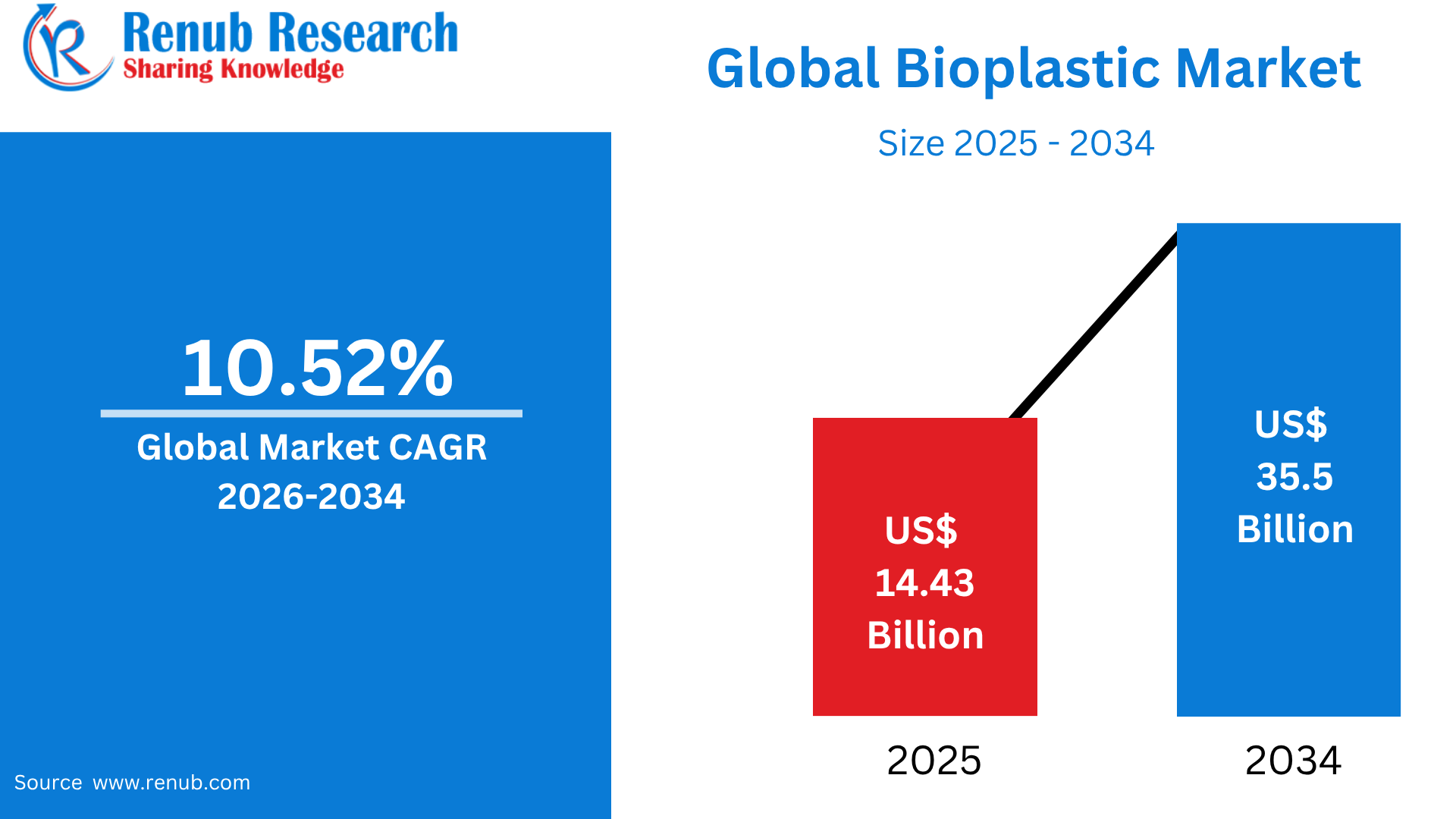
Bioplastic Market is expected to reach US$ 35.5 billion by 2034 from US$ 14.43 billion in 2025, with a CAGR of 10.52% from 2026 to 2034. Among the main drivers propelling the market's expansion are the public's growing awareness of environmental sustainability, the imposition of more stringent laws pertaining to waste management and emissions, and the growing demand for eco-friendly goods.
Bioplastic Industry Overview
The bioplastic industry is gaining significant traction as environmental concerns and sustainability goals reshape material consumption patterns worldwide. Bioplastics are derived from renewable resources such as corn starch, sugarcane, and cellulose, offering a more sustainable alternative to conventional petroleum-based plastics. With increasing awareness about plastic pollution and its long-term environmental impact, industries are actively transitioning toward biodegradable and bio-based materials. Governments across various regions are implementing strict regulations on single-use plastics, further encouraging the adoption of bioplastics in sectors such as packaging, agriculture, automotive, and consumer goods. The shift toward a circular economy is also playing a vital role in accelerating the demand for sustainable materials, positioning bioplastics as a key solution.
The packaging sector remains the dominant application area for bioplastics, driven by rising demand from food and beverage, e-commerce, and retail industries. Companies are increasingly focusing on sustainable packaging solutions to meet regulatory requirements and consumer expectations. Technological advancements in material science have improved the performance characteristics of bioplastics, making them more durable, flexible, and suitable for diverse applications. Innovations in biopolymer development are enabling the production of high-performance materials that can compete with conventional plastics in terms of functionality and cost efficiency. Additionally, collaborations between manufacturers, research institutions, and governments are fostering innovation and expanding the application scope of bioplastics.
Despite promising growth prospects, the bioplastic industry faces challenges such as high production costs, limited availability of raw materials, and inadequate waste management infrastructure. The lack of standardized labeling and composting facilities can create confusion regarding disposal methods, limiting the environmental benefits of bioplastics. Furthermore, competition from conventional plastics, which are often more cost-effective, may hinder widespread adoption. However, continuous research and development efforts, increasing investments in sustainable technologies, and growing consumer awareness are expected to address these challenges. As industries continue to prioritize sustainability and environmental responsibility, the bioplastic market is poised for long-term growth, driven by innovation and expanding global adoption.
Recent Developments in Bioplastic Market
- In EarthPlus Hercules Bioflex Stretch Wrap, our newest environmentally friendly packaging that can be used for food wrap and pallet wrap, was successfully introduced in May 2025, according to Intec Bioplastics, Inc. We are the world's most sustainable and economically viable stretch wrap. Bio-resin engineering firm Intec Bioplastics, Inc. helps its clients reach their sustainability objectives of a Net Zero Carbon Footprint, Net Zero plastic, and waste to landfills.
- Buscar Company, a diversified holding company with a focus on sustainable energy and natural resources, announced a strategic purchase in April 2025. Through a stock transfer, the company acquired a 50% share in Terramer, Inc., a pioneer in hemp-based bioplastics. The $44 billion bioplastics business is predicted to be disrupted by this factory, which can generate up to 300 million pounds of bioplastic annually.
Continuous growth: global production capacities of biobased plastics
- Global biobased plastics production capacity currently represents roughly 0.5% of the 431 million tonnes of plastics produced annually.
- Global plastics production is maintaining its upward trajectory, supported by expanding end-use industries and innovation in material performance. Within this momentum, bioplastics continue to rise. Current forecasts indicate that global biobased plastics production capacity will double from 2.31 million tonnes in 2025 to about 4.69 million tonnes by 2030 reflecting rising demand and emergence of ever more advanced applications and products.
- Although varying in some parts quite significantly from one polymer to another, ranging from 28% to 100%, the comparison between the production capacities and actual production in 2025 shows that the bioplastics industry is currently producing at an average of 72% of global capacity (1.67 million tonnes production vs. 2.31 million tonnes production capacities). The European biobased bioplastics industry is producing at an average of 73% of capacity.
Growth Drivers for the Bioplastic Market
Constant Improvements in Technology
Another important factor supporting the bioplastics market is technological innovation. Furthermore, bioplastics are becoming more and more similar to their petroleum-based equivalents in terms of cost and performance because to developments in polymer science, material engineering, and production techniques. Additionally, a number of major firms are creating alliances and working together to take advantage of cutting-edge technologies for the manufacture of bioplastics. For example, in March 2024, Sulzer Ltd. agreed to provide Balrampur Chini Mills Limited (BCML) with its state-of-the-art polylactic acid (PLA) production technologies in order to facilitate the building of India's first bioplastics facility. Using sugarcane as a feedstock, the new, cutting-edge bioplastics facility will generate 75,000 tons of fully recyclable, biodegradable bioplastic annually. Additionally, a number of businesses are using waste materials in novel ways to create bioplastics and lessen environmental pollution, which is driving the bioplastics market's earnings. For example, PlantSwitch, a bioplastics company, produces 50 million pounds of bioplastic pellets annually from at least 30 million pounds of agricultural waste.
Growing Use in the Food Sector
A favorable picture for the market as a whole is also being created by the growing use of flexible bioplastics in the food and beverage industry. Applications for cornstarch-based bioplastics include flexible and loose-fill packaging. Additionally, the demand for bioplastics for packaging is being boosted by the growing demand for ready-to-cook food packaging due to consumers' busy lifestyles, the world's expanding working population, and their rising purchasing power. The market for ready-to-eat meals is expected to generate US$1.02 billion in revenue by 2024.
By 2025, the market is probably going to double. In a similar vein, Germany's food and beverage industry is distinguished by its more than 6,000 small and medium-sized businesses. In 2021, the food and beverage industry was projected to generate US$3,222 million in revenue. The market is anticipated to expand dramatically in the upcoming years, propelling the nation's use of bioplastics and flexible and rigid packaging.
Growing Concerns About the Environment
Growing environmental concerns are pushing a number of sectors to switch from plastics to bioplastics, which is a major factor propelling the market. Additionally, the demand for bio-based or compostable bags used in the collecting of food leftovers and other organic waste is increasing due to the growing efforts of government authorities around the world to prevent landfilling, such as the U.S. 2030 Food Loss and Waste Reduction Goal. In a similar vein, the government of India's ambitious biomanufacturing project and the global ban on single-use plastics are acting as facilitators for the manufacture of bioplastics.
Furthermore, as of 2023, 10 states—California, Connecticut, Delaware, Hawaii, Maine, New Jersey, New York, Oregon, Vermont, and Washington—had some kind of statewide ban on single-use plastic bags; prohibitions in Colorado and Rhode Island took effect on the first day of 2024. The market share of bioplastics is being further accelerated by such activities.
Challenges in the Bioplastic Market
High Production Costs and Price Competitiveness
One of the primary challenges in the bioplastic market is the high production cost compared to conventional plastics. The use of renewable raw materials and specialized production processes often results in higher manufacturing expenses. Additionally, limited economies of scale and supply chain inefficiencies further contribute to increased costs. These factors make bioplastics less competitive in price-sensitive markets, particularly in developing regions. While demand for sustainable materials is growing, cost considerations remain a critical factor influencing purchasing decisions. Manufacturers are working to reduce costs through technological advancements and process optimization, but affordability remains a significant barrier. Addressing this challenge will be essential to ensure widespread adoption and long-term growth of the bioplastic market.
Limited Waste Management and Composting Infrastructure
The lack of adequate waste management and composting infrastructure is another significant challenge for the bioplastic market. Bioplastics require specific conditions to degrade effectively, which are not always available in standard waste management systems. In many regions, the absence of industrial composting facilities limits the proper disposal and processing of biodegradable materials. This can result in bioplastics ending up in landfills, where they may not decompose as intended. Additionally, lack of standardized labelling and consumer awareness regarding disposal methods can create confusion and reduce environmental benefits. Improving waste management infrastructure and educating consumers about proper disposal practices will be crucial for maximizing the potential of bioplastics and ensuring their sustainable use.
United States Bioplastic Market
The United States bioplastic market is growing due to increasing environmental awareness and strong regulatory initiatives aimed at reducing plastic waste. Industries such as packaging, consumer goods, and automotive are adopting bioplastics to meet sustainability goals and comply with regulations. The presence of advanced research facilities and strong technological capabilities is supporting innovation in biopolymer development. Additionally, increasing investments in sustainable materials and growing consumer demand for eco-friendly products are driving market growth. Companies are focusing on developing high-performance bioplastics that can compete with conventional plastics. As sustainability becomes a key priority across industries, the adoption of bioplastics in the United States is expected to increase steadily.
Germany Bioplastic Market
The Germany bioplastic market is characterized by strong regulatory support and a well-established focus on sustainability and environmental protection. The country’s commitment to reducing plastic waste and promoting eco-friendly materials is driving the adoption of bioplastics across industries. The packaging and automotive sectors are key contributors to market growth, with companies actively integrating sustainable materials into their products. Germany’s advanced manufacturing capabilities and strong research ecosystem are supporting innovation in biopolymer development. Additionally, collaboration between industry players and government bodies is fostering the development of sustainable solutions. As the country continues to emphasize environmental responsibility and circular economy practices, the bioplastic market in Germany is expected to grow steadily.
China Bioplastic Market
The China bioplastic market is experiencing rapid growth driven by strong government regulations aimed at reducing plastic pollution. The country’s large manufacturing base and increasing industrial activities are creating significant demand for sustainable materials. The packaging sector is a key contributor, supported by growing demand from food and beverage and e-commerce industries. Additionally, investments in research and development and expansion of production capacities are strengthening the market. Increasing consumer awareness and demand for eco-friendly products are further supporting growth. The government’s focus on sustainability and environmental protection is encouraging the adoption of bioplastics across industries. As China continues to implement strict regulations and invest in sustainable technologies, the bioplastic market is expected to grow significantly.
United Arab Emirates Bioplastic Market
The UAE bioplastic market is gaining traction due to increasing government initiatives focused on sustainability and environmental conservation. The country is actively promoting the reduction of plastic waste through regulations and awareness campaigns. Growing demand for eco-friendly packaging solutions in sectors such as retail, food and beverage, and hospitality is driving market growth. The UAE’s commitment to sustainability and innovation is encouraging businesses to adopt biodegradable materials. Additionally, investments in advanced technologies and infrastructure are supporting market development. The presence of a strong tourism and hospitality sector is also contributing to demand for sustainable products. As environmental awareness continues to rise and regulatory support strengthens, the bioplastic market in the UAE is expected to witness steady growth.
Bioplastics Market Segments
Material Type
- Biodegradable
- Non-Biodegradable
Biodegradable
- PBAT
- PBS
- PLA
- PHA
- Starch Blends
- Others
Non-Biodegradable
- PE
- PET
- PA
- PP
- PTT
- Others
Application
- Packaging
- Agriculture
- Consumer goods
- Textile
- Automotive & Transportation
- Building & Construction
- Others
Countries
North America
- United States
- Canada
Europe
- France
- Germany
- Italy
- Spain
- United Kingdom
- Belgium
- Netherlands
- Turkey
Asia Pacific
- China
- Japan
- India
- Australia
- South Korea
- Thailand
- Malaysia
- Indonesia
- New Zealand
Latin America
- Brazil
- Mexico
- Argentina
Middle East & Africa
- South Africa
- Saudi Arabia
- United Arab Emirates
All companies have been covered with 5 Viewpoints
- Overviews
- Key Person
- Recent Developments
- SWOT Analysis
- Revenue Analysis
Key Players Analysis:
- Total Corbion
- Mitsubishi Chemical Holding Corporation
- Toray Industries
- BASF SE
- Green Dot Bioplastics
- Amcor Limited
Report Details:
| Report Features | Details |
| Base Year |
2025 |
| Historical Period |
2022 - 2025 |
| Forecast Period |
2026 - 2034 |
| Market |
US$ Billion |
| Segment Covered |
Material Type, Biodegradable, Non-Biodegradable, Application and Countries |
| Countries Covered |
|
| Companies Covered |
|
| Customization Scope |
20% Free Customization |
| Post-Sale Analyst Support |
1 Year (52 Weeks) |
| Delivery Format |
PDF and Excel through Email (We can also provide the editable version of the report in PPT/Word format on request) |
Customization Services available
- Analysis of Market Size and Its Segments
- More Company Profiles (Upto 10 without any additional cost):
- Additional Countries (Other than mentioned Countries):
- Region/Country Specific Reports:
- Market Entry Strategy:
- Region-Specific Market Dynamics:
- Regional Market Share Analysis:
- Trade Analysis:
- Production Insights:
- Others Customized Requests:
For more information contact our analysts.
Need More Assistance?
- Talk to our analysts to get more precious information on the current market trends.
- Include more countries and segments and customize the report based on the final requirement.
- Get a competitive advantage in your industry by knowing the report findings and making a positive impact on your revenues and operations.
- Our analysts are always ready to provide more help and pertinent information if you need any additional assistance.