Zinc Methionine Chelates Market Report by Livestock, Countries and Company Analysis 2025-2033
Buy NowZinc Methionine Chelates Market Size and Forecast 2025-2033
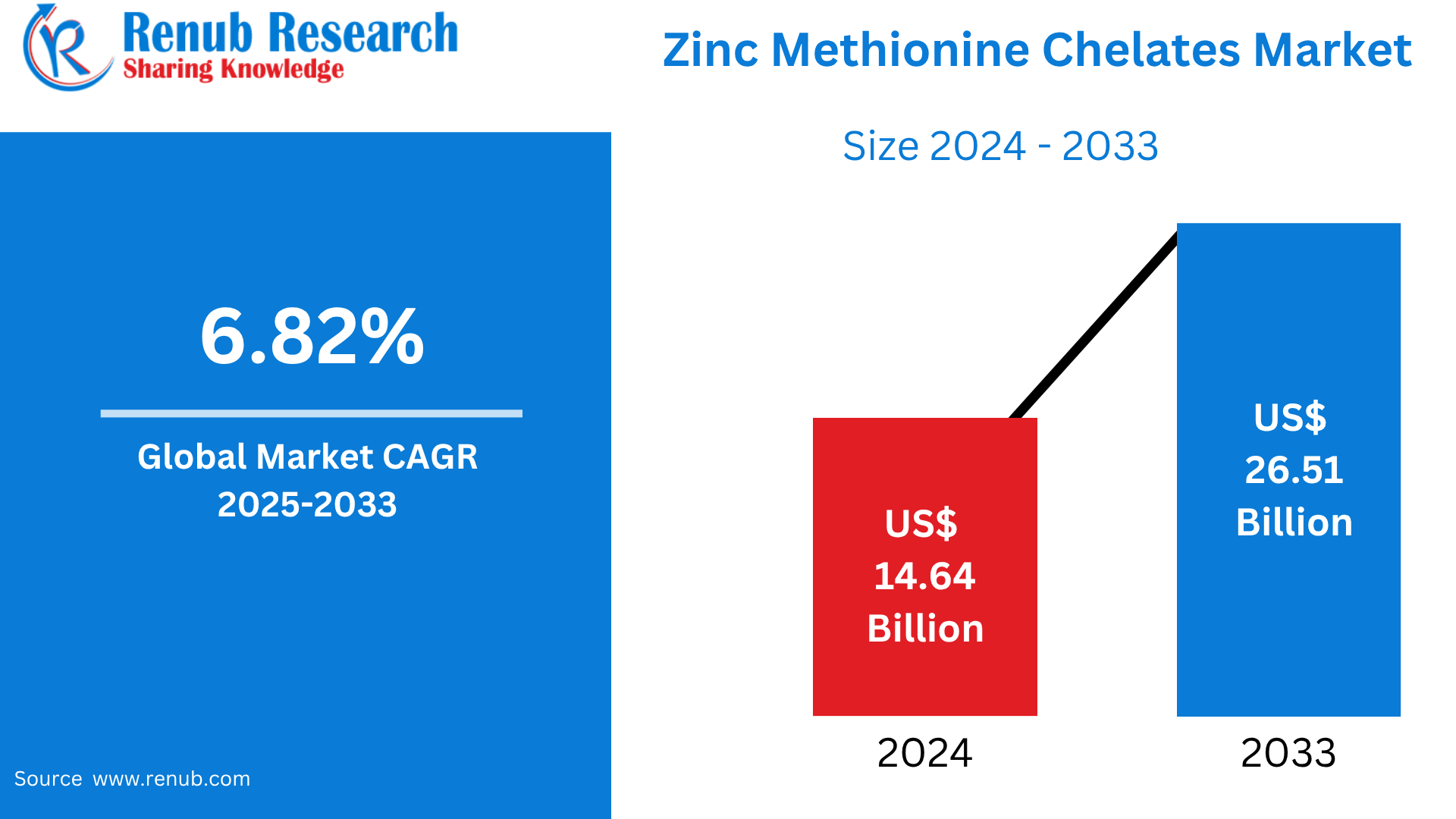
Zinc Methionine Chelates Market is expected to reach US$ 26.51 million by 2033 from US$ 14.64 million in 2024, with a CAGR of 6.82% from 2025 to 2033. The global market for zinc methionine chelates is expanding due to a number of factors, including increased adoption of bioavailable mineral supplements in livestock feed, growing awareness of the need to prevent zinc deficiency, and growing demand for improved animal nutrition in the pharmaceutical, nutraceutical, and agricultural sectors.
Zinc Methionine Chelates Industry Overview
Methionine, an amino acid, and zinc, a necessary trace mineral, are bound to produce zinc methionine chelate, a chelated molecule. When compared to inorganic zinc sources, this chelation improves zinc's bioavailability and absorption. Enzyme activation, immunological function, development, and reproductive health are just a few of the biological processes in which it is essential. In humans, it promotes skin health, wound healing, and metabolic function; in livestock, it enhances feed efficiency, fertility, and disease resistance. Zinc Methionine Chelate is frequently utilized in pharmaceutical formulations, nutraceuticals, and animal feed additives because of its exceptional stability and absorption.
The growing need for high-performance feed additives that improve animal health and production is the main factor propelling the global market for zinc methionine chelates. Because of their better absorption and lower environmental effect, chelated minerals are becoming more and more popular as organic and sustainable livestock nutrition gains more attention. Product uptake is being stimulated by raising consumer knowledge of micronutrient deficits in both people and animals. Further driving market expansion include the expanding cattle sector, especially in developing nations, and ongoing advancements in chelation technology. The growing market outlook is also influenced by government measures that support animal welfare and nutritional fortification.
Growth Drivers for the Zinc Methionine Chelates Market
Rising Demand for Bioavailable Trace Minerals in Animal Feed
The global demand for bioavailable trace minerals such as Zinc Methionine Chelates is accelerating as livestock producers seek improved feed efficiency, animal health, and productivity. These chelated minerals offer superior absorption and utilization compared to traditional inorganic zinc sources, leading to better growth rates and reproductive outcomes. Additionally, the rising awareness of mineral deficiencies and their economic impact on livestock production is pushing feed manufacturers to adopt more effective formulations. The trend is further supported by regulatory bodies promoting nutrient-efficient solutions that minimize waste. With growing consumer preference for safe and high-quality animal-derived food, the emphasis on feed quality and nutrient optimization continues to drive market growth for highly bioavailable mineral sources like Zinc Methionine Chelates.
Shift Toward Sustainable and Organic Animal Nutrition
The global livestock industry is undergoing a significant transition toward sustainable and organic feeding practices to reduce environmental impact and meet consumer expectations for ethically produced animal products. Chelated minerals, such as Zinc Methionine Chelates, are gaining traction because they minimize mineral runoff and improve absorption efficiency, aligning with green farming objectives. Producers are increasingly replacing inorganic minerals with environmentally responsible alternatives that ensure nutrient utilization and reduce ecological footprints. A notable development reinforcing this trend occurred on 2nd October 2024, when DSM-Firmenich inaugurated a 100,000-metric-ton animal nutrition plant in Sete Lagoas, Brazil. The facility enhances regional access to mineral premixes for beef and dairy cattle, including Zinc Methionine Chelates, thereby supporting the growing demand for sustainable, high-performance feed solutions in one of the world’s largest livestock markets.
Technological Advancements in Chelation Processes
Technological innovation has become a key catalyst in the Zinc Methionine Chelates market, improving the efficiency, stability, and bioavailability of chelated mineral compounds. Advances in chelation chemistry have optimized the bonding process between zinc and methionine, ensuring consistent performance and improved nutrient delivery in animal feed. Automation, precision formulation, and real-time quality monitoring have further enhanced production scalability and product reliability. These innovations enable manufacturers to meet diverse nutritional requirements across species while maintaining cost efficiency. As research institutions and feed companies collaborate on next-generation chelation technologies, the market continues to evolve toward smarter, more sustainable solutions that balance economic productivity with environmental stewardship and animal well-being.
Challenges in the Zinc Methionine Chelates Market
High Production Costs and Complex Manufacturing Processes
The high cost of production is one of the main issues facing the market for zinc methionine chelates. To guarantee stability and purity, the chelation procedure necessitates sophisticated technology and exact control over chemical reactions. Compared to conventional inorganic zinc supplements, this raises operating costs. Additionally, changes in the price of raw materials like zinc and methionine affect the total cost of manufacture. The inability of many small-scale businesses to purchase advanced production equipment restricts their ability to enter new markets. Production complexity is increased by the requirement for strong quality assurance and regulatory compliance, which limits scalability and impacts profitability, especially in developing nations where cost competitiveness is a crucial market issue.
Limited Awareness and Regulatory Barriers
Despite the proven benefits of Zinc Methionine Chelates, limited awareness among livestock farmers and feed manufacturers remains a key challenge. In several emerging economies, the preference still leans toward cheaper inorganic minerals, restricting the adoption of chelated forms. Moreover, varying regulatory standards for feed additives across different countries create compliance challenges for manufacturers. Obtaining approvals for chelated mineral formulations can be time-consuming and costly, delaying product commercialization. Lack of harmonization in labeling and efficacy standards further complicates market expansion. This limited understanding of long-term benefits and inconsistent policy frameworks continues to hinder large-scale adoption, particularly in price-sensitive and underdeveloped feed markets.
United States Zinc Methionine Chelates Market
The United States represents a significant market for Zinc Methionine Chelates, driven by its highly developed livestock and poultry industries. Increasing emphasis on animal welfare, nutritional optimization, and sustainable farming practices fuels demand for chelated minerals. The widespread use of premium feed additives and strong consumer awareness of nutrient-rich meat and dairy products further support market growth. The presence of established nutraceutical and pharmaceutical manufacturers also contributes to expanding applications beyond animal feed. Regulatory support from agencies like the FDA, promoting safe and effective nutritional supplements, enhances market confidence. Continuous R&D investments and partnerships between feed producers and research institutions sustain the market’s steady expansion in the U.S.
Germany Zinc Methionine Chelates Market
Germany holds a strong position in the European Zinc Methionine Chelates market due to its advanced livestock management systems and stringent feed quality standards. The country’s focus on animal health, productivity, and environmentally responsible nutrition drives demand for bioavailable mineral sources. German feed manufacturers increasingly favor chelated zinc to improve absorption efficiency and reduce mineral excretion, aligning with sustainability goals. Moreover, a growing consumer preference for high-quality, antibiotic-free animal products supports the integration of organic trace minerals into feed formulations. The presence of leading biotechnology and chemical companies in Germany fosters innovation in chelation technologies. Strict EU regulatory oversight ensures product safety and quality, reinforcing Germany’s role as a key market hub in Europe.
China Zinc Methionine Chelates Market
China is one of the fastest-growing markets for Zinc Methionine Chelates, fueled by rapid expansion in livestock, poultry, and aquaculture industries. Rising population, urbanization, and growing meat consumption are driving demand for high-quality animal nutrition solutions. The government’s initiatives to improve feed efficiency and reduce environmental pollution have encouraged the use of chelated minerals. Domestic feed producers are adopting Zinc Methionine Chelates to enhance productivity and maintain animal health under intensive farming conditions. Additionally, the increasing use of chelates in human dietary supplements and pharmaceuticals broadens the market scope. However, price sensitivity and competition from low-cost alternatives pose challenges to widespread adoption in rural areas.
Saudi Arabia Zinc Methionine Chelates Market
In Saudi Arabia, the Zinc Methionine Chelates market is expanding steadily, driven by efforts to strengthen domestic livestock and poultry production for food security. The government’s initiatives under Vision 2030 to enhance agricultural sustainability and reduce import dependence are creating opportunities for advanced feed solutions. Increasing awareness of micronutrient deficiencies in animals and humans supports demand for chelated minerals. The region’s harsh climatic conditions make nutritional efficiency a critical factor in animal health, further boosting chelate adoption. Partnerships with international feed additive suppliers and the growing interest in premium animal products are supporting market development. However, limited local manufacturing capacity and dependency on imports slightly constrain growth.
Recent Developments in Zinc Methionine Chelates Market
- In May 2025, the U.S. Food and Drug Administration (FDA) approved zinc L-selenomethionine for inclusion in broiler diets, reinforcing the scientific validation of chelated mineral efficacy and safety. This regulatory milestone marks a significant advancement for the animal nutrition industry, confirming the performance and bioavailability benefits of organic trace minerals such as zinc methionine chelates.
- In January 2025, Novus International entered a three-year partnership with Resilient Biotics to identify and develop microbial strains that enhance swine respiratory health. This collaboration complements existing trace mineral nutrition strategies by integrating microbiome-based approaches, strengthening animal immunity, and promoting overall herd productivity through science-driven innovation.
- In July 2024, ADM inaugurated a new nutrient plant in Apucarana, Paraná, expanding its Brazilian premix production capacity by 40%. The facility supports the country’s rapidly growing livestock industry and the rising demand for advanced trace minerals such as zinc methionine chelates. This expansion improves local access to high-bioavailability feed ingredients, helping producers enhance animal performance and sustainability across Brazil’s feed supply chain.
Zinc Methionine Chelates Market Segments:
Livestock
- Bovine
- Poultry
- Swine
- Equine
- Aqua
- Others
Countries–Market breakup in 25 viewpoints:
North America
- United States
- Canada
Europe
- France
- Germany
- Italy
- Spain
- United Kingdom
- Belgium
- Netherlands
- Turkey
Asia Pacific
- China
- Japan
- India
- Australia
- South Korea
- Thailand
- Malaysia
- Indonesia
- New Zealand
Latin America
- Brazil
- Mexico
- Argentina
Middle East & Africa
- South Africa
- United Arab Emirates
- Saudi Arabia
All companies have been covered from 5 viewpoints:
- Company Overview
- Key Persons
- Recent Development & Strategies
- SWOT Analysis
- Sales Analysis
Key Players Analysis
- Alltech
- Balchem Inc.
- Titan Biotech Ltd.
- UNO VETCHEM
- Zinpro Corporation
- Chaitanya Biologicals Private Limited
- Chengdu Chelation Biology Technology Co. Ltd.
- JH Biotech Inc.
- Novus International Inc (Mitsui & Co. Ltd.)
- Priya Chemicals
Report Details:
| Report Features | Details |
| Base Year |
2024 |
| Historical Period |
2021 - 2024 |
| Forecast Period |
2025 - 2033 |
| Market |
US$ Billion |
| Segment Covered |
Livestock and Countries |
| Countries Covered |
|
| Companies Covered |
|
| Customization Scope |
20% Free Customization |
| Post-Sale Analyst Support |
1 Year (52 Weeks) |
| Delivery Format |
PDF and Excel through Email (We can also provide the editable version of the report in PPT/Word format on request) |
Customization Services available
- Analysis of Market Size and Its Segments
- More Company Profiles (Upto 10 without any additional cost):
- Additional Countries (Other than mentioned Countries):
- Region/Country Specific Reports:
- Market Entry Strategy:
- Region-Specific Market Dynamics:
- Regional Market Share Analysis:
- Trade Analysis:
- Production Insights:
- Others Customized Requests:
For more information contact our analysts.
Need More Assistance?
- Talk to our analysts to get more precious information on the current market trends.
- Include more countries and segments and customize the report based on the final requirement.
- Get a competitive advantage in your industry by knowing the report findings and making a positive impact on your revenues and operations.
- Our analysts are always ready to provide more help and pertinent information if you need any additional assistance.