United States Epoxy Resin Market Size, Share, Trends, Growth and Forecast Report by Type, Form, Application, End Use, States and Company Analysis 2026–2034
Buy NowUnited States Epoxy Resin Market Trends
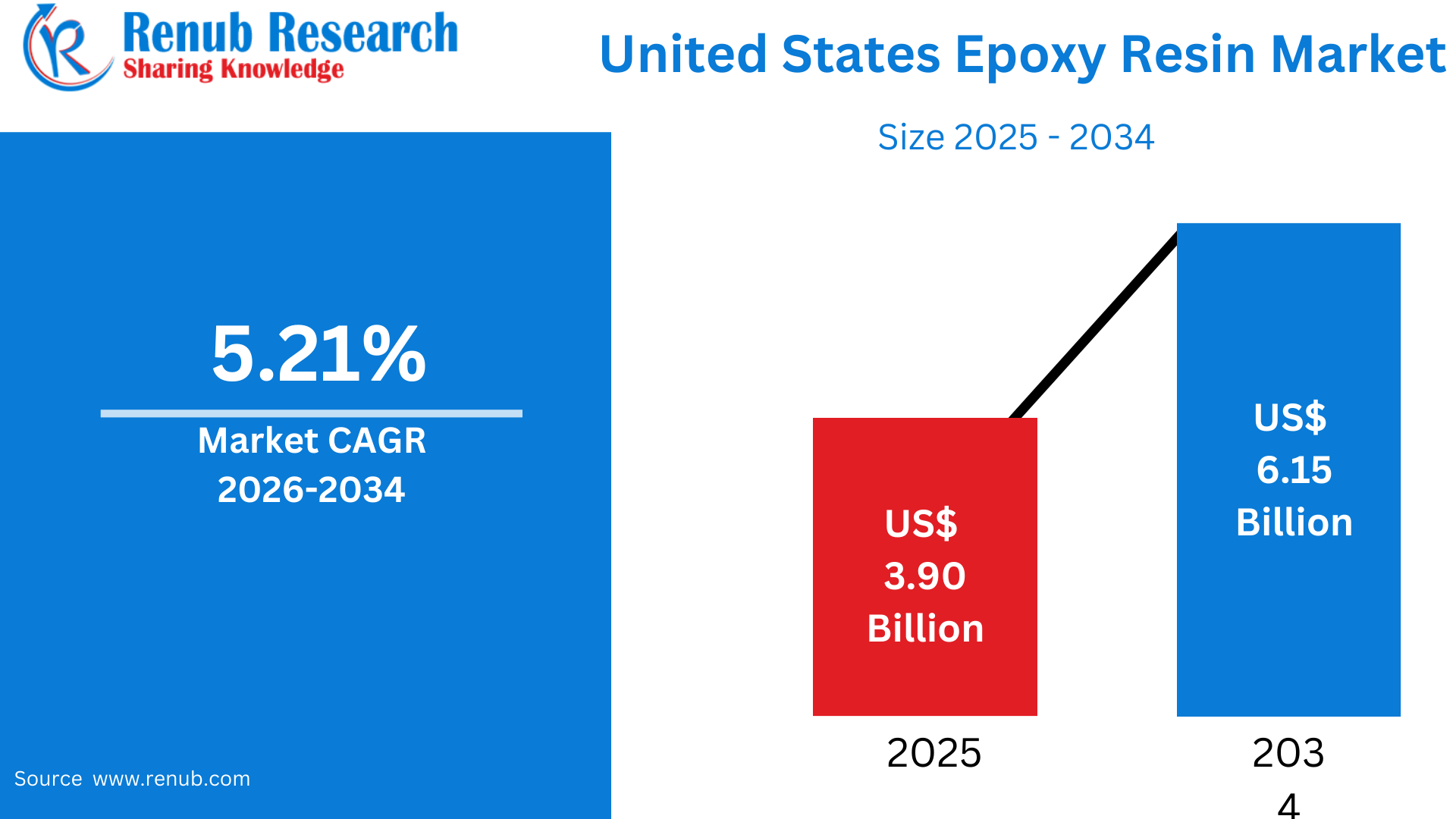
U.S. epoxy resin market is projected to grow from US$ 3.90 billion in 2025 to US$ 6.15 billion by 2034, driven by rising demand across the construction, automotive, aerospace, electronics, and renewable energy sectors. The market is expected to register a CAGR of 5.21% during 2026–2034, supported by the increasing adoption of epoxy-based composites, protective coatings, and adhesives.
What is Epoxy Resin and its Demands in USA?
Epoxy resin is a versatile class of high-performance thermosetting polymers formed through the reaction of epoxide compounds with curing agents. Once cured, these resins exhibit outstanding mechanical strength, chemical resistance, thermal stability, and strong adhesive properties. Their ability to bond effectively with materials such as metals, wood, concrete, and composites makes them indispensable across a wide range of applications, including protective coatings, adhesives, laminates, encapsulation, flooring systems, and structural components. Owing to these performance characteristics, epoxy resins are extensively utilized in industries such as construction, electrical and electronics, aerospace, automotive, marine, and consumer goods.
In the United States, epoxy resin demand continues to expand, driven by its broad industrial applicability and superior performance. The increasing adoption of lightweight composite materials in the automotive and aerospace sectors is a key growth driver, as manufacturers seek to improve fuel efficiency and overall performance. Epoxy-based coatings are also widely employed to protect infrastructure, pipelines, bridges, and industrial equipment from corrosion, chemicals, and environmental degradation, supporting infrastructure modernization initiatives. Additionally, the growing popularity of epoxy products in home improvement and DIY applications—including decorative flooring, countertops, waterproofing, and artistic projects—has broadened the consumer market. The rapid expansion of renewable energy, particularly the production of wind turbine blades that rely on epoxy-based composites, further boosts market demand. Supported by continuous technological advancements and robust industrial activity, epoxy resin remains a critical material for manufacturing, engineering, and infrastructure development across the United States.
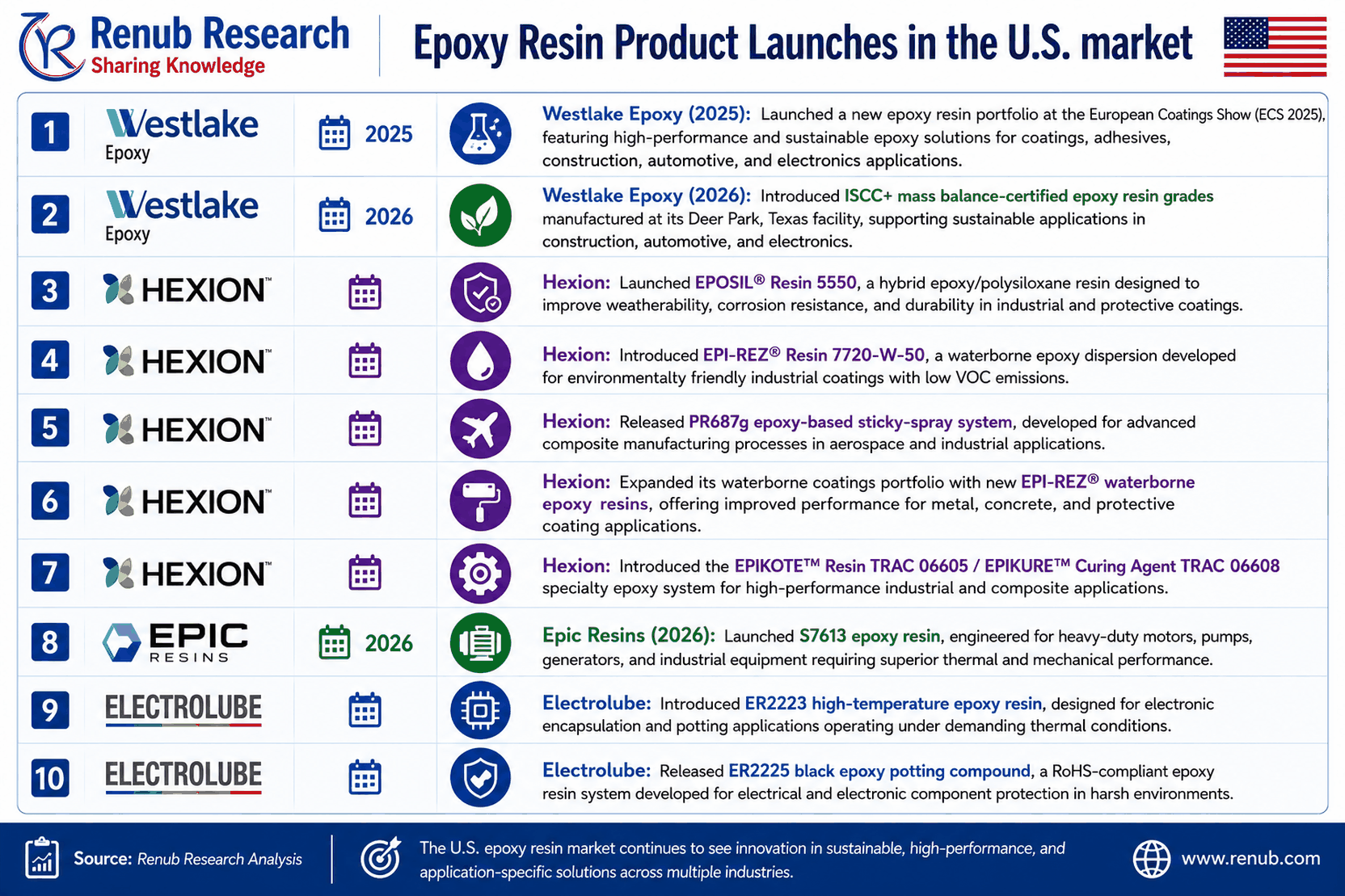
Epoxy Resin Product Launches in the U.S. market
- Westlake Epoxy (2025): Launched a new epoxy resin portfolio at the European Coatings Show (ECS 2025), featuring high-performance and sustainable epoxy solutions for coatings, adhesives, construction, automotive, and electronics applications.
- Westlake Epoxy (2026): Introduced ISCC+ mass balance-certified epoxy resin grades manufactured at its Deer Park, Texas facility, supporting sustainable applications in construction, automotive, and electronics.
- Hexion: Launched EPOSIL® Resin 5550, a hybrid epoxy/polysiloxane resin designed to improve weatherability, corrosion resistance, and durability in industrial and protective coatings.
- Hexion: Introduced EPI-REZ® Resin 7720-W-50, a waterborne epoxy dispersion developed for environmentally friendly industrial coatings with low VOC emissions.
- Hexion: Released PR687g epoxy-based sticky-spray system, developed for advanced composite manufacturing processes in aerospace and industrial applications.
- Hexion: Expanded its waterborne coatings portfolio with new EPI-REZ® waterborne epoxy resins, offering improved performance for metal, concrete, and protective coating applications.
- Hexion: Introduced the EPIKOTE™ Resin TRAC 06605 / EPIKURE™ Curing Agent TRAC 06608 specialty epoxy system for high-performance industrial and composite applications.
- Epic Resins (2026): Launched S7613 epoxy resin, engineered for heavy-duty motors, pumps, generators, and industrial equipment requiring superior thermal and mechanical performance.
- Electrolube: Introduced ER2223 high-temperature epoxy resin, designed for electronic encapsulation and potting applications operating under demanding thermal conditions.
- Electrolube: Released ER2225 black epoxy potting compound, a RoHS-compliant epoxy resin system developed for electrical and electronic component protection in harsh environments.
Market Drivers and Key Development
Cross-Industry Shift Toward High-Performance Materials
A primary catalyst for the U.S. epoxy resin market is the surging demand for high-performance materials across the construction, automotive, aerospace, marine, and electronics sectors. Renowned for its exceptional adhesion, mechanical strength, and corrosion resistance, epoxy resin has become indispensable for structural bonding, protective coatings, advanced composites, and heavy-duty flooring. As industries prioritize durable, lightweight, and energy-efficient alternatives, the adoption of epoxy-based composites is accelerating. This demand is further amplified by nationwide infrastructure modernization projects—including highways, bridges, and industrial facilities.
In June 2025, the Aditya Birla Group strategically expanded its U.S. footprint and diversified its industrial portfolio by acquiring Cargill’s specialty chemical production plant in Georgia.
Infrastructure Modernization and Advanced Coatings Demand
Heavy U.S. investment in public infrastructure, commercial construction, and industrial refurbishment is heavily reliant on epoxy resins due to their superior chemical resistance and durability. Epoxy coatings are widely deployed to shield concrete floors, steel structures, pipelines, and storage tanks from severe environmental wear and corrosion. Furthermore, stricter sustainability standards are driving a market shift toward low-VOC formulations. In the residential and commercial sectors, decorative epoxy flooring is seeing rapid growth due to its aesthetic versatility, low maintenance requirements, and multi-decade lifespan.
Driven by regional demand for sustainable and high-performance flooring, 305 Epic Epoxy launched custom residential and commercial epoxy services in Miami, Florida, in 2025, prioritizing longevity and eco-safe installations.
Light weighting and EV Integration in Automotive & Aerospace
The accelerating adoption of advanced composites in the automotive and aerospace sectors is a major consumption driver for epoxy resins. Epoxy-based composites offer unmatched strength-to-weight ratios, thermal stability, and fatigue resistance—making them critical for aerospace structures, commercial and defense aircraft, and lightweight automotive body parts. Crucially, the booming electric vehicle (EV) market relies on epoxy resins for battery encapsulation, insulation, and thermal management systems to improve vehicle range and safety.
In April 2024, Huntsman introduced a specialized, toughened epoxy resin system engineered for high-pressure hydrogen storage tanks in fuel-cell vehicles, significantly mitigating microcracking risks to enhance safety and operational lifespans.
Market Challenges
Raw Material Volatility and Supply Chain Constraints
The U.S. epoxy resin market faces significant headwinds from price volatility in petroleum-derived feedstocks, specifically bisphenol-A (BPA) and epichlorohydrin. Fluctuations in crude oil prices, refinery capacity bottlenecks, and geopolitical uncertainties create unpredictable cost pressures for manufacturers. Additionally, global supply chain bottlenecks frequently disrupt the availability of critical additives and hardeners. These compounded uncertainties complicate long-term pricing strategies and squeeze profit margins, leaving small and medium-sized manufacturers particularly vulnerable due to limited sourcing flexibility.
Stringent Environmental Regulations and Chemical Restrictions
As environmental sustainability becomes a regulatory priority, the epoxy resin industry faces intense scrutiny over toxic by-products, volatile organic compound (VOC) emissions, and the overall ecological footprint of synthetic manufacturing. Regulatory bodies are enforcing stricter standards on chemical formulations, workplace exposure, and emissions control. Achieving compliance requires heavy capital investment in cleaner production technologies and product reformulation, which drives up operational costs. While shifting consumer preferences are pushing the market toward bio-based or biodegradable epoxy resins, these green alternatives currently face adoption barriers due to higher production costs and performance limitations.
Type Insights
DGBEA Epoxy Resin
It is the single largest resin group due to the superior performance characteristics of US DGBEA epoxy resins, including strong adhesion, chemical resistance, high strength, and versatility across major industries. The broad usage of DGBEA includes coatings, adhesives, composites, and electrical encapsulation systems, serving as the backbone in many applications. It balances mechanical strength and good compatibility with a wide range of curing agents; hence, applications include those related to construction flooring, protective coatings, marine finishes, and automotive parts. In industrial maintenance, these DGBEA-based systems are effective for durability in the long term and improve corrosion protection. Because of thermal stability and moisture resistance, DGBEA resins find a place in potting and insulation applications in electronics manufacturing. Demand for lightweight materials is increasing in transportation systems and infrastructure repairs; this is one of the strong factors influencing market growth. As industries require reliable thermosetting polymers with proven performance, DGBEA remains a preferred choice across a number of US manufacturing and engineering applications.
Aliphatic Epoxy Resin
The U.S. aliphatic epoxy resin market is growing steadily, as aliphatic epoxy systems show much better UV resistance, color stability, and weathering performance than the aromatic epoxy systems of old. Because of these properties, aliphatic resins are used in a variety of applications that require exposure to sunlight and an outdoor environment: protective topcoats, clear coatings, decorative floorings, automotive refinishes, marine exteriors, and architectural surfaces are but a few examples. Aliphatic epoxies continue to be preferred in industries such as aerospace, transportation, and specialty coatings that need long-term gloss retention and minimum yellowing, since compatibility with state-of-the-art curing systems allows superior mechanical stability in high-performance formulations. Needs for appearance and durability are driving consumption in commercial construction, sports flooring, and industrial facilities. While typically more expensive, aliphatic epoxies remain valuable in premium applications requiring excellent weather resistance and long-term protection.
Form Insights
Solid Epoxy Resin
The excellent stability, long shelf life, and suitability for powder coatings and applications calling for high durability make solid epoxy resins widely employed in the U.S. They form one of the most important corrosion-resistant coatings on appliances and metal components and are applied to pipes, furniture, and automobile parts. Solid epoxy resin-based powder coatings have outstanding abrasion resistance, chemical resistance, and adhesion; thus, they find favor in many industrial and protective applications. For electrical and electronic applications, solid resin is employed for laminates, circuit boards, and insulation materials because it possesses good heat and structural stability. Solid epoxy is valued by manufacturers of composites because the resulting material can be tough, yet light in weight, and is used for many sporting goods, automotive panels, and construction elements. In industry, the move toward solvent-free and environmentally friendly coating technologies is further increasing the demand for solid epoxy systems.
Application Insights
Epoxy Resin Paints and Coatings
Epoxy resin paints and coatings account for a major share in the U.S. market because of their unparalleled durability, chemical resistance, and adhesion performance. Coatings protect steel structures, concrete floors, pipelines, machinery, marine vessels, and storage tanks from corrosion and severe environmental conditions. Epoxy flooring systems are installed in industrial facilities for cleanability, impact resistance, and long-term wear. In commercial sectors, including hospitals, warehouses, and retail spaces, epoxy coatings provide aesthetic appearance along with structural strength. Epoxy coatings enhance metal surface performance exposed to saltwater in marine and offshore industries. Demand continues to rise in infrastructure modernization projects such as bridge repairs and upgrades in water-treatment plants. Along with advances in low-VOC and hybrid epoxy technologies, the paints and coatings segment remains central to U.S. consumption of epoxy resins.
Electronic Encapsulation United States Epoxy Resin
Epoxy resins play an indispensable role in the U.S. electronic encapsulation market, where they protect sensitive components from moisture, vibration, dust, and thermal stress. Potting and encapsulation materials based on epoxy ensure long-term reliability for transformers, semiconductors, sensors, LED systems, automotive electronics, and renewable energy inverters. Their excellent dielectric strength and thermal conductivity make them ideal for applications requiring insulation and heat dissipation. Due to the acceleration in electric vehicle production, demand for epoxy potting compounds is also increasing for battery systems and control units. High-purity epoxy materials in packaging and microelectronics are sought by the semiconductor industry. With increased manufacturing capacities for electronics in the United States, epoxy-based encapsulants maintain their importance as part of improving durability, efficiency, and safety for modern electronic devices.
End User Insights
Building and Construction Epoxy Resin
Epoxy resin is relied on by the U.S. building and construction industries because of its superior mechanical strength, chemical resistance, and long-term durability. Because of its seamless finish and easy maintenance, epoxy-based flooring systems are widely installed in industrial plants, commercial buildings, hospitals, and public facilities. Epoxy adhesives bond the concrete, steel, and composite materials of structural applications. Repair compounds based on epoxy are needed to restore deteriorated bridges, beams, columns, and industrial structures. Epoxy waterproofing and protective coatings prevent moisture intrusion and improve the longevity of critical infrastructure. Decorative epoxy systems have gained wide applications in residential construction for countertops, creative flooring, and interior designs. Because many infrastructure modernization and renovation projects are on the increase across the nation, epoxy resin will be an ongoing trusted material for high-performance construction solutions.
Consumer Goods Epoxy Resin
The popularity of epoxy resin in the U.S. consumer products market has grown significantly, particularly within DIY crafts, home décor, art, furniture design, and small-scale manufacturing. Epoxy is used by consumers in various ways: to make river tables, jewelry, resin artwork, 3D ornaments, woodwork, and waterproofing solutions. Its capability for curing into a brilliant, robust, and crystal-like surface makes it an ideal material for contemporary interior design trends. In household goods, the applications of epoxy include repair kits, protection finishes, adhesive solutions, and customized items. The awareness and sales of do-it-yourself epoxy kits have been boosted with the emergence of tutorials on social media and communities of creators. Various home renovation projects that involve refinishing countertops and garage flooring contribute to the market's growth. The versatility, ease of customization, and aesthetic appeal of epoxy products guarantee continuous growth in the U.S. consumer segment of the market.
Aerospace Epoxy Resin
The major consumer of epoxy resin in the U.S. is the aerospace sector, as it plays a very critical role in manufacturing lightweight composites, structural adhesives, and protective coatings. Epoxy-based composites offer excellent strength-to-weight ratios, thermal resistance, and fatigue durability for aircraft fuselage, wings, interior components, and engine structure. Epoxy-based adhesives securely bond metals, carbon fibers, and composite layers, enhancing structural integrity and minimizing fastener usage. Demand for such high-performance epoxy materials has increased with growing interest in commercial aviation, defense aircraft manufacturing, and space exploration technologies. Advanced curing technologies and optimized resin formulations will further enable the attainment of strict performance and safety standards in the aerospace industry. Epoxy contributes to reducing aircraft weight and enhancing fuel efficiency, thus supporting next-generation aerospace engineering and remaining vital to U.S. aviation manufacturing.
State-wise Insights
California
California has one of the strongest epoxy resin markets due to the state's expanding construction sector, tech-driven electronics production, and widespread adoption of sustainable materials. The commercial and residential building activities of the state depend heavily on the demand for epoxy coatings, flooring, and repair systems. Encapsulant and insulation materials based on epoxy are in high demand from the electronics and semiconductor manufacturing industries in Silicon Valley. The corrosion-resistant performance of epoxy solutions is of great relevance to some infrastructure along the coasts of California. Increasing awareness about environmental impacts urges low-VOC and bio-based formulations of epoxy, which also has its say in market preference in each industry.
New York
Continuous construction, maintenance, and renovation in New York City and surrounding areas sustain New York's epoxy resin market. Skyscraper buildings, subway systems, bridges, and commercial centers demand various applications of epoxy coatings and adhesives to sustain such heavy use and drastic weather conditions. Industrial warehouses, manufacturing and production plants, and logistics centers make use of epoxy flooring for durable resistance to mechanical and chemical attack. With high population density and aging infrastructure, New York City creates regular demand for leading-edge epoxy technologies that can ensure protection and performance over an extended period.
Washington
The various demands for epoxy resins within Washington State emanate from the influence of the aerospace sector, maritime activities, and advanced manufacturing. As such, the state is a substantial market for high-performance formulations in aerospace manufacturing for epoxy composites used in aircraft parts, adhesives, and lightweight structures. The same raw material is used in marine coatings, which help in protecting against corrosion, waterproofing, and hull strengthening. Washington’s thriving technology sector increases demand for epoxy applications in electronics assembly and protective insulation. Sustainability trends encourage low-emission and durable epoxy products across industries.
Arizona
The key end-user for epoxy resins, particularly for concrete repair, protective coatings, and high-durability flooring systems, is Arizona's fast-growing construction sector. The state experiences a hot, arid climate, thus necessitating coatings capable of resisting UV exposure, temperature extremities, and abrasive outdoor conditions. Due to longevity and ease of maintenance, epoxy flooring is applied in warehouses, hospitals, and commercial establishments. In correlation with the growth of the population and building of industrial zones, demand for epoxy adhesives, coatings, and repair compounds constantly increases. Do-it-yourself and home renovation trends give further impetus to such a market.
Market Segmentations
Type
- DGBEA (Bisphenol A and ECH)
- DGBEF (Bisphenol F and ECH)
- Novolac (Formaldehyde and Phenols)
- Aliphatic (Aliphatic Alcohols)
- Glycidylamine (Aromatic Amines and ECH)
- Others
Form
- Solid
- Liquid
- Solution
Application
- Paints and Coatings
- Adhesives and Sealants
- Composites
- Electronic Encapsulation
- Others
End Use
- Building and Construction
- Transportation
- General Industrial
- Consumer Goods
- Wind Energy
- Aerospace
- Marine
Top States
- California
- Texas
- New York
- Florida
- Illinois
- Pennsylvania
- Ohio
- Georgia
- New Jersey
- Washington
- North Carolina
- Massachusetts
- Virginia
- Michigan
- Maryland
- Colorado
- Tennessee
- Indiana
- Arizona
- Minnesota
- Wisconsin
- Missouri
- Connecticut
- South Carolina
- Oregon
- Louisiana
- Alabama
- Kentucky
- Rest of United States
All companies have been covered with 5 Viewpoints
- Overviews
- Key Person
- Recent Developments
- SWOT Analysis
- Revenue Analysis
Company Analysis:
- Aditya Birla Group Chemicals
- Atul Ltd.
- BASF SE
- Chang Chun Group
- Covestro AG
- Daicel Corporation
- Dupont De Nemours Inc.
- Hexion Holdings Corporation
- Kukdo Chemicals Co. Ltd.
- Olin Corporation
Report Details:
| Report Features | Details |
| Base Year |
2025 |
| Historical Period |
2022 - 2025 |
| Forecast Period |
2026 - 2034 |
| Market |
US$ Billion |
| Segment Covered |
Type, Form. Application, End Use and States |
| States Covered |
|
| Companies Covered |
|
| Customization Scope |
20% Free Customization |
| Post-Sale Analyst Support |
1 Year (52 Weeks) |
| Delivery Format |
PDF and Excel through Email (We can also provide the editable version of the report in PPT/Word format on request) |
Customization Services available
- Analysis of Market Size and Its Segments
- More Company Profiles (Upto 10 without any additional cost):
- Additional Countries (Other than mentioned Countries):
- Region/Country Specific Reports:
- Market Entry Strategy:
- Region-Specific Market Dynamics:
- Regional Market Share Analysis:
- Trade Analysis:
- Production Insights:
- Others Customized Requests:
For more information contact our analysts.
Need More Assistance?
- Talk to our analysts to get more precious information on the current market trends.
- Include more countries and segments and customize the report based on the final requirement.
- Get a competitive advantage in your industry by knowing the report findings and making a positive impact on your revenues and operations.
- Our analysts are always ready to provide more help and pertinent information if you need any additional assistance.