Aroma Chemicals Market Size, Share, Growth, Trends, Industry Analysis & Forecast 2026–2034
Buy NowAroma Chemicals Market
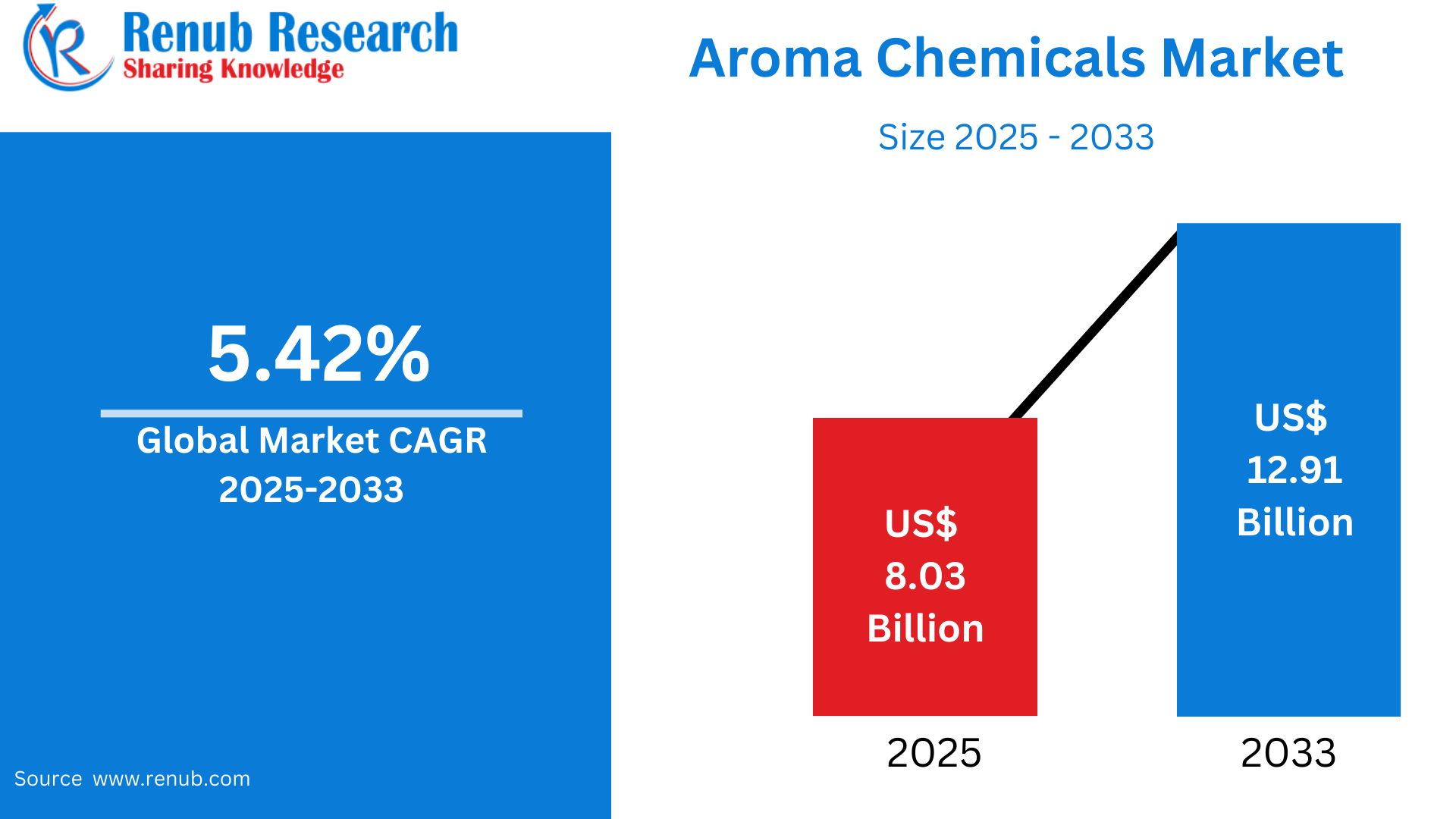
Aroma Chemicals Market is projected to expand from US$ 8.03 billion in 2025 to US$ 12.91 billion by 2034, registering a CAGR of 5.42% during 2026–2034. Market growth is being fueled by rising consumer demand for household cleaning products and laundry detergents, increasing adoption of aroma chemicals in healthcare environments and residential applications, and expanding pharmaceutical manufacturing. Additionally, the growing popularity of premium personal care products, cosmetics, and fine fragrances is accelerating the demand for high-quality aroma ingredients worldwide.
Aroma Chemicals Industry Overview
The aroma chemicals industry forms the backbone of the global fragrance and flavor market by supplying essential compounds that create, enhance, and stabilize scents and tastes across numerous consumer and industrial products. Aroma chemicals are organic substances obtained from natural sources, synthesized through chemical processes, or produced as nature-identical compounds. Compared with conventional natural extracts, these ingredients offer superior consistency, improved stability, reliable quality, and cost-efficient manufacturing, making them indispensable for large-scale production.
Beyond food and personal care, aroma chemicals are widely utilized in household and industrial applications, including detergents, fabric conditioners, surface cleaners, dishwashing products, air fresheners, and home care solutions. Pleasant and long-lasting fragrances have become an important factor in consumer purchasing decisions, prompting manufacturers to incorporate advanced aroma ingredients that enhance product appeal, strengthen brand differentiation, and improve the overall user experience.
The aroma chemicals industry is experiencing a significant transformation driven by sustainability initiatives, increasing health consciousness, and evolving regulatory standards. Growing consumer demand for clean-label, eco-friendly, and naturally sourced products is accelerating the adoption of bio-based and naturally derived aroma chemicals. In response, manufacturers are investing heavily in green chemistry, biotechnology, fermentation-based production methods, and renewable feedstocks to minimize environmental impact while maintaining product quality, performance, and regulatory compliance. These innovations are expected to shape the future of the industry, supporting sustainable growth and expanding opportunities across fragrance, flavor, pharmaceutical, and home care applications.
World Consumption of Flavor and Fragrance Products by Region (2024)
- Europe accounted for the largest share of global flavor and fragrance product consumption in 2024.
- Mainland China represented the second-largest market, reflecting strong demand from food, beverage, and personal care industries.
- North America ranked third, driven by mature consumer markets and high spending on premium fragrance and flavor products.
- The Rest of the World contributed a significant share, highlighting growing demand across emerging markets.
- Latin America maintained a moderate share, supported by increasing consumption of cosmetics, food, and household products.
- South-eastern Asia showed a growing contribution, fueled by urbanization, rising disposable incomes, and expanding consumer goods industries.
- Europe, Mainland China, and North America together represented the majority of global consumption, making them the key regional markets for flavor and fragrance products.
- Emerging regions, including South-eastern Asia, Latin America, and the Rest of the World, continue to offer strong growth opportunities due to expanding consumer demand.
- Overall, global consumption remains concentrated in developed and rapidly industrializing economies, where demand for processed foods, personal care products, and household fragrances is highest.
Growth Drivers for the Aroma Chemicals Market
Increasing Demand for Personal Care and Fragrance Products
Growing consumption of personal care, cosmetic, and fragrance products is a major factor driving the aroma chemicals market. Consumers increasingly view fragrances as an extension of their personality, lifestyle, and emotional well-being, resulting in greater demand for scented products such as perfumes, deodorants, skincare, haircare, soaps, and grooming solutions. Aroma chemicals help manufacturers develop distinctive, long-lasting, and consistent fragrance profiles while enabling large-scale, cost-effective production. Rising awareness of personal hygiene and wellness has further increased the use of everyday products containing fragrance ingredients. In addition, the premiumization of beauty and personal care products, particularly across urban populations and emerging economies, is encouraging the development of sophisticated, customized scent formulations. Continuous product launches, limited-edition collections, and evolving fragrance trends are expected to sustain strong demand for aroma chemicals in the coming years.
Rapid Expansion of the Food and Beverage Industry
Steady growth of the global food and beverage sector is significantly contributing to the expansion of the aroma chemicals market. These compounds play an essential role in enhancing flavor, ensuring taste consistency, and restoring flavor that may be lost during food processing, packaging, or storage. Increasing demand for processed foods, ready-to-eat meals, beverages, bakery products, dairy products, and confectionery, supported by changing lifestyles and urbanization, has accelerated the adoption of aroma ingredients worldwide. Food manufacturers utilize aroma chemicals to create appealing sensory experiences while maintaining product quality and production efficiency. Moreover, the growing popularity of plant-based foods, functional nutrition, and health-conscious products has created new opportunities for specialized aroma compounds that improve taste without excessive amounts of sugar, sodium, or fat. As food innovation continues to evolve, aroma chemicals remain a key component of modern flavor development.
Growing Preference for Natural, Sustainable, and Bio-Based Ingredients
Increasing emphasis on sustainability and consumer health is accelerating the adoption of natural and bio-based aroma chemicals. Modern consumers are actively seeking clean-label products manufactured using environmentally responsible processes and renewable resources, encouraging companies to reduce reliance on conventional synthetic ingredients. In response, manufacturers are investing in green chemistry, biotechnology, fermentation techniques, and renewable feedstocks to produce sustainable aroma compounds without compromising product performance or quality. Regulatory requirements promoting environmental protection and corporate sustainability commitments are further supporting this transition. Bio-based aroma chemicals also enable companies to strengthen brand positioning, differentiate premium product offerings, and comply with evolving global safety standards. As sustainability becomes a central focus across multiple industries, continued investment in research and development is expected to drive long-term innovation and growth in the aroma chemicals market.
Challenges in the Aroma Chemicals Market
Stringent Regulatory Compliance and Safety Requirements
One of the key challenges confronting the aroma chemicals industry is the increasingly complex regulatory framework governing fragrance and flavor ingredients. Manufacturers must comply with strict safety, health, and environmental standards that vary across countries and end-use industries, particularly in food, cosmetics, pharmaceuticals, and personal care products. Regulatory authorities frequently revise guidelines covering ingredient approvals, allergen disclosure, usage limitations, product safety, and environmental impact, requiring companies to continuously monitor compliance. Meeting these evolving regulations demands significant investment in testing, quality assurance, documentation, and product reformulation. Smaller manufacturers often face financial and technical constraints in adapting to these changes, limiting their competitive capabilities. Furthermore, restrictions on certain synthetic ingredients may force companies to redesign existing formulations, potentially affecting fragrance consistency, product performance, and brand recognition. Successfully balancing regulatory compliance with continuous innovation remains a major challenge for industry participants.
Volatile Raw Material Prices and Complex Supply Chains
Fluctuating raw material costs and increasingly complex global supply chains present another major obstacle for the aroma chemicals market. Production depends heavily on petrochemical derivatives as well as natural agricultural resources, both of which are susceptible to price fluctuations caused by climate conditions, geopolitical tensions, supply disruptions, and changing market dynamics. Naturally sourced ingredients are especially vulnerable to seasonal variations, inconsistent crop yields, and quality differences, making procurement more challenging. In addition, the global sourcing network exposes manufacturers to transportation delays, trade barriers, shipping disruptions, and rising logistics expenses. To ensure uninterrupted production, companies often diversify suppliers, establish strategic inventories, and strengthen supply chain resilience, which can increase operational costs. Balancing reliable raw material availability, sustainable sourcing practices, and cost efficiency while maintaining consistent product quality continues to be a significant operational challenge for aroma chemical manufacturers worldwide.
Aroma Chemicals Launches Worldwide
- June 2024 – IFF introduced Ylanganate™, a new fragrance molecule featuring radiant white floral notes designed to enhance fruity, sweet, and balsamic perfume accords. The launch was showcased at the World Perfumery Congress (WPC) 2024 alongside new natural grapefruit and Persian lime oils.
- June 2024 – IFF launched LMR Grapefruit Oil, a premium natural aroma ingredient produced by its LMR Naturals division to meet growing demand for sustainable citrus fragrance materials.
- June 2024 – IFF introduced LMR Persian Lime Oil, expanding its portfolio of naturally sourced citrus aroma ingredients for fine fragrance, personal care, and home care applications.
- July 2024 – dsm-firmenich launched AROMActive™, a new fragrance and wellness platform combining aroma chemicals with skincare science to create mood-enhancing and wellbeing-focused personal care formulations.
- October 2023 – BASF Aroma Ingredients launched Isobionics® Natural α-Bisabolene 98, a fermentation-based natural flavor ingredient developed to support sustainable flavor and fragrance applications.
- October 2023 – BASF Aroma Ingredients introduced Isobionics® Natural (-)-α-Bisabolol 99, expanding its biotechnology-based natural aroma ingredient portfolio for flavor applications.
- March 2023 – BASF announced new world-scale Citral production capacity at its Zhanjiang, China site to strengthen global supply of one of the industry’s key aroma chemical building blocks.
- March 2023 – BASF announced expansion of Menthol production in Ludwigshafen, Germany, supporting rising global demand for aroma ingredients used in fragrances, oral care, and personal care products.
- March 2023 – BASF announced expanded Linalool production capacity in Germany, increasing supply of this widely used floral aroma chemical for perfumes, cosmetics, and household products.
- 2025 – dsm-firmenich commercialized Sylvamber®, a multifunctional synthetic aroma molecule delivering amber, cedarwood, and vanillic notes in a single ingredient, enabling more efficient fragrance formulations.
Synthetic Aroma Chemicals Cost-Effective Solutions Driving Large-Scale Fragrance and Flavor Production
Synthetic Aroma Chemicals Market continues to dominate the global aroma chemicals industry due to its cost efficiency, consistent quality, and broad application across multiple end-use sectors. Synthetic aroma chemicals are produced through chemical synthesis and are widely used in fragrances, personal care products, household cleaners, food flavorings, and pharmaceuticals. Unlike natural extracts, synthetic ingredients offer stable supply, longer shelf life, and uniform performance, making them ideal for large-scale commercial manufacturing. Manufacturers increasingly prefer synthetic compounds because they can accurately replicate natural scents while maintaining lower production costs and reducing dependence on seasonal agricultural raw materials. Continuous advancements in organic chemistry have enabled the development of innovative fragrance molecules with improved stability and enhanced sensory characteristics. The growing demand for affordable perfumes, cosmetics, detergents, and processed foods, particularly in emerging economies, is further supporting market growth. Although sustainability trends are encouraging the adoption of natural alternatives, synthetic aroma chemicals remain indispensable due to their scalability, reliability, and ability to meet the evolving requirements of global consumer goods manufacturers.
Terpenoids Aroma Chemicals Naturally Derived Ingredients Supporting Sustainable Innovation
Terpenoids Aroma Chemicals Market is gaining significant momentum as manufacturers increasingly focus on naturally derived ingredients and sustainable product development. Terpenoids are organic compounds primarily extracted from plants such as citrus fruits, pine trees, eucalyptus, lavender, and herbs, offering distinctive floral, woody, citrus, and herbal fragrance profiles. These compounds are widely used in perfumes, cosmetics, food flavorings, aromatherapy, pharmaceuticals, and household products due to their pleasant aroma and functional properties. Growing consumer preference for clean-label, botanical, and environmentally friendly products has accelerated the demand for terpenoid-based aroma chemicals worldwide. In addition to their fragrance applications, many terpenoids possess antimicrobial, antioxidant, and anti-inflammatory characteristics, making them valuable ingredients in skincare, healthcare, and wellness products. Advances in biotechnology, fermentation, and sustainable extraction methods are improving production efficiency while reducing environmental impact. As consumers increasingly prioritize natural ingredients and eco-conscious brands, terpenoid aroma chemicals are expected to experience strong growth across premium fragrance, beauty, food, and healthcare industries over the coming years.
Food & Beverages Aroma Chemicals Enhancing Flavor, Consistency, and Consumer Experience
Food & Beverages Aroma Chemicals Market represents one of the fastest-growing application segments within the global aroma chemicals industry. Aroma chemicals are extensively used to improve flavor profiles, restore aroma lost during processing, and ensure consistent taste across processed foods, beverages, confectionery, dairy products, bakery items, snacks, and ready-to-eat meals. Rapid urbanization, changing dietary habits, and increasing demand for convenience foods are encouraging food manufacturers to incorporate advanced aroma ingredients into product formulations. Consumers are also seeking unique, authentic, and globally inspired flavors, prompting continuous innovation in aroma chemical development. Furthermore, the growing popularity of plant-based foods, sugar-reduced beverages, functional nutrition, and clean-label products has increased the need for specialized aroma compounds that deliver satisfying taste without compromising nutritional value. Food manufacturers rely on aroma chemicals to enhance overall sensory appeal, improve product differentiation, and strengthen brand loyalty. Continuous investments in flavor science and food technology are expected to support sustained market expansion throughout the forecast period.
Cosmetics & Toiletries Aroma Chemicals Premium Fragrances Elevating Personal Care Products
Cosmetics & Toiletries Aroma Chemicals Market remains one of the largest consumers of aroma chemicals, driven by rising global demand for beauty, hygiene, and wellness products. Aroma chemicals are essential ingredients in perfumes, deodorants, soaps, shampoos, conditioners, skincare products, body lotions, shaving products, and other personal care formulations. Pleasant and long-lasting fragrances have become a key purchasing factor for consumers, encouraging manufacturers to develop sophisticated scent profiles that enhance product appeal and strengthen brand identity. Growing disposable incomes, expanding urban populations, and increasing awareness of personal grooming are fueling higher consumption of premium cosmetics and toiletries worldwide. In addition, consumer demand for natural, hypoallergenic, and sustainable beauty products is driving innovation in bio-based aroma ingredients alongside traditional synthetic compounds. Advances in fragrance encapsulation technology are also improving scent longevity and product performance. As beauty brands continue launching personalized, luxury, and multifunctional products, the demand for high-quality aroma chemicals is expected to remain strong across the global cosmetics and toiletries industry.
United States strong demand from the personal care, cosmetics, food and beverage, and pharmaceutical industries driving Aroma Chemicals
United States aroma chemicals market represents one of the world’s largest and most technologically advanced markets, supported by strong demand from the personal care, cosmetics, food and beverage, pharmaceutical, and household care industries. Aroma chemicals are widely incorporated into perfumes, skincare products, detergents, air fresheners, processed foods, and beverages to improve fragrance and flavor quality. Growing consumer preference for premium products, clean-label formulations, and naturally derived ingredients is encouraging manufacturers to develop sustainable, bio-based, and nature-identical aroma chemicals without compromising product performance. The country’s well-established fragrance and flavor industry continues to invest in advanced research, biotechnology, and green chemistry to create innovative aroma compounds that meet evolving regulatory and consumer expectations. Rising health awareness, increasing demand for eco-friendly products, and greater transparency regarding ingredient sourcing are further reshaping the market. Supported by strong research capabilities, continuous product innovation, and the presence of leading global fragrance manufacturers, the U.S. aroma chemicals market is expected to maintain steady growth throughout the forecast period.
United Kingdom Growing awareness of clean-label products, ethical sourcing, and ingredient transparency Supporting Aroma Chemicals
United Kingdom aroma chemicals market continues to expand steadily, driven by increasing demand from the cosmetics, personal care, food and beverage, home care, and luxury fragrance industries. Consumers across the UK place significant emphasis on premium-quality fragrances, wellness products, and sustainable formulations, encouraging manufacturers to develop environmentally friendly aroma chemicals derived from renewable and natural sources. Growing awareness of clean-label products, ethical sourcing, and ingredient transparency has accelerated investments in green chemistry and bio-based fragrance technologies. The country’s stringent regulatory framework also encourages continuous innovation to ensure high safety, quality, and environmental standards across fragrance and flavor applications. In addition, the UK’s thriving beauty and premium perfume industry continues to introduce new fragrance collections that require advanced aroma ingredients with superior performance and long-lasting scent profiles. Despite challenges related to raw material sourcing and supply chain disruptions, strong research capabilities, innovation, and consumer demand for sustainable products continue to create favorable opportunities for the long-term growth of the UK aroma chemicals market.
Increasing awareness of sustainability and clean-label products Expanding India Aroma Chemicals
India aroma chemicals market is witnessing robust growth, supported by rapid urbanization, rising disposable incomes, expanding middle-class consumption, and increasing demand for personal care, cosmetics, food products, and household cleaning solutions. Consumers are increasingly seeking premium fragrances, flavored foods, and wellness products, encouraging manufacturers to incorporate advanced aroma chemicals into a wide range of consumer goods. India’s well-established perfume, incense, and traditional fragrance industries provide a strong foundation for continued market expansion while creating opportunities for modern aroma chemical manufacturers. The country also serves as an important manufacturing and export hub for specialty chemicals, supported by competitive production costs and a growing industrial base. Increasing awareness of sustainability and clean-label products is driving investments in natural, botanical, and bio-based aroma compounds, although synthetic aroma chemicals continue to dominate due to their affordability, consistent quality, and scalability. With expanding domestic consumption, rising exports, and ongoing investments in specialty chemical production, India’s aroma chemicals market is expected to experience sustained long-term growth.
United Arab Emirates Growing consumer demand for premium Aroma Chemicals
United Arab Emirates aroma chemicals market is experiencing healthy growth, supported by the country’s strong luxury fragrance culture, expanding retail sector, flourishing tourism industry, and rising demand for premium consumer goods. Aroma chemicals are widely utilized in perfumes, cosmetics, personal care products, home fragrances, air fresheners, and food flavoring applications, reflecting the UAE’s strong preference for high-quality and distinctive sensory experiences. As one of the Middle East’s major trading and distribution hubs, the UAE facilitates the import, manufacturing, and regional distribution of aroma chemicals to neighboring countries. Growing consumer demand for premium, long-lasting, and customized fragrances continues to encourage innovation among fragrance manufacturers and formulators. Sustainability is also becoming an increasingly important purchasing factor, prompting companies to introduce bio-based, responsibly sourced, and environmentally friendly aroma ingredients. Although the market remains influenced by imported raw materials and global supply chain dynamics, continuous product innovation, luxury retail expansion, and increasing consumer spending on premium fragrances are expected to support the long-term growth and diversification of the UAE aroma chemicals market.
Recent Developments in Aroma Chemicals Market
- In June 2025: With a completion date of Q1 2027, dsm-firmenich is building a cutting-edge production facility in Parma, Italy. The factory will boost its capacity for functional blends, reaction flavors, and concentrated powder flavors, propelling the market for aroma chemicals.
- L-Menthol FCC, BASF scent Ingredients' first scent product with a decreased Product Carbon Footprint, was introduced in April 2025 and has 10–15% fewer emissions than its conventional counterparts. The market for fragrance chemicals is anticipated to adopt sustainable practices more quickly as a result of this campaign.
- Bedoukian Research Inc. and Inscripta partnered in July 2023 to create and market natural products with better quality, consistency, and less environmental effect. It will optimize microbial strains for high-yield ingredient production using Inscripta's GenoScaler platform. BRI will be able to create ingredients in greater quantities while preserving environmental sustainability thanks to the partnership.
Market Segmentation
Source
- Synthetic
- Natural
Product
- Terpenoids
- Benzenoids
- Musk Chemicals
- Others
Application
- Food & Beverages
- Fine Fragrances
- Cosmetics & Toiletries
- Soaps & Detergents
- Others
Countries
North America
- United States
- Canada
Europe
- France
- Germany
- Italy
- Spain
- United Kingdom
- Belgium
- Netherlands
- Turkey
Asia Pacific
- China
- Japan
- India
- Australia
- South Korea
- Thailand
- Malaysia
- Indonesia
- New Zealand
Latin America
- Brazil
- Mexico
- Argentina
Middle East & Africa
- South Africa
- Saudi Arabia
- United Arab Emirates
All the key players have been covered from 5 Viewpoints:
- Overview
- Key Persons
- Recent Development
- SWOT Analysis
- Financial Insights
Key Players Analysis:
- BASF SE
- Takasago International Corp
- Kao Corporation
- Givaudan SA
- Dsm BV
- Cargill inc.
- Symrise AG
- Aromatech
Report Details:
| Report Features | Details |
| Base Year |
2025 |
| Historical Period |
2022 - 2025 |
| Forecast Period |
2026 - 2034 |
| Market |
US$ Billion |
| Segment Covered |
Source, Product, Application and Countries |
| Countries Covered |
|
| Companies Covered |
|
| Customization Scope |
20% Free Customization |
| Post-Sale Analyst Support |
1 Year (52 Weeks) |
| Delivery Format |
PDF and Excel through Email (We can also provide the editable version of the report in PPT/Word format on request) |
Customization Services available
- Analysis of Market Size and Its Segments
- More Company Profiles (Upto 10 without any additional cost):
- Additional Countries (Other than mentioned Countries):
- Region/Country Specific Reports:
- Market Entry Strategy:
- Region-Specific Market Dynamics:
- Regional Market Share Analysis:
- Trade Analysis:
- Production Insights:
- Others Customized Requests:
For more information contact our analysts.
Need More Assistance?
- Talk to our analysts to get more precious information on the current market trends.
- Include more countries and segments and customize the report based on the final requirement.
- Get a competitive advantage in your industry by knowing the report findings and making a positive impact on your revenues and operations.
- Our analysts are always ready to provide more help and pertinent information if you need any additional assistance.