Global Voice Biometrics Market Size, Share, Growth, Trends, Industry Analysis & Forecast 2026–2034
Buy NowGlobal Voice Biometrics Market Size & Forecast
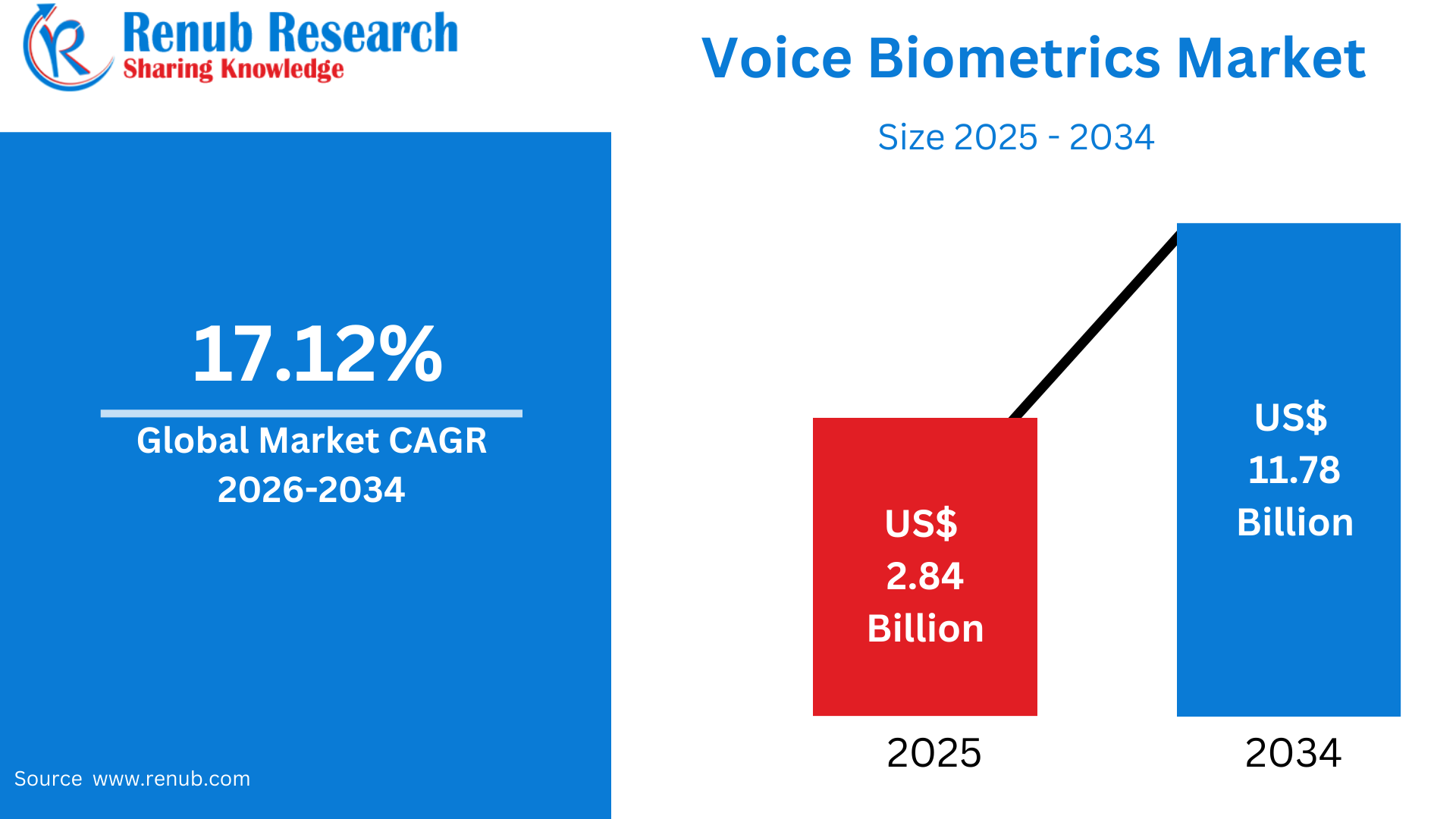
Global Voice Biometrics Market, valued at US$ 2.84 billion in 2025, is projected to reach US$ 11.78 billion by 2034, registering a CAGR of 17.12% during the forecast period from 2026 to 2034. Market growth is primarily driven by the increasing demand for secure, seamless, and user-friendly authentication solutions, along with rising adoption across the banking, financial services, telecommunications, and government sectors. The growing prevalence of identity theft, cyber fraud, and account takeover incidents is further accelerating the adoption of voice biometrics for identity verification.
Global Voice Biometrics Market Outlook
Voice biometrics is a biometric authentication solution used for identifying or authenticating a person through the distinctive qualities in the voices they use. Unlike conventional voice recognition, where the focus is on the words used, voice biometrics involves studying the manner in which a person speaks, for instance, the pitch, tone, and rhythm of speech. This provides a voice print, a technique used for authenticating people. Voice biometrics is ideal for identity, fraud, and secure access offered in voice biometrics for various digital and telecom platforms. It is a password-free and hands-free technique used for authenticating people.
Globally, the adoption of voice biometrics has gained momentum because of the increasing need to protect identity fraud, data breaches, and cyber-crimes. Sectors such as banking, financial, insurance, healthcare, and telecom are adopting voice biometrics to ensure safe customer interactions, especially in call centers and mobile apps. With the increasing adoption of remote services, digital banking, and contactless authentication, voice biometrics has gained pace. Also, the development of Artificial Intelligence and Machine Learning has greatly improved the remittance error of voice biometrics. In fact, voice biometrics also provides multilingual and global support, hence offering voice biometrics as an international solution to adopters.
What is Voice Biometrics and Its Uses & Popularity Worldwide
Voice biometrics is a biometric authentication technology that identifies or verifies an individual’s identity based on the unique physical and behavioral characteristics of their voice. Unlike traditional authentication methods such as passwords or PINs, voice biometrics analyzes features including vocal tract shape, pitch, tone, pronunciation, cadence, and speech patterns to create a unique voiceprint. This technology is widely used for secure customer authentication, fraud prevention, and identity verification across industries. Major applications include banking and financial services, telecommunications, healthcare, government services, contact centers, insurance, and smart devices. Voice biometrics enables users to access accounts, authorize transactions, and verify identities through natural speech, improving both security and customer convenience. Globally, its popularity has increased with the rapid growth of digital banking, remote customer onboarding, and AI-powered virtual assistants. Financial institutions increasingly deploy voice authentication to reduce identity fraud and improve call center efficiency. The widespread adoption of cloud computing, artificial intelligence, and speech recognition technologies has further accelerated market growth. As organizations prioritize frictionless customer experiences while strengthening cybersecurity, voice biometrics has become an essential component of modern digital identity management worldwide.
Growth Drivers of the Voice Biometrics Market
Rising Incidence of Identity Fraud and Cybersecurity Threats
The increasing frequency of identity theft, account takeover attacks, and financial fraud is one of the strongest growth drivers for the global voice biometrics market. According to industry estimates, cybercrime causes global financial losses exceeding US$10 trillion annually, while identity fraud incidents continue to rise across banking, telecommunications, and e-commerce sectors. Traditional authentication methods such as passwords, PINs, and security questions have become increasingly vulnerable to phishing, credential theft, and social engineering attacks. Voice biometrics provides a more secure authentication mechanism by analyzing more than 100 unique vocal characteristics, making impersonation significantly more difficult than conventional credentials. Financial institutions, insurance providers, and government agencies are integrating voice authentication into customer service platforms to strengthen fraud detection while improving user experience. AI-powered liveness detection and anti-spoofing technologies further enhance system security against recorded or synthetic voices. As digital transactions, online banking, and remote customer interactions continue to expand globally, organizations are increasingly investing in voice biometric solutions to protect sensitive customer information and comply with evolving cybersecurity requirements.
Growing Adoption of Digital Banking and Contact Center Automation
Digital transformation across financial services and customer support operations is significantly driving demand for voice biometrics. More than 75% of banking customers now use digital banking channels, while millions of customer service interactions occur through contact centers every day. Traditional identity verification processes often require customers to answer multiple security questions, increasing call handling time and operational costs. Voice biometrics enables authentication within a few seconds through natural speech, reducing average verification time while improving customer satisfaction. Banks, insurance companies, telecom operators, and utility providers are increasingly implementing passive voice authentication to streamline customer service without interrupting conversations. Contact centers adopting voice biometrics have reported substantial reductions in fraud-related losses and improvements in first-call resolution rates. The integration of voice authentication with AI-powered virtual assistants, interactive voice response (IVR) systems, and omnichannel customer engagement platforms further supports market expansion. Growing consumer preference for frictionless digital experiences continues to encourage enterprises worldwide to invest in advanced voice biometric technologies.
Advancements in Artificial Intelligence and Speech Recognition Technologies
Rapid advancements in artificial intelligence, machine learning, and deep learning algorithms have significantly improved the performance and commercial adoption of voice biometrics. Modern voice biometric systems achieve authentication accuracy exceeding 95% under favorable operating conditions by analyzing complex vocal patterns, pronunciation, speech rhythm, and behavioral characteristics. AI-powered algorithms continuously learn from user interactions, improving recognition accuracy while reducing false acceptance and false rejection rates. Cloud computing has also enabled scalable deployment across financial institutions, healthcare providers, government agencies, and multinational enterprises without requiring extensive on-premise infrastructure. Natural language processing (NLP) and speech analytics technologies further enhance customer authentication while enabling fraud detection during live conversations. Integration with mobile banking applications, smart speakers, digital assistants, and enterprise communication platforms has expanded the range of commercial applications. Continuous investments in generative AI detection, anti-spoofing capabilities, multilingual voice recognition, and real-time authentication are strengthening the competitiveness of voice biometrics and accelerating adoption across both developed and emerging markets.
Major Voice Biometrics Launches Worldwide
- January 2023 – Nuance Communications (Microsoft) launched enhanced Nuance Gatekeeper voice biometrics with advanced AI-powered liveness detection and fraud prevention capabilities for banking and contact center authentication.
- March 2023 – Verint Systems introduced upgraded Verint Voice Biometrics solutions featuring passive customer authentication and real-time fraudster detection for enterprise contact centers.
- June 2023 – Pindrop launched its next-generation Pindrop® Pulse Voice Authentication Platform, incorporating deepfake detection and AI-driven voice verification to combat synthetic voice fraud.
- September 2023 – Auraya released an upgraded version of ArmorVox Voice Biometrics, featuring multilingual speaker verification, improved anti-spoofing technology, and cloud-native deployment capabilities.
- February 2024 – NICE launched enhanced CXone Voice Biometrics, integrating AI-powered authentication with customer experience (CX) platforms to reduce call verification time and strengthen fraud detection.
- April 2024 – Phonexia introduced its latest Voice Biometrics Engine, delivering higher speaker recognition accuracy, faster enrollment, and improved performance for law enforcement, financial services, and enterprise security applications.
- July 2024 – ID R&D launched an advanced Passive Voice Biometrics Platform featuring deepfake-resistant authentication, behavioral voice analysis, and real-time fraud detection for digital banking and fintech applications.
- October 2024 – ValidSoft unveiled the next generation of its Voice Verity™ Authentication Suite, combining voice biometrics, behavioral biometrics, and multi-factor authentication to strengthen identity verification across financial institutions.
- March 2025 – Daon expanded its IdentityX® platform by introducing AI-enhanced voice biometrics for omnichannel customer authentication, enabling secure verification across mobile apps, web portals, and contact centers.
- January 2026 – Aculab launched an upgraded Voice Biometrics Authentication Platform with enhanced neural-network speech recognition, multilingual support, cloud deployment flexibility, and improved protection against AI-generated voice spoofing attacks.
Challenges of the Voice Biometrics Market
Increasing Sophistication of AI-Generated Voice Deepfakes
One of the most significant challenges facing the voice biometrics market is the rapid advancement of AI-generated synthetic voices and deepfake technologies. Modern generative AI models can replicate an individual’s voice using only a few seconds of recorded speech, creating new security concerns for biometric authentication systems. As voice cloning technology becomes more accessible, fraudsters can potentially attempt unauthorized access to financial accounts, customer service systems, and digital platforms. Organizations are responding by integrating advanced liveness detection, behavioral analysis, and multi-factor authentication to distinguish genuine users from synthetic voices. However, these additional security measures increase implementation complexity and deployment costs. Enterprises must also continuously update AI models to defend against evolving attack techniques. The ongoing technological competition between voice synthesis and anti-spoofing solutions requires sustained investment in research and development. Maintaining high authentication accuracy while minimizing false acceptance rates remains a critical challenge for vendors seeking to preserve customer trust and ensure secure voice-based authentication.
Privacy Concerns and Regulatory Compliance Requirements
Privacy protection and regulatory compliance represent major barriers to wider adoption of voice biometrics. Voiceprints are considered sensitive biometric data in many jurisdictions and are subject to strict data protection regulations. Organizations deploying voice authentication systems must ensure secure collection, encryption, storage, processing, and deletion of biometric information while complying with laws such as the General Data Protection Regulation (GDPR) and other national privacy frameworks. Failure to adequately protect biometric databases may expose organizations to financial penalties, reputational damage, and legal liabilities following data breaches. Consumer concerns regarding surveillance, consent, and misuse of biometric information may also limit adoption, particularly in highly regulated industries. Cross-border data transfer restrictions further complicate multinational deployments, requiring organizations to implement region-specific compliance strategies. In addition, maintaining transparent consent mechanisms, secure cloud infrastructure, and continuous cybersecurity monitoring increases operational costs for enterprises implementing voice biometric solutions, making regulatory compliance a persistent challenge for market participants.
Rising Enterprise Adoption of End-to-End Identity Verification Solutions
Voice Biometrics Solutions segment represents the largest component of the voice biometrics market, driven by increasing enterprise demand for comprehensive identity verification, customer authentication, and fraud prevention platforms. Organizations across banking, financial services, healthcare, telecommunications, and government sectors are replacing traditional password-based authentication with voice biometric solutions that deliver faster, more secure, and frictionless customer experiences. Industry estimates indicate that more than 70% of financial institutions are investing in AI-powered digital identity technologies, with voice biometrics becoming a key component of omnichannel authentication strategies. These solutions integrate voiceprint enrollment, real-time authentication, fraud detection, call center verification, and customer analytics into a unified platform. The growing shift toward cloud computing and AI-powered authentication further accelerates adoption among enterprises seeking scalable security infrastructure. Continuous improvements in speech recognition, natural language processing (NLP), multilingual voice models, and anti-spoofing technologies are enhancing solution accuracy beyond 95% under controlled operating environments, making voice biometric solutions increasingly attractive for organizations managing millions of customer interactions annually.
Secure User Authentication through Spoken Passphrases
Active voice biometrics requires users to speak a predetermined phrase or password during authentication, making it one of the most secure forms of voice-based identity verification. This segment remains widely adopted in banking, government services, enterprise security, and remote customer onboarding because users intentionally participate in the authentication process. Active authentication systems analyze more than 100 unique vocal characteristics, including pitch, tone, cadence, pronunciation, and vocal tract features, significantly reducing the likelihood of unauthorized access. Financial institutions increasingly utilize active voice biometrics for transaction approvals, account recovery, and high-value payment verification where stronger authentication is essential. The technology also supports multi-factor authentication by combining voice verification with PINs, facial recognition, or mobile authentication. Continuous AI improvements have significantly reduced false acceptance and false rejection rates while improving performance across multiple languages and accents. As organizations strengthen cybersecurity frameworks and comply with stricter digital identity regulations, active voice biometrics continues to play an important role in securing sensitive customer interactions across global enterprises.
High Security Requirements Continue to Support On-Premises Enterprise Deployment
The on-premises voice biometrics market remains significant among organizations requiring maximum control over sensitive biometric information. Government agencies, defense organizations, financial institutions, healthcare providers, and critical infrastructure operators continue to prefer on-premises deployments because biometric voiceprints remain within their own secure data centers. Many regulated industries process highly confidential customer information and therefore maintain strict policies regarding data residency, cybersecurity, and regulatory compliance. Large enterprises handling millions of customer records annually often deploy dedicated authentication servers to maintain complete operational control while reducing external cybersecurity risks. Although cloud deployment is expanding rapidly, on-premises solutions remain essential for organizations operating under strict regulatory frameworks or national security requirements. These deployments support customized authentication workflows, integration with existing enterprise identity management systems, and greater flexibility in implementing internal cybersecurity policies. Continuous investments in enterprise IT modernization, hybrid cloud architectures, and private data centers are expected to sustain demand for on-premises voice biometric solutions despite increasing cloud adoption across commercial industries.
Digital Transformation and High Customer Volumes Accelerate Large Enterprises Adoption
Large enterprises account for the largest share of the voice biometrics market because they manage extensive customer databases, high transaction volumes, and complex cybersecurity requirements. Global corporations operating across banking, telecommunications, insurance, healthcare, aviation, retail, and government sectors process millions of customer interactions every day, making automated authentication essential for operational efficiency. Voice biometrics enables organizations to authenticate customers within seconds, reducing call handling times, improving user experience, and lowering operational costs. Large enterprises increasingly integrate voice authentication into customer relationship management (CRM), enterprise resource planning (ERP), and digital identity management platforms to enhance both security and productivity. AI-powered analytics further enable continuous fraud monitoring, behavioral analysis, and real-time identity verification across multiple communication channels. Growing investments in digital transformation, cloud migration, cybersecurity modernization, and customer experience initiatives continue to support enterprise-wide implementation of voice biometric technologies. As cyber threats become increasingly sophisticated, large organizations remain the primary investors in advanced biometric authentication solutions worldwide.
AI-Driven Authentication Reduces Financial Fraud Risks
Fraud detection and prevention has emerged as one of the fastest-growing applications within the voice biometrics market due to increasing financial crime and identity theft. Global financial fraud results in hundreds of billions of dollars in annual losses, encouraging organizations to strengthen authentication systems beyond conventional passwords and security questions. Voice biometrics detects fraudulent callers by comparing live speech against stored voiceprints while simultaneously analyzing behavioral speech characteristics for anomalies. Advanced AI-powered platforms can identify suspicious activity during live conversations, helping organizations prevent account takeover, social engineering attacks, and impersonation attempts before transactions are completed. Banks, insurance providers, telecommunications companies, and government agencies increasingly integrate voice biometrics into fraud management platforms to strengthen customer security while maintaining seamless user experiences. Continuous improvements in deepfake detection, liveness verification, behavioral biometrics, and machine learning algorithms are significantly improving fraud detection capabilities. As digital transactions continue to expand globally, organizations are expected to increase investments in voice biometric fraud prevention systems to reduce financial losses and strengthen regulatory compliance.
Connected Vehicles and Intelligent Cockpits Drive Automotive Voice Biometrics Market Growth
The automotive voice biometrics market is expanding rapidly with the growing adoption of connected vehicles, intelligent infotainment systems, and advanced driver assistance technologies. Modern vehicles increasingly utilize voice biometrics to authenticate drivers, personalize vehicle settings, authorize digital payments, and improve in-vehicle cybersecurity. The global connected car fleet is expected to exceed 400 million vehicles over the coming years, creating substantial opportunities for secure voice-based identity management. Automotive manufacturers are integrating AI-powered voice assistants capable of recognizing authorized drivers while automatically adjusting seat positions, climate controls, navigation preferences, entertainment systems, and personal profiles. Voice authentication also supports secure access to digital vehicle keys, fleet management platforms, and subscription-based vehicle services. Continuous advancements in artificial intelligence, natural language processing, and edge computing are improving recognition accuracy even in noisy driving environments. As software-defined vehicles become increasingly common and vehicle connectivity continues to expand, automotive manufacturers are expected to invest heavily in voice biometrics to strengthen cybersecurity while enhancing personalized driving experiences.
Growing Cybersecurity Investments and Widespread Enterprise Biometrics Solutions Adoption in the United States
United States represents one of the largest biometrics solutions markets globally, supported by rapid digital transformation, increasing cybersecurity investments, and widespread deployment across government agencies and private enterprises. The country experiences millions of cyberattack attempts every day, encouraging organizations to adopt advanced biometric authentication technologies such as fingerprint, facial, iris, and voice recognition. The U.S. banking sector, serving more than 330 million residents, increasingly utilizes biometric authentication for mobile banking, digital payments, and customer identity verification. Government agencies also deploy biometric solutions across border control, law enforcement, defense, and immigration management to strengthen national security. Additionally, the United States hosts thousands of hyperscale data centers and technology companies that integrate biometrics into enterprise access control and cloud security platforms. Healthcare organizations, airports, and educational institutions are also expanding biometric deployments to enhance operational efficiency and prevent identity fraud. Continuous advancements in artificial intelligence, cloud computing, and behavioral biometrics are expected to sustain strong market growth across the United States throughout the forecast period.
Expanding Digital Identity Programs and Financial Sector Adoption in the United Kingdom
United Kingdom has emerged as a mature biometrics solutions market due to increasing digital identity initiatives, strong financial services infrastructure, and widespread adoption of secure authentication technologies. The country has a population of approximately 68 million, with one of Europe’s highest rates of digital banking and online public service usage. Financial institutions increasingly implement biometric authentication for customer onboarding, payment authorization, fraud detection, and account access to reduce identity theft and improve user convenience. Government agencies continue expanding biometric verification across immigration, border security, law enforcement, and passport services. Healthcare providers also utilize biometric systems to enhance patient identification and protect medical records. Rising demand for contactless authentication following accelerated digitalization has further encouraged adoption of facial recognition, fingerprint authentication, and voice biometrics. Enterprises across retail, telecommunications, transportation, and corporate security are integrating AI-powered biometric solutions into workforce management and customer verification systems. Continued investment in cybersecurity, digital infrastructure, and smart city initiatives is expected to support long-term expansion of the UK’s biometrics solutions market.
Large-Scale Digital Identity Ecosystem Accelerates India Market Growth
India is one of the fastest-growing biometrics solutions markets worldwide, driven by its massive population, expanding digital economy, and government-led digital identity initiatives. The country has a population exceeding 1.4 billion people, creating enormous demand for secure identity verification across banking, healthcare, telecommunications, and public services. India’s digital identity ecosystem has enrolled more than 1.3 billion biometric identities, making it the world’s largest biometric identification platform. Financial institutions increasingly utilize fingerprint, facial recognition, and voice authentication for digital banking, electronic Know Your Customer (eKYC), and payment verification. The rapid growth of smartphone users, estimated at over 750 million, has further accelerated mobile biometric authentication across consumer applications. Government agencies continue expanding biometric verification in welfare distribution, taxation, healthcare services, and border management. Meanwhile, private enterprises are deploying biometrics for employee attendance, enterprise security, and customer onboarding. Continued investments in artificial intelligence, fintech innovation, and digital governance are expected to drive sustained growth of India’s biometrics solutions market.
Vision 2030 and Smart City Development Strengthen Adoption in Saudi Arabia
Saudi Arabia’s biometrics solutions market is expanding rapidly as the Kingdom accelerates digital transformation under its Vision 2030 economic diversification strategy. The country’s population exceeds 36 million, while smartphone penetration is estimated at over 95%, creating favorable conditions for mobile biometric authentication and digital identity services. Government agencies are increasingly deploying biometric technologies across immigration control, national identity management, border security, law enforcement, and electronic government services to improve operational efficiency and strengthen public security. Financial institutions are integrating biometric authentication into mobile banking, digital payments, and customer verification to enhance cybersecurity and regulatory compliance. Major smart city developments, including NEOM and other large-scale infrastructure projects, are expected to incorporate facial recognition, fingerprint authentication, iris scanning, and AI-powered access control systems. The healthcare, aviation, hospitality, and oil & gas sectors are also investing in biometric workforce management and secure facility access. Rising investments in artificial intelligence, cybersecurity, and digital infrastructure are expected to position Saudi Arabia as one of the leading biometrics solutions markets in the Middle East over the coming years.
Market Segmentation
Component
- Solutions
- Services
Type
- Active Voice Biometrics
- Passive Voice Biometrics
Deployment Mode
- On-premises
- Cloud-based
Organization Size
- Large Enterprises
- Small and Medium-sized Enterprises (SMEs)
Application
- Fraud Detection and Prevention
- Access Control Authentication
- Forensic Voice Analysis and Criminal Investigation
- Others
End User
- BFSI
- IT and Telecom
- Consumer Electronics
- Automotive
- Government
- Healthcare
- Others
Countries
North America
- United States
- Canada
Europe
- France
- Germany
- Italy
- Spain
- United Kingdom
- Belgium
- Netherlands
- Turkey
Asia Pacific
- China
- Japan
- India
- Australia
- South Korea
- Thailand
- Malaysia
- Indonesia
- New Zealand
Latin America
- Brazil
- Mexico
- Argentina
Middle East & Africa
- South Africa
- Saudi Arabia
- United Arab Emirates
All companies have been covered with 5 Viewpoints
- Overview
- Key Persons
- Recent Development
- Product Portfolio
- Financial Insights
Company Analysis
- Aculab PLC
- Aware Inc
- NICE Ltd
- Nuance Communications Inc. (Microsoft Corporation)
- OneVault
- Phonexia SRO
- Verint Systems Inc
Report Details:
| Report Features | Details |
| Base Year |
2025 |
| Historical Period |
2022 - 2025 |
| Forecast Period |
2026 - 2034 |
| Market |
US$ Billion |
| Segment Covered |
Component, Type, Deployment Mode, Organization Size, Application, End User and Countries |
| Countries Covered |
|
| Companies Covered |
|
| Customization Scope |
20% Free Customization |
| Post-Sale Analyst Support |
1 Year (52 Weeks) |
| Delivery Format |
PDF and Excel through Email (We can also provide the editable version of the report in PPT/Word format on request) |
Key Questions Answered in Report:
- How big is the Voice Biometrics industry?
- What is the Voice Biometrics growth rate?
- Who are the key players in Voice Biometrics industry?
- What are the factors driving the Voice Biometrics industry?
- Which Region held the largest market share in the Voice Biometrics industry?
- What segments are covered in the Voice Biometrics Market report?
Customization Services available
- Analysis of Market Size and Its Segments
- More Company Profiles (Upto 10 without any additional cost):
- Additional Countries (Other than mentioned Countries):
- Region/Country Specific Reports:
- Market Entry Strategy:
- Region-Specific Market Dynamics:
- Regional Market Share Analysis:
- Trade Analysis:
- Production Insights:
- Others Customized Requests:
For more information contact our analysts.
Need More Assistance?
- Talk to our analysts to get more precious information on the current market trends.
- Include more countries and segments and customize the report based on the final requirement.
- Get a competitive advantage in your industry by knowing the report findings and making a positive impact on your revenues and operations.
- Our analysts are always ready to provide more help and pertinent information if you need any additional assistance.