Vegetable Oil Market Report by Oil Type, Application, Distribution Channel, Countries and Companies Analysis 2026-2034
Buy NowGlobal Vegetable Oil Market Size and Forecast
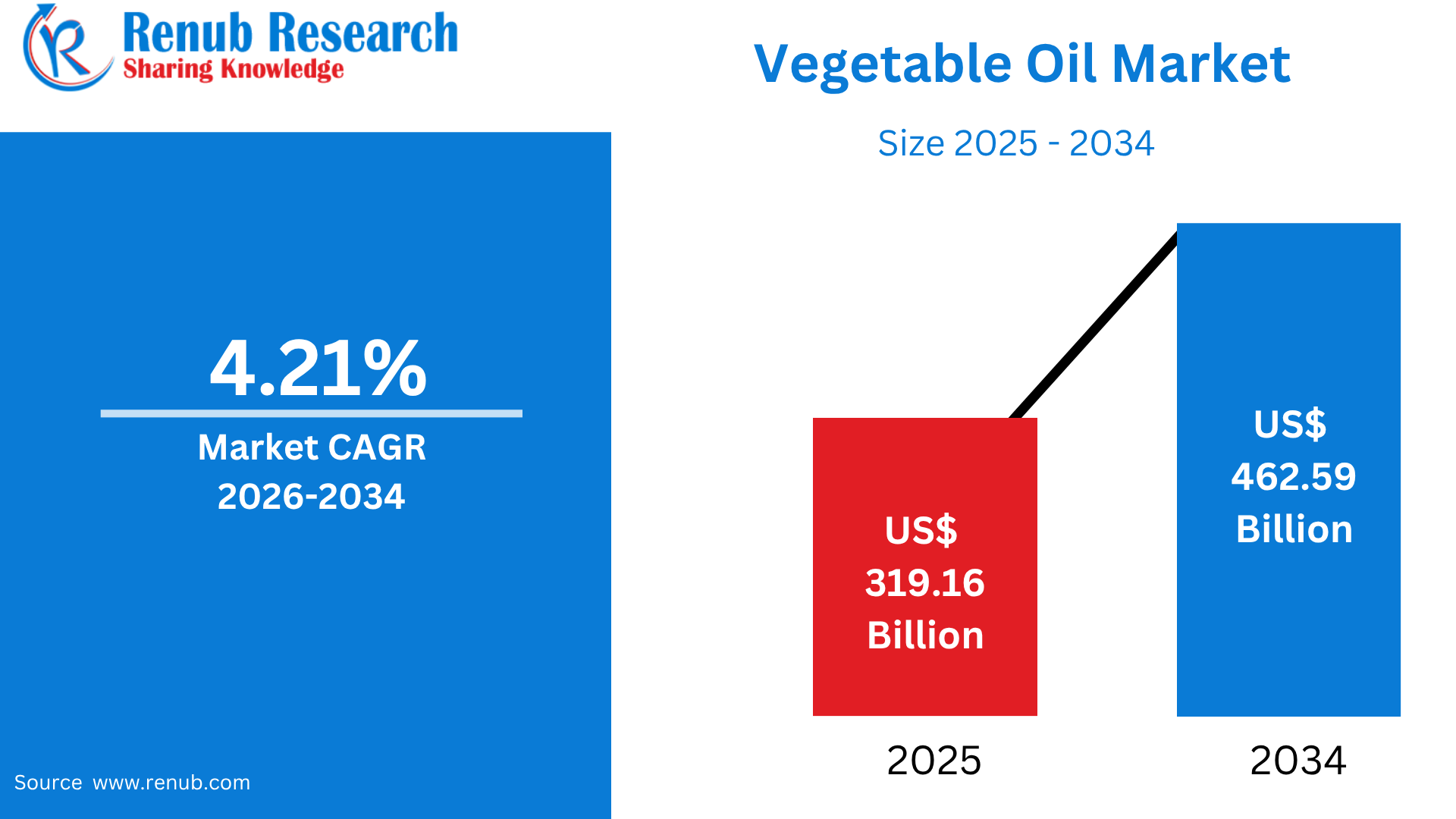
Global Vegetable Oil Market is projected to grow from US$ 319.16 Billion in 2025 to US$ 462.59 Billion by 2034, registering a CAGR of 4.21% during 2026–2034. Market expansion is being driven by rising demand for vegetable oils across the food processing, biofuel, personal care, and industrial sectors. Increasing consumer awareness of healthier cooking oils, coupled with changing dietary preferences and rapid urbanization, is further strengthening demand worldwide. In addition, growing adoption of plant-based and functional food products is creating new opportunities for vegetable oil manufacturers.
What is Vegetable Oil and Its Uses & Popularity Worldwide
Vegetable oil refers to edible or industrial oils extracted from plant-based sources such as soybeans, oil palm, rapeseed, sunflower, coconut, peanut, and cottonseed. Vegetable oils are primarily used for cooking, frying, baking, salad dressings, food processing, and margarine production, while non-food applications include biofuels, cosmetics, personal care products, soaps, lubricants, and oleochemicals. In 2025/26, global vegetable oil production is forecast at approximately 234.5 million metric tons, while consumption is projected at 228.9 million metric tons. Food applications account for about 72% of total consumption, demonstrating the category’s importance to global food systems. Palm and soybean oils together represent roughly 65% of global vegetable oil production, making them the dominant commercial oils worldwide. Vegetable oil remains highly popular because of its versatility, relatively affordable cost, long shelf life, and widespread availability. Growing demand from emerging economies, changing dietary habits, expansion of packaged foods, and increasing industrial use are further supporting its global importance.
Top 10 Countries with Palm Oil Production in 2023
- 1. Indonesia: Produced 47,084,299 tons of palm oil in 2023, making it the world’s largest palm oil producer.
- 2. Malaysia: Produced 18,551,950 tons, ranking second globally and representing a major share of international palm oil supply.
- 3. Thailand: Recorded 3,323,200 tons of palm oil production in 2023, ranking third worldwide.
- 4. Colombia: Produced 1,841,880 tons, making it the leading palm oil producer in Latin America.
- 5. Nigeria: Recorded 1,460,000 tons of production and remained one of Africa’s major palm oil producers.
- 6. Guatemala: Produced 933,926 tons of palm oil in 2023, supported by its expanding plantation sector.
- 7. Papua New Guinea: Recorded 770,000 tons, making it an important palm oil producer in the Pacific region.
- 8. Honduras: Produced 655,000 tons of palm oil, ranking among the leading producers in Central America.
- 9. Brazil: Recorded 637,353 tons of production, with palm oil cultivation concentrated in selected agricultural regions.
- 10. Côte d’Ivoire: Produced 562,465 tons, placing it among Africa’s leading palm oil-producing countries.
Source: FAOSTAT, 2026.
Growth Drivers of the Vegetable Oil Market
Rising Food Consumption and Expanding Food Processing Industry
The growing global population, urbanization, and increasing consumption of processed and convenience foods are major drivers of vegetable oil demand. Vegetable oils are essential ingredients in frying, baking, sauces, dressings, snacks, ready-to-eat meals, margarine, and numerous packaged food products. USDA forecasts global vegetable oil consumption at 228.9 million metric tons in 2025/26, representing an increase of approximately 4.9 million metric tons from the previous year. Importantly, food applications account for around 72% of total vegetable oil consumption, highlighting the sector’s dependence on food demand. Soybean, palm, rapeseed, and sunflower oils are particularly important because of their functionality, availability, and suitability for large-scale food manufacturing. China and India are expected to lead growth in food-use consumption during 2025/26. Rising disposable incomes, expansion of supermarkets and foodservice businesses, and growing demand for packaged foods in developing economies are therefore creating sustained opportunities for vegetable oil producers and processors.
Increasing Demand for Biofuels and Industrial Applications
The expansion of biofuels is becoming an increasingly important growth opportunity for vegetable oil producers. Soybean, palm, rapeseed, and other vegetable oils can be used as feedstocks for biodiesel and renewable diesel production, creating demand beyond traditional food applications. USDA projects global industrial use of vegetable oils at approximately 64.1 million metric tons in 2025/26, including feedstock requirements for biofuel production. Industrial consumption is also supported by applications in cosmetics, personal care, soaps, detergents, lubricants, coatings, and oleochemical manufacturing. According to USDA estimates, palm oil accounts for approximately 44% of industrial vegetable oil consumption, followed by soybean oil at 25% and rapeseed oil at 15%. Government policies promoting renewable fuels, decarbonization targets, and investments in alternative energy are encouraging refiners and fuel producers to increase vegetable-oil-based feedstock consumption. Consequently, the growing overlap between agriculture, food production, renewable energy, and industrial manufacturing is broadening the addressable market for vegetable oils worldwide.
Growing Consumer Preference for Plant-Based and Health-Oriented Oils
Changing consumer preferences are encouraging manufacturers to offer vegetable oils with improved nutritional profiles, functional benefits, and greater transparency. Consumers increasingly seek oils perceived as suitable for balanced diets, including soybean, sunflower, rapeseed/canola, olive, and other oils containing higher proportions of unsaturated fatty acids. This trend is also supporting premium, organic, non-GMO, cold-pressed, and specialty vegetable oil categories. The four major crops—oil palm, soybean, rapeseed, and sunflower—account for more than 91% of globally traded vegetable oil production, demonstrating their central role in meeting worldwide demand. At the same time, manufacturers are investing in refining, fractionation, deodorization, filtration, and extraction technologies to improve quality and create application-specific products. Rising awareness of nutritional labeling and healthier cooking practices is particularly influential in urban markets. Growing interest in plant-based diets and alternatives to animal fats is further expanding vegetable oil consumption, while product innovation enables producers to target both mainstream food applications and higher-value health-focused segments.
Challenges of the Vegetable Oil Market
Climate Change, Crop Volatility, and Raw Material Price Fluctuations
Vegetable oil production is highly dependent on agricultural conditions, making the market vulnerable to droughts, excessive rainfall, heatwaves, pests, and other climate-related disruptions. Fluctuations in oilseed yields can directly affect the availability and prices of palm fruit, soybeans, rapeseed, and sunflower seeds. USDA forecasts global vegetable oil production at approximately 234.5 million metric tons in 2025/26, while consumption is expected to reach 228.9 million metric tons, leaving relatively limited room for supply disruptions. Weather-related production losses can therefore create substantial volatility in international commodity markets. Palm oil production alone is forecast at about 80 million metric tons in 2025/26, with Indonesia and Malaysia representing major production centers. Geopolitical conflicts, trade restrictions, transportation disruptions, fertilizer costs, and changing energy prices can further influence production economics. These uncertainties create challenges for manufacturers, food processors, biodiesel producers, and retailers seeking stable procurement costs and long-term supply contracts.
Environmental Sustainability and Regulatory Pressures
Environmental concerns surrounding vegetable oil production represent another significant challenge, particularly for palm oil and other crops associated with land-use change, biodiversity loss, and greenhouse-gas emissions. The concentration of production in specific geographic regions can intensify scrutiny of agricultural expansion, deforestation, water consumption, and supply-chain traceability. At the same time, governments, retailers, food manufacturers, and consumers are increasingly demanding sustainably sourced and responsibly produced oils. The major vegetable oil crops—palm, soybean, rapeseed, and sunflower—collectively account for more than 91% of globally traded vegetable oil production, making sustainability improvements across these supply chains particularly important. Producers may need to invest in certified sourcing, traceability systems, improved farming practices, waste reduction, and lower-carbon processing. Compliance requirements can increase operational costs, especially for smaller producers and exporters. Consequently, balancing rising global demand with environmental protection, responsible land use, and sustainable agricultural practices remains a key challenge for the vegetable oil industry.
World’s Most Produced Vegetable Oils in 2023
- 1. Palm Oil: Production increased from 79,031,128 tons in 2022 to 79,567,198 tons in 2023, maintaining its position as the world’s most produced vegetable oil.
- 2. Soybean Oil: Production rose from 59,054,274 tons in 2022 to 59,911,090 tons in 2023, supported by strong food and industrial demand.
- 3. Rapeseed Oil: Output increased significantly from 27,579,726 tons to 31,399,693 tons during 2023.
- 4. Sunflower-Seed Oil: Production grew from 20,168,677 tons in 2022 to 22,655,348 tons in 2023.
- 5. Groundnut Oil: Production declined slightly from 6,595,933 tons to 6,430,826 tons.
- 6. Cottonseed Oil: Production increased from 4,071,255 tons to 4,173,834 tons.
- 7. Coconut Oil: Output decreased from 3,313,824 tons in 2022 to 3,122,675 tons in 2023.
- 8. Maize Oil: Production edged upward from 3,053,514 tons to 3,079,477 tons.
- 9. Olive Oil: Production declined from 2,689,407 tons to 2,629,863 tons.
- 10. Sesame Seed Oil: Production increased from 1,154,891 tons to 1,201,842 tons.
- 11. Linseed Oil: Production rose from 736,579 tons to 780,981 tons.
- 12. Safflower Oil: Production decreased from 86,267 tons in 2022 to 77,543 tons in 2023.
Source: Scienceagri.com, FAOSTAT, 2026.
Rising Consumption Across Food and Industrial Applications
The vegetable soybean oil market is expanding due to its extensive use in household cooking, food processing, foodservice, and industrial applications. Soybean oil remains one of the world’s major vegetable oils because of its affordability, availability, neutral flavor, and favorable fatty-acid profile. USDA forecasts global soybean crush at 384.8 million metric tons in 2026/27, with strong demand for both soybean meal and soybean oil driving processing activity. Global soybean oil use is forecast to increase by 3% in 2026/27, following approximately 5% growth in 2025/26. Food manufacturers use soybean oil in bakery products, snacks, sauces, margarine, and prepared meals, while industrial demand comes from biodiesel, cosmetics, soaps, coatings, and lubricants. India is particularly important, as it is the world’s leading soybean oil importer, with domestic soybean oil consumption having grown at double-digit rates over the past decade. Growing urbanization, packaged-food consumption, and biofuel applications are expected to sustain soybean oil demand worldwide.
Health-Oriented Consumption and Expanding Food Applications
The vegetable sunflower oil market is supported by growing demand for edible oils perceived as healthier cooking alternatives. Sunflower oil is widely used for frying, baking, salad dressings, sauces, snacks, and processed foods because of its relatively light flavor and versatility. Global sunflowerseed production and crushing remain important components of the vegetable-oil supply chain, with USDA tracking sunflower oil alongside soybean, rapeseed, palm, and other major oils. In the European Union, 2025/26 sunflower oil output is estimated to increase 3.1% year over year, supported by higher crushing volumes. However, higher sunflower oil prices are expected to reduce EU food consumption by 2.2% during the same period, demonstrating the influence of price competition. Demand is also influenced by growing interest in organic, non-GMO, and minimally processed oils. Continued food-processing expansion in Europe, Asia-Pacific, and North America, together with consumer interest in plant-based products, is expected to create opportunities for sunflower oil producers.
Growing Demand from Households, Foodservice, and Processed Foods
The food vegetable oil market represents the largest application area for vegetable oils worldwide, supported by household cooking and commercial food production. USDA estimates that global vegetable oil consumption will reach 228.9 million metric tons in 2025/26, with food applications accounting for approximately 72% of total consumption. Vegetable oils are essential in frying, baking, confectionery, sauces, margarine, snacks, ready-to-eat meals, and other processed-food categories. Rising urban populations and busy lifestyles are encouraging greater consumption of convenience foods, strengthening demand from restaurants, hotels, catering businesses, and food manufacturers. Soybean, palm, sunflower, and rapeseed oils remain important feedstocks for food applications because of their availability and functional characteristics. At the same time, consumers are increasingly interested in oils with favorable nutritional profiles, including sunflower, canola, soybean, and specialty oils. Improved refining, filtration, packaging, and shelf-life technologies are further supporting product quality. Developing markets with population growth and increasing disposable income are expected to remain important contributors to future edible-oil demand.
Bulk Procurement and Expanding Commercial Applications
The vegetable oil B2B market is expanding as food manufacturers, restaurants, hotels, bakeries, catering companies, retailers, and industrial processors increasingly require reliable bulk supplies. B2B transactions typically involve large-volume purchases of soybean, palm, sunflower, rapeseed, and other oils for food production and industrial processing. USDA projects global industrial vegetable oil use at approximately 64.1 million metric tons in 2025/26, including substantial demand associated with biofuel feedstocks. This broad industrial base creates opportunities for suppliers serving biodiesel, cosmetics, soaps, detergents, lubricants, and oleochemical manufacturers in addition to food companies. Commercial buyers increasingly prioritize consistent specifications, food safety, traceability, sustainability credentials, and competitive pricing. Digital procurement platforms and integrated supply-chain systems are also making it easier to manage international sourcing and bulk contracts. Global trade remains important because production and consumption are geographically concentrated. The availability of comprehensive USDA supply, demand, trade, and price datasets further reflects the highly interconnected nature of the international oilseed and vegetable-oil industry.
Soybean Dominance and Strong Biofuel Demand in the USA
The United States has a highly developed vegetable oil industry supported by extensive soybean production, large-scale crushing infrastructure, food processing, and biofuel manufacturing. Soybeans account for more than 90% of U.S. oilseed production, making soybean oil a critical component of the domestic vegetable-oil supply chain. USDA forecasts 2026/27 U.S. soybean production at a record 4.52 billion bushels, while soybean crush is projected at 2.78 billion bushels. Domestic demand comes from food, industrial products, and renewable fuels. In 2025/26, U.S. soybean oil use for biomass-based diesel is forecast at 14.8 billion pounds, approximately 14% above the previous record recorded in 2023/24. Consumer demand is also diversifying toward olive, avocado, canola, organic, and non-GMO oils. However, producers face raw-material price volatility, changing biofuel policies, competition from alternative feedstocks, and sustainability considerations. Continued investment in crushing capacity and renewable fuels is expected to support the U.S. market.
Preference for Rapeseed and Sunflower Oils in Germany
Germany represents an important European market for vegetable oils, supported by household consumption, food processing, foodservice, and industrial applications. Consumers commonly use rapeseed, sunflower, soybean, and olive oils across cooking and food manufacturing. Demand is increasingly influenced by nutritional considerations, sustainability, organic products, and transparent sourcing. The broader European vegetable-oil market is also being affected by changing relative prices between different oils. USDA’s 2025/26 European Union outlook indicates that sunflower oil food consumption is expected to decline 2.2% year over year, with Germany among the major users reporting lower consumption. This illustrates the importance of price competitiveness between sunflower, rapeseed, soybean, and other edible oils. Germany’s mature food-processing industry generates demand for oils used in bakery products, snacks, sauces, convenience foods, and prepared meals. Growing plant-based food consumption and interest in organic and non-GMO products are creating opportunities for premium oils. Meanwhile, European sustainability requirements are encouraging suppliers to strengthen traceability, responsible sourcing, and efficient processing throughout the supply chain.
High Consumption and Dependence on Imported Oils in India
India is one of the world’s most important vegetable oil markets because of its large population, expanding food industry, urbanization, and substantial import requirements. USDA forecasts India’s 2026/27 vegetable-oil food-use mix at 34% palm oil, 29% soybean oil, 17% rapeseed oil, and 9% sunflower oil, demonstrating the importance of soybean oil within the country’s edible-oil basket. Soybean oil demand is supported by household cooking, restaurants, packaged foods, snacks, and foodservice businesses. India is also the world’s leading soybean oil importer, highlighting the country’s dependence on international supplies. USDA reports that soybean oil imports are forecast to increase 2%, supported by competitive supplies from Brazil, Argentina, and China. Government trade policy remains an important market factor; crude edible-oil import duties were reduced from 27.5% to 16.5% in 2025, with the lower rate continuing into 2026. Rising packaged-food consumption, expanding modern retail, and changing consumer preferences are expected to maintain strong long-term demand.
Import Dependence and Growing Foodservice Demand in Saudi Arabia
Saudi Arabia’s vegetable oil market is supported by population growth, urbanization, foodservice expansion, and rising consumption of processed and packaged foods. Palm, soybean, and sunflower oils are widely used in households, restaurants, bakeries, catering operations, and food manufacturing. Because domestic agricultural production is constrained by arid climatic conditions, the market depends substantially on international agricultural and food-oil supply chains. Global vegetable-oil production is forecast at 234.5 million metric tons in 2025/26, while consumption is projected at 228.9 million metric tons, illustrating the scale of the international supply network on which importing markets depend. Saudi food manufacturers increasingly require consistent-quality oils for frying, baking, snacks, sauces, and ready-to-eat products. The country’s expanding hospitality and foodservice sectors are creating additional bulk demand. Health awareness is also encouraging interest in oils with favorable nutritional characteristics, while premium, organic, and specialty products provide opportunities for differentiated brands. Long-term market development will depend on import prices, freight costs, food-security policies, supply-chain resilience, and the ability of distributors to maintain reliable supplies.
Market Segmentation:
Oil Type
- Palm Oil
- Soybean Oil
- Rapeseed Oil
- Sunflower Oil
- Olive Oil
- Others
Application
- Food
- Feed
- Others
Distribution Channel
- B2B
- B2C
Countries
North America
- United States
- Canada
Europe
- France
- Germany
- Italy
- Spain
- United Kingdom
- Belgium
- Netherlands
- Turkey
Asia Pacific
- China
- Japan
- India
- Australia
- South Korea
- Thailand
- Malaysia
- Indonesia
- New Zealand
Latin America
- Brazil
- Mexico
- Argentina
Middle East & Africa
- South Africa
- Saudi Arabia
- United Arab Emirates
All companies have been covered with 5 Viewpoints
- Overviews
- Key Person
- Recent Developments
- SWOT Analysis
- Revenue Analysis
Key Players Analysis
- Archer – Daniels -Midland Company
- Wilmar
- AAK (Aarhuskarlshamn)
- Unilever Plc
- Bunge
- Cargill
- Sime Darby
- Associated British Foods
Report Details:
| Report Features | Details |
| Base Year |
2025 |
| Historical Period |
2022 - 2025 |
| Forecast Period |
2026 - 2034 |
| Market |
US$ Billion |
| Segment Covered |
Oil Type, Application, Distribution Channel and Countries |
| Countries Covered |
|
| Companies Covered |
|
| Customization Scope |
20% Free Customization |
| Post-Sale Analyst Support |
1 Year (52 Weeks) |
| Delivery Format |
PDF and Excel through Email (We can also provide the editable version of the report in PPT/Word format on request) |
Customization Services available
- Analysis of Market Size and Its Segments
- More Company Profiles (Upto 10 without any additional cost):
- Additional Countries (Other than mentioned Countries):
- Region/Country Specific Reports:
- Market Entry Strategy:
- Region-Specific Market Dynamics:
- Regional Market Share Analysis:
- Trade Analysis:
- Production Insights:
- Others Customized Requests:
For more information contact our analysts.
Need More Assistance?
- Talk to our analysts to get more precious information on the current market trends.
- Include more countries and segments and customize the report based on the final requirement.
- Get a competitive advantage in your industry by knowing the report findings and making a positive impact on your revenues and operations.
- Our analysts are always ready to provide more help and pertinent information if you need any additional assistance.