United States Online Food Delivery Market Report by Business Model, Platform Type, Payment Method, Cities and Company Analysis 2026-2034
Buy NowUnited States Online Food Delivery Market Size and Forecast
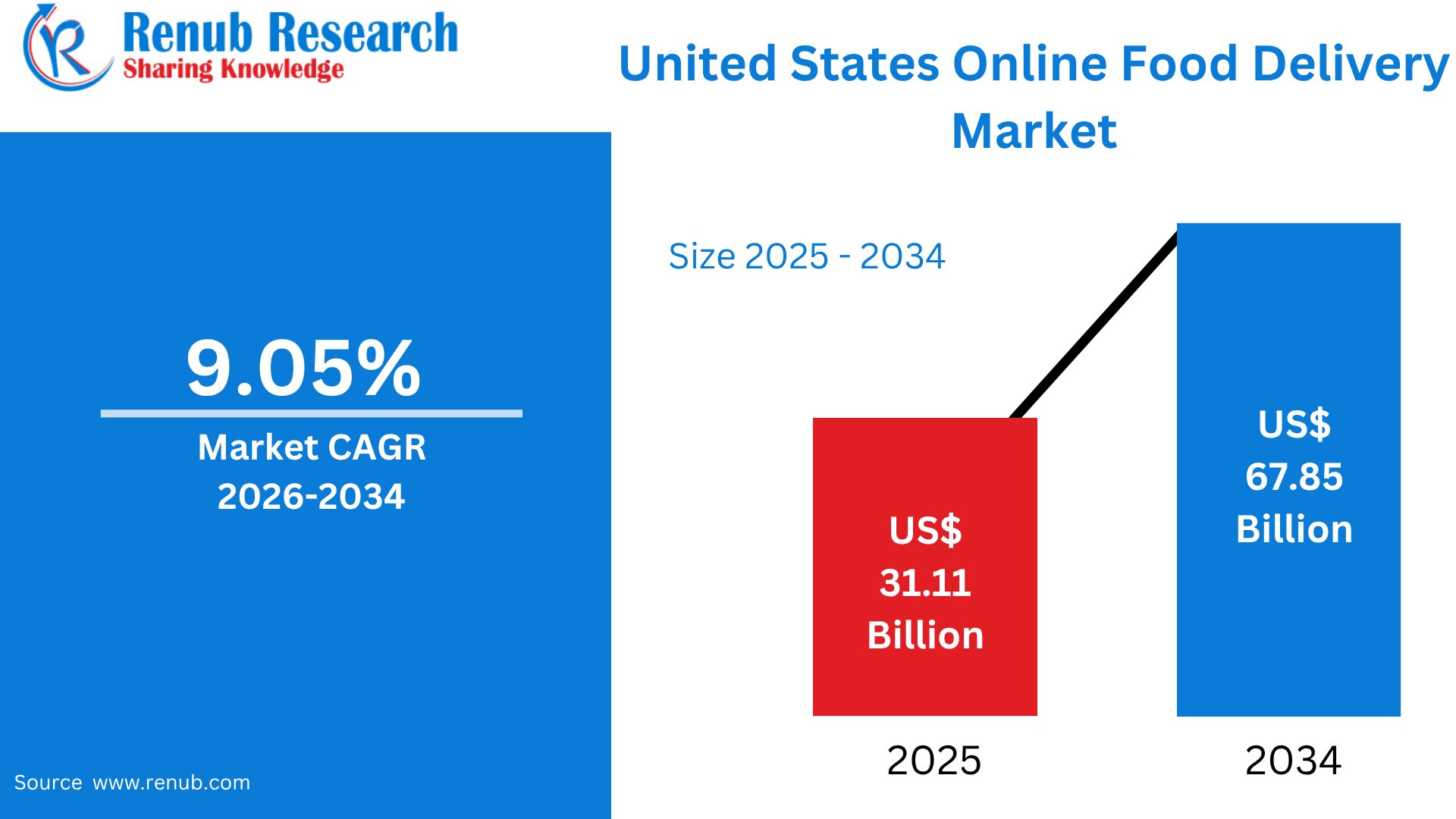
United States Online Food Delivery Market is projected to expand significantly, increasing from US$ 31.11 billion in 2025 to US$ 67.85 billion by 2034, registering a CAGR of 9.05% during 2026–2034. Market growth is being driven by rising consumer demand for convenient and time-saving meal solutions, increasing smartphone penetration, and the widespread adoption of digital ordering platforms. The growing availability of online payment options, including mobile wallets, digital cards, and app-based payments, is making food ordering faster and more seamless for consumers.
What is Online Food Delivery and its Uses & Popularity in the United States
Online food delivery is a technology-enabled service that allows consumers to order prepared meals, restaurant food, groceries, and other food products through mobile applications or websites and receive them at their homes, workplaces, or other preferred locations. The service connects customers with restaurants, grocery stores, delivery platforms, and logistics providers, creating a convenient digital food-ordering ecosystem.
In the United States, online food delivery has become increasingly popular because of its convenience, flexibility, and ability to provide access to a wide variety of restaurants and cuisines without requiring customers to travel. Consumers can browse menus, compare prices, customize orders, select delivery options, make digital payments, and track orders in real time. It is particularly useful for busy professionals, families, students, elderly consumers, and people who prefer eating at home. The service also benefits restaurants by helping them reach more customers, increase online visibility, and generate additional sales. The availability of mobile apps, digital payments, personalized recommendations, subscription programs, and faster delivery has further integrated online food ordering into everyday American dining habits.
Top food delivery apps in the US:
- DoorDash
- Grubhub
- Uber Eats
- Postmates
Growth Drivers of the United States Online Food Delivery Market
Rising Consumer Demand for Convenience and Time-Saving Services
Convenience is one of the strongest factors supporting the growth of online food delivery in the United States. Busy work schedules, longer commuting times, dual-income households, and changing lifestyles encourage consumers to order prepared meals rather than cook or travel to restaurants. Online platforms allow customers to compare menus, customize meals, pay digitally, and track deliveries from a smartphone. According to DoorDash’s 2025 consumer research, 90% of consumers surveyed said DoorDash gives them greater control over their time, while 86% of parents said it helps them care for loved ones and spend more time with family. Furthermore, 98% of surveyed consumers reported ordering delivery to satisfy a craving, and one in five said they were ordering restaurant delivery more frequently than the previous year. Third-party platforms are particularly attractive because 49% of consumers say they are easier to use and 42% consider them more convenient. These trends demonstrate that convenience has shifted food delivery from an occasional service toward an integrated component of everyday consumption.
Smartphone Adoption, Digital Payments, and App-Based Ordering
Rapid adoption of smartphones, mobile applications, digital wallets, and online payment systems is accelerating the U.S. online food delivery market. Consumers can order meals within minutes using applications that provide personalized recommendations, saved payment information, promotional offers, loyalty programs, and real-time tracking. Mobile applications accounted for 72.3% of the U.S. online food delivery market by platform type in 2025, while websites represented 27.7%. Online payments accounted for 81.6% of transactions, highlighting the importance of digital payment infrastructure. Third-party platforms are also highly established among American consumers. 46.05% of surveyed consumers prefer ordering through third-party apps or websites, while users order food delivery through these platforms an average of 4.6 times per month; the frequency rises to 5.1 times among Gen Z consumers. In addition, DoorDash reported more than 600,000 U.S. merchants connected to its Marketplace by December 2025, demonstrating the expanding digital ecosystem connecting restaurants with consumers.
Expansion of Restaurant Partnerships and Digital Food Ecosystems
The growing participation of restaurants, chains, independent food businesses, and other merchants is expanding the availability and attractiveness of online food delivery services. Delivery platforms provide restaurants with digital ordering infrastructure, delivery networks, customer discovery, marketing tools, and access to consumers beyond their immediate locations. DoorDash reported that U.S. merchants generated more than US$60 billion in sales through its Marketplace in 2025, while 90% of surveyed merchants said the platform helped them reach new consumers they otherwise would not have reached. Restaurants are also increasingly using delivery to supplement dine-in operations and reach customers during off-peak periods. At the same time, social media and digital discovery are stimulating demand for new restaurants and viral food products. DoorDash found that 74% of Gen Z and 69% of Millennials had ordered a restaurant item after seeing it go viral on social media. The expansion of restaurant partnerships, social-media-driven discovery, loyalty programs, and personalized recommendations therefore creates a broader ecosystem that supports sustained market growth.
Challenges of the United States Online Food Delivery Market
High Delivery Fees, Commissions, and Profitability Pressure
High operating costs and delivery-related charges remain significant challenges for the U.S. online food delivery industry. Platforms must manage expenses associated with driver compensation, incentives, technology, customer acquisition, insurance, payment processing, and logistics, while restaurants often face platform commissions and additional marketing expenses. At the consumer level, service charges, delivery fees, small-order fees, and other costs can increase the final price substantially compared with ordering directly from a restaurant. The issue has attracted regulatory attention. In 2026, the U.S. Federal Trade Commission (FTC) highlighted concerns over unfair or misleading fee practices and noted a US$25 million settlement with Grubhub in 2024 over allegations concerning misleading delivery-cost information, while Instacart agreed to a US$60 million settlement in 2025 over allegations involving its advertising of free delivery and subsequent fees. At the restaurant level, profitability is also pressured by broader inflation and labor expenses. Toast’s 2025 survey found that 20% of restaurant operators identified inflation as their top business pain point, while 48% said they would increase menu prices if inflation continued.
Intense Competition and Customer Loyalty Challenges
The U.S. online food delivery market is highly competitive, with major platforms competing for consumers, restaurants, drivers, and market share. DoorDash, Uber Eats, Grubhub, restaurant-owned ordering systems, and emerging delivery services compete through discounts, subscriptions, loyalty programs, faster delivery, wider restaurant selection, and personalized recommendations. This competition makes customer retention difficult because consumers can easily download multiple applications and compare prices and promotions before placing an order. Statista reported that the United States had more than 180 million meal-delivery users in 2025, but also noted that customer loyalty remains difficult because consumers can easily switch between platforms. Competition also extends to profitability, as platforms have historically faced pressure to balance growth with sustainable margins. Meanwhile, restaurants have greater incentives to develop direct ordering channels to reduce dependence on third-party platforms and their associated fees. Consequently, delivery companies must continuously invest in technology, promotions, logistics efficiency, customer experience, and merchant relationships to maintain market position while controlling operating costs.
Online Food Delivery Launches in the USA
- Amazon–Grubhub Integration – May 2024: Amazon and Grubhub launched direct restaurant ordering through Amazon.com and the Amazon Shopping app for U.S. customers, providing access to restaurants across all 50 states.
- Instacart–Uber Eats Restaurant Delivery – May 2024: Instacart and Uber Eats launched a partnership enabling Instacart customers to order meals from hundreds of thousands of Uber Eats restaurant partners through a new Restaurants tab.
- Starbucks–Grubhub Delivery Expansion – June 2024: Starbucks launched its expanded delivery partnership with Grubhub in the U.S., initially covering selected markets before planned nationwide expansion.
- DoorDash Family Sharing – June 2025: DoorDash launched a family sharing feature, allowing DashPass members and households to share delivery-related benefits and simplify group ordering.
- DoorDash Grocery Expansion – July 2025: DoorDash expanded its grocery delivery network by adding six grocery retailers, strengthening its position beyond restaurant meal delivery.
- Dollar General–Uber Eats Expansion – August 2025: Dollar General expanded its availability on Uber Eats, allowing customers to order products through the delivery platform.
- DoorDash–Kroger Partnership – September 2025: DoorDash expanded its grocery fulfillment capabilities through a partnership with Kroger, supporting broader on-demand delivery services.
- DoorDash–Waymo Autonomous Delivery Pilot – October 2025: DoorDash and Waymo launched a pilot involving autonomous vehicle deliveries, demonstrating the industry’s move toward technology-enabled delivery logistics.
- DoorDash Zesty AI Restaurant Discovery App – December 2025: DoorDash began public testing of Zesty, an AI-powered restaurant discovery application, in New York and San Francisco, offering personalized restaurant recommendations.
- DoorDash–DoubleDash Expansion: DoorDash’s DoubleDash service enables customers to add convenience and grocery products to restaurant orders, illustrating the expansion of food delivery platforms into broader on-demand commerce.
Online Platform-to-Customer Food Delivery Market
Online platform-to-customer food delivery refers to digital marketplaces that connect restaurants, foodservice providers, and consumers through centralized online platforms. These services allow customers to discover restaurants, browse menus, customize meals, place orders, make payments, and track deliveries from a single interface. Platforms such as DoorDash, Uber Eats, and Grubhub have become important channels for restaurants seeking to expand their reach without developing independent delivery infrastructure. Customers also benefit from restaurant ratings, reviews, personalized recommendations, promotional offers, and convenient payment options. The emergence of cloud kitchens and virtual restaurants has further strengthened dependence on digital delivery platforms, as these businesses are primarily designed around online ordering rather than traditional dine-in operations.
Online Food Delivery Websites Market
Online food delivery websites enable consumers to order meals through desktop or laptop web browsers. These platforms provide access to restaurant menus, pricing, customization options, promotions, payment facilities, and delivery tracking. Websites remain particularly useful for consumers ordering from workplaces or homes where larger screens make menu comparison and bulk ordering easier. According to U.S. market estimates, websites accounted for approximately 27.7% of the online food delivery platform market in 2025, while mobile applications represented the larger share. Restaurants also benefit by displaying their menus and brand information to a broader audience. Most major food delivery companies operate websites alongside mobile applications, allowing customers to maintain accounts, save payment information, review previous orders, and receive personalized offers. Although mobile ordering continues to dominate due to smartphone convenience, websites remain relevant for consumers who prefer browser-based ordering, advance meal planning, or larger-screen navigation.
Online Food Delivery Applications Market
Online food delivery applications have become a leading channel for digital meal ordering because they provide speed, convenience, personalization, and location-based services. Smartphone users can search restaurants, compare menus, customize meals, place orders, receive notifications, and track deliveries in real time. In the United States, mobile applications accounted for around 72.3% of the online food delivery platform market in 2025, highlighting their strong consumer adoption. Applications also incorporate GPS technology to connect customers with nearby restaurants and enable delivery personnel to optimize routes. Artificial intelligence-powered recommendations, voice search, loyalty programs, subscription memberships, digital wallets, and personalized promotions are further improving the user experience. The widespread adoption of smartphones and high-speed mobile internet has strengthened the segment, particularly among younger consumers who frequently use apps for everyday purchases. Continuous investment in application design, faster delivery systems, personalization, and digital engagement is expected to support the expansion of this segment.
Online Food Delivery Payment Market
Online food delivery payments encompass the digital transaction systems used to pay for meals and delivery services. Common payment methods include credit and debit cards, digital wallets, mobile payments, online banking, and other cashless transaction options. Convenient and secure payment infrastructure is essential because it enables customers to complete orders quickly while providing restaurants and delivery platforms with efficient transaction processing. In the United States, online payments accounted for approximately 81.6% of online food delivery transactions in 2025, demonstrating the strong preference for cashless payment methods. Secure payment gateways, encryption, fraud prevention, and tokenized transactions also increase consumer confidence. Food delivery platforms frequently integrate promotional incentives such as cashback, discounts, loyalty rewards, and subscription benefits to encourage digital payments and repeat purchases. The expansion of fintech, mobile wallets, one-click checkout, and embedded payment technologies is further improving transaction convenience. As consumers increasingly expect fast, secure, and frictionless checkout experiences, digital payment systems are expected to remain a critical component of the online food delivery ecosystem.
New York Online Food Delivery Market
New York City represents one of the most mature and competitive online food delivery markets in the United States. The city’s dense population, fast-paced lifestyle, extensive restaurant ecosystem, and multicultural consumer base create strong demand for convenient meal delivery. Consumers can order everything from New York-style pizza and street food to Asian, Mediterranean, Latin American, and fine-dining cuisine through digital platforms. The concentration of restaurants within relatively short distances also supports efficient delivery operations. Mobile applications are particularly important because customers can conveniently search restaurants, compare menus, access discounts, track orders, and make cashless payments. Food delivery is also widely used by office workers, students, households, and tourists seeking convenient dining options. The availability of independent restaurants alongside major national chains increases consumer choice and intensifies competition among delivery platforms. Subscription programs, loyalty rewards, personalized recommendations, and faster delivery options are further strengthening the market. As consumers increasingly prioritize convenience and digital ordering, New York is expected to remain a key market for online food delivery services.
Los Angeles Online Food Delivery Market
Los Angeles has a rapidly evolving online food delivery market supported by its large population, extensive geographic area, diverse restaurant industry, and convenience-oriented consumer lifestyle. The city offers a broad selection of cuisines, including Mexican, Korean, Japanese, American, Mediterranean, and health-focused food. Online delivery platforms enable consumers to discover both established restaurants and smaller independent businesses without traveling across the city. Convenience is particularly valuable in Los Angeles because commuting distances and traffic congestion can make restaurant visits time-consuming. Smartphone applications provide consumers with easy access to menus, promotions, digital payments, delivery tracking, and personalized recommendations. Demand for healthy, organic, plant-based, and customized meals also contributes to market development, reflecting the city’s strong wellness and lifestyle culture. Restaurants increasingly use delivery platforms to reach customers beyond their immediate neighborhoods and generate additional sales channels. Promotional discounts, subscription memberships, and loyalty programs further encourage repeat orders. Continued adoption of mobile technology and digital payments is expected to support sustained expansion of Los Angeles’s online food delivery market.
San Diego Online Food Delivery Market
San Diego’s online food delivery market is expanding as consumers increasingly seek convenient ways to access meals from restaurants and foodservice businesses. The city’s combination of students, young professionals, families, and technology-oriented consumers creates a broad customer base for digital food ordering. Customers can choose from national restaurant chains, independent eateries, Mexican cuisine, seafood, Asian food, fast food, and health-oriented restaurants through delivery applications. Health and wellness trends are particularly relevant to San Diego, encouraging demand for nutritious, organic, plant-based, and specialized meal options. Delivery platforms help restaurants respond to these preferences by making diverse food choices accessible through digital channels. Customers also value reliable delivery, food quality, competitive pricing, and transparent ordering processes. Discounts, promotional campaigns, loyalty programs, and subscription services can encourage consumers to order more frequently. Smartphone applications remain an important ordering channel because they combine restaurant discovery, digital payment, GPS-based delivery tracking, and personalized recommendations. The continued integration of technology with foodservice is expected to create further opportunities for delivery platforms and participating restaurants in San Diego.
Jacksonville Online Food Delivery Market
Jacksonville is developing as an important regional market for online food delivery, supported by population growth, expanding restaurant options, and increasing consumer preference for convenience. The city offers a combination of Southern-style cuisine, seafood, American food, fast food, and international options, giving delivery platforms a broad selection of products to offer consumers. Online food delivery is particularly useful for families, professionals, students, and consumers who prefer convenient meals at home. Digital platforms allow customers to compare restaurants, review menus, identify promotional offers, customize orders, and track deliveries. Price sensitivity is an important consideration, making discounts, affordable delivery options, and value-oriented meal deals useful for attracting customers. Jacksonville’s relatively spread-out urban environment also creates opportunities for delivery platforms to connect restaurants with customers across different neighborhoods. Group and family orders represent another potential growth area because households can conveniently order multiple meals through a single platform. As smartphone usage, digital payments, restaurant partnerships, and online ordering continue to expand, Jacksonville’s food delivery ecosystem is positioned for further development.
United States Online Food Delivery Market Segments
Business Model
- Platform to customer delivery
- Restaurant to customer delivery
Platform Type
- Websites
- Applications
Payment Method
- Cash on delivery
- Online
States
- California
- Texas
- New York
- Florida
- Illinois
- Pennsylvania
- Ohio
- Georgia
- New Jersey
- Washington
- North Carolina
- Massachusetts
- Virginia
- Michigan
- Maryland
- Colorado
- Tennessee
- Indiana
- Arizona
- Minnesota
- Wisconsin
- Missouri
- Connecticut
- South Carolina
- Oregon
- Louisiana
- Alabama
- Kentucky
- Rest of United States
All the Key players have been covered
- Overviews
- Key Person
- Recent Developments
- SWOT Analysis
- Revenue Analysis
Company Analysis
- Grubhub
- Doordash
- Uber Eats
- Postmates
- Dominos Pizza Inc.
- Kroger Co.
- Blue Apron Holdings
- HelloFresh
Report Details:
| Report Features | Details |
| Base Year |
2024 |
| Historical Period |
2021 - 2024 |
| Forecast Period |
2025 - 2033 |
| Market |
US$ Billion |
| Segment Covered |
By Business Model, By Platform Type, By Payment Method and By Cities |
| Cities Covered |
|
| Companies Covered |
|
| Customization Scope |
20% Free Customization |
| Post-Sale Analyst Support |
1 Year (52 Weeks) |
| Delivery Format |
PDF and Excel through Email (We can also provide the editable version of the report in PPT/Word format on request) |
Customization Services available
- Analysis of Market Size and Its Segments
- More Company Profiles (Upto 10 without any additional cost):
- Additional Countries (Other than mentioned Countries):
- Region/Country Specific Reports:
- Market Entry Strategy:
- Region-Specific Market Dynamics:
- Regional Market Share Analysis:
- Trade Analysis:
- Production Insights:
- Others Customized Requests:
For more information contact our analysts.
Need More Assistance?
- Talk to our analysts to get more precious information on the current market trends.
- Include more countries and segments and customize the report based on the final requirement.
- Get a competitive advantage in your industry by knowing the report findings and making a positive impact on your revenues and operations.
- Our analysts are always ready to provide more help and pertinent information if you need any additional assistance.