Online Grocery Market Report by Product, Purchaser Type, Delivery Type, Payment Mode, Country and Company Analysis 2026-2034
Buy NowOnline Grocery Market Size & Forecast
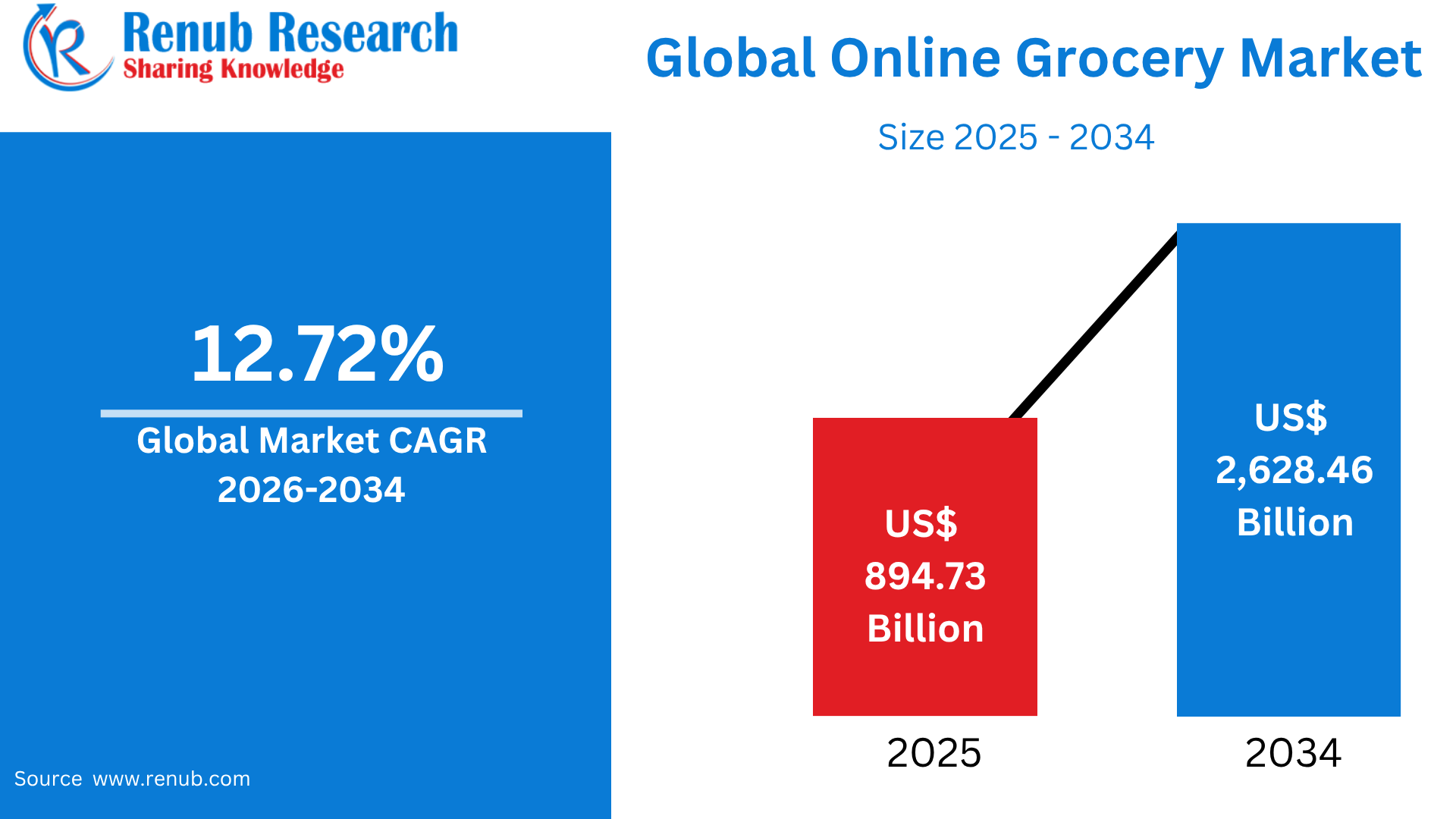
The global online grocery market is projected to expand from US$ 894.73 billion in 2025 to US$ 2,628.46 billion by 2034, registering a CAGR of 12.72% during 2026–2034. Market growth is being driven by the increasing consumer preference for convenient and time-saving grocery shopping, the rapid development of delivery and fulfillment networks, technological advancements, and rising smartphone and internet penetration. The expansion of quick-commerce services, digital payment systems, personalized shopping experiences, and app-based grocery platforms is further encouraging consumers to shift from traditional stores to online channels.
What Is the Online Grocery Market? Uses & Popularity Worldwide
The online grocery market refers to the buying and selling of food, beverages, household essentials, personal-care products, fresh produce, and other everyday grocery items through digital platforms such as retailer websites, mobile applications, online marketplaces, and quick-commerce services. Consumers can browse products, compare prices, place orders, make digital payments, and receive groceries at their homes or selected pickup locations. The market is increasingly used for weekly grocery shopping, emergency purchases, fresh-food delivery, bulk purchasing, and recurring household requirements. Integration of artificial intelligence, personalized recommendations, digital wallets, automated warehouses, and real-time order tracking is further improving the online shopping experience.
Online grocery has become increasingly popular worldwide because of convenience, time savings, expanding product availability, and improving delivery infrastructure. Rising smartphone and internet penetration is enabling consumers to access grocery platforms from virtually anywhere. Urbanization and busy lifestyles are also encouraging households to choose home delivery rather than visiting physical stores. Rapid delivery services, attractive discounts, loyalty programs, subscription models, and improved cold-chain logistics are further strengthening consumer adoption across developed and emerging markets.
Smartphone Usage Statistics 2026
- Over 5.78 billion people use smartphones.
- More than 7.58 billion smartphones are in use.
- Over 97% of users between 18 and 49 years old use smartphones.
- Almost half of the people in the United States spend 5 to 6 hours on smartphones daily.
- Smartphones make up 70% of digital media time in the United States.
- M-commerce accounted for 60% of e-commerce.
- Smartphone users touch their phones an average of 2,617 times daily in the United States.
- Nearly 72% of teenagers check their phone messages and notifications after waking up.
Individuals Using the Internet – Key Points
- Global internet usage increased significantly from around 1 billion users in 2005 to approximately 6 billion users in 2025.
- The number of internet users grew steadily throughout the period, reaching around 2 billion users by 2010.
- Internet adoption accelerated during the 2010–2015 period, with users increasing from approximately 2 billion to 3 billion.
- By 2018, the number of global internet users exceeded 4 billion, reflecting broader digital connectivity.
- A notable acceleration occurred between 2019 and 2021, with internet users rising from approximately 4.2 billion to more than 5 billion.
- By 2025, approximately 6 billion people were using the Internet worldwide.
- The percentage of the global population using the Internet increased from roughly 15% in 2005 to around 75% in 2025.
- Internet penetration crossed approximately 50% of the global population around 2019, marking a major milestone in global digital adoption.
- The rapid expansion of internet access has been supported by smartphones, mobile broadband, affordable connectivity, and expanding digital infrastructure.
- Source: International Telecommunication Union (ITU).
Growth Drivers of the Global Online Grocery Market
Rising Demand for Convenience and Time-Saving Shopping
The growing consumer preference for convenient, fast, and time-saving shopping is one of the strongest drivers of the global online grocery market. Online platforms allow consumers to purchase fresh produce, packaged foods, beverages, dairy products, household essentials, and personal-care products without visiting physical stores. This convenience is particularly valuable for urban households, working professionals, elderly consumers, and families with busy schedules. In the United States, online grocery is also becoming an integral part of omnichannel shopping; more than 94% of grocery shoppers purchased both online and in-store during 2025, demonstrating that consumers increasingly combine digital and physical channels. Retailers are responding with scheduled delivery, same-day fulfillment, click-and-collect, subscriptions, and quick-commerce services. Increasingly personalized recommendations and digital loyalty programs are also making online shopping more convenient. As consumers become accustomed to ordering groceries through smartphones, convenience is expected to remain a fundamental long-term growth driver.
Smartphone, Internet and Digital Payment Penetration
The rapid expansion of smartphone usage, internet connectivity, mobile applications, and digital payment systems is creating a strong foundation for online grocery adoption worldwide. Modern grocery platforms allow consumers to search thousands of products, compare prices, receive personalized recommendations, track deliveries, and complete purchases within minutes. The expansion of digital wallets, contactless payments, bank transfers, and one-click checkout is reducing friction during online purchases. Artificial intelligence is also improving product recommendations, demand forecasting, search functions, inventory management, and personalized promotions. In emerging markets, affordable smartphones and expanding mobile internet access are enabling consumers to move directly from traditional grocery shopping toward app-based purchasing. Retailers are additionally integrating loyalty programs and personalized discounts into mobile applications, encouraging repeat purchases. As digital infrastructure continues improving, online grocery services are becoming accessible to increasingly broader consumer populations, supporting sustained market expansion.
Expansion of Quick Commerce and Advanced Delivery Networks
The rapid development of quick-commerce services, micro-fulfillment centers, warehouses, and last-mile delivery networks is significantly accelerating online grocery adoption. Consumers increasingly expect groceries to arrive quickly, particularly for urgent household requirements, fresh foods, beverages, and ready-to-consume products. GlobalData identifies improvements in last-mile delivery and rising consumer expectations for convenience as major factors supporting food and grocery e-commerce growth. Retailers are investing in dark stores, automated warehouses, micro-fulfillment centers, route optimization, AI-based inventory management, and strategically located distribution hubs to shorten delivery times. Quick-commerce models are particularly influential in densely populated urban markets, where high order density can improve delivery efficiency. In India, for example, quick commerce represented approximately 47% of online grocery sales, illustrating how rapidly fast-delivery models can reshape the category, as per The Economic Times. Continued investment in fulfillment infrastructure is expected to improve product availability, delivery reliability, and customer satisfaction.
Challenges of the Global Online Grocery Market
High Last-Mile Delivery Costs and Profitability Pressure
High last-mile fulfillment and delivery costs remain one of the most significant challenges for online grocery companies because grocery products typically have relatively low margins while requiring frequent deliveries. Retailers must cover picking, packing, warehousing, delivery labor, fuel, routing, technology, and customer-service expenses. The challenge becomes more severe when consumers place small orders or expect extremely rapid delivery. Capgemini reports that the last mile is the most expensive part of the supply chain, while around 40% of consumers consider delivery service a must-have for food and grocery products. This creates a difficult balance between providing fast or free delivery and maintaining profitability. Subscription models can encourage smaller and more frequent grocery orders, but research shows that they can simultaneously increase delivery-related travel and expenses. Quick-commerce companies face additional costs because they require dense networks of dark stores or micro-fulfillment facilities close to customers. Discounts and free-delivery promotions can further weaken margins. Consequently, companies are investing in route optimization, automated fulfillment, minimum order values, delivery fees, subscriptions, and higher-margin private-label products to improve unit economics. Managing delivery costs without compromising service quality will remain critical to sustainable online grocery growth.
Perishable Inventory, Food Waste and Supply-Chain Complexity
Managing fresh and perishable groceries presents another major challenge because products such as fruits, vegetables, dairy, meat, and seafood require careful inventory planning, temperature control, rapid fulfillment, and quality assurance. Unlike non-food e-commerce, online grocery retailers must ensure that products remain fresh throughout storage, picking, transportation, and final delivery. Limited shelf life can create inventory losses when demand forecasts are inaccurate or orders are cancelled. Cold-chain requirements also increase infrastructure and operating costs, particularly in emerging markets where refrigerated logistics networks remain underdeveloped. Research on online grocery retail highlights the trade-off between delivery efficiency, inventory management, and food waste, while recent research specifically examines how online grocery adoption affects waste at both retail and consumer levels. In addition, inconsistent product availability can negatively affect customer satisfaction when shoppers receive substitutions or out-of-stock notifications. Retailers therefore need sophisticated demand forecasting, real-time inventory visibility, automated replenishment, temperature-controlled storage, and optimized delivery routes. Competition also increases the pressure to maintain wide product assortments while minimizing unsold inventory. Improving fresh-food supply chains and reducing waste will be essential for protecting margins, maintaining product quality, and building consumer trust in online grocery platforms.
Online Grocery Product Launches Worldwide
- Amazon Grocery – Amazon (U.S., 2025): Amazon launched Amazon Grocery, a new private-label grocery brand offering more than 1,000 products, including milk, olive oil, fresh produce, meat, seafood, pantry staples, and snacks. Most products are priced below US$5.
- Organic Oaty White Strong Bread Flour – Doves Farm (UK, 2026): Doves Farm launched Organic Oaty White Strong Bread Flour, expanding its organic grocery range and targeting consumers seeking innovative baking ingredients.
- Paratha Toasties – Shana Foods (UK, 2026): Shana Foods launched Paratha Toasties, a convenient frozen grocery product designed around quick preparation and changing demand for convenient meal solutions.
- Korean-Style Maggi Noodles – Nestlé (UK, 2026): Maggi introduced new Korean-inspired noodle flavors, responding to growing consumer interest in Korean cuisine and globally influenced grocery products.
- Organic Thai Green Curry Paste – Biona (UK, 2026): Biona expanded its grocery portfolio with Organic Thai Green Curry Paste, catering to demand for convenient cooking ingredients and international flavors.
- Live Like You Mean It Range – Tilda (UK, 2026): Tilda introduced its “Live Like You Mean It” initiative alongside its rice portfolio, supporting consumer interest in convenient and versatile staple foods.
- Noodle Blocks – Pot Noodle (UK, 2026): Pot Noodle announced Noodle Blocks, extending its instant-noodle offering with a new format aimed at convenient meal occasions.
- New Organic Blends – Pukka Herbs (UK, 2026): Pukka Herbs introduced new organic tea blends, strengthening its natural and wellness-oriented grocery portfolio.
- Baked Beans Range – Merchant Gourmet (UK, 2026): Merchant Gourmet launched a new baked beans range, adding convenient plant-based pantry products to its grocery portfolio.
- Amazon Fresh Expanded Grocery Selection – Amazon India (India, 2025): Amazon Fresh expanded across 270+ Indian cities, offering more than 40,000 products, including fresh produce, dairy, packaged foods, frozen products, staples, and household essentials. The expansion connected more than 13,000 farmers with customers through the platform.
High-Frequency Purchases Strengthen Online Demand
Online ready-to-eat breakfast and dairy market is gaining importance as consumers increasingly seek convenient foods that can be ordered quickly and delivered to their homes. The category includes milk, yogurt, paneer, cheese, butter, eggs, cereals, bread, spreads, breakfast mixes, and ready-to-eat breakfast products. Dairy and breakfast products are particularly suitable for online and quick-commerce platforms because many are purchased frequently and require convenient replenishment. Research on Zepto found that dairy and breakfast products were among the most popular categories, with the platform processing approximately 1.45–1.55 million orders per day in March 2025. Rising urbanization, busy lifestyles, home delivery, subscription-based purchasing, and improved cold-chain infrastructure are encouraging consumers to order breakfast essentials digitally. Retailers are also using discounts, bundled offers, personalized recommendations, and early-morning delivery to increase purchase frequency. Growing demand for healthy, premium, protein-rich, and ready-to-eat breakfast options is expected to further strengthen this segment.
Freshness, Hygiene and Convenience Drive Digital Meat & Seafood Adoption
Online meat and seafood market is expanding as consumers increasingly value convenience, product hygiene, quality assurance, and doorstep delivery. Online platforms allow customers to select fresh or frozen chicken, mutton, fish, prawns, seafood, and processed meat products while accessing information about sourcing, weight, cuts, packaging, and preparation. In India, grocery retailing through e-commerce for processed meat, seafood, and meat alternatives increased in 2024. The growth is particularly strong in urban and Tier-1 markets where consumers have greater exposure to digital shopping and quick-commerce services. Platforms offering 15–20-minute delivery are further encouraging online purchases for urgent meal requirements. Consumers are also becoming more interested in high-protein foods, while branded packaging and cold-chain logistics help address concerns surrounding freshness and food safety. Nevertheless, maintaining temperature-controlled supply chains and delivering products within short timeframes remain important operational requirements. Continued investments in cold storage, quality control, hygienic packaging, and last-mile logistics are expected to accelerate digital adoption.
Flexible Shopping Behavior Supports One-Time Orders
One-time purchase grocery market consists of consumers who place individual online grocery orders according to immediate or periodic household requirements rather than committing to subscription or recurring purchasing programs. This model remains important because consumers often require flexibility when buying groceries, particularly for unexpected needs, special occasions, fresh foods, snacks, beverages, and household essentials. The rapid development of quick commerce is strengthening one-time purchasing by allowing consumers to order small baskets and receive products within minutes. Swiggy Instamart’s 2025 data, for example, showed that the platform had evolved beyond emergency top-ups into a broader everyday shopping destination, with orders ranging from ₹10 purchases to a ₹4.3 lakh largest single cart during the year. Discounts, free-delivery thresholds, promotional campaigns, and personalized recommendations encourage consumers to make individual purchases without long-term commitments. One-time purchasing is also attractive to new online grocery users who want to test product quality and delivery reliability before adopting subscriptions. However, retailers face higher fulfillment costs when customers place small-value orders. Consequently, minimum-order thresholds, delivery fees, bundled promotions, and cross-selling are increasingly being used to improve average order values while preserving flexibility for consumers.
Same-Day and Fast Delivery Become Core Consumer Expectations
Online home delivery grocery market is expanding rapidly as consumers increasingly prefer receiving groceries directly at their homes rather than visiting physical stores. Home delivery provides convenience for working professionals, elderly consumers, families, and households located in urban areas. Quick-commerce platforms are further transforming consumer expectations by providing delivery within minutes for selected products. In India, platforms such as Blinkit, Zepto, and Swiggy Instamart are using localized fulfillment networks to provide rapid access to groceries, including fresh produce, dairy, meat, beverages, and household essentials. Retailers are investing in dark stores, micro-fulfillment centers, route optimization, cold-chain systems, and real-time inventory management to improve delivery performance. Despite strong demand, high last-mile costs, delivery congestion, perishables management, and customer expectations for low or free delivery charges remain challenges. Continued logistics innovation is therefore essential for profitable expansion.
Trust and Accessibility Sustain COD Adoption
Cash-on-delivery grocery market remains relevant, particularly among consumers who are hesitant to make online payments, lack access to digital payment facilities, or prefer paying after receiving their orders. Although digital payments are becoming increasingly dominant, COD provides an important bridge for first-time online shoppers and consumers in Tier-2, Tier-3, semi-urban, and less digitally mature markets. A 2025 pilot by Kiko Live found that neighborhood stores offering COD experienced a 30% increase in daily online orders, demonstrating how payment flexibility can expand customer adoption. COD also allows customers to inspect delivered products before making payment, which can be particularly valuable for fresh and perishable groceries. However, retailers face higher cash-handling costs, reconciliation challenges, failed deliveries, and return-related expenses. The increasing adoption of UPI and digital wallets will gradually reduce dependence on physical cash, but COD is expected to remain an important acquisition and trust-building mechanism in emerging online grocery markets.
High Digital Adoption and Advanced Fulfillment Infrastructure in USA
United States online grocery market is one of the world’s most developed, supported by high internet and smartphone penetration, sophisticated logistics infrastructure, and widespread consumer familiarity with digital shopping. Consumers increasingly use online channels for fresh produce, packaged foods, beverages, household essentials, and recurring weekly purchases. Major retailers are strengthening their competitive positions through same-day delivery, pickup services, subscriptions, loyalty programs, and personalized recommendations. Investments in automation, artificial intelligence, micro-fulfillment centers, robotics, and real-time inventory management are improving order accuracy and reducing fulfillment times. Quick-commerce services are also expanding in major metropolitan areas, while retailers are working to improve delivery coverage in suburban and rural communities. The growing integration of online and offline shopping is creating an omnichannel environment in which consumers move between physical stores, retailer applications, and delivery platforms. Continued investments in fulfillment infrastructure, digital personalization, and convenience are expected to sustain the U.S. market’s strong growth.
Growing Consumer Acceptance and Omnichannel Retail Development in Germany
Germany online grocery market is developing steadily as consumers increasingly value convenient home delivery, digital ordering, and flexible grocery shopping. Germany’s strong logistics infrastructure, high internet penetration, and well-established supermarket sector provide a foundation for online grocery expansion. The country’s e-commerce food and grocery market is expected to benefit from increasing consumer acceptance of digital purchasing, particularly among younger urban households and time-constrained consumers. Major cities such as Berlin, Hamburg, and Munich remain important demand centers because of their population density and favorable delivery economics. Retailers are investing in temperature-controlled fulfillment, automated warehouses, optimized delivery routes, and broader online assortments to improve customer experience. Consumers increasingly expect reliable delivery windows, transparent product information, competitive pricing, and high-quality fresh produce. Click-and-collect services are also supporting omnichannel adoption by allowing customers to order digitally and collect groceries from physical locations. Meanwhile, subscription models, personalized promotions, and loyalty integration are encouraging repeat purchases. Although online grocery penetration remains below several more digitally mature Asian markets, continued infrastructure development and increasing consumer familiarity with digital food shopping are expected to support Germany’s long-term market expansion.
Rapid Delivery Ecosystem and Digital Commerce Leadership in China
China is one of the world’s most advanced online grocery markets, supported by high smartphone penetration, widespread digital payments, sophisticated e-commerce platforms, and highly developed last-mile delivery networks. The country’s digital retail ecosystem allows consumers to purchase fresh produce, meat, seafood, dairy, packaged foods, and household products through mobile applications and online marketplaces. Quick-commerce services have become particularly influential in major cities, where consumers increasingly expect groceries to be delivered within minutes or a few hours. Retailers and technology companies are investing heavily in automated warehouses, cold-chain logistics, AI-driven inventory management, predictive pricing, and localized fulfillment centers to improve efficiency. Livestream commerce and social-commerce platforms are also creating new ways for brands and retailers to showcase food products and interact with consumers. China’s extensive mobile-payment infrastructure makes checkout fast and convenient, while personalized recommendations encourage additional purchases. E-commerce expansion into lower-tier cities and rural areas is creating additional growth opportunities as digital infrastructure improves. At the same time, consumers are becoming increasingly demanding regarding freshness, product variety, delivery speed, and pricing. Continued technological innovation and expansion of fulfillment networks are expected to maintain China’s position as a leading global online grocery market.
Vision 2030 and Rapid Digital Transformation Accelerate Saudi Arabia Adoption
Saudi Arabia online grocery market is expanding rapidly as consumers increasingly embrace e-commerce, digital payments, and convenient home-delivery services. The country’s Vision 2030 strategy is supporting digital transformation, e-commerce development, logistics modernization, and greater adoption of technology across the retail sector. Saudi Arabia’s high smartphone and internet penetration provides a strong foundation for online grocery platforms, while rapid urbanization and concentrated populations in cities such as Riyadh and Jeddah support efficient delivery operations. Consumers are increasingly purchasing fresh food, beverages, packaged groceries, household essentials, and personal-care products through mobile applications and online marketplaces. Retailers are investing in fulfillment centers, temperature-controlled delivery fleets, automated inventory systems, and faster last-mile logistics to improve reliability and product quality. The expansion of digital wallets and electronic payment systems is also reducing barriers to online purchasing. Quick-commerce services are strengthening the market by offering consumers rapid delivery for urgent grocery requirements. Increasing competition among supermarkets, e-commerce companies, and specialized delivery platforms is encouraging broader product assortments and promotional offers. As logistics infrastructure continues to improve and consumers become more comfortable with digital grocery shopping, Saudi Arabia is expected to remain one of the Middle East’s important growth markets for online grocery.
Recent Developments in Online Grocery Market
- October 2025 – Amazon launched a new private-label food brand featuring over 1,000 grocery products, many priced under $5 to appeal to cost-conscious consumers. The assortment includes fresh produce, dairy, meats, and pantry staples, available both online and in Amazon Fresh stores, reinforcing the company’s value-driven grocery strategy.
- October 2025 – Indonesian e-commerce leader Blibli introduced its online grocery service emphasizing freshness, fast fulfillment, and reliability. The platform addresses common shopper concerns—such as delivery delays and inconsistent quality—by offering one-hour delivery windows and simple return options to improve customer satisfaction.
- September 2025 – Amazon UK announced plans to enhance its online grocery operations by expanding partnerships with Morrisons, Co-op, Iceland, and Gopuff. The initiative will more than double grocery availability for Prime members and introduce same-day delivery for fresh goods starting in 2026.
- September 2025 – South Korea’s Naver and Kurly jointly launched a premium online grocery offering within the Naver Plus Store. It features curated fresh foods, including Kurly’s private-label items, supported by next-morning delivery through Kurly’s cold-chain network. The move directly targets competition with Coupang, aiming to capture greater market share in Korea’s online grocery segment.
Online Grocery Market Segments
Products
- Ready-to-eat Breakfast & Dairy
- Staples & Cooking Essentials
- Snacks & Beverages
- Meat & Seafood
- Fresh Produce
- Others
Purchaser Type
- Ready-to-eat Subscription Purchase
- One Time Purchase
Delivery Type
- Ready-to-eat Click & Collect
- Home Delivery
Payment Mode
- Online
- Cash on Delivery
Country
North America
- United States
- Canada
Europe
- France
- Germany
- Italy
- Spain
- United Kingdom
- Belgium
- Netherlands
- Turkey
Asia Pacific
- China
- Japan
- India
- Australia
- South Korea
- Thailand
- Malaysia
- Indonesia
- New Zealand
Latin America
- Brazil
- Mexico
- Argentina
Middle East & Africa
- South Africa
- Saudi Arabia
- United Arab Emirates
All companies have been covered with 5 Viewpoints
- Overviews
- Key Person
- Recent Developments
- SWOT Analysis
- Revenue Analysis
Company Analysis:
- Tesco Plc.
- Walmart Inc.
- Auchan SA
- The Kroger Co.
- Carrefour
- Costco Wholesale Corporation
- Koninklijke Ahold Delhaize N.V.
- Target Corporation
Report Details:
| Report Features | Details |
| Base Year |
2025 |
| Historical Period |
2022 - 2025 |
| Forecast Period |
2026 - 2034 |
| Market |
US$ Billion |
| Segment Covered |
Product, Purchase Type, Delivery Type, Payment Method and Countries |
| Countries Covered |
|
| Companies Covered |
|
| Customization Scope |
20% Free Customization |
| Post-Sale Analyst Support |
1 Year (52 Weeks) |
| Delivery Format |
PDF and Excel through Email (We can also provide the editable version of the report in PPT/Word format on request) |
Key Questions Answered in This Report:
-
What is the projected market size of the online grocery market in 2034?
-
What is the expected CAGR for the online grocery market from 2026 to 2034?
-
Which consumer preference is the primary driver of the online grocery market growth?
-
How does AI contribute to the growth of the online grocery market?
-
What are some major challenges in the online grocery market related to logistics?
-
Which delivery method is becoming more popular in the online grocery market?
-
Which regions are showing the most significant growth in the online grocery sector?
-
How is the competition in the online grocery market impacting pricing strategies?
-
What is the role of ready-to-eat subscription services in the online grocery market?
-
Which companies are the leading players in the global online grocery market?
Customization Services available
- Analysis of Market Size and Its Segments
- More Company Profiles (Upto 10 without any additional cost):
- Additional Countries (Other than mentioned Countries):
- Region/Country Specific Reports:
- Market Entry Strategy:
- Region-Specific Market Dynamics:
- Regional Market Share Analysis:
- Trade Analysis:
- Production Insights:
- Others Customized Requests:
For more information contact our analysts.
Need More Assistance?
- Talk to our analysts to get more precious information on the current market trends.
- Include more countries and segments and customize the report based on the final requirement.
- Get a competitive advantage in your industry by knowing the report findings and making a positive impact on your revenues and operations.
- Our analysts are always ready to provide more help and pertinent information if you need any additional assistance.