United States Home Decor Market by Products, Distribution Channel, Income Group, States and Company Analysis (2026-2034)
Buy NowUnited States Home Décor Market Size and Forecast 2026-2034
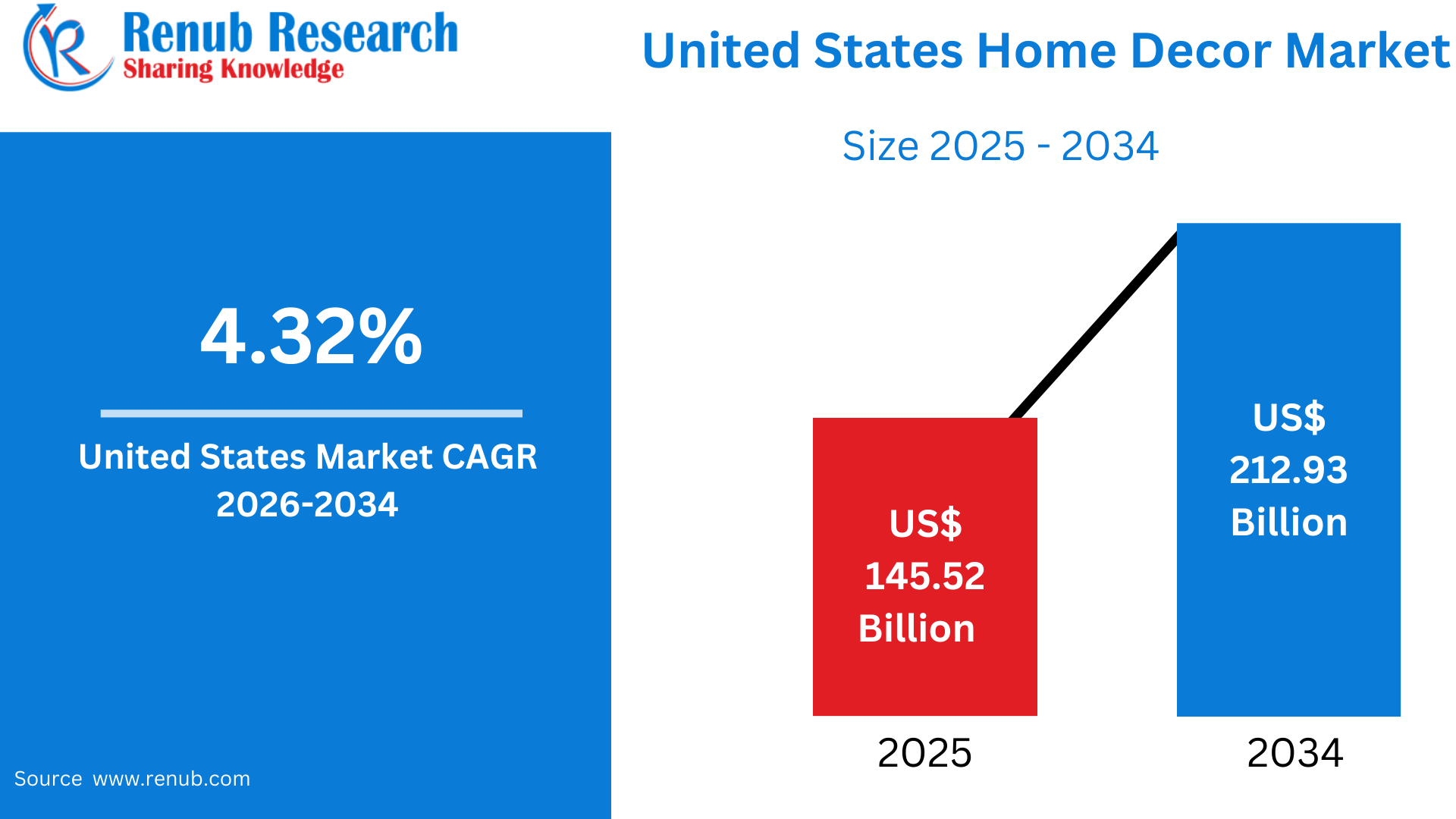
United States Home Décor Market is expected to reach US$ 212.93 billion by 2034 from US$ 145.52 billion in 2025, with a CAGR of 4.32% from 2026 to 2034. The U.S. home décor market is driven by rising home renovation spending, growing e-commerce penetration, sustainability-focused product launches, and increasing demand for personalized interiors supported by AI and digital visualization tools that simplify product discovery, customization, and purchasing.
United States Home Décor Industry Overview
Home décor refers to the aesthetic enhancement of interior spaces through furnishings, accessories, textiles, lighting, and decorative objects. It encompasses both functional and artistic elements that shape the ambiance and visual appeal of a home. The category includes furniture, wall décor, flooring, artwork, decorative lighting, storage solutions, and seasonal accessories. Home décor trends often evolve with lifestyle changes, technological innovations, and consumer preferences. In the United States, homeowners increasingly prioritize comfort, personalization, sustainability, and modern design. Digital platforms, virtual room planners, and augmented reality tools have further simplified product exploration, enabling consumers to visualize décor items before purchasing.
The U.S. home décor market is expanding due to rising consumer investment in home improvement, strong housing renovation trends, and the rapid adoption of e-commerce channels. Growing interest in sustainable décor and eco-conscious materials has encouraged innovation among major retailers. Additionally, digital transformation in the retail sector—through visualization tools, AI-powered recommendations, and virtual room planning—has enhanced customer engagement and reduced purchase uncertainty. Increasing urban lifestyles, the popularity of open-layout interiors, and rising disposable income continue to fuel demand for premium décor products. Together, these factors strengthen market growth across both online and offline retail channels.
Growth Drivers for the United States Home Décor Market
Digital Personalization & AI Integration
One of the most significant growth drivers for the U.S. home décor market is the integration of AI, visualization technologies, and personalized digital shopping experiences. Consumers increasingly expect interactive and immersive tools that simplify décor selection and eliminate uncertainty. In February 2025, Wayfair launched Muse, an advanced AI-powered tool capable of generating photorealistic room scenes from text prompts while enabling direct product shopping within the visualized design. This innovation reduces decision fatigue, improves customer confidence, and accelerates purchase conversions. AI-driven personalization—such as style-based recommendations, virtual staging, and space planning—also supports greater customization, a key preference among younger buyers. These tools cater to DIY decorators, first-time homeowners, and renovation-focused consumers seeking inspiration. As digital-first shopping continues to rise, retailers leveraging AI and 3D visualization gain a competitive advantage, enhancing both user engagement and sales performance. Consequently, technological advancements remain a central catalyst for long-term market expansion.
Sustainability & Eco-Friendly Décor Adoption
Sustainability has become a core priority for U.S. consumers, significantly influencing home décor demand. Eco-conscious buyers increasingly prefer décor made from recycled, renewable, or ethically sourced materials. This shift has pushed major retailers to introduce green product lines and redesign their supply chains. In January 2024, IKEA launched its "Eco-Friendly Home Decor" collection, produced entirely from recycled materials, marking a major step toward circular product development. Such initiatives resonate strongly with millennial and Gen Z consumers, who value transparency and sustainable production practices. Recycled textiles, reclaimed wood furniture, biodegradable décor accents, and low-VOC paints are witnessing strong adoption. The rise of sustainable interior design trends, including minimalism, biophilic elements, and natural textures, further supports this demand. Government incentives promoting energy-efficient homes also indirectly drive interest in eco-friendly décor products. Together, these factors position sustainability as a primary growth engine for the U.S. home décor market.
Rising Home Renovation & Lifestyle Upgrading
The U.S. home décor market benefits greatly from continuous investment in home remodeling, space optimization, and lifestyle-oriented interior upgrades. With hybrid and remote work models becoming more common, consumers increasingly prioritize stylish, comfortable, and functional living spaces. Spending on home renovation, DIY décor projects, and room makeovers has grown substantially as homeowners seek to improve aesthetics, functionality, and long-term property value. Kitchen remodeling, living room redesigns, patio upgrades, and home office décor are among the strongest demand categories. Additionally, rising disposable income and urban apartment living have amplified demand for multifunctional furniture, compact décor items, lighting solutions, and premium accessories. Social media platforms and interior design influencers also play a major role by shaping design preferences and encouraging frequent décor refreshes. As consumers view home improvement as an expression of identity and lifestyle, décor spending continues to rise steadily across the country.
Challenges in the United States Home Décor Market
High Price Sensitivity & Inflation-Driven Costs
Inflation and rising raw material, manufacturing, and logistics costs pose significant challenges to the U.S. home décor market. Consumers are increasingly price-conscious, particularly when purchasing non-essential decorative items. Premium décor segments—such as luxury furniture, artisanal accessories, and high-end textiles—often experience slower growth during economic uncertainty. Retailers face shrinking margins as they balance competitive pricing with higher production and import expenses. Supply chain disruptions can further increase costs and lead to inventory delays, affecting consumer satisfaction. Budget retailers and online marketplaces continue to compete aggressively on price, compelling brands to offer discounts that impact profitability. These economic pressures hinder consistent market growth and influence consumer purchasing patterns.
Intense Competition & Brand Saturation
The U.S. home décor market is highly fragmented, with thousands of retailers, specialty boutiques, direct-to-consumer brands, and marketplace sellers competing for attention. This saturation makes differentiation difficult, especially as many products overlap in design, material, and price range. Online platforms further intensify competition by enabling low-cost imports and private-label alternatives. Customer loyalty is often limited, as shoppers frequently switch brands based on discounts, style trends, or convenience. Additionally, emerging digital-native brands use aggressive marketing strategies, increasing pressure on traditional retailers. Without strong brand identities, innovative designs, or unique value propositions, businesses may struggle to stand out in this crowded marketplace.
United States Furniture Market
The U.S. furniture market continues to grow due to rising home renovation activity, increased housing turnover, and strong demand for multifunctional and space-saving designs. Remote and hybrid work trends have boosted sales of home office furniture, ergonomic chairs, and modular setups. Consumers increasingly favor modern, minimalist, and sustainable furniture crafted from recycled or responsibly sourced materials. E-commerce expansion has improved accessibility, allowing customers to compare prices, styles, and features more easily. High-end furniture brands are benefiting from demand for premium aesthetics, while budget retailers attract consumers seeking affordable upgrades. Despite inflationary pressures, furniture remains a key spending category as homeowners prioritize comfort and long-term durability.
United States Floor Covering Market
The U.S. floor covering market is driven by strong residential remodeling, commercial construction, and rising demand for aesthetic and durable flooring solutions. Luxury vinyl tile (LVT), engineered wood, and waterproof flooring continue to gain popularity due to their versatility, cost-effectiveness, and easy installation. Carpet remains widely used in bedrooms and living areas, while hardwood maintains its appeal as a premium, long-lasting option. Eco-friendly flooring, including recycled carpet tiles, bamboo, and cork, is rapidly gaining interest among sustainability-focused buyers. Technological innovations such as scratch-resistant coatings and digital printing on vinyl enhance product performance and design flexibility. Overall, flooring demand remains robust as consumers prioritize style, durability, and value.
United States Specialty Stores Market
Specialty stores in the United States play a vital role in providing curated, high-quality home décor, furniture, lighting, and lifestyle products. These stores differentiate themselves with expert guidance, unique assortments, and personalized shopping experiences that appeal to consumers seeking distinctive designs. Premium décor boutiques, home improvement retailers, and branded lifestyle stores benefit from strong demand for aesthetic, functional, and trend-driven items. Specialty stores also integrate omnichannel strategies, offering online catalogs, virtual consultations, and in-store pickup options. Despite competition from e-commerce giants, specialty retailers maintain an advantage through tailored service and exclusive collections. Their focus on craftsmanship, authenticity, and niche styles continues to attract a dedicated customer base.
California Home Décor Market
California’s home décor market reflects the state’s diverse lifestyles and strong design culture. Coastal, modern, and eco-friendly styles dominate, with buyers drawn to natural materials, light palettes, and relaxed contemporary themes. There is also significant interest in sustainable, locally crafted, and artisanal pieces that fit the state’s emphasis on environmental consciousness. Urban areas favor minimalist, design-forward products, while suburban buyers seek comfort-driven décor with a balance of functionality and style. The state’s multicultural population influences demand for eclectic aesthetics, blending global motifs with California’s signature casual elegance. Retailers and designers often experiment with indoor–outdoor living concepts, wellness-oriented décor, and technology-integrated furnishings, making the market ideal for brands offering fresh, adaptable, and design-centric products.
Texas Home Décor Market
Texas’s home décor market blends traditional regional influences with a growing interest in contemporary and transitional styles. Buyers often look for décor that brings a sense of warmth, durability, and character, whether through rustic elements, modern farmhouse themes, or updated Western-inspired accents. Urban centers lean toward sleek, versatile designs that suit new-build homes and open-concept layouts, while suburban and rural customers often prefer pieces with strong craftsmanship and a comfortable, inviting feel. Bold colors, substantial furniture, and statement décor remain popular. The state’s broad housing landscape—from expansive homes to upscale urban apartments—creates demand for a wide range of styles. Brands that offer customizable, long-lasting, and personality-rich décor tend to resonate strongly with Texas consumers.
New York Home Décor Market
New York’s home décor market is shaped by its mix of urban sophistication, historic architecture, and fast-paced lifestyles. In the city, demand leans toward space-efficient, modern, and multifunctional pieces that complement smaller living areas and contemporary design tastes. Clean lines, refined materials, and innovative storage solutions are especially valued. Beyond the city, suburban and upstate regions embrace a wider range of styles, from classic and traditional to rustic and cottage-inspired aesthetics. Buyers often seek décor that reflects individuality, artistic expression, and a sense of curated refinement. The state’s strong creative culture also fuels interest in boutique, handmade, and design-driven items. Brands offering thoughtful craftsmanship, unique accents, and flexible styling options find a receptive market across New York.
Recent Developments in United States Home Décor Market
- June 2025 – The Home Depot announced that SRS Distribution has signed a definitive agreement to acquire GMS Inc. for an enterprise value of USD 5.5 billion. The deal strengthens SRS’s specialty building products distribution network and expands its access to professional contractor spending across the U.S.
- June 2025 – Lowe’s finalized its acquisition of Artisan Design Group, a nationwide provider of interior surface design, distribution, and installation services. The move enhances Lowe’s capabilities in serving home builders, property managers, and large-scale interior finishing projects.
- May 2024 – Herman Miller, a leading office furniture manufacturer, acquired Design Within Reach (DWR), a prominent modern design retailer. This acquisition broadened Herman Miller’s product portfolio and extended its presence in the premium home décor and modern furnishings market.
- March 2024 – Wayfair entered a strategic partnership with Amazon, enabling its home goods assortment to be sold through the Amazon Marketplace. The collaboration significantly expands Wayfair’s reach and strengthens its omnichannel distribution strategy.
Market Segmentation
Products
- Furniture
- Floor Covering
- Home Textiles
- Others
Distribution Channel
- Supermarkets & Hypermarkets
- Specialty Stores
- E-Commerce
- Others
Income Group
- Higher Income
- Upper-middle Income
- Lower-middle Income
Top States
- California
- Texas
- New York
- Florida
- Illinois
- Pennsylvania
- Ohio
- Georgia
- New Jersey
- Washington
- North Carolina
- Massachusetts
- Virginia
- Michigan
- Maryland
- Colorado
- Tennessee
- Indiana
- Arizona
- Minnesota
- Wisconsin
- Missouri
- Connecticut
- South Carolina
- Oregon
- Louisiana
- Alabama
- Kentucky
- Rest of United States
All companies have been covered from 5 viewpoints:
- Overviews
- Key Person
- Recent Developments
- SWOT Analysis
- Revenue Analysis
Company Analysis:
- Inter IKEA Systems B.V.
- Bed Bath & Beyond Inc,
- Herman Miller Inc.
- Mohawk Industries Inc.
- Williams-Sonoma, Inc.
- Kimball International, Inc,
- HNI Corporation
Report Details:
| Report Features | Details |
| Base Year |
2025 |
| Historical Period |
2022 - 2025 |
| Forecast Period |
2026 - 2034 |
| Market |
US$ Billion |
| Segment Covered |
Products, Distribution Channel, Income Group and States |
| States Covered |
|
| Companies Covered |
|
| Customization Scope |
20% Free Customization |
| Post-Sale Analyst Support |
1 Year (52 Weeks) |
| Delivery Format |
PDF and Excel through Email (We can also provide the editable version of the report in PPT/Word format on request) |
Customization Services available
- Analysis of Market Size and Its Segments
- More Company Profiles (Upto 10 without any additional cost):
- Additional Countries (Other than mentioned Countries):
- Region/Country Specific Reports:
- Market Entry Strategy:
- Region-Specific Market Dynamics:
- Regional Market Share Analysis:
- Trade Analysis:
- Production Insights:
- Others Customized Requests:
For more information contact our analysts.
Need More Assistance?
- Talk to our analysts to get more precious information on the current market trends.
- Include more countries and segments and customize the report based on the final requirement.
- Get a competitive advantage in your industry by knowing the report findings and making a positive impact on your revenues and operations.
- Our analysts are always ready to provide more help and pertinent information if you need any additional assistance.