India Home Automation Market Size, Share, Growth, Trends, Industry Analysis & Forecast 2026–2034
Buy NowIndia Home Automation Market Forecast
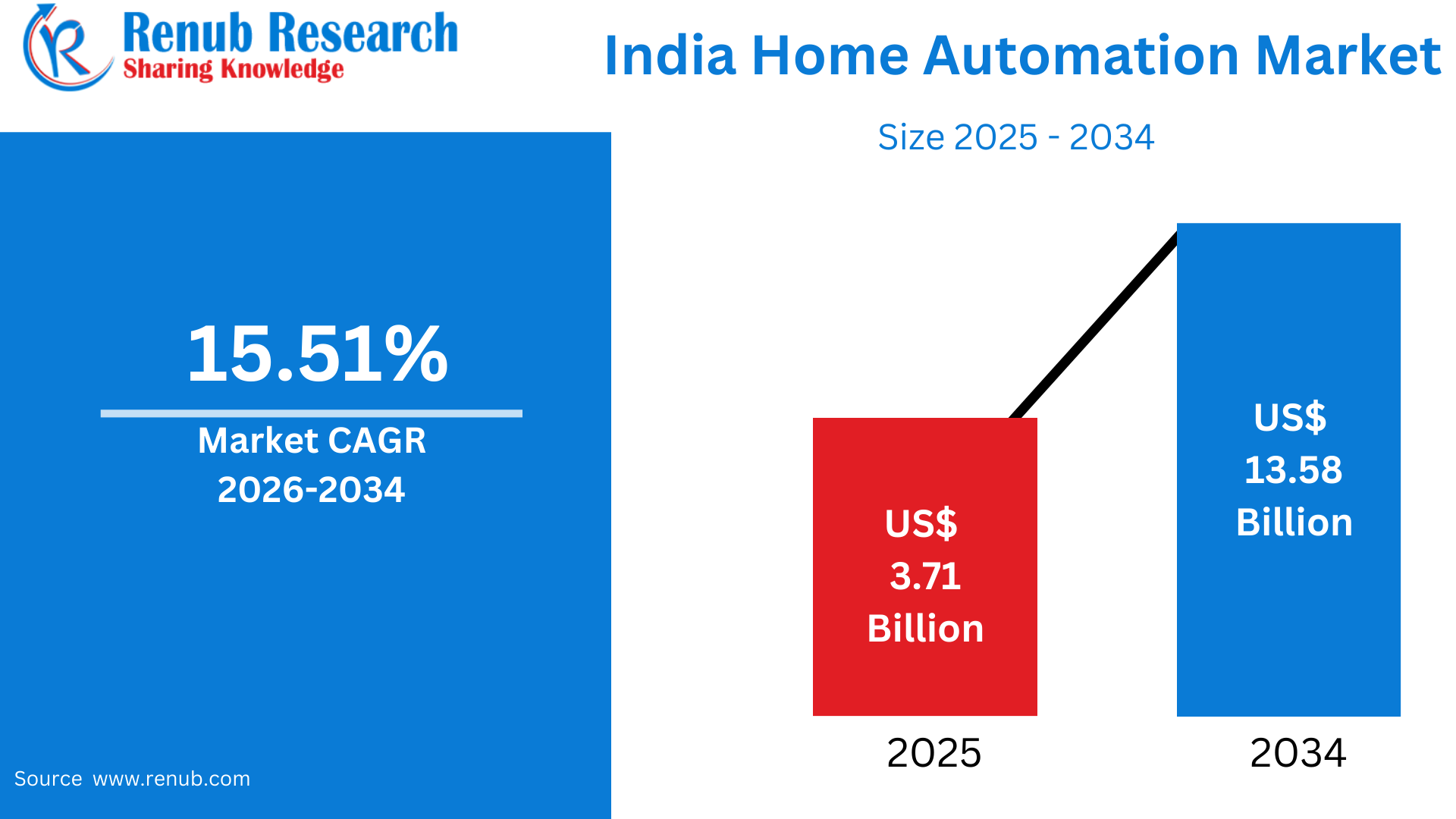
India Home Automation Market is projected to grow from US$ 3.71 billion in 2025 to US$ 13.58 billion by 2034, registering a CAGR of 15.51% during the forecast period from 2026 to 2034. Market expansion is driven by increasing disposable incomes, rapid smartphone adoption, and growing consumer awareness of smart home technologies. The availability of cost-effective IoT-enabled devices, rising demand for energy-efficient and connected homes, and the expansion of high-speed internet infrastructure are further fueling adoption.
What is Home Automation and Its Uses & Popularity in India
Home automation refers to the integration of smart devices, sensors, and internet-connected technologies that enable homeowners to monitor, control, and automate household functions remotely through smartphones, tablets, or voice assistants. These systems manage lighting, security cameras, smart locks, thermostats, entertainment systems, appliances, and energy management solutions, enhancing convenience, safety, and energy efficiency. Modern home automation platforms also utilize artificial intelligence (AI) and the Internet of Things (IoT) to learn user preferences and automate routine tasks.
Home automation is gaining significant popularity in India due to rising disposable incomes, rapid urbanization, and increasing smartphone penetration. The growing adoption of high-speed internet, affordable smart home devices, and voice-enabled assistants has made automation solutions more accessible to middle-income households. Consumers are increasingly investing in smart security systems, automated lighting, smart doorbells, and energy-efficient appliances to improve comfort and reduce electricity consumption. Government initiatives promoting digital infrastructure and smart cities further encourage the adoption of connected home technologies. Additionally, the expansion of residential real estate, premium housing projects, and the increasing awareness of sustainable living continue to drive demand. As smart devices become more affordable and technologically advanced, home automation is expected to become a standard feature in modern Indian homes.
Key Smart Home Device Ownership in India (2022)
- 85% of smart home device owners use entertainment devices, including:
-
- Bluetooth speakers
- Smart TVs
- Streaming devices
- 56% use smart electricity and lighting solutions, such as:
-
- Smart plugs
- Connected light bulbs
- 52% own smart safety and security devices, including:
-
- Connected smoke detectors
- Connected security cameras
- 49% use smart home appliances, such as:
-
- Robot vacuum cleaners
- Smart microwave ovens
- 45% use energy management devices, including:
-
- Connected thermostats
- Temperature sensors
- 38% own smart speakers with integrated virtual assistants, such as:
-
- Amazon Echo
- Other voice-enabled smart speakers
- 9% reported not owning any smart home devices.
- 8% own other smart home devices not included in the listed categories.
Key Insights
- Entertainment devices are the most widely adopted smart home products in India, with 85% ownership.
- Smart lighting and security solutions are also highly popular, with adoption rates exceeding 50%.
- Nearly half of Indian smart home users have invested in connected appliances and energy management systems.
- Voice-controlled smart speakers continue to gain traction, with 38% of users owning integrated virtual assistant devices.
- Only 9% of respondents reported not using any smart home devices, indicating growing awareness and adoption of smart home technologies across India.
Growth Driver of the India Home Automation Market
Rising Smartphone and Internet Penetration
The rapid expansion of smartphone ownership and internet connectivity is a major growth driver for the India Home Automation Market. Smart home devices are primarily controlled through mobile applications and cloud-based platforms, making smartphones essential for adoption. India has over 950 million internet subscribers and more than 800 million smartphone users, creating one of the world’s largest connected consumer bases. The widespread rollout of affordable 4G services and expanding 5G networks has significantly improved the reliability of connected home ecosystems. Consumers are increasingly using smartphones to manage lighting, security cameras, smart locks, air conditioners, and household appliances remotely. Voice assistants integrated with smart speakers have also simplified device control, encouraging adoption among first-time users. Growing digital literacy and the increasing availability of affordable IoT-enabled products have expanded the market beyond metropolitan cities into Tier II and Tier III locations. As smartphone penetration and broadband connectivity continue to improve, demand for integrated home automation systems is expected to rise steadily across India’s residential sector.
Rapid Urbanization and Smart Housing Development
India’s accelerating urbanization and expanding residential construction industry are creating substantial opportunities for home automation solutions. According to government estimates, over 40% of India’s population is expected to live in urban areas by 2036, increasing demand for modern residential infrastructure. Real estate developers are increasingly incorporating smart home technologies into premium apartments, gated communities, and luxury housing projects to enhance property value and attract technology-oriented buyers. Automated lighting, digital door locks, video door phones, smart surveillance, climate control systems, and centralized home management platforms are becoming common features in new residential developments. Government initiatives such as Smart Cities Mission and Digital India are further supporting investments in connected infrastructure and intelligent buildings. Rising disposable incomes and changing consumer lifestyles have also encouraged homeowners to upgrade existing residences with smart devices. As urban housing demand continues to grow, home automation is becoming an important differentiating feature in India’s evolving residential real estate market.
Increasing Demand for Energy Efficiency and Home Security
Growing awareness of energy conservation and residential security is significantly driving the adoption of home automation technologies in India. Smart home systems enable homeowners to monitor electricity consumption, automate lighting schedules, optimize air conditioning usage, and remotely control appliances, helping reduce energy costs. India remains one of the world’s largest electricity consumers, making energy-efficient technologies increasingly attractive for households seeking lower utility bills. Smart thermostats, motion sensors, occupancy-based lighting, and automated power management systems contribute to improved energy efficiency. Simultaneously, rising concerns regarding residential safety have increased demand for smart surveillance cameras, motion detectors, video doorbells, biometric locks, and remote security monitoring systems. AI-powered security solutions provide instant alerts and real-time monitoring through smartphones, improving homeowner confidence. Insurance providers and premium residential developers are also encouraging the installation of advanced security technologies. As consumers increasingly prioritize sustainability, convenience, and safety, energy-efficient and security-focused home automation solutions will continue to fuel long-term market growth across India.
Challenges of the India Home Automation Market
High Initial Installation and Integration Costs
Despite growing awareness, the high upfront cost of smart home systems remains a major challenge for the India Home Automation Market. Comprehensive home automation solutions involving smart lighting, security systems, automated curtains, HVAC controls, entertainment systems, sensors, and centralized controllers require significant investment, limiting adoption among middle-income households. Although individual IoT devices have become more affordable, integrating multiple products into a seamless ecosystem often requires professional installation, networking infrastructure, and ongoing maintenance. India’s price-sensitive consumer market remains cautious about investing in premium automation technologies, particularly in smaller cities. Compatibility issues between products from different manufacturers may also require additional gateways or customized integration services, increasing deployment costs. While luxury housing projects increasingly include automation features, mass-market residential adoption remains relatively limited. Continued reductions in hardware prices, greater standardization of communication protocols, and locally manufactured smart devices will be essential to making home automation solutions more affordable and accessible across a broader segment of Indian consumers.
Cybersecurity Risks and Limited Consumer Awareness
Cybersecurity concerns and limited consumer understanding continue to restrain the growth of India’s home automation market. Smart home ecosystems rely on internet-connected devices that continuously exchange personal and household data through cloud platforms. Weak passwords, unsecured Wi-Fi networks, outdated software, and device vulnerabilities may expose users to unauthorized access, data breaches, or cyberattacks. As the number of connected devices increases, maintaining secure communication across the entire smart home ecosystem becomes increasingly complex. Many consumers also remain unfamiliar with configuring secure smart home environments or understanding privacy settings, creating additional security risks. Furthermore, awareness regarding the long-term benefits of home automation remains relatively low outside major metropolitan areas, slowing adoption among first-time buyers. Concerns regarding data privacy, interoperability between brands, and after-sales technical support also influence purchasing decisions. Increasing public awareness, stronger cybersecurity standards, regular software updates, and improved consumer education will be essential to building trust and accelerating nationwide adoption of home automation technologies.
Home Automation Product Launches in India
- ABB India – ABB-free@home® Wireless Home Automation System (September 2024)
- ABB India launched ABB-free@home®, a wireless smart home automation platform featuring control of lighting, blinds, HVAC, security, and appliances with interoperability through Samsung SmartThings, Apple HomeKit, Google Home, and Amazon Alexa.
- Schneider Electric – Miluz ZeTa Smart Switches & Wiser Integration (October 2024)
- Schneider Electric introduced the Miluz ZeTa range with built-in Air Quality Indicator (AQI), Voltage Surge Protection, USB A+C charging, and compatibility with the Wiser Smart Home ecosystem.
- Schneider Electric – Wiser Smart Home Portfolio Expansion (June 2025)
- Schneider Electric expanded its Indian smart home portfolio by promoting Wiser Smart Home Automation, GPS-enabled appliance control, energy management, motion-sensing lighting, and intelligent home electrical solutions.
- Panasonic – Smart Home Experience Centre (April 2025)
- Panasonic launched its Smart Home Experience Centre in India, showcasing integrated home automation solutions focused on wellness, AI-powered living, home security, indoor air quality, and energy-efficient connected homes.
- Godrej Enterprises – Advantis IoT9 Smart Lock (June 2025)
- Godrej introduced the Advantis IoT9 Smart Lock, featuring app-based access, multiple unlocking methods, IoT connectivity, and seamless integration with modern smart home ecosystems.
- Samsung – 2025 Bespoke AI Home Appliances (June 2025)
- Samsung launched its Bespoke AI appliance lineup with SmartThings connectivity, Knox security, AI-powered controls, and intelligent home management features for connected households.
- Samsung – AI Home: Future Living, Now (September 2025)
- Samsung unveiled its AI Home ecosystem in India, integrating Galaxy AI, SmartThings, Vision AI, and connected appliances to deliver personalized automation, energy savings, and enhanced home security.
- Sekyo – Smart Door Alarm Sensor (July 2026)
- Sekyo launched its Smart Door Alarm Sensor with smartphone alerts, wireless connectivity, tamper detection, and real-time monitoring to strengthen residential security.
- Livpure – Allura Premia Ultra Smart Water Purifier (July 2026)
- Livpure introduced the Allura Premia Ultra water purifier powered by ClearDrop Technology, offering smart purification, extended maintenance-free operation, and enhanced home wellness capabilities.
- Amazon Alexa – Smart Home Ecosystem Expansion in India (2024)
- Amazon significantly expanded its Alexa smart home ecosystem in India, reporting a 200% increase in connected smart home devices and broader compatibility with lighting, appliances, switches, cameras, and other IoT products across the country.
India Wireless Home Automation Market
India Wireless Home Automation Market is witnessing rapid growth due to increasing demand for flexible, cost-effective, and easy-to-install smart home solutions. Wireless technologies such as Wi-Fi, Zigbee, Bluetooth, Thread, and Z-Wave eliminate the need for extensive rewiring, making automation suitable for both newly constructed and existing homes. India has over 950 million internet subscribers and more than 800 million smartphone users, providing a strong foundation for wireless smart home adoption. Consumers are increasingly purchasing wireless smart lighting, security cameras, smart plugs, sensors, and voice-controlled devices that can be managed remotely through mobile applications. Residential developers are also incorporating wireless automation systems into premium housing projects because of their scalability and lower installation costs. Continuous improvements in broadband connectivity and expanding 5G services further enhance device performance and reliability. As wireless communication technologies become more secure and interoperable, the wireless segment is expected to dominate India’s home automation market due to its affordability, convenience, and compatibility with expanding IoT ecosystems.
India Home Appliances Automation Market
India Home Appliances Automation Market is expanding steadily as consumers increasingly adopt connected household appliances that improve convenience, energy efficiency, and remote accessibility. Smart refrigerators, washing machines, air conditioners, televisions, robotic vacuum cleaners, water heaters, and kitchen appliances are becoming increasingly popular among urban households. India has more than 800 million smartphone users, enabling seamless remote monitoring and control of automated appliances through mobile applications and voice assistants. Manufacturers are integrating artificial intelligence, IoT connectivity, predictive maintenance, and energy optimization features to enhance user experience while reducing electricity consumption. Rising disposable incomes, growing urbanization, and increasing consumer preference for premium home appliances are encouraging demand across metropolitan and Tier II cities. Energy-efficient smart appliances also align with India’s sustainability objectives by optimizing power consumption. With continuous product innovation, expanding e-commerce availability, and increasing investments by domestic and international appliance manufacturers, the home appliances automation segment is expected to experience robust growth throughout the forecast period.
India Residential Automation Market
India Residential Automation Market is experiencing significant expansion due to rising urban housing development, growing awareness of smart living, and increasing investments in premium residential properties. Government estimates indicate that more than 40% of India’s population is expected to reside in urban areas by 2036, driving demand for technologically advanced homes. Residential automation systems integrate lighting control, climate management, home security, entertainment systems, automated curtains, smart door locks, and energy management into a unified platform. Real estate developers increasingly differentiate residential projects by offering integrated smart home features that enhance convenience, safety, and property value. Homeowners also benefit from lower energy consumption through automated scheduling and occupancy-based controls. Artificial intelligence and voice-enabled assistants further improve user experience by enabling personalized automation routines. The increasing availability of affordable IoT devices, improved internet connectivity, expanding broadband infrastructure, and rising consumer purchasing power continue to strengthen the long-term outlook for India’s residential automation market across both luxury and mid-income housing segments.
India Smart Home Switch Market
India Smart Home Switch Market is growing rapidly as consumers upgrade conventional electrical switches with intelligent, internet-connected alternatives that provide enhanced convenience and energy management. Smart switches enable homeowners to remotely control lighting, ceiling fans, air conditioners, and electrical appliances through smartphones, voice assistants, or automated schedules. India has over 230 million households, creating a substantial addressable market for smart electrical solutions as home automation adoption increases. Modern smart switches support Wi-Fi, Zigbee, Bluetooth, and Matter-compatible connectivity, allowing integration with broader smart home ecosystems. Consumers increasingly prefer touch-enabled switches with scene control, scheduling capabilities, and energy monitoring functions to improve household efficiency. Real estate developers are incorporating smart electrical systems into premium residential projects, while renovation activities are creating opportunities for retrofit installations. Continuous product innovation, declining hardware costs, and expanding availability through online and offline retail channels are expected to accelerate adoption, making smart switches one of the fastest-growing categories within India’s home automation industry.
India Home Automation Retailer Market
India Home Automation Retailer Market is expanding rapidly as organized retail, e-commerce platforms, and specialized smart home solution providers improve product accessibility across the country. Consumers now have access to a broad portfolio of smart lighting systems, security cameras, smart locks, switches, sensors, voice assistants, thermostats, and connected appliances through both physical stores and digital marketplaces. India’s retail sector continues to modernize alongside a rapidly growing e-commerce ecosystem, enabling consumers to compare products, pricing, and technical specifications before purchase. Retailers increasingly provide installation services, technical consultations, after-sales support, and integrated smart home packages to simplify adoption for first-time buyers. Experience centers allow customers to interact with connected home ecosystems before making purchasing decisions, increasing consumer confidence. Strategic partnerships between retailers, technology companies, and home builders are further expanding market reach. As awareness of smart living continues to grow and distribution networks extend into Tier II and Tier III cities, the home automation retailer market is expected to witness sustained long-term growth across India.
Pune Home Automation Market
Pune Home Automation Market is witnessing robust growth, driven by the city’s expanding IT industry, rising disposable incomes, and increasing demand for premium residential housing. Pune has a metropolitan population of over 7 million, making it one of India’s fastest-growing urban centers and an attractive market for smart home technologies. The city hosts numerous technology parks, multinational corporations, and a large base of young professionals who are early adopters of connected living solutions. Demand for smart lighting, automated climate control, intelligent security systems, smart door locks, and voice-controlled appliances is increasing across luxury apartments and gated communities. Residential developers are integrating home automation into new projects to differentiate their offerings and enhance property value. Growing broadband connectivity, expanding 5G services, and widespread smartphone adoption further support market expansion. Additionally, increasing consumer awareness of energy-efficient living and home security solutions is encouraging retrofit installations in existing homes, positioning Pune as one of India’s leading regional markets for home automation technologies.
Delhi NCR Home Automation Market
Delhi NCR Home Automation Market is one of the largest in India due to its high-income population, extensive urban infrastructure, and significant concentration of luxury residential developments. The National Capital Region has a population exceeding 32 million, creating substantial demand for technologically advanced housing solutions. Smart home adoption is increasing across Delhi, Gurugram, Noida, Ghaziabad, and Faridabad, where premium residential projects increasingly feature integrated automation systems. Homeowners are investing in smart surveillance cameras, video door phones, intelligent lighting, automated curtains, HVAC controls, and centralized home management platforms to improve convenience and security. The region’s strong internet connectivity, expanding fiber broadband networks, and growing adoption of AI-powered voice assistants further accelerate market growth. Corporate professionals, expatriates, and high-net-worth individuals continue driving demand for premium home automation products. Increasing awareness of energy conservation, rising electricity costs, and the expansion of smart city initiatives are expected to further strengthen the Delhi NCR home automation market during the forecast period.
Mumbai Home Automation Market
Mumbai Home Automation Market continues to expand rapidly as India’s financial capital experiences growing demand for luxury housing and digitally connected lifestyles. Mumbai’s metropolitan population exceeds 20 million, making it one of the country’s largest consumer markets for advanced residential technologies. High-rise residential developments increasingly incorporate integrated home automation systems that include smart lighting, intelligent security, automated climate control, voice-enabled entertainment systems, and energy management solutions. Affluent homeowners and working professionals are investing in smart home technologies to improve convenience, optimize energy consumption, and strengthen residential security. Developers are using automation features to enhance premium housing projects and increase property differentiation in a competitive real estate market. The city’s widespread broadband availability, strong smartphone penetration, and expanding adoption of cloud-connected devices continue supporting market growth. Growing environmental awareness and rising electricity costs are also encouraging homeowners to adopt energy-efficient automation solutions, positioning Mumbai as one of India’s most advanced smart home markets.
Hyderabad Home Automation Market
Hyderabad Home Automation is experiencing significant growth, supported by the city’s expanding IT sector, thriving startup ecosystem, and rapid residential infrastructure development. Hyderabad has a metropolitan population of over 10 million, with a large concentration of technology professionals who readily adopt innovative smart home solutions. Residential projects across areas such as Gachibowli, HITEC City, Kondapur, and Financial District increasingly incorporate integrated automation systems that include smart lighting, digital locks, surveillance cameras, automated curtains, and intelligent climate control. Rising disposable incomes, increasing demand for luxury apartments, and strong consumer interest in connected living are accelerating market expansion. Hyderabad also benefits from high internet penetration, expanding 5G deployment, and a rapidly growing ecosystem of IoT solution providers. Developers are partnering with home automation companies to offer fully connected residences that enhance comfort, safety, and energy efficiency. As urbanization continues and smart city initiatives progress, Hyderabad is expected to remain one of India’s fastest-growing regional markets for home automation solutions.
Recent Developments in India Home Automation Market
- June 2025: Signify and Dixon Technologies announced a 50:50 joint venture to scale domestic lighting manufacturing in India.
- June 2025: Samsung unveiled its 2025 Bespoke AI appliance lineup, featuring the AI Laundry Combo priced at INR 319,000.
- June 2025: Schneider Electric India expanded its home electrical and automation portfolio with the launch of Miluz Zeta switches featuring built-in AQI indicators, motion-sensing LED foot lamps, and Wiser Smart Home solutions. Through its “Bring Home the Smart” campaign, the company aims to strengthen consumer engagement, promote intuitive smart living, and support India’s growing adoption of connected home technologies.
- March 2025: The PM Surya Ghar Yojana surpassed one million solar-equipped homes, generating annual savings of INR 1,619 crore.
- February 2025: Havells introduced India’s first domestically manufactured energy-efficient heat-pump water heater, offering up to 75% energy savings.
Market Segmentation
Network Type
- Wired
- Wireless
- Power Line Based
Segment Type
- Appliances
- Energy Management
- Entertainment
- Security
- Control Connectivity
Product
- Smart Speaker Market
- Security Camera
- Smart Doorbell
- Smart light
- Smart Door lock
- Smart Switch
- Smart Sensor
- Others
Distribution Channels
- System Integrator
- Manufacturer
- Retailer
Customer Spending on Home
- Less than 15000
- 15001-30000
- 30001-45000
- 45001-60000
- More than 60001
End User
- Residential
- Commercial
Cities
- Pune
- Delhi NCR
- Mumbai
- Hyderabad
- Ahmedabad
- Bengaluru
- Chennai
- Jaipur
- Kolkata
- Ludhiana
- Chandigarh
- Cochin
- Coimbatore
- Others
All companies have been covered with 5 Viewpoints
- Overview
- Key Persons
- Recent Developments
- SWOT analysis
- Revenue Analysis
Company Analysis
- Koninklijke Philips
- Schneider Electric
- Johnson Controls
- Honeywell
- ABB
- Amazon (ECHO)
- Alphabet
Report Details:
| Report Features | Details |
| Base Year |
2025 |
| Historical Period |
2022 - 2025 |
| Forecast Period |
2026 - 2034 |
| Market |
US$ Billion |
| Segment Covered |
Segment Type, Product, Distribution Channels, Customer Spending on Home Automation, End User and Cities |
| City Covered |
|
| Companies Covered |
|
| Customization Scope |
20% Free Customization |
| Post-Sale Analyst Support |
1 Year (52 Weeks) |
| Delivery Format |
PDF and Excel through Email (We can also provide the editable version of the report in PPT/Word format on request) |
Customization Services available
- Analysis of Market Size and Its Segments
- More Company Profiles (Upto 10 without any additional cost):
- Additional Countries (Other than mentioned Countries):
- Region/Country Specific Reports:
- Market Entry Strategy:
- Region-Specific Market Dynamics:
- Regional Market Share Analysis:
- Trade Analysis:
- Production Insights:
- Others Customized Requests:
For more information contact our analysts.
Need More Assistance?
- Talk to our analysts to get more precious information on the current market trends.
- Include more countries and segments and customize the report based on the final requirement.
- Get a competitive advantage in your industry by knowing the report findings and making a positive impact on your revenues and operations.
- Our analysts are always ready to provide more help and pertinent information if you need any additional assistance.