United States Alcoholic Beverages Market Size, Share, Growth, Trends, Industry Analysis & Forecast 2026–2034
Buy NowU.S. Alcoholic Beverages Market Analysis: Industry Valuation, Key Segments, and Long-Term Outlook
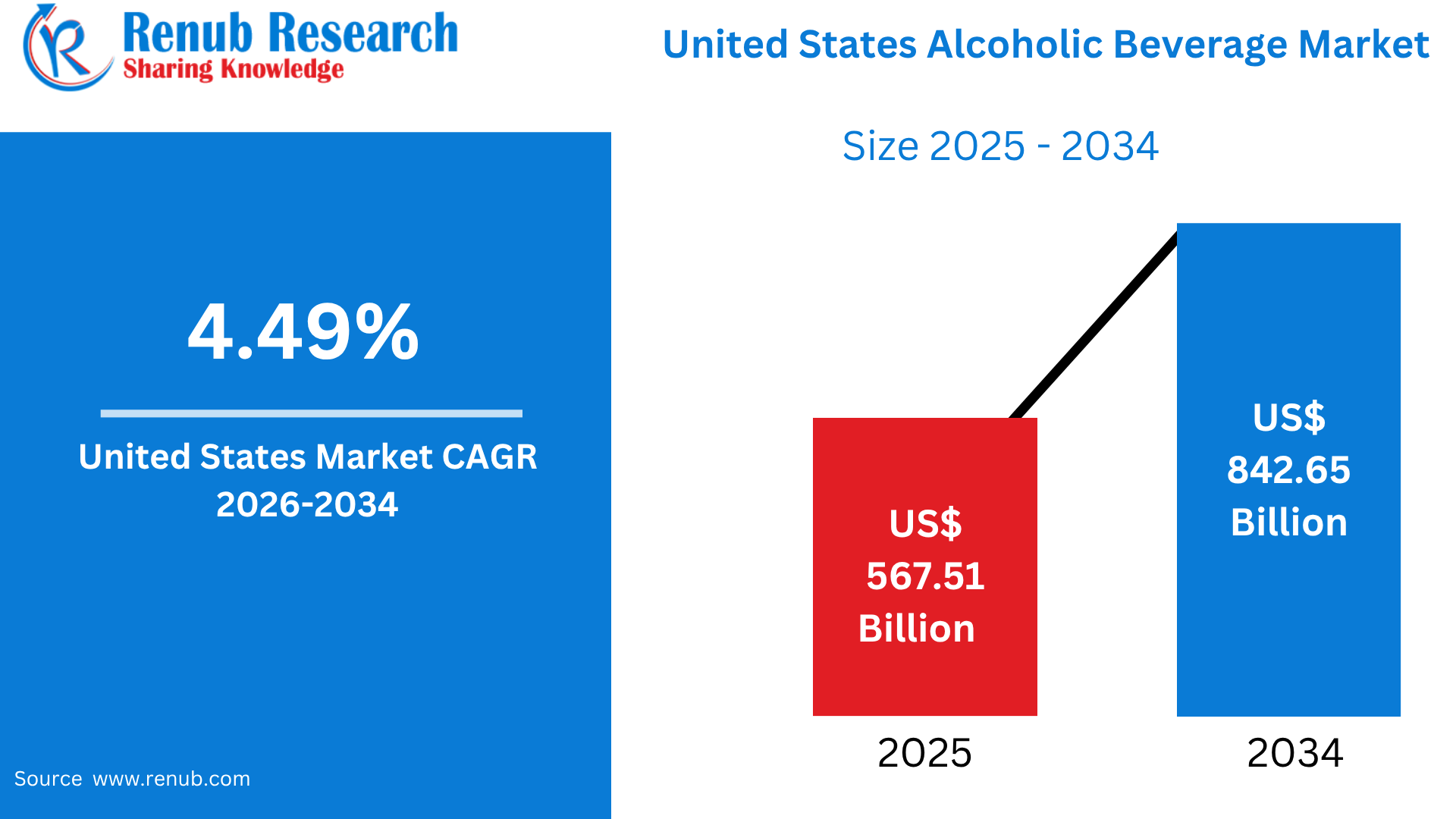
United States alcoholic beverages market is projected to expand from US$ 567.51 billion in 2025 to US$ 842.65 billion by 2034, registering a compound annual growth rate (CAGR) of 4.49% during the forecast period from 2026 to 2034. Market growth is being driven by evolving consumer preferences, increasing demand for premium, craft, and innovative alcoholic beverages, and a growing inclination toward premiumization. In addition, the expansion of retail and e-commerce distribution channels, rising social consumption, and the introduction of new product varieties and flavored beverages are further supporting market growth.
U.S. Alcohol Market Opportunity Analysis
Alcoholic beverages are drinks that contain ethanol (ethyl alcohol), produced through the fermentation of grains, fruits, sugar, or other agricultural ingredients. The major categories include beer, wine, spirits (such as whiskey, vodka, rum, gin, and tequila), cider, and ready-to-drink (RTD) alcoholic beverages. In the United States, alcoholic beverages are widely consumed for socializing, celebrations, dining, entertainment, and cultural occasions. They are commonly served at restaurants, bars, hotels, sporting events, festivals, weddings, and private gatherings. Premium wines and craft beers are often paired with meals, while spirits are popular for cocktails and mixology. Alcoholic beverages also play an important role in the hospitality, tourism, and foodservice industries, supporting employment and economic activity.
The popularity of alcoholic beverages in the United States continues to grow due to changing consumer preferences, rising demand for premium and craft products, and increasing interest in flavored and low-alcohol beverages. The expansion of craft breweries, boutique wineries, and artisanal distilleries has diversified product offerings and attracted younger consumers seeking unique drinking experiences. Ready-to-drink cocktails, hard seltzers, and premium spirits have also gained widespread acceptance because of their convenience and variety. In addition, the growth of e-commerce, home delivery services, and digital marketing has improved product accessibility. Continuous product innovation, premiumization trends, and evolving consumer lifestyles continue to support the strong popularity of alcoholic beverages across the United States.
Americans' Use of Alcoholic Beverages (1939–2025) – Key Highlights
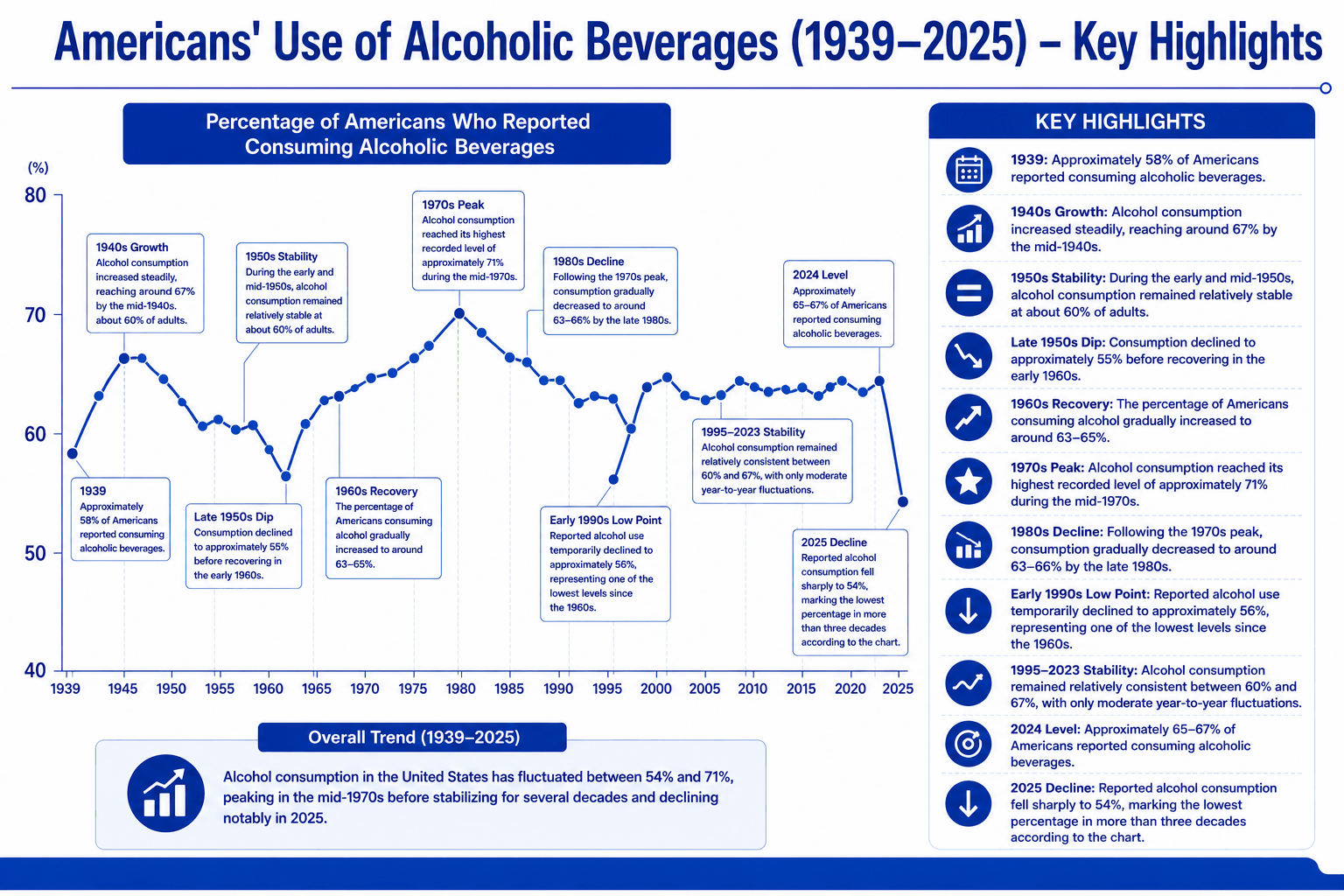
- 1939: Approximately 58% of Americans reported consuming alcoholic beverages.
- 1940s Growth: Alcohol consumption increased steadily, reaching around 67% by the mid-1940s.
- 1950s Stability: During the early and mid-1950s, alcohol consumption remained relatively stable at about 60% of adults.
- Late 1950s Dip: Consumption declined to approximately 55% before recovering in the early 1960s.
- 1960s Recovery: The percentage of Americans consuming alcohol gradually increased to around 63–65%.
- 1970s Peak: Alcohol consumption reached its highest recorded level of approximately 71% during the mid-1970s.
- 1980s Decline: Following the 1970s peak, consumption gradually decreased to around 63–66% by the late 1980s.
- Early 1990s Low Point: Reported alcohol use temporarily declined to approximately 56%, representing one of the lowest levels since the 1960s.
- 1995–2023 Stability: Alcohol consumption remained relatively consistent between 60% and 67%, with only moderate year-to-year fluctuations.
- 2024 Level: Approximately 65–67% of Americans reported consuming alcoholic beverages.
- 2025 Decline: Reported alcohol consumption fell sharply to 54%, marking the lowest percentage in more than three decades according to the chart.
- Overall Trend (1939–2025): Alcohol consumption in the United States has fluctuated between 54% and 71%, peaking in the mid-1970s before stabilizing for several decades and declining notably in 2025.
Growth Driver
Premiumization and Rising Consumer Demand for High-Value Alcoholic Beverages
The growing preference for premium alcoholic beverages is one of the strongest drivers of the United States alcoholic beverages market. Consumers are increasingly shifting from standard products toward premium spirits, craft beers, fine wines, aged whiskies, tequila, and ready-to-drink (RTD) cocktails that offer superior quality, distinctive flavors, and authentic production methods. Industry surveys indicate that premium and super-premium spirits account for more than one-third of total spirits sales value in the U.S., reflecting consumers’ willingness to spend more on quality products. Premiumization is particularly strong among millennials and Generation Z adults of legal drinking age, who prioritize unique tasting experiences, limited-edition releases, and locally produced beverages. Craft breweries and artisanal distilleries continue to introduce innovative products featuring botanical ingredients, barrel aging, and seasonal flavors. Hospitality establishments are also expanding premium beverage menus to meet evolving customer preferences. Rising disposable incomes, product innovation, and increasing demand for premium drinking experiences continue to accelerate revenue growth across the U.S. alcoholic beverages market.
Expansion of Ready-to-Drink (RTD) Beverages and Product Innovation
Continuous product innovation and the rapid growth of ready-to-drink (RTD) alcoholic beverages are significantly expanding the U.S. alcoholic beverages market. RTD products, including canned cocktails, hard seltzers, flavored malt beverages, and spirit-based mixed drinks, have become increasingly popular because of their convenience, portability, and consistent taste. Industry estimates suggest that the U.S. RTD alcoholic beverage segment has achieved double-digit annual growth in recent years, outperforming several traditional alcohol categories. Manufacturers are introducing low-calorie, low-sugar, gluten-free, organic, and premium RTD products to meet changing consumer health and lifestyle preferences. Seasonal flavors, cocktail-inspired recipes, and premium packaging have further enhanced consumer appeal. Major beverage companies continue investing in research, marketing, and production capacity to capitalize on this growing segment. Expansion into convenience stores, supermarkets, online retail, and foodservice channels has improved product availability nationwide. Continuous innovation and changing consumption habits are expected to sustain long-term growth within the U.S. alcoholic beverages market.
Expanding Distribution Channels and Hospitality Industry Recovery
The continued expansion of retail distribution networks and the recovery of the hospitality industry are driving sustained growth in the United States alcoholic beverages market. Alcoholic beverages are now widely available through supermarkets, liquor stores, convenience stores, specialty retailers, bars, restaurants, hotels, entertainment venues, and licensed e-commerce platforms. The United States has hundreds of thousands of licensed retail outlets selling alcoholic beverages, providing consumers with extensive product accessibility. The reopening and continued growth of restaurants, sports arenas, music festivals, tourism destinations, and nightlife venues have significantly increased on-premise alcohol consumption. At the same time, online alcohol sales and home delivery services have expanded rapidly, allowing consumers to purchase premium products more conveniently. Beverage manufacturers are strengthening partnerships with distributors and retailers while investing in digital marketing and direct-to-consumer strategies. Rising tourism, growing consumer spending on leisure activities, and broader retail availability continue to support stable expansion of the U.S. alcoholic beverages market.
Challenges
Strict Government Regulations and Increasing Taxation
The United States alcoholic beverages market operates under a complex regulatory framework that presents ongoing challenges for manufacturers, distributors, and retailers. Federal, state, and local governments enforce regulations governing production, labeling, advertising, interstate distribution, licensing, and minimum legal drinking age requirements. Alcohol excise taxes, licensing fees, and compliance costs continue to increase operational expenses for producers and distributors. Regulatory requirements vary significantly across states, requiring companies to manage multiple compliance standards for packaging, product registration, and sales. Restrictions on marketing, digital advertising, sponsorships, and alcohol promotions further limit brand visibility, particularly for emerging craft producers. In addition, public health initiatives aimed at reducing excessive alcohol consumption have encouraged stricter warning labels, responsible drinking campaigns, and tighter advertising oversight. These evolving regulatory and taxation policies increase business complexity and may slow product launches, market expansion, and profitability, particularly for smaller manufacturers operating in highly competitive market segments.
Changing Consumer Health Preferences and Competition from Low- and No-Alcohol Alternatives
Growing health consciousness among American consumers is creating challenges for the traditional alcoholic beverages market. Increasing awareness of alcohol-related health risks has encouraged many consumers to reduce alcohol intake or participate in trends such as “Dry January,” “Sober October,” and mindful drinking. Younger adults are increasingly seeking beverages with lower alcohol content, fewer calories, reduced sugar, and functional ingredients. This shift has accelerated demand for alcohol-free beers, non-alcoholic spirits, alcohol-free wines, kombucha, sparkling water, and wellness beverages. The expanding low- and no-alcohol beverage category is creating intense competition for traditional alcoholic products. Manufacturers must continuously innovate by introducing lower-alcohol formulations, premium non-alcoholic alternatives, and health-oriented product lines while maintaining brand loyalty. At the same time, fluctuating raw material prices, supply chain disruptions, and changing consumer preferences require ongoing investment in product development and marketing. Successfully adapting to these evolving consumption patterns remains a critical challenge for sustained market growth.
Alcoholic Beverages Launches in the United States
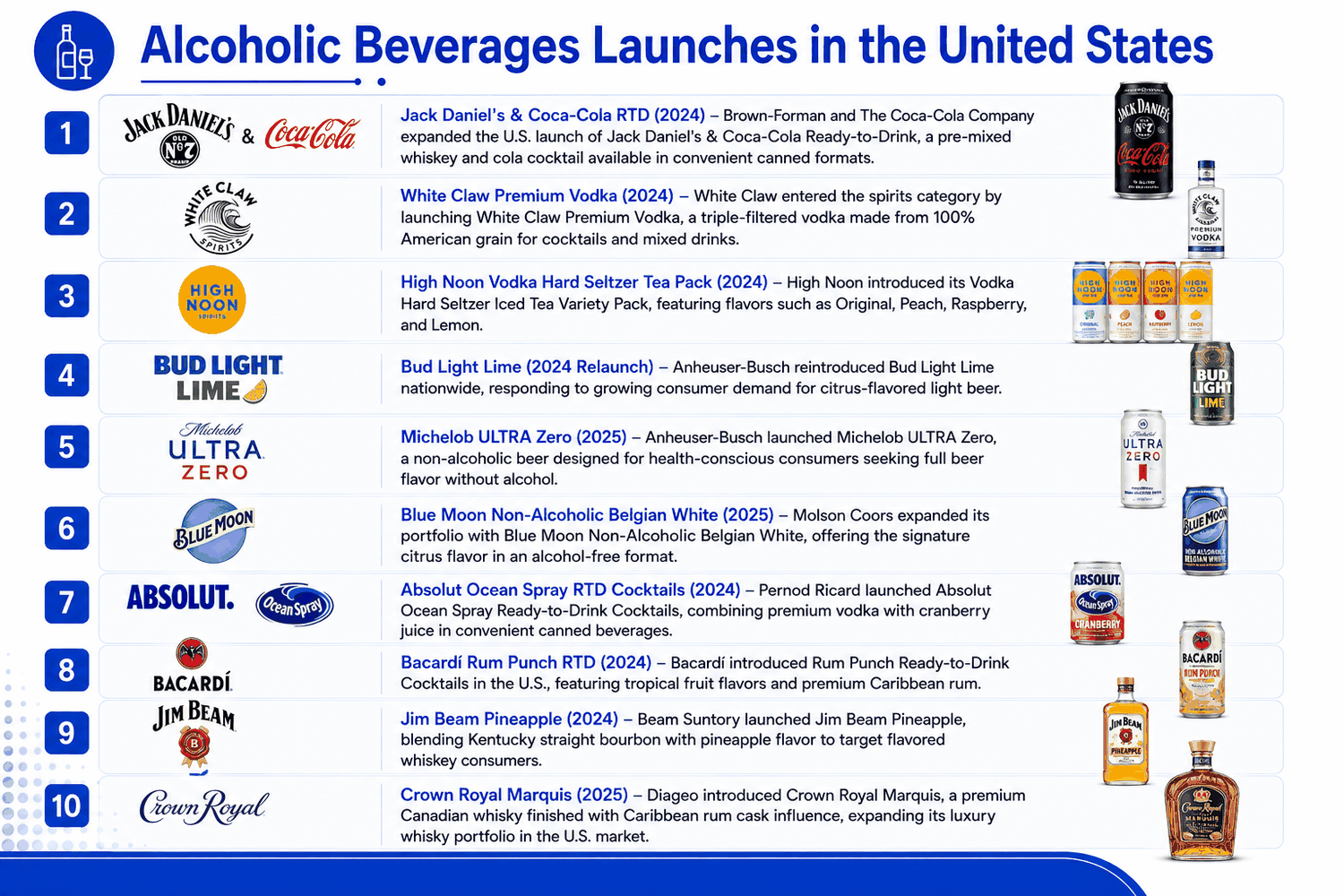
- Jack Daniel's & Coca-Cola RTD (2024) – Brown-Forman and The Coca-Cola Company expanded the U.S. launch of Jack Daniel's & Coca-Cola Ready-to-Drink, a pre-mixed whiskey and cola cocktail available in convenient canned formats.
- White Claw Premium Vodka (2024) – White Claw entered the spirits category by launching White Claw Premium Vodka, a triple-filtered vodka made from 100% American grain for cocktails and mixed drinks.
- High Noon Vodka Hard Seltzer Tea Pack (2024) – High Noon introduced its Vodka Hard Seltzer Iced Tea Variety Pack, featuring flavors such as Original, Peach, Raspberry, and Lemon.
- Bud Light Lime (2024 Relaunch) – Anheuser-Busch reintroduced Bud Light Lime nationwide, responding to growing consumer demand for citrus-flavored light beer.
- Michelob ULTRA Zero (2025) – Anheuser-Busch launched Michelob ULTRA Zero, a non-alcoholic beer designed for health-conscious consumers seeking full beer flavor without alcohol.
- Blue Moon Non-Alcoholic Belgian White (2025) – Molson Coors expanded its portfolio with Blue Moon Non-Alcoholic Belgian White, offering the signature citrus flavor in an alcohol-free format.
- Absolut Ocean Spray RTD Cocktails (2024) – Pernod Ricard launched Absolut Ocean Spray Ready-to-Drink Cocktails, combining premium vodka with cranberry juice in convenient canned beverages.
- Bacardí Rum Punch RTD (2024) – Bacardí introduced Rum Punch Ready-to-Drink Cocktails in the U.S., featuring tropical fruit flavors and premium Caribbean rum.
- Jim Beam Pineapple (2024) – Beam Suntory launched Jim Beam Pineapple, blending Kentucky straight bourbon with pineapple flavor to target flavored whiskey consumers.
- Crown Royal Marquis (2025) – Diageo introduced Crown Royal Marquis, a premium Canadian whisky finished with Caribbean rum cask influence, expanding its luxury whisky portfolio in the U.S. market.
United States Beer Alcoholic Beverage Segment with Strong Premium Growth
United States beer market remains the largest segment of the country’s alcoholic beverages industry, supported by widespread consumer acceptance, an extensive brewing industry, and continuous product innovation. The U.S. has more than 9,500 operating breweries, including craft breweries, microbreweries, brewpubs, and large commercial producers, making it one of the world’s largest beer-producing nations. Beer accounts for a substantial share of total alcohol consumption, with lagers, ales, stouts, wheat beers, and flavored malt beverages remaining popular across different consumer groups. Premium craft beer, low-calorie beer, non-alcoholic beer, and flavored beer continue to gain popularity among younger consumers seeking diverse drinking experiences. Technological advancements in brewing, sustainable packaging, and ingredient innovation have further strengthened the market. Growing demand for locally brewed products, seasonal beer varieties, and premium imports also supports market expansion. Increasing sales through supermarkets, convenience stores, liquor stores, restaurants, bars, and online retail continue to drive sustained growth in the United States beer market.
United States Glass Premium Packaging Supporting Consumer Preference
United States glass alcoholic beverages market continues to expand as glass bottles remain the preferred packaging format for premium wines, spirits, imported beers, and luxury alcoholic beverages. Industry estimates indicate that glass packaging accounts for more than half of premium alcoholic beverage packaging because it preserves product quality, protects flavor integrity, and enhances brand image. Consumers often associate glass bottles with authenticity, premium quality, and sustainability due to their recyclability and chemical stability. Premium whiskey, vodka, tequila, gin, rum, champagne, and fine wines are predominantly sold in glass containers. Beverage manufacturers continue investing in lightweight glass bottles and sustainable manufacturing processes to reduce transportation costs and environmental impact. Premiumization trends, increasing gift purchases, expanding hospitality services, and rising exports continue supporting demand for glass-packaged alcoholic beverages. Although glass packaging has higher production and transportation costs than alternative materials, strong consumer preference for premium presentation continues to drive steady growth in this market segment.
United States Plastic Alcoholic Beverages Convenience and Portability Driving Adoption
The United States plastic alcoholic beverages market is growing steadily due to increasing demand for lightweight, portable, and convenient packaging solutions. Plastic bottles, primarily manufactured from polyethylene terephthalate (PET), are widely used for selected spirits, ready-to-drink (RTD) cocktails, wine, and value-oriented alcoholic beverages. PET packaging offers advantages including lower transportation costs, reduced breakage risk, and improved handling during outdoor events, sporting venues, concerts, airlines, and travel. The rapid expansion of RTD alcoholic beverages has further increased demand for lightweight packaging alternatives. Manufacturers continue developing recyclable PET materials and sustainable packaging technologies to address growing environmental concerns while maintaining product quality. Plastic packaging also enables cost-effective distribution across convenience stores, supermarkets, and mass retail channels. However, premium alcoholic beverage brands continue to favor glass packaging due to stronger consumer perceptions of quality. Ongoing innovation in recyclable plastics, lightweight packaging, and sustainable materials is expected to support moderate long-term growth in the U.S. plastic alcoholic beverages market.
Hospitality and Entertainment Fueling Consumption in United States Alcoholic Beverages On-Premises
United States alcoholic beverages on-premises market represents a major distribution channel, encompassing bars, restaurants, hotels, clubs, casinos, stadiums, entertainment venues, and event locations where alcoholic beverages are consumed on-site. The country has hundreds of thousands of licensed on-premises establishments, serving millions of consumers each week. Rising tourism, business travel, live entertainment, sporting events, and social gatherings continue to drive alcohol consumption through hospitality venues. Premium cocktails, craft beer, imported wine, and high-end spirits have become increasingly popular as consumers seek unique drinking experiences outside the home. Many establishments are expanding beverage menus with locally produced craft products, signature cocktails, and premium wine selections to attract customers. Digital ordering systems, contactless payments, and loyalty programs have further enhanced customer convenience. The continued recovery of the hospitality industry, increasing consumer spending on leisure activities, and growth in nightlife and tourism are expected to sustain long-term expansion of the U.S. alcoholic beverages on-premises market.
United States Dominant Retail Channel with Broad Product Availability in Alcoholic Beverages
Liquor stores remain one of the most important retail distribution channels for alcoholic beverages in the United States, offering consumers extensive product variety, expert recommendations, and convenient purchasing options. The country has tens of thousands of licensed liquor stores, ranging from independent retailers to large specialty chains. These stores provide a comprehensive selection of beer, wine, spirits, ready-to-drink cocktails, imported beverages, craft products, and premium limited-edition brands. Growing consumer demand for premium spirits, fine wines, craft beer, and seasonal alcoholic beverages has strengthened liquor store sales. Many retailers have expanded digital platforms offering online ordering, curbside pickup, home delivery, and personalized product recommendations to improve customer convenience. Promotional events, tasting sessions, and loyalty programs continue attracting repeat customers while encouraging premium purchases. Increasing disposable income, expanding product portfolios, and strong consumer preference for specialized alcohol retailers continue to support sustained growth in the United States alcoholic beverages liquor stores market.
Florida Tourism and Hospitality Driving Strong Demand Alcoholic Beverages
Florida represents one of the largest alcoholic beverages markets in the United States due to its large population of over 23 million residents, year-round tourism, and vibrant hospitality industry. The state welcomes more than 140 million visitors annually, creating substantial demand for beer, wine, spirits, and ready-to-drink (RTD) beverages across hotels, restaurants, bars, cruise ports, and entertainment venues. Beer remains the highest-volume alcoholic beverage category, while premium spirits and imported wines continue to gain popularity among residents and international tourists. Florida is also home to a rapidly expanding craft brewery industry, with over 400 craft breweries producing locally inspired beers. Growth in luxury tourism, beach destinations, sporting events, and nightlife has strengthened on-premises alcohol consumption. Retail sales through supermarkets, liquor stores, and e-commerce platforms have also increased as consumer preferences shift toward premium and convenience-focused products. Rising disposable incomes, continuous tourism growth, and expanding hospitality infrastructure are expected to sustain long-term growth in Florida’s alcoholic beverages market.
Alcoholic Beverages Premium Consumption and Urban Lifestyle Supporting New York Market Growth
New York maintains one of the country’s most valuable alcoholic beverages markets, supported by a population exceeding 19 million people, high disposable incomes, and a globally recognized hospitality sector. New York City alone supports thousands of restaurants, bars, hotels, rooftop lounges, and entertainment venues that generate significant demand for premium alcoholic beverages. The state is also one of the leading wine-producing regions in the United States, with more than 500 wineries, particularly concentrated in the Finger Lakes, Hudson Valley, and Long Island regions. Premium wines, craft spirits, imported whiskey, tequila, champagne, and craft beer remain popular among urban consumers seeking premium drinking experiences. Increasing demand for ready-to-drink cocktails, alcohol-free alternatives, and locally produced beverages has encouraged continuous product innovation. Strong tourism, corporate events, fine dining, and nightlife contribute substantially to on-premises alcohol sales. Expansion of digital retail platforms and premium liquor stores further supports market growth, making New York one of the most dynamic alcoholic beverages markets in the United States.
Texas Population Growth and Craft Brewing Expanding Demand in Alcoholic Beverages
Texas has become one of the fastest-growing alcoholic beverages markets in the United States, driven by its population of more than 31 million residents, rapid urbanization, and expanding consumer spending. Major metropolitan areas including Houston, Dallas, Austin, and San Antonio account for significant alcohol consumption through restaurants, bars, entertainment venues, and sporting events. Texas has over 450 craft breweries, making it one of the country’s largest craft beer markets. Beer continues to dominate overall consumption, while premium bourbon, tequila, whiskey, wine, and RTD beverages are experiencing strong growth among younger adult consumers. The state’s expanding Hispanic population has also contributed to increasing demand for tequila and premium agave-based spirits. Growth in tourism, music festivals, business travel, and hospitality infrastructure has strengthened both on-premises and retail alcohol sales. Continued investment in beverage manufacturing, distribution networks, and premium product innovation is expected to support sustained long-term expansion of the Texas alcoholic beverages market.
California Alcoholic Beverages Market Driven by Wine and Premium Innovation
California represents the largest alcoholic beverages market in the United States, supported by its population of nearly 40 million residents, world-renowned wine industry, and diverse consumer preferences. The state produces more than 80% of U.S. wine, with over 4,800 wineries located primarily in Napa Valley, Sonoma County, Paso Robles, and Central Coast regions. California also has more than 1,100 craft breweries, making it one of the nation’s largest beer-producing states. Premium wine, craft beer, tequila, whiskey, vodka, and ready-to-drink cocktails continue to experience strong consumer demand, particularly among younger urban professionals. California’s thriving tourism industry, fine dining sector, luxury hospitality, and entertainment economy significantly contribute to alcohol sales through on-premises channels. Sustainability initiatives, organic wines, low-alcohol beverages, and innovative packaging solutions are becoming increasingly popular among environmentally conscious consumers. Strong manufacturing capabilities, premiumization trends, expanding exports, and continuous product innovation position California as the leading alcoholic beverages market in the United States.
Market Segments
By Type
- Beer
- Distilled Spirits
- Wine
- Others
Packaging
- Glass Bottle
- Tin
- Plastic Bottle
Distribution Channel
- Convenience Stores
- On Premises
- Liquor Stores
- Grocery Shops
- Internet Retailing
- Supermarkets
States
- California
- Texas
- New York
- Florida
- Illinois
- Pennsylvania
- Ohio
- Georgia
- New Jersey
- Washington
- North Carolina
- Massachusetts
- Virginia
- Michigan
- Maryland
- Colorado
- Tennessee
- Indiana
- Arizona
- Minnesota
- Wisconsin
- Missouri
- Connecticut
- South Carolina
- Oregon
- Louisiana
- Alabama
- Kentucky
- Rest of United States
All the Key players have been covered from 5 Viewpoints:
- Overviews
- Key Person
- Recent Developments
- SWOT Analysis
- Revenue Analysis
Competitive Landscape
- Anheuser-Busch
- Altria
- Boston Beer
- Constellation Brands Inc.
- Diageo
- Molson Coors
- Pernod Ricard SA
Report Details:
| Report Features | Details |
| Base Year |
2025 |
| Historical Period |
2022 - 2025 |
| Forecast Period |
2026 - 2034 |
| Market |
US$ Billion |
| Segment Covered |
Type, Packaging, Distribution Channels and States |
| States Covered |
|
| Companies Covered |
|
| Customization Scope |
20% Free Customization |
| Post-Sale Analyst Support |
1 Year (52 Weeks) |
| Delivery Format |
PDF and Excel through Email (We can also provide the editable version of the report in PPT/Word format on request) |
Key Questions Answered in This Report:
-
What is the projected market size of the U.S. alcoholic beverages market by 2033?
-
What was the market size of the U.S. alcoholic beverages market in 2024?
-
What is the expected annual growth rate of the U.S. alcoholic beverages market between 2025 and 2033?
-
Which segment of alcoholic beverages is expected to dominate the U.S. market: beer, distilled spirits, wine, or others?
-
How has the demand for craft alcoholic beverages influenced the U.S. market?
-
What role does health consciousness play in shaping the U.S. alcoholic beverages market?
-
How has e-commerce impacted alcohol sales in the U.S.?
-
What are the challenges faced by the U.S. alcoholic beverages market due to regulatory and legal issues?
-
Which U.S. state has the largest alcoholic beverages market and why?
-
How has the trend towards sustainable packaging, like glass bottles, influenced the U.S. alcoholic beverages industry?
Customization Services available
- Analysis of Market Size and Its Segments
- More Company Profiles (Upto 10 without any additional cost):
- Additional Countries (Other than mentioned Countries):
- Region/Country Specific Reports:
- Market Entry Strategy:
- Region-Specific Market Dynamics:
- Regional Market Share Analysis:
- Trade Analysis:
- Production Insights:
- Others Customized Requests:
For more information contact our analysts.
Need More Assistance?
- Talk to our analysts to get more precious information on the current market trends.
- Include more countries and segments and customize the report based on the final requirement.
- Get a competitive advantage in your industry by knowing the report findings and making a positive impact on your revenues and operations.
- Our analysts are always ready to provide more help and pertinent information if you need any additional assistance.