United Arab Emirates Quick Service Restaurant Market Report by Cuisine, Outlet, Location, Cities and Company Analysis 2026-2034
Buy NowUnited Arab Emirates Quick Service Restaurant Market Size and Forecast
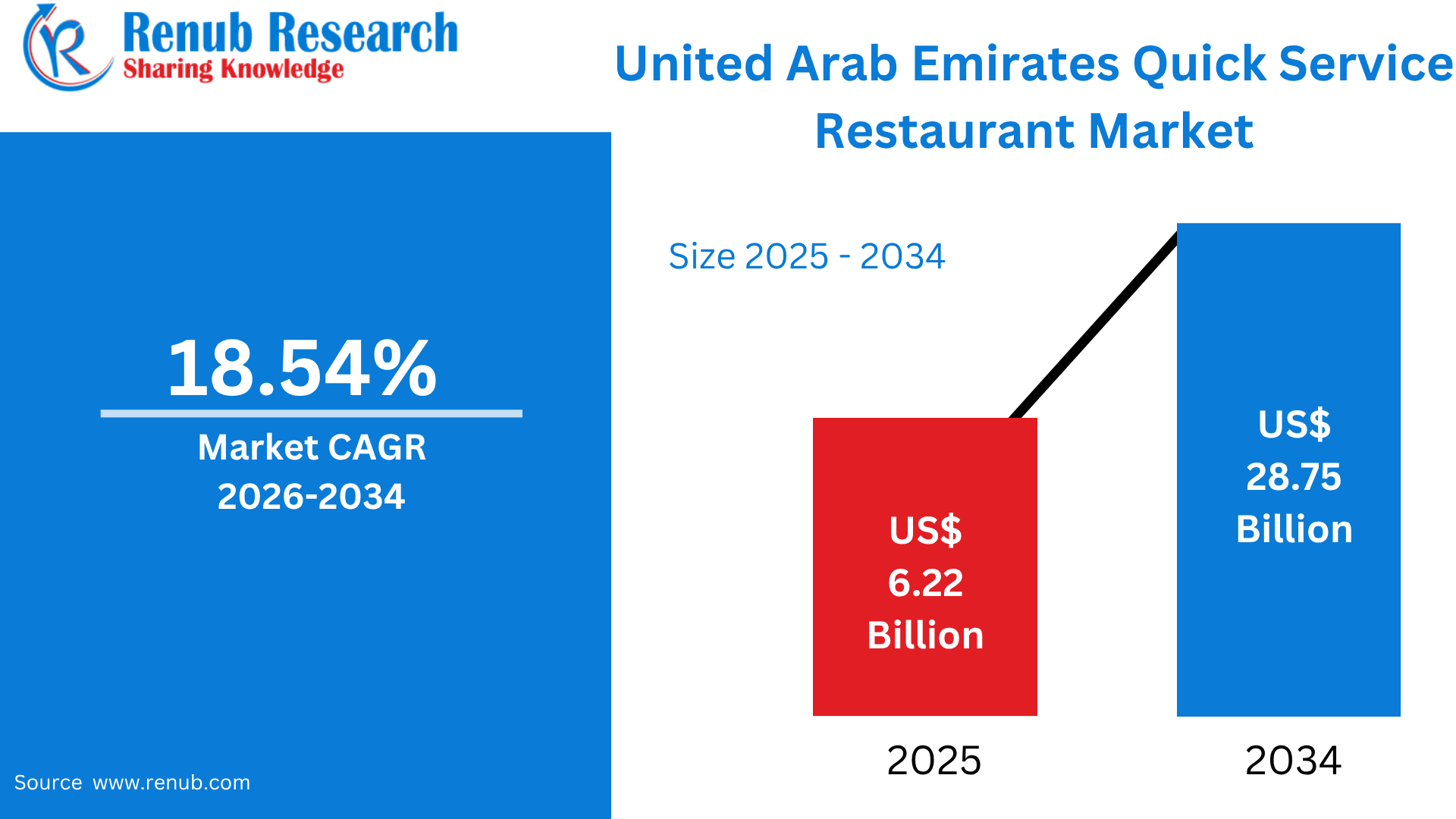
United Arab Emirates Quick Service Restaurant Market is projected to grow from US$ 6.22 billion in 2025 to US$ 28.75 billion by 2034, expanding at a CAGR of 18.54% from 2026 to 2034. The market is witnessing robust growth, supported by rapid urbanization, changing consumer lifestyles, rising demand for convenient dining options, and the increasing adoption of digital ordering and delivery platforms. Continued expansion of foodservice chains, tourism activity, and technology-enabled restaurant services is expected to further strengthen market growth throughout the forecast period.
What is Quick Service Restaurant and its Uses & Popularity in the United Arab Emirates?
A Quick Service Restaurant (QSR) is a foodservice establishment that specializes in providing meals and beverages quickly, conveniently, and generally at affordable prices. QSRs typically operate with standardized menus, limited table service, takeaway, drive-through, and delivery facilities. Popular formats include burger restaurants, pizza outlets, fried-chicken chains, bakeries, sandwich shops, coffee outlets, and other fast-food concepts.
In the United Arab Emirates (UAE), QSRs are widely used by professionals, families, expatriates, tourists, and young consumers seeking convenient dining solutions during busy daily schedules. The segment benefits from the UAE’s fast-paced urban lifestyle, multicultural population, tourism industry, and strong consumer spending. The increasing preference for convenient, affordable, and fast dining solutions has accelerated the expansion of QSR outlets across major UAE cities, including Dubai, Abu Dhabi, and Sharjah. The market features a strong mix of international fast-food chains and regional restaurant brands, providing consumers with diverse culinary choices such as American, Middle Eastern, Asian, and fusion cuisines. This broad selection aligns with the UAE’s highly multicultural population and attracts both local residents and international visitors. In addition, the availability of takeaway, drive-through, online ordering, and food-delivery services has further enhanced the accessibility and convenience of QSRs. As a result, quick service restaurants have become an increasingly popular dining option among busy professionals, families, younger consumers, expatriates, and tourists throughout the country.
Growth Drivers of the United Arab Emirates Quick Service Restaurant Market
Strong Tourism Growth and Rising Visitor Spending
Tourism is one of the most important growth drivers for the United Arab Emirates Quick Service Restaurant Market. The UAE, particularly Dubai, attracts millions of international visitors who create substantial demand for convenient and recognizable food options across shopping malls, airports, tourist attractions, hotels, and entertainment destinations. Dubai welcomed 19.59 million international overnight visitors in 2025, representing a 5% increase from 18.72 million in 2024. The expanding tourism ecosystem directly benefits QSR operators because tourists often prefer quick-service formats that provide familiar menus, fast preparation, accessible locations, and multiple price points. With tourism identified as a major contributor to sector growth. Continued investment in tourism, hospitality, retail, and major events is therefore expected to generate additional customer traffic and support QSR outlet expansion.
Increasing Demand for Convenience and Fast Dining
Changing lifestyles, busy work schedules, urbanization, and demand for convenient meals are accelerating QSR adoption across the UAE. Consumers increasingly seek food that can be ordered, prepared, collected, or delivered quickly, particularly during working hours and busy evening periods. The country’s highly urbanized environment provides a favorable setting for QSR formats, including standalone restaurants, drive-through outlets, mall-based stores, takeaway counters, and delivery-focused kitchens. QSR operators are responding by extending operating hours, introducing smaller-format outlets, simplifying menus, and offering takeaway and delivery services. The combination of convenience, speed, accessibility, and affordability is expected to keep consumer demand strong throughout the forecast period.
Rapid Growth of Digital Ordering and Food Delivery
Digitalization and food delivery are transforming the UAE QSR industry by allowing consumers to order meals through mobile applications, restaurant websites, aggregators, and digital platforms. The expansion of delivery infrastructure enables QSR operators to reach customers beyond their physical outlets while supporting higher order frequency and convenience. The development of cloud kitchens is also reducing the need for large dining spaces, allowing operators to establish delivery-focused facilities with lower capital requirements. Digital payments, mobile ordering, loyalty programs, personalized promotions, and real-time order tracking further enhance the customer experience. In addition, platforms such as Talabat, Deliveroo, Careem, and Noon Food have increased consumer access to restaurant brands. The continued shift toward off-premise consumption is encouraging QSR companies to invest in proprietary applications, online promotions, automated ordering, and delivery-optimized menus, supporting sustained market expansion.
Challenges of the United Arab Emirates Quick Service Restaurant Market
High Rental and Operating Costs
High operating costs represent a significant challenge for QSR operators, particularly in prime locations across Dubai and Abu Dhabi. Restaurants must manage expenses related to commercial rents, labor, utilities, ingredients, licensing, equipment, marketing, and store maintenance. Prime shopping malls, tourist districts, and high-traffic retail areas can generate strong customer volumes but also require substantial occupancy costs. Dubai’s commercial rents increased in 2024, adding pressure to foodservice operators’ profit margins. High rental costs in prime urban and mall locations as a major restraint on the UAE QSR market. Rising labor expenses further increase financial pressure because QSR operations require employees for food preparation, customer service, cleaning, delivery coordination, and management. Food costs can also fluctuate because the UAE relies significantly on imported food products and global supply chains. Operators therefore need strong cost controls, efficient inventory management, optimized staffing, and careful site selection. Failure to control these expenses can reduce profitability even when sales volumes remain strong.
Delivery Commissions, Competition, and Margin Pressure
The rapid expansion of food delivery creates significant opportunities for UAE QSR operators but also introduces margin-related challenges. Restaurants increasingly depend on third-party delivery platforms to reach customers, but commissions, promotional discounts, packaging expenses, and delivery-related costs can reduce the profitability of individual orders. Industry analysis indicates that delivery platforms can charge UAE restaurants approximately 25–30% commission per order, although actual rates vary according to contracts, promotions, and service arrangements. At the same time, the UAE foodservice environment is becoming increasingly value-conscious. Euromonitor reported that consumer foodservice faced a challenging environment in 2025, as operators absorbed higher costs while trying to remain affordable and competitive; delivery and takeaway also became increasingly embedded in fulfillment strategies. QSR brands must therefore balance competitive pricing with sustainable margins while investing in digital marketing and customer acquisition. Intense competition from international chains, regional brands, independent restaurants, cafés, and cloud kitchens further increases promotional pressure. Developing direct-ordering channels, loyalty programs, differentiated menus, and efficient delivery models will be essential for maintaining profitability.
Quick Service Restaurant Launches in the UAE
- Chipotle – Dubai (2024): Chipotle opened its first UAE location at The Beach, JBR, introducing its customizable burritos, bowls, tacos, quesadillas, and salads to the UAE market.
- Firehouse Subs – Dubai (2024): Firehouse Subs made its UAE debut at Carton Downtown Hotel on Sheikh Zayed Road, offering premium hot subs and grab-and-go meals.
- Marrybrown – Al Barsha, Dubai (2025): Marrybrown opened a new outlet in Al Barsha 1, expanding its UAE presence with crispy chicken, burgers, family meals, and delivery services.
- Raising Cane’s – Al Barsha, Dubai (2024): Raising Cane’s opened its first Dubai drive-through in Al Barsha, offering chicken fingers, fries, burgers, Texas toast, and its signature sauce.
- Eataly – Abu Dhabi (2024): Eataly launched its first Abu Dhabi outlet at Reem Mall, featuring quick-service counters alongside restaurants, cafés, bakery products, pizza, pasta, panini, and Italian street food.
- Aminia – Dubai (2025): Aminia expanded from India into Dubai, bringing its established Mughlai cuisine and biryani-focused menu to the UAE.
- XFire – Dubai (2025): Qatar-based XFire was among the new international food concepts launched in Dubai during January 2025, adding another regional brand to the emirate’s rapidly expanding restaurant scene.
- Timbuktu Market – Dubai (2024): Timbuktu Market was introduced as a street-food destination in Barsha Heights, combining home-grown and international food concepts with communal seating, coffee, retail, and entertainment elements.
- Tre – Dubai (2024): Tre, an Italian grab-and-go concept in Al Wasl, opened with a focus on Tuscan schiacciata, offering savory and sweet variations together with affogato and pastry desserts.
- District 8 – Dubai (2025): District 8 was among Dubai’s January 2025 restaurant openings, representing a multi-concept dining destination introduced as part of the emirate’s continuing expansion of new foodservice venues.
Growing Demand for Convenient Bakery-Based Meals
UAE Quick Service Restaurant Bakeries Market is benefiting from strong consumer demand for convenient breakfast, snacks, pastries, sandwiches, and bakery-based meals. Bakery formats fit well with the UAE’s fast-paced lifestyle because products can be purchased quickly through takeaway counters, mall outlets, cafés, drive-through locations, and delivery platforms. Croissants, breads, sandwiches, cakes, pastries, and other baked products are increasingly consumed by office workers, students, families, expatriates, and tourists. The UAE’s multicultural population also encourages bakeries to introduce products influenced by European, Middle Eastern, Asian, and fusion cuisines. The broader UAE foodservice market was valued at approximately US$18.6 billion in 2025, creating a substantial consumer base for bakery-oriented QSR concepts. Rising tourism and retail activity are providing additional customer traffic in shopping centers, airports, hotels, and entertainment destinations. At the same time, digital ordering and delivery are helping bakery QSRs reach customers beyond traditional storefronts. However, rising ingredient costs, particularly flour and dairy, can pressure margins, encouraging operators to optimize menus, pricing, and production efficiency.
Convenience, Digitalization, and Expanding Consumer Demand
UAE Quick Service Restaurant Market is expanding as consumers increasingly prioritize speed, convenience, affordability, and accessible dining. QSRs accounted for approximately 43.6% of the UAE foodservice market in 2025, making them the largest foodservice type by market share. The market was estimated at around US$6.69 billion in 2025, with continued double-digit growth projected over the coming years. Urban lifestyles, a large expatriate population, tourism, rising disposable incomes, and extensive retail infrastructure are supporting demand for fast meals. Consumers can choose from dine-in, takeaway, drive-through, and delivery formats, allowing QSR brands to serve multiple consumption occasions. Digital ordering is becoming increasingly important, with delivery projected to record a CAGR of approximately 21.88% between 2026 and 2031. The UAE’s foodservice environment also benefits from strong mall penetration, airports, business districts, residential communities, and tourist destinations. International chains and local brands are continuously introducing new menu items, value meals, healthier choices, and localized flavors. This combination of convenience, variety, technology, and accessibility is strengthening QSR popularity across the country.
Strong Preference for Chicken, Burgers, Shawarma, and Grilled Foods
UAE Quick Service Restaurant Meat-based Cuisines Market represents one of the strongest cuisine categories within the country’s QSR industry. Meat-based cuisines accounted for approximately 32.01% of UAE QSR revenue in 2025, making them the leading cuisine segment. Consumer demand is supported by the popularity of fried chicken, burgers, shawarma, kebabs, grilled chicken, meat sandwiches, and other protein-based meals. Meat consumption in the UAE reached approximately 445,000 tonnes in 2022, demonstrating the importance of meat products within the country’s food culture. The multicultural population has also expanded demand for different meat-based preparations, ranging from Middle Eastern and South Asian dishes to American-style burgers and fried chicken. Halal food requirements further shape the market, with QSR brands widely offering halal-certified meat products. Major international and regional restaurant chains continue to expand their chicken, burger, and grilled-food portfolios through new outlets, delivery channels, and promotional meal combinations. Growing tourism and demand for convenient meals are providing additional opportunities, while premium burgers and specialty chicken products are helping brands target higher-value consumers.
Strong Brand Recognition and Standardized Consumer Experience
UAE Chained Quick Service Restaurant Market is supported by strong consumer familiarity with established international and regional restaurant brands. Chained outlets accounted for approximately 58.9% of the overall UAE foodservice market in 2025, demonstrating the importance of branded restaurant networks. Major QSR chains benefit from standardized menus, recognizable branding, established supply chains, centralized marketing, loyalty programs, and consistent customer experiences across multiple locations. Chains are particularly well positioned in high-footfall environments such as shopping malls, airports, business districts, highways, hotels, and entertainment destinations. The UAE had approximately 10,300 QSR outlets in 2022, highlighting the extensive scale of the country’s quick-service ecosystem. Large operators are also increasingly using digital ordering, mobile applications, delivery partnerships, self-service kiosks, and loyalty programs to strengthen customer engagement. Franchise-based expansion enables international brands to enter new communities while maintaining standardized operating models. At the same time, regional chains are competing by introducing locally relevant flavors and menus. Although competition and rental expenses remain significant concerns, established chains continue to benefit from brand trust, operational scale, and strong customer recognition.
High-Footfall Retail Locations Supporting QSR Expansion
UAE Quick Service Restaurant Retail Market is gaining importance as shopping malls, retail centers, supermarkets, convenience stores, and mixed-use developments become major locations for foodservice consumption. Retail environments provide QSR operators with access to concentrated customer traffic generated by shoppers, families, employees, tourists, and entertainment visitors. In 2024, consumer foodservice through retail locations increased by approximately 5% to US$8.9 billion, demonstrating the importance of retail-based food consumption in the UAE. Shopping malls are particularly attractive for QSR brands because consumers can combine dining with shopping, entertainment, cinema visits, and family activities. Retail-based QSR outlets also benefit from longer operating hours and strong weekend and holiday traffic. The UAE’s extensive mall infrastructure creates opportunities for both international chains and regional concepts to establish highly visible outlets. Food courts, standalone mall units, kiosks, and takeaway counters allow operators to select formats according to location and target customers. In addition, delivery and online ordering can extend the reach of retail-based restaurants beyond physical visitors. Continued retail development and tourism activity are expected to support demand for convenient QSR options in these high-traffic environments.
Population Growth and Expanding Consumer Base in Abu Dhabi
Abu Dhabi Quick Service Restaurant Market is supported by strong population growth, expanding residential communities, business activity, and increasing demand for convenient dining. Abu Dhabi Emirate’s population reached 4.14 million in 2024, increasing by 7.5% year over year. The Abu Dhabi Region accounted for 2.82 million residents, or approximately 68% of the emirate’s population, creating a substantial customer base for QSR operators. The emirate also recorded approximately 2.76 million employed people, with employment increasing by 9.1% in 2024. This large working population supports demand for breakfast, lunch, takeaway, delivery, and quick evening meals. QSR outlets are increasingly concentrated around residential neighborhoods, business districts, shopping centers, highways, and mixed-use developments. The multicultural population also supports demand for burgers, fried chicken, pizza, shawarma, Asian meals, sandwiches, and other international cuisines. Continued housing development and commercial expansion are creating additional locations for restaurants, while digital ordering and delivery services are making QSR products accessible across a wider geographic area.
Sharjah Residential Population and Affordable Dining Demand
The Sharjah Quick Service Restaurant Market benefits from its large residential population, extensive retail infrastructure, proximity to Dubai, and relatively affordable lifestyle compared with some neighboring markets. Sharjah has developed into an important residential and commercial center, with dense communities creating consistent demand for affordable meals, takeaway products, and food delivery. QSR operators benefit from locations near residential buildings, universities, offices, shopping centers, and major road networks connecting Sharjah with Dubai and Ajman. The emirate’s multicultural population creates demand for a broad variety of cuisines, including Middle Eastern, Indian, Pakistani, Asian, American, and fusion foods. Value-oriented menus are particularly important because consumers frequently compare prices across restaurants and delivery platforms. Shopping malls and neighborhood retail centers provide additional opportunities for branded QSR chains, while smaller independent restaurants compete through localized menus and lower prices. Digital ordering has further expanded the reach of restaurants, allowing consumers to order meals directly to homes and workplaces. The combination of population density, commuting activity, retail development, and price-sensitive consumers is expected to maintain strong demand for quick-service dining in Sharjah.
Dubai Tourism, International Brands, and High Consumer Traffic
Dubai Quick Service Restaurant Market represents one of the most developed and competitive QSR environments in the UAE. Dubai’s large resident population is complemented by a substantial international visitor base, creating demand from residents, tourists, business travelers, and expatriates. Dubai’s population reached approximately 4.58 million by the end of 2025, representing 7.5% growth compared with the previous year. In addition, the emirate welcomed 19.59 million international overnight visitors in 2025, up 5% from 18.72 million in 2024. These population and tourism trends generate significant customer traffic for restaurants across malls, airports, hotels, entertainment venues, business districts, and tourist attractions. Dubai also has a strong presence of international QSR chains, regional brands, premium fast-food concepts, cafés, cloud kitchens, and delivery-focused businesses. Consumers increasingly expect mobile ordering, fast delivery, digital payments, loyalty rewards, and diverse menus.
Recent Developments in UAE Quick Service Restaurant Market
- In June 2025, Papa John's introduced a croissant pizza with a buttery, flaky dough foundation in the United Arab Emirates. This product mixes classic pizza toppings with a crust that resembles pastry.
- In February 2025, Haldiram's launched a restaurant in Manazil Al Raffa, Bur Dubai, United Arab Emirates. The establishment offers quick service and dine-in restaurant alternatives with a focus on authentic Indian flavors and premium products.
- In February 2025, Al Safadi opened Oventine, a quick service restaurant with Levantine influences, as part of its expansion. The company's first fast-casual restaurant, Oventine, offers Lebanese cuisine, including wraps, flatbreads, dips, and specialty dishes.
United Arab Emirates Quick Service Restaurant Market Segmentation
Cuisine
- Bakeries
- Burger
- Ice Cream
- Meat-based Cuisines
- Pizza
- Other QSR Cuisines
Outlet
- Chained Outlets
- Independent Outlets
Location
- Leisure
- Lodging
- Retail
- Standalone
- Travel
Cities
- Dubai
- Abu Dhabi
- Sharjah
- Al Ain
- Ajman
- Ras Al Khaimah
- Fujairah
All companies have been covered from 5 viewpoints:
- Overviews
- Key Person
- Recent Developments
- SWOT Analysis
- Revenue Analysis
Key Players Analysis
- AlAmar Foods Company
- ALBAIK Food Systems Company S.A.
- Alghanim Industries & Yusuf A. Alghanim & Sons WLL
- Americana Restaurants International PLC
- Apparel Group
- Emirates Fast Food Company
- Kamal Osman Jamjoom Group LLC
- M.H. Alshaya Co. WLL
- Ring International Holding AG
Report Details:
| Report Features | Details |
| Base Year |
2024 |
| Historical Period |
2020 - 2024 |
| Forecast Period |
2025 - 2033 |
| Market |
US$ Billion |
| Segment Covered |
By Cuisine, By Outlet & By Location |
| Companies Covered |
|
| Customization Scope |
20% Free Customization |
| Post-Sale Analyst Support |
1 Year (52 Weeks) |
| Delivery Format |
PDF and Excel through Email (We can also provide the editable version of the report in PPT/Word format on request) |
Customization Services available
- Analysis of Market Size and Its Segments
- More Company Profiles (Upto 10 without any additional cost):
- Additional Countries (Other than mentioned Countries):
- Region/Country Specific Reports:
- Market Entry Strategy:
- Region-Specific Market Dynamics:
- Regional Market Share Analysis:
- Trade Analysis:
- Production Insights:
- Others Customized Requests:
For more information contact our analysts.
Need More Assistance?
- Talk to our analysts to get more precious information on the current market trends.
- Include more countries and segments and customize the report based on the final requirement.
- Get a competitive advantage in your industry by knowing the report findings and making a positive impact on your revenues and operations.
- Our analysts are always ready to provide more help and pertinent information if you need any additional assistance.