Saudi Arabia Foodservice Market Report by Foodservice Type, Outlet, Location, Cities and Company Analysis 2026-2034
Buy NowSaudi Arabia Foodservice Market Size and Forecast
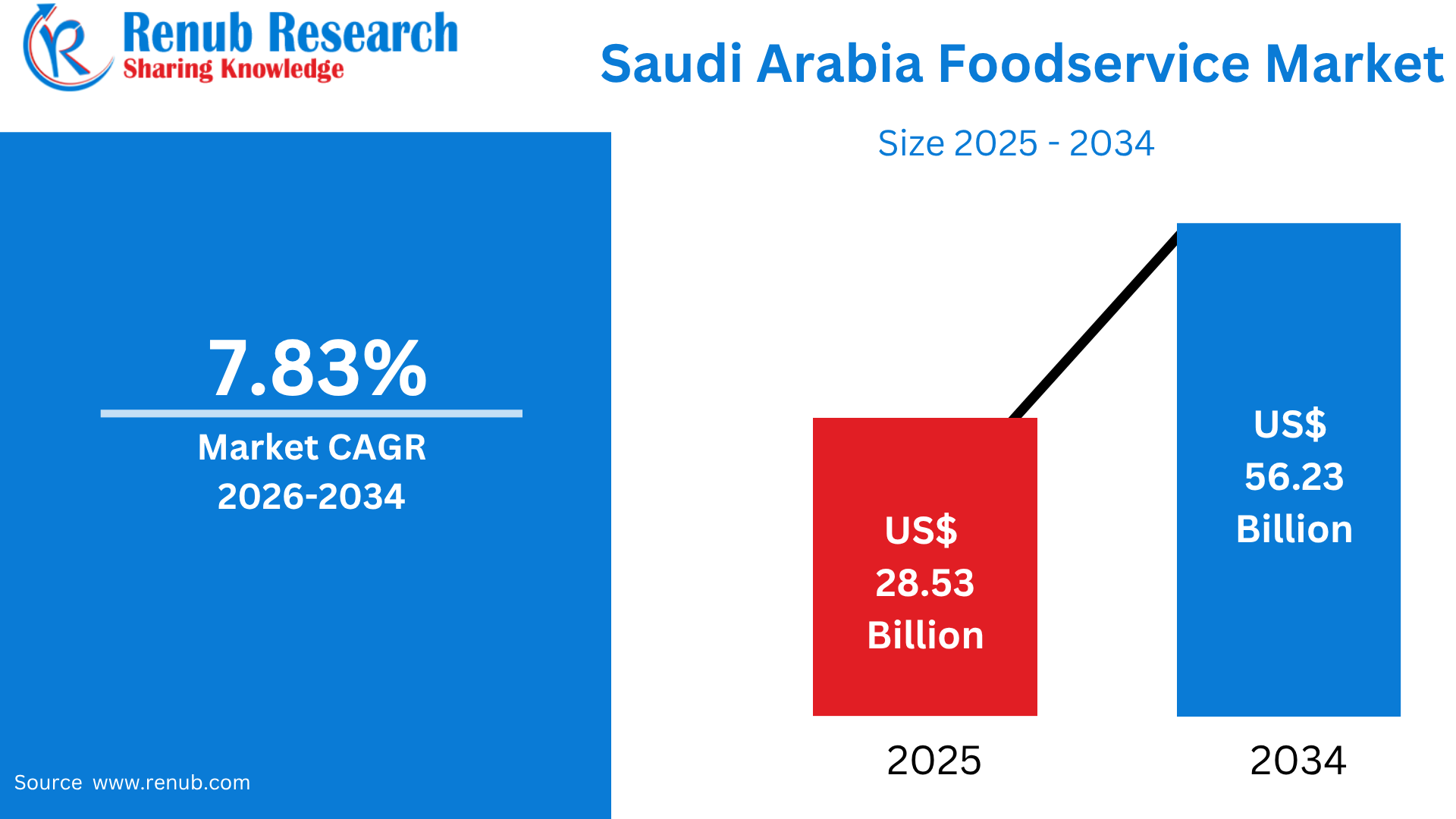
Saudi Arabia Foodservice Market is projected to grow from US$ 28.53 billion in 2025 to US$ 56.23 billion by 2034, registering a CAGR of 7.83% during 2026–2034. Market growth is driven by rapid urbanization, rising disposable incomes, an expanding tourism sector, and changing consumer lifestyles that favor dining out and food delivery services. The increasing presence of international restaurant chains, digital ordering platforms, and diverse cuisine offerings, supported by Saudi Vision 2030, is expected to sustain strong growth throughout the forecast period.
What is Foodservice and Its Uses & Popularity in Saudi Arabia?
Foodservice refers to the industry involved in preparing, serving, and delivering food and beverages through restaurants, cafés, hotels, quick-service restaurants (QSRs), catering companies, cloud kitchens, institutional cafeterias, and food delivery platforms. It caters to consumers seeking convenient, high-quality dining experiences outside the home or through takeaway and home delivery services. The foodservice sector serves residential consumers, corporate offices, educational institutions, healthcare facilities, tourism establishments, and large-scale events. It also plays a vital role in supporting employment, tourism, hospitality, and economic development through diverse dining formats and innovative culinary offerings.
In Saudi Arabia, foodservice has become one of the fastest-growing segments of the hospitality industry due to rapid urbanization, rising disposable incomes, and changing consumer lifestyles. The Kingdom’s population exceeds 38 million, with more than 80% living in urban areas, creating strong demand for restaurants and cafés. Government initiatives under Saudi Vision 2030, expanding tourism, increasing female workforce participation, and a growing young population are accelerating dining-out culture. International restaurant chains, premium cafés, and local brands continue to expand across major cities such as Riyadh, Jeddah, and Dammam. In addition, widespread adoption of online food delivery apps, digital payment systems, and cloud kitchens has transformed consumer purchasing behavior, making foodservice an essential and rapidly evolving sector within Saudi Arabia’s economy.
Major Food Delivery Apps in Saudi Arabia
HungerStation
- Coverage: 100+ cities across Saudi Arabia
- Delivery Speed: Fast (30–45 minutes)
- Price Range: SAR 6–25; HPlus subscription: SAR 69/month
- Restaurant Variety: Very High (55,000+ restaurant partners)
Talabat
- Coverage: Major cities across Saudi Arabia
- Delivery Speed: Average (35–50 minutes)
- Price Range: SAR 5–20, with frequent promotional offers
- Restaurant Variety: Very High (10,000+ restaurant partners)
ToYou
- Coverage: 57 cities across Saudi Arabia
- Delivery Speed: Fast (30–45 minutes)
- Price Range: Competitive pricing
- Restaurant Variety: High
Shgardi
- Coverage: 80+ cities across Saudi Arabia
- Delivery Speed: Fast and cost-effective
- Price Range: Varies depending on service and delivery distance
- Restaurant Variety: High (10,000+ restaurant partners)
Dailymealz
- Coverage: Riyadh, Jeddah, and other major cities
- Delivery Speed: Scheduled, on-time deliveries
- Pricing Model: Subscription-based meal plans
- Restaurant Variety: Meal plans from 200+ restaurants
The Chefz
- Coverage: Selected cities in Saudi Arabia
- Delivery Speed: Premium service (30–45 minutes)
- Price Range: Premium pricing
- Restaurant Variety: Gourmet and Fine Dining (12,429+ restaurant partners)
Jahez
- Coverage: 54+ cities across Saudi Arabia
- Delivery Speed: Fast (25–40 minutes)
- Price Range: SAR 4–15, competitive pricing
- Restaurant Variety: High
Lugmety
- Coverage: Limited service areas in Saudi Arabia
- Delivery Speed: Average (40–60 minutes)
- Price Range: SAR 15+, focused on premium dining
- Restaurant Variety: Local restaurants and gourmet dining options
Mrsool
- Coverage: Nationwide across Saudi Arabia
- Delivery Speed: Varies (30–60 minutes)
- Price Range: Flexible and negotiable pricing
- Restaurant Variety: Delivers from virtually any store or restaurant
Growth Driver
Saudi Vision 2030 and Tourism Expansion Accelerating Foodservice Demand
Saudi Vision 2030 has become one of the strongest catalysts for the country’s foodservice industry by diversifying the economy and expanding tourism, hospitality, and entertainment sectors. The Kingdom aims to attract 150 million domestic and international tourists annually by 2030, creating substantial demand for restaurants, cafés, hotels, catering services, and quick-service restaurants (QSRs). Mega-projects such as NEOM, The Red Sea Project, Diriyah Gate, Qiddiya, and Amaala are driving investments in hospitality infrastructure and international foodservice brands. According to government development plans, tourism’s contribution to Saudi Arabia’s GDP is expected to increase significantly during the forecast period. The rapid expansion of hotels, shopping malls, airports, and entertainment destinations has increased opportunities for both local and international restaurant operators. Furthermore, international sporting events, concerts, exhibitions, and business conferences continue to stimulate demand for premium dining experiences and catering services. These long-term infrastructure investments are expected to provide sustained growth opportunities for the Saudi Arabian foodservice market.
Rapid Urbanization, Young Population, and Changing Consumer Lifestyles
Saudi Arabia’s growing urban population and youthful demographic profile are significantly boosting foodservice consumption. The Kingdom has a population of over 38 million people, with more than 80% living in urban areas, creating strong demand for restaurants, cafés, food courts, and takeaway services. Nearly two-thirds of the population is under the age of 35, making younger consumers one of the primary drivers of dining-out culture. Rising disposable incomes, increasing female workforce participation, busy work schedules, and growing acceptance of Western dining habits have encouraged consumers to spend more on convenient food options. Coffee culture has also expanded rapidly, supporting the growth of premium cafés and specialty coffee chains throughout Riyadh, Jeddah, Dammam, and other major cities. Consumers increasingly seek international cuisines, healthier menu options, premium dining experiences, and customized meals. These evolving consumption patterns continue to encourage restaurant expansion, menu innovation, and investment across both organized and independent foodservice operators.
Digital Food Delivery and Quick-Service Restaurant (QSR) Expansion
The rapid digital transformation of Saudi Arabia’s foodservice sector has significantly accelerated market growth. High smartphone penetration, widespread internet access, and increasing digital payment adoption have fueled online food ordering across the country. Saudi Arabia records internet penetration exceeding 95%, while smartphone usage ranks among the highest in the Middle East, supporting the expansion of mobile ordering platforms. Food delivery applications and cloud kitchens have become integral components of the modern restaurant ecosystem, allowing operators to serve customers beyond traditional dine-in formats. Quick-service restaurants (QSRs) continue to expand aggressively due to rising demand for affordable, convenient, and fast meal options among students, working professionals, and families. International restaurant chains are investing heavily in digital ordering, loyalty programs, AI-powered customer engagement, and automated kitchen technologies to improve operational efficiency. The combination of digital innovation, delivery infrastructure, and increasing consumer preference for convenience continues to strengthen long-term growth prospects across Saudi Arabia’s foodservice market.
Major Foodservice Launches in Saudi Arabia
- April 2025 – Pret A Manger opened its first Saudi Arabian outlet at Olaya Towers, Riyadh, marking the brand's entry into the Kingdom and expanding its GCC footprint.
- July 2025 – Tanmiah Food Company & McDonald's Saudi Arabia announced a strategic partnership to strengthen the supply of locally sourced poultry for McDonald's restaurants across Saudi Arabia.
- October 2024 – Dunkin' opened its 800th store in Saudi Arabia in partnership with Shahia Food Limited, expanding its coffee and bakery network across the Kingdom.
- August 2024 – Epik Foods launched its first physical restaurant, Healthy & Co., in Riyadh, focusing on healthy meals, salads, and wellness-oriented dining.
- July 2024 – Gong Cha opened its first Saudi Arabian outlet in Riyadh, introducing its international bubble tea concept to the Kingdom.
- 2025 – Zuma Riyadh announced the opening of its luxury Japanese Izakaya restaurant in Riyadh, expanding the globally renowned fine-dining brand into Saudi Arabia.
- 2025 – SUSHISAMBA launched its first Saudi Arabian restaurant in King Abdullah Financial District (KAFD), Riyadh, offering Japanese, Brazilian, and Peruvian fusion cuisine.
- 2025 – Black Tap Craft Burgers & Shakes opened its first Jeddah restaurant, bringing its signature gourmet burgers and CrazyShake® beverages to Saudi consumers.
- 2025 – CÉ LA VI expanded into Jeddah with a premium rooftop dining destination featuring contemporary Asian cuisine and luxury hospitality.
- 2025 – Em Sherif Café launched its Riyadh outlet, introducing upscale Lebanese cuisine as part of Saudi Arabia's rapidly expanding premium dining sector.
Challenge
Rising Operating Costs and Labor Dependency
One of the major challenges facing Saudi Arabia’s foodservice market is the continuous increase in operating expenses. Restaurants and cafés face rising costs related to commercial rents, imported food ingredients, utilities, transportation, packaging materials, and equipment maintenance. Labor costs have also increased as businesses adapt to workforce nationalization initiatives while continuing to recruit skilled hospitality professionals. Premium restaurant operators often depend on imported specialty ingredients, exposing them to global commodity price fluctuations and supply chain disruptions. Inflationary pressures have further reduced profit margins, particularly for independent restaurants and small foodservice businesses. Additionally, investments in digital ordering systems, food safety compliance, delivery logistics, and sustainability initiatives require significant capital expenditure. While larger international chains benefit from economies of scale, smaller operators face increasing financial pressure to remain competitive without substantially increasing menu prices. Managing cost efficiency while maintaining food quality and customer satisfaction remains a significant challenge throughout the Saudi Arabian foodservice industry.
Intense Market Competition and Changing Consumer Expectations
Saudi Arabia’s foodservice industry has become increasingly competitive as international brands, regional restaurant groups, and local independent operators continue expanding across the Kingdom. Hundreds of new restaurants, cafés, cloud kitchens, and food delivery concepts enter the market each year, making customer retention more challenging. Consumers now expect premium food quality, fast service, personalized menus, digital ordering, contactless payments, loyalty programs, and competitive pricing simultaneously. Social media platforms and food influencers significantly influence purchasing decisions, increasing pressure on restaurants to continuously innovate their menus and dining experiences. Furthermore, growing health consciousness has increased demand for healthier meals, calorie transparency, organic ingredients, and plant-based options, requiring additional investments in product development. Seasonal demand fluctuations linked to Ramadan, Hajj, tourism cycles, and holiday periods also create operational challenges. Restaurants that fail to adapt quickly to changing consumer preferences, technological advancements, and evolving dining trends risk losing market share in this highly dynamic and competitive environment.
Coffee Culture and Premium Social Dining Driving Saudi Arabia Cafés & Bars Foodservice Growth
Saudi Arabia Cafés & Bars Foodservice Market is witnessing robust expansion, fueled by the Kingdom’s growing coffee culture, rising disposable incomes, and increasing demand for premium social dining experiences. Saudi Arabia has a population exceeding 38 million, with more than 80% living in urban areas, creating strong demand for cafés and casual gathering spaces. Specialty coffee consumption has increased significantly, particularly among younger consumers aged 18–35, who represent a large share of café visitors. International coffee chains and local boutique cafés continue expanding across Riyadh, Jeddah, Makkah, Dammam, and Al Khobar. Premium Arabic coffee, espresso-based beverages, teas, desserts, and healthy snack offerings are becoming increasingly popular. Digital ordering, loyalty applications, self-service kiosks, and cashless payments have enhanced customer convenience. Lifestyle changes, higher female workforce participation, and expanding mixed-use commercial developments continue supporting café traffic. Product innovation, premium beverage offerings, and experiential café concepts are expected to strengthen long-term growth across Saudi Arabia’s cafés and bars foodservice segment.
Digital Food Delivery Transforming Restaurant Operations in Saudi Arabia Cloud Kitchen Foodservice
The Saudi Arabia Cloud Kitchen Foodservice Market is expanding rapidly due to rising online food ordering, increasing smartphone penetration, and growing consumer preference for convenient home-delivered meals. Saudi Arabia records internet penetration above 95%, while smartphone adoption remains among the highest in the Middle East, creating a favorable environment for digital foodservice platforms. Cloud kitchens operate without dine-in facilities, allowing businesses to reduce rental costs and improve operational efficiency while serving multiple food brands from centralized production units. Increasing urbanization and busy lifestyles have accelerated demand for quick-service meals delivered directly to consumers. Artificial intelligence-based order management, automated kitchens, cloud-based inventory systems, and real-time delivery tracking are improving operational productivity. Major metropolitan cities including Riyadh, Jeddah, Dammam, and Makkah have witnessed rapid expansion of cloud kitchen facilities. Growing investments from restaurant operators, technology companies, and food delivery platforms continue to strengthen this business model, making cloud kitchens one of the fastest-growing segments within Saudi Arabia’s foodservice industry.
International Brands and Franchise Expansion Supporting Saudi Arabia Foodservice Chained Outlets Market Growth
Saudi Arabia Foodservice Chained Outlets Market continues to experience strong growth, driven by expanding international restaurant brands, increasing franchising activities, and rising consumer demand for standardized dining experiences. Global quick-service restaurants (QSRs), casual dining chains, cafés, and bakery brands continue expanding across shopping malls, commercial districts, airports, and mixed-use developments. The Kingdom’s young demographic profile, where approximately two-thirds of the population is below 35 years of age, supports frequent restaurant visits and strong brand loyalty. Chained outlets benefit from established quality standards, digital loyalty programs, mobile ordering applications, and efficient supply chain management. International cuisine, including American, Italian, Asian, and Middle Eastern concepts, continues attracting a broad consumer base. Investments in restaurant automation, AI-powered customer engagement, self-order kiosks, and drive-through facilities further enhance operational efficiency. Saudi Vision 2030, rising tourism, and expanding commercial infrastructure continue creating attractive opportunities for domestic and international restaurant chains throughout the Kingdom.
Tourism and Entertainment Investments Fuel Dining Demand in Saudi Arabia
Saudi Arabia Foodservice Leisure Market is expanding significantly as tourism, entertainment, and recreational activities continue to grow under Saudi Vision 2030. Government initiatives aim to attract 150 million domestic and international visitors annually by 2030, creating substantial demand for restaurants, cafés, catering services, and premium dining experiences. Entertainment destinations, cinemas, sporting venues, amusement parks, cultural festivals, waterfront developments, and shopping malls have become important foodservice demand centers. Mega-projects including NEOM, The Red Sea, Diriyah Gate, and Qiddiya are expected to generate millions of visitor arrivals while encouraging investment in hospitality and leisure dining. Family entertainment centers and lifestyle destinations increasingly incorporate premium restaurants, themed cafés, and international food concepts to enhance visitor experiences. Consumers are seeking experiential dining, international cuisines, and social gathering venues that combine food with entertainment. Continued investment in hospitality infrastructure and leisure tourism will further strengthen long-term expansion of Saudi Arabia’s leisure foodservice market.
Modern Retail Infrastructure Expanding Consumer Access in Saudi Arabia
Saudi Arabia Foodservice Retail Market is experiencing sustained growth due to rapid expansion of modern retail infrastructure, increasing supermarket penetration, and evolving consumer purchasing behavior. Hypermarkets, supermarkets, convenience stores, fuel stations, and mixed-use retail developments increasingly incorporate foodservice offerings such as cafés, bakeries, quick-service restaurants, fresh meal counters, and grab-and-go concepts. Retail developments across Riyadh, Jeddah, Dammam, Makkah, and Medina continue attracting strong consumer traffic through integrated shopping and dining experiences. Rising urbanization, higher disposable incomes, and increasing numbers of working professionals have accelerated demand for convenient ready-to-eat meals and premium food options within retail environments. Retail operators are investing in digital payment systems, self-checkout technologies, smart inventory management, and omnichannel food ordering services to improve customer convenience. Growing demand for healthier menu options, premium coffee, fresh bakery products, and international cuisine continues driving innovation across retail foodservice outlets. Ongoing commercial development and expansion of organized retail networks are expected to support steady long-term growth in Saudi Arabia’s retail foodservice market.
Tourism, Hospitality, and Coastal Lifestyle Driving Jeddah Foodservice Market Growth
Jeddah Foodservice Market is one of Saudi Arabia’s largest and most dynamic regional markets, supported by its strategic location on the Red Sea, strong commercial activity, and thriving tourism industry. With a population exceeding 4.8 million, Jeddah serves as the Kingdom’s primary gateway for millions of international visitors, business travelers, and Hajj and Umrah pilgrims passing through King Abdulaziz International Airport. The city’s expanding hospitality sector has significantly increased demand for restaurants, cafés, quick-service restaurants (QSRs), fine dining establishments, and food delivery services. High-traffic destinations including shopping malls, waterfront developments, hotels, and entertainment districts continue to attract substantial consumer spending on foodservice. Growing demand for international cuisines, specialty coffee, seafood, and premium dining experiences has encouraged both domestic and international restaurant brands to expand operations. Digital ordering platforms, cloud kitchens, and delivery services have further enhanced customer accessibility. Continuous investment under Saudi Vision 2030, combined with ongoing urban redevelopment projects, positions Jeddah as a major contributor to the long-term growth of Saudi Arabia’s foodservice industry.
Industrial Growth and Urban Expansion Supporting Dammam Foodservice Demand
Dammam Foodservice Market is experiencing steady expansion, driven by the city’s role as the commercial and industrial center of Saudi Arabia’s Eastern Province. Home to a population of more than 1.3 million within the metropolitan area, Dammam benefits from strong economic activity generated by the energy, logistics, manufacturing, and port sectors. A large working population has created sustained demand for quick-service restaurants, cafés, casual dining outlets, corporate catering services, and takeaway meals. Rising disposable incomes, increasing urbanization, and growing residential developments continue to support higher spending on dining experiences. The city’s multicultural workforce has also encouraged the expansion of diverse international and regional cuisines. Digital food ordering applications, contactless payments, and rapid delivery services have become essential components of the local foodservice ecosystem. Expansion of shopping centers, mixed-use developments, business districts, and family entertainment destinations continues to create attractive opportunities for restaurant operators. These factors position Dammam as one of the fastest-growing regional foodservice markets in Saudi Arabia.
Corporate Workforce and Premium Dining Driving Dhahran Foodservice Expansion
Dhahran Foodservice Market continues to develop alongside the city’s growing importance as a corporate, educational, and residential center in Saudi Arabia’s Eastern Province. Although smaller than Riyadh, Jeddah, and Dammam, Dhahran benefits from a highly educated population and the presence of major employers, research institutions, and universities. The city’s large community of professionals, expatriates, students, and families generates consistent demand for cafés, quick-service restaurants, premium casual dining establishments, bakeries, and takeaway services. Business districts and educational campuses contribute to steady customer traffic throughout the year, while rising digital adoption has accelerated online food ordering and home delivery services. Consumers increasingly seek high-quality dining experiences, international cuisine, specialty coffee, healthier menu options, and convenient meal solutions. Continuous urban development, modern retail expansion, and improvements in hospitality infrastructure are creating additional opportunities for foodservice operators. As consumer lifestyles evolve and disposable incomes rise, Dhahran is expected to remain an attractive niche market for premium and technology-driven foodservice concepts within Saudi Arabia.
Urban Expansion, Young Population, and Digital Dining Driving Riyadh Foodservice Growth
Riyadh Foodservice Market is the largest and most influential foodservice market in Saudi Arabia, supported by its position as the Kingdom’s political, financial, and commercial capital. With a population exceeding 8 million, Riyadh accounts for a significant share of the country’s restaurant, café, and quick-service restaurant (QSR) sales. Rapid urbanization, rising disposable incomes, and a young population—where nearly two-thirds of Saudi Arabia’s population is under the age of 35—continue to drive strong demand for diverse dining experiences. The city hosts an extensive network of shopping malls, business districts, entertainment destinations, hotels, and mixed-use developments, creating substantial opportunities for foodservice operators. Consumers increasingly seek international cuisines, premium cafés, healthy dining options, and experiential restaurants. Digital transformation has further accelerated market growth through widespread adoption of online ordering platforms, contactless payments, cloud kitchens, and home delivery services. Major initiatives under Saudi Vision 2030, including new commercial districts, tourism projects, and entertainment developments, continue attracting both domestic and international restaurant brands, reinforcing Riyadh’s position as the primary growth engine of Saudi Arabia’s foodservice industry.
Recent Developments in Saudi Arabia Foodservice Market
- July 2025: Tanmiah and McDonald's Saudi Arabia have partnered to raise the Kingdom's standards for poultry production. This collaboration demonstrates a common goal of supplying the internationally renowned quick-service restaurant business with more locally produced poultry.
- April 2025: In the Olaya Towers of Riyadh, Pret A Manger opened its first location in Saudi Arabia. This project represents a significant turning point in the brand's larger plan to expand throughout the Gulf Cooperation Council (GCC).
- In partnership with Shahia Food Limited Company, Dunkin opened their 800th location in Saudi Arabia in October 2024. The store sells a range of food items and menus.
Saudi Arabia Foodservice Market Segments
Foodservice Type
- Cafes & Bars
- Cloud Kitchen
- Full Service Restaurants
- Quick Service Restaurants
Outlet
- Chained Outlets
- Independent Outlets
Location
- Leisure
- Lodging
- Retail
- Standalone
- Travel
Cities
- Riyadh
- Jeddah
- Dammam
- Dhahran
- Jubail
- Khobar
- Tabuk
- Mecca
- Medina
- Rest of Cities
All companies have been covered with 5 Viewpoints
- Overviews
- Key Person
- Recent Developments
- SWOT Analysis
- Revenue Analysis
Company Analysis
- Al Tazaj Fakeih
- AlAmar Foods Company
- ALBAIK Food Systems Company S.A.
- Americana Restaurants International PLC
- Apparel Group
- Fawaz Abdulaziz AlHokair Company
- Galadari Ice Cream Co Ltd LLC
- Herfy Food Service Company
- Kudu Company For Food And Catering
- LuLu Group International
Report Details:
| Report Features | Details |
| Base Year |
2024 |
| Historical Period |
2020 - 2024 |
| Forecast Period |
2025 - 2033 |
| Market |
US$ Billion |
| Segment Covered |
By Foodservice Type, By Outlet, By Location and By Country |
| Region Covered |
|
| Companies Covered |
|
| Customization Scope |
20% Free Customization |
| Post-Sale Analyst Support |
1 Year (52 Weeks) |
| Delivery Format |
PDF and Excel through Email (We can also provide the editable version of the report in PPT/Word format on request) |
Customization Services available
- Analysis of Market Size and Its Segments
- More Company Profiles (Upto 10 without any additional cost):
- Additional Countries (Other than mentioned Countries):
- Region/Country Specific Reports:
- Market Entry Strategy:
- Region-Specific Market Dynamics:
- Regional Market Share Analysis:
- Trade Analysis:
- Production Insights:
- Others Customized Requests:
For more information contact our analysts.
Need More Assistance?
- Talk to our analysts to get more precious information on the current market trends.
- Include more countries and segments and customize the report based on the final requirement.
- Get a competitive advantage in your industry by knowing the report findings and making a positive impact on your revenues and operations.
- Our analysts are always ready to provide more help and pertinent information if you need any additional assistance.