School Bags Market Size, Share, Growth, Trends, Industry Analysis & Forecast 2026–2034
Buy NowSchool Bags Market Forecast
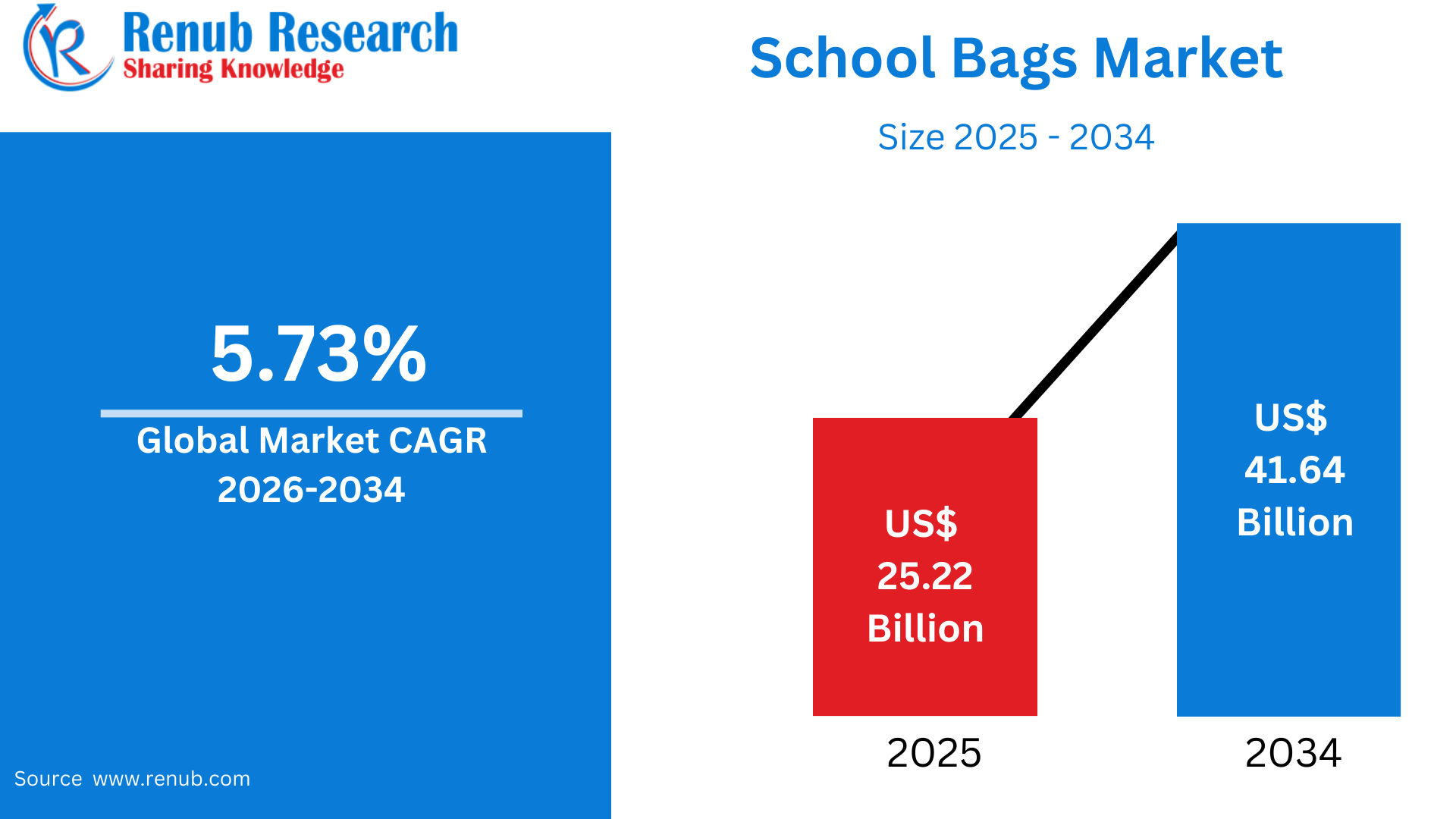
School Bags Market is projected to grow from USD 25.22 billion in 2025 to USD 41.64 billion by 2034, registering a CAGR of 5.73% during the forecast period from 2026 to 2034. Market growth is primarily driven by the increasing population of school-going children, rising awareness of ergonomic backpack designs that support proper posture, and growing demand for durable, lightweight, and stylish school bags. In addition, the expansion of organized retail channels, the rapid growth of e-commerce platforms, and higher consumer spending during the back-to-school season are expected to further stimulate market demand.
School Bags Market Outlook
A school bag is a specialized carrying accessory that school-going kids use to carry their textbooks, note-taking journals and stationery materials, lunch boxes, electronic devices like smartphones and computers, and many more essentials. The most common types and designs of a school bag are a backpack, satchel bag, trolley bags, and a messenger bag; among those designs and types, a backpack is the most popular type of school bag. The modern designs and materials of a school bag are made to be comfortable to carry with the aid of padded shoulder straps and are made in a way that provides support to kids’s shoulders.
Globally, the demand for school bags has always been steady with increased enrollments in schools and the general need for students to carry their learning materials on a daily basis. There has been increased awareness among parents regarding posture and back health, thereby increasing demand for school bags with advanced ergonomic designs. Fashion trends, character school bags, and brand influence are also key factors for purchasing school bags, mainly among school children. Additionally, increased e-retail and organization have enhanced access to various school bags, thereby contributing towards steady growth in global demand.
What are School Bags and Their Uses & Popularity Worldwide
School bags are specially designed bags used by students to carry educational materials such as textbooks, notebooks, stationery, electronic devices, lunch boxes, and personal belongings to and from school. Available in various forms including backpacks, trolley bags, messenger bags, and shoulder bags, school bags are designed to provide convenience, organization, and comfort for daily academic activities. Modern school bags often incorporate ergonomic features such as padded shoulder straps, back support, multiple compartments, water-resistant materials, and lightweight construction to reduce physical strain on students. School bags are widely used across primary, secondary, and higher education institutions worldwide. Their popularity continues to grow due to increasing school enrollment rates, rising awareness of student health and posture, and growing demand for stylish and personalized designs. Manufacturers are increasingly introducing bags featuring cartoon characters, licensed brands, smart compartments, USB charging ports, and eco-friendly materials to attract consumers. The expansion of organized retail stores and online shopping platforms has further increased product accessibility. As education remains a global priority, school bags continue to be an essential product supporting millions of students worldwide throughout their academic journey.
More than 25 Additional Children in School Every Minute
- Global school enrolment reached 1.4 billion students in 2024, reflecting substantial progress in access to education worldwide.
- Primary and secondary school enrolment increased by 327 million students (30%) between 2000 and 2024.
- Pre-primary education enrolment grew by 45% over the same period, highlighting greater emphasis on early childhood education.
- Post-secondary education enrolment surged by 161% since 2000, driven by expanding access to colleges, universities, and vocational institutions.
- The overall increase is equivalent to more than 25 additional children entering school every minute over the past two decades.
- Ethiopia’s primary school enrolment rate rose significantly from 18% in 1974 to 84% in 2024, demonstrating major progress in educational access.
- China’s tertiary education enrolment expanded from 7% in 1999 to more than 60% in 2024, reflecting rapid growth in higher education participation.
- Gender disparities in primary and secondary education have largely narrowed worldwide through sustained educational reforms.
- Nepal has made remarkable progress in gender equality, with girls matching or exceeding boys’ enrolment in several regions.
- Global primary school completion rates improved from 77% in 2000 to 88% in 2024.
- Lower secondary education completion rates increased from 60% to 78% during the same period.
- Upper secondary completion rates climbed substantially from 37% in 2000 to 61% in 2024, indicating that more students are successfully completing their education rather than simply enrolling.
Growth Drivers of the School Bags Market
Rising Global Student Population and School Enrollment Rates
The increasing number of school-going children remains one of the primary growth drivers of the global school bags market. According to international education estimates, there are more than 1.5 billion students enrolled in educational institutions worldwide, creating sustained demand for school supplies and backpacks. Growing population levels, expanding access to education, and government initiatives promoting universal education have significantly increased student enrollment across developing and emerging economies. Countries in Asia-Pacific, Africa, and Latin America continue to witness rising school attendance rates, particularly at primary and secondary education levels. Every academic year generates recurring demand for new school bags as students replace worn-out products or upgrade to larger models. In addition, increasing participation in extracurricular activities and after-school programs has expanded the need for multifunctional bags capable of carrying sports equipment, electronic devices, and educational materials. Continuous growth in educational infrastructure and literacy programs worldwide is expected to support stable long-term demand for school bags, making student enrollment one of the most important drivers of market expansion.
Growing Demand for Ergonomic and Health-Conscious Designs
Rising awareness regarding student health, posture, and musculoskeletal well-being is driving demand for ergonomically designed school bags. Health experts increasingly emphasize that overloaded or poorly designed backpacks can contribute to back pain, shoulder strain, and posture-related issues among children. Studies indicate that students often carry loads equivalent to 10–15% of their body weight, encouraging parents and schools to prioritize ergonomic backpack features. Manufacturers are responding by introducing padded shoulder straps, lumbar support systems, adjustable harnesses, breathable back panels, and lightweight materials to improve comfort and weight distribution. Premium ergonomic backpacks are gaining popularity in developed markets where parents are increasingly willing to invest in products that support children’s physical well-being. Schools and healthcare professionals also promote awareness campaigns highlighting proper backpack usage and weight management. Continuous product innovation focused on comfort, safety, and durability has expanded consumer interest across multiple age groups. As awareness of student health continues to increase globally, ergonomic school bags are expected to remain a major growth segment within the broader market.
Expansion of E-Commerce and Organized Retail Channels
The rapid growth of e-commerce and organized retail networks has significantly enhanced accessibility and visibility for school bag products worldwide. Online shopping platforms now offer consumers access to thousands of backpack designs, brands, sizes, and price points, enabling convenient product comparison and purchasing. Global e-commerce sales continue to grow at double-digit rates in many regions, creating substantial opportunities for school bag manufacturers and retailers. Seasonal back-to-school promotions, digital marketing campaigns, and influencer-driven advertising have further stimulated consumer spending on school accessories. Organized retail chains also provide dedicated school supply sections featuring branded backpacks, ergonomic models, and licensed character products. Consumers increasingly prefer online channels due to product variety, competitive pricing, customer reviews, and home delivery convenience. Manufacturers are utilizing digital platforms to launch customized products and limited-edition collections targeting specific student demographics. As internet penetration, smartphone adoption, and digital payment usage continue to rise globally, e-commerce and organized retail expansion will remain a key driver supporting growth in the school bags market.
Challenges of the School Bags Market
Intense Market Competition and Price Sensitivity
The global school bags market is highly competitive, with numerous international brands, regional manufacturers, and local suppliers competing across multiple price segments. Consumers often view school bags as relatively standardized products, resulting in strong price competition and limited product differentiation in many markets. In developing economies, purchasing decisions are frequently influenced by affordability rather than premium features, making price sensitivity a significant challenge for manufacturers. The availability of low-cost unbranded products further intensifies competition and places pressure on profit margins. Retailers often offer substantial discounts during back-to-school seasons, creating additional pricing challenges for established brands. Counterfeit and imitation products also affect market performance by providing lower-priced alternatives that resemble premium brands. To remain competitive, manufacturers must continuously invest in design innovation, product quality, branding, and marketing while maintaining cost efficiency. Balancing affordability with durability, ergonomic performance, and attractive designs remains a major challenge, particularly in highly competitive and price-sensitive consumer markets.
Fluctuating Raw Material Costs and Sustainability Pressures
School bag manufacturers face ongoing challenges related to fluctuations in raw material prices and increasing sustainability expectations. Common materials such as polyester, nylon, canvas, foam padding, zippers, and plastic accessories are subject to changes in petroleum-based raw material costs, supply chain disruptions, and transportation expenses. Rising production costs can affect profitability and may require manufacturers to increase retail prices, potentially impacting consumer demand. At the same time, consumers and regulatory authorities are placing greater emphasis on environmentally responsible manufacturing practices. Many parents and educational institutions increasingly prefer products made from recycled fabrics, organic materials, and sustainable production processes. However, eco-friendly materials often carry higher production costs compared to conventional alternatives. Manufacturers must therefore balance sustainability goals with affordability and product durability. Additionally, compliance with environmental regulations regarding plastics, waste management, and supply chain transparency requires ongoing investment. Meeting these evolving sustainability requirements while maintaining competitive pricing continues to be a significant challenge for the global school bags industry.
Major School Bags Product Launches Worldwide
- January 2023 – American Tourister launched its 2023 Back-to-School Backpack Collection, featuring lightweight ergonomic backpacks with padded shoulder straps, laptop compartments, water-resistant fabric, and vibrant student-focused designs.
- April 2023 – Samsonite introduced the Samsonite Kids Collection, offering durable school backpacks with ergonomic back panels, multiple organizer pockets, reflective safety accents, and eco-friendly recycled polyester construction.
- July 2023 – Wildcraft India launched its Ergo Series School Bags, incorporating ergonomic spine-support technology, breathable mesh back panels, lightweight construction, and dedicated laptop compartments for school and college students.
- January 2024 – Safari Industries unveiled its Safari Smart School Backpack Range, featuring USB charging ports, anti-theft zippers, waterproof materials, and organized storage compartments designed for digitally connected students.
- March 2024 – Skybags (VIP Industries) launched its Back to School 2024 Collection, introducing colorful backpacks with enhanced lumbar support, water-resistant fabric, reinforced stitching, and spacious multi-compartment designs.
- June 2024 – Decathlon introduced its updated Quechua School Backpack Collection, manufactured using recycled polyester fabrics and lightweight ergonomic designs suitable for school, travel, and outdoor educational activities.
- August 2024 – JanSport expanded its Adaptive Backpack Collection, featuring improved ergonomic support, padded laptop sleeves, recycled materials, and customizable storage solutions for middle school, high school, and college students.
- January 2025 – Puma launched its Essentials School Backpack Series 2025, combining lightweight performance fabrics, ergonomic shoulder straps, laptop protection, and modern sports-inspired styling for students.
- April 2025 – Adidas introduced its Back to School Backpack Collection 2025, featuring recycled materials, water-resistant coatings, breathable back padding, and dedicated compartments for laptops, books, and accessories.
- February 2026 – LEGO launched its 2026 School Bag Collection, offering ergonomic backpacks with adjustable harness systems, reflective safety details, lightweight construction, and themed character designs for preschool and primary school students.
Premium Durability and Stylish Designs Drive Consumer Leather Demand
The leather school bags market continues to attract steady demand due to its premium appearance, superior durability, and long product lifespan. Leather school bags are particularly popular among high school, college, and university students who prefer sophisticated designs combined with functionality. Industry estimates indicate that premium school bags account for approximately 20–25% of the overall school bag market, with leather products representing a significant share within this category. Genuine and synthetic leather bags offer excellent resistance to daily wear and tear, making them suitable for carrying heavy textbooks, laptops, and educational accessories. Manufacturers are increasingly introducing lightweight leather alternatives, water-resistant coatings, ergonomic shoulder straps, and multiple storage compartments to enhance user comfort. Growing disposable incomes, rising consumer preference for premium accessories, and increasing demand for fashionable educational products continue to support market expansion. Sustainability trends have also encouraged manufacturers to introduce vegan leather and recycled leather products that appeal to environmentally conscious consumers. Continuous innovation in design and material quality is expected to maintain stable growth in the global leather school bags market.
Growing Digital Education Accelerates Laptop School Bags Market Expansion
Laptop school bags have become one of the fastest-growing product categories as educational institutions increasingly integrate digital learning into classrooms. The widespread adoption of laptops, tablets, and hybrid learning platforms has significantly increased demand for school bags featuring dedicated padded laptop compartments and enhanced device protection. Industry estimates suggest that more than 70% of secondary and higher education students regularly use digital devices for learning, creating strong demand for specialized laptop backpacks. Modern laptop school bags incorporate shock-absorbing compartments, USB charging ports, anti-theft zippers, water-resistant fabrics, RFID-protected pockets, and ergonomic back support to improve convenience and security. Growing online education, digital assignments, and remote learning continue to strengthen consumer demand worldwide. Educational institutions increasingly recommend protective laptop bags to minimize device damage during daily transportation. Manufacturers are also incorporating sustainable materials, lightweight construction, and modern aesthetics to attract technology-oriented students. Continued investment in educational technology and digital infrastructure is expected to sustain long-term growth in the laptop school bags market.
Multi-Purpose Functionality Expands Student Adoption in Duffel School Bags
Duffel school bags are gaining popularity among students due to their spacious interiors, versatile design, and suitability for academic as well as extracurricular activities. Unlike traditional backpacks, duffel bags provide larger storage capacity, allowing students to carry sports equipment, uniforms, musical instruments, and travel essentials alongside books and stationery. Industry observations indicate that participation in school sports and extracurricular programs continues to increase globally, driving greater demand for multifunctional carrying solutions. Manufacturers are responding by introducing duffel bags with reinforced handles, adjustable shoulder straps, shoe compartments, waterproof linings, and multiple storage pockets. Durable polyester, nylon, and canvas materials enhance product longevity while keeping overall weight low. Duffel school bags are particularly popular among middle school, high school, and college students who require flexible storage options for daily activities. Rising participation in fitness, athletics, and weekend educational programs further supports market demand. Continuous improvements in ergonomic design, durability, and fashionable aesthetics are expected to strengthen the duffel school bags market over the forecast period.
Rising Early Childhood Education Enrollment Supports Preschool Bags Market Growth
The preschool bags market is expanding steadily due to increasing enrollment in early childhood education programs and growing parental spending on children’s educational products. Globally, hundreds of millions of children participate in preschool and kindergarten education, creating recurring demand for age-appropriate school bags every academic year. Preschool bags are specifically designed using lightweight materials, compact dimensions, padded straps, and child-friendly features that ensure comfort and ease of use for young children. Bright colors, cartoon characters, educational themes, and licensed entertainment brands significantly influence purchasing decisions among parents. Manufacturers increasingly utilize non-toxic, water-resistant, and easy-to-clean materials to improve product safety and durability. Ergonomic designs help reduce strain on children’s developing shoulders and backs while encouraging independent use. Growing awareness of early childhood education, rising urbanization, and increasing disposable household incomes continue to stimulate consumer demand. Expansion of organized preschool education and increasing emphasis on quality educational accessories are expected to support sustained growth in the global preschool bags market.
Organized Retail Expansion Enhances Product Accessibility For School Bags
Supermarkets and hypermarkets remain one of the most important offline distribution channels for school bags due to their broad product selection, competitive pricing, and seasonal promotional campaigns. Industry estimates indicate that organized retail accounts for a substantial share of offline school bag sales, particularly during annual back-to-school shopping periods. Large retail chains provide consumers with convenient access to multiple brands, price ranges, and product categories under one roof, allowing easy comparison before purchase. Seasonal discounts, bundled school supply offers, loyalty programs, and promotional displays significantly increase sales during peak demand periods. Parents often prefer purchasing school bags alongside uniforms, stationery, lunch boxes, and other educational supplies during a single shopping trip. Supermarkets also provide opportunities for manufacturers to launch new designs, ergonomic collections, and licensed character products through dedicated promotional campaigns. Although online retail continues to expand rapidly, supermarkets remain highly relevant because consumers can physically evaluate product quality, size, comfort, and storage capacity before making purchasing decisions. Continuous expansion of organized retail infrastructure is expected to sustain the importance of supermarkets in the global school bags market.
High Education Enrollment and Premium Backpack Demand Drive United States Market Growth
United States represents one of the largest school bags markets globally, supported by a well-established education system, high consumer spending, and strong demand for premium backpacks. The country has more than 50 million students enrolled in K–12 schools, generating consistent annual demand for school bags and related accessories. Back-to-school shopping remains one of the largest retail events each year, with families spending hundreds of dollars per student on school supplies, including backpacks. Consumers increasingly prefer ergonomic backpacks featuring padded shoulder straps, laptop compartments, water-resistant materials, and anti-theft designs to support daily academic activities. Growing adoption of laptops and tablets in classrooms has accelerated demand for technologically advanced school bags with dedicated device protection. Sustainability is also influencing purchasing decisions, encouraging manufacturers to introduce backpacks made from recycled polyester, organic fabrics, and eco-friendly materials. The expansion of e-commerce, specialty retail stores, and licensed character merchandise continues to strengthen market growth. Continuous product innovation and premiumization are expected to support long-term expansion of the United States school bags market.
Growing Preference for Ergonomic and Sustainable School Bags in United Kingdom
The United Kingdom school bags market continues to expand steadily due to rising awareness of student health, increasing demand for premium educational accessories, and widespread adoption of environmentally sustainable products. The UK has more than 10 million school-age students, creating recurring annual demand for school bags across primary and secondary education. Parents increasingly prioritize ergonomic backpacks designed with padded back panels, adjustable shoulder straps, and lightweight construction to reduce physical strain on children. Schools are also encouraging appropriate backpack usage to support better posture and spinal health. Sustainability has become an important purchasing factor, with consumers showing greater interest in backpacks manufactured from recycled plastics, organic cotton, and responsibly sourced materials. Retailers continue expanding both physical and online sales channels, offering a broad range of branded, designer, and character-themed backpacks. The popularity of laptop-compatible school bags has also increased as digital learning becomes more common across educational institutions. Continued emphasis on product quality, comfort, and environmental responsibility is expected to support sustained market growth throughout the forecast period.
Expanding Student Population and Rising Education Spending Fuel Demand in India
India is one of the fastest-growing school bags markets worldwide due to its large student population, expanding educational infrastructure, and increasing household expenditure on education. The country has more than 250 million students enrolled across schools, making it one of the world’s largest education markets. Government initiatives promoting universal education, improving literacy, and expanding school enrollment continue to generate substantial demand for school bags every academic year. Rising disposable incomes and increasing urbanization have encouraged parents to purchase higher-quality backpacks featuring ergonomic designs, lightweight materials, multiple storage compartments, and durable construction. Growing digital education has further increased demand for laptop-compatible school bags capable of safely carrying electronic devices. Organized retail stores and rapidly expanding e-commerce platforms have significantly improved product accessibility across both urban and semi-urban regions. Manufacturers are increasingly introducing affordable, colorful, and character-themed backpacks targeting different age groups. Continuous growth in private schools, educational institutions, and digital learning is expected to sustain strong expansion of the Indian school bags market over the forecast period.
Rising School Enrollment and Premium Consumer Preferences Support Saudi Arabia Growth
Saudi Arabia’s school bags market is experiencing steady growth, driven by increasing investment in education, rising student enrollment, and growing consumer preference for premium educational products. The Kingdom has more than 6 million students enrolled across public and private educational institutions, generating stable annual demand for school bags and related accessories. Government investment in modernizing the education sector under Vision 2030 has contributed to expanding educational infrastructure and improving access to quality learning environments. Parents increasingly prefer ergonomic backpacks equipped with padded shoulder straps, breathable back panels, laptop compartments, and water-resistant materials to improve student comfort and convenience. Premium international brands and licensed character products continue gaining popularity, particularly among urban consumers. The rapid expansion of shopping malls, organized retail outlets, and e-commerce platforms has improved product availability throughout the country. Increasing awareness of sustainability has also encouraged interest in eco-friendly backpacks manufactured from recycled materials. Continued growth in education spending, digital learning, and retail modernization is expected to support long-term expansion of the Saudi Arabian school bags market.
Market Segmentation
Fabric
- Canvas
- Polyesters
- Nylon
- Leather
- Others
Type
- Messenger Bag
- Backpack
- Laptop Bag
- Duffel Bag
- Clutch Bag
Age
- Preschool
- Elementary School
- Middle School
- High School
Distribution Channel
- Supermarkets
- Hypermarket
- Online Retail
- Others
Countries
North America
- United States
- Canada
Europe
- France
- Germany
- Italy
- Spain
- United Kingdom
- Belgium
- Netherlands
- Turkey
Asia Pacific
- China
- Japan
- India
- Australia
- South Korea
- Thailand
- Malaysia
- Indonesia
- New Zealand
Latin America
- Brazil
- Mexico
- Argentina
Middle East & Africa
- South Africa
- Saudi Arabia
- United Arab Emirates
All companies have been covered with 5 Viewpoints
- Overview
- Key Persons
- Recent Development & Strategies
- Product Portfolio
- Financial Insights
Company Analysis
- Adidas AG
- Nike Inc.
- Puma SE
- Samsonite International S.A.
- Sumdex Group
- VIP Industries Limited
- Wildcraft
Report Details:
| Report Features | Details |
| Base Year |
2025 |
| Historical Period |
2022 - 2025 |
| Forecast Period |
2026 - 2034 |
| Market |
US$ Billion |
| Segment Covered |
Fabric, Type, Age, Distribution Channel, and Countries |
| Countries Covered |
|
| Companies Covered |
|
| Customization Scope |
20% Free Customization |
| Post-Sale Analyst Support |
1 Year (52 Weeks) |
| Delivery Format |
PDF and Excel through Email (We can also provide the editable version of the report in PPT/Word format on request) |
Key Questions Answered in Report:
- How big is the School Bags industry?
- What is the School Bags growth rate?
- Who are the key players in School Bags industry?
- What are the factors driving the School Bags industry?
- Which Region held the largest market share in the School Bags industry?
- What segments are covered in the School Bags Market report?
Customization Services available
- Analysis of Market Size and Its Segments
- More Company Profiles (Upto 10 without any additional cost):
- Additional Countries (Other than mentioned Countries):
- Region/Country Specific Reports:
- Market Entry Strategy:
- Region-Specific Market Dynamics:
- Regional Market Share Analysis:
- Trade Analysis:
- Production Insights:
- Others Customized Requests:
For more information contact our analysts.
Need More Assistance?
- Talk to our analysts to get more precious information on the current market trends.
- Include more countries and segments and customize the report based on the final requirement.
- Get a competitive advantage in your industry by knowing the report findings and making a positive impact on your revenues and operations.
- Our analysts are always ready to provide more help and pertinent information if you need any additional assistance.