Radiofrequency Ablation Devices Market Report by Product, Application, End User, Country and Company Analysis 2026-2034
Buy NowRadiofrequency Ablation Device Market Size and Forecast
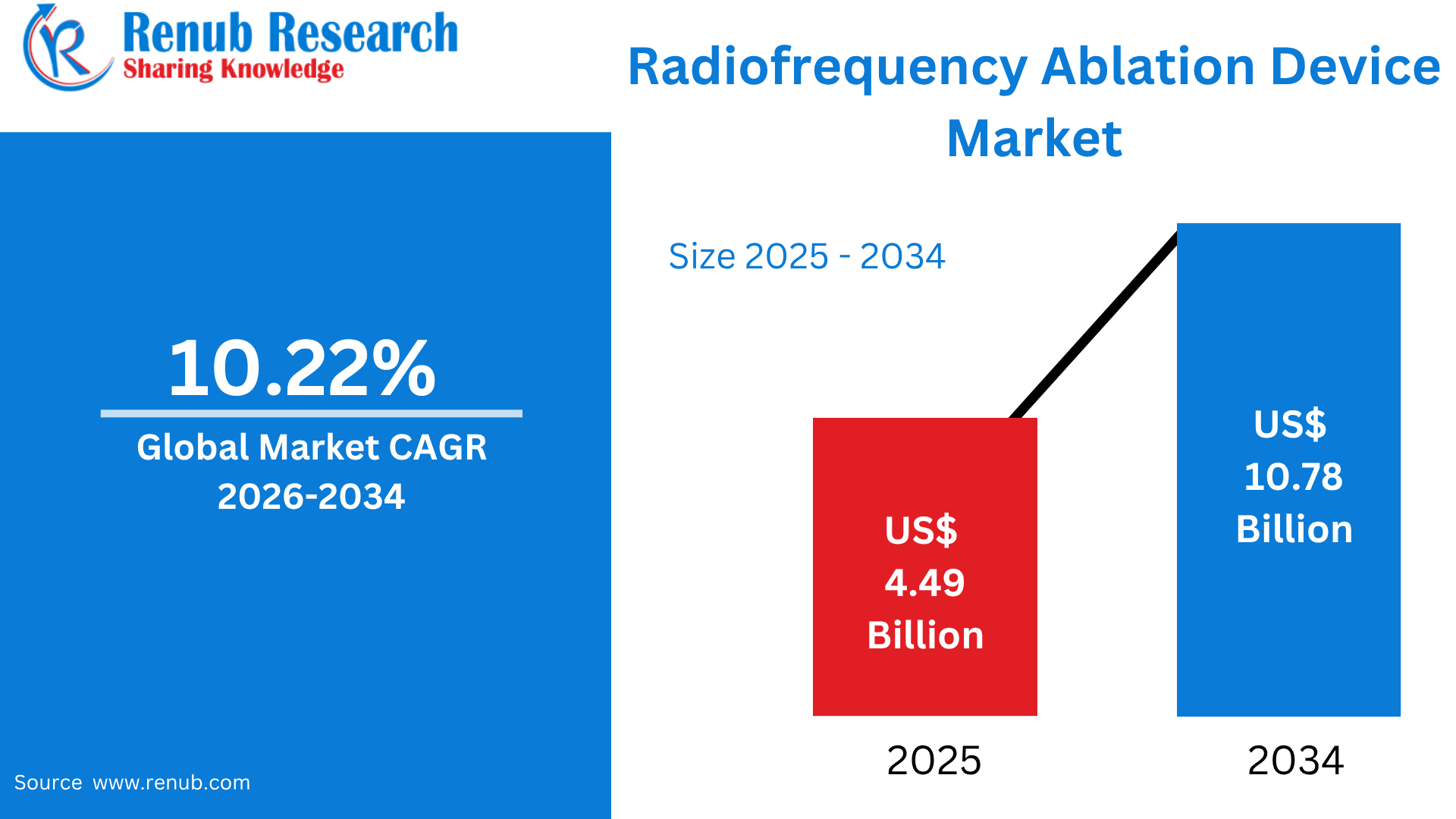
Radiofrequency Ablation Devices Market is projected to expand significantly, reaching US$4.49 billion in 2025 and growing to approximately US$10.78 billion by 2034, registering a CAGR of 10.22% during 2026–2034. Market growth is driven by the increasing prevalence of chronic pain, cancer, and cardiovascular diseases, alongside rising demand for minimally invasive treatment procedures. Technological advancements in ablation systems, improved treatment precision, enhanced clinical outcomes, and the expanding adoption of radiofrequency ablation devices across hospitals and specialty clinics are further supporting global market expansion.
What is Radiofrequency Ablation and Its Uses & Popularity Worldwide
Radiofrequency (RF) ablation is a minimally invasive medical procedure that uses high-frequency radiofrequency energy to generate controlled heat and destroy targeted abnormal tissue. RF ablation devices generally include generators, electrodes, catheters, probes, and related accessories designed to deliver energy accurately to the treatment site. The technology is used across multiple medical specialties, including pain management, oncology, cardiology, electrophysiology, and certain surgical procedures. In pain management, RF ablation can target nerves responsible for chronic pain, while in oncology it can destroy selected tumors.
In cardiology, catheter-based RF ablation is widely used to treat abnormal heart rhythms by creating small areas of controlled tissue damage that interrupt faulty electrical signals. Its popularity worldwide is supported by the growing preference for minimally invasive procedures, shorter recovery periods, improved targeting capabilities, and technological advances in imaging and catheter systems. The increasing burden of chronic diseases and expanding access to specialized healthcare are also encouraging adoption. As healthcare providers seek less invasive alternatives to conventional surgery, RF ablation is becoming an increasingly important treatment technology in hospitals, ambulatory centers, and specialty clinics.
Statistics at a Glance: The Burden of Cancer Worldwide
- Cancer is among the leading causes of death worldwide. In 2022, there were almost 20 million new cases and 9.7 million cancer-related deaths worldwide.
- By 2050, the number of new cancer cases per year is expected to rise to 33 million and the number of cancer-related deaths to 18.2 million.
- Generally, cancer rates are highest in countries whose populations have the highest life expectancy, education level, and standard of living. But for some cancer types, such as cervical cancer, the reverse is true, and the incidence rate is highest in countries in which the population ranks low on these measures.
Statistics at a Glance: The Burden of Cancer in the United States
- In 2025, an estimated 2,041,910 new cases of cancer will be diagnosed in the United States and 618,120 people will die from the disease.
- The most common cancers (listed in descending order according to estimated new cases in 2025) are breast cancer, prostate cancer, lung and bronchus cancer, colon and rectum cancer, melanoma of the skin, bladder cancer, kidney and renal pelvis cancer, non-Hodgkin lymphoma, uterine corpus cancer, pancreatic cancer, leukemia, thyroid cancer, and liver and intrahepatic bile duct cancer.
- Prostate, lung, and colorectal cancers account for an estimated 48% of all cancers diagnosed in men in 2025. For women, the three most common cancers are breast, lung, and colorectal, and they will account for an estimated 51% of all new cancer diagnoses in women in 2025.
- The rate of new cases of cancer (cancer incidence) is 445.8 per 100,000 men and women per year (based on 2018–2022 cases).
Growth Drivers of the Radiofrequency Ablation Devices Market
Rising Burden of Cancer and Growing Adoption of Tumor Ablation
The increasing global cancer burden is an important growth driver for radiofrequency ablation devices, particularly in interventional oncology. The World Health Organization (WHO) estimates that approximately 20 million new cancer cases and 9.7 million cancer-related deaths occurred globally in 2022. WHO also projects that the number of new cancer cases could reach approximately 35 million annually by 2050, representing a substantial increase from 2022 levels. Radiofrequency ablation can be used to destroy selected tumors by delivering controlled thermal energy directly into abnormal tissue. It may be considered for certain patients who are not suitable candidates for conventional surgery or when localized treatment is appropriate. Technological improvements in electrode design, temperature control, imaging guidance, and treatment planning are improving procedural precision. Growing investment in interventional oncology infrastructure is also supporting adoption in hospitals and specialized cancer centers. As cancer incidence increases and healthcare systems seek less invasive local treatment options, demand for ablation technologies is expected to expand, particularly for appropriately selected liver, kidney, lung, and other tumors.
Increasing Prevalence of Cardiac Arrhythmias and Catheter Ablation
The growing prevalence of heart-rhythm disorders is another major factor supporting the RF ablation devices market. Atrial fibrillation (AF) is one of the most common sustained cardiac arrhythmias. The Centers for Disease Control and Prevention estimates that approximately 6.2 million people in the United States have atrial fibrillation, while the condition is projected to affect more than 12 million Americans by 2030. Catheter ablation uses specialized catheters to deliver energy and create small areas of scar tissue that interrupt abnormal electrical pathways in the heart. Radiofrequency energy remains an important technology used in cardiac electrophysiology procedures. Growing awareness of arrhythmia diagnosis, improvements in mapping and navigation technologies, increasing availability of electrophysiology laboratories, and advances in catheter design are supporting procedure volumes. The aging global population also contributes to the prevalence of cardiovascular conditions. As healthcare providers increasingly emphasize rhythm management and minimally invasive interventions, RF catheter ablation is expected to remain an important treatment option. Expansion of specialized cardiac centers in emerging markets could further increase demand for ablation systems and associated accessories.
Growing Preference for Minimally Invasive Procedures and Technological Advancements
The shift toward minimally invasive treatment is creating opportunities for radiofrequency ablation technologies across pain management, cardiology, oncology, and other specialties. Minimally invasive interventions can reduce tissue trauma compared with open procedures and may offer benefits such as shorter hospital stays and faster recovery for appropriately selected patients. Technological innovation is further improving RF ablation systems through temperature-controlled energy delivery, multi-electrode systems, improved catheter designs, three-dimensional mapping, imaging integration, and computerized treatment planning. In electrophysiology, the American Heart Association notes that catheter ablation is an established treatment option for certain abnormal heart rhythms, including atrial fibrillation and other arrhythmias. In pain management, RF techniques are also used for selected chronic pain conditions when conservative treatments have not provided adequate relief. Increasing healthcare expenditure, expansion of specialty clinics, and improved access to advanced medical technologies in developing countries can broaden the addressable market. Manufacturers are therefore focusing on improving precision, safety, usability, and clinical workflow, helping RF ablation devices gain wider acceptance among physicians and healthcare institutions.
Challenges of the Radiofrequency Ablation Devices Market
High Equipment Costs and Limited Access to Advanced Healthcare Infrastructure
High capital costs associated with RF ablation systems can restrict adoption, particularly in developing and price-sensitive healthcare markets. A complete ablation platform may require specialized generators, catheters or electrodes, imaging and navigation equipment, monitoring systems, procedure-room infrastructure, and trained personnel. Hospitals must also account for recurring expenditure on disposable accessories and maintenance. These costs can make RF ablation less accessible for smaller hospitals and healthcare facilities with limited budgets. The challenge is particularly relevant in low- and middle-income countries, where access to advanced medical technology remains uneven. The World Health Organization reports that 5.5 billion people lack access to safe, affordable, and quality-assured assistive products, illustrating broader inequalities in healthcare access and medical technology availability. Although this statistic is not specific to RF ablation, it highlights the wider infrastructure and affordability challenges affecting advanced healthcare technologies. Manufacturers must therefore develop cost-effective systems, strengthen distribution networks, offer financing solutions, and expand physician training to increase adoption. Hospitals may also require reimbursement support and evidence of cost-effectiveness before making significant investments in advanced ablation technology.
Procedural Risks, Regulatory Requirements and Need for Specialized Expertise
Radiofrequency ablation is minimally invasive, but it is not risk-free. Potential complications vary according to the treatment area and procedure and may include bleeding, infection, damage to surrounding tissue, nerve injury, vascular complications, or other procedure-specific adverse events. Cardiac ablation, for example, requires highly specialized electrophysiology expertise and appropriate imaging, mapping, monitoring, and emergency-care capabilities. Consequently, successful adoption depends on the availability of trained physicians, nurses, technicians, and specialized facilities. Regulatory requirements can also increase product-development timelines and commercialization costs because manufacturers must demonstrate device safety, performance, quality, and clinical effectiveness according to applicable regulations. The U.S. FDA maintains extensive requirements for medical-device manufacturers, including quality-system and regulatory controls applicable to medical devices. Additionally, healthcare providers increasingly require clinical evidence before adopting new ablation platforms. Companies must therefore invest substantially in research and development, clinical studies, regulatory compliance, physician education, and post-market surveillance. These requirements can create barriers for smaller manufacturers and extend the time required to introduce innovative RF ablation technologies into international markets.
Radiofrequency Ablation Device Product Launches Worldwide
- Medtronic – Sphere-9™ Catheter & Affera™ Mapping and Ablation System (2024): Medtronic received U.S. FDA approval in October 2024 for the Sphere-9 catheter and Affera system, integrating high-density mapping with both radiofrequency and pulsed-field ablation capabilities for atrial fibrillation and typical atrial flutter.
- NeuroOne – OneRF™ Ablation System (2024): NeuroOne initiated the limited commercial launch of its OneRF Ablation System in March 2024. The FDA-cleared system combines sEEG-guided electrical recording with temperature-controlled RF ablation of nervous tissue for functional neurosurgical procedures.
- Boston Scientific – INTELLANAV STABLEPOINT™ Ablation Catheter (2024): The company received FDA approval in February 2024 for the INTELLANAV STABLEPOINT ablation catheter and force-sensing system. The catheter uses RF energy to destroy cardiac tissue responsible for abnormal heart rhythms.
- Johnson & Johnson MedTech – Dual Energy THERMOCOOL SMARTTOUCH™ SF Catheter (2024): The dual-energy catheter received European CE Mark approval in December 2024. It combines pulsed-field and RF energy with contact-force sensing and integration with the CARTO 3 mapping system.
- Biosense Webster – HELIOSTAR™ Balloon Ablation Catheter (2022): Biosense Webster launched HELIOSTAR in Europe in October 2022 as the first RF balloon ablation catheter, designed to support pulmonary vein isolation and more efficient cardiac ablation procedures.
- Biosense Webster – THERMOCOOL SMARTTOUCH™ SF Catheter Zero-Fluoroscopy Workflow (2023): In August 2023, Biosense Webster received FDA approval for a workflow allowing its THERMOCOOL SMARTTOUCH SF RF catheter and associated mapping products to be used without fluoroscopy during AF ablation procedures.
- Medtronic – Affera™ Mapping and Ablation System European Expansion (2023): Medtronic expanded the Affera platform in Europe, incorporating the Sphere-9 catheter’s combined high-density mapping and RF/PFA ablation capabilities for cardiac arrhythmia treatment.
- Abbott – TactiFlex™ Sensor Enabled™ Ablation Catheter (2025): Abbott introduced the TactiFlex Sensor Enabled ablation catheter in India in May 2025. The catheter features a flexible electrode tip and contact-force sensing for treating abnormal heart rhythms and is designed for use with Abbott’s EnSite X EP System.
- Merit Medical – STAR RF Ablation System (2026): Merit Medical’s STAR RF Ablation System received FDA 510(k) clearance in February 2026. The device is classified as a radiofrequency lesion probe for neurological applications, representing a recent addition to the RF ablation device landscape.
- Johnson & Johnson MedTech – HELIOSTAR™ RF Balloon Expansion in Europe (2022): The European launch of HELIOSTAR represented a notable product introduction in cardiac RF ablation, using a balloon-based design and customized energy delivery to support pulmonary vein isolation.
Reusable Radiofrequency Ablation Device Market
Reusable Radiofrequency Ablation (RFA) Devices Market includes generators, probes, electrodes, cables, and other components designed for repeated clinical use after validated cleaning, sterilization, inspection, and maintenance. These devices are primarily used in hospitals, ambulatory surgical centers, pain-management clinics, cardiology centers, and oncology facilities. Reusable systems can offer economic advantages when procedure volumes are high because the initial equipment investment is distributed across multiple procedures. They can also reduce the volume of medical waste compared with single-use alternatives. Demand is supported by the increasing use of RFA in chronic pain management, cardiac electrophysiology, and image-guided tumor treatment. The World Health Organization estimates that 1 in 6 people worldwide is affected by infertility, while cardiovascular and cancer-related healthcare needs continue to increase, supporting broader demand for advanced minimally invasive technologies. However, reusable devices require validated reprocessing procedures, appropriate sterilization infrastructure, regular inspection, and maintenance to minimize infection and device-performance risks. Consequently, hospitals increasingly evaluate reusable equipment based on total cost of ownership, procedure volume, safety, durability, and reprocessing requirements.
Disposable Radiofrequency Ablation Device Market
Disposable Radiofrequency Ablation (RFA) Devices Market comprises single-use products such as catheters, probes, electrodes, needles, cannulas, and accessories designed for one procedure and then discarded. Disposable RFA devices are increasingly attractive because they eliminate the need for reprocessing between patients and can reduce concerns associated with inadequate sterilization or cross-contamination. This makes them particularly useful in cardiology, oncology, pain management, ambulatory surgical centers, and specialty clinics. The global healthcare sector is experiencing increasing attention toward infection prevention and patient safety. WHO estimates that 7 out of every 100 patients in acute-care hospitals in high-income countries and 15 out of every 100 patients in low- and middle-income countries acquire at least one healthcare-associated infection during their hospital stay. This highlights the importance of effective infection-prevention practices. Disposable RFA products can simplify clinical workflows and provide consistent device performance for individual procedures. However, their higher per-procedure cost and contribution to medical waste remain important considerations. Manufacturers are therefore focusing on ergonomic designs, precision, safety features, improved energy delivery, and environmentally conscious materials.
Cardiology Radiofrequency Ablation Device Market
Cardiology Radiofrequency Ablation Device Market represents a major application area for RFA technology and is primarily driven by the increasing prevalence of cardiac arrhythmias, including atrial fibrillation (AF), atrial flutter, atrioventricular nodal reentrant tachycardia, and other supraventricular tachycardias. During catheter ablation, physicians use specialized catheters to deliver controlled radiofrequency energy to targeted cardiac tissue responsible for abnormal electrical signals. The Centers for Disease Control and Prevention estimates that approximately 6.2 million people in the United States have atrial fibrillation, and the number is projected to exceed 12 million by 2030. This growing disease burden is supporting demand for electrophysiology procedures and associated ablation technologies. Modern systems increasingly integrate three-dimensional electroanatomical mapping, contact-force sensing, advanced navigation, temperature monitoring, and improved catheter designs. These technologies help physicians identify abnormal electrical pathways and deliver energy more accurately. The expansion of electrophysiology laboratories and specialist cardiac centers, together with growing physician experience, is further supporting market development. Increasing preference for minimally invasive rhythm-management procedures also contributes to the segment’s long-term growth.
Oncology Radiofrequency Ablation Device Market
Oncology Radiofrequency Ablation Device Market is expanding as healthcare providers increasingly adopt minimally invasive approaches for selected solid tumors. RFA uses controlled thermal energy to heat and destroy targeted tumor tissue while limiting damage to surrounding structures. Depending on clinical circumstances, the technology may be used for selected tumors involving the liver, kidney, lung, bone, and other organs. The growing global cancer burden represents a major underlying opportunity. According to the World Health Organization, approximately 20 million new cancer cases and 9.7 million cancer-related deaths were recorded globally in 2022. WHO projects that the annual number of new cancer cases could reach approximately 35 million by 2050, representing a substantial increase. RFA can be particularly useful for carefully selected patients who may not be suitable candidates for conventional surgery because of age, comorbidities, tumor location, or other clinical considerations. Its potential advantages include minimally invasive treatment, shorter recovery, reduced surgical trauma, and image-guided targeting. RFA may also be incorporated into multidisciplinary treatment strategies alongside surgery, chemotherapy, radiation, or other interventional oncology approaches.
Rising Demand for Minimally Invasive Pain and Cardiac Procedures in United States
The United States Radiofrequency Ablation (RFA) device market is expanding as healthcare providers increasingly adopt minimally invasive procedures for chronic pain, cancer treatment, and cardiac arrhythmias. The addressable patient pool is substantial: CDC data show that 24.3% of U.S. adults experienced chronic pain in 2023, while 8.5% experienced high-impact chronic pain that frequently limited daily or work activities. In addition, atrial fibrillation affects more than 6 million Americans, with the number projected to double by 2030, supporting demand for electrophysiology and cardiac-ablation technologies. Advances in multi-electrode systems, three-dimensional mapping, image-guided procedures, navigation technologies, and increasingly precise catheter designs are improving the accuracy and efficiency of RFA. Clinical evidence also highlights the continued role of radiofrequency ablation alongside newer modalities such as pulsed-field ablation and cryoablation. These developments are encouraging hospitals and specialized centers to upgrade their ablation capabilities.
Advanced Healthcare Infrastructure Drives Germany Adoption
Germany’s Radiofrequency Ablation Device market is positioned for steady growth, supported by a highly developed healthcare system, sophisticated hospitals, specialist clinics, and growing demand for minimally invasive treatment. RFA is used across areas including chronic pain management, oncology, and cardiac electrophysiology, where physicians value targeted treatment and potentially shorter recovery periods compared with conventional surgical approaches. The country’s cardiovascular disease burden provides an important demand base for cardiac ablation technologies. According to Germany’s Federal Statistical Office, 23,184 deaths in 2024 were attributed to atrial fibrillation and atrial flutter, representing 6.83% of cardiovascular disease deaths recorded in the relevant classification. The presence of a large cardiac-care ecosystem therefore supports continued investment in electrophysiology and ablation technologies. Germany’s substantial healthcare expenditure and established specialist-care network create favorable conditions for advanced medical technologies. Healthcare expenditure data from Destatis cover spending across public insurance, private insurance, households, hospitals, physicians, and other healthcare providers, highlighting the scale of Germany’s healthcare system. At the same time, high treatment costs, competition from cryotherapy and microwave ablation, reimbursement considerations, and regulatory requirements may restrain adoption. Continued technological development and the expansion of specialized outpatient procedures should nevertheless support the market.
Growing Need for Minimally Invasive Treatment in India
The India Radiofrequency Ablation Device market is gaining momentum as hospitals and specialty centers increasingly adopt minimally invasive approaches for cancer, chronic pain, and cardiovascular conditions. RFA can offer targeted treatment with reduced tissue disruption and potentially shorter recovery compared with conventional surgery, making it attractive as healthcare providers expand advanced intervention capabilities. India’s substantial burden of cardiovascular disease, cancer, diabetes, and chronic pain provides a significant long-term opportunity for ablation technologies. WHO identifies cardiovascular diseases as the leading cause of death in India, while more than 17 million hypertension and diabetes patients had received treatment by the end of 2024 under efforts supported by the Government of India and WHO. WHO data also identify ischaemic heart disease and back and neck pain among India’s leading causes of disease burden, reinforcing the need for advanced cardiovascular and pain-management services. India is expanding its healthcare workforce and advanced-care capacity. The number of medical colleges increased from 387 in 2014 to 731 in 2024, an increase of 88%, while medical seats rose from 51,348 to 112,112. These developments can improve the availability of specialists capable of performing advanced ablation procedures. However, high equipment and treatment costs, uneven access to advanced technology outside major cities, and shortages of highly trained specialists remain challenges. Increasing private-sector investment and medical-technology adoption should support future market expansion.
Healthcare Transformation Creates New Opportunities in Saudi Arabia
Saudi Arabia’s Radiofrequency Ablation Device market is benefiting from the country’s ongoing healthcare transformation and increasing investment in advanced medical services. RFA provides a minimally invasive option for selected applications in pain management, oncology, and cardiac electrophysiology, supporting demand as hospitals upgrade their diagnostic and interventional capabilities. Healthcare investment under Vision 2030 is creating a favorable environment for advanced medical technologies. Saudi Arabia’s 2024 Health Sector Transformation Report recorded SAR 7.8 billion+ in investment volume across eight healthcare and health-industry deals, while 20 healthcare investment opportunities had been published through the Invest Saudi platform. The country’s healthcare transformation has also expanded digital and specialized-care capabilities, supporting broader access to advanced treatment. Saudi Arabia has made substantial progress in healthcare capacity. The Vision 2030 healthcare transformation report noted that the number of healthcare professionals had increased by more than 65% since the launch of Vision 2030. The 2025 Vision 2030 report further highlights expanded healthcare capacity, private-sector participation, advanced technologies, and specialized services. These developments can encourage RFA adoption, although high procedure costs, specialist-training requirements, competition from alternative ablation technologies, and differences in access between major cities and other areas may constrain market penetration.
Radiofrequency Ablation Device Market Segments
Product
- Capital Equipment
- Disposable Equipment
- Reusable Equipment
Application
- Oncology
- Cardiology
- Cosmetic Surgery
- Gynecology
- Others
End User
- Hospital
- Ambulatory Surgical Centers
- Others
Country
North America
- United States
- Canada
Europe
- France
- Germany
- Italy
- Spain
- United Kingdom
- Belgium
- Netherlands
- Turkey
Asia Pacific
- China
- Japan
- India
- South Korea
- Thailand
- Malaysia
- Indonesia
- Australia
- New Zealand
Latin America
- Brazil
- Mexico
- Argentina
Middle East & Africa
- Saudi Arabia
- UAE
- South Africa
All companies have been covered with 5 Viewpoints
- Overviews
- Key Person
- Recent Developments
- SWOT Analysis
- Revenue Analysis
Company Analysis:
- Boston Scientific Corporation, Inc.
- Abbott Laboratories
- AtriCure, Inc.
- Medtronic plc
- Stryker
- Smith & Nephew plc
- Conmed Corporation
- Hologic, Inc.
Report Details:
| Report Features | Details |
| Base Year |
2025 |
| Historical Period |
2022 - 2025 |
| Forecast Period |
2026 - 2034 |
| Market |
US$ Billion |
| Segment Covered |
Product, Application, End User and Country |
| Countries Covered |
|
| Companies Covered |
|
| Customization Scope |
20% Free Customization |
| Post-Sale Analyst Support |
1 Year (52 Weeks) |
| Delivery Format |
PDF and Excel through Email (We can also provide the editable version of the report in PPT/Word format on request) |
Customization Services available
- Analysis of Market Size and Its Segments
- More Company Profiles (Upto 10 without any additional cost):
- Additional Countries (Other than mentioned Countries):
- Region/Country Specific Reports:
- Market Entry Strategy:
- Region-Specific Market Dynamics:
- Regional Market Share Analysis:
- Trade Analysis:
- Production Insights:
- Others Customized Requests:
For more information contact our analysts.
Need More Assistance?
- Talk to our analysts to get more precious information on the current market trends.
- Include more countries and segments and customize the report based on the final requirement.
- Get a competitive advantage in your industry by knowing the report findings and making a positive impact on your revenues and operations.
- Our analysts are always ready to provide more help and pertinent information if you need any additional assistance.