Global Potato Starch Market Report by Type, Nature, End Use, Countries and Company Analysis 2026-2034
Buy NowGlobal Potato Starch Market Size & Forecast
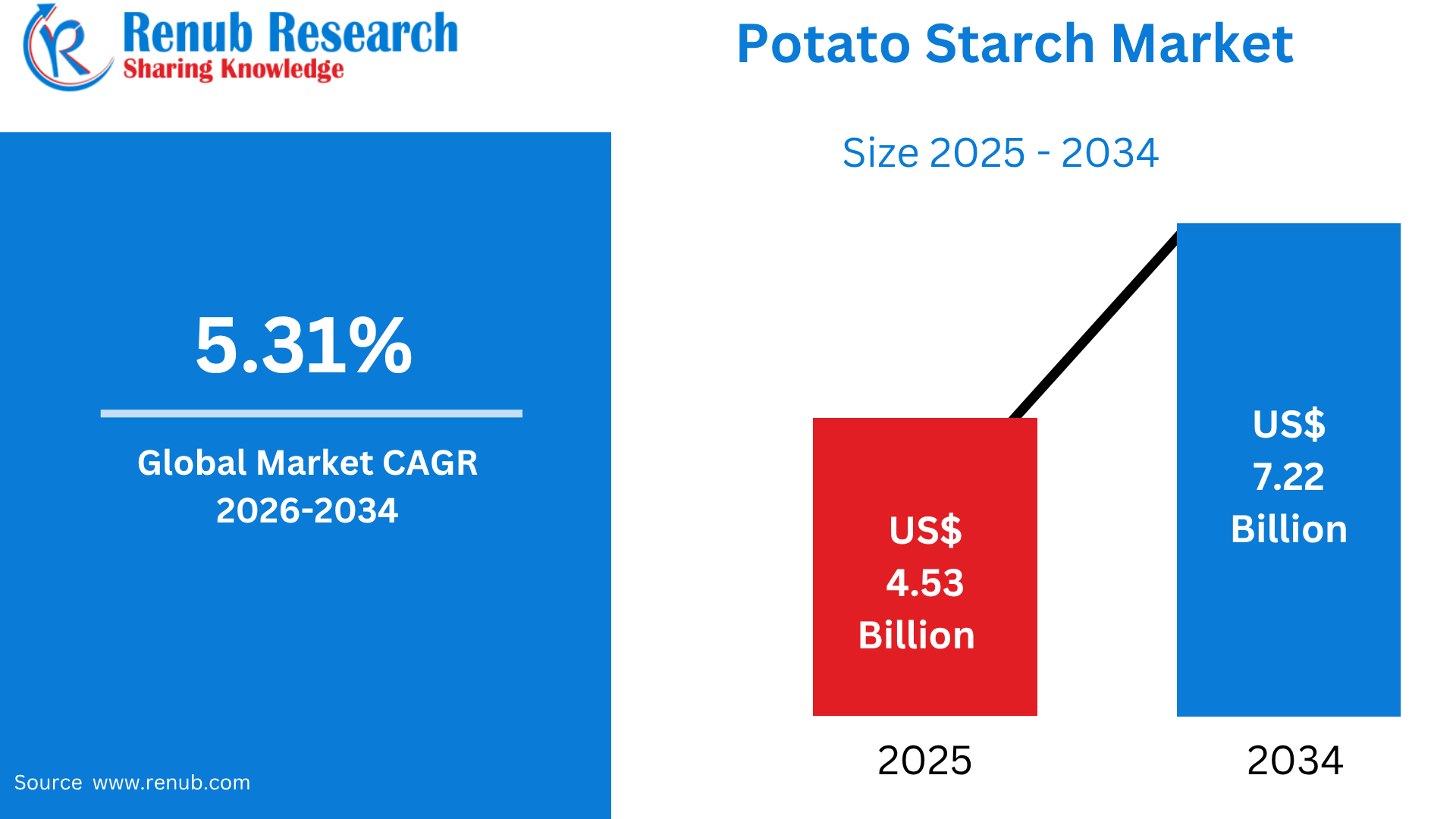
Potato Starch Market is projected to increase from approximately US$ 4.53 billion in 2025 to US$ 7.22 billion by 2034, registering a CAGR of 5.31% during the forecast period from 2026 to 2034. Market growth is being supported by rising demand from the food processing, paper, and textile industries, where potato starch is widely used for thickening, binding, coating, and texture enhancement. Increasing consumer preference for natural, clean-label, and plant-based ingredients is further encouraging the adoption of potato starch across various applications.
What is Potato Starch and Its Uses & Popularity Worldwide
Potato starch is a fine, white, odorless powder extracted from potato tubers by separating starch granules from other components of the potato. It is primarily composed of carbohydrates and is valued for its high thickening capacity, neutral flavor, smooth texture, and binding properties. Potato starch is widely used in the food industry as a thickener, stabilizer, binder, and texture enhancer in products such as soups, sauces, gravies, bakery products, noodles, processed meats, confectionery, and dairy alternatives. It is also used in gluten-free formulations to improve texture and structure.
Beyond food applications, potato starch is utilized in the paper, textile, pharmaceutical, cosmetics, and adhesive industries. In paper manufacturing, it improves surface strength and printability, while textile producers use it for sizing and finishing. Growing consumer preference for natural, plant-based, gluten-free, and clean-label ingredients is increasing demand for potato starch worldwide. Its versatility and functional performance have made it an attractive alternative to synthetic additives and other starch sources. Expanding processed-food production and increasing industrial applications are further strengthening its global popularity.
India Potato Production & Potato Starch Processing Potential
- World Ranking: India is the world’s second-largest potato producer, after China.
- Potato Production: According to the Ministry of Agriculture and Farmers’ Welfare’s Final Estimates for 2024–25, India produced approximately 58.108 million tonnes of potatoes.
- Official Data: The production estimate was cited in a Press Information Bureau (PIB) release dated March 17, 2026 (PRID 2241379).
- Low Processing Rate: Despite its large potato supply, only around 7–10% of India’s total potato production is processed into value-added products.
- International Comparison: Potato processing in India remains considerably lower than in developed markets.
- Germany: Approximately 70–80% of potatoes are processed into value-added products.
- United States: Approximately 60% of potato production is processed.
- India: Only around 7–10% is processed.
- Untapped Opportunity: The significant gap between potato production and processing indicates substantial potential for expanding potato starch manufacturing and other value-added potato products in India.
- Industry Potential: Greater investment in processing infrastructure, cold storage, technology, and value-added product manufacturing could help India utilize its large potato raw-material base more efficiently.
- Key Sources: ICAR–Central Potato Research Institute (ICAR-CPRI) and research published in Potato Research (Springer, 2024) highlight the significant scope for increasing potato processing in India.
European Starch Industry – Key Facts
- 95% of EU Starch Production: Starch Europe members account for more than 95% of total EU starch production.
- 28 Member Companies: The organization comprises 28 starch-producing companies operating 70 plants across 18 EU member states.
- Agricultural Raw Materials: Member companies process approximately 22 million tonnes of agricultural raw materials annually.
- Starch Derivatives & Proteins: This processing generates around 9.8 million tonnes of starch derivatives and 5 million tonnes of proteins and fibres.
- Growth in EU Starch Production: EU starch production increased from 8.7 million tonnes in 2004 to 9.8 million tonnes in 2024, demonstrating long-term industry expansion.
- EU Starch Consumption: The EU consumes approximately 7.2 million tonnes of starch and starch derivatives annually, excluding around 5 million tonnes of proteins and fibres.
- Food Industry – Largest Application: Approximately 54% of EU starch consumption is used in food applications.
- Feed Applications: Around 2% of starch consumption is used in animal feed.
- Non-Food Applications: Approximately 44% is consumed in non-food applications, primarily corrugated packaging and paper manufacturing.
- Native vs. Modified Starch: Of the 7.2 million tonnes of starch and starch derivatives consumed in the EU, 34% is native starch, 18% is modified starch, and 48% is starch sweeteners.
Growth Drivers of the Global Potato Starch Market
Rising Demand for Processed and Convenience Foods
The growing consumption of processed, frozen, and convenience foods is a major driver of the global potato starch market. Potato starch is widely used as a thickener, stabilizer, binder, and texture enhancer in soups, sauces, gravies, bakery products, noodles, snacks, processed meat, and dairy alternatives. According to industry estimates, the global packaged food market represents trillions of dollars in annual sales, creating a substantial application base for functional starch ingredients. Potato starch is particularly valued for its high viscosity, neutral taste, and ability to improve texture and stability. The expansion of food processing in emerging economies, particularly across Asia-Pacific and Latin America, is increasing demand for starch-based ingredients. Additionally, manufacturers are focusing on ready-to-eat and ready-to-cook products as consumers seek convenient meal solutions. Gluten-free food demand is another important opportunity because potato starch can provide structure and texture without wheat-based ingredients. As food manufacturers continue developing convenient, processed, and specialty products, the requirement for versatile starch ingredients is expected to support sustained market expansion.
Growing Preference for Natural and Clean-Label Ingredients
The increasing consumer preference for natural, recognizable, and clean-label ingredients is supporting potato starch demand worldwide. Potato starch is plant-derived and can be incorporated into formulations as a functional ingredient without significantly affecting flavor. Clean-label products have expanded across categories including bakery, snacks, sauces, meat alternatives, and dairy alternatives. Consumer surveys in major markets consistently show that a significant share of shoppers consider ingredient lists when purchasing packaged foods, encouraging manufacturers to replace synthetic additives with naturally derived alternatives. Potato starch also supports gluten-free and plant-based formulations, two categories experiencing strong growth. The global gluten-free food market is estimated to be worth tens of billions of dollars, creating additional opportunities for potato-derived ingredients. Manufacturers are increasingly promoting simple ingredient lists and natural sourcing, particularly in North America and Europe. Potato starch’s ability to provide thickening, binding, moisture retention, and texture improvement makes it suitable for multiple clean-label applications. Consequently, changing consumer preferences and formulation trends are expected to remain important contributors to market growth.
Expanding Industrial Applications Beyond Food
Increasing utilization of potato starch in paper, textiles, pharmaceuticals, adhesives, and other industrial applications is creating additional growth opportunities. In the paper industry, starch is used for surface sizing, coating, and improving paper strength and printability. Textile manufacturers use starch-based formulations for yarn sizing and finishing, while the adhesive industry uses starch as a renewable raw material. Potato starch is also used in pharmaceutical formulations and personal-care products because of its functional and binding properties. Global paper and paperboard production remains above 400 million metric tons annually, representing a significant potential application base for industrial starches. At the same time, manufacturers are increasingly seeking renewable and biodegradable alternatives to petroleum-derived materials. Potato starch can contribute to this transition because it is derived from a renewable agricultural resource and can be incorporated into biodegradable materials and formulations. The expansion of sustainable packaging and bio-based products is further broadening its potential applications. Diversification across food and non-food industries therefore reduces reliance on a single end-use sector and supports long-term growth of the global potato starch market.
Challenges of the Global Potato Starch Market
Fluctuations in Potato Supply and Raw Material Prices
Dependence on potatoes as the primary raw material creates a significant challenge for potato starch manufacturers. Potato production is influenced by weather conditions, water availability, agricultural input costs, pests, diseases, and seasonal variations, which can affect both supply and pricing. Global potato production is estimated at more than 370 million tonnes annually, but production volumes vary considerably between regions and growing seasons. Extreme weather events, including droughts, excessive rainfall, and heatwaves, can reduce yields and affect starch quality. Rising fertilizer, energy, labor, transportation, and storage costs can further increase production expenses. Because potatoes are also an important food crop, competition between food consumption and industrial processing can influence raw-material availability. Manufacturers may therefore experience fluctuations in procurement costs and production margins. Establishing reliable contracts with farmers, improving agricultural productivity, developing efficient storage systems, and diversifying sourcing regions can help reduce these risks. However, continued volatility in potato availability and input costs remains a key challenge that could affect pricing and profitability throughout the potato starch supply chain.
Competition from Alternative Starches and High Processing Costs
The potato starch market faces strong competition from alternative starches, particularly corn, tapioca, wheat, and rice starch. Corn starch remains one of the most widely used starch ingredients globally because of its extensive availability, established processing infrastructure, and competitive pricing. Tapioca starch is also increasingly popular in food, beverage, and industrial applications because of its functional properties and suitability for gluten-free products. In addition, potato starch production requires specialized extraction, separation, drying, and purification processes, which can increase manufacturing costs. Energy consumption is another concern because industrial starch processing involves significant water and energy requirements. Smaller producers may find it difficult to compete with large-scale manufacturers that benefit from economies of scale. Price-sensitive food manufacturers may consequently substitute potato starch with less expensive alternatives when their functional requirements can be met by other starches. To remain competitive, potato starch producers are focusing on processing efficiency, product differentiation, modified starches, specialty grades, and sustainable production methods. Nevertheless, competition and production economics remain important constraints on market expansion.
Potato Starch Product Launches Worldwide
- ULTRA-TEX 1311 – Ingredion (United States): Ingredion launched ULTRA-TEX 1311, a modified potato starch designed for dairy desserts, bakery fillings, dressings, sauces, and savory applications. It offers high viscosity, water-holding capacity, processing tolerance, and improved shelf-life stability.
- CheeseMaker CF66 – KMC (Europe, 2024): KMC introduced CheeseMaker CF66, a potato-starch-based ingredient developed for plant-based cheese. The ingredient is designed to improve stretchability, meltability, texture, and nutritional performance in plant-based pizza cheese.
- Clean & Simple Potato Starch Range – AKV (UK, 2024): Danish potato-ingredient producer AKV expanded its Clean & Simple range of potato starches, designed to provide functionality under challenging food-processing conditions. The range was made available in the UK through Daymer Ingredients.
- Plant-Based Confectionery Potato Starch Ingredients – KMC (2025): KMC introduced new potato-based ingredients for plant-based gummies, chewy candy, and sugar confectionery, offering manufacturers greater textural flexibility while supporting production-energy savings.
- Potato-Turned Rice – China (2024): Researchers in China’s Yunnan Province introduced a rice-shaped starch product made from potatoes. Initial production and sales testing began in November 2024, aiming to transform potatoes into a longer-lasting staple food.
- Dual-Crop Potato & Sweet Potato Starch Production – Sanli Food, China (2023/24): Sanli Food upgraded its production capabilities to manufacture both potato starch and sweet potato starch on one production line. The facility reached a reported capacity of 110 tonnes for potato starch production.
- Potato Starch-Based Binders for Plant-Based Meat – Avebe: Avebe developed potato-starch-based binding solutions for plant-based meat applications, targeting improved moisture retention and texture in meat alternatives.
- Enzymatically Treated Potato Starch – KMC: KMC developed an enzymatically treated potato starch designed to improve freeze-thaw stability, particularly for frozen bakery applications.
- Compostable Potato-Starch Film Solution – Emsland Group: Emsland Group developed a starch-based compostable film solution for sustainable packaging applications, highlighting the increasing use of potato starch beyond food applications.
- Potato Starch Excipient Blend – Roquette: Roquette developed a potato-starch-based pharmaceutical excipient blend designed to support rapid tablet disintegration, expanding potato starch applications into pharmaceutical formulations.
Modified Potato Starch Growing Demand for High-Performance Ingredients
The modified potato starch market is expanding as food and industrial manufacturers increasingly seek starches with enhanced functional performance. Modified potato starch is produced through physical, chemical, or enzymatic processes that improve properties such as stability, viscosity, texture, and resistance to heat, acids, and shear. These characteristics make it suitable for demanding applications in processed foods, ready meals, sauces, frozen foods, bakery products, and snacks. The growing global processed-food industry, valued at several trillion dollars annually, provides a substantial application base for modified starch ingredients. Beyond food, modified potato starch is increasingly used in paper, textiles, adhesives, and biodegradable materials because of its improved binding and film-forming capabilities. The rising popularity of convenience foods and formulations requiring consistent texture and stability is strengthening demand. In addition, manufacturers are developing modified starch products that align with clean-label and plant-based ingredient trends. As industries increasingly prioritize versatile, functional, and sustainable raw materials, modified potato starch is expected to register steady market growth.
Conventional Potato Starch Preference for Natural and Cost-Effective Ingredients
The conventional potato starch market continues to benefit from demand for natural, minimally processed, and economical starch ingredients. Also known as native potato starch, it is extracted directly from potatoes without significant chemical modification, making it suitable for applications where a simple and recognizable ingredient profile is preferred. Potato starch offers strong thickening, binding, moisture-retention, and texture-enhancing properties, supporting its use in traditional food preparation and commercial food processing. The expanding clean-label food sector, which represents a significant and growing portion of the packaged-food industry, is creating additional opportunities for native starch. It is used in sauces, soups, bakery products, snacks, and gluten-free foods, while also finding applications in paper and textile manufacturing. However, conventional potato starch has comparatively lower resistance to heat, acid, and mechanical shear than modified starch, limiting its use in some demanding industrial formulations. Nevertheless, increasing consumer preference for natural and plant-derived ingredients, combined with the need for cost-effective functional ingredients, is expected to sustain demand for conventional potato starch.
Food and Beverage Potato Starch Dominant Application Segment
The food and beverage potato starch market represents the leading application area because of the ingredient’s versatility, neutral flavor, and strong functional characteristics. Potato starch is widely incorporated into soups, sauces, gravies, bakery products, noodles, snacks, processed meat, dairy products, and ready-to-eat meals as a thickener, stabilizer, binder, and texture enhancer. Its high viscosity allows manufacturers to achieve the desired consistency using relatively small quantities, while its neutral taste minimizes interference with the flavor profile of finished products. The growing global demand for processed and convenience foods is expanding the addressable market for potato starch. In addition, the increasing popularity of gluten-free diets is creating opportunities because potato starch can replace wheat-based ingredients in several formulations. The global gluten-free food market is already valued at tens of billions of dollars, reflecting strong consumer interest in alternative ingredients. Plant-based foods, clean-label products, and healthier convenience foods are further encouraging manufacturers to explore potato starch. Consequently, continued innovation in food formulations and expanding processed-food production are expected to maintain the segment’s strong growth trajectory.
Rising Demand for Sustainable Paper Solutions
The paper potato starch market is benefiting from increasing demand for high-quality paper, packaging, printing, and labeling materials. Potato starch is used as a binding, sizing, and coating agent, helping improve paper strength, surface properties, printability, and resistance during processing. The global paper and paperboard industry produces more than 400 million metric tons annually, providing a substantial potential application base for starch-based additives. The rapid expansion of e-commerce is also increasing demand for corrugated boxes, protective packaging, labels, and other paper-based materials. At the same time, growing environmental concerns are encouraging manufacturers to replace certain petroleum-based or synthetic materials with renewable and biodegradable alternatives. Potato starch, being derived from an agricultural source, fits well with the broader transition toward bio-based materials. Advances in paper manufacturing are also creating opportunities for starch products with improved bonding and coating performance. As sustainable packaging becomes increasingly important for manufacturers and consumers, demand for plant-derived functional materials is expected to support the continued adoption of potato starch within the paper industry.
Expanding Functional and Bio-Based Applications
The pharmaceutical and chemical potato starch market is gaining importance because of the material’s functional properties, safety profile, binding capacity, and film-forming characteristics. In pharmaceutical manufacturing, potato starch is commonly used as an excipient, binder, disintegrant, and filler in tablet formulations. Its ability to support tablet structure and facilitate drug release makes it useful across various pharmaceutical formulations. The global pharmaceutical market is valued at more than US$1 trillion annually, providing significant opportunities for functional excipients. In chemical applications, potato starch is increasingly utilized in adhesives, biodegradable plastics, coatings, and other bio-based materials. Growing environmental regulations and efforts to reduce dependence on petroleum-derived materials are encouraging manufacturers to explore renewable starch-based alternatives. Potato starch is particularly attractive because it is biodegradable and derived from a renewable agricultural resource. Growth in pharmaceutical manufacturing across emerging economies is also creating additional demand for cost-effective excipients. With continued investment in bio-based materials and pharmaceutical formulation technologies, the pharmaceutical and chemical segment is expected to become an increasingly important application area for potato starch.
United States Strong Food Processing and Clean-Label Demand
United States potato starch market is well established, supported by strong demand from the food processing, pharmaceutical, and industrial sectors. The country’s extensive processed-food industry uses potato starch as a thickener, stabilizer, binder, and texture enhancer in snacks, sauces, ready-to-eat meals, bakery products, and processed foods. Rising consumer preference for gluten-free and clean-label products is creating additional opportunities, while advanced manufacturing capabilities support the production of both native and modified potato starch. Industrial applications in paper, adhesives, and biodegradable materials are also contributing to demand as manufacturers increasingly adopt sustainable alternatives. The United States processed-food and packaged-food industry represents a multibillion-dollar market, providing a substantial application base for starch ingredients. However, potato starch faces strong competition from corn and tapioca starch, which benefit from established supply chains and competitive pricing. In November 2024, KMC introduced CheeseMaker CF66, a potato starch-based ingredient designed for plant-based pizza cheese, offering improved stretchability, meltability, and texture. Continued product innovation, clean-label trends, and demand for sustainable ingredients are expected to support steady market expansion.
Sustainability and Gluten-Free Trends Supporting United Kingdom Growth
United Kingdom potato starch market is experiencing stable demand, primarily driven by food and beverage applications and increasing emphasis on sustainable ingredients. Potato starch is widely used in bakery products, sauces, processed foods, snacks, and gluten-free formulations because of its thickening and binding properties. Growing consumer awareness of food ingredients and increasing demand for clean-label products are encouraging manufacturers to incorporate plant-derived starches into food formulations. The UK’s sustainability agenda is also creating opportunities for potato starch in industrial applications, particularly paper, adhesives, and biodegradable materials. The country’s advanced retail and food distribution infrastructure enables manufacturers to efficiently supply starch-based products across domestic and export markets. However, dependence on imported raw materials and international supply chains can expose manufacturers to fluctuations in transportation costs, exchange rates, and ingredient prices. In June 2024, Danish potato-ingredient producer AKV entered an agreement with UK-based Daymer Ingredients to supply its Clean & Simple range of potato starches designed to withstand challenging processing conditions. Increasing demand for natural ingredients and sustainable materials is expected to support the UK’s potato starch market over the coming years.
India Expanding Food Processing and Pharmaceutical Applications
India potato starch market is expanding steadily as the country’s food processing industry develops and consumer demand for convenient packaged foods increases. Potato starch is increasingly used in snacks, bakery products, instant foods, sauces, and processed-food formulations, where it provides thickening, binding, and texture-enhancing properties. India’s large population and expanding middle-income consumer base are supporting demand for processed and convenience foods. The pharmaceutical sector also provides an important application opportunity, as potato starch can be used as an excipient, binder, and disintegrant in tablet manufacturing. India’s food processing industry is valued at hundreds of billions of dollars, providing considerable potential for functional food ingredients. Although corn starch remains more widely used because of its availability and competitive pricing, potato starch is gaining attention in specialized applications, particularly gluten-free and premium food products. Challenges include inconsistent raw-material supply, limited consumer awareness, and comparatively smaller domestic production capacity. Nevertheless, improvements in agricultural productivity, food-processing infrastructure, and government support for the sector are expected to create new opportunities. Rising urbanization and changing dietary habits should further strengthen demand for potato starch in India.
Saudi Arabia Food Industry and Import-Driven Demand
Saudi Arabia potato starch market is developing steadily, supported by increasing demand from the food and beverage industry and expanding industrial applications. Since domestic potato starch production is limited, Saudi Arabia relies substantially on imports, making the market sensitive to international prices, transportation expenses, and supply-chain disruptions. The country’s growing consumption of packaged and processed foods is creating demand for potato starch as a thickener, stabilizer, binder, and texture enhancer. Expansion of restaurants, hotels, supermarkets, and food-processing facilities is further increasing the requirement for functional food ingredients. Industrial applications in paper, adhesives, and other bio-based products provide additional opportunities. Saudi Arabia’s economic diversification initiatives are also encouraging investment in food processing, manufacturing, and sustainable materials. The country’s food and beverage sector is a major component of its broader non-oil economic development strategy, supporting long-term demand for food ingredients. In October 2022, Nawah Scientific began its presence in Saudi Arabia through a soft launch and announced plans for a large laboratory facility serving pharmaceutical, food, agriculture, chemical, and oil-sector requirements. Increasing food-processing activity, industrial diversification, and demand for high-quality convenience foods are expected to support the Saudi potato starch market.
Potato Starch Market Segments
Type
- Modified
- Native
Nature
- Conventional
- Organic
End Use
- Food & Beverage
- Paper
- Pharmaceutical & Chemical
- Others
Countries
North America
- United States
- Canada
Europe
- France
- Germany
- Italy
- Spain
- United Kingdom
- Belgium
- Netherlands
- Turkey
Asia Pacific
- China
- Japan
- India
- Australia
- South Korea
- Thailand
- Malaysia
- Indonesia
- New Zealand
Latin America
- Brazil
- Mexico
- Argentina
Middle East & Africa
- South Africa
- Saudi Arabia
- UAE
All the Key players have been covered from 5 Viewpoints:
- Business overview
- Key Persons
- Recent Development & Strategies
- SWOT Analysis
- Revenue Analysis
Key Company Covered
- Cargill Inc.
- Ingredion Inc.
- Tate & Lyle PLC
- Tereos Group
- Sudzucker AG
- Pepees SA
- Royal Avebe U.A.
- Agrana Beteiligungs-AG
Report Details:
| Report Features | Details |
| Base Year |
2025 |
| Historical Period |
2022 - 2025 |
| Forecast Period |
2026 - 2034 |
| Market |
US$ Billion |
| Segment Covered |
By Type, By Nature, By End User and By Countries |
| Countries Covered |
|
| Companies Covered |
|
| Customization Scope |
20% Free Customization |
| Post-Sale Analyst Support |
1 Year (52 Weeks) |
| Delivery Format |
PDF and Excel through Email (We can also provide the editable version of the report in PPT/Word format on request) |
Customization Services available
- Analysis of Market Size and Its Segments
- More Company Profiles (Upto 10 without any additional cost):
- Additional Countries (Other than mentioned Countries):
- Region/Country Specific Reports:
- Market Entry Strategy:
- Region-Specific Market Dynamics:
- Regional Market Share Analysis:
- Trade Analysis:
- Production Insights:
- Others Customized Requests:
For more information contact our analysts.
Need More Assistance?
- Talk to our analysts to get more precious information on the current market trends.
- Include more countries and segments and customize the report based on the final requirement.
- Get a competitive advantage in your industry by knowing the report findings and making a positive impact on your revenues and operations.
- Our analysts are always ready to provide more help and pertinent information if you need any additional assistance.