Asia Pacific Crowdfunding Market Report by Type, Application, Countries and Companies Analysis 2026-2034
Buy NowAsia Pacific Crowdfunding Market Size & Forecast
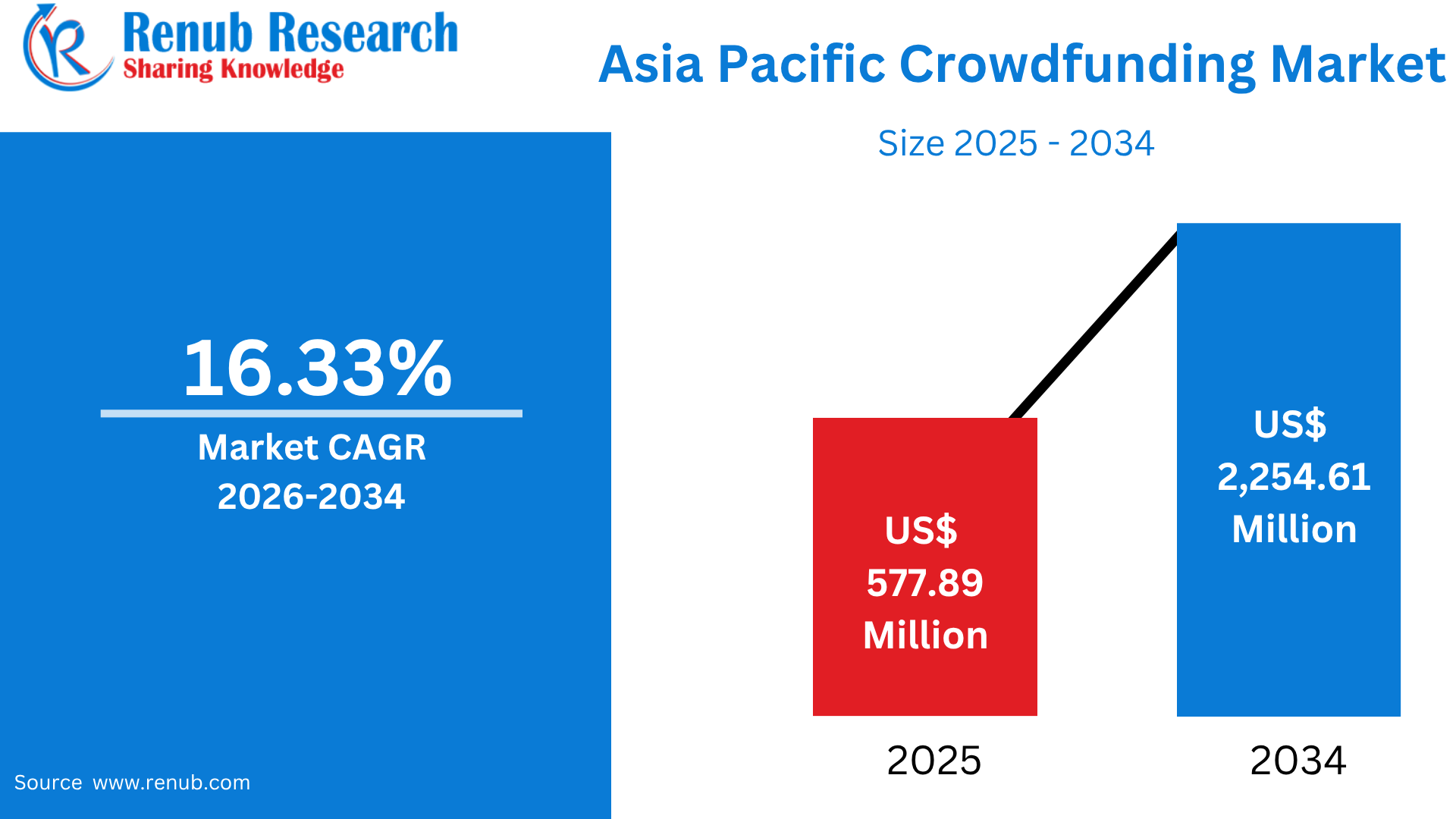
Asia Pacific Crowdfunding Market is projected to expand from US$ 577.89 million in 2025 to US$ 2,254.61 million by 2034, registering a Compound Annual Growth Rate (CAGR) of 16.33% during 2026–2034. The market’s expansion is being supported by rapid digital transformation, increasing internet and smartphone penetration, and growing acceptance of online crowdfunding as an alternative source of financing. The region’s expanding startup and small-business ecosystem is also creating greater demand for accessible capital-raising platforms.
What is Crowdfunding and its Uses & Popularity in Asia Pacific
Crowdfunding is an online financing method that enables individuals, startups, small and medium-sized enterprises (SMEs), entrepreneurs, creators, and social organizations to raise money from a large number of contributors through digital platforms. Depending on the model, participants may contribute funds in exchange for rewards, equity, debt repayments, or simply to support a social or charitable cause. Crowdfunding is increasingly used to finance startups, innovative products, creative projects, healthcare needs, real estate initiatives, community programs, and small-business expansion. In Asia Pacific, its popularity is supported by rapid digitalization, widespread smartphone usage, expanding fintech ecosystems, and increasing acceptance of alternative financing.
Across Asia Pacific, crowdfunding adoption is expanding alongside the region’s rapid digital transformation and development of fintech ecosystems. Greater internet and smartphone penetration, digital payments, and online financial services are making fundraising platforms easier to access. Crowdfunding also provides startups and smaller businesses with additional financing channels while enabling individuals to participate in investment or social-impact opportunities with comparatively modest amounts. The region’s expanding entrepreneurial ecosystem, improving digital financial infrastructure, and evolving regulatory environment are further supporting adoption.
Top Asia Pacific Countries for Healthcare Crowdfunding in 2025
- China – Large-Scale Medical Crowdfunding Participation: As of December 31, 2025, approximately 490 million people had cumulatively donated around RMB 72.3 billion through Waterdrop Medical Crowdfunding, supporting approximately 3.68 million patients. This highlights China’s significant position in Asia Pacific healthcare crowdfunding, supported by widespread digital payments, social-network sharing, and large-scale online fundraising platforms.
- Japan – Institutional and Medical Research Crowdfunding: In January 2025, READYFOR announced a partnership with Asahikawa Medical University to promote healthcare-related crowdfunding initiatives. The development reflects growing participation from universities, hospitals, and medical institutions, where crowdfunding is increasingly used to support medical research, healthcare infrastructure, patient assistance, and specialized healthcare projects.
- India – Medical Treatment as a Major Crowdfunding Category: Research analyzing 119,493 crowdfunding campaigns on Ketto found that medical campaigns represented the largest category of social-cause fundraising on the platform. Healthcare crowdfunding in India is particularly associated with chronic diseases, cancer treatment, emergency medical care, and other high-cost treatments.
- South Korea – Expanding Participation in Crowdfunding Projects: During 2025, more than 140,000 participants supported over 1,000 crowdfunding projects, generating approximately KRW 12.2 billion in cumulative funding. The level of participation demonstrates the growing acceptance of crowdfunding for healthcare innovation, startup initiatives, social-impact projects, and community-oriented causes.
- Singapore – Strong Growth in Digital Giving: Singapore’s national giving platform giving.sg reportedly raised a record S$104.9 million in donations during 2025, representing a 21% increase compared with 2024. Healthcare, community welfare, and social-impact causes benefited from the country’s increasingly developed digital donation ecosystem, highlighting Singapore’s role as a mature market for technology-enabled charitable fundraising.
Growth Drivers of the Asia Pacific Crowdfunding Market
Rapid Digitalization and Expanding Internet Connectivity
The rapid development of digital infrastructure is one of the strongest growth drivers for the Asia Pacific crowdfunding market. Increasing internet access, smartphone adoption, mobile applications, digital wallets, and online payment systems have made crowdfunding more accessible to both fundraisers and contributors. Research covering 9,458 crowdfunding projects across 111 emerging economies found that digitalization significantly increased the number of backers, pledged amounts, and successful projects. Asia Pacific is particularly attractive because of its large and digitally active population, while countries such as India, Indonesia, China, Singapore, and Australia have developed strong fintech ecosystems. The Asian Development Bank reports that internet usage in developing Asia and the Pacific is 13 percentage points higher in urban areas than rural areas, although a digital divide remains.As connectivity and digital literacy continue improving, crowdfunding platforms can reach previously underserved consumers and entrepreneurs. Social media also enables campaigns to build awareness rapidly, attract communities, and generate contributions beyond traditional geographic boundaries.
Growing Startup Ecosystems and Alternative Financing Demand
The expansion of startups, SMEs, creative businesses, and technology-driven ventures is increasing demand for flexible sources of capital across Asia Pacific. Crowdfunding allows emerging businesses to approach a broad investor or supporter base without relying entirely on conventional bank loans or venture capital. It is particularly useful for early-stage companies, innovative consumer products, creative projects, social enterprises, and community initiatives that may face difficulties obtaining traditional financing. Business funding has historically represented a major component of alternative finance activity in the Asia Pacific region, demonstrating the importance of online platforms for entrepreneurial capital formation. The World Bank also identifies startups supported by accelerators and incubators, an investment culture among individuals, and technology-oriented business environments as important conditions for crowdfunding development. Furthermore, the availability of donation-, reward-, debt-, and equity-based models allows businesses and organizations to select financing structures according to their requirements. This diversification strengthens crowdfunding’s role as an alternative financing channel.
Improving Regulatory Frameworks and Investor Participation
The development of clearer fintech and crowdfunding regulations is strengthening confidence among platforms, businesses, and investors across Asia Pacific. Regulatory frameworks can improve transparency, establish operating requirements, protect investors, and reduce uncertainty for crowdfunding businesses. According to Cambridge Centre for Alternative Finance research, 78% of sampled APAC jurisdictions had an equity-crowdfunding framework, with 50% using bespoke frameworks and 28% regulating equity crowdfunding through existing frameworks. In addition, 25 jurisdictions had at least one regulatory sandbox, compared with 13 in 2019. These developments encourage responsible innovation while giving investors greater clarity regarding platform operations and investment risks. Growing familiarity with digital financial services is also helping attract retail participants who can contribute relatively small amounts across different campaigns. As financial technology becomes more integrated with payments, investment, and lending, crowdfunding platforms can benefit from stronger digital trust and wider investor participation. Continued regulatory harmonization and investor-protection measures are expected to further support sustainable market expansion.
Challenges of the Asia Pacific Crowdfunding Market
Regulatory Fragmentation and Compliance Complexity
Regulatory fragmentation remains a major challenge for the Asia Pacific crowdfunding market because countries differ considerably in their approaches to equity crowdfunding, peer-to-peer lending, investor protection, licensing, taxation, and cross-border fundraising. Although 78% of sampled APAC jurisdictions had an equity-crowdfunding framework, the structure and requirements varied significantly across markets. For P2P lending, only 50% of sampled jurisdictions had a bespoke regulatory framework, while 22% prohibited the activity and another 22% treated it as unregulated or self-regulated. This creates compliance difficulties for platforms seeking regional expansion. Different disclosure requirements, investor eligibility rules, fundraising limits, reporting obligations, and licensing procedures can increase operational costs and delay market entry. Regulators themselves reported challenges including limited technical expertise, coordination between regulators, unclear jurisdictional responsibilities, and resource constraints. As crowdfunding platforms expand across borders, developing more consistent regulatory standards, stronger supervisory capabilities, and clear consumer-protection mechanisms will be important for supporting sustainable regional growth.
Investor Risk, Trust and Digital Inclusion Gaps
Investor trust and financial risk remain important barriers to wider crowdfunding adoption. Investment-based crowdfunding can expose participants to risks including information asymmetry, misleading information, limited liquidity, platform failure, and the higher risk profile of early-stage businesses. The World Bank highlights investor inexperience, unreliable information, platform business-conduct issues, and the illiquid nature of some securities among key risks associated with investment-based crowdfunding. Digital inclusion is another challenge because access to reliable internet connectivity and digital skills remains uneven across Asia Pacific. The Asian Development Bank reports a 13-percentage-point urban-rural gap in internet usage across developing Asia and the Pacific, while mobile internet speeds are 38% faster in urban areas than rural areas. These disparities can limit participation among rural communities and smaller businesses. Strengthening cybersecurity, platform transparency, investor education, financial literacy, and dispute-resolution mechanisms will therefore be essential for building confidence and expanding crowdfunding participation.
Recent Industry Developments
- December 2025 – Kalshi Raises US$1 Billion: Kalshi announced a US$1 billion Series E funding round at an US$11 billion valuation, demonstrating strong institutional interest in emerging digital-finance and alternative-market platforms. While Kalshi operates as a prediction market rather than a traditional crowdfunding platform, the transaction highlights the increasing investor appetite for technology-enabled alternative financial models.
- March 2025 – SQUID Crowdfunding Round: SQUID completed a €1.69 million crowdfunding campaign through Crowdcube, attracting 2,624 investors. The campaign demonstrated the ability of established crowdfunding platforms to mobilize large numbers of individual backers and broaden access to early-stage investment opportunities.
- March 2025 – Nothing Community Equity Campaign: Nothing launched its second community equity funding round through Crowdcube, allowing members of its global community to participate in the company’s growth. The campaign also illustrated the regulatory and compliance complexities associated with accepting investments from participants across multiple international markets.
- January 2025 – Malaysia Strengthens Alternative Financing: Malaysia’s Securities Commission highlighted equity crowdfunding (ECF) and peer-to-peer (P2P) financing as important mechanisms for improving funding access for micro, small, and medium enterprises (MSMEs). By December 2024, ECF and P2P financing had facilitated more than RM9 billion for over 20,000 businesses, while total funds raised during 2024 reached RM2.6 billion, an 18% increase from 2023.
- November 2024 – SEBI Reviews Angel-Fund Regulations in India: India’s Securities and Exchange Board of India (SEBI) initiated a consultation on reforms to the regulatory framework for angel funds. The proposal included lowering the minimum investment threshold from ₹2.5 million to ₹1 million and raising the maximum from ₹100 million to ₹250 million, potentially widening participation and improving capital availability for startups.
- March 2023 – Enabot Launches EBO X Kickstarter Campaign: Enabot introduced a Kickstarter fundraising campaign for its EBO X robot companion, using crowdfunding to generate financial support and market interest for its consumer robotics product. The campaign demonstrated how crowdfunding platforms can combine capital raising with early customer engagement and product validation.
- December 2023 – Congress Launches “Donate for Desh”: India’s Congress party introduced the “Donate for Desh” fundraising initiative ahead of the 2024 general elections. The campaign used digital contributions to mobilize financial support from individuals, demonstrating how online fundraising mechanisms can be applied to large-scale social and organizational campaigns.
- March 2022 – TipSnaps Raises Funds Through Republic: TipSnaps, a creator-focused social media company, launched a fundraising campaign on Republic, providing individuals with an opportunity to invest in the company at an early stage. The campaign reflected the expanding use of equity-based online fundraising to connect startups with individual investors and consumer communities.
Product Innovation and Consumer-Led Validation
The Asia Pacific reward-based crowdfunding market is gaining momentum as startups, creators, and entrepreneurs use online campaigns to finance products while testing consumer demand before commercial launch. Under this model, backers typically receive products, early access, discounts, memberships, or exclusive experiences rather than financial returns. Asia Pacific is particularly suited to reward-based campaigns because of its mobile-first consumer environment, expanding e-commerce ecosystem, and large digitally engaged population. Campaigns allow emerging brands to communicate directly with prospective customers, collect feedback, build communities, and generate publicity alongside funding. Consumer electronics, gaming, smart devices, lifestyle products, sustainable goods, and creative projects are among the areas that can benefit from this model. Social media further amplifies campaign visibility by enabling creators to reach audiences across national borders. As startups seek capital without immediately relying on conventional loans or institutional investment, reward-based crowdfunding is expected to remain an important mechanism for product validation and early-stage commercialization across Asia Pacific.
Digital Giving and Social Impact
Donation-based crowdfunding is becoming increasingly important across Asia Pacific as individuals, nonprofit organizations, communities, and social groups use digital platforms to mobilize financial support for humanitarian and social needs. Unlike investment-oriented models, contributors generally provide funds without expecting financial returns, making the model particularly relevant to medical treatment, disaster relief, education, poverty reduction, and community assistance. The growing use of online payment systems and social media enables campaigns to reach large audiences rapidly and facilitates small-value contributions from geographically dispersed donors. Healthcare represents a particularly significant application. A 2025 study of online medical crowdfunding in India identified 2,440 medical campaigns, with cancer accounting for 620 campaigns, or 25.4%, the largest disease category. Singapore also illustrates the growing scale of digital giving, with giving.sg reportedly raising S$104.9 million in 2025, a 21% increase from 2024. Digital connectivity, community participation, and increasing awareness of social causes are therefore supporting the expansion of donation-based crowdfunding across the region.
Funding Innovation in Food and Beverage Startups
Asia Pacific Food & Beverage crowdfunding market is developing as emerging brands increasingly use online fundraising to introduce innovative products and engage consumers before large-scale commercialization. Crowdfunding can help food and beverage entrepreneurs finance product development while simultaneously measuring consumer interest, generating early orders, and building brand communities. Potential applications include specialty beverages, functional foods, plant-based products, sustainable packaging, premium snacks, alternative proteins, and locally inspired food concepts. The region has a substantial entrepreneurial base in this sector, with Crunchbase identifying 9,959 Asia Pacific food and beverage organizations in its broader company database and 1,418 organizations with seed funding. Crowdfunding can provide an additional financing route for smaller businesses that may face difficulties accessing conventional capital. It also creates a direct feedback mechanism between consumers and producers, allowing companies to refine flavors, packaging, pricing, and positioning. Increasing digital commerce and social-media marketing further support campaign promotion. As Asia Pacific consumers show growing interest in healthier, sustainable, premium, and differentiated food products, crowdfunding can increasingly support experimentation and market entry.
Rising Medical Costs and Digital Fundraising
Healthcare crowdfunding is emerging as an important digital fundraising mechanism across Asia Pacific, particularly for medical treatment, emergency care, chronic diseases, cancer therapy, research, and healthcare-related social initiatives. Increasing healthcare expenditure, out-of-pocket costs, and gaps in financial protection encourage patients and families to seek assistance from wider online communities. Digital platforms allow campaigns to be created and shared rapidly through social networks, while mobile payments make contributions easier for donors. India provides a strong example of this demand: a 2025 JAMA Network Open study found that 2,440 medical crowdfunding campaigns were identified in its dataset, with cancer representing 25.4% of campaigns. The study also reported that only 7.4% of campaigns reached their fundraising target, compared with 33.4% in high-income countries, highlighting both the demand and challenges surrounding medical crowdfunding. Meanwhile, APAC’s digital health ecosystem raised US$1.2 billion across 102 deals in H1 2025, indicating a strong regional environment for healthcare innovation and digital health financing. Continued digital-payment adoption, social awareness, and healthcare financing needs are expected to support further growth.
Digital Scale, Platform Ecosystem, and Regulatory Transformation in China
China has developed a significant crowdfunding ecosystem, supported by its large digital consumer base, extensive internet connectivity, and sophisticated mobile-payment infrastructure. The market initially experienced rapid platform proliferation as entrepreneurs, consumers, and project owners increasingly sought alternatives to conventional financing. However, concerns surrounding fraudulent fundraising, unauthorized securities activities, investor protection, and platform compliance resulted in tighter oversight and substantial industry restructuring. Chinese regulators have specifically emphasized information disclosure, protection of investor funds, and restrictions on unauthorized public equity fundraising. Major technology ecosystems, including Alibaba, JD.com, Baidu, and Tencent, have contributed to the broader digital-finance environment by connecting large user communities with online commercial and financing services. Crowdfunding activity spans consumer products, creative projects, entrepreneurship, technology, and social initiatives. Going forward, the Chinese market is likely to be influenced by continued fintech innovation, digital entrepreneurship, platform consolidation, and regulatory efforts aimed at balancing financial innovation with risk control.
Trusted Funding Models and Strong Investor Protection in Japan
Japan has established a comparatively mature crowdfunding environment, supported by advanced digital infrastructure, a sophisticated financial system, and increasing recognition of alternative financing channels. Crowdfunding is used across donation, purchase/reward, and investment-based models, providing funding opportunities for entrepreneurs, creators, community organizations, and innovative businesses. Japan’s Financial Services Agency distinguishes between donation or purchase-based crowdfunding and investment-based crowdfunding, with investment activities subject to financial-market regulations depending on their structure. The market benefits from strong emphasis on transparency, accountability, and investor protection. Regulatory reforms have also facilitated smaller-scale equity crowdfunding while requiring platforms to conduct appropriate checks and provide information about issuers. Social causes, regional development, creative projects, consumer products, and startup initiatives remain important application areas. Nevertheless, relatively cautious investor behavior, competition among platforms, and increasing market specialization can limit expansion. Continued digitalization, greater awareness of crowdfunding, and demand for innovative products are expected to support steady market development.
India Digital Payments and Donation-Based Fundraising
India’s crowdfunding market is expanding alongside the country’s rapidly developing digital economy, growing smartphone adoption, and widespread use of online payment systems. Crowdfunding provides an alternative mechanism for raising funds for charitable activities, healthcare expenses, education, social initiatives, creative projects, and entrepreneurial ventures. Donation-based fundraising has become particularly relevant for individuals and organizations seeking financial assistance for medical treatment and social causes. The country’s large population, expanding internet user base, and growing familiarity with digital transactions create a substantial foundation for online fundraising. At the same time, the regulatory environment differs according to the type of crowdfunding. Donation and reward-based models generally do not fall within securities-market regulation in the same manner as investment-based models, while equity and lending structures face greater regulatory considerations. Greater transparency, stronger campaign verification, improved disclosure practices, and clearer regulatory frameworks could increase public confidence. As India’s startup ecosystem and digital-finance infrastructure continue to develop, crowdfunding is expected to gain wider relevance as a supplementary source of funding.
South Korea Startup Financing, Innovation, and Regulated Equity Crowdfunding
South Korea has emerged as an important crowdfunding market in Asia Pacific, benefiting from high digital connectivity, a technology-oriented economy, and a well-developed startup ecosystem. Crowdfunding platforms support a wide range of activities, including startup financing, product development, creative projects, cultural initiatives, and social enterprises. The country’s strong technology adoption provides favorable conditions for online fundraising and digital investor participation. Regulatory reforms have played an important role in establishing a more structured equity-crowdfunding environment. South Korea introduced specific crowdfunding provisions under its financial-market framework, allowing eligible startups and smaller companies to raise capital while establishing requirements for intermediaries and investor protection. Under the framework, eligible issuers can raise up to KRW 700 million annually through crowdfunding, while investment limits vary according to investor characteristics and risk capacity. The market continues to face challenges related to investor awareness, project risk assessment, regulatory compliance, and competition among platforms. Nevertheless, increasing startup activity, digital financial innovation, and improvements in platform transparency are expected to strengthen crowdfunding’s contribution to entrepreneurial financing and innovation-led economic development.
Asia Pacific Crowdfunding Market Segments
Type
- Reward-based
- Equity-Based
- Debt-Based
- Donation-Based
- Others
Application
- Food & Beverage
- Technology
- Media
- Real Estate
- Healthcare
- Others
Countries
- China
- Japan
- India
- South Korea
- Thailand
- Malaysia
- Indonesia
- Australia
- New Zealand
- Rest of Asia Pacific
All the Key players have been covered from 5 Viewpoints:
- Overviews
- Key Person
- Recent Developments
- SWOT Analysis
- Revenue Analysis
Key Players Analysis
- Fundly
- Alibaba Group Holding Ltd
- Kickstarter, PBC
- Indiegogo, Inc.
- GoFundMe
- Fundable
- SeedInvest Technology, LLC
- Crowdcube
- Corteva Agriscience
Report Details:
| Report Features | Details |
| Base Year |
2025 |
| Historical Period |
2022 - 2025 |
| Forecast Period |
2026 - 2034 |
| Market |
US$ Billion |
| Segment Covered |
Type, Application and Countries |
| Countries Covered |
|
| Companies Covered |
|
| Customization Scope |
20% Free Customization |
| Post-Sale Analyst Support |
1 Year (52 Weeks) |
| Delivery Format |
PDF and Excel through Email (We can also provide the editable version of the report in PPT/Word format on request) |
Customization Services available
- Analysis of Market Size and Its Segments
- More Company Profiles (Upto 10 without any additional cost):
- Additional Countries (Other than mentioned Countries):
- Region/Country Specific Reports:
- Market Entry Strategy:
- Region-Specific Market Dynamics:
- Regional Market Share Analysis:
- Trade Analysis:
- Production Insights:
- Others Customized Requests:
For more information contact our analysts.
Need More Assistance?
- Talk to our analysts to get more precious information on the current market trends.
- Include more countries and segments and customize the report based on the final requirement.
- Get a competitive advantage in your industry by knowing the report findings and making a positive impact on your revenues and operations.
- Our analysts are always ready to provide more help and pertinent information if you need any additional assistance.