n-Hexane Market Size, Share, Growth, Trends, Industry Analysis & Forecast 2026–2034
Buy Nown-Hexane Market Size
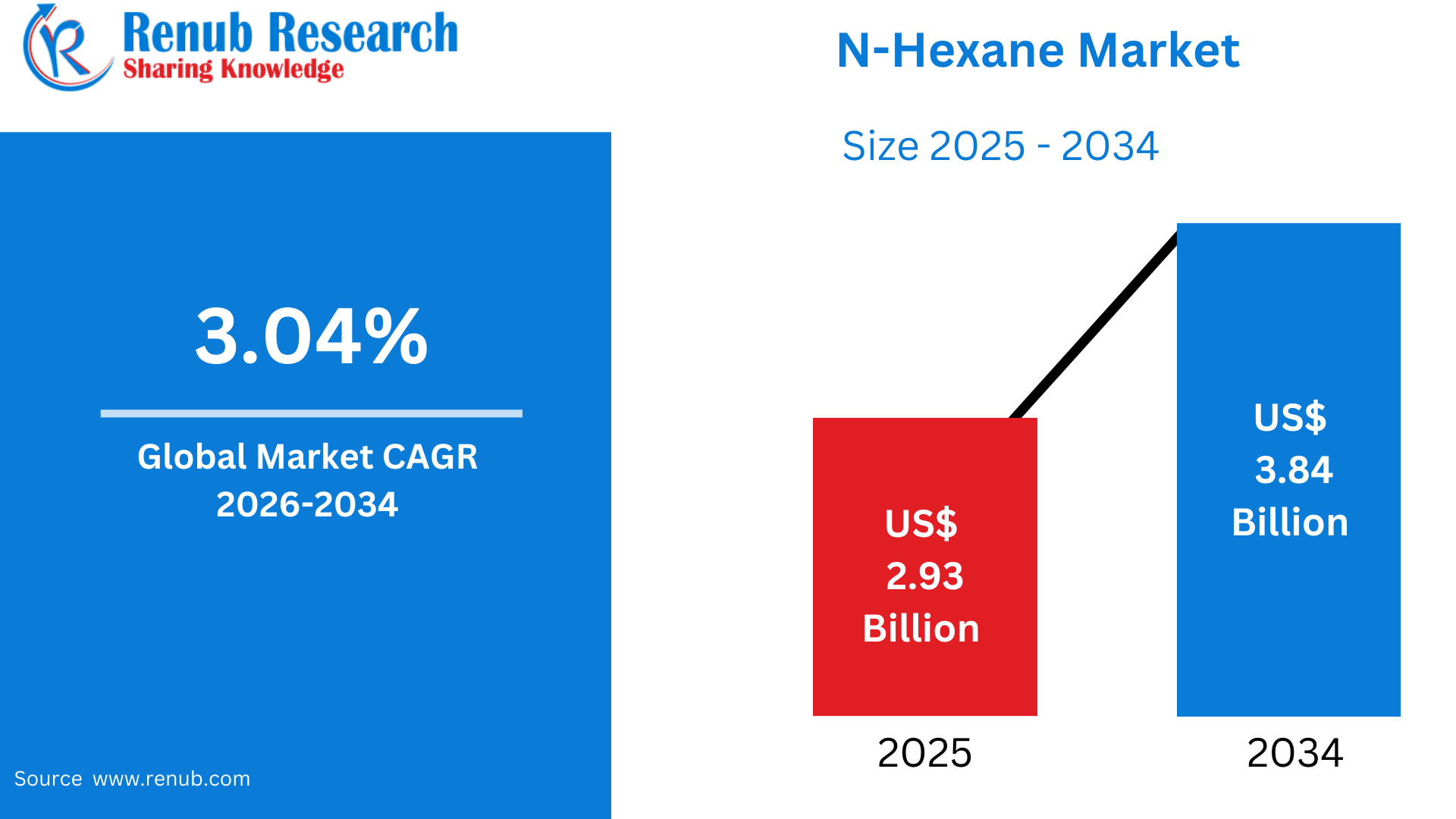
n-Hexane Market is projected to grow from US$ 2.93 billion in 2025 to US$ 3.84 billion by 2034, registering a CAGR of 3.04% during the forecast period from 2026 to 2034. Market growth is primarily driven by the extensive use of n-hexane as an industrial solvent in chemical manufacturing, adhesives, paints, coatings, and cleaning applications. The expanding pharmaceutical industry is also contributing significantly to demand, as n-hexane is widely utilized in the production of active pharmaceutical ingredients (APIs) and various chemical processes. In addition, the food processing industry continues to increase its consumption of n-hexane as an efficient solvent for extracting edible oils from soybeans, sunflower seeds, canola, and other oilseeds. Rising industrialization, growing demand for vegetable oils, and expanding chemical production across emerging economies are further supporting market expansion.
n-Hexane Industry Overview
n-Hexane is a linear alkane hydrocarbon (C₆H₁₄) widely used as an industrial solvent due to its excellent oil-dissolving properties, low boiling point, and relatively low cost. It is primarily derived from crude oil refining and natural gas processing, often obtained as part of light petroleum fractions such as straight-run gasoline.
The largest end-use sector for n-hexane is the edible oil industry, where it is used as a solvent for extracting vegetable oils from oilseeds such as soybeans, rapeseed, sunflower, and cottonseed. Its high extraction efficiency and ease of recovery through distillation make it the preferred solvent globally for large-scale oil processing. As global consumption of vegetable oils continues to grow—driven by population growth, urbanization, and food processing demand—this application remains the backbone of the n-hexane market.
Another important application is in the chemical manufacturing sector, where n-hexane serves as a reaction medium, cleaning solvent, and diluent. It is used in the production of adhesives, coatings, rubber, and polymer formulations. The pharmaceutical industry also uses high-purity grades of n-hexane for laboratory analysis, drug formulation, and purification processes, though volumes are smaller compared to food and industrial uses.
In industrial cleaning and degreasing, n-hexane is valued for its fast evaporation and strong solvency, particularly in electronics, mechanical parts, and precision equipment cleaning. Additionally, it is used in printing, textile processing, and leather finishing, as well as in laboratory and research settings.
Geographically, Asia-Pacific dominates the n-hexane market, led by China and India, due to large edible oil processing industries and expanding manufacturing sectors. North America and Europe represent mature markets with stable demand but face stricter regulatory oversight.
A key challenge for the industry is health and environmental regulation. Prolonged exposure to n-hexane is associated with neurotoxicity, leading to tighter workplace exposure limits and increasing pressure to adopt safer alternatives. As a result, there is growing interest in bio-based solvents and low-toxicity substitutes, especially in developed regions.
Despite regulatory constraints, the n-hexane industry remains resilient, supported by its critical role in food processing and the lack of equally cost-effective substitutes at scale.
What is n-Hexane? Its Uses & Worldwide Popularity
n-Hexane is a colorless, highly volatile, and flammable hydrocarbon solvent derived from crude oil during the petroleum refining process. It belongs to the alkane family and is widely valued for its excellent dissolving properties, rapid evaporation rate, and relatively low boiling point. These characteristics make n-hexane an essential industrial solvent used across a variety of manufacturing and processing industries. It is commonly employed in the extraction of edible vegetable oils from soybeans, sunflower seeds, canola, and other oilseeds, making it a critical component of the global food processing industry. In addition, n-hexane is extensively used in the production of pharmaceuticals, adhesives, paints, coatings, printing inks, rubber products, leather processing, textile manufacturing, and industrial cleaning applications.
Worldwide, n-hexane remains in high demand due to expanding industrialization, increasing edible oil production, and the growth of the chemical and pharmaceutical industries. Asia-Pacific is the largest consumer owing to its strong manufacturing base and food processing sector, while North America and Europe maintain significant demand for chemical processing and pharmaceutical applications. Although environmental and occupational safety concerns have encouraged stricter handling regulations and the development of alternative solvents, n-hexane continues to be widely used because of its high extraction efficiency, cost-effectiveness, and versatility in industrial processes. Ongoing growth in manufacturing, agriculture, and specialty chemicals is expected to support its global demand over the coming years.
Global Oilseed Crush by Country/Region (Million Metric Tonnes)
2012–2014
- Global oilseed crush: Approximately 360 million metric tonnes
- China: Around 80 million metric tonnes, the largest individual contributor.
- United States: Approximately 50 million metric tonnes.
- Argentina: Around 40 million metric tonnes.
- Brazil: Approximately 40 million metric tonnes.
- European Union: Nearly 40 million metric tonnes.
- India: Around 20 million metric tonnes.
- Rest of the World: Approximately 90 million metric tonnes.
2022–2024
- Global oilseed crush: Approximately 500 million metric tonnes.
- China: Increased to about 130 million metric tonnes, maintaining its leading position.
- United States: Around 60 million metric tonnes.
- Argentina: Approximately 40 million metric tonnes.
- Brazil: Nearly 55 million metric tonnes.
- European Union: Around 45 million metric tonnes.
- India: Approximately 30 million metric tonnes.
- Rest of the World: Around 135 million metric tonnes.
2034 (Forecast)
- Global oilseed crush: Expected to reach approximately 580 million metric tonnes.
- China: Forecast to process around 140 million metric tonnes.
- United States: Expected to reach approximately 75 million metric tonnes.
- Argentina: Forecast at around 50 million metric tonnes.
- Brazil: Expected to increase to nearly 70 million metric tonnes.
- European Union: Projected at approximately 50 million metric tonnes.
- India: Expected to reach around 40 million metric tonnes.
- Rest of the World: Forecast to account for approximately 155 million metric tonnes.
Key Highlights
- Global oilseed crushing is projected to increase from about 360 million metric tonnes (2012–2014) to nearly 580 million metric tonnes by 2034.
- China remains the world’s largest oilseed crushing market throughout the forecast period.
- Brazil records one of the strongest growth rates, reflecting expanding soybean production and processing capacity.
- The United States continues to strengthen its position as a leading oilseed processor due to growing soybean demand.
- India shows consistent growth, supported by rising edible oil consumption and increasing domestic processing capacity.
- The Rest of the World contributes the largest cumulative share, highlighting expanding oilseed processing across emerging economies.
- Overall growth is driven by rising demand for edible oils, animal feed, and biofuel production worldwide.
Growth Drivers for the n-Hexane Market
Rising Global Consumption of Edible Oils
The increasing worldwide demand for edible oils remains the most significant growth driver for the n-hexane market. n-Hexane is extensively used as a solvent in the extraction of vegetable oils because of its high extraction efficiency, excellent oil recovery rate, rapid evaporation, and cost-effectiveness. Growing global populations, urbanization, changing dietary preferences, and higher consumption of processed and convenience foods are driving demand for edible oils such as soybean, sunflower, rapeseed, palm, and canola oil. Rapid expansion of food processing industries across Asia-Pacific, Latin America, and Africa has further increased investments in large-scale oilseed crushing facilities, where n-hexane remains the preferred extraction solvent. Although alternative extraction technologies are being explored, very few can currently match the industrial efficiency, scalability, and economic advantages of n-hexane. As edible oil production continues to expand to meet rising global food demand, sustained consumption from the oil extraction industry is expected to remain a key factor supporting long-term growth in the global n-hexane market.
Expansion of Industrial Manufacturing and Chemical Processing
Rapid industrialization and the continued growth of chemical manufacturing activities are significantly contributing to the expansion of the n-hexane market. n-Hexane serves as an important industrial solvent in the production of adhesives, paints, coatings, rubber products, polymers, printing inks, leather processing chemicals, and specialty chemicals. Its strong solvency characteristics, quick evaporation, and excellent cleaning performance make it highly suitable for industrial degreasing, surface preparation, and formulation applications. Increasing demand from construction, automotive, electronics, packaging, and manufacturing industries is indirectly driving the consumption of products that utilize n-hexane during production. Furthermore, the pharmaceutical industry relies on high-purity n-hexane for the manufacturing of active pharmaceutical ingredients and laboratory applications, further strengthening market demand. Emerging economies are investing heavily in industrial infrastructure, manufacturing capacity, and chemical production, creating favorable conditions for solvent consumption. As industrial output continues to increase globally, n-hexane is expected to remain an essential solvent across numerous manufacturing and processing industries.
Cost Efficiency and Limited Availability of Industrial-Scale Alternatives
The affordability and proven industrial performance of n-hexane continue to support its widespread adoption across multiple end-use industries. Produced as a petroleum refining byproduct, n-hexane benefits from well-established global production facilities, reliable supply chains, and competitive pricing. Compared to many bio-based or environmentally friendly solvent alternatives, n-hexane offers higher extraction efficiency, lower operating costs, and compatibility with existing industrial equipment. Industries such as edible oil extraction, where production volumes are high and operating margins are relatively narrow, continue to rely on n-hexane because replacing it with alternative solvents could significantly increase processing costs. In many developing countries, relatively moderate regulatory requirements also contribute to continued usage across industrial applications. While sustainable solvent technologies continue to evolve, most alternatives still face challenges related to cost, scalability, and commercial adoption. Until economically viable substitutes become widely available, the cost advantage and operational efficiency of n-hexane will remain major drivers supporting global market growth.
Challenges in the n-Hexane Market
Strict Health, Safety, and Environmental Regulations
Increasing regulatory oversight regarding occupational health, workplace safety, and environmental protection represents one of the major challenges for the global n-hexane market. Prolonged exposure to n-hexane vapors has been associated with adverse health effects, particularly neurological disorders such as peripheral neuropathy, leading regulatory agencies worldwide to establish stricter workplace exposure limits and emission standards. Manufacturers are required to invest in advanced ventilation systems, solvent recovery technologies, monitoring equipment, and worker safety measures to comply with evolving regulations. In the food processing industry, authorities also enforce strict controls on residual solvent levels in edible oils and food products, requiring sophisticated quality assurance and solvent recovery systems. Additionally, n-hexane is classified as a volatile organic compound (VOC), making manufacturers subject to increasingly stringent environmental regulations related to air emissions and pollution control. Compliance with these requirements significantly increases operating costs and may limit production expansion, particularly for smaller manufacturers operating in highly regulated markets.
Growing Adoption of Alternative and Sustainable Solvents
The increasing emphasis on sustainability, environmental responsibility, and worker safety is encouraging industries to explore alternatives to conventional n-hexane-based processing methods. Food processors, pharmaceutical manufacturers, and chemical companies are gradually adopting bio-based solvents, supercritical carbon dioxide (CO₂) extraction, ethanol-based systems, and other low-toxicity extraction technologies that reduce environmental impact and improve workplace safety. Although many of these alternatives currently involve higher investment costs and technical limitations, continuous research and technological advancements are steadily improving their commercial feasibility. Large multinational companies are also strengthening their environmental, social, and governance (ESG) commitments by reducing dependence on hazardous industrial chemicals and implementing greener manufacturing processes. Increasing consumer awareness regarding food safety, chemical residues, and environmentally responsible production is further accelerating this transition. As governments introduce incentives for sustainable manufacturing and cleaner technologies become more commercially viable, growing adoption of alternative solvents may gradually reduce long-term demand for n-hexane across several industrial applications, presenting an ongoing challenge for market participants.
n-Hexane Product Launches & Commercial Introductions Worldwide
- June 2024 – ExxonMobil Chemical introduced an advanced solvent-grade n-Hexane with enhanced environmental compliance and reduced VOC emissions, designed for pharmaceutical and food processing applications.
- January 2024 – BASF SE launched a new portfolio of eco-friendly industrial solvents, including bio-based alternatives for n-hexane applications, supporting more sustainable chemical processing.
- 2025 – Bharat Petroleum Corporation Limited (BPCL) expanded its D-Solvents portfolio with upgraded Food Grade Hexane, offering ultra-low aromatic content and improved recovery efficiency for edible oil extraction.
- 2025 – BPCL introduced an enhanced Polymer Grade Hexane, developed for slurry polymerization processes in HDPE, LDPE, and LLDPE manufacturing with very low sulfur content.
- 2025 – BPCL launched its upgraded Pharma Grade Hexane, designed for API manufacturing and pharmaceutical intermediates with high n-hexane purity and minimal aromatic impurities.
- 2024 – CSIR–Indian Institute of Petroleum (IIP) commercially launched Food Grade Hexane manufactured using advanced Sulfolane extraction technology, providing improved purity and efficient edible oil extraction.
- March 2023 – ExxonMobil announced the commercial expansion of its n-Hexane production portfolio at the Baytown, Texas facility to meet increasing demand from the pharmaceutical and edible oil industries.
- 2023 – Spectrochem Pvt. Ltd. expanded its laboratory solvent portfolio with 99.9% GC Grade n-Hexane, specifically developed for residual solvent analysis, headspace analysis, and chromatographic applications.
- 2023 – Spectrochem Pvt. Ltd. introduced 99% Anhydrous n-Hexane, targeting research laboratories, analytical testing, pharmaceutical development, and industrial quality control applications.
- 2026 – Rompetrol Vega Refinery commercially introduced High-Purity Hexane (minimum 60% purity) for polypropylene manufacturing and edible oil processing following optimization of its n-Hexane production unit.
Oil Extraction n-Hexane High-Efficiency Solvent Supporting Global Edible Oil Production
Oil Extraction n-Hexane Market accounts for the largest share of global n-hexane consumption, primarily due to its widespread use in extracting edible oils from oilseeds such as soybeans, sunflower seeds, rapeseed, cottonseed, groundnuts, and canola. n-Hexane is preferred because of its excellent solvency, high oil recovery efficiency, rapid evaporation, and cost-effectiveness, making it the industry standard for large-scale oilseed processing. Growing global demand for edible oils, driven by population growth, urbanization, and increasing consumption of processed foods, continues to strengthen market demand. Expanding food processing industries in Asia-Pacific, Latin America, and Africa are encouraging investments in new oil extraction facilities equipped with modern solvent recovery systems. Manufacturers are also improving extraction technologies to increase production efficiency while minimizing solvent losses and environmental emissions. Although research into greener extraction methods is progressing, n-hexane remains the preferred industrial solvent due to its proven performance, economic advantages, and compatibility with existing extraction infrastructure, supporting continued long-term market growth.
Adhesive n-Hexane Reliable Solvent Enhancing Industrial Bonding Applications
Adhesive n-Hexane Market is growing steadily as demand for high-performance adhesives increases across construction, automotive, packaging, footwear, furniture, and consumer goods industries. n-Hexane serves as an effective solvent in adhesive manufacturing because of its strong dissolving capability, low viscosity, and fast evaporation characteristics, enabling manufacturers to produce adhesives with excellent bonding strength and quick drying performance. It is widely used in contact adhesives, rubber-based adhesives, pressure-sensitive adhesives, and industrial bonding formulations. Rapid industrialization, infrastructure development, and expanding manufacturing activities worldwide continue to increase the consumption of adhesive products, thereby supporting demand for n-hexane. The packaging industry’s growth, particularly due to e-commerce and food packaging applications, has further strengthened adhesive consumption. While manufacturers are gradually introducing environmentally friendly and low-VOC adhesive formulations, n-hexane continues to remain an important solvent because of its processing efficiency, affordability, and compatibility with established manufacturing technologies. Continuous innovation in industrial adhesives is expected to sustain market demand over the forecast period.
Pharmaceuticals n-Hexane Supporting Chemical Synthesis and Drug Manufacturing
Pharmaceuticals n-Hexane Market plays an important role in pharmaceutical manufacturing by providing a highly effective solvent for chemical synthesis, purification, extraction, and laboratory applications. High-purity n-hexane is widely utilized during the production of active pharmaceutical ingredients (APIs), intermediates, and specialty chemicals where precise solvent performance and high purity are essential. The compound is also used in research laboratories, quality control testing, and analytical procedures because of its excellent solvent properties and rapid evaporation rate. Increasing global pharmaceutical production, rising healthcare expenditures, expanding generic drug manufacturing, and continuous investments in pharmaceutical research and development are supporting market growth. Emerging economies are expanding pharmaceutical manufacturing capabilities to meet rising domestic and international demand, further increasing consumption of industrial solvents. Although pharmaceutical manufacturers must comply with stringent quality, safety, and residual solvent regulations, advanced purification technologies enable the safe and efficient use of n-hexane in controlled manufacturing environments. Continued expansion of the global pharmaceutical industry is expected to support stable demand for pharmaceutical-grade n-hexane.
Polymerisation n-Hexane Essential Solvent for High-Performance Polymer Production
Polymerisation n-Hexane Market is witnessing steady growth due to increasing demand for polymers and specialty plastics across packaging, automotive, construction, healthcare, electronics, and consumer goods industries. n-Hexane is commonly used as a reaction medium and processing solvent during polymerization processes, particularly in the production of polyethylene, polypropylene, synthetic rubber, and other specialty polymers. Its excellent chemical stability, low boiling point, and efficient solvent characteristics contribute to improved reaction control, product consistency, and manufacturing efficiency. Growing investments in petrochemical production and expanding polymer manufacturing capacity, especially in Asia-Pacific and the Middle East, are creating favorable opportunities for market expansion. The rising demand for lightweight plastics, high-performance packaging materials, automotive components, and industrial polymers continues to support solvent consumption. Although the industry is gradually exploring alternative processing technologies with lower environmental impact, n-hexane remains widely utilized due to its proven industrial performance, cost-effectiveness, and compatibility with established polymer manufacturing processes. Continuous growth in global polymer production is expected to sustain demand for n-hexane throughout the forecast period.
United States n-Hexane Market
United States n-Hexane market is a mature and highly regulated segment of the industrial solvents industry, supported by stable demand from the food processing, chemical manufacturing, pharmaceutical, and industrial sectors. The largest application remains edible oil extraction, particularly soybean oil production, where n-hexane is widely used because of its excellent extraction efficiency, rapid evaporation, and compatibility with existing processing equipment. The country’s advanced food manufacturing industry continues to ensure consistent consumption of the solvent. Beyond food processing, n-hexane is extensively utilized in the production of adhesives, coatings, rubber products, polymers, printing inks, and industrial cleaning solutions. High-purity grades are also used in pharmaceutical manufacturing and laboratory research. Strict environmental and occupational safety regulations have encouraged manufacturers to invest in advanced solvent recovery systems, emission control technologies, and workplace safety measures rather than replacing n-hexane entirely. Supported by strong industrial infrastructure and continuous compliance improvements, the U.S. n-hexane market is expected to maintain stable long-term demand despite moderate growth prospects.
United Kingdom n-Hexane Market
United Kingdom n-Hexane market is a well-established but relatively moderate-sized market, driven by demand from the food processing, chemical manufacturing, pharmaceutical, and industrial sectors. The solvent is primarily utilized for extracting edible oils from oilseeds and nuts, while additional demand comes from applications involving adhesives, coatings, rubber processing, specialty chemicals, and laboratory operations. Its excellent solvency characteristics and fast evaporation make it an important ingredient in various industrial processes. One of the defining characteristics of the UK market is its strong emphasis on regulatory compliance, particularly regarding workplace safety, volatile organic compound (VOC) emissions, and environmental sustainability. Manufacturers continue investing in efficient solvent recovery technologies and emission reduction systems to meet evolving regulatory standards. Although research into environmentally friendly alternatives continues, n-hexane remains widely utilized because of its proven industrial performance, established supply chain, and cost-effectiveness. Overall, the UK market is expected to experience steady demand supported by stable industrial activity and continued compliance with environmental regulations.
India n-Hexane Market
India n-Hexane market is witnessing robust growth, driven by the rapid expansion of the country’s edible oil processing industry and increasing industrial manufacturing activities. n-Hexane is extensively used for extracting vegetable oils from soybeans, mustard seeds, sunflower seeds, cottonseed, and other oil-bearing crops due to its high extraction efficiency, economic viability, and compatibility with large-scale processing facilities. Rising population, increasing consumption of packaged foods, growing demand for edible oils, and government initiatives to strengthen domestic food processing continue to support market expansion. Beyond edible oil extraction, n-hexane is widely employed in pharmaceutical manufacturing, adhesives, paints, coatings, rubber processing, specialty chemicals, and industrial cleaning applications. India’s rapidly growing manufacturing sector and expanding chemical industry are creating additional demand for industrial solvents. Although awareness regarding occupational safety and environmental protection is increasing, regulatory requirements remain relatively moderate compared to developed markets. Supported by expanding industrial capacity, increasing investments in food processing, and rising domestic consumption, India’s n-hexane market is expected to maintain strong long-term growth.
United Arab Emirates n-Hexane Market
United Arab Emirates (UAE) n-Hexane market is supported by the country’s position as a regional industrial, logistics, and trade hub serving the Middle East and neighboring regions. Although the UAE has relatively limited domestic oilseed crushing capacity compared to major global producers, demand for n-hexane is generated through edible oil refining, blending, storage, and regional distribution activities. The solvent is also widely utilized in industrial applications, including adhesives, coatings, polymers, specialty chemicals, rubber processing, and precision cleaning for manufacturing, construction, automotive, and engineering industries. The UAE’s well-developed logistics infrastructure and diversified industrial economy continue to support stable consumption across multiple sectors. Growing industrial investments and expanding manufacturing activities are further strengthening demand for industrial solvents. At the same time, government regulations promoting workplace safety, environmental protection, and emission control have encouraged companies to implement advanced solvent handling and recovery technologies. While interest in sustainable alternatives is gradually increasing, n-hexane continues to maintain a strong market position due to its proven performance, cost efficiency, and widespread industrial applications, supporting stable long-term market growth.
Recent Developments in n-Hexane Market
- BPCL declared in May 2025 that hexane prices would drop in the Indian domestic market starting on May 16, 2025. In order to get a larger market share in India's edible oil and industrial solvent industries, this price adjustment takes into account market dynamics as well as possible increases in supply or strategic positioning.
- May 8, 2024: CAPGC Pte. Ltd., a joint venture between Glencore Asian Holdings Pte. Ltd. and Chandra Asri Capital Pte. Ltd., has agreed to purchase Royal Dutch Shell PLC's Energy and Chemicals Park in Singapore. Through the deal, CAPGC will acquire all of Shell's stake in Shell Energy and Chemicals Park Singapore.
- Exxon Mobil Corporation declared on May 3, 2024, that it had completed the purchase of Pioneer Natural Resources Company. ExxonMobil and Pioneer's merger will result in an unconventional company with the Permian Basin's greatest potential for high-return development.
Market Segmentation
Application
- Oil Extraction
- Pharmaceuticals
- Adhesive
- Industrial Cleaning
- Polymerisation
- Degreasing
- Rubber Processing
- Others
Countries
North America
- United States
- Canada
Europe
- France
- Germany
- Italy
- Spain
- United Kingdom
- Belgium
- Netherlands
- Turkey
Asia Pacific
- China
- Japan
- India
- Australia
- South Korea
- Thailand
- Malaysia
- Indonesia
- New Zealand
Latin America
- Brazil
- Mexico
- Argentina
Middle East & Africa
- South Africa
- Saudi Arabia
- United Arab Emirates
All the key players have been covered from 5 Viewpoints:
- Overview
- Key Persons
- Recent Development
- SWOT Analysis
- Financial Insights
Key Players Analysis:
- ExxonMobil Corporation
- Shell plc
- Indian Oil Corporation Ltd
- Chevron Corporation
- Bharat Petroleum Corporation Ltd
- DHC Solvent Chemie GmbH
- Sak Chaisidhi Company Limited
- Liaoning Yufeng Chemical Co. Ltd.
Report Details:
| Report Features | Details |
| Base Year |
2025 |
| Historical Period |
2022 - 2025 |
| Forecast Period |
2026 - 2034 |
| Market |
US$ Billion |
| Segment Covered |
Application and Countries |
| Countries Covered |
|
| Companies Covered |
|
| Customization Scope |
20% Free Customization |
| Post-Sale Analyst Support |
1 Year (52 Weeks) |
| Delivery Format |
PDF and Excel through Email (We can also provide the editable version of the report in PPT/Word format on request) |
Customization Services available
- Analysis of Market Size and Its Segments
- More Company Profiles (Upto 10 without any additional cost):
- Additional Countries (Other than mentioned Countries):
- Region/Country Specific Reports:
- Market Entry Strategy:
- Region-Specific Market Dynamics:
- Regional Market Share Analysis:
- Trade Analysis:
- Production Insights:
- Others Customized Requests:
For more information contact our analysts.
Need More Assistance?
- Talk to our analysts to get more precious information on the current market trends.
- Include more countries and segments and customize the report based on the final requirement.
- Get a competitive advantage in your industry by knowing the report findings and making a positive impact on your revenues and operations.
- Our analysts are always ready to provide more help and pertinent information if you need any additional assistance.