Global Millets Market Report by Product, Application, Distribution Channels, Countries and Companies Analysis 2026-2034
Buy NowGlobal Millets Market Size and Forecast
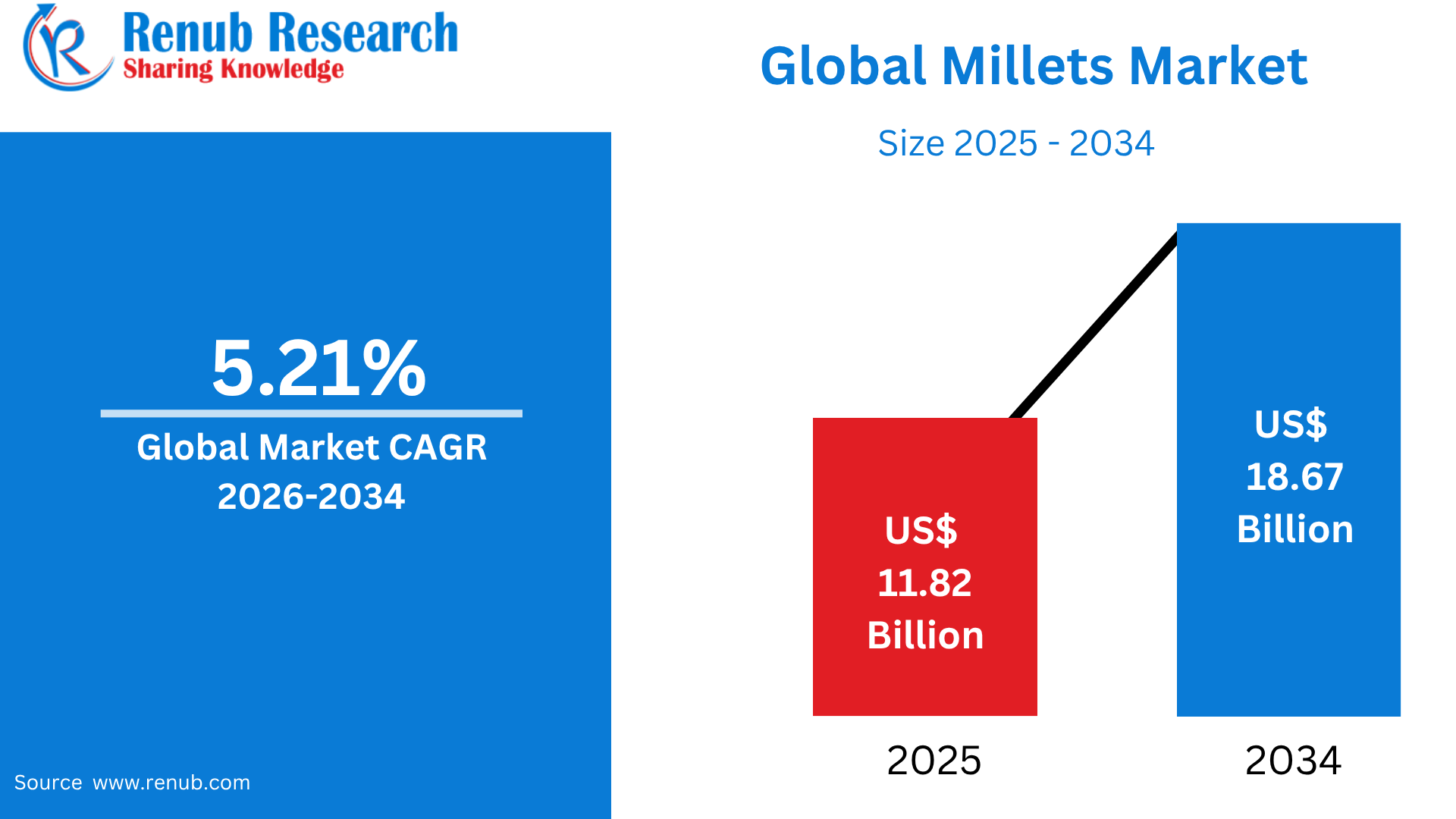
Global Millets Market is projected to grow from US$ 11.82 billion in 2025 to US$ 18.67 billion by 2034, registering a Compound Annual Growth Rate (CAGR) of 5.21% during 2026–2034. Market expansion is being supported by increasing consumer awareness of the nutritional benefits of millets, growing demand for gluten-free and plant-based grains, and their ability to withstand challenging climatic conditions. Government initiatives promoting millet cultivation, sustainable agricultural practices, and the rising adoption of healthy eating habits are further driving demand.
What are Millets and Their Uses & Popularity Worldwide
Millets are a diverse group of small-grained, dryland cereals that include pearl, finger, foxtail, proso, barnyard, little, and kodo millet, among others. They are naturally gluten-free and provide dietary fiber, protein, vitamins, and minerals, making them increasingly relevant to health-conscious consumers and people seeking alternatives to refined grains. According to the Food and Agriculture Organization (FAO), millets can grow in poor soils, tolerate high temperatures and limited water, and remain productive under challenging climatic conditions.
Millets are traditionally consumed across Asia and Sub-Saharan Africa, where they are used for porridge, flatbreads, fermented foods, cereals, and staple meals. Globally, nearly three-quarters of domestic millet supply is used for food, while the remainder is utilized for animal feed and other applications. Increasingly, millets are being incorporated into bakery products, breakfast cereals, snacks, beverages, pasta, flour blends, and functional foods. Their popularity is expanding beyond traditional markets because of growing awareness of nutrition, gluten-free diets, sustainable agriculture, and climate-resilient food systems. The United Nations’ designation of 2023 as the International Year of Millets further increased global awareness of their nutritional and environmental benefits.
Growth Drivers in the Market
Rising Demand for Nutritious and Gluten-Free Foods
Growing consumer awareness of healthy diets is a major driver of the worldwide millets market. Millets are whole grains that can provide dietary fiber, protein, minerals, and vitamins, while many varieties have a relatively low glycemic index compared with refined cereal products. FAO identifies millets as naturally gluten-free and notes their potential to contribute to diversified and nutritious diets. These characteristics have increased their relevance among consumers looking for gluten-free grains, plant-based foods, whole grains, and nutrient-dense ingredients. Demand is also expanding beyond traditional millet-consuming regions as food manufacturers incorporate millet flour and grains into breakfast cereals, bakery products, snacks, pasta, ready-to-eat foods, and beverages. A 2025 review of the global millet market reported increasing consumer interest in millet-based gluten-free products and functional foods. Nearly 75% of global domestic millet supply is used for food, demonstrating the crop’s importance as a human food source. Rising health awareness and the development of convenient millet-based products are therefore helping transform millets from traditional staples into commercially attractive ingredients for modern food applications.
Climate Resilience and Sustainable Agriculture
The climate-resilient characteristics of millets are supporting their adoption as governments, farmers, and food companies seek crops capable of performing under water scarcity, heat, and difficult soil conditions. According to FAO, millets can grow in high temperatures, with limited water and on poor soils, while tolerating several crop diseases and pests. Their relatively low-input production characteristics make them relevant to sustainable agricultural systems, particularly in dryland regions. The importance of this characteristic is significant because FAO notes that more than 2 billion people live in dryland areas, where resilient crops can contribute to food security and agricultural stability. Millets can also support soil protection and biodiversity by providing land cover in arid environments and can be incorporated into crop rotations. In addition, approximately 70% of global millet production occurs in warm tropical dryland climates, while Africa and Asia together account for about 98% of global millet-growing area and 97% of production. These characteristics are encouraging investment in millet cultivation, breeding, processing, and sustainable food supply chains.
Government Initiatives and Expanding Food Applications
Government programs and international initiatives are increasing awareness of millets and encouraging their cultivation, processing, and consumption. A major milestone was the United Nations General Assembly’s declaration of 2023 as the International Year of Millets, coordinated by FAO. The initiative was designed to raise awareness of the nutritional benefits, climate resilience, and economic potential of these crops. FAO subsequently reported that the initiative generated global momentum and emphasized the need for continued investment, research, and policy support. Millets are also gaining commercial opportunities through diversification into higher-value food categories. FAO highlights opportunities for innovation in processing and food technology, including products designed for younger consumers and specialized applications. Nearly three-quarters of domestic millet supply is already directed toward food, providing a substantial foundation for value-added applications. India remains the world’s largest millet producer, while Africa and Asia collectively account for 97% of global millet production, creating a large agricultural base for expansion. Continued government support, improved processing technologies, breeding programs, and product innovation are helping strengthen the commercial ecosystem surrounding millets worldwide.
Challenges in the Market
Limited Productivity and Underdeveloped Value Chains
Despite their climate resilience, millet production faces productivity and value-chain constraints that can limit market expansion. FAO identifies limited productivity as an important issue and notes significant scope for improvement through genetic and agronomic advances. A 2024 review reported that global millet cultivation area declined from approximately 35 million hectares in 2007 to 32 million hectares in 2019, largely because of reductions in Asia. Although yields in Asia increased from around 1,100 kg/ha to 1,292 kg/ha during that period, productivity remains uneven across producing regions. Processing and post-harvest infrastructure also remain important constraints. FAO emphasizes the need for improved harvesting, post-harvest handling, mechanization, processing technologies, and farmer access to appropriate equipment and finance. Traditional processing can be labor-intensive, while millet flour can have relatively short storage stability because wholemeal can become rancid. Limited processing capacity, inconsistent supply, and fragmented value chains can therefore increase costs and make it more difficult for manufacturers to secure standardized millet ingredients at scale.
Competition from Major Cereals and Changing Consumer Preferences
Millets face strong competition from established cereals such as wheat, rice, and maize, which benefit from mature production, processing, distribution, and consumer ecosystems. Historical FAO analysis indicates that millet food consumption grew only marginally over several decades while overall food use of cereals increased substantially. Factors contributing to lower millet demand included changing consumer preferences toward wheat and rice, inexpensive imports of competing grains, irregular millet supplies, rising incomes, and urbanization. Convenience is another challenge because traditional millet preparation can require more processing and cooking effort than widely available refined cereal products. This is particularly relevant in urban markets, where consumers often prioritize ready-to-use and quickly prepared foods. FAO notes that urbanization and changing household time constraints contributed to shifts toward more convenient processed foods. Although the market is now benefiting from renewed interest in nutrition and sustainability, expanding consumption requires convenient, competitively priced, and appealing millet products. Greater investment in milling, ready-to-cook formats, bakery ingredients, snacks, beverages, and other value-added applications can help address these barriers and broaden consumer adoption worldwide.
Millets Product Launches Worldwide
- Nestlé a+ Masala Millet – India (2023): Nestlé India launched Masala Millet in Tangy Tomato and Veggie Masala variants. The product contains bajra, is high in fiber, has 30% fewer calories, and is free from added preservatives.
- Britannia Millet Bread – India (2023): Britannia introduced Millet Bread with zero added maida, combining ragi, jowar, bajra, and oats to offer a fiber- and mineral-rich bakery product.
- Tata Soulfull Ragi Bites Choco Sticks – India (2023): Tata Soulfull expanded its millet snack portfolio with chocolate-filled ragi wafer sticks, targeting children and modern snacking occasions.
- Tata Soulfull GCC Portfolio – UAE & Kuwait (2024): Tata Soulfull expanded internationally into the UAE and Kuwait, introducing its millet-based snacks and breakfast cereals through major retailers and supermarkets.
- Saffola Masala Millets – India (2024): Marico launched Saffola Masala Millets in two flavors as a convenient ready-to-cook millet offering aimed at consumers seeking nutritious and flavorful meals.
- Tata Soulfull Corn Flakes+ – India (2024): Tata Soulfull introduced Corn Flakes+, blending corn with jowar in every flake. It was offered in Original and Honey Almond variants and positioned as a high-fiber breakfast cereal.
- Sabala Millets – India (2024): Ramoji Group launched Sabala Millets, introducing 45 millet-based products in its first phase, including regional khichdi, cookies, health bars, munchies, and noodles.
- Bake&Co Millet Bakery Products – India (2024): Agrimax Foods launched Bake&Co, a millet-focused bakery brand featuring cookies, indulgence cookies, and other baked snacks using millets such as ragi, bajra, and jowar.
- Kurkure Jowar Puffs – India (2025): PepsiCo India expanded into millet-based snacking with Kurkure Jowar Puffs, using jowar to create a modern packaged snack aimed at health-conscious consumers.
- RiteBite Max Protein Millet Wafer Bars – India (2026): Zydus Wellness launched a millet-based protein wafer bar range, combining millet such as jowar with 10 grams of protein per bar to target consumers seeking convenient, protein-rich snacks.
Organic Millets Market
The organic millets market is expanding as consumers increasingly prioritize natural, minimally processed, sustainably produced, and clean-label foods. Organic millet varieties such as ragi, pearl millet, foxtail millet, and other small grains are being incorporated into breakfast cereals, flour, snacks, baby foods, bakery products, and ready-to-cook meals. Germany provides an example of the broader organic trend: its Federal Ministry of Food and Agriculture reported that 36,680 farms operated organically in 2023, while organic farmland had increased 17.1% between 2019 and 2023. Organic food certification and traceability requirements are also strengthening consumer confidence; Germany’s Bio-Siegel framework requires certified operators to comply with EU organic regulations and undergo regular controls. As consumers associate organic foods with sustainable agriculture and transparent sourcing, millet producers and processors are increasingly developing certified organic product lines. E-commerce and specialist organic retailers are also improving access to premium millet products. Growing interest in plant-based diets, whole grains, regenerative agriculture, and climate-resilient crops is creating additional opportunities for organic millet producers and food manufacturers worldwide.
Millet-Based Bakery Products Market
The millet-based bakery products market is gaining momentum as manufacturers respond to demand for whole-grain, gluten-free, nutrient-focused, and alternative-flour products. Millets such as ragi, jowar, and bajra are being incorporated into breads, cookies, pizza bases, burger buns, crackers, cakes, and other baked foods. Product innovation is helping overcome the traditional perception of millet as primarily a staple grain by presenting it in convenient and familiar formats. In India, Bonn Group launched millet bread, millet pizza bases, and millet burger products in 2023, using combinations of jowar, bajra, and ragi. The millet bread was offered in a 300-gram pack priced at INR 50, while the pizza base and burger products were introduced in 200-gram and 160-gram packs, respectively. Similarly, ITC launched Sunfeast Farmlite Super Millets Cookies in Multi Millet and Choco-chip Multi Millet variants. The 75-gram packs were priced at INR 50 and initially distributed across multiple major Indian cities. Such launches are expanding millet applications across mainstream bakery and snacking categories.
Traditional Grocery Stores Market
Traditional grocery stores remain an important distribution channel for millets, particularly in India and other regions where consumers have longstanding familiarity with millet-based foods. Kirana stores, neighborhood grain shops, local markets, and small retailers commonly provide access to loose grains, flours, and regional varieties such as bajra, ragi, jowar, foxtail millet, and little millet. Their proximity and established consumer relationships are particularly important for price-sensitive and semi-urban households. The channel is also evolving as packaged millet products enter conventional retail. ITC, for example, initially distributed its Sunfeast Farmlite Super Millets Cookies through retail stores across cities including Mumbai, Pune, Ahmedabad, Delhi-NCR, Kolkata, Chennai, Hyderabad, Bengaluru, and other markets, with e-commerce and quick-commerce expansion planned. Meanwhile, FAO reports that India produces approximately 13.2 million tonnes of millet annually, providing a large domestic supply base for traditional and modern retail channels. Increasing consumer awareness, government promotion, packaged-food innovation, and improved retail availability are therefore helping traditional grocery stores remain an important route for millet adoption.
United States Millets Market
United States millets market is expanding as consumers increasingly seek gluten-free, whole-grain, nutrient-rich, and sustainable food options. Millets are used in breakfast cereals, granola, bakery products, snack bars, flour blends, and specialty health foods. USDA research identifies millet as a gluten-free cereal with useful nutritional characteristics, while USDA Agricultural Research Service research continues to investigate processing technologies that can improve millet digestibility and food applications. Demand is supported by consumers interested in gluten-free diets, whole grains, plant-based foods, and alternative grains. The U.S. Department of Agriculture maintains millet within its foreign coarse-grain statistical database, covering production, imports, utilization, and related supply indicators. The market is also benefiting from product innovation as food manufacturers incorporate millet into breads, cereals, crackers, snacks, and functional foods. E-commerce and specialty natural-food retailers are improving accessibility beyond traditional ethnic-food channels. Continued consumer education, improved processing technologies, and greater availability of convenient millet-based products are expected to support broader adoption in the U.S. food industry.
Germany Millets Market
Germany’s millets market is benefiting from consumer interest in organic, sustainable, gluten-free, and plant-based foods. Millet is increasingly used in breakfast cereals, muesli, porridges, bakery products, baby foods, and health-oriented prepared foods. The country’s broader organic-food market provides a favorable environment for millet products. According to Germany’s Federal Ministry of Food and Agriculture, 59% of consumers considered the EU organic label when shopping in 2024, compared with 47% in 2015. In addition, 36,680 farms, equivalent to approximately one in seven German farms, were operating organically in 2023. These trends support demand for organically produced alternative grains such as millet. Germany also provides regulatory support for sustainable farming through the EU Common Agricultural Policy’s eco-schemes, which allocate approximately €1 billion annually for environmental, climate, and animal-welfare measures. Millet’s compatibility with health-focused and sustainable diets is therefore strengthening its position in German specialty food, organic retail, and breakfast-product categories.
India Millets Market
India remains the leading global millet-producing country and one of the most important markets for millet consumption, processing, and product innovation. FAO reported that India produced approximately 13.2 million tonnes of millet annually, representing a leading share of global production. Millets including pearl millet, finger millet, sorghum, foxtail millet, and little millet are traditionally consumed across the country and are increasingly being incorporated into modern packaged foods. Government initiatives following the International Year of Millets 2023 have strengthened awareness, research, processing, and commercialization. FAO also identifies India as a global center of excellence for millet production and value-chain development. Food manufacturers are expanding into millet cookies, breads, noodles, pasta, snacks, breakfast foods, and ready-to-cook mixes. For example, ITC launched Sunfeast Farmlite Super Millets Cookies in two variants in 2023, while its broader millet portfolio includes noodles, pasta, vermicelli, dosa mixes, cookies, and snacks. These developments are supporting mainstream adoption across Indian retail and foodservice channels.
Saudi Arabia Millets Market
Saudi Arabia’s millets market is gaining attention as the country strengthens domestic agriculture, food security, and sustainable crop production under Saudi Vision 2030. The Ministry of Environment, Water and Agriculture identifies millet as a promising crop because of its nutritional value, relatively low water requirements, and ability to tolerate the Kingdom’s harsh climatic conditions. In September 2024, the National Research and Development Center for Sustainable Agriculture, Estidamah, initiated research projects covering more than 10 promising crops, including millet, across Al-Kharj, Jizan, AlUla, and Najran. More recently, Saudi authorities highlighted millet cultivation in Makkah, Jazan, Aseer, Al-Baha, and Madinah, with pearl millet identified as the most widespread variety. Demand is also increasing for millet flour, traditional bread, pastries, and biscuits. The Sustainable Agricultural Rural Development Program supports farmers and production capacity to increase local supply and reduce import dependence. Consequently, millet is becoming relevant not only as a traditional food but also as a climate-adaptive crop within Saudi Arabia’s broader agricultural diversification and food-security strategy.
Millets Market Segments
Product
- Organic
- Regular
Application
- Infant Food
- Bakery Product
- Breakfasts
- Beverages
- Fodder
- Others
Distribution Channels
- Trade Associations & organizations
- Supermarkets
- Traditional Grocery Stores
- Online Stores
- Others
Countries
North America
- United States
- Canada
Europe
- France
- Germany
- Italy
- Spain
- United Kingdom
- Belgium
- Netherlands
- Turkey
Asia Pacific
- China
- Japan
- India
- Australia
- South Korea
- Thailand
- Malaysia
- Indonesia
- New Zealand
Latin America
- Brazil
- Mexico
- Argentina
Middle East & Africa
- South Africa
- Saudi Arabia
- United Arab Emirates
All companies have been covered with 5 Viewpoints
- Overviews
- Key Person
- Recent Developments
- SWOT Analysis
- Revenue Analysis
Competitive Landscape
- Amgen Inc.
- AstraZeneca
- Bayer AG
- Bristol-Myers Squibb Company
- Pfizer Inc.
- Novarts AG
- Johnson & Johnson
- Eli Lily Company
- Seattle Genetics Inc
Report Details:
| Report Features | Details |
| Base Year |
2025 |
| Historical Period |
2022 - 2025 |
| Forecast Period |
2026 - 2034 |
| Market |
US$ Billion |
| Segment Covered |
Product, Application, Distribution Channels and Countries |
| Countries Covered |
|
| Companies Covered |
|
| Customization Scope |
20% Free Customization |
| Post-Sale Analyst Support |
1 Year (52 Weeks) |
| Delivery Format |
PDF and Excel through Email (We can also provide the editable version of the report in PPT/Word format on request) |
Customization Services available
- Analysis of Market Size and Its Segments
- More Company Profiles (Upto 10 without any additional cost):
- Additional Countries (Other than mentioned Countries):
- Region/Country Specific Reports:
- Market Entry Strategy:
- Region-Specific Market Dynamics:
- Regional Market Share Analysis:
- Trade Analysis:
- Production Insights:
- Others Customized Requests:
For more information contact our analysts.
Need More Assistance?
- Talk to our analysts to get more precious information on the current market trends.
- Include more countries and segments and customize the report based on the final requirement.
- Get a competitive advantage in your industry by knowing the report findings and making a positive impact on your revenues and operations.
- Our analysts are always ready to provide more help and pertinent information if you need any additional assistance.