Industrial Automation and Control Systems Market Size, Share, Growth Trends, Forecast by System, Component Type, End Use, Countries and Company Analysis 2026-2034
Buy NowIndustrial Automation and Control Systems Market Size and Forecast
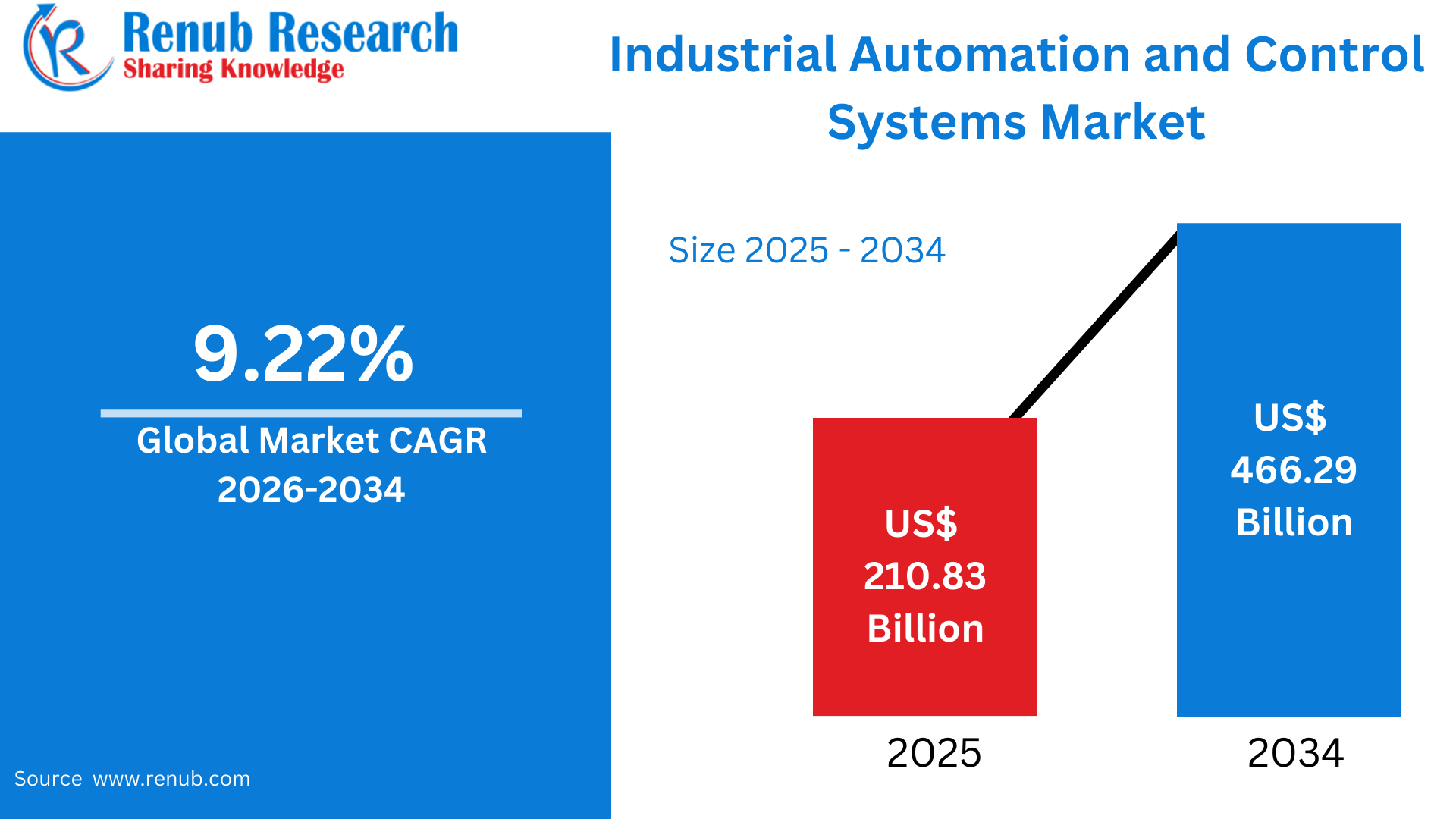
Industrial Automation and Control Systems Market is projected to grow from US$ 210.83 billion in 2025 to US$ 466.29 billion by 2034, registering a CAGR of 9.22% during the forecast period from 2026 to 2034. The market is experiencing robust growth due to the rapid adoption of digital transformation strategies, increasing demand for real-time operational data, expanding implementation of industrial artificial intelligence (AI), and the global shift toward smart manufacturing facilities. Businesses across various industries are investing in advanced automation and control technologies to improve productivity, enhance process accuracy, and optimize resource utilization.
Industrial Automation And Control Systems Industry Overview
Industrial Automation and Control Systems (IACS) refer to integrated hardware and software platforms used to automate, monitor, and control industrial processes with precision and minimal human intervention. These systems include PLCs, SCADA, DCS, HMI, sensors, industrial networks, and intelligent controllers. IACS enhances productivity, accuracy, and consistency by enabling real-time decision-making, advanced data analysis, and automated process execution. They play a critical role in manufacturing, energy, oil and gas, automotive, chemicals, pharmaceuticals, and utilities. As industries adopt digitalization, AI, robotics, and IIoT technologies, IACS acts as the backbone of smart factories, predictive maintenance, and end-to-end process optimization.
The IACS market is expanding rapidly due to rising industrial digitalization, increasing demand for real-time monitoring, and the need for cost-efficient, high-precision production processes. The shift toward smart factories and predictive maintenance is encouraging greater adoption of advanced automation solutions. Additionally, industries are adopting AI-driven analytics, robotics, and IIoT-based architectures to improve flexibility and productivity. The need to streamline operations, reduce downtime, and enhance safety is pushing companies toward advanced automation platforms. Growing investments in semiconductor development, open automation frameworks, and high-performance controllers also contribute significantly to market acceleration across industrial sectors.
What is Industrial Automation and Control Systems and Its Uses & Popularity Worldwide?
Industrial Automation and Control Systems (IACS) refer to integrated technologies that automate, monitor, and control industrial processes with minimal human intervention. These systems combine programmable logic controllers (PLCs), distributed control systems (DCS), supervisory control and data acquisition (SCADA), human-machine interfaces (HMI), industrial robots, sensors, drives, and industrial software to improve production efficiency, precision, and operational safety.
Industrial automation enables manufacturers to streamline workflows, reduce manual errors, optimize energy consumption, and maintain consistent product quality while increasing overall productivity. These systems are widely used across industries including automotive, oil and gas, chemicals, pharmaceuticals, food and beverages, power generation, mining, electronics, logistics, and water treatment.
Worldwide, the popularity of industrial automation and control systems is rapidly increasing as manufacturers embrace Industry 4.0, Industrial Internet of Things (IIoT), artificial intelligence (AI), cloud computing, and digital twin technologies. Growing demand for smart factories, predictive maintenance, real-time production monitoring, and data-driven decision-making is accelerating global adoption. Rising labor costs, increasing focus on workplace safety, and the need for sustainable manufacturing practices continue to make industrial automation and control systems essential for modern industrial operations.
Growth Drivers of the Industrial Automation and Control Systems Market
Expansion of Smart Manufacturing and Industry 4.0 Initiatives
The rapid adoption of Industry 4.0 technologies and smart manufacturing is one of the primary drivers of the Industrial Automation and Control Systems Market. Manufacturers across automotive, electronics, pharmaceuticals, food processing, chemicals, and energy sectors are investing heavily in automation to improve productivity, product quality, and operational efficiency. Industrial automation enables real-time monitoring, predictive maintenance, intelligent production planning, and automated quality control while reducing manual intervention. According to the International Federation of Robotics (IFR), global industrial robot installations reached a record 541,302 units in 2023, reflecting continued investment in factory automation worldwide. The growing deployment of Industrial Internet of Things (IIoT), artificial intelligence (AI), digital twins, cloud computing, and advanced robotics is further transforming industrial operations. Smart factories equipped with programmable logic controllers (PLCs), distributed control systems (DCS), SCADA platforms, and industrial sensors enable faster decision-making and optimized resource utilization. As manufacturers seek higher efficiency, lower production costs, and improved flexibility, investments in industrial automation and intelligent control systems continue to accelerate globally.
Increasing Adoption of Artificial Intelligence and Industrial Internet of Things (IIoT)
Artificial intelligence (AI) and the Industrial Internet of Things (IIoT) are significantly reshaping industrial operations and driving demand for advanced automation and control systems. AI-powered analytics enable predictive maintenance, automated inspection, process optimization, energy management, and real-time production monitoring, allowing manufacturers to reduce downtime and improve equipment reliability. IIoT devices continuously collect operational data from machines, enabling intelligent decision-making and remote asset management across manufacturing facilities. According to IoT Analytics, the number of connected IoT devices worldwide exceeded 19 billion in 2024, with industrial applications representing one of the fastest-growing segments. Manufacturers are increasingly integrating AI algorithms with industrial robots, machine vision systems, autonomous guided vehicles, and edge computing platforms to improve manufacturing accuracy and operational agility. Cloud-based industrial software, digital twins, and intelligent process automation further strengthen production efficiency while minimizing operational risks. These technological advancements are encouraging industries to modernize legacy production facilities, creating sustained demand for industrial automation and control systems worldwide.
Rising Demand for Energy-Efficient and Sustainable Industrial Operations
The growing emphasis on sustainability, energy efficiency, and carbon emission reduction is accelerating investment in industrial automation and control technologies. Manufacturing industries are under increasing pressure to optimize energy consumption, reduce waste generation, and comply with stricter environmental regulations. Industrial automation systems enable continuous monitoring of energy usage, process efficiency, and equipment performance, allowing manufacturers to minimize resource consumption while maintaining high productivity. According to the International Energy Agency (IEA), the industrial sector accounts for nearly 37% of global final energy consumption, making energy optimization a strategic priority for manufacturers worldwide. Advanced automation platforms use AI, smart sensors, variable frequency drives, and energy management software to optimize production processes and reduce unnecessary energy losses. Automated process control also improves material utilization, reduces production defects, and lowers greenhouse gas emissions. As industries increasingly pursue net-zero targets and sustainable manufacturing strategies, demand for intelligent automation solutions that improve operational efficiency and environmental performance continues to grow across global industrial sectors.
Challenges of the Industrial Automation and Control Systems Market
High Capital Investment and Integration Complexity
The high initial investment required for industrial automation remains a significant challenge, particularly for small and medium-sized enterprises. Deploying advanced automation infrastructure—including programmable logic controllers (PLCs), distributed control systems (DCS), SCADA platforms, industrial robots, sensors, industrial Ethernet networks, and AI-powered software—requires substantial capital expenditure. Beyond equipment costs, organizations must invest in system integration, software licensing, workforce training, cybersecurity, maintenance, and infrastructure modernization. Integrating new automation technologies with existing legacy manufacturing systems often requires customized engineering and extended implementation timelines. According to the World Bank, small and medium-sized enterprises account for approximately 90% of businesses globally, and many face financial constraints that limit large-scale digital transformation investments. As a result, automation projects are frequently implemented in phases rather than through complete factory modernization. These financial and technical barriers slow the pace of automation adoption, particularly in developing economies where manufacturing companies operate under tighter capital budgets and infrastructure limitations.
Rising Cybersecurity Threats in Connected Industrial Environments
The increasing connectivity of industrial automation systems has significantly expanded cybersecurity risks across manufacturing environments. As factories integrate Industrial Internet of Things (IIoT), cloud computing, artificial intelligence, remote monitoring, and industrial networking technologies, operational technology (OT) systems become more vulnerable to cyberattacks. Industrial control systems such as SCADA, DCS, PLCs, and industrial communication networks are attractive targets because disruptions can halt production, damage equipment, compromise worker safety, and result in significant financial losses. According to IBM’s Cost of a Data Breach Report 2024, the global average cost of a data breach reached approximately US$ 4.88 million, highlighting the growing financial impact of cybersecurity incidents. Many industrial facilities continue to operate legacy control systems that were not originally designed with modern cybersecurity protections, increasing their exposure to cyber threats. Strengthening industrial cybersecurity requires continuous investment in network segmentation, encryption, identity management, threat detection, and employee awareness programs, making cybersecurity one of the most critical challenges facing the Industrial Automation and Control Systems Market.
Industrial Automation and Control Systems Launches Worldwide
- Siemens – SIMATIC S7-1200 G2 PLC (March 2025)
Siemens launched the SIMATIC S7-1200 G2, a next-generation programmable logic controller (PLC) featuring higher processing power, integrated cybersecurity functions, improved communication capabilities, and enhanced motion control for smart manufacturing and Industry 4.0 applications. - Schneider Electric – EcoStruxure Automation Expert Platform (April 2025)
Schneider Electric expanded its EcoStruxure Automation Expert platform, introducing software-defined and vendor-agnostic automation capabilities that improve interoperability, engineering flexibility, and digital transformation across industrial facilities. - Rockwell Automation – FactoryTalk Optix (February 2025)
Rockwell Automation introduced the latest version of FactoryTalk Optix, an advanced Human-Machine Interface (HMI) platform with cloud connectivity, edge computing support, remote visualization, and AI-enabled industrial analytics. - ABB – OmniCore Industrial Robot Controller (2024)
ABB launched the OmniCore Controller, providing faster robot performance, enhanced precision, AI-enabled automation capabilities, and reduced energy consumption for manufacturing, logistics, and electronics industries. - Emerson – DeltaV Automation Platform Update (2024)
Emerson introduced an upgraded DeltaV Distributed Control System (DCS) featuring improved cybersecurity, predictive maintenance capabilities, enhanced operator interfaces, and cloud-ready industrial automation for process industries. - Honeywell – Experion PKS Release R530 (2024)
Honeywell launched the latest Experion Process Knowledge System (PKS), offering enhanced SCADA functionality, advanced cybersecurity, AI-assisted operational insights, and improved industrial process control. - Mitsubishi Electric – MELSEC MX Controller Series (2024)
Mitsubishi Electric introduced the MELSEC MX Controller, integrating PLC, motion control, safety, and industrial networking into a single high-performance automation platform for smart factories. - GigaDevice – GD32H75E EtherCAT SubDevice Controller (November 2024)
GigaDevice launched the GD32H75E EtherCAT SubDevice Controller, designed for programmable logic controllers, servo systems, industrial Ethernet communication, and real-time factory automation applications. - Yokogawa – CENTUM VP Release 7 (2024)
Yokogawa Electric released CENTUM VP Release 7, an enhanced distributed control system featuring stronger cybersecurity, cloud integration, advanced diagnostics, and improved lifecycle management for industrial plants. - Bosch Rexroth – ctrlX Automation Platform Update (2024)
Bosch Rexroth expanded its ctrlX Automation platform with new AI-enabled applications, open automation architecture, edge computing capabilities, and advanced industrial communication technologies to support flexible and software-defined manufacturing.
Growing Adoption of Distributed Control Systems in Process Industries
Industrial Distributed Control System (DCS) segment represents one of the most critical components of the Industrial Automation and Control Systems Market, particularly in process-intensive industries such as oil and gas, chemicals, power generation, pharmaceuticals, mining, pulp and paper, and water treatment. DCS platforms provide centralized monitoring and decentralized process control, enabling manufacturers to manage complex production operations with high reliability and precision. Modern DCS solutions integrate artificial intelligence, Industrial Internet of Things (IIoT), cloud analytics, and predictive maintenance capabilities to optimize plant performance while reducing operational downtime. As industrial facilities increasingly modernize aging infrastructure, demand for scalable and cyber-secure DCS platforms continues to rise. According to industry estimates, process industries account for more than 40% of global industrial automation investments, highlighting the importance of DCS solutions in modern manufacturing. The growing emphasis on operational safety, energy efficiency, regulatory compliance, and digital transformation is expected to further strengthen the adoption of distributed control systems across global industrial operations throughout the forecast period.
Rising Demand for Advanced Human-Machine Interface (HMI) Solutions
Human-Machine Interface (HMI) segment is witnessing significant growth as industries prioritize user-friendly visualization, real-time monitoring, and intelligent process control. HMI systems enable operators to monitor production equipment, analyze machine performance, detect operational abnormalities, and control industrial processes through intuitive graphical interfaces. Modern HMI platforms incorporate touchscreen technology, cloud connectivity, mobile accessibility, AI-powered analytics, and remote monitoring capabilities, improving operational efficiency and reducing response times. Industries including automotive, food and beverage, pharmaceuticals, electronics, energy, and manufacturing increasingly rely on advanced HMI systems to improve productivity while minimizing operator errors. The expansion of smart factories and Industry 4.0 initiatives has accelerated demand for interactive dashboards and centralized production management solutions. Growing investments in industrial digitalization, predictive maintenance, and remote plant management continue to support HMI adoption worldwide. As manufacturers seek greater visibility into production processes and faster decision-making, the HMI segment is expected to remain one of the fastest-growing areas within industrial automation and control systems.
Expanding Deployment of Industrial Robots Across Manufacturing Industries
Industrial Robots segment continues to be a major contributor to the Industrial Automation and Control Systems Market as manufacturers increasingly automate repetitive, hazardous, and precision-based production tasks. Industrial robots improve production speed, consistency, product quality, and workplace safety while reducing labor costs and operational inefficiencies. They are extensively used for welding, assembly, packaging, painting, inspection, machine tending, and material handling across automotive, electronics, metal fabrication, logistics, food processing, and pharmaceutical industries. According to the International Federation of Robotics (IFR), global industrial robot installations reached approximately 541,000 units in 2023, demonstrating continued investment in manufacturing automation worldwide. Advances in collaborative robots (cobots), AI-powered vision systems, autonomous mobile robots, and machine learning algorithms are expanding robotic applications beyond traditional manufacturing environments. The increasing shortage of skilled labor, rising wage pressures, and growing demand for flexible production systems are encouraging companies to invest in intelligent robotic automation, supporting sustained growth of this market segment over the coming years.
Increasing Automation Across Healthcare Manufacturing and Medical Facilities
Healthcare Industrial Automation and Control Systems segment is experiencing rapid expansion due to the growing need for precision, efficiency, and regulatory compliance across pharmaceutical manufacturing, biotechnology production, medical device manufacturing, and hospital operations. Automation technologies help healthcare organizations streamline production processes, improve product quality, reduce human errors, and ensure compliance with stringent international quality standards. Industrial automation systems—including programmable logic controllers (PLCs), robotics, SCADA systems, machine vision, and automated packaging solutions—are widely used in sterile manufacturing, laboratory automation, vaccine production, diagnostic equipment assembly, and pharmaceutical packaging. The increasing adoption of AI-powered manufacturing, digital quality management systems, and automated inspection technologies further enhances operational accuracy and traceability. Rising global healthcare expenditure, expanding pharmaceutical production, growing demand for biologics, and increasing investments in smart manufacturing facilities continue to drive market growth. As healthcare companies focus on improving manufacturing efficiency while maintaining strict quality and safety standards, industrial automation and control systems are becoming an indispensable part of modern healthcare production and facility management.
Strong Industrial Digitalization and Smart Factory Investments in United States
United States Industrial Automation and Control Systems Market is one of the world’s largest and most technologically advanced markets, supported by widespread adoption of smart manufacturing technologies and Industry 4.0 initiatives. The country has more than 12 million manufacturing employees, and the manufacturing sector contributes approximately 10% of the national GDP, creating strong demand for industrial automation solutions. Manufacturers are increasingly deploying programmable logic controllers (PLCs), distributed control systems (DCS), SCADA platforms, industrial robots, machine vision systems, and AI-powered analytics to improve production efficiency and reduce operating costs. The automotive, aerospace, electronics, pharmaceutical, food and beverage, and oil & gas industries are leading adopters of intelligent automation technologies. The increasing use of Industrial Internet of Things (IIoT), cloud computing, digital twins, and predictive maintenance is transforming manufacturing operations across the country. Government support for domestic manufacturing, reshoring initiatives, and investments in semiconductor production continue to accelerate automation deployment. As labor shortages and rising operational costs persist, manufacturers are expected to further invest in advanced industrial automation and control systems.
Growing Adoption of Industry 4.0 Across Advanced Manufacturing in United Kingdom
United Kingdom Industrial Automation and Control Systems Market is expanding steadily as manufacturers accelerate digital transformation and invest in intelligent production technologies. Manufacturing contributes approximately 9% of the UK’s GDP, while the country remains a global leader in aerospace, automotive, pharmaceutical, food processing, and advanced engineering industries. Companies are modernizing production facilities by integrating industrial robots, human-machine interfaces (HMI), SCADA systems, distributed control systems, and Industrial Internet of Things (IIoT) platforms to improve operational efficiency and product quality. Growing emphasis on energy-efficient manufacturing, carbon reduction, and sustainable industrial practices is encouraging wider adoption of automation technologies. AI-powered quality inspection, predictive maintenance, and cloud-based industrial monitoring are increasingly being implemented to improve productivity and reduce downtime. In addition, the UK’s strong focus on research, innovation, and digital manufacturing supports the development of smart factories capable of highly flexible and data-driven production. These trends are expected to sustain long-term growth in the industrial automation and control systems market.
Rapid Industrialization and Government Manufacturing Initiatives in India
India Industrial Automation and Control Systems Market is witnessing robust growth, driven by rapid industrialization, expanding manufacturing capacity, and government-led initiatives promoting domestic production. Manufacturing contributes approximately 17% of India’s GDP, with the government targeting a significantly higher share through programs such as Make in India, Digital India, and the Production Linked Incentive (PLI) scheme. Industries including automotive, pharmaceuticals, electronics, food processing, chemicals, textiles, and renewable energy are investing heavily in automation technologies to improve productivity and global competitiveness. The adoption of programmable logic controllers (PLCs), industrial robots, supervisory control systems, machine vision, and Industrial Internet of Things (IIoT) solutions is increasing across both large enterprises and medium-sized manufacturers. Growing investments in industrial corridors, smart factories, warehouse automation, and digital manufacturing infrastructure are further supporting market expansion. Rising labor costs, increasing export-oriented production, and greater emphasis on product quality and operational efficiency are expected to continue driving demand for industrial automation and control systems throughout the forecast period.
Industrial Diversification and Vision 2030 Accelerate Automation Adoption in Saudi Arabia
Saudi Arabia Industrial Automation and Control Systems Market is expanding rapidly as the country advances economic diversification under Vision 2030 and invests heavily in industrial modernization. The Kingdom is developing advanced manufacturing capabilities beyond the oil sector, creating strong demand for automation technologies across petrochemicals, mining, power generation, food processing, pharmaceuticals, logistics, and water treatment industries. Saudi Arabia possesses some of the world’s largest oil and gas processing facilities, where distributed control systems (DCS), SCADA platforms, industrial sensors, and advanced process automation play a critical role in ensuring operational efficiency and safety. Large-scale investments in smart industrial cities, renewable energy projects, and digital infrastructure are encouraging greater deployment of Industrial Internet of Things (IIoT), artificial intelligence, robotics, and predictive maintenance solutions. Government initiatives supporting local manufacturing, industrial sustainability, and advanced technologies are strengthening market growth. As companies continue modernizing industrial facilities and improving production efficiency, demand for intelligent automation and control systems is expected to increase steadily across Saudi Arabia.
Recent Developments in Industrial Automation And Control Systems Market
- In April 2025, a global leader in digital transformation for energy management, Schneider Electric Company, introduced the open automation movement. The movement highlights its intent and includes liberalizing industrial automation to make it more accessible with the help of open and software-defined solutions. This initiative holds the vision of software-driven and vendor-agnostic automation solutions achieved by Schneider Electric.
- In March 2025, Oxa tapped NVIDIA to enhance industrial mobility automation. A self-driving vehicle software introduces, reinforcing its collaboration with the leader in the AI processor to expand its plans in the IMA sector. This can be attained with the support of physical AI, creating photoreal virtual real-world states to escalate its training tools.
- In November 2024, GigaDevice, a leading semiconductor supplier launched its EtherCat SubDevice Controller Chip, an ultra-high-performance industrial automation MCU series -GD32H75E. This new product is designed to meet the industrial automation market demand by providing optimal solutions for applications such as servo control, variable frequency drivers, industrial PLCs, and communication modules.
- In October 2024, Siemens launched the SIRIUS 3RC7 intelligent link module which offers s quick and easy way to gain complete data transparency. This innovation is equipped with Totally Integrated Automation (TIA) from Siemens which provides seamless integration into the existing automation environment.
- On July 2024, Nozomi Networks Inc., a leader in OT and IoT security, introduced Arc Embedded—the first security sensor for OT and IoT that can be embedded directly within Mitsubishi Electric programmable logic controllers (PLCs). This advancement provides security and operations teams with unprecedented process-level visibility into industrial automation equipment and field assets, enabling them to detect and counteract process-level threats and unauthorized activity. This solution enhances operational resilience, reduces cyber risk, and improves compliance without impacting existing resources or disrupting critical networks.
- In February 2023, ABB introduced an updated version of its ABB Ability™ Symphony® Plus distributed control system (DCS) to drive digital transformation in the power generation and water industries. DCS offers a secure OPC UA connection to Edge and Cloud environments, supporting digital advancement while maintaining core control and automation functions.
Market Segmentation
System
- Distributed Control System
- Programmable Logic Controller
- Supervisory Control and Data Acquisition
- Others
Component Type
- HMI
- Industrial Robots
- Control Valves
- Sensors
- Others
End Use
- Manufacturing
- Food & Beverage
- Healthcare
- Automotive
- Oil & Gas
- Chemical
- Energy & Utilities
- Mining & Metal
- Aerospace & Defense
- Others
Countries
North America
- United States
- Canada
Europe
- France
- Germany
- Italy
- Spain
- United Kingdom
- Belgium
- Netherlands
- Turkey
Asia Pacific
- China
- Japan
- India
- South Korea
- Thailand
- Malaysia
- Indonesia
- Australia
- New Zealand
Latin America
- Brazil
- Mexico
- Argentina
Middle East & Africa
- Saudi Arabia
- UAE
- South Africa
All companies have been covered with 5 Viewpoints
- Overview
- Key Persons
- Recent Development
- SWOT Analysis
- Revenue Analysis
Company Analysis
- Siemens AG
- Honeywell International Inc.
- General Electric Company
- Mitsubishi Electric
- Rockwell Automation
- Johnson Controls Inc.
- Schneider Electric
- Yokogawa Electric Corporation
- OMRON Corporation
- Danaher Corporation
Report Details:
| Report Features | Details |
| Base Year |
2025 |
| Historical Period |
2022 - 2025 |
| Forecast Period |
2026 - 2034 |
| Market |
US$ Billion |
| Segment Covered |
System, Component Type, End User and Countries |
| Countries Covered |
|
| Companies Covered |
|
| Customization Scope |
20% Free Customization |
| Post-Sale Analyst Support |
1 Year (52 Weeks) |
| Delivery Format |
PDF and Excel through Email (We can also provide the editable version of the report in PPT/Word format on request) |
Key Questions Answered in Report:
- How big is the Industrial Automation and Control Systems industry?
- What is the Industrial Automation and Control Systems growth rate?
- Who are the key players in Industrial Automation and Control Systems industry?
- What are the factors driving the Industrial Automation and Control Systems industry?
- Which Region held the largest market share in the Industrial Automation and Control Systems industry?
- What segments are covered in the Industrial Automation and Control Systems Market report?
Customization Services available
- Analysis of Market Size and Its Segments
- More Company Profiles (Upto 10 without any additional cost):
- Additional Countries (Other than mentioned Countries):
- Region/Country Specific Reports:
- Market Entry Strategy:
- Region-Specific Market Dynamics:
- Regional Market Share Analysis:
- Trade Analysis:
- Production Insights:
- Others Customized Requests:
For more information contact our analysts.
Need More Assistance?
- Talk to our analysts to get more precious information on the current market trends.
- Include more countries and segments and customize the report based on the final requirement.
- Get a competitive advantage in your industry by knowing the report findings and making a positive impact on your revenues and operations.
- Our analysts are always ready to provide more help and pertinent information if you need any additional assistance.