India Industrial Automation Market Size, Share, Growth, Trends, Industry Analysis & Forecast 2026–2034
Buy NowIndia Industrial Automation Market Size & Forecast
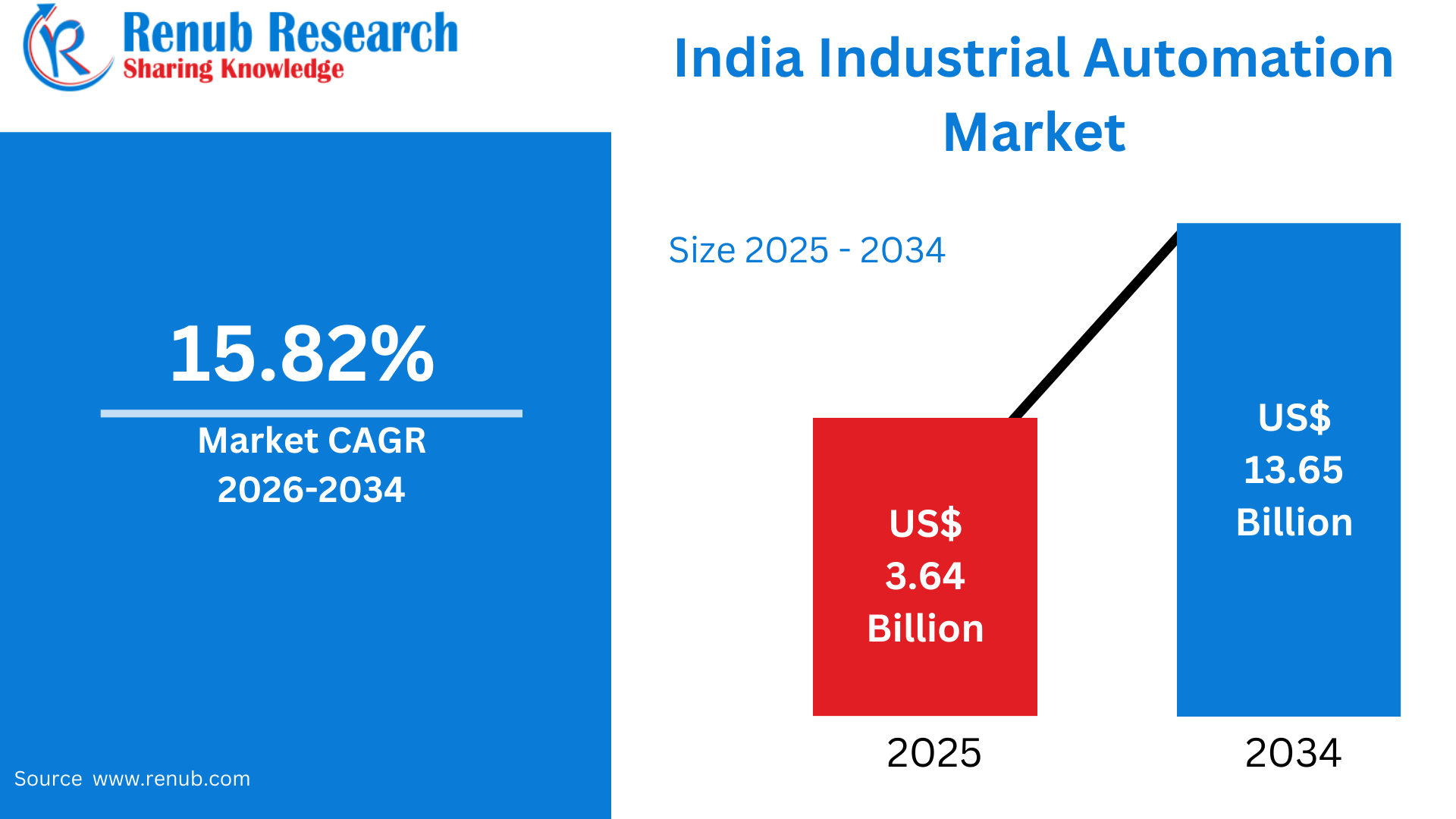
India Industrial Automation Market is projected to grow from US$ 3.64 billion in 2025 to US$ 13.65 billion by 2034, expanding at a CAGR of 15.82% during 2026–2034. The market is witnessing robust growth as industries increasingly adopt advanced automation technologies to improve productivity, operational efficiency, and product quality. Rapid digital transformation across manufacturing facilities, coupled with the widespread implementation of Industry 4.0 solutions, is encouraging businesses to integrate robotics, artificial intelligence (AI), machine learning, industrial Internet of Things (IIoT), and smart sensors into production processes. Government initiatives such as Make in India, the Production Linked Incentive (PLI) scheme, and the Digital India program are accelerating investments in smart manufacturing infrastructure.
India Industrial Automation Industry Overview
Industrial automation in India refers to the use of technologies such as robotics, industrial IoT, AI-based control systems, sensors, and advanced software to streamline manufacturing and operational processes. These systems help industries reduce manual intervention, enhance productivity, improve quality, and minimize downtime. Automation is widely deployed in sectors including automotive, pharmaceuticals, FMCG, chemicals, electronics, and heavy engineering. As India advances toward Industry 4.0, manufacturers are adopting smart factory solutions, digital twins, predictive maintenance, and cloud-connected equipment. Government initiatives like Make in India, PLI schemes, and digital transformation programs further boost automation adoption and strengthen India’s global competitiveness in manufacturing.
India’s industrial automation market is gaining momentum due to increasing adoption of Industry 4.0 technologies and rising demand for faster, safer, and more efficient manufacturing processes. Industries are integrating robotics, smart sensors, and AI-driven control systems to improve reliability and reduce operational costs. Expansion of the electronics, automotive, and pharmaceutical sectors fuels the need for automated production lines. Businesses are also embracing predictive analytics, cloud-based monitoring, and real-time data systems to optimize performance. With supportive policies, growing digital infrastructure, and heightened focus on global competitiveness, automation technologies are becoming essential to India’s rapidly modernizing industrial landscape.
What is Industrial Automation and Its Uses & Popularity in India?
Industrial automation refers to the use of advanced technologies such as robotics, programmable logic controllers (PLCs), industrial sensors, artificial intelligence (AI), machine learning, industrial Internet of Things (IIoT), and automated control systems to operate manufacturing and industrial processes with minimal human intervention. Its primary objective is to improve production efficiency, accuracy, product quality, workplace safety, and operational reliability while reducing labor costs and downtime. Industrial automation is widely used across industries including automotive, electronics, pharmaceuticals, food and beverage, chemicals, oil and gas, textiles, logistics, and power generation. In India, industrial automation has gained significant popularity as manufacturers increasingly embrace Industry 4.0 and smart factory solutions to remain globally competitive. Government initiatives such as Make in India, Digital India, and the Production Linked Incentive (PLI) scheme are encouraging businesses to modernize production facilities through automation. Rapid growth in electronics manufacturing, automotive production, renewable energy, and e-commerce logistics is further accelerating automation adoption. Additionally, rising demand for predictive maintenance, real-time monitoring, energy efficiency, and data-driven decision-making is driving investments in intelligent automation technologies, making industrial automation a key pillar of India’s rapidly evolving manufacturing sector.
Key Government Initiatives & Incentive Schemes
• SAMARTH Udyog Bharat 4.0 o It is a flagship initiative of India’s Ministry of Heavy Industries to promote smart and advanced manufacturing practices under the Industry 4.0 framework. o It supports the creation of Smart Manufacturing Demonstration Centres (SMDCs) across the country, enabling industries—especially MSMEs—to access cutting-edge technologies, training, and best practices for digital transformation.
• Digital MSME Scheme and MSME Competitive Lean Scheme o It is a Government of India initiative aimed at digitally empowering Micro, Small, and Medium Enterprises (MSMEs) by enhancing their access to affordable digital tools, ecommerce platforms, and online services. o It focuses on providing MSMEs with digital infrastructure, software solutions, and digital marketing support to improve their operational efficiency, competitiveness, and market reach.
• Production-Linked Incentive (PLI) schemes The PLI scheme, launched in 2020, incentivizes companies across 14 sectors—including electronics, textiles, pharmaceuticals, and automobiles—to scale up domestic manufacturing and boost India’s global competitiveness.
India's rise of the robots: Country among top 10 markets in installations
India is emerging as a significant player in the global industrial robot market, achieving the highest growth rate for installations in 2023. According to the International Federation of Robotics, India installed 8,510 industrial robots in 2023, marking a 59% increase from the previous year. This growth places India seventh among the top ten markets globally, outperforming France, Mexico, Spain, and Italy. Despite fluctuations in annual installations, India has shown substantial improvement over the past decade, with notable growth in 2021 and 2023. The automotive industry dominates industrial robot adoption in India, accounting for 42% of the total market share, with installations increasing by 139% to 3,551 units in 2023. Other sectors, such as rubber and plastics, also contributed to the growth with a 17% increase in installations.
However, India still lags in robot density, a key indicator of industrial automation maturity. In 2021, India had only seven robots per 10,000 manufacturing employees, compared to the global average of 141. Even within the automotive industry, where India performs well, the density was 148 robots per 10,000 workers, significantly lower than South Korea's 2,867, Germany's 1,500, and China's 772. While India's robot workforce is growing, it is starting from an extremely low base, indicating that there is substantial room for further development and expansion in the use of industrial robots across various sectors.
Growth Drivers for the India Industrial Automation Market
Expansion of Semiconductor and Electronics Manufacturing
India’s rapidly expanding semiconductor and electronics manufacturing sector is significantly accelerating the adoption of industrial automation technologies. As manufacturers establish advanced production facilities, the demand for highly accurate, reliable, and automated manufacturing processes continues to increase. Automation solutions, including industrial robots, programmable logic controllers (PLCs), machine vision systems, industrial Internet of Things (IIoT) platforms, and automated material handling systems, enable manufacturers to achieve higher precision, greater production efficiency, and consistent product quality while minimizing defects and operational downtime. Government initiatives such as the India Semiconductor Mission, the Production Linked Incentive (PLI) scheme, and Make in India are attracting substantial investments in semiconductor fabrication, electronic component manufacturing, and assembly operations. The growing production of smartphones, consumer electronics, electric vehicle components, and advanced electronic devices further strengthens the need for intelligent automation. As India’s electronics manufacturing ecosystem continues to expand, industrial automation is expected to play a crucial role in improving productivity, ensuring quality control, and enhancing global manufacturing competitiveness.
Shift Toward Open, Interoperable, and Software-Driven Automation
The growing adoption of open, software-defined, and interoperable automation platforms is transforming India’s industrial landscape. Traditional proprietary automation systems often limit flexibility, increase integration costs, and make future upgrades more complex. Modern manufacturers are increasingly shifting toward open automation architectures that support seamless communication between equipment from multiple vendors while simplifying system integration and expansion. Software-driven automation enables real-time data sharing, centralized monitoring, predictive maintenance, and remote management of industrial operations. These flexible platforms also facilitate the adoption of artificial intelligence, cloud computing, digital twins, and advanced analytics to improve production planning and operational efficiency. Industries such as automotive, pharmaceuticals, chemicals, food processing, and consumer goods are increasingly embracing modular automation systems to improve productivity and reduce lifecycle costs. As digital transformation becomes a strategic priority across Indian manufacturing, open and interoperable automation solutions are expected to become one of the strongest drivers supporting long-term industrial automation market growth.
Rising Focus on Digital Transformation and Sustainable Manufacturing
The increasing emphasis on digital transformation and sustainable manufacturing practices is driving substantial investments in industrial automation across India. Manufacturers are integrating artificial intelligence, industrial IoT, smart sensors, cloud-based monitoring systems, and advanced analytics to optimize production processes while minimizing energy consumption and operational waste. Automation enables real-time monitoring of equipment performance, predictive maintenance, resource optimization, and improved production planning, helping organizations enhance operational efficiency while reducing environmental impact. Growing environmental, social, and governance (ESG) commitments are encouraging industries to deploy intelligent automation systems that support emission monitoring, energy management, waste reduction, and workplace safety. The rapid adoption of Industry 4.0 technologies is enabling manufacturers to create connected smart factories capable of making data-driven decisions and responding quickly to changing market demands. As Indian industries continue prioritizing sustainability, operational excellence, and global competitiveness, investments in digital automation technologies are expected to expand significantly throughout the forecast period.
Challenges in the India Industrial Automation Market
High Capital Investment and Limited Adoption Among SMEs
The high initial investment required for industrial automation remains one of the biggest challenges restricting market growth in India. Deploying advanced robotics, industrial control systems, AI-powered software, industrial sensors, and digital infrastructure requires substantial capital expenditure, making automation less accessible for many small and medium-sized enterprises (SMEs). Beyond equipment costs, businesses must also invest in software integration, employee training, maintenance, cybersecurity, and ongoing system upgrades. Many SMEs remain uncertain about the return on investment and hesitate to modernize existing production facilities due to budget limitations and operational risks. Since SMEs constitute a significant portion of India’s manufacturing sector, their slower adoption of automation limits overall market penetration. Developing cost-effective automation solutions, flexible financing options, and government support programs will be essential to encourage broader adoption and strengthen India’s manufacturing competitiveness.
Skilled Workforce Shortage and Technical Expertise Gaps
The shortage of skilled professionals capable of operating and maintaining advanced automation systems continues to challenge India’s industrial automation market. Modern manufacturing increasingly relies on robotics, artificial intelligence, industrial Internet of Things (IIoT), cloud computing, machine learning, and advanced industrial software that require specialized technical knowledge. However, many workers lack practical experience in programming, system integration, industrial networking, predictive maintenance, and digital manufacturing technologies. The gap between industry requirements and available technical skills often delays automation implementation and reduces operational efficiency. Limited collaboration between educational institutions and industrial organizations further contributes to the shortage of qualified automation engineers and technicians. Companies are therefore investing heavily in employee upskilling, certification programs, and technical training to prepare their workforce for Industry 4.0. Strengthening technical education and expanding digital manufacturing skills will be critical to supporting India’s long-term industrial automation growth.
Industrial Automation Launches in India
- Schneider Electric – Open Automation Movement (2025)
Schneider Electric launched its Open Automation Movement in India, promoting software-defined, interoperable, and vendor-neutral industrial automation solutions. The platform enables plug-and-play integration, improves operational flexibility, and accelerates Industry 4.0 adoption across manufacturing industries. - ABB India – Digital Manufacturing & ESG Solutions (2024)
ABB India introduced advanced industrial automation and digitalization solutions designed to improve factory productivity, predictive maintenance, energy efficiency, and sustainability while supporting manufacturers’ ESG goals. - Siemens India – SIMATIC S7-1200 G2 PLC (2025)
Siemens India launched the SIMATIC S7-1200 G2 programmable logic controller (PLC), offering faster processing, improved cybersecurity, enhanced communication capabilities, and greater flexibility for smart manufacturing applications. - Rockwell Automation – FactoryTalk Optix Platform (2024)
Rockwell Automation introduced FactoryTalk Optix, a next-generation human-machine interface (HMI) platform that enables scalable visualization, cloud connectivity, remote monitoring, and real-time industrial control. - Emerson – AVENTICS Series XV Pneumatic Valve System (2024)
Emerson launched the AVENTICS Series XV, an intelligent pneumatic valve platform that improves machine automation, simplifies maintenance, and enhances manufacturing productivity across industrial applications. - Honeywell – Forge Performance+ for Industrials (2024)
Honeywell introduced Forge Performance+, an AI-powered industrial software platform that enables predictive maintenance, production optimization, asset performance monitoring, and digital transformation for manufacturing facilities. - Mitsubishi Electric India – MELSEC iQ-R Automation Controller (2024)
Mitsubishi Electric expanded its automation portfolio in India with the MELSEC iQ-R Series, providing high-speed industrial control, advanced networking, enhanced cybersecurity, and seamless Industry 4.0 integration. - Yokogawa India – OpreX Robot Management Core (2024)
Yokogawa launched the OpreX Robot Management Core, a software solution that centrally manages industrial robots, automates maintenance scheduling, and improves operational efficiency within smart factories. - Delta Electronics India – DIATwin Digital Twin Platform (2024)
Delta Electronics introduced the DIATwin Digital Twin Platform, enabling manufacturers to simulate production processes, optimize equipment performance, improve predictive maintenance, and accelerate digital manufacturing initiatives. - Bosch Rexroth India – ctrlX Automation Platform (2024)
Bosch Rexroth launched the ctrlX Automation Platform in India, an open automation ecosystem that integrates PLCs, motion control, IoT connectivity, artificial intelligence, and edge computing for highly flexible smart manufacturing operations.
Digital Manufacturing Accelerating Industrial Software Adoption in India
India Industrial Automation Software Market is experiencing rapid growth as manufacturers increasingly adopt digital technologies to optimize production, improve operational efficiency, and support Industry 4.0 initiatives. Industrial automation software enables real-time monitoring, production planning, predictive maintenance, process optimization, and centralized control of manufacturing operations. Solutions such as Supervisory Control and Data Acquisition (SCADA), Manufacturing Execution Systems (MES), Distributed Control Systems (DCS), Human Machine Interfaces (HMI), and Enterprise Resource Planning (ERP) integration are becoming essential across industries. Automotive, pharmaceuticals, electronics, food and beverage, chemicals, and energy sectors are investing heavily in automation software to improve productivity, reduce downtime, and ensure product quality. The growing use of artificial intelligence, machine learning, cloud computing, digital twins, and Industrial Internet of Things (IIoT) platforms is further enhancing software capabilities. As manufacturers continue modernizing factories and implementing data-driven production strategies, the demand for industrial automation software is expected to expand significantly across India’s industrial sector.
Industrial Automation Robotics Transforming Smart Manufacturing in India
India Industrial Automation Robots Market is expanding rapidly as industries increasingly deploy robotic systems to improve manufacturing precision, efficiency, and workplace safety. Industrial robots perform repetitive, hazardous, and high-precision tasks such as welding, assembly, painting, packaging, inspection, machine tending, and material handling with greater consistency than manual operations. Automotive manufacturing remains the largest adopter of industrial robots, while electronics, pharmaceuticals, food processing, logistics, and metal fabrication industries are also accelerating robotic deployment. Collaborative robots (cobots), artificial intelligence-powered robots, and vision-guided robotic systems are becoming increasingly popular because they can safely work alongside human employees while improving productivity. Rising labor costs, growing demand for consistent product quality, and increasing production volumes continue to encourage automation investments. Government initiatives promoting advanced manufacturing and smart factories further strengthen robot adoption. As India’s manufacturing sector continues embracing Industry 4.0 technologies, industrial robotics will remain a key driver of automation and industrial competitiveness.
Enhancing Workplace Safety Through Intelligent Automation in India Industrial Automation Safety
India Industrial Automation Safety Market is witnessing strong growth as industries prioritize employee safety, regulatory compliance, and operational reliability. Industrial safety automation includes safety sensors, emergency shutdown systems, programmable safety controllers, machine guarding systems, safety relays, safety light curtains, and integrated monitoring solutions that minimize workplace accidents and equipment failures. Manufacturing industries including automotive, oil and gas, chemicals, pharmaceuticals, mining, power generation, and food processing are investing in advanced safety technologies to reduce operational risks while ensuring uninterrupted production. The integration of artificial intelligence, Industrial Internet of Things (IIoT), predictive analytics, and real-time monitoring enables manufacturers to identify equipment failures, hazardous conditions, and operational anomalies before they cause accidents. Growing awareness of occupational safety standards and increasing adoption of smart manufacturing practices continue to accelerate investments in industrial safety automation. As Indian industries modernize production facilities, automation-based safety systems will remain essential for improving worker protection and operational efficiency.
Smart Processing Driving Manufacturing Efficiency in India Industrial Automation Food & Beverage
India Industrial Automation Food & Beverage Market is expanding steadily as food manufacturers adopt advanced automation technologies to improve productivity, product quality, food safety, and operational efficiency. Automation solutions are widely used for food processing, packaging, bottling, labeling, sorting, quality inspection, palletizing, and warehouse management. Automated production systems help manufacturers maintain consistent product quality while reducing human errors, contamination risks, production waste, and operating costs. Artificial intelligence, robotics, machine vision systems, Industrial Internet of Things (IIoT), and automated process control technologies enable real-time monitoring and optimization of production lines. Growing consumer demand for packaged foods, beverages, dairy products, ready-to-eat meals, and processed foods is encouraging manufacturers to expand production capacity through intelligent automation. Compliance with stringent food safety regulations and traceability requirements further supports investment in digital manufacturing technologies. As India’s food processing industry continues to modernize, industrial automation will play a critical role in enhancing efficiency, sustainability, and long-term competitiveness.
Maharashtra Manufacturing Hub Accelerating Smart Factory Adoption
Maharashtra Industrial Automation Market is the largest and most mature industrial automation market in India, driven by the state’s strong manufacturing ecosystem and rapid industrial modernization. Maharashtra is home to major automotive, pharmaceuticals, chemicals, engineering, electronics, food processing, and consumer goods industries that increasingly rely on automation to improve productivity, product quality, and operational efficiency. Manufacturers are investing in industrial robots, programmable logic controllers (PLCs), supervisory control and data acquisition (SCADA) systems, artificial intelligence (AI), Industrial Internet of Things (IIoT), and advanced manufacturing execution systems to support smart factory initiatives. The presence of major industrial corridors, special economic zones, and logistics infrastructure further encourages automation investments across production facilities. Growing adoption of predictive maintenance, cloud-based manufacturing platforms, and energy-efficient production systems is strengthening digital transformation across industries. As companies continue expanding manufacturing capacity and adopting Industry 4.0 technologies, Maharashtra is expected to remain a leading contributor to India’s industrial automation market throughout the forecast period.
Tamil Nadu Automotive and Electronics Industries Driving Automation Growth
Tamil Nadu Industrial Automation Market is experiencing significant expansion due to the state’s well-established automotive, electronics, textiles, renewable energy, and heavy engineering industries. Often recognized as one of India’s largest manufacturing destinations, Tamil Nadu has become a major hub for advanced production technologies and smart manufacturing practices. Industrial automation solutions such as robotics, automated assembly systems, machine vision, distributed control systems (DCS), and industrial software are increasingly deployed to improve production efficiency, reduce operational costs, and enhance product quality. The rapid growth of electric vehicle manufacturing, electronics production, and export-oriented industries has accelerated demand for intelligent automation technologies. Manufacturers are also integrating artificial intelligence, Industrial Internet of Things (IIoT), cloud computing, and predictive maintenance systems to optimize factory operations. Government support for industrial development, expanding industrial parks, and continuous investments in advanced manufacturing infrastructure are expected to further strengthen Tamil Nadu’s position as one of India’s fastest-growing industrial automation markets.
Karnataka Industrial Technology Innovation Supporting Industrial Digitalization
Karnataka Industrial Automation Market is expanding rapidly as the state combines its strong technology ecosystem with a growing manufacturing base. Karnataka’s leadership in information technology, electronics, aerospace, biotechnology, precision engineering, and machine manufacturing has created favorable conditions for widespread adoption of industrial automation solutions. Manufacturers are increasingly deploying industrial robots, artificial intelligence, Industrial Internet of Things (IIoT), cloud-based manufacturing platforms, digital twins, and advanced analytics to improve operational efficiency and production flexibility. The state’s thriving startup ecosystem and research institutions further encourage innovation in automation software, industrial intelligence, and smart manufacturing technologies. Growing investments in electronics manufacturing, electric vehicles, semiconductor development, and aerospace production continue to generate demand for highly automated production environments. In addition, companies are prioritizing predictive maintenance, cybersecurity, and energy-efficient manufacturing systems to remain globally competitive. These factors position Karnataka as one of India’s most advanced and technology-driven industrial automation markets.
Uttar Pradesh Industrial Expansion Creating New Automation Opportunities
Uttar Pradesh Industrial Automation Market is witnessing strong growth as rapid industrialization, infrastructure development, and manufacturing investments increase across the state. Expanding sectors such as electronics, food processing, textiles, automotive components, pharmaceuticals, logistics, and consumer goods are driving demand for advanced automation technologies that improve production efficiency and operational reliability. Manufacturers are increasingly implementing programmable logic controllers (PLCs), industrial robotics, automated material handling systems, machine vision technologies, and Industrial Internet of Things (IIoT) solutions to modernize production facilities and reduce manual intervention. The development of industrial corridors, manufacturing clusters, logistics parks, and electronics production hubs is further supporting automation adoption. Growing awareness of smart manufacturing, digital transformation, workplace safety, and energy-efficient production is encouraging businesses to invest in intelligent automation systems. As Uttar Pradesh continues strengthening its industrial base through manufacturing expansion and technology adoption, the demand for industrial automation solutions is expected to grow steadily over the forecast period.
Recent Developments in India Industrial Automation Market
- September 2025: Schneider Electric finalized the purchase of the remaining 35% stake in its India joint venture for INR 499,000 million, giving the company complete ownership of its domestic operations. This move strengthens Schneider’s competitive positioning and supports its ambition to secure nearly 25% of India’s industrial automation market.
- July 2025: Sonepar India entered into a new distribution partnership with Siemens, enabling broader availability of Siemens’ industrial automation solutions across Tier-2 and Tier-3 regions. The collaboration aims to deepen market penetration and enhance supply-chain reach in emerging industrial clusters.
- December 2024: ABB expanded its capabilities in smart infrastructure and industrial digitalization by acquiring Solutions Industry and Building, strengthening its ability to deliver integrated automation solutions across commercial and industrial environments.
- December 2024: Rockwell Automation announced plans to transform India into a major manufacturing hub for its global operations. The decision builds on India’s strong IT and engineering talent base, which Rockwell has already been leveraging for international digital automation projects.
- December 2024: Honeywell was selected to implement automation and energy-optimization technologies for the upcoming Melton Hospital in Australia. The project includes the deployment of IoT-enabled building management systems, advanced HVAC controls, and integrated lighting solutions to enhance efficiency, reduce energy consumption, and improve overall patient comfort. This initiative reinforces Honeywell’s expanding role in smart and sustainable healthcare infrastructure.
- October 2024: Delta Electronics introduced a new portfolio of smart building automation products at the ISE 2025 event. The offerings combine energy-efficient HVAC, intelligent lighting, and building automation systems with IoT connectivity and AI-driven analytics. The solutions provide real-time insights and predictive maintenance capabilities, showcasing Delta’s commitment to sustainable, high-performance building technologies.
- October 2024: Honeywell and Chevron announced a collaboration to develop AI-enabled refinery optimization solutions. By merging Honeywell’s process automation expertise with Chevron’s operational knowledge, the partnership aims to enhance safety, increase plant efficiency, reduce emissions, and improve overall refinery profitability through real-time analytics and predictive monitoring.
- August 2024: Neilsoft launched a suite of Industry 4.0 solutions in India to support digital transformation across manufacturing and automation environments. The company’s offering spans Digital Factory, Manufacturing Automation, and Building Automation technologies, enabling organizations to modernize operations at the shopfloor, plant-wide, and enterprise levels.
Market Segmentation
Component
- Hardware
- Software
- Service
Hardware
- Industrial Sensors
- Machine Vision Systems
- Field Instruments
- Industrial Robots
- Human machine Interface
- Industrial PCs
- Others
Software
- Manufacturing Execution System
- Industrial Safety
- Plant Asset Management
- Supervisory Control and Data Acquisition
- Programmable Logic Controller
- Distributed Control System
Service
- Project Engineering and Installation
- Maintenance and Support Services
- Consulting Services
- Operational Services
End User
- Manufacturing
- Food & Beverage
- Healthcare
- Automotive
- Oil & Gas
- Chemical
- Energy & Utilities
- Mining & Metal
- Aerospace & Defense
- Others
Top States
- Maharashtra
- Tamil Nadu
- Karnataka
- Uttar Pradesh
- Gujarat
- West Bengal
- Rajasthan
- Telangana
- Andhra Pradesh
- Madhya Pradesh
- Other States
All companies have been covered with 5 Viewpoints
- Overview
- Key Persons
- Recent Development & Strategies
- SWOT Analysis
- Revenue Analysis
Company Analysis
- Siemens AG
- Honeywell International Inc.
- Mitsubishi Electric
- Rockwell Automation
- Schneider Electric
- Bharat Heavy Electricals Limited (BHEL)
- ABB Ltd
Report Details:
| Report Features | Details |
| Base Year |
2025 |
| Historical Period |
2022 - 2025 |
| Forecast Period |
2026 - 2034 |
| Market |
US$ Billion |
| Segment Covered |
Component, Hardware, Software, Service, End User and Countries |
| States Covered |
|
| Companies Covered |
|
| Customization Scope |
20% Free Customization |
| Post-Sale Analyst Support |
1 Year (52 Weeks) |
| Delivery Format |
PDF and Excel through Email (We can also provide the editable version of the report in PPT/Word format on request) |
Customization Services available
- Analysis of Market Size and Its Segments
- More Company Profiles (Upto 10 without any additional cost):
- Additional Countries (Other than mentioned Countries):
- Region/Country Specific Reports:
- Market Entry Strategy:
- Region-Specific Market Dynamics:
- Regional Market Share Analysis:
- Trade Analysis:
- Production Insights:
- Others Customized Requests:
For more information contact our analysts.
Need More Assistance?
- Talk to our analysts to get more precious information on the current market trends.
- Include more countries and segments and customize the report based on the final requirement.
- Get a competitive advantage in your industry by knowing the report findings and making a positive impact on your revenues and operations.
- Our analysts are always ready to provide more help and pertinent information if you need any additional assistance.