India Online Food Delivery Market Size, Share, Growth Trends, Forecast by Type, Payment Mode, Cuisine, States and Company Analysis 2026-2034
Buy NowIndia Online Food Delivery Market Size
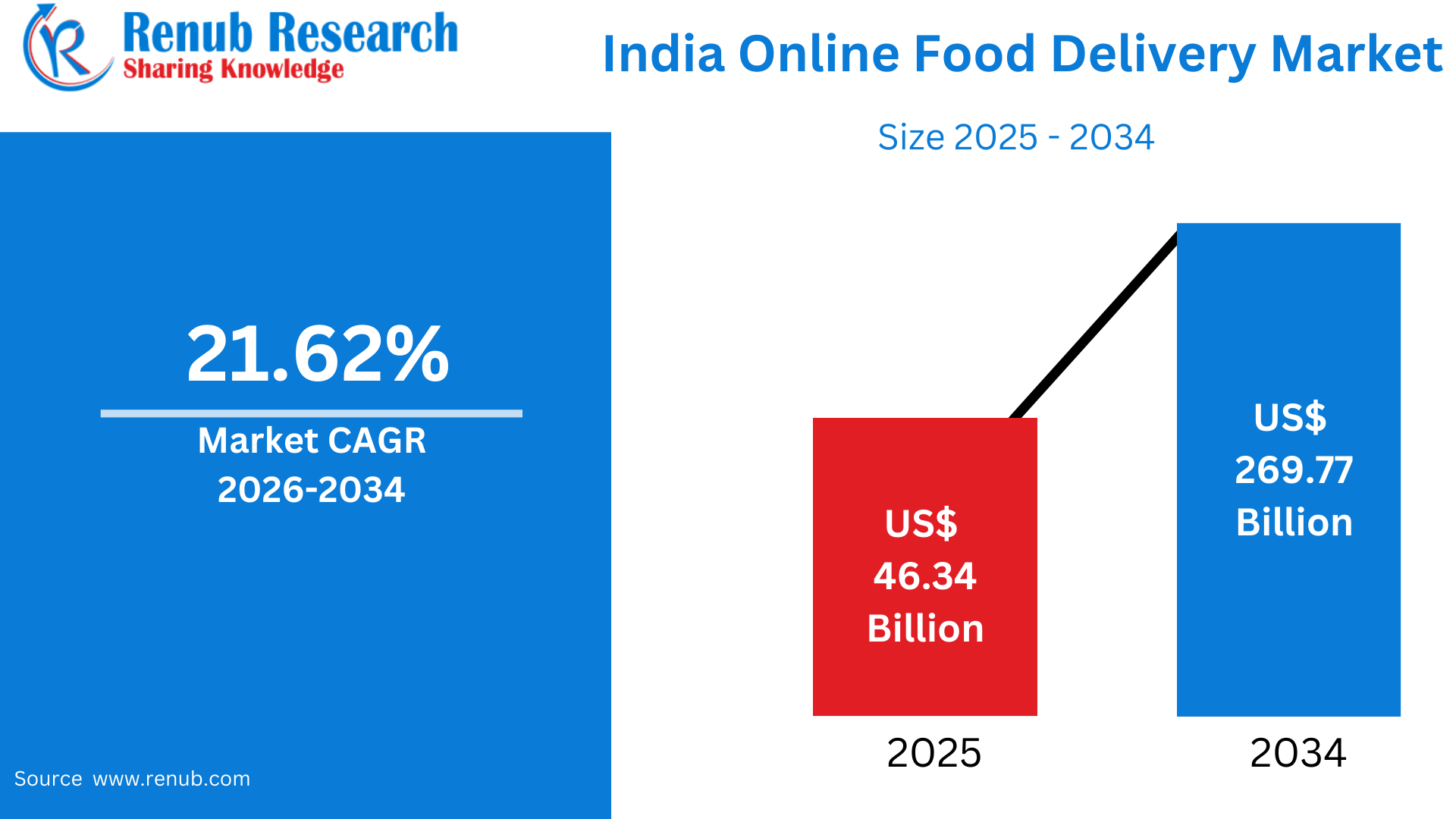
India Online Food Delivery Market is projected to grow from US$ 46.34 billion in 2025 to US$ 269.77 billion by 2034, registering a CAGR of 21.62% during the forecast period from 2026 to 2034. Market growth is driven by increasing smartphone penetration, the widespread adoption of digital payment platforms, and fast-paced urban lifestyles that encourage convenient meal ordering. Attractive discounts, subscription programs, and access to a wide variety of cuisines have further boosted consumer demand.
India Online Food Delivery Industry Overview
The online food delivery market in India enables consumers to order meals from restaurants, cloud kitchens, and cafés through mobile apps or websites. Platforms like Swiggy and Zomato offer extensive cuisine options, real-time tracking, digital payments, and personalized recommendations. Growing internet access, changing lifestyles, and increasing demand for convenience have accelerated adoption. Cloud kitchens and quick-service brands rely heavily on these platforms for reach and scalability. Urban professionals, students, and families prefer online delivery for convenience, variety, and affordability. With technological advancements, AI-driven recommendations, faster deliveries, and expanding service coverage, online food delivery has become an integral part of India’s consumption ecosystem.
India’s online food delivery market is driven by increasing digital adoption, rising disposable incomes, and the growing preference for convenience among urban consumers. The availability of diverse cuisines, flexible pricing, and quick delivery options further fuels demand. Platforms continually invest in route optimization, safety, and loyalty programs to enhance user experience. The expansion of cloud kitchens and restaurant aggregation has widened food choices. Additionally, rising smartphone penetration and seamless digital payment systems make ordering easy and accessible. Strong marketing campaigns, reward programs, and expanding service into Tier-2 and Tier-3 cities continue to accelerate the sector’s growth.
What is Online Food Delivery and Its Uses & Popularity in India
Online food delivery is a digital service that allows consumers to order meals, beverages, and groceries from restaurants, cloud kitchens, and food outlets through mobile applications or websites. Customers can browse menus, compare prices, customize orders, make secure digital payments, and track deliveries in real time. Modern food delivery platforms leverage technologies such as artificial intelligence (AI), GPS tracking, and data analytics to provide personalized recommendations, optimize delivery routes, and enhance customer satisfaction.
Online food delivery has gained tremendous popularity in India due to increasing smartphone penetration, affordable internet access, and the widespread adoption of digital payment methods such as UPI and mobile wallets. Busy urban lifestyles, longer working hours, and growing demand for convenience have encouraged consumers to order food instead of cooking at home. The availability of multiple cuisines, attractive discounts, subscription programs, and quick delivery services has further accelerated market growth. Expansion into Tier-2 and Tier-3 cities has significantly broadened the customer base, while the rapid growth of cloud kitchens has increased menu variety and service efficiency. Continuous improvements in logistics, AI-powered order recommendations, and faster delivery networks have made online food delivery an essential part of India’s evolving digital economy and modern consumer lifestyle.
India's internet usage grew from 15% to 70% in just a decade, fueled by Widespread Mobile Adoption
- India’s internet penetration increased from 15% in 2015 to 70% in 2025.
- Internet usage in India grew by 55 percentage points over the past decade.
- The global average internet penetration reached 74% in 2025.
- India’s 70% internet penetration is now close to the global average.
- High-income countries recorded approximately 94% internet penetration in 2025.
- Low-income countries reached around 23% internet penetration in 2025.
- Internet adoption in India remained below 5% until the late 2000s before accelerating rapidly.
- The fastest growth occurred after 2018, driven by affordable smartphones and low-cost mobile data.
- Mobile internet has been the primary driver of digital connectivity across urban and rural India.
- The rapid rise in internet access has supported the growth of e-commerce, online food delivery, digital payments, and other digital services.
Growth Driver of the India Online Food Delivery Market
Rapid Smartphone Penetration and Digital Payment Adoption
The rapid growth of smartphones and digital payment infrastructure is one of the primary drivers of India's online food delivery market. India has over 800 million smartphone users and more than 950 million internet subscribers, providing a massive customer base for food delivery platforms. Additionally, the widespread adoption of Unified Payments Interface (UPI) has transformed online transactions, with over 18 billion UPI transactions recorded in a single month during 2025, making cashless payments fast, secure, and convenient. Consumers can easily browse restaurant menus, place orders, make instant payments, and track deliveries through mobile applications. The availability of affordable mobile data and expanding 4G and 5G networks has further improved accessibility across urban and semi-urban regions. Food delivery companies continue integrating AI-powered recommendations, digital wallets, loyalty programs, and subscription services to enhance customer engagement. As internet connectivity and digital payment adoption continue expanding across India, online food ordering is expected to witness sustained long-term growth.
Urbanization, Changing Lifestyles, and Rising Disposable Income
Rapid urbanization and evolving consumer lifestyles are significantly accelerating India's online food delivery market. India is expected to have over 40% of its population living in urban areas by 2036, resulting in increasing demand for convenient meal solutions. Busy work schedules, dual-income households, longer commuting times, and changing food consumption habits have encouraged consumers to order ready-to-eat meals instead of cooking at home. Young professionals, students, and nuclear families increasingly rely on food delivery platforms for everyday dining convenience. Rising disposable incomes have also enabled greater spending on restaurant food, premium cuisines, and healthier meal options. Food delivery companies continue expanding their offerings by partnering with restaurants, cloud kitchens, cafés, and specialty food brands to provide greater menu diversity. Personalized recommendations, scheduled deliveries, subscription memberships, and attractive promotional offers further enhance customer retention. These changing lifestyle trends continue to create substantial growth opportunities for India's online food delivery industry.
Expansion of Cloud Kitchens and Tier-II & Tier-III Cities
The rapid expansion of cloud kitchens and increasing penetration into Tier-II and Tier-III cities are creating significant growth opportunities for India's online food delivery market. Cloud kitchens operate exclusively for online orders without maintaining dine-in facilities, reducing operational costs while increasing menu variety and delivery efficiency. Simultaneously, food delivery platforms are expanding beyond metropolitan cities into emerging urban centers, supported by improving internet connectivity, smartphone adoption, and digital payment infrastructure. India has more than 4,000 urban centers, offering enormous untapped potential for food delivery providers. Consumers in smaller cities are increasingly adopting app-based food ordering due to improved logistics networks, greater restaurant participation, and expanding delivery coverage. AI-driven demand forecasting, optimized delivery routes, and dark kitchens enable faster service while improving profitability. Strong partnerships with local restaurants, regional cuisine providers, and national food chains further broaden customer choices. These developments are expected to significantly accelerate market expansion throughout the forecast period.
Challenges of the India Online Food Delivery Market
High Operational Costs and Thin Profit Margins
Despite rapid growth, maintaining profitability remains one of the biggest challenges for India's online food delivery market. Delivery platforms incur substantial costs related to rider incentives, fuel expenses, logistics management, technology development, customer support, marketing campaigns, and promotional discounts. Last-mile delivery represents one of the largest operating expenses, particularly during peak demand periods and adverse weather conditions. Companies also invest heavily in artificial intelligence, route optimization, cloud infrastructure, and customer acquisition to remain competitive. Intense competition frequently leads to aggressive discounting and promotional offers, reducing average order profitability. Additionally, increasing fuel prices, inflation, and rising labor costs place further pressure on operating margins. Restaurant commission disputes and increasing expectations for faster deliveries also contribute to higher business expenses. Achieving sustainable profitability while maintaining competitive pricing and high service quality remains a major challenge for food delivery companies operating in India's highly dynamic and price-sensitive market.
Food Quality, Delivery Reliability, and Regulatory Compliance
Maintaining consistent food quality and ensuring reliable delivery across diverse geographic regions remain significant challenges for India's online food delivery market. Delays caused by traffic congestion, weather conditions, and logistical disruptions can negatively affect food freshness, customer satisfaction, and brand reputation. Temperature-sensitive items require specialized packaging to preserve quality during transportation, increasing operational costs. Platforms must also ensure that restaurant partners comply with food safety regulations, hygiene standards, and licensing requirements established by regulatory authorities. Customer expectations regarding fast deliveries, accurate orders, and responsive customer support continue to rise as market competition intensifies. Managing thousands of restaurant partners while maintaining standardized quality across multiple cities is operationally complex. Furthermore, increasing regulatory scrutiny related to food safety, consumer protection, labor practices, and data privacy requires continuous investment in compliance systems and monitoring processes. Addressing these operational and regulatory challenges will be essential for sustaining long-term growth and customer trust in India's online food delivery market.
Online Restaurant-to-Consumer Food Delivery in India
India Online Restaurant-to-Consumer (R2C) Food Delivery Market is expanding rapidly as consumers increasingly order meals directly from restaurants through digital platforms. Rising smartphone penetration, affordable mobile internet, and widespread digital payment adoption have transformed restaurant ordering behavior across metropolitan and emerging cities. India has over 950 million internet subscribers and more than 800 million smartphone users, providing an extensive customer base for online restaurant delivery services. Restaurants are partnering with food delivery aggregators to expand customer reach without investing in additional dine-in infrastructure. Artificial intelligence is enhancing customer experiences through personalized menu recommendations, demand forecasting, and optimized delivery routes. Premium restaurants, quick-service restaurants (QSRs), cafés, and local eateries are increasingly adopting digital ordering systems to improve sales and customer engagement. Subscription-based loyalty programs, real-time order tracking, and contactless delivery options further strengthen market growth. As consumers continue prioritizing convenience, restaurant-to-consumer food delivery is expected to remain one of the largest segments within India’s digital food service industry.
Major Online Food Delivery Launches in India
- Swiggy Bolt (October 2024)
Swiggy launched Bolt, a 10-minute food delivery service that delivers ready-to-prepare meals from nearby restaurants. Initially introduced in Bengaluru, Chennai, Hyderabad, Delhi, Mumbai, and Pune, the service later expanded nationwide. - Swiggy Bolt Expansion (May 2025)
Swiggy expanded Bolt to 500+ cities, partnering with over 45,000 restaurant brands and making it one of India’s largest rapid restaurant food delivery services. - Swiggy One BLCK (January 2025)
Swiggy introduced One BLCK, a premium membership offering faster food delivery, on-time guarantees, priority customer support, and exclusive dining benefits for frequent users. - Swiggy Snacc (2025)
Swiggy launched Snacc, a rapid food delivery service focused on snacks, beverages, and light meals, strengthening its presence in India’s growing quick-food delivery segment. - Zomato Quick (2025)
Zomato launched Quick, enabling delivery of selected restaurant meals in approximately 15 minutes by partnering with restaurants offering fast-to-prepare dishes. - Blinkit Bistro by Blinkit (2025)
Blinkit introduced Bistro, offering freshly prepared meals, snacks, and beverages with ultra-fast delivery through dedicated kitchen infrastructure. - Zepto Café Expansion (2025)
Zepto expanded Zepto Café, delivering coffee, tea, sandwiches, bakery products, and ready-to-eat meals within minutes through its quick-commerce network. - Magicpin MagicNOW Food Delivery (2024)
Magicpin expanded its MagicNOW service to provide faster restaurant food delivery, focusing on value pricing, local restaurants, and rapid order fulfillment across major Indian cities. - EatSure Multi-Brand Food Delivery Expansion (2024)
EatSure expanded its platform by introducing additional restaurant brands, cloud kitchens, and AI-powered order management, allowing customers to order multiple brands in a single delivery. - Swiggy–HPCL On-Demand LPG Delivery Pilot (2026)
Swiggy partnered with HPCL to launch India’s first quick-commerce LPG cylinder delivery pilot through Instamart, showcasing the company’s continued expansion of its last-mile delivery ecosystem beyond restaurant meals.
India Online Food Delivery Payment Market Growth
The India Online Food Delivery Payment Market is witnessing substantial growth due to the rapid expansion of digital payment infrastructure and increasing consumer preference for cashless transactions. Unified Payments Interface (UPI), mobile wallets, credit cards, debit cards, and buy-now-pay-later solutions have significantly simplified online food ordering. India processes over 18 billion UPI transactions per month, making digital payments the preferred option for millions of consumers ordering food online. Payment platforms provide instant transaction confirmation, cashback rewards, loyalty points, and secure authentication, improving the overall customer experience. Food delivery companies increasingly integrate multiple payment options to enhance convenience and reduce transaction failures. Artificial intelligence and machine learning are also improving fraud detection, payment security, and personalized promotional offers. The continued expansion of digital banking, financial inclusion initiatives, and smartphone adoption is encouraging consumers in Tier-II and Tier-III cities to shift toward online food ordering. These developments are expected to support sustained growth in India’s online food delivery payment ecosystem.
Online Fast Food Delivery expansion in India
The India Online Fast Food Delivery Market is experiencing strong growth as changing consumer lifestyles, increasing urbanization, and rising demand for quick meal options boost online ordering. Quick-service restaurants (QSRs), burger chains, pizza outlets, sandwich brands, fried chicken restaurants, and local fast-food providers increasingly rely on digital delivery platforms to expand their customer reach. India has one of the world’s youngest populations, with over 65% of citizens below the age of 35, supporting strong demand for convenient and affordable fast-food options. Busy professionals, students, and nuclear families frequently order fast food due to convenience and shorter preparation times. AI-powered recommendation engines, subscription programs, combo meal promotions, and rapid delivery services further enhance customer engagement. Cloud kitchens dedicated to fast-food preparation are also expanding to reduce delivery times and improve operational efficiency. As disposable incomes continue rising and digital ordering becomes increasingly mainstream, the online fast-food delivery segment is expected to record robust long-term growth.
India Online Chinese Food Delivery Market Investment
India Online Chinese Food Delivery Market continues to expand as Chinese cuisine remains one of the most popular international food categories among Indian consumers. Dishes such as noodles, fried rice, momos, Manchurian, spring rolls, and soups are widely available across food delivery platforms through restaurants, quick-service chains, and cloud kitchens. India’s rapidly growing urban population and increasing demand for convenient dining have significantly strengthened online orders for Chinese cuisine. Food delivery platforms use artificial intelligence to recommend personalized meal combinations based on customer preferences and purchasing history. Cloud kitchens specializing in Indo-Chinese cuisine are expanding across metropolitan and Tier-II cities to improve delivery efficiency and menu variety. Attractive discounts, combo meals, subscription memberships, and late-night delivery options continue attracting younger consumers. Growing internet penetration, widespread smartphone adoption, and improved logistics infrastructure have enabled Chinese food delivery services to expand beyond major metropolitan regions, supporting continued market growth across India’s evolving digital food ecosystem.
India Online Indian Food Delivery Market
Indian Online Food Delivery Market represents the largest cuisine segment within the country’s online food service industry, driven by strong consumer preference for regional and traditional meals. Indian cuisine accounts for a substantial share of online food orders, with demand spanning North Indian, South Indian, Punjabi, Gujarati, Bengali, Rajasthani, Maharashtrian, Hyderabadi, and other regional specialties. India has over 1.4 billion people, creating one of the world’s largest consumer markets for diverse food offerings. Restaurants and cloud kitchens increasingly specialize in authentic regional cuisine to meet evolving consumer preferences. AI-powered recommendation systems, personalized promotions, and customer reviews help users discover local restaurants and traditional dishes. Festivals, family gatherings, and daily meal requirements further contribute to strong ordering volumes throughout the year. Expansion into Tier-II and Tier-III cities, improved delivery logistics, and greater participation by local restaurants continue strengthening the online Indian food delivery market, ensuring sustained long-term growth across both metropolitan and emerging urban regions.
Maharashtra is India's largest online food delivery market, driven by high urbanization and digital adoption.
Maharashtra has a population exceeding 125 million, with more than 55% living in urban areas, creating a substantial customer base for app-based food ordering services. Rising disposable incomes, widespread smartphone usage, and extensive adoption of UPI and digital wallets have accelerated online food purchases driven by its high urban population, strong digital infrastructure, and concentration of metropolitan cities such as Mumbai, Pune, Nagpur, Nashik, and Thane. Busy lifestyles among working professionals and students continue to increase reliance on restaurant delivery and cloud kitchens. Food delivery platforms are expanding partnerships with quick-service restaurants, premium dining outlets, and local eateries to offer diverse cuisine options. AI-powered recommendations, real-time order tracking, subscription memberships, and rapid delivery models further enhance customer engagement. The state’s robust logistics infrastructure and growing demand for convenience position Maharashtra as one of India’s most significant contributors to the online food delivery industry.
Tamil Nadu has a large and growing consumer base, supporting strong demand for online food delivery services.
Tamil Nadu Online Food Delivery Market is experiencing strong growth due to rapid urbanization, increasing internet penetration, and expanding digital payment adoption across cities including Chennai, Coimbatore, Madurai, Tiruchirappalli, and Salem. Tamil Nadu has a population of approximately 80 million, with an urbanization rate of nearly 48%, supporting a large consumer base for online food services. Consumers increasingly use food delivery applications to order South Indian cuisine, fast food, biryani, seafood, and international dishes because of busy lifestyles and growing workforce participation. Cloud kitchens and quick-service restaurants continue expanding across the state to meet rising demand for affordable and convenient meals. AI-powered personalized recommendations, subscription benefits, and express delivery services improve customer retention and order frequency. High smartphone penetration, reliable broadband connectivity, and extensive UPI adoption further support market expansion. Continuous investments in logistics networks and restaurant partnerships are expected to strengthen Tamil Nadu’s position as one of India’s leading online food delivery markets.
Karnataka's thriving IT sector, startup ecosystem, and young workforce drive high online food ordering demand.
Karnataka Online Food Delivery Market is expanding rapidly, led by Bengaluru’s position as India’s technology hub and the state’s growing urban consumer base. Karnataka has a population exceeding 68 million, while Bengaluru alone is home to more than 14 million residents, creating one of the country’s largest digital food ordering markets. The state’s strong IT industry, startup ecosystem, and high concentration of young professionals contribute significantly to online food ordering frequency. Consumers increasingly order meals from restaurants, cafés, cloud kitchens, and quick-service chains through mobile applications, supported by widespread smartphone ownership and digital payment usage. Food delivery companies continue investing in AI-based recommendation engines, quick-commerce delivery models, and subscription services to improve customer experience. Demand for healthy meals, regional cuisine, gourmet food, and late-night delivery continues rising among urban consumers. Strong internet infrastructure, expanding 5G connectivity, and increasing restaurant digitization are expected to sustain robust growth in Karnataka’s online food delivery market.
Recent Developments in India Online Food Delivery Market
- December 2024: Swiggy expanded Bolt, its 10-minute food delivery service, to more than 400 cities following its initial rollout in Bengaluru, Hyderabad, New Delhi, Chennai, Mumbai, and Pune in October. The nationwide expansion comes as competitors like Zepto and Swish accelerate their own quick-delivery offerings.
- December 2024: Blinkit, Zomato’s quick-commerce arm, introduced Bistro, a dedicated 10-minute food delivery app positioned against Zepto Café. Bistro offers rapid delivery of snacks, meals, and beverages, strengthening Blinkit’s presence in the rapidly growing quick-food segment alongside services like Swiggy Bolt.
- November 2024: WAAYU, a zero-commission food delivery platform, launched in Hyderabad and Secunderabad in partnership with ONDC and the Telangana State Hotels Association. The platform aims to onboard and support around 3,000 restaurants, providing a commission-free alternative for food businesses.
Market Segmentation
Type
- Platform to consumer
- Restaurant to consumer
Payment
- Cash on Delivery
- Online
Cuisine
- Fast Food
- Indian
- Chinese
- Italian
- Others
Top States
- Maharashtra
- Tamil Nadu
- Karnataka
- Uttar Pradesh
- Gujarat
- West Bengal
- Rajasthan
- Telangana
- Andhra Pradesh
- Madhya Pradesh
- Other States
All companies have been covered with 5 Viewpoints
- Overview
- Key Persons
- Recent Developments
- SWOT analysis
- Revenue Analysis
Company Analysis
- Zomato
- Swiggy
- Jubiliant Foodworks Ltd.
- Yum Brands Inc.
- Uber Eats
- Dominos
- McDonalds
Report Details:
| Report Features | Details |
| Base Year |
2025 |
| Historical Period |
2022 - 2025 |
| Forecast Period |
2026 - 2034 |
| Market |
US$ Billion |
| Segment Covered |
Type, Payment, Cuisine and States |
| States Covered |
|
| Companies Covered |
|
| Customization Scope |
20% Free Customization |
| Post-Sale Analyst Support |
1 Year (52 Weeks) |
| Delivery Format |
PDF and Excel through Email (We can also provide the editable version of the report in PPT/Word format on request) |
Customization Services available
- Analysis of Market Size and Its Segments
- More Company Profiles (Upto 10 without any additional cost):
- Additional Countries (Other than mentioned Countries):
- Region/Country Specific Reports:
- Market Entry Strategy:
- Region-Specific Market Dynamics:
- Regional Market Share Analysis:
- Trade Analysis:
- Production Insights:
- Others Customized Requests:
For more information contact our analysts.
Need More Assistance?
- Talk to our analysts to get more precious information on the current market trends.
- Include more countries and segments and customize the report based on the final requirement.
- Get a competitive advantage in your industry by knowing the report findings and making a positive impact on your revenues and operations.
- Our analysts are always ready to provide more help and pertinent information if you need any additional assistance.