India Frozen Paratha Market Report by Туре, Distribution Channel, States and Company Analysis 2026-2034
Buy NowIndia Frozen Paratha Market Size and Forecast
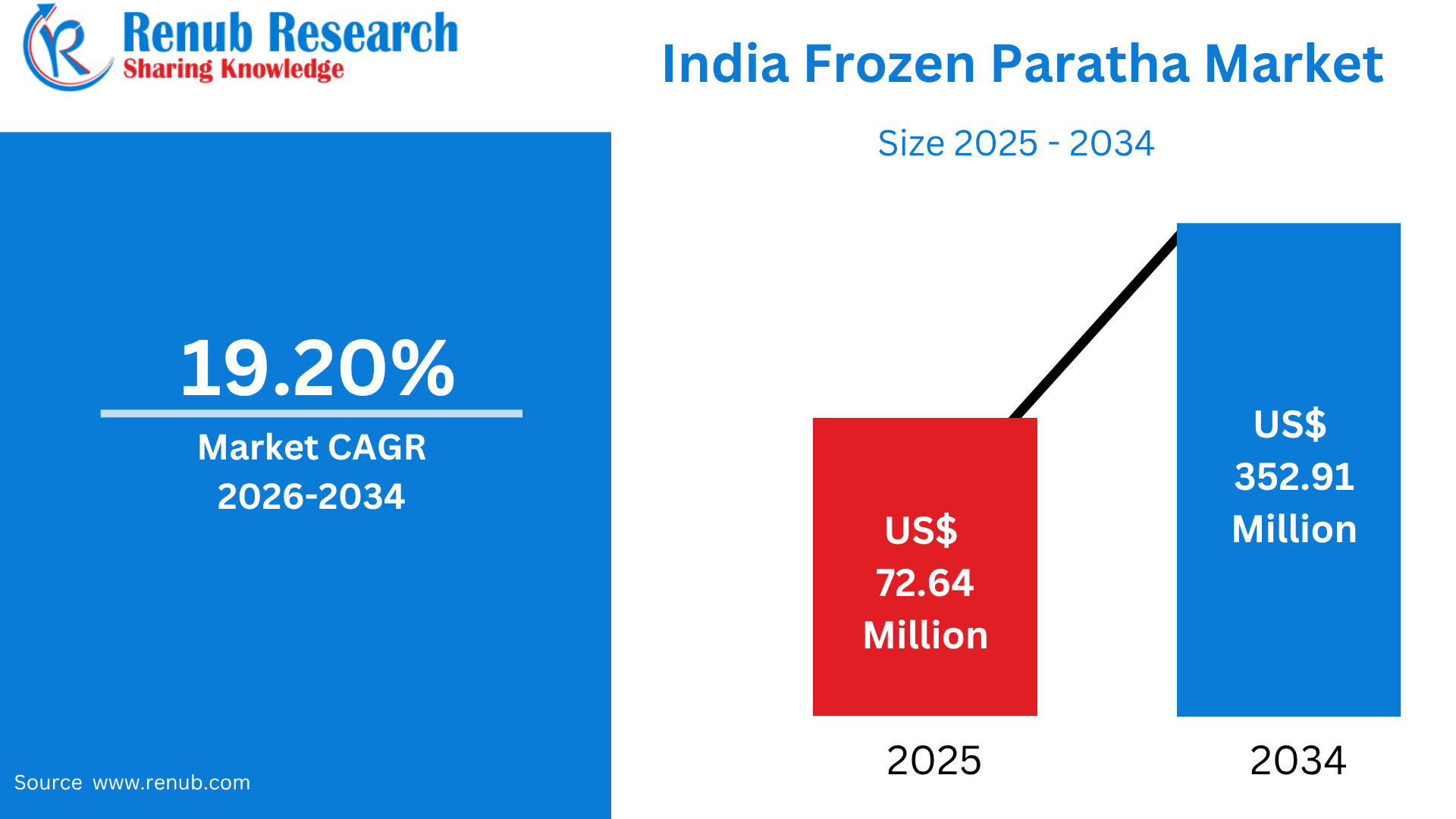
India Frozen Paratha Market is projected to witness robust growth, increasing from US$ 72.64 million in 2025 to US$ 352.91 million by 2034, registering a CAGR of 19.20% during 2026–2034. Market expansion is driven by rapid urbanization, increasingly busy lifestyles, and growing consumer demand for convenient, quick-to-prepare food products. Changing dietary preferences and the rising acceptance of ready-to-cook and frozen foods are encouraging households to incorporate frozen parathas into their daily meals.
What is Frozen Paratha and Its Uses & Popularity in India
Frozen paratha is a partially prepared Indian flatbread that is frozen to preserve its freshness, texture, and flavor until cooking. It is commonly made from wheat flour and is available in varieties such as aloo, paneer, lachha, onion, and mixed-vegetable parathas. Consumers generally prepare frozen parathas by cooking them on a tawa or pan, making them a convenient option for breakfast, lunch, dinner, or quick snacks. Their popularity in India is increasing as consumers seek convenient foods that retain familiar Indian flavors while reducing preparation time.
India’s urban population accounted for approximately 35% of the total population in 2024, supporting demand for convenient meal solutions. The broader Indian frozen-food market is also expanding rapidly; one recent industry estimate places it at ₹18,400 crore in FY2025, nearly double its FY2020 level. Modern retail, supermarkets, e-commerce, quick-commerce platforms, improved cold-chain infrastructure, and changing household structures are improving accessibility. As busy professionals, students, nuclear families, and younger consumers increasingly prioritize convenience, frozen parathas are becoming a popular ready-to-cook ethnic food in India.
Growth Drivers of the India Frozen Paratha Market
Rising Urbanization and Busy Lifestyles
Increasing urbanization and increasingly hectic lifestyles are among the strongest growth drivers for India’s frozen paratha market. India’s urban population represented around 35% of the country’s total population in 2024, according to World Bank data based on UN population estimates. As more consumers live in cities and work longer or more demanding schedules, demand is increasing for food products that require minimal preparation without completely changing traditional eating habits. Frozen parathas address this requirement because consumers can prepare them within minutes using a tawa or pan. They are particularly attractive to working professionals, students, nuclear families, and consumers living away from their hometowns. Industry research identifies urbanization and busy lifestyles as major factors behind the category’s growth, particularly in major cities such as Mumbai, Delhi, Bengaluru, and Hyderabad. The convenience-food trend is also supported by the broader frozen-food industry, which reportedly grew from ₹9,200 crore in FY2020 to ₹18,400 crore in FY2025, representing a 15% CAGR. Continued urban expansion and changing meal-preparation habits are therefore expected to sustain demand for frozen parathas.
Expansion of Modern Retail, E-Commerce, and Cold-Chain Infrastructure
The expansion of modern retail and digital grocery channels is making frozen parathas increasingly accessible to Indian consumers. Supermarkets, hypermarkets, convenience stores, online grocery platforms, and quick-commerce services provide manufacturers with more opportunities to reach households beyond traditional retail outlets. Mintel identifies the evolution of modern retail chains and e-commerce as important factors supporting India’s frozen-food category. At the same time, improvements in cold-chain infrastructure and packaging are helping manufacturers maintain product quality during transportation and storage. Better refrigeration facilities can reduce distribution challenges associated with frozen products and enable brands to expand into semi-urban markets. The broader Indian frozen-food market is benefiting from the development of cold-chain networks, modern retail, and e-commerce, which are improving product availability. This distribution expansion is particularly important for frozen parathas because consumers need reliable access to products maintained at appropriate temperatures. As online grocery and quick-commerce adoption continues to expand, brands can reach consumers seeking convenient meal solutions with greater frequency. Consequently, stronger retail penetration and distribution infrastructure are expected to widen the consumer base for frozen parathas.
Growing Preference for Convenient Traditional and Ethnic Foods
Growing consumer preference for convenient foods that retain familiar Indian flavors is creating significant opportunities for frozen paratha manufacturers. Unlike many Western-style convenience foods, frozen parathas allow consumers to enjoy traditional Indian flatbreads while substantially reducing preparation effort. Industry research indicates that changing eating habits, rising disposable incomes, demand for convenience foods, and increasing consumer acceptance of frozen ethnic products are supporting the category. Product variety is also expanding, with manufacturers offering Malabar, lachha, paneer, aloo, and other paratha varieties, allowing brands to target different taste preferences and consumer segments. The wider Indian frozen-food market provides additional evidence of this shift, with the category reportedly reaching ₹18,400 crore in FY2025 and projected to reach ₹40,500 crore by FY2030, equivalent to a projected 17% CAGR. Rising disposable incomes and greater willingness to experiment with food products are further supporting adoption. As consumers increasingly balance convenience with traditional tastes, frozen parathas are positioned as an attractive ready-to-cook alternative for everyday meals.
Challenges of the India Frozen Paratha Market
Cold-Chain Dependence and Distribution Challenges
Dependence on an efficient cold-chain network remains a significant challenge for the India frozen paratha market. Frozen parathas must generally remain within controlled temperature conditions throughout storage, transportation, retail display, and delivery. Any interruption in the cold chain can affect product quality, texture, safety, and shelf life. This makes distribution more complex and potentially more expensive than conventional packaged food products. The challenge becomes particularly important when brands attempt to expand beyond major metropolitan markets into smaller cities and semi-urban or rural areas. Industry reports identify better cold-chain infrastructure as an important factor supporting India’s frozen-paratha growth, indicating that infrastructure availability remains central to category expansion. (The broader frozen-food sector is similarly dependent on cold-chain distributors and refrigerated retail infrastructure. Rising energy and logistics costs can also increase operating expenses for manufacturers, distributors, and retailers. Consequently, companies need reliable refrigerated transportation, appropriately equipped storage facilities, and strong inventory management. Expanding cold-chain networks can create substantial growth opportunities, but inadequate infrastructure and higher distribution costs remain barriers to nationwide penetration.
Consumer Price Sensitivity and Health Perceptions
Consumer price sensitivity and concerns regarding the nutritional profile of processed frozen foods can limit the adoption of frozen parathas. Indian consumers often compare packaged frozen products with freshly prepared homemade parathas, which can make the packaged alternative appear relatively expensive on a per-serving basis. Manufacturers must therefore demonstrate value through convenience, consistent quality, portion control, and product variety. Health perceptions are another challenge. Some consumers may associate frozen or packaged foods with higher levels of refined ingredients, fat, sodium, preservatives, or lower nutritional value compared with freshly prepared meals. Mintel’s research highlights consumer vigilance around food health and safety, with shoppers increasingly seeking evidence regarding naturalness and nutrition. This creates pressure on manufacturers to improve formulations, communicate ingredient transparency, and introduce products aligned with changing dietary preferences. Inflation can further affect purchasing decisions; recent Indian food-price data indicate renewed pressure on household food costs in 2026. Brands that can combine competitive pricing with healthier formulations, transparent labeling, and convenient preparation are therefore better positioned to overcome these barriers.
Frozen Paratha Launches in India
- Aashirvaad Frozen Aloo Paratha – 2023: ITC’s Aashirvaad entered the frozen-food category with a ready-to-cook range that included Aloo Paratha, offering consumers a quick alternative to homemade preparation.
- Aashirvaad Frozen Malabar Paratha – 2023: Aashirvaad launched Malabar Paratha as part of its five-product frozen naan and paratha portfolio, targeting consumers seeking convenient regional Indian flatbreads.
- Aashirvaad Frozen Paneer Paratha – 2023: Paneer Paratha was introduced alongside Aashirvaad’s frozen range, providing a stuffed, ready-to-cook option for household consumption.
- GOELD Paneer Paratha – 2023: GOELD introduced its frozen-food range featuring Paneer Paratha, positioning pre-cooked stuffed parathas as convenient meal and snack options.
- GOELD Gobi Paratha – 2023: As part of the same range expansion, GOELD launched Gobi Paratha, giving consumers a frozen stuffed-paratha option prepared with cauliflower filling.
- GOELD Mix Veg Paratha – 2023: GOELD expanded its frozen portfolio with Mix Veg Paratha, providing a vegetable-filled ready-to-cook product aimed at convenience-focused consumers.
- Foods & Inns Frozen Mix Veg Paratha – 2024: Foods & Inns recorded commercial shipments of Frozen Mix Veg Paratha in 2024, indicating expansion of frozen paratha offerings for domestic and international markets.
- Sumeru Frozen Malabar Paratha – 2024: Sumeru’s Malabar Paratha appeared in commercial shipments during 2024, reflecting continued product availability and expansion of regional-style frozen parathas.
- Foods & Inns Frozen Mix Veg Paratha – 2025: Foods & Inns recorded another Frozen Mix Veg Paratha shipment in March 2025, demonstrating continued commercial activity around frozen vegetable paratha products.
- Ashoka Frozen Paratha Portfolio – 2026: Ashoka’s 2026 product catalogue lists an expanded frozen paratha portfolio including Methi, Pudina, Ajwain, Aloo Palak, Aloo, Gobi, Green Peas, Lachcha, Malabari, Paneer, Onion, Muli, Aloo Piyaz, and Onion Paneer Parathas, demonstrating substantial product diversification in India’s frozen paratha segment.
Rising Demand for Authentic South Indian Flatbreads
India Malabar Paratha Market is expanding as consumers increasingly seek flavorful ethnic foods and convenient alternatives to traditional meal preparation. Malabar paratha is distinguished by its soft, flaky texture and multiple layers, making it particularly popular in South India while gaining acceptance across other regions. Its growing presence in restaurants, hotels, quick-service outlets, and frozen-food aisles is helping broaden consumer awareness. India’s urban population reached approximately 35% of the country’s total population in 2024, according to World Bank data, supporting demand for convenient ready-to-cook foods among urban households. The expansion of India’s frozen-food industry is also supporting product availability, with the market reportedly increasing from around ₹9,200 crore in FY2020 to ₹18,400 crore in FY2025. As consumers increasingly value restaurant-style taste with minimal preparation, frozen Malabar paratha is gaining popularity among working professionals, nuclear families, and younger consumers. Improved cold-chain infrastructure, modern retail expansion, and e-commerce grocery platforms are further helping manufacturers distribute Malabar paratha beyond its traditional South Indian markets.
Growing Preference for Premium and Convenient Flatbreads in Lacha Paratha
India Lacha Paratha Market is witnessing steady growth due to increasing consumer preference for flavorful, layered North Indian flatbreads across households and food-service establishments. Known for its distinctive flaky texture and crispy layers, lacha paratha is commonly consumed with curries, paneer dishes, vegetables, and gravies. Hotels, restaurants, cafés, and quick-service restaurants are important demand generators, while the growing frozen-food segment is making ready-to-cook lacha parathas increasingly accessible to households. India’s frozen-food market reportedly reached approximately ₹18,400 crore in FY2025, demonstrating the expanding consumer acceptance of frozen and convenience foods. Frozen lacha parathas are particularly attractive to working professionals and nuclear families because they reduce preparation time while retaining familiar taste and texture. Manufacturers are also introducing whole-wheat, multigrain, low-oil, and stuffed variants to address evolving consumer preferences. The expansion of supermarkets, hypermarkets, online grocery platforms, and quick-commerce services is improving product visibility and availability. Rising urbanization, changing meal patterns, and demand for convenient ethnic foods are expected to continue supporting the lacha paratha market.
Protein-Rich Convenience Food Gains Consumer Attention
India Paneer Paratha Market is developing rapidly as consumers increasingly look for filling, flavorful, and protein-rich meal options. Paneer paratha combines wheat flatbread with a spiced cottage-cheese filling, making it a popular breakfast and meal choice, particularly in North India. Its combination of taste, satiety, and protein content makes it attractive to families, children, and consumers seeking alternatives to conventional snacks and fast foods. Growing modern retail penetration is also improving access to frozen paneer parathas through supermarkets, hypermarkets, and organized grocery stores. The broader Indian frozen-food industry reportedly grew to ₹18,400 crore in FY2025, reflecting increasing acceptance of convenient frozen products. The expansion of restaurants, cafés, cloud kitchens, and food-delivery services is further supporting demand by increasing consumer exposure to paneer-based dishes. Manufacturers are responding by introducing products featuring whole wheat, multigrain formulations, reduced-oil recipes, and cleaner ingredient profiles. Rising urbanization and busy lifestyles are particularly important market drivers because consumers increasingly seek products that can be prepared quickly without sacrificing the familiar flavor of traditional Indian meals.
Traditional Retail Remains an Important Distribution Channel
India offline paratha market continues to represent an important distribution channel because consumers widely purchase frozen and ready-to-cook foods through supermarkets, hypermarkets, convenience stores, and neighborhood kirana outlets. Physical retail allows shoppers to examine product packaging, brand information, quantity, pricing, and storage conditions before making a purchase. Prominent placement in frozen-food sections can also encourage impulse purchases and increase brand visibility. India’s large network of neighborhood grocery stores provides manufacturers with opportunities to reach consumers in smaller cities and semi-urban markets where online grocery penetration may be comparatively lower. At the same time, organized retail chains are increasing the visibility of frozen paratha products through dedicated refrigerated sections and promotional campaigns. India’s overall frozen-food market reportedly reached approximately ₹18,400 crore in FY2025, highlighting the expanding opportunity for frozen convenience products. Offline sales also extend beyond household consumption, as wholesalers and distributors supply restaurants, hotels, caterers, cafés, and institutional food-service operators. Retailer relationships, attractive shelf placement, product sampling, discounts, and promotional activities can therefore play an important role in increasing paratha sales through physical channels.
Urbanization and Expanding Retail Drive Maharashtra Demand
Maharashtra frozen paratha market is experiencing strong growth, supported by rapid urbanization, busy lifestyles, and expanding organized retail infrastructure. Major cities such as Mumbai, Pune, Nagpur, and Nashik are important demand centers, where working professionals, students, and nuclear families increasingly prefer convenient ready-to-cook foods. Maharashtra is one of India’s most urbanized states, with approximately 45% of its population living in urban areas, according to the 2011 Census, creating a large addressable consumer base for convenience foods. The growing presence of supermarkets, hypermarkets, modern grocery stores, and online grocery platforms is improving access to frozen paratha products. Quick-commerce services are further increasing convenience by enabling consumers to receive frozen foods rapidly. The state’s extensive hotel, restaurant, café, catering, and cloud-kitchen ecosystem is also generating institutional demand for products such as aloo, paneer, lachha, and Malabar parathas. Rising disposable incomes, changing meal patterns, and increasing acceptance of packaged ethnic foods are expected to support continued market expansion across Maharashtra.
Large Population and Traditional Food Preferences Support Uttar Pradesh Growth
Uttar Pradesh frozen paratha market is expected to expand steadily, supported by the state’s large population, urbanization, and strong preference for traditional North Indian foods. Uttar Pradesh had a population of approximately 199.6 million according to the 2011 Census, making it India’s most populous state and providing a substantial potential consumer base. Cities including Lucknow, Noida, Ghaziabad, Kanpur, Agra, and Varanasi are witnessing increasing demand for convenient ready-to-cook food products as working professionals, students, and young households seek to reduce meal-preparation time. Paratha varieties such as aloo, paneer, and lachha align closely with established regional food preferences. Expansion of supermarkets, modern retail outlets, online grocery platforms, and refrigerated distribution networks is improving product availability in urban and semi-urban locations. The foodservice industry also contributes to demand, with restaurants, hotels, caterers, and cloud kitchens using frozen parathas to improve operational convenience. Increasing consumer awareness of packaged frozen foods and improvements in cold-chain infrastructure are expected to create further opportunities for manufacturers and distributors throughout Uttar Pradesh.
Kolkata and Urban Centers Strengthen Convenience-Food Adoption in West Bengal
West Bengal frozen paratha market is developing steadily as consumers increasingly embrace convenient frozen ethnic foods and ready-to-cook flatbreads. Kolkata, Howrah, Durgapur, and other urban centers represent important markets because busy professionals, students, and nuclear families increasingly seek quick breakfast and dinner solutions. West Bengal had an urbanization rate of approximately 31.9% according to the 2011 Census, providing a substantial urban consumer base for convenience-oriented food products. Consumers are purchasing both traditional North Indian varieties and products such as Malabar and stuffed parathas as product awareness expands. Supermarkets, modern grocery stores, and online food-delivery and grocery platforms are improving access to frozen products across major cities. Improvements in refrigeration, cold storage, transportation, and packaging are also helping manufacturers maintain product quality and extend distribution. Foodservice establishments, including restaurants, cafés, hotels, caterers, and cloud kitchens, provide an additional source of demand. As urban consumers increasingly balance traditional food preferences with limited preparation time, frozen parathas are gaining acceptance as convenient alternatives to freshly prepared flatbreads.
Rising Foodservice Demand and Urban Convenience Boost Andhra Pradesh Adoption
Andhra Pradesh frozen paratha market is witnessing steady growth due to increasing demand for ready-to-cook foods, expanding urban populations, and a growing foodservice industry. Visakhapatnam, Vijayawada, Guntur, and other urban centers are important consumption markets, where working professionals, students, and nuclear families increasingly prioritize quick and convenient meal options. Andhra Pradesh’s urban population accounted for approximately 29.6% of the state’s population in 2011, providing a significant base for convenience-food consumption. Frozen parathas offer advantages such as easy storage, consistent quality, and rapid preparation, making them suitable for both household and commercial use. Restaurants, hotels, caterers, cafés, and cloud kitchens are increasingly using products such as Malabar and lachha parathas to simplify food preparation and manage kitchen operations. The availability of branded frozen foods through supermarkets and organized retail is also improving consumer awareness. Furthermore, investments in refrigeration and cold-storage infrastructure are supporting wider distribution. Increasing urbanization, changing food habits, and growing acceptance of packaged convenience foods are expected to strengthen demand for frozen parathas across Andhra Pradesh.
India Frozen Paratha Market Segments:
Type
- Malabar Paratha
- Lacha Paratha
- Paneer Paratha
- Aloo Paratha
- Others
Distribution Channel
- Offline
- Online
Top States
- Maharashtra
- Tamil Nadu
- Karnataka
- Gujarat
- Uttar Pradesh
- West Bengal
- Rajasthan
- Telangana
- Andhra Pradesh
- Madhya Pradesh
All companies have been covered from 5 viewpoints:
- Overview
- Recent Development & Strategies
- Monthly all India sales (June 2022-May 2023)
- Major City Sales (June 2022-May 2023)
- Yearly Volume Analysis by Distribution Channel (June 2022-May 2023)
Company Analysis
- ID Fresh
- Haldiram
- Sumeru
- Goeld
- Aashirvad
- Tasty Fresh
- Buffet
- Asal Foods (Milky Mist Dairy)
- Godrej
- WahUstad
- Keventer
- Miraj Group
- Vadilal
- Brillar
- Kawaan
- Swaad
Report Details:
| Report Features | Details |
| Base Year |
2025 |
| Historical Period |
2022 - 2025 |
| Forecast Period |
2026 - 2034 |
| Market |
US$ Million |
| Segment Covered |
Туре, Distribution Channel and States |
| States Covered |
|
| Companies Covered |
|
| Customization Scope |
20% Free Customization |
| Post-Sale Analyst Support |
1 Year (52 Weeks) |
| Delivery Format |
PDF and Excel through Email (We can also provide the editable version of the report in PPT/Word format on request) |
Customization Services available
- Analysis of Market Size and Its Segments
- More Company Profiles (Upto 10 without any additional cost):
- Additional Countries (Other than mentioned Countries):
- Region/Country Specific Reports:
- Market Entry Strategy:
- Region-Specific Market Dynamics:
- Regional Market Share Analysis:
- Trade Analysis:
- Production Insights:
- Others Customized Requests:
For more information contact our analysts.
Need More Assistance?
- Talk to our analysts to get more precious information on the current market trends.
- Include more countries and segments and customize the report based on the final requirement.
- Get a competitive advantage in your industry by knowing the report findings and making a positive impact on your revenues and operations.
- Our analysts are always ready to provide more help and pertinent information if you need any additional assistance.