Game-based Learning Market Report by Component, Platform Type, Deployment Mode, Game Type, End-User, Countries and Company Analysis 2026-2034
Buy NowGlobal Game-based Learning Market Size & Forecast 2026-2034
The Global Game-based Learning Market is expected to witness strong expansion, growing from US$ 27.54 billion in 2025 to US$ 138.62 billion by 2034, at a CAGR of 19.67% during the forecast period 2026–2034. Market growth is driven by rising adoption of digital learning platforms, increasing use of gamification in corporate training and education, and growing demand for interactive and engaging learning experiences. Advances in mobile technology, AI, and AR/VR further accelerate market development across academic and enterprise sectors.
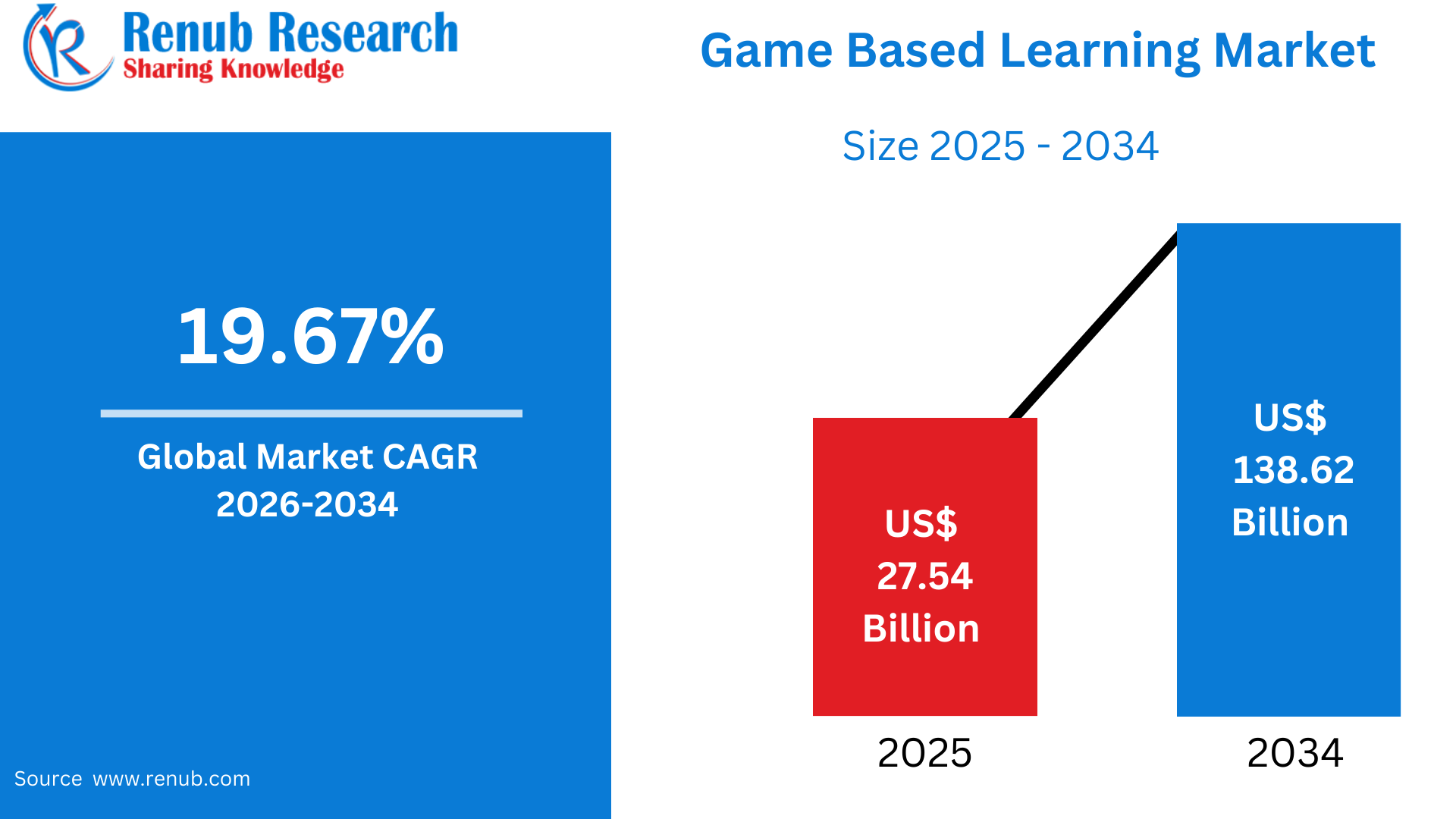
Global Game-based Learning Market Outlook
Game-based learning is an educational approach that uses game mechanics—such as challenges, rewards, levels, storytelling, and competition—to enhance learning outcomes. It integrates educational content into interactive games or game-like environments, enabling learners to acquire knowledge and skills through active participation rather than passive instruction. Game-based learning can be delivered through digital platforms, mobile apps, video games, simulations, and even physical or hybrid formats. It is widely used across schools, universities, corporate training programs, and professional skill development, as it improves engagement, motivation, problem-solving ability, and knowledge retention. By providing instant feedback and allowing learners to progress at their own pace, game-based learning supports both cognitive and behavioral development.
Worldwide, game-based learning has gained significant popularity due to rapid digitalization of education and the widespread availability of smartphones, tablets, and high-speed internet. Educators and organizations increasingly recognize its effectiveness in addressing diverse learning styles and improving learner participation. The rise of remote learning, corporate upskilling needs, and younger, tech-savvy populations has further accelerated adoption. As a result, game-based learning is becoming a mainstream educational strategy across academic, professional, and lifelong learning environments globally.
Growth Drivers of the Game-based Learning Market
Rapid Digitalization of Education and Training
The accelerating digital transformation of education systems and corporate training programs is a major driver of the game-based learning market. Schools, universities, and enterprises worldwide are shifting from traditional teaching methods to digital platforms that support interactive and learner-centric experiences. Game-based learning fits well into this shift by combining technology with engagement, making learning more immersive and effective. Cloud platforms, mobile learning apps, and learning management systems increasingly integrate game elements such as simulations, quizzes, leaderboards, and scenario-based challenges. In corporate environments, digital learning tools are used to train distributed workforces efficiently and consistently. As governments and institutions invest in digital infrastructure and e-learning initiatives, game-based learning benefits from higher adoption rates, scalability, and the ability to deliver standardized yet engaging content across geographies. May 2025, The African Congolese government has launched an online learning platform designed to train young people in information technology (IT) and communication skills. Developed by the African Centre for Research in Artificial Intelligence (Caria), the platform was presented to the Minister of Posts,
Growing Demand for Engaging and Personalized Learning Experiences
Learners today expect education and training to be interactive, engaging, and tailored to their individual needs. Game-based learning addresses these expectations by offering personalized pathways, adaptive difficulty levels, and real-time feedback. Unlike traditional methods, it encourages active participation, critical thinking, and problem-solving through experiential learning. This is particularly effective for younger learners, digital natives, and employees undergoing skill development. Personalization enabled by data analytics and AI allows game-based platforms to track progress, identify skill gaps, and adjust content accordingly. As attention spans shorten and competition for learner engagement increases, educators and organizations increasingly adopt game-based approaches to improve motivation, retention, and learning outcomes. This growing emphasis on learner experience is a strong driver of sustained market growth. July 2025, D2L launched new AI-powered experiences under its D2L Lumi platform, designed to advance hyper-personalized learning for students and educators. The update leverages machine learning to improve adaptability, content recommendations, and learner engagement across digital education environments.
Expansion of Corporate Training and Workforce Upskilling
The global need for continuous workforce upskilling and reskilling is significantly boosting demand for game-based learning solutions. Rapid technological change, automation, and evolving job roles require employees to learn new skills quickly and effectively. Game-based learning is particularly well-suited for corporate training because it supports scenario-based simulations, role-playing, and practical decision-making exercises. These methods help employees apply knowledge in real-world contexts, improving performance and confidence. Gamification elements such as rewards, badges, and competition also increase participation in otherwise mandatory training programs. As organizations prioritize employee development, leadership training, compliance education, and soft-skill enhancement, game-based learning is increasingly viewed as a cost-effective and impactful training strategy, driving market expansion across industries. November 2025, LinkedIn Learning launched AI-driven corporate training modules that personalize skill development paths for employees across technology, leadership, and compliance areas. The platform improves workforce productivity and engagement. This reinforces LinkedIn Learning’s leadership in digital corporate education.
Challenges of the Game-based Learning Market
High Development Costs and Content Complexity
Developing high-quality game-based learning solutions can be expensive and time-consuming. Effective educational games require collaboration between subject matter experts, instructional designers, game developers, and UX designers. Creating engaging content that is both pedagogically sound and technically robust adds complexity, especially for advanced simulations or immersive experiences using AR or VR. Smaller educational institutions and organizations may find these costs prohibitive, limiting adoption. Additionally, content often needs regular updates to remain relevant, aligned with curriculum changes, or compliant with industry standards, further increasing long-term costs. This financial and operational barrier can slow market penetration, particularly in price-sensitive regions.
Resistance to Adoption and Learning Curve Issues
Despite proven benefits, resistance to adopting game-based learning remains a challenge in some educational and corporate settings. Educators, trainers, or decision-makers may be skeptical about the effectiveness of games compared to traditional teaching methods. Lack of familiarity, insufficient training, and concerns about excessive screen time can also hinder acceptance. In corporate environments, employees from non-digital-native generations may struggle with game-based platforms, reducing engagement. Additionally, poorly designed games risk being perceived as entertainment rather than serious learning tools, undermining credibility. Overcoming these challenges requires awareness, training, and evidence of measurable learning outcomes, which can take time and slow widespread adoption.
Game-based Learning Services Market
The game-based learning services market focuses on consulting, design, development, integration, and ongoing support for organizations adopting game-based solutions. Many schools, universities, and enterprises lack in-house expertise to design pedagogically sound and engaging learning games, creating strong demand for specialized service providers. These services include needs assessment, instructional design, custom game development, localization, analytics integration, and trainer support. In corporate settings, service providers help align games with specific business objectives such as compliance training, leadership development, or technical upskilling. Ongoing services—updates, performance analytics, and content optimization—are especially valuable as learning needs evolve. As organizations prioritize measurable outcomes and return on investment, professional services play a critical role in ensuring effectiveness and adoption. This segment grows steadily alongside platform adoption, benefiting from long-term client relationships, recurring contracts, and the increasing complexity of game-based learning implementations.
Online Game-based Learning Market
The online game-based learning market is expanding rapidly due to widespread internet access and the normalization of digital learning. Online delivery enables learners to access game-based content from any location, supporting remote education, hybrid classrooms, and distributed workforces. Educational institutions use online games to supplement curricula, reinforce concepts, and assess learner progress in real time. In corporate environments, online game-based modules support onboarding, compliance training, and continuous learning without physical constraints. Scalability is a major advantage, allowing organizations to deploy standardized content across regions while tracking performance centrally. Social features such as multiplayer modes, leaderboards, and collaborative challenges further enhance engagement. As remote learning and flexible work models continue to grow, online game-based learning remains a core deployment model, valued for accessibility, cost efficiency, and broad reach.
Cloud Game-based Learning Market
Cloud-based game-based learning platforms are gaining traction as organizations move away from on-premise systems. Cloud deployment enables rapid scaling, easy updates, and lower upfront infrastructure costs, making it attractive for schools, training providers, and enterprises of all sizes. Content can be deployed globally, updated instantly, and accessed across devices, ensuring consistency and reliability. Cloud platforms also support advanced analytics, allowing educators and trainers to monitor learner behavior, progress, and outcomes in real time. Integration with learning management systems (LMS), HR platforms, and collaboration tools further enhances value. Security, backup, and compliance are managed centrally, reducing operational burden for users. As demand grows for flexible, data-driven learning environments, cloud-based game-based learning solutions continue to see strong adoption, especially among organizations pursuing digital transformation and scalable training strategies.
AI Game-based Learning Market
The AI-driven game-based learning market represents a fast-evolving segment focused on personalization and adaptive learning. Artificial intelligence enables platforms to analyze learner behavior, performance, and preferences, dynamically adjusting game difficulty, content flow, and feedback. This creates highly individualized learning experiences that improve engagement and knowledge retention. AI also supports intelligent tutoring systems, predictive analytics for skill gaps, and automated assessments, reducing instructor workload. In corporate training, AI-driven simulations help employees practice decision-making in realistic scenarios, while continuously adapting challenges based on performance. In education, AI helps address diverse learning styles and pacing needs. Although still emerging, AI integration significantly enhances the effectiveness of game-based learning, making it a key growth engine as organizations seek smarter, outcome-focused learning solutions.
Game-based Education Learning Market
The game-based education learning market focuses on K–12 and higher education institutions using games to support academic instruction. Educational games help students grasp complex concepts through interactive simulations, storytelling, and problem-solving activities. Subjects such as mathematics, science, language learning, and history benefit from experiential learning approaches that improve comprehension and retention. Teachers use game-based tools to assess understanding in real time and encourage participation from diverse learners. The market is driven by education digitalization, curriculum innovation, and the need to improve student motivation and outcomes. Government initiatives supporting e-learning and classroom technology further contribute to adoption. As educators move toward student-centered and competency-based learning models, game-based education solutions continue to gain importance as effective instructional tools.
Game-based Consumer Learning Market
The game-based consumer learning market targets individual users seeking self-improvement, skill development, or knowledge acquisition outside formal institutions. Popular applications include language learning, brain training, financial literacy, coding basics, and personal development. Consumers are drawn to game-based learning because it blends education with entertainment, making learning enjoyable and habit-forming. Mobile apps dominate this segment, offering short, interactive sessions that fit into daily routines. Freemium models, subscriptions, and in-app purchases drive monetization. Social competition, rewards, and progress tracking enhance user retention. Growth is fueled by smartphone penetration, lifelong learning trends, and increasing demand for flexible, self-paced education. As consumers increasingly take ownership of their learning journeys, game-based learning continues to gain popularity as an accessible and engaging option.
United States Game-based Learning Market
The game-based learning market in United States is one of the most advanced globally, driven by strong digital infrastructure, high education spending, and a mature corporate training ecosystem. Schools, universities, and edtech providers actively use game-based platforms to improve student engagement, personalized learning, and STEM education outcomes. In the corporate sector, game-based learning is widely adopted for employee onboarding, leadership development, compliance training, and soft-skills enhancement. The U.S. market benefits from rapid innovation, with widespread use of AI, analytics, AR/VR, and cloud-based platforms. Learners are highly receptive to interactive and gamified formats, especially in remote and hybrid learning environments. Strong venture capital investment and a large base of content developers further accelerate market growth. June 2025, Arizona State University and the nonprofit organization Games for Change have entered into a collaborative agreement to advance educational innovation through game-based learning, research and microcredentials. The partnership brings together one of the nation’s most innovative universities and a leading nonprofit at the intersection of games and social impact.
France Game-based Learning Market
The game-based learning market in France is growing steadily as education systems and enterprises modernize learning methods. French schools and higher education institutions increasingly integrate game-based tools to support curriculum delivery, language learning, and problem-solving skills. Government initiatives promoting digital education and classroom technology play a key role in adoption. In corporate environments, game-based learning is used for professional training, compliance, and employee engagement, particularly in large enterprises. The market emphasizes pedagogical quality, alignment with academic standards, and cultural relevance, which supports demand for localized content and specialized services. While adoption is more structured and regulated compared to the U.S., acceptance is rising as educators recognize measurable learning benefits.
India Game-based Learning Market
The game-based learning market in India is expanding rapidly due to a large youth population, widespread smartphone usage, and increasing demand for accessible education. Game-based learning is widely used in K–12 education, competitive exam preparation, language learning, and skill development. Mobile-first platforms dominate, offering affordable, bite-sized learning experiences that appeal to students and young professionals. Government initiatives supporting digital education and online learning further accelerate adoption. In the corporate sector, startups and IT companies use gamified training to upskill employees efficiently. Cost sensitivity encourages scalable, freemium, and subscription-based models. While infrastructure and digital literacy gaps remain in some regions, overall growth momentum is strong. India stands out as a volume-driven, innovation-oriented market where game-based learning plays a key role in democratizing education and workforce readiness. Meghalaya government is introducing game-based learning for the children in the state.
Saudi Arabia Game-based Learning Market
The game-based learning market in Saudi Arabia is gaining momentum as part of broader digital and education reforms. National initiatives focused on modernizing education and developing a skilled workforce encourage adoption of interactive and technology-enabled learning tools. Game-based learning is increasingly used in schools, universities, and vocational training to enhance engagement and practical skill development. In the corporate and government sectors, gamified platforms support leadership training, compliance, and workforce nationalization programs. High smartphone penetration and growing acceptance of e-learning contribute to market growth. Content localization and alignment with cultural and language preferences are important success factors. While the market is still emerging compared to Western regions, strong government support and investment position Saudi Arabia as a fast-developing game-based learning market in the Middle East. November 2025, The King Salman Science Oasis has introduced a new play based learning programme designed to strengthen children’s cognitive and creative abilities as part of the festival, “Math, the Language of Science.” The initiative highlights Saudi Arabia’s growing emphasis on innovative and engaging educational experiences that nurture future generations.
Market Segmentations
Component
- Solutions
- Services
Platform Type
- Online
- Offline
Deployment Mode
- Cloud
- On-Premise
Game Type
- AR/VR Games
- AI-Based Games
- Location-Based Games
- Knowledge and Skill-Based Games
- Language-Learning Games
- Others
End-User
- Education
- Enterprises
- Government
- Consumer
- Others
Countries
North America
- United States
- Canada
Europe
- France
- Germany
- Italy
- Spain
- United Kingdom
- Belgium
- Netherlands
- Turkey
Asia Pacific
- China
- Japan
- India
- South Korea
- Thailand
- Malaysia
- Indonesia
- Australia
- New Zealand
Latin America
- Brazil
- Mexico
- Argentina
Middle East & Africa
- Saudi Arabia
- UAE
- South Africa
All companies have been covered with 5 Viewpoints
- Overviews
- Key Person
- Recent Developments
- SWOT Analysis
- Revenue Analysis
Key Players Analysis
- Badgeville (CallidusCloud)
- Bunchball (BI WORLDWIDE)
- Classcraft Studios Inc.
- Six Waves Inc.
- Recurrence, Inc.
- Gametize Pte. Ltd.
- Kuato Studios
- BreakAway Ltd., Inc.
- Filament Games
- LearningWare, Inc
Report Details:
| Report Features | Details |
| Base Year |
2025 |
| Historical Period |
2022 - 2025 |
| Forecast Period |
2026 - 2034 |
| Market |
US$ Billion |
| Segment Covered |
Component, Platform Type, Deployment Mode, Game Type, End-User and Countries |
| Countries Covered |
|
| Companies Covered |
|
| Customization Scope |
20% Free Customization |
| Post-Sale Analyst Support |
1 Year (52 Weeks) |
| Delivery Format |
PDF and Excel through Email (We can also provide the editable version of the report in PPT/Word format on request) |
Customization Services available
- Analysis of Market Size and Its Segments
- More Company Profiles (Upto 10 without any additional cost):
- Additional Countries (Other than mentioned Countries):
- Region/Country Specific Reports:
- Market Entry Strategy:
- Region-Specific Market Dynamics:
- Regional Market Share Analysis:
- Trade Analysis:
- Production Insights:
- Others Customized Requests:
For more information contact our analysts.
Need More Assistance?
- Talk to our analysts to get more precious information on the current market trends.
- Include more countries and segments and customize the report based on the final requirement.
- Get a competitive advantage in your industry by knowing the report findings and making a positive impact on your revenues and operations.
- Our analysts are always ready to provide more help and pertinent information if you need any additional assistance.