Gaming Console Market Size, Share, Growth, Trends, Industry Analysis & Forecast 2026–2034
Buy NowGaming Console Market Forecast
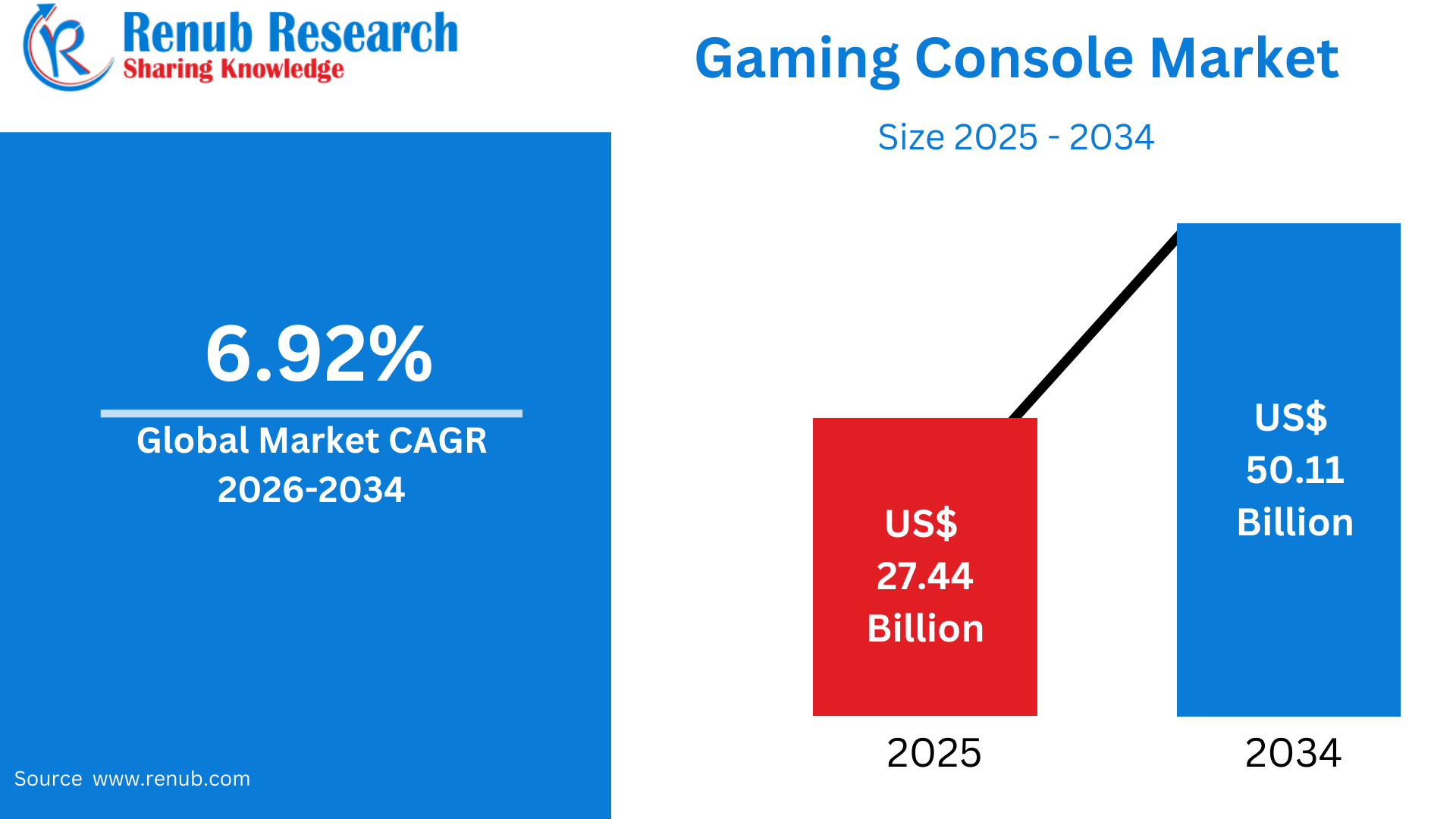
Gaming Console Market is projected to grow from US$ 27.44 billion in 2025 to US$ 50.11 billion by 2034, registering a CAGR of 6.92% during the forecast period from 2026 to 2034. Market growth is being fueled by the rising global demand for immersive and interactive entertainment experiences, coupled with increasing consumer spending on advanced gaming technologies. Continuous innovations in gaming hardware, including high-performance processors, ray tracing, virtual reality (VR), augmented reality (AR), and cloud gaming capabilities, are significantly enhancing user experiences and driving console adoption.
What is Gaming Console and Its Uses & Popularity Worldwide?
A gaming console is a specialized electronic device designed primarily for playing video games through a television, monitor, or compatible display. Unlike traditional computers, gaming consoles are optimized for high-performance gaming with dedicated hardware, powerful graphics processors, advanced controllers, and user-friendly operating systems. Popular consoles support both physical game discs and digital downloads while offering online multiplayer gaming, cloud storage, streaming services, and subscription-based game libraries. Beyond gaming, modern consoles function as complete entertainment hubs, allowing users to stream movies, music, live sports, and other digital content through integrated applications.
Worldwide, gaming consoles have gained tremendous popularity due to technological advancements, immersive graphics, virtual reality (VR) compatibility, cloud gaming, and cross-platform multiplayer experiences. The rapid growth of e-sports, game streaming platforms, and online gaming communities has further expanded their global appeal. Consumers of all age groups are increasingly investing in gaming consoles for entertainment, social interaction, and competitive gaming. Rising disposable incomes, expanding broadband connectivity, frequent game releases, and exclusive titles from major developers continue to drive console adoption across North America, Europe, Asia-Pacific, Latin America, and the Middle East, making gaming consoles a vital part of the global digital entertainment industry.
Global Active Gamers Over Time (2015–2024)
- 2015: Approximately 2.03 billion active gamers worldwide.
- 2016: Increased to around 2.17 billion gamers.
- 2017: Reached approximately 2.33 billion gamers.
- 2018: Expanded to nearly 2.49 billion gamers.
- 2019: Grew to approximately 2.63 billion gamers.
- 2020: Increased to around 2.81 billion gamers, driven by higher digital entertainment adoption.
- 2021: Surpassed 2.96 billion active gamers globally.
- 2022: Reached approximately 3.09 billion gamers.
- 2023: Increased further to around 3.22 billion gamers.
- 2024: Estimated at approximately 3.32 billion active gamers worldwide, marking the highest level during the period.
Most Played Games Right Now (2026)— Key Highlights
- Roblox leads globally with 144.5 million daily active players.
- Minecraft sold 350 million copies, making it the best-selling game.
- Tetris tops history with 520 million copies sold worldwide.
- Fortnite reached 14.3 million peak players across all platforms.
- Free Fire sustained 13.95 million daily active users in 2026.
- Counter-Strike 2 dominates Steam with 935K+ concurrent players.
- Roblox mobile sees 129.7 million monthly active users.
- Candy Crush still attracts 273 million monthly active players.
Growth Drivers for the Gaming Console Market
Rapid Technological Innovation and Expansion of Cloud Gaming
Technological advancements continue to drive significant growth in the Gaming Console Market by transforming the way consumers access and experience digital entertainment. Modern gaming consoles feature high-performance processors, advanced graphics processing units (GPUs), ray tracing technology, artificial intelligence (AI)-powered rendering, ultra-fast solid-state drives (SSDs), and immersive virtual reality capabilities that deliver realistic gameplay and faster performance. The rapid expansion of cloud gaming services is further reshaping the industry by enabling users to stream high-quality games without relying solely on physical hardware. Improved broadband connectivity, low-latency networks, and expanding cloud infrastructure allow gamers to enjoy seamless experiences across multiple devices. Cross-platform compatibility also enables players to connect with friends regardless of their gaming platform, strengthening user engagement. Continuous investments by leading gaming companies in hardware innovation, cloud services, and next-generation gaming ecosystems are enhancing consumer experiences and supporting sustained demand for gaming consoles worldwide.
Rising Popularity of E-Sports and Online Competitive Gaming
The growing global popularity of e-sports and competitive gaming has become one of the strongest growth drivers for the Gaming Console Market. Professional gaming tournaments attract millions of viewers worldwide while offering substantial prize pools and sponsorship opportunities, encouraging greater participation among gamers. Modern gaming consoles provide powerful hardware capable of supporting fast-paced multiplayer titles, competitive gameplay, and live streaming. Online gaming services, voice communication features, and digital communities enable players to compete and collaborate with others across the globe. The increasing influence of gaming content creators, streamers, and professional players has further expanded consumer interest in console gaming. Educational institutions and gaming organizations are also incorporating e-sports into structured programs, creating additional demand for gaming hardware. As online gaming communities continue to grow and game developers regularly release competitive titles with frequent updates, gaming consoles remain a preferred platform for both casual players and professional competitors.
Expanding Digital Entertainment Ecosystems
Gaming consoles have evolved beyond dedicated gaming devices into comprehensive digital entertainment platforms, significantly contributing to market growth. Modern consoles support a wide range of multimedia applications, including video streaming, music services, cloud storage, web browsing, and digital content subscriptions. Consumers increasingly value devices that combine gaming, entertainment, and social interaction within a single ecosystem. Subscription services offering extensive game libraries, downloadable content, and exclusive releases provide users with continuous access to new experiences while generating recurring revenue for manufacturers. Integration with virtual reality, augmented reality, smart home technologies, and cloud-based gaming services further expands console functionality. Families and casual users also appreciate gaming consoles for their ability to deliver entertainment, education, fitness applications, and interactive experiences through one device. As digital lifestyles continue to evolve and consumer demand for all-in-one entertainment solutions grows, multifunctional gaming consoles are expected to maintain strong global demand throughout the forecast period.
Gaming Console Product Launches Worldwide
- Sony – PlayStation 5 Pro (2024)
Sony launched the PlayStation 5 Pro, featuring enhanced GPU performance, advanced ray tracing, AI-driven PlayStation Spectral Super Resolution (PSSR), a 2TB SSD, and Wi-Fi 7 support for improved gaming performance. - Microsoft – Xbox Series X 2TB Galaxy Black Special Edition (2024)
Microsoft introduced a 2TB Galaxy Black Special Edition of the Xbox Series X with expanded storage and a premium design for gamers requiring greater digital game capacity. - Microsoft – Xbox Series X 1TB Digital Edition (2024)
Microsoft launched the all-digital Xbox Series X 1TB in Robot White, eliminating the disc drive while delivering the same next-generation gaming performance. - Microsoft – Xbox Series S 1TB Robot White (2024)
Microsoft expanded its console lineup with the 1TB Xbox Series S, providing increased storage for digital downloads, Game Pass titles, and cloud gaming users. - Nintendo – Nintendo Switch 2 (2025)
Nintendo released the Nintendo Switch 2, featuring upgraded graphics, improved processing performance, enhanced display capabilities, expanded storage, and backward compatibility for many existing Switch games. - Sony – PlayStation Portal Remote Player (2023)
Sony introduced the PlayStation Portal, a dedicated handheld Remote Play device that streams PlayStation 5 games over Wi-Fi, expanding the PlayStation ecosystem. - ASUS & Xbox – ROG Xbox Ally (2025)
ASUS and Xbox unveiled the ROG Xbox Ally, a Windows-based handheld gaming device optimized for Xbox Game Pass, cloud gaming, and PC gaming experiences. - ASUS & Xbox – ROG Xbox Ally X (2025)
ASUS launched the ROG Xbox Ally X, a premium handheld gaming console offering enhanced processing power, larger battery capacity, improved cooling, and higher memory specifications. - Lenovo – Legion Go S (2025)
Lenovo introduced the Legion Go S, a portable gaming console featuring an ergonomic design, AMD-powered performance, and support for modern PC gaming platforms. - MSI – Claw 8 AI+ (2025)
MSI launched the Claw 8 AI+, an AI-enhanced handheld gaming console equipped with upgraded processing capabilities, a larger display, and extended battery life for portable gaming.
Challenges in the Gaming Console Market
High Hardware Costs and Affordability Constraints
The high cost of gaming consoles remains a significant challenge limiting broader market adoption, particularly in developing and price-sensitive regions. Manufacturing next-generation consoles requires advanced processors, graphics chips, high-speed storage, and sophisticated cooling systems, which substantially increase production costs. These expenses are reflected in retail prices, making premium gaming consoles less affordable for many consumers. Additional costs associated with accessories such as extra controllers, virtual reality headsets, online gaming subscriptions, and premium game purchases further increase the overall investment required. Economic uncertainty, inflation, currency fluctuations, and import duties can also raise console prices in international markets. Furthermore, the increasing availability of cloud gaming platforms and mobile gaming alternatives provides consumers with lower-cost entertainment options. To sustain long-term growth, manufacturers must continue improving affordability while maintaining high performance, innovation, and premium gaming experiences.
Supply Chain Disruptions and Component Availability
Supply chain disruptions and shortages of critical electronic components continue to pose major challenges for the Gaming Console Market. Modern gaming consoles rely heavily on advanced semiconductors, graphics processors, memory chips, and other specialized components that require complex manufacturing processes. Any disruption in global semiconductor production or logistics networks can delay manufacturing schedules, limit product availability, and increase production costs. Geopolitical tensions, transportation bottlenecks, rising raw material prices, and fluctuating demand further complicate supply chain operations. Limited inventory during new console launches often results in stock shortages, delayed deliveries, and higher resale prices, negatively affecting consumer satisfaction. Manufacturers must also manage supplier diversification, inventory planning, and production efficiency to minimize future disruptions. Building resilient global supply chains and strengthening partnerships with semiconductor manufacturers will remain essential for ensuring consistent product availability and supporting continued market expansion.
Premium Entertainment Driving Household Gaming Growth Worldwide
Home Gaming Console Market represents the largest segment of the gaming console industry, driven by increasing demand for immersive home entertainment and high-performance gaming experiences. Home gaming consoles are designed to connect with televisions or monitors, offering advanced graphics, powerful processors, expansive storage, and online connectivity for single-player and multiplayer gaming. Consumers increasingly prefer home consoles for their exclusive game titles, 4K and 8K visual capabilities, virtual reality compatibility, and seamless integration with digital entertainment platforms. Subscription-based gaming services, downloadable content, cloud gaming support, and backward compatibility have further enhanced the value proposition of home consoles. Rising adoption of smart televisions, high-speed internet, and digital game marketplaces is strengthening demand worldwide. In addition to gaming, these consoles function as multimedia hubs for streaming movies, music, and live content. Continuous hardware innovation and expanding gaming communities are expected to sustain strong growth in the Home Gaming Console Market over the coming years.
Flexible Gaming Across Home and Portable Environments
Hybrid Gaming Console Market is witnessing significant growth as consumers increasingly seek flexible gaming experiences that combine home entertainment with portable gameplay. Hybrid gaming consoles allow users to seamlessly switch between television-based gaming and handheld operation without sacrificing performance or game quality. This versatility appeals to gamers who value convenience, mobility, and uninterrupted gaming across different environments. Advances in battery technology, wireless connectivity, cloud synchronization, and lightweight hardware have significantly improved hybrid console performance and portability. Manufacturers continue expanding digital game libraries, online multiplayer capabilities, and subscription services to enhance user engagement. The growing popularity of casual gaming, family entertainment, and mobile lifestyles has further accelerated demand for hybrid gaming devices. Cross-platform compatibility, cloud saves, and digital purchases enable users to access their gaming content anytime and anywhere. As consumers increasingly prioritize convenience alongside premium gaming experiences, hybrid consoles are expected to remain one of the fastest-growing segments within the global gaming console market.
Expanding Digital Entertainment Beyond Traditional Gaming
Non-Gaming Console Market refers to console-like entertainment devices primarily designed for multimedia consumption, educational content, streaming services, and interactive digital experiences rather than conventional video gaming. These devices support applications such as video streaming, music playback, internet browsing, video conferencing, cloud services, fitness programs, and smart home management. Growing consumer demand for multifunctional entertainment systems has increased the popularity of these platforms among households seeking centralized digital experiences. Many non-gaming consoles integrate artificial intelligence, voice assistants, cloud connectivity, and app ecosystems that enhance convenience and user engagement. Educational institutions and families also utilize these systems for interactive learning, online classes, and digital collaboration. As connected homes become more common and streaming platforms continue expanding globally, non-gaming consoles provide cost-effective entertainment and productivity solutions. Continuous software innovation, improved connectivity, and integration with broader smart home ecosystems are expected to support steady growth in the Non-Gaming Console Market.
Home Entertainment Fueling Consumer Demand
Residential Gaming Console Market continues to expand as gaming becomes an increasingly important form of home entertainment for consumers of all age groups. Residential users purchase gaming consoles for recreational gaming, online multiplayer experiences, family entertainment, educational activities, and digital media consumption. Modern gaming consoles offer high-definition graphics, virtual reality support, digital downloads, cloud gaming services, and subscription-based content libraries that enhance long-term user engagement. The increasing popularity of online multiplayer games, live game streaming, and social gaming communities has strengthened console adoption in households worldwide. Improved broadband connectivity, affordable digital payment methods, and expanding game libraries have further contributed to residential market growth. In addition to gaming, consoles serve as multimedia centers for streaming movies, television shows, music, and online applications. Growing disposable incomes, rising digital entertainment spending, and continuous technological innovation are expected to drive sustained demand for residential gaming consoles throughout the forecast period.
Innovation and Premium Gaming Experiences Driving Growth in United States
United States Gaming Console Market remains one of the largest and most technologically advanced markets globally, supported by a strong gaming culture, high consumer spending, and continuous technological innovation. Consumers increasingly invest in next-generation gaming consoles that offer ultra-high-definition graphics, fast processing speeds, immersive gameplay, and advanced online multiplayer capabilities. The widespread adoption of digital game downloads, subscription-based gaming services, and cloud gaming platforms has transformed the gaming ecosystem while providing players with instant access to extensive game libraries. The popularity of e-sports, live game streaming, and competitive gaming continues to attract millions of active gamers across all age groups. Strong broadband infrastructure and high penetration of smart televisions further support console adoption in residential households. Continuous releases of exclusive game titles, virtual reality experiences, and hardware upgrades encourage repeat purchases and long-term consumer engagement, ensuring sustained growth for the United States Gaming Console Market.
Digital Entertainment and Online Gaming Fueling United Kingdom Gaming Console Expansion
United Kingdom Gaming Console Market continues to experience steady growth as consumers increasingly embrace digital entertainment and interactive gaming experiences. High internet penetration, widespread adoption of online gaming platforms, and growing popularity of multiplayer games have strengthened demand for modern gaming consoles across the country. Consumers are attracted to consoles that offer high-performance graphics, seamless online connectivity, subscription-based gaming libraries, and exclusive game releases. Cloud gaming services and digital downloads have further enhanced accessibility while reducing dependence on physical media. The expanding e-sports ecosystem, gaming influencers, and live streaming communities continue to encourage greater participation among younger audiences. Families also use gaming consoles for multimedia entertainment, including video streaming and music applications, increasing household adoption. Continuous investments by game developers and hardware manufacturers in innovative gaming technologies, virtual reality integration, and cross-platform compatibility are expected to support long-term growth in the United Kingdom Gaming Console Market.
Rising Disposable Income and Expanding Gaming Community Driving Demand in India Gaming Console
India Gaming Console Market is witnessing rapid growth due to increasing disposable incomes, expanding internet connectivity, and a rapidly growing population of gaming enthusiasts. Consumers are becoming more willing to invest in premium gaming devices as digital entertainment gains popularity across urban and semi-urban areas. Improvements in broadband infrastructure and affordable high-speed internet have significantly enhanced online multiplayer gaming experiences. The rising influence of e-sports tournaments, gaming influencers, and live streaming platforms has further accelerated interest in console gaming among younger consumers. Digital payment systems and online marketplaces have also made purchasing consoles and downloadable games more convenient. In addition, subscription-based gaming services and cloud gaming platforms are expanding access to premium gaming content. As households increasingly seek advanced entertainment options and game developers continue introducing localized content and global titles, India is expected to emerge as one of the fastest-growing Gaming Console Markets during the forecast period.
Youth Population and Digital Transformation Supporting Saudi Arabia Gaming Console Market Growth
Saudi Arabia Gaming Console Market is expanding steadily as rising digital adoption, a young population, and increasing investments in the entertainment sector boost demand for gaming technologies. Gaming has become a popular recreational activity among consumers, supported by widespread smartphone usage, high-speed internet connectivity, and growing awareness of next-generation gaming platforms. Increasing participation in e-sports competitions, gaming festivals, and online multiplayer communities is encouraging greater investment in high-performance gaming consoles. Consumers are increasingly purchasing consoles that offer advanced graphics, cloud gaming capabilities, virtual reality support, and subscription-based gaming services. The expansion of digital payment infrastructure and online retail channels has improved access to gaming hardware and digital content throughout the country. Growing household spending on entertainment, government initiatives supporting digital innovation, and continuous launches of premium gaming titles are expected to strengthen market demand. These factors position Saudi Arabia as an emerging and attractive market within the global gaming console industry.
Market Segmentation
Type
- Home Consoles
- Handheld Consoles
- Hybrid Consoles
- Dedicated Consoles
- Others
Application
- Gaming
- Non- Gaming
End Use
- Residential
- Commercial
Countries
North America
- United States
- Canada
Europe
- France
- Germany
- Italy
- Spain
- United Kingdom
- Belgium
- Netherlands
- Turkey
Asia Pacific
- China
- Japan
- India
- South Korea
- Thailand
- Malaysia
- Indonesia
- Australia
- New Zealand
Latin America
- Brazil
- Mexico
- Argentina
Middle East & Africa
- Saudi Arabia
- UAE
- South Africa
All companies have been covered with 5 Viewpoints
- Overview
- Key Persons
- Recent Development & Strategies
- Product Portfolio
- Financial Insights
Company Analysis
- Sony Corporation
- Microsoft Corporation
- Nintendo Co. Ltd
- Atari Inc.
- Sega Enterprises Inc.
- Mitashi Edutainment Pvt. Ltd
- NVIDIA Corporation
- HTC Corporation
- Oculus (Facebook Inc.)
Report Details:
| Report Features | Details |
| Base Year |
2025 |
| Historical Period |
2022 - 2025 |
| Forecast Period |
2026 - 2034 |
| Market |
US$ Billion |
| Segment Covered |
Type, Application, End User and Countries |
| Countries Covered |
|
| Companies Covered |
|
| Customization Scope |
20% Free Customization |
| Post-Sale Analyst Support |
1 Year (52 Weeks) |
| Delivery Format |
PDF and Excel through Email (We can also provide the editable version of the report in PPT/Word format on request) |
Key Questions Answered in Report:
- How big is the Gaming Console industry?
- What is the Gaming Console growth rate?
- Who are the key players in Gaming Console industry?
- What are the factors driving the Gaming Console industry?
- Which Region held the largest market share in the Gaming Console industry?
- What segments are covered in the Gaming Console Market report?
Customization Services available
- Analysis of Market Size and Its Segments
- More Company Profiles (Upto 10 without any additional cost):
- Additional Countries (Other than mentioned Countries):
- Region/Country Specific Reports:
- Market Entry Strategy:
- Region-Specific Market Dynamics:
- Regional Market Share Analysis:
- Trade Analysis:
- Production Insights:
- Others Customized Requests:
For more information contact our analysts.
Need More Assistance?
- Talk to our analysts to get more precious information on the current market trends.
- Include more countries and segments and customize the report based on the final requirement.
- Get a competitive advantage in your industry by knowing the report findings and making a positive impact on your revenues and operations.
- Our analysts are always ready to provide more help and pertinent information if you need any additional assistance.