GCC Wires and Cables Market Report by Cable Type, Voltage, Installation, End User, Countries and Companies Analysis 2026-2034
Buy NowGCC Wires & Cables Market Size and Forecast
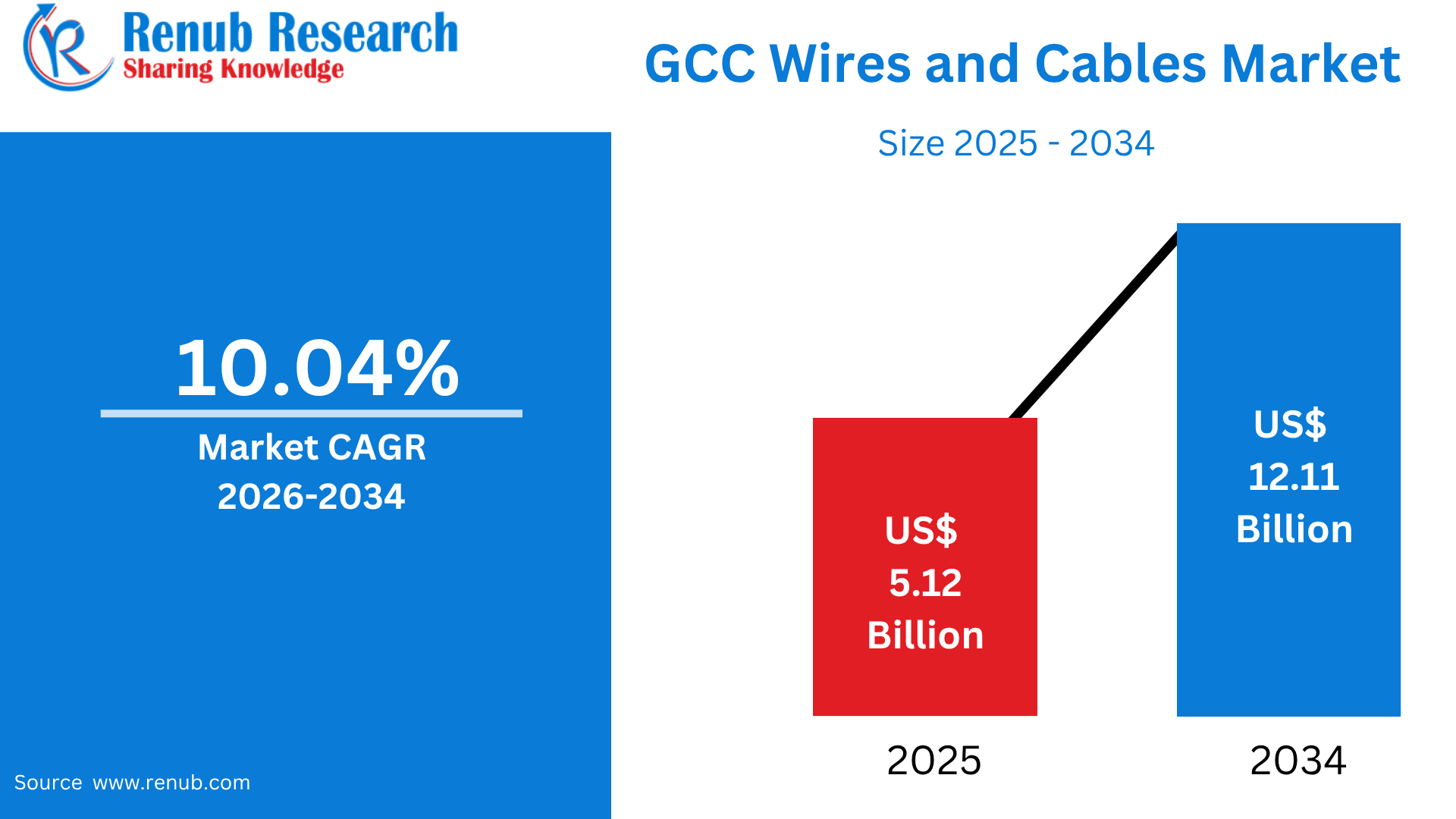
GCC Wires & Cables Market is projected to expand significantly, increasing from US$ 5.12 billion in 2025 to US$ 12.11 billion by 2034, registering a Compound Annual Growth Rate (CAGR) of 10.04% during 2026–2034. The market is expected to witness sustained growth, supported by rapid infrastructure development, expanding construction activities, and increasing investments in power and utility networks across the Gulf region. The rising deployment of renewable energy projects, industrial facilities, smart grids, and advanced power transmission and distribution systems is further generating demand for high-performance wires and cables.
What are Wires & Cables and Their Uses & Popularity in GCC
Wires and cables are essential electrical components designed to transmit electrical power, signals, and data across residential, commercial, industrial, and infrastructure applications. While a wire generally consists of a single conductor, a cable typically contains multiple insulated conductors protected by an outer covering. In the GCC, wires and cables are extensively used in power generation and transmission, electricity distribution, buildings, oil and gas facilities, industrial plants, telecommunications, data centers, transportation networks, renewable energy projects, and smart-city infrastructure. Their importance is increasing as GCC countries expand urban infrastructure, modernize electricity networks, and invest in large-scale construction and digitalization projects. Demand is further supported by renewable-energy installations, grid modernization, expanding telecom networks, and rising electricity requirements. Saudi Arabia and the UAE represent major regional markets because of their large infrastructure investments, construction activity, and economic diversification programs. Growing deployment of smart grids, high-speed telecommunications, and renewable power systems is expected to further strengthen the popularity and adoption of advanced cable technologies across the GCC.
Renewable Energy and Energy Efficiency Targets in Gulf States
- Kuwait: Kuwait is targeting 15% of total electricity generation from renewable energy by 2030. In terms of energy efficiency, the country aims to achieve a 30% reduction in energy consumption in buildings by 2030, supporting more efficient use of electricity across the built environment.
- Qatar: Qatar has set a target of developing 200–500 MW of solar energy by 2022. Alongside renewable energy expansion, the country targeted an 8% reduction in electricity consumption by 2022 through energy-efficiency initiatives and improved demand management.
- Bahrain: Bahrain aims to generate 10% of its electricity from renewable energy sources by 2035. The country also established an energy-efficiency target of achieving a 6% reduction in electricity consumption by 2025, encouraging more efficient energy use across various sectors.
- United Arab Emirates (UAE): The UAE’s 2050 strategy targets 50% clean energy, comprising 44% renewable energy and 6% nuclear energy. For energy efficiency, the country aims to reduce electricity consumption by 30% by 2030 and 40% by 2050, emphasizing efficient buildings, infrastructure, and energy systems.
- Saudi Arabia: Saudi Arabia targets achieving 30% of electricity generation from renewable energy sources by 2030. The country has also pursued energy-efficiency measures, including a target to achieve a 14% reduction in peak electricity demand by 2021 through demand-side management and efficiency improvements.
- Oman: Oman aims to obtain 10% of its electricity generation from renewable energy by 2025. The country has also established an energy-efficiency objective of achieving a 2% reduction in electricity consumption by 2030, supporting more sustainable energy utilization.
Growth Drivers of the GCC Wires & Cables Market
Rapid Infrastructure Development and Mega Projects
Large-scale infrastructure development across the GCC is generating substantial demand for wires and cables used in buildings, transportation networks, utilities, commercial facilities, and industrial projects. Governments are investing in economic diversification programs, smart cities, tourism developments, airports, railways, residential communities, and large entertainment projects. These developments require extensive low-, medium-, and high-voltage cabling for electricity distribution, lighting, communications, automation, and safety systems. Saudi Arabia’s Vision 2030 projects are particularly important, with major developments such as NEOM, the Red Sea Project, and Qiddiya creating requirements for extensive electrical infrastructure. Across the GCC, the broader wires and cables market is projected to demonstrate the scale of infrastructure-related demand. Continued construction activity, urban expansion, and modernization of existing infrastructure are therefore expected to remain fundamental growth contributors.
Renewable Energy Expansion and Grid Modernization
GCC’s transition toward renewable energy is creating new requirements for specialized power cables used in generation, transmission, distribution, and grid interconnection. Solar parks, wind projects, battery systems, and other renewable installations require cables capable of handling high power loads and demanding environmental conditions. According to the Center on Global Energy Policy, the six GCC countries had invested more than US$42.5 billion in developing approximately 62.1 GW of renewable-energy projects, although only 19.3 GW had been connected to the grid as of July 2025. The region has a 2030 renewable-capacity target of 165 GW, indicating significant additional infrastructure requirements. Saudi Arabia is also targeting 130 GW of renewable capacity by 2030, increasing demand for transmission, distribution, and grid-connection cables. At the same time, GCC utilities are modernizing existing networks and integrating smart-grid technologies. Advanced cables are increasingly required for high-capacity transmission, underground networks, renewable interconnections, and digital monitoring systems. These investments are expected to support sustained demand for high-performance wires and cables across the region.
Growth of Digital Infrastructure, Telecommunications, and Data Centers
Rapid digitalization across the GCC is expanding demand for communication cables, fiber-optic systems, structured cabling, and specialized electrical infrastructure. Investments in 5G networks, cloud computing, data centers, smart cities, digital services, and connected infrastructure require reliable high-speed connectivity and power distribution systems. The GCC wires and cables industry is increasingly benefiting from telecommunications and data-center development alongside traditional electricity applications. Saudi Arabia provides a significant example: telecommunications and data centers are projected to be among the fastest-growing end-user areas of its wire and cable market. As enterprises, governments, and telecom operators expand digital infrastructure, demand is increasing for fiber-optic cables, power cables, fire-resistant systems, and specialized communication cabling. This diversification beyond conventional power applications provides an additional growth avenue for GCC cable manufacturers.
Challenges of the GCC Wires & Cables Market
Volatility in Copper, Aluminum, and Raw Material Prices
Fluctuations in the prices of copper, aluminum, polymers, and other raw materials represent an important challenge for wires and cables manufacturers. Conductors account for a substantial portion of cable production costs, meaning changes in commodity prices can directly affect manufacturing expenses, quotations, project margins, and procurement decisions. Cable manufacturers operating under long-term infrastructure contracts may face difficulties when raw-material costs rise after project pricing has already been established. Higher input costs can also increase prices for contractors and utilities, potentially affecting project budgets and procurement schedules. In addition, international supply-chain disruptions, transportation costs, and currency movements can create further uncertainty for imported materials and components. Manufacturers therefore increasingly need effective procurement strategies, inventory management, supplier diversification, and price-adjustment mechanisms. Maintaining competitive pricing while meeting technical and quality requirements remains a key challenge, particularly for large infrastructure and power-transmission contracts where margins and delivery schedules are closely managed.
High Technical Standards, Certification Requirements, and Project Complexity
The GCC wires and cables industry faces increasingly demanding technical, safety, and performance requirements across utilities, construction, oil and gas, telecommunications, and renewable energy projects. Cables must often comply with requirements related to voltage ratings, fire resistance, insulation, temperature performance, electromagnetic protection, environmental durability, and electrical safety. Large infrastructure projects can also require customized specifications, testing, certification, and approvals before products can be deployed. Differences in procurement standards and certification requirements across GCC countries can increase compliance costs and extend product qualification timelines. In addition, advanced projects such as renewable-energy plants, smart grids, data centers, and large industrial facilities require specialized high-performance cable systems rather than standardized products. The growing use of underground and submarine installations adds further technical complexity; in Saudi Arabia, underground cables. Manufacturers therefore need continuous investment in testing, engineering, product development, certification, and quality assurance to compete successfully in increasingly sophisticated GCC infrastructure projects.
Wires & Cables Launches in GCC
- Ducab – High Voltage Fiber Optic Cable, UAE (April 2025): Ducab launched the GCC’s first High Voltage (HV) Fiber Optic Cable at Middle East Energy 2025 in Dubai. The product combines high-voltage power transmission with fiber-optic technology and enables utilities to monitor temperature, strain, and cable performance in real time.
- Oman Cables Industry – Prysmian E Path, GCC (April 2025): Oman Cables Industry introduced Prysmian E Path at Middle East Energy 2025. The solution is designed to assess cable sustainability using six internationally recognized environmental and performance criteria while supporting lower-impact and energy-efficient cable solutions.
- Ray International / V-Marc – E-Beam Flexi Tough Wires & Power Cables, UAE (September 2024): Ray International announced the launch of E-Beam Flexi Tough Wires & Power Cables at WETEX 2024 in Dubai. The products were positioned around enhanced safety, thermal performance, reliability, and the use of eco-friendly materials.
- Riyadh Cables & Enertechnos – Capacitive Transfer System Cable, Saudi Arabia (August 2024): Riyadh Cables Group and UK-based Enertechnos signed a development and licensing agreement covering the production of Capacitive Transfer System (CTS) cable technology in the Middle East. The technology is intended to improve cable efficiency and increase electricity-grid capacity and resilience.
- Gulf Gateway Cable 1 (GGC1) – Qatar & UAE (March 2024): Ooredoo Group and e& launched the Gulf Gateway Cable 1 subsea system connecting data centers in Abu Dhabi and Doha. The system supports capacity of up to 28 Tbps, strengthening international connectivity and regional digital infrastructure.
- PEACE Cable – UAE (February 2025): du and PEACE Cable International announced plans to land the PEACE submarine cable system in the UAE. The high-capacity system is designed to connect the UAE with networks spanning Singapore, Pakistan, Africa, and Europe, supporting secure and resilient connectivity.
- Fibre in Gulf (FIG) – GCC (January 2025): Ooredoo Group announced the Fibre in Gulf (FIG) submarine cable project, connecting Qatar, Oman, UAE, Bahrain, Saudi Arabia, Kuwait, and Iraq. The system is planned with up to 24 fiber pairs and 720 Tbps capacity, targeting telecom operators, data centers, governments, AI providers, and hyperscalers.
- REPL Industry Factory – Saudi Arabia (April 2024): AL Ojaimi Industrial Group and REPL International inaugurated a new cable-accessories manufacturing facility in Riyadh. The plant focuses on heat-shrink, cold-shrink, and pre-molded cable accessories for power and telecommunications applications, supporting local manufacturing under Saudi Vision 2030.
- Neelkanth Cables – Dubai Manufacturing Facility, UAE (May 2024): Neelkanth Cables announced a new AED 130 million manufacturing facility at Dubai Industrial City. The facility is designed to produce low- and medium-voltage conductors and instrumentation cables, with planned annual throughput of 20,000 metric tonnes, including 13,000 tonnes of copper and 7,000 tonnes of aluminum power cables.
- ADNOC – Local Cable Manufacturing Agreements, UAE (May 2025): ADNOC signed AED 6 billion (US$1.64 billion) framework agreements with 12 UAE-based companies for manufacturing critical industrial equipment, including cables. The agreements are expected to support up to 1,300 skilled private-sector jobs, reduce import dependence, and strengthen local cable supply chains.
Kuwait Power Infrastructure and Industrial Development
Kuwait’s wires and cables market is expanding as the country invests in electricity infrastructure, urban development, industrial facilities, and telecommunications networks. Growing electricity requirements and the need to upgrade aging transmission and distribution infrastructure are generating demand for low-, medium-, and high-voltage cables. Residential developments, commercial buildings, hospitals, educational facilities, and infrastructure projects require extensive electrical wiring, while Kuwait’s oil and gas sector creates demand for specialized power, control, instrumentation, and communication cables capable of operating in demanding environments. Renewable-energy development is also creating additional opportunities for cables used in solar-power generation and grid integration. Kuwait’s Shagaya Renewable Energy Park has been planned as a major renewable-energy development, with the project designed around multiple renewable technologies and a targeted capacity of approximately 4.0 GW in its broader development plans. Telecommunications modernization and digitalization are simultaneously increasing demand for fiber-optic and data communication cables. Manufacturers are also responding to requirements for fire-resistant, energy-efficient, low-smoke, and environmentally compliant cable systems. As Kuwait continues to modernize its power network and diversify its economy, infrastructure investment is expected to remain an important contributor to wires and cables demand.
United Arab Renewable Energy and High-Performance Cabling Demand
UAE wires and cables market is being supported by substantial investments in renewable energy, electricity infrastructure, smart cities, and digital connectivity. The country’s increasing deployment of solar power and battery storage is creating demand for high-capacity transmission cables capable of connecting generation assets, storage systems, substations, and distribution networks. The country’s renewable-energy ambitions are further strengthening demand for specialized and durable cabling systems. A major development is the US$6 billion renewable-energy project announced by Masdar and Emirates Water and Electricity Company, designed to combine 5.2 GW of solar photovoltaic capacity with 19 GWh of battery storage and provide up to 1 GW of continuous power. Such large-scale projects require sophisticated cables with high conductivity, thermal resistance, insulation performance, and durability, supporting opportunities for advanced cabling technologies across the UAE.
Bahrain Infrastructure Modernization and Industrial Connectivity
Bahrain’s wires and cables market is supported by ongoing investments in residential construction, commercial infrastructure, industrial facilities, utilities, and telecommunications networks. Electrical cables are essential for expanding power-distribution infrastructure, while communication and fiber-optic cables support the country’s digital-transformation objectives. Bahrain’s electricity system is also undergoing continued modernization as demand for reliable power and efficient distribution increases. The country’s Bahrain Economic Vision 2030 provides a broader framework for economic diversification, private-sector development, and infrastructure modernization, supporting long-term demand for electrical and communication equipment. Industrial activities, including aluminum production, manufacturing, petrochemicals, and oil-related operations, create additional requirements for power, control, instrumentation, and specialty cables. The country’s Aluminium Bahrain (Alba) smelter is among the world’s largest aluminum production facilities, highlighting the importance of reliable industrial electrical infrastructure. At the same time, expanding telecommunications and data connectivity are supporting fiber-optic cable demand. Rising construction activity, industrial modernization, and investments in energy-efficient infrastructure are therefore expected to sustain demand for low-, medium-, and high-voltage cables in Bahrain.
Saudi Arabia Vision 2030 and Large-Scale Infrastructure Investment
Saudi Arabia represents one of the largest wires and cables markets in the GCC, supported by extensive infrastructure development, energy investments, industrial expansion, and economic diversification. Vision 2030 is generating significant requirements for electrical and communication infrastructure through large-scale developments such as NEOM, Qiddiya, and the Red Sea Project. These developments require extensive power-distribution, telecommunications, data, automation, and building-cable systems. Saudi Arabia’s renewable-energy expansion is another important demand driver, with the country targeting 130 GW of renewable-energy capacity by 2030. Oil and gas, petrochemicals, mining, manufacturing, airports, railways, and utilities further contribute to cable consumption. Growing requirements for high-voltage, fire-resistant, underground, and renewable-energy cables are encouraging manufacturers to develop higher-performance products. Continued infrastructure spending and industrial diversification are expected to maintain Saudi Arabia’s importance within the GCC wires and cables industry.
GCC Wires & Cables Market Segments
Cable Type
- Low Voltage Energy
- Power Cable
- Fiber Optic Cable
- Signal and Control Cable
- Other Cable Types
Voltage
- Low Voltage
- Medium Voltage
- High Voltage
- Extra High Voltage
Installation
- Overhead
- Underground
End User
- Aerospace & Defense
- Building & Construction
- Oil & Gas
- Energy & Power
- IT & Telecommunication
- Automotive
- Others
Countries
- Saudi Arabia
- UAE
- Kuwait
- Qatar
- Oman
- Bahrain
- Rest of GCC
All companies have been covered with 5 Viewpoints
- Overviews
- Key Person
- Recent Developments
- SWOT Analysis
- Revenue Analysis
Key Players Analysis
- Riyadh Cable
- Al Fanar Electrical Systems
- Jeddah Cable
- Bahra Cable
- Dubai Cable
- National Cable Industry
- Power Plus Cables
- Oman Cables Industry (OCI)
- Doha Cables
- QICC Cables
Report Details:
| Report Features | Details |
| Base Year |
2025 |
| Historical Period |
2022 - 2025 |
| Forecast Period |
2026 - 2034 |
| Market |
US$ Billion |
| Segment Covered |
Cable Type, Voltage, Installation, End User and Countries |
| Countries Covered |
|
| Companies Covered |
|
| Customization Scope |
20% Free Customization |
| Post-Sale Analyst Support |
1 Year (52 Weeks) |
| Delivery Format |
PDF and Excel through Email (We can also provide the editable version of the report in PPT/Word format on request) |
Customization Services available
- Analysis of Market Size and Its Segments
- More Company Profiles (Upto 10 without any additional cost):
- Additional Countries (Other than mentioned Countries):
- Region/Country Specific Reports:
- Market Entry Strategy:
- Region-Specific Market Dynamics:
- Regional Market Share Analysis:
- Trade Analysis:
- Production Insights:
- Others Customized Requests:
For more information contact our analysts.
Need More Assistance?
- Talk to our analysts to get more precious information on the current market trends.
- Include more countries and segments and customize the report based on the final requirement.
- Get a competitive advantage in your industry by knowing the report findings and making a positive impact on your revenues and operations.
- Our analysts are always ready to provide more help and pertinent information if you need any additional assistance.