Global Wireless Router Market Report by Component Type (Single Band, Dual Band, Tri Band), End User, Countries and Competitive Landscape 2026-2034
Buy NowWireless Router Market Size & Forecast 2026-2034
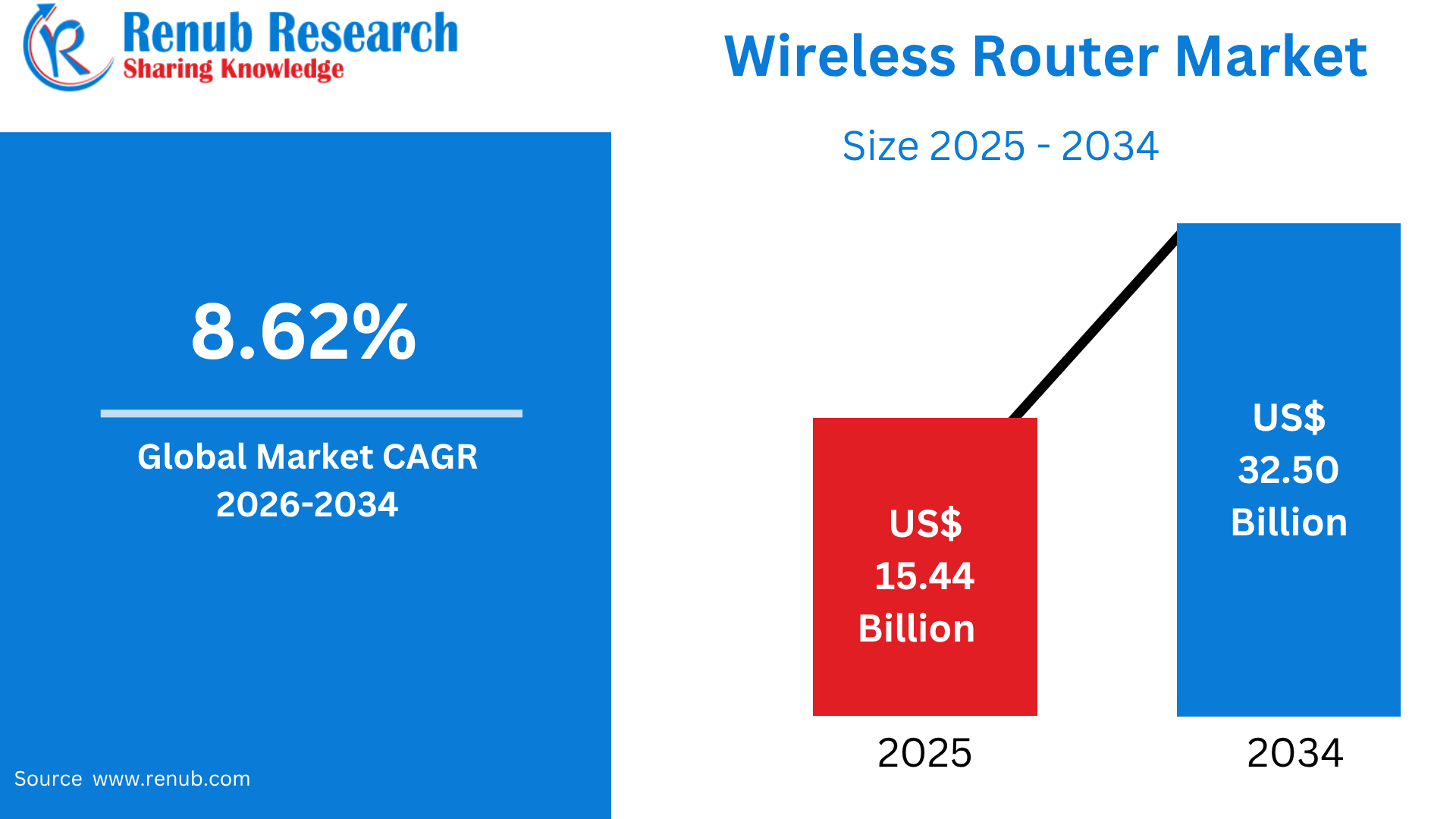
Wireless router market is expected to grow from US$ 15.44 Billion in 2025 to US$ 32.50 Billion in 2034 at a compound annual growth rate (CAGR) of 8.62% during 2026-2034. This growth is due to increasing internet penetration rates, smart home device usage, and rising trends in remote work. Development in Wi-Fi standards such as Wi-Fi 6 and Wi-Fi 7, along with the increasing need for high-speed connectivity, also contributes to the growth of the wireless router market.
Wireless Router Market Outlooks
A wireless router is a network device that provides internet connectivity to various devices without the use of wires. It receives internet data from a modem and sends the data wirelessly to devices. This way, devices such as smartphones, laptops, tablets, smart TVs, and smart home devices can connect to the internet. A wireless router provides internet connectivity and communication between devices through a local area network (LAN) using Wi-Fi technology. Modern wireless routers support advanced technologies such as Wi-Fi 5, Wi-Fi 6, and Wi-Fi 7. These technologies provide faster internet connectivity and support simultaneous connectivity of multiple devices.
A wireless router can be found in homes, businesses, and public spaces. At home, wireless routers provide connectivity for devices such as smart home devices and security cameras. At work, wireless routers provide communication between devices. They are also essential in public spaces such as airports, hotels, and cafes. People in these spaces need internet connectivity.
The popularity of wireless routers is increasing around the world due to the penetration of internet connectivity, digital transformation, and the surge of connected devices. Remote working, online learning, and streaming are also contributing to the popularity of wireless routers. In addition, the development of smart cities and IoT devices has enhanced the significance of wireless routers. As the world is becoming more dependent on internet connectivity, wireless routers are playing a key role.
Growth Drivers of the Wireless Router Market
Increasing Internet Penetration and Connected Device Usage
Today, in the year 2025, the percentage of people online in the world totals 74 percent, an increase from the 71 percent recorded in the previous year. In absolute figures, this translates to an increase in the number of people online to 6 billion people, an increase from the 5.8 billion people recorded in the previous year. The rate of increase in the number of people online in the world annually has also risen to 3.3 percent, an increase from the previous rate of 2.9 percent. Despite this progress towards universal online penetration, over a quarter of the people in the world still do not have an online presence. The rapid growth in the number of people online in the world contributes to the wireless router market. This is because an increase in the number of people online translates to an increase in the number of people in need of wireless routers. Nowadays, people are using different internet facilities such as smartphones, laptops, smart TVs, gaming consoles, and tablets. These devices require efficient wireless connectivity. Moreover, the penetration of affordable internet facilities in developing countries has also led to the increased adoption of wireless routers. Wireless routers have become essential devices that facilitate connectivity to multiple devices at one time. The increased dependence on cloud services, online communication tools, and digital entertainment also supports the demand for wireless routers. Today, governments and telecom providers are investing in digital infrastructure to promote the growth of high-speed internet facilities. Internet facilities have become a basic necessity in countries around the world. Therefore, the demand for advanced wireless routers is rising steadily.
Growth of Smart Homes and Internet of Things (IoT) Devices
Number of connected IoT devices expected to grow by 14% in 2025, reaching 39 billion in 2030, and over 50 billion in 2035. The number of connected IoT devices stood at 18.5 billion in 2024, up by 12% from 2023, based on the continuous tracking and analysis of IoT connectivity by IoT Analytics. The growing use of smart home devices and IoT devices is a major factor contributing to the wireless router market. This is because smart devices, such as voice assistants, smart thermostats, security cameras, smart lighting systems, and connected appliances, require a stable wireless connection to operate optimally. The wireless router acts as a central hub that connects all the devices and facilitates communication between them. With the increased trend of smart home devices among consumers for convenience, energy savings, and security, the demand for high-end routers is on the rise. New-age routers provide a range of advanced capabilities such as dual-band and tri-band connectivity, improved security protocols, and better management capabilities. IoT is also penetrating the commercial and industrial sectors with the advent of smart offices, healthcare centers, and industrial plants. This increased IoT landscape requires robust and quick wireless connectivity solutions, which makes wireless routers a key component of smart technology adoption around the world.
Rising Demand for High-Speed Connectivity and Remote Work Trends
The move towards remote work, online classes, and digital entertainment has led to a rise in the demand for high-speed and efficient internet connectivity. Wireless routers have become essential in enabling video conferencing, cloud computing, and online collaborations. Due to the rise in remote work and online classes, households require wireless routers that have the capability to handle high data traffic. The introduction of advanced technologies such as Wi-Fi 6 and Wi-Fi 7 has led to the upgrade and replacement of wireless routers. Firms have also adopted advanced wireless router technologies to enable hybrid work. Moreover, the increasing demand for online games and high-definition streaming services also demands low-latency and high-performance connectivity. Thus, all these factors contribute to the demand for modern wireless routers. January 2025, SAS is launching a completely new concept of in-flight connectivity with the launch of free high-speed Wi-Fi. Starlink is developed by SpaceX and is the first and largest satellite constellation in the world to use a low earth orbit. This will provide SAS passengers across all classes of travel free high-speed internet connectivity. This premium feature will be available to EuroBonus members for free. This will roll out to the entire fleet towards the end of 2025.
Challenges of the Wireless Router Market
Security Concerns and Increasing Cyber Threats
Security risks pose a significant challenge for the wireless router market. Wireless networks face a threat of cyber attacks such as hacking, data breaches, malware attacks, and unauthorized access. Weak passwords and poor network configuration expose the user to a significant threat. As the amount of sensitive personal and professional information is being carried through wireless networks, the need for security is also on the rise. For example, a business faces a threat of loss of confidential information and disruption of business processes. However, manufacturers are introducing advanced security features such as encryption protocols and firewalls. But the need for security is not met with the required security practices by the user. Similarly, the increased usage of IoT devices poses a threat to the network, as they do not come with robust security systems.
Market Saturation and Intense Competition Among Manufacturers
The wireless router market is a highly competitive one, with a number of global and regional manufacturers of wireless routers. Established brands face competition from low-cost manufacturers, which impacts the profitability of the firms. As consumers use wireless routers for a long time, they don’t change them often. This impacts the frequency of purchases, which is a major factor that influences the growth of the market. Telecom service providers give away free routers to consumers, which impacts the demand for wireless routers. Technological changes are happening at a fast pace, and this impacts the products. As products become outdated quickly, manufacturers have to invest a lot in research and development to stay ahead in the competition. In a highly competitive market, manufacturers face difficulties in differentiating their products, as all products are more or less the same.
Dual Band Wireless Router Market
Dual band wireless routers have gained popularity due to their capability to operate on two different bands or frequency ranges, i.e., 2.4 GHz and 5 GHz. This feature enables users to utilize these routers effectively to achieve their goals in the most efficient manner. For example, the 2.4 GHz frequency band extends the coverage area, while the 5 GHz frequency band enables faster data transfer rates compared to the 2.4 GHz frequency band. These wireless routers are used in households and small commercial environments where the overall usage of the internet is not very high. These dual band wireless routers have helped to reduce network congestion in a considerable manner. These wireless routers are also cheaper compared to other advanced tri band wireless routers. Due to the increasing demand for home connectivity and smart devices, dual band wireless routers are in great demand. These wireless routers have been in great demand due to their affordability and capability to operate on two different bands or frequency ranges.
Tri Band Wireless Router Market
Tri band wireless routers provide greater benefits through the use of one 2.4 GHz frequency and two separate 5 GHz frequencies. This enhances the management of traffic and the use of multiple devices that require high bandwidth connectivity without the loss of speed and stability. Tri band wireless routers are best for use in homes, gaming, and offices that require heavy use of the internet. 4K and 8K video streaming, gaming, video conferencing, and smart home devices benefit from the use of tri band wireless routers. Although the use of tri band wireless routers is expensive compared to the use of dual band wireless routers, the benefits obtained from the use of these devices justify the cost. Tri band wireless routers are the best choice for businesses and individuals who require the best connectivity solutions. Therefore, the use of tri band wireless routers will become a necessity for individuals who require faster internet connectivity.
Residential Wireless Router Market
The market for residential wireless routers is witnessing rapid growth due to the increasing rate of internet usage in homes across the world. Wireless routers play a vital role in facilitating daily activities such as watching videos, online learning, working from home, playing games, and controlling smart home devices. With the increasing rate of smart home devices such as smart TV sets, security cameras, and voice assistants, people require robust and reliable wireless connectivity. Internet service providers provide wireless routers to their customers; however, many people prefer to own advanced wireless routers to enhance their internet experience. With the rise of smart home devices and the increasing rate of internet usage in homes across the world, the residential segment is the largest and most significant market for wireless router manufacturers.
Healthcare Wireless Router Market
Wireless routers are extremely important in the modern healthcare industry because they help ensure a safe and sound connectivity solution for all the medical devices and digital healthcare systems. For example, electronic health records, patient monitoring systems, telemedicine solutions, and imaging systems are some of the key applications where wireless solutions are employed. The need for reliable wireless solutions is extremely important because they help ensure timely data transmission, which is extremely beneficial for the overall healthcare industry. Wireless routers also help support mobile devices for the healthcare staff who need connectivity solutions for communication and accessing patient records. Advanced wireless routers with robust security solutions are extremely important for the modern healthcare industry. The demand for wireless routers is also on the rise because telehealth solutions and connected devices are increasingly employed. As the healthcare industry continues to adopt more connected solutions, the need for wireless solutions is also on the rise.
Education Wireless Router Market
Wireless routers have become very crucial for the education sector, especially for digital learning, online classrooms, and connected campus environments. Schools, colleges, and other educational institutions require wireless routers for the establishment of a wireless network, which enables the entire student community, teachers, and other staff members to access the internet. Wireless routers have also become very popular due to the increased use of online classrooms, especially after the global shift towards online classrooms due to the COVID-19 outbreak. Educational institutions require wireless routers that can support multiple users simultaneously without any disruption of the network. Wireless routers also support smart classrooms, where digital boards, tablets, and other connected tools are available for teachers. In addition, the establishment of a campus-wide wireless network has also become very crucial for communication, research, and other operations. As digital education becomes more popular worldwide, the use of wireless routers has become a fundamental technology for the establishment of online classrooms and connected campus environments.
United States Wireless Router Market
The United States wireless router market is a developed market due to the high penetration rate of the internet and the digital infrastructure in the country. Smart home devices such as smart speakers, smart security systems, and smart home appliances have become extremely popular in the country. This has led to a significant increase in the demand for high-performance wireless routers. Remote working, online classes, and streaming have become extremely popular in the country. Internet connectivity is widespread in the country. People are upgrading to high-performance wireless routers that come with Wi-Fi 6 and Wi-Fi 7 connectivity. These devices are used in business organizations to run cloud computing and digital business processes. Internet service providers usually give away free wireless routers with their plans. However, people prefer to buy premium wireless routers. Continuous technological developments, robust consumer spending power, and the rise of connected devices ensure the consistent demand and evolution of the United States' wireless router market. Sept 2025 - D-Link Corporation (TWSE: 2332), one of the world's leading networking solutions providers, today announced the launch of its latest Wi-Fi 7 products: the AQUILA PRO AI M36 BE3600 Wi-Fi 7 Smart Mesh Router and the AQUILA PRO AI R36 BE3600 Wi-Fi 7 Smart Router. As the trend of working from home and the need for streaming and smart home solutions continue to grow, the need for a solution that offers connectivity without hassle is on the rise.
United Kingdom Wireless Router Market
The United Kingdom wireless router market is witnessing steady growth due to the increasing adoption of high-speed broadband connections and devices. With the increasing demand for wireless connectivity for streaming media content, video conferencing, online gaming, and communication, people are relying on wireless connectivity. With the expansion of fiber broadband connectivity, people are looking to upgrade their wireless routers to high-end devices to take advantage of the high speeds offered. With the rise of smart home devices, people are looking to adopt wireless connectivity solutions. Businesses are also investing in wireless connectivity solutions to support their hybrid work culture. Retail availability of advanced wireless routers with better security and performance capabilities is driving the market. Moreover, the rising awareness of network performance and security also prompts consumers to replace old devices. These are the key factors driving the growth of the wireless router market in the residential and commercial sectors of the United Kingdom. Aug 2025, In a significant leap forward for home connectivity, award-winning YouFibre today announced that Wi-Fi 7 will now be included as standard across all residential and business broadband packages, making it the first among the broadband majors to deliver the next generation of wireless connectivity to every new consumer, at no additional cost.
India Wireless Router Market
India’s wireless router market is expanding at a rapid rate, mainly because of the growth in internet penetration and the overall increase in the number of people adopting digital technologies. The government’s initiatives to promote the use of digital connectivity and affordable internet services have led to a significant increase in internet penetration, thereby expanding the overall scope for the growth of the wireless router industry. In the context of the overall increase in the number of people adopting internet connectivity, the growth of remote work, the use of the internet for educational purposes, the use of the internet for payment, and the use of the internet for streaming services, the growth of the use of smart devices such as smartphones, smart TVs, and home automation devices, and the growth of fiber internet connectivity, the overall growth of the wireless router industry can be regarded as promising. Jun 2025, Reliance Jio has announced the launch of a new high-speed WiFi 6 router for Indian consumers. The latest device, named the AX6000 WiFi 6 Universal Router, has been designed to offer a reliable and high-speed internet experience to the masses.
Saudi Arabia Wireless Router Market
The wireless router market in Saudi Arabia is growing, given the rapid rate of digitalization and the government’s support for the development of smart infrastructure. Internet penetration rates are rising, and the adoption rate for digital solutions is very high. Therefore, the demand for wireless connectivity solutions is significant. In Saudi Arabia, the development of smart city infrastructure and the use of connected devices are contributing to the growth of the wireless router market. Smart home solutions are gaining traction among households, and the use of wireless routers to connect these devices to the internet is significant. Businesses are adopting advanced wireless routers to support cloud-based solutions, digitalization, and secure communication. In Saudi Arabia, the development of advanced internet infrastructure, such as high-speed internet and 5G, has encouraged people to upgrade to the latest wireless router solutions. In conclusion, the focus on the development of the digital economy and the advancement of technology ensures the growth of the wireless router market. July 2025: Saudi Arabia’s Communications, Space and Technology Commission (CST) announced that standard power 6 GHz outdoor (and indoor) Wi-Fi operation using AFC is now allowed in the Kingdom. This announcement reinforces Saudi Arabia’s position in the region and around the world as a strong supporter of 6 GHz Wi-Fi everywhere.
Market Segmentation
Component Type
- Single Band Wireless Router
- Dual Band Wireless Router
- Tri Band Wireless Router
End User
- Residential
- Commercial
- IT and Telecom
- Healthcare
- BFSI
- Education
- Others
Countries
North America
- United States
- Canada
Europe
- France
- Germany
- Italy
- Spain
- United Kingdom
- Belgium
- Netherlands
- Turkey
Asia Pacific
- China
- Japan
- India
- Australia
- South Korea
- Thailand
- Malaysia
- Indonesia
- New Zealand
Latin America
- Brazil
- Mexico
- Argentina
Middle East & Africa
- South Africa
- Saudi Arabia
- United Arab Emirates
All companies have been covered with 5 Viewpoints
- Overviews
- Key Person
- Recent Developments
- SWOT Analysis
- Revenue Analysis
Competitive Landscape
- Cisco
- AT&T
- Verizona
- Comcast
- Charter Communication
- Lumen Technology
- Viasat
- Netgear
Report Details:
| Report Features | Details |
| Base Year |
2025 |
| Historical Period |
2022 - 2025 |
| Forecast Period |
2026 - 2034 |
| Market |
US$ Billion |
| Segment Covered |
Component Type, End User and Countries |
| Countries Covered |
|
| Companies Covered |
|
| Customization Scope |
20% Free Customization |
| Post-Sale Analyst Support |
1 Year (52 Weeks) |
| Delivery Format |
PDF and Excel through Email (We can also provide the editable version of the report in PPT/Word format on request) |
Customization Services available
- Analysis of Market Size and Its Segments
- More Company Profiles (Upto 10 without any additional cost):
- Additional Countries (Other than mentioned Countries):
- Region/Country Specific Reports:
- Market Entry Strategy:
- Region-Specific Market Dynamics:
- Regional Market Share Analysis:
- Trade Analysis:
- Production Insights:
- Others Customized Requests:
For more information contact our analysts.
Need More Assistance?
- Talk to our analysts to get more precious information on the current market trends.
- Include more countries and segments and customize the report based on the final requirement.
- Get a competitive advantage in your industry by knowing the report findings and making a positive impact on your revenues and operations.
- Our analysts are always ready to provide more help and pertinent information if you need any additional assistance.