India Wires and Cables Market Report by Cable Type, Voltage, Installation, End User, States and Companies Analysis 2026-2034
Buy NowIndia Wires and Cables Market Size and Forecast
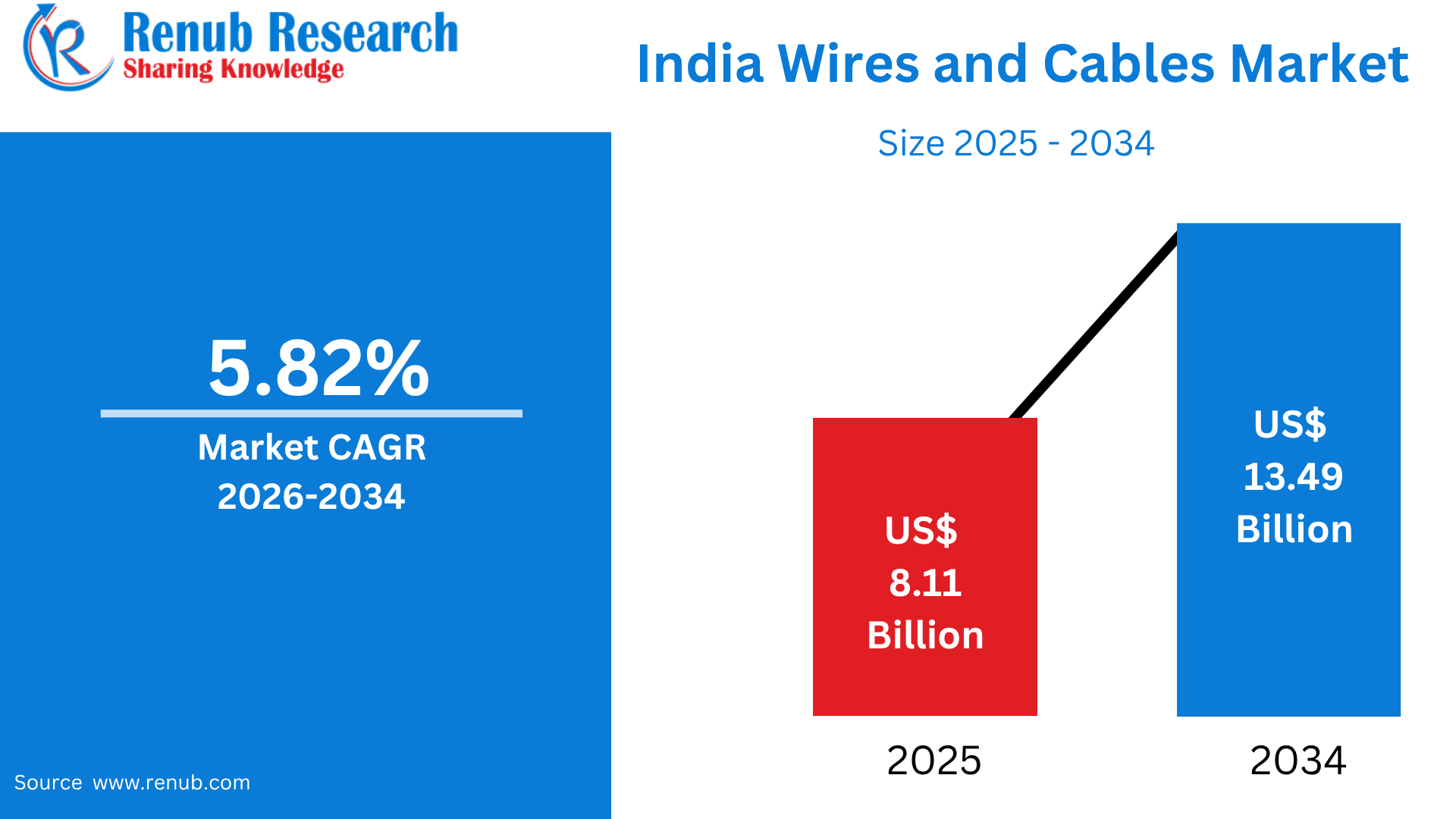
India Wires and Cables Market is projected to grow from US$ 8.11 billion in 2025 to US$ 13.49 billion by 2034, registering a CAGR of 5.82% during 2026–2034. Market expansion is being supported by rapid infrastructure development, continued electrification initiatives, and increasing investments in renewable energy projects. In addition, rising construction activity, industrial expansion, growing electricity demand, and the development of digital and telecommunications infrastructure are creating strong demand for wires and cables across India.
What Are Wires and Cables and Their Uses & Popularity in India
Wires and cables are electrical conductors used to transmit and distribute electricity, data, and communication signals between power sources, equipment, buildings, and infrastructure. Wires generally consist of one or more conductive strands, commonly copper or aluminium, while cables may contain multiple insulated conductors protected by an outer sheath. They are extensively used in residential buildings, commercial complexes, industrial facilities, power transmission and distribution networks, telecommunications, railways, automobiles, renewable-energy projects, and infrastructure development. Their importance in India is increasing alongside rapid urbanization, industrialization, electrification, and expansion of power infrastructure.
India’s electricity transmission network at 220 kV and above has surpassed 5 lakh circuit kilometres, demonstrating the enormous infrastructure base requiring transmission and distribution conductors. The country’s peak electricity demand reached 249,856 MW during FY2024–25 through February 2025, further highlighting the need for reliable electrical infrastructure. Wires and cables are also becoming increasingly important for solar and wind installations, electric vehicles, data centers, and smart-grid projects. Their essential role in electricity delivery and connectivity makes them a highly popular and indispensable component of India’s infrastructure and industrial ecosystem.
Power Generation Capacity Added
- FY 2024–25: 34,054 MW
- FY 2025–26 (up to 31st January 2026): 52,537 MW
Improvement in Daily Average Power Supply
- Rural Areas: Increased from 12.5 hours in FY 14 to 22.6 hours in FY 25
- Urban Areas: Increased from 22.1 hours in FY 14 to 23.4 hours in FY 25
(Source: Ministry of Power / PIB)
Major investments and developments in the Indian power sector are as follows:
- The Ministry of Power has allocated Rs. 29,997 crore (US$ 3.39 billion) in February 2026 to the power sector, encompassing investments in new and renewable energy. This represents a 39% increase from the previous year's outlay.
- The PM-KUSUM scheme (Pradhan Mantri Kisan Urja Suraksha evam Utthan Mahabhiyan) has received Rs. 5,000 crore (US$ 529.77 million) in FY27 budget, up from Rs. 2,600 crore (US$ 294.22 million) in FY26 budget.
- Power Finance Corporation Limited (PFC) has entered into a Memorandum of Understanding (MoU) with the Government of Madhya Pradesh, under which it will provide financial support of Rs. 26,800 crore (US$ 3.17 billion) to the state's power utilities.
- Over the next decade, India plans to invest Rs. 42,00,000 crore (US$ 488.37 billion) to upgrade its power sector, modernizing renewable energy, battery storage, and transmission networks to meet rising demand.
- Following the enactment of the landmark Sustainable Harnessing and Advancement of Nuclear Energy for Transforming India (SHANTI) Act in December 2025, India has unlocked the world's largest untapped nuclear market, targeting over US$ 214 billion in investments to achieve a 100 GW capacity by 2047.
- India and Canada are nearing a Rs. 24,982 crore (US$ 2.8 billion), 10-year uranium-supply agreement under which Canada’s Cameco Corp. would provide uranium fuel to support India’s expanding nuclear power programme.
- On October 30, 2025, India and Nepal agreed to develop two new 400 kV cross-border transmission lines, connecting Inaruwa to New Purnea and Lamki (Dodhara) to Bareilly, to strengthen electricity trade and regional grid integration.
- India aims to cut green hydrogen costs from Rs. 401.60 (US$ 4.50) per kg to Rs. 89.24 (US$ 1) per kg by 2030, according to former NITI Aayog CEO Mr. Amitabh Kant.
- India plans to double capex to Rs. 72,72,600 crore (US$ 850 billion) by 2030, with Rs. 25,66,800 crore (US$ 300 billion) directed to power and transmission, led by NTPC, Tata Power, and Power Grid Corporation.
- The International Solar Alliance (ISA), launched by India and France at the 21st Conference of the Parties (COP21) in 2015, the ISA of 100+ countries aims to mobilise Rs. 86,09,000 crore (US$ 1 trillion) by 2030. It aims cut solar costs, and promote affordable clean energy, especially for Least Developed Countries (LDCs) and Small Island Developing States (SIDS).
- India’s thermal power sector is set to attract Rs. 2,30,000 crore (US$ 26.71 billion) in investments by 2027-28, with private players contributing around one-third, supporting the addition of 80 GW capacity by 2031-32 and ensuring stable base load energy alongside renewable growth.
- India’s energy storage sector is poised to attract an investment of Rs. 4,79,000 crore (US$ 56.07 billion) by 2032, as per the India Energy Storage Alliance (IESA).
- Adani Group will invest US$ 60 billion in power by FY32 to build 50 GW renewable capacity, expand transmission to 30,000 km, and strengthen coal-based baseload to support India’s 1,000 GW capacity target.
- On September 6, 2025, Adani Power has signed an agreement with Bhutan’s Druk Green Power to develop the 570 MW Wangchhu hydroelectric project with Rs. 6,000 crore (US$ 700.2 million) investment, marking the first project under their 5,000 MW hydropower partnership.
- Hindustan Power has signed a 25-year Power Purchase Agreement (PPA) with Uttar Pradesh Power Corporation Limited (UPPCL) for a 435 MW Direct Current (DC) solar project, supporting the state’s 22,000 MW clean energy goal by FY27 and boosting private sector participation in renewable growth.
- Tata Power, with 43% of its portfolio in green energy, plans to invest 60% of its Rs. 1,46,000 crore (US$ 16.96 billion) capex to expand renewable capacity to 23 GW by FY30, supporting India’s 500 GW non-fossil fuel target.
- On August 21, 2025, PFC signed a US$ 175.78 million loan agreement with Germany’s KfW, to fund projects under the Revamped Distribution Sector Scheme (RDSS) and strengthen India’s power distribution sector.
- In July 2025, NHPC Ltd signed a MoU with IIM Jammu to drive leadership development, capacity building, and research collaboration. The partnership will deliver executive training, joint case studies, and knowledge-sharing platforms to build a future-ready workforce.
- On July 27, 2025, NHPC Ltd and Indian Oil Corporation Ltd (IOCL) signed an MoU to jointly develop pumped storage, hydroelectric, and renewable energy projects in India and overseas, aimed at accelerating clean energy expansion and strengthening their renewable portfolios.
- Avaada Group announced on April 29, 2025, that it has signed an initial agreement with the Maharashtra government to develop two pumped storage projects in the state, with a combined capacity of 3,600 megawatts (MW). The projects, which include the 2,400 MW Pawana Falyan and the 1,200 MW Sirsala, will require a cumulative investment of Rs. 15,100 crore (US$ 1.77 billion).
- On April 21, 2025, DVC and Coal India Ltd signed an MoU to develop a Rs. 16,500 crore (US$ 1.92 billion) 2x800 MW ultra-supercritical coal power plant at Chandrapura and explore additional thermal and green energy projects.
- On April 21, 2025, Prime Minister Mr. Narendra Modi inaugurated the first 660 MW unit of the 1,320 MW Buxar Thermal Power Project by SJVN, a Rs. 13,757 crore (US$ 1.6 billion) investment to enhance power supply in Bihar and the Eastern Region.
- India has achieved a historic milestone, surpassing one billion tonnes of coal production in FY24, reinforcing its commitment to energy security and self-reliance. The country produced 997.83 million tonnes of coal during the fiscal year, marking a significant step towards reducing import dependence and strengthening domestic energy supply.
- Bharat Heavy Electricals Limited (BHEL) and Hitachi Energy India have secured a contract from Adani Energy Solutions to develop India’s largest private power transmission project, valued at Rs. 12,000 crore (US$ 1.41 billion). The project aims to establish high-voltage direct current (HVDC) terminals to facilitate power transmission from Bhadla, Rajasthan, a major renewable energy hub, to Fatehpur, Uttar Pradesh.
- In FY25, the power generation in India was 1,821 BU, representing a 5% year-on-year growth over the 1,734 BU generated in FY24
- On December 13, 2024, PGCIL and ONGC signed an MoU to collaborate on green hydrogen and clean energy projects, leveraging their strengths to explore new business opportunities and support India’s energy transition.
- In 2023-24, India’s renewable energy sector received Rs. 32,141 crore (US$ 3.7 billion) in foreign investment.
- India has received a cumulative amount of US$ 3.8 billion in foreign direct investment (FDI) in the solar energy sector over the past three fiscal years and the ongoing fiscal year until September 2023.
- The power generation industry in India will require a total investment of Rs. 33 lakh crore (US$ 400 billion) and 3.78 million power professionals by 2032 to meet the rising energy demands, as per the National Electricity Plan 2022-32.
Growth Drivers of the India Wires and Cables Market
Rapid Expansion of Power Transmission and Distribution Infrastructure
The expansion and modernization of India’s electricity network is a major growth driver for the wires and cables market. Rising electricity consumption, increasing generation capacity, and the integration of renewable energy require continuous investment in transmission and distribution infrastructure. According to the Ministry of Power, India had an installed generation capacity of approximately 470 GW as of February 2025, while more than 238 GW of generation capacity had been added since April 2014. During the same period, the country added approximately 2.01 million circuit kilometres of transmission lines, demonstrating the scale of infrastructure development. India also added 11,116 circuit kilometres of transmission lines of 220 kV and above during 2024, creating additional demand for high-voltage cables and associated electrical products. Furthermore, the National Electricity Plan projects peak electricity demand of 277.2 GW in 2026–27 and 366.4 GW by 2031–32. Such rising demand requires substantial investment in power evacuation, substations, distribution networks, and grid modernization. Consequently, manufacturers of low-, medium-, and high-voltage wires and cables are benefiting from expanding utility infrastructure, replacement requirements, and new grid projects across India.
Renewable Energy Expansion and Grid Integration
India’s aggressive renewable-energy expansion is creating significant opportunities for the wires and cables industry. Solar parks, wind farms, hybrid renewable projects, and distributed rooftop systems require extensive cabling for electricity collection, transmission, and connection to the national grid. The Ministry of New and Renewable Energy (MNRE) maintains dedicated renewable-energy statistics covering installed capacity and generation from solar, wind, hydro, and bio-power at national and state levels, reflecting the growing importance of renewable generation in India’s electricity system. Renewable projects require specialized products such as solar DC cables, power cables, flexible cables, control cables, and high-voltage transmission conductors. As renewable generation becomes increasingly geographically distributed, additional transmission infrastructure is required to transport electricity from resource-rich states to major consumption centers. India’s National Electricity Plan also incorporates the impact of increasing rooftop solar, electric vehicles, and green-hydrogen production in future electricity demand projections. This combination of new renewable generation and grid expansion is expected to sustain demand for advanced cable products. Manufacturers are consequently focusing on products offering improved temperature resistance, durability, energy efficiency, and reliability for demanding renewable-energy applications.
Construction, Industrialization, and Electrification Demand
Rapid construction activity and industrial development are generating strong demand for wires and cables across residential, commercial, and industrial applications. New homes, offices, factories, warehouses, shopping centers, hospitals, airports, metro systems, and data centers require extensive electrical wiring and communication infrastructure. India’s continuing electrification and infrastructure development further broaden the addressable market. The Ministry of Power reported that average daily electricity availability reached 22.6 hours in rural areas and 23.4 hours in urban areas by February 2025, demonstrating the country’s extensive electrification progress. At the same time, industrial facilities increasingly require specialized power, control, instrumentation, and data cables to support automated production systems. Growing adoption of electric vehicles is also creating demand for charging infrastructure and associated electrical cabling. In addition, data centers and telecommunications networks require fiber-optic and specialized communication cables to support India’s expanding digital economy. The combination of urbanization, industrial investment, infrastructure modernization, and rising electricity consumption is therefore supporting broad-based demand. As construction and manufacturing activity expands across Tier-1, Tier-2, and Tier-3 cities, cable manufacturers are expected to benefit from increasing requirements for reliable, energy-efficient, and safety-compliant electrical products.
Challenges of the India Wires and Cables Market
Volatility in Copper and Aluminium Prices
Fluctuations in the prices of copper and aluminium represent a significant challenge for India’s wires and cables manufacturers because these metals constitute major components of many cable products. Changes in international commodity prices, exchange rates, energy costs, mining supply, and geopolitical conditions can substantially affect manufacturing expenses. When raw-material prices increase rapidly, manufacturers face pressure to either absorb higher costs or increase selling prices, potentially reducing demand and profit margins. This issue is particularly important in large infrastructure projects where contracts may have been negotiated before substantial changes in input costs occur. Smaller manufacturers can be more vulnerable because they generally have less purchasing power and weaker ability to hedge commodity exposure. Manufacturers may respond through inventory management, long-term procurement agreements, price-adjustment clauses, and greater use of aluminium where technically appropriate. However, maintaining stable margins remains difficult during periods of sharp commodity movements. The industry’s exposure to globally traded metals therefore creates uncertainty for manufacturers and infrastructure contractors. As India’s wires and cables market expands, companies will increasingly need effective supply-chain management and commodity-risk strategies to protect profitability while maintaining competitive pricing.
Intense Competition and Quality/Counterfeit Concerns
The Indian wires and cables industry faces strong competition from established organized manufacturers as well as numerous regional and unorganized producers. Price competition can place pressure on margins, particularly in standard electrical-wire categories where product differentiation is relatively limited. Another challenge is the availability of low-quality or counterfeit electrical products that may compete primarily on price rather than safety, durability, or compliance with technical standards. Such products can create safety risks and potentially undermine consumer confidence in the broader category. The increasing complexity of applications also requires manufacturers to meet stringent performance and safety requirements for high-voltage networks, renewable-energy systems, industrial facilities, and modern buildings. Companies must therefore invest in quality control, testing, certification, research and development, and brand-building to differentiate their products. Government and industry efforts to improve standardization and enforcement can help strengthen the organized market, but compliance can increase operating costs for manufacturers. At the same time, customers increasingly demand energy-efficient, durable, fire-resistant, and application-specific cables. Consequently, companies that combine competitive pricing with strong quality standards, technological innovation, distribution reach, and after-sales support are better positioned to capture India’s expanding wires and cables market.
Wires and Cables Launches in India
- 2023 – Polycab Etira Wires: Polycab expanded its domestic wiring portfolio with Etira, positioned as an entry-level wire solution for price-conscious consumers and residential applications. The product formed part of Polycab’s newer generation of wire offerings.
- 2023 – Polycab Primma Wires: Primma was introduced as part of Polycab’s tiered domestic-wire portfolio, targeting customers seeking a balance between affordability and enhanced electrical performance.
- 2023 – Polycab Maxima+ Wires: Polycab added Maxima+ to its newer domestic-wire range, focusing on upgraded performance and safety requirements for residential and commercial applications.
- 2023 – Polycab Suprema Wires: Suprema was developed as a premium wire offering, responding to increasing consumer demand for higher-quality, fire-resistant, and energy-efficient wiring products.
- 2024 – Polycab SPC Cables: Polycab commissioned a dedicated manufacturing facility for SPC cables, expanding its ability to serve emerging industrial and specialized cable applications.
- 2024 – Polycab EV Charging Cables: Polycab expanded into AC charging cables for electric-vehicle charging stations, supporting India’s rapidly developing EV charging infrastructure.
- 2025 – KEI Electrical Submersible Pump (ESP) Cables: KEI began supplying ESP cables to global oilfield markets after more than three years of development, marking its entry into a specialized B2B cable application.
- 2025 – KEI E-beam Cables: KEI developed E-beam cable manufacturing capabilities at its Sanand facility. These specialized cables are intended for applications including railways and shipbuilding.
- 2025 – KEI HVDC Cables: KEI announced the development of high-voltage direct-current (HVDC) cables at its Sanand facility, expanding its portfolio toward high-capacity electricity transmission applications.
- 2025–2026 – KEI EV Charging Solutions: KEI developed a broader EV charging cable and charging solution portfolio for existing and upcoming electric-vehicle infrastructure, responding to India’s accelerating EV adoption.
Rising Transmission Investment and Renewable-Energy Expansion
India power cables market is expanding as electricity transmission, distribution, renewable-energy integration, and urban electrification require large volumes of low-, medium-, and high-voltage cables. India’s National Electricity Plan also envisages substantial transmission-network expansion, with the transmission system expected to increase from 4.95 lakh circuit km in May 2025 to 6.48 lakh circuit km by 2032. The plan involves an estimated investment of Rs. 9.15 lakh crore, creating substantial opportunities for power-cable manufacturers. Increasing solar and wind installations, grid modernization, industrial electrification, and rising electricity consumption are further supporting demand. Utilities and infrastructure developers are increasingly adopting XLPE-insulated, fire-resistant, high-voltage, and underground cables to improve network reliability and reduce transmission losses. Consequently, continued investment in generation, transmission, distribution, and renewable-energy evacuation infrastructure is expected to keep the India power cables market on a steady growth trajectory.
Digital Connectivity and BharatNet Drive Fiber Deployment
India fiber optic cable market is benefiting from rapid digitalization, broadband expansion, 5G deployment, data-center development, and government-led rural connectivity programs. Fiber optic cables are increasingly used for telecommunications backhaul, FTTH networks, enterprise connectivity, cloud infrastructure, and data transmission because of their high bandwidth and low signal loss. BharatNet provides a particularly important demand base. As of March 25, 2025, BharatNet’s optical-fiber network had reached 42.13 lakh route km, while 6,92,676 km of OFC had been laid under the project by January 2025. More than 2.18 lakh Gram Panchayats had been made service-ready, demonstrating the scale of rural fiber deployment. The latest government dashboard also shows continued expansion of optical-fiber infrastructure and FTTH connectivity. Private telecom operators are simultaneously expanding fiber networks to support broadband, mobile backhaul, and 5G services. Growing internet usage, cloud computing, smart cities, digital payments, and enterprise networking will therefore continue to create strong demand for single-mode and multi-mode fiber optic cables across India.
Urbanization and Distribution-Network Modernization Support Demand
The India medium-voltage wires and cables market is gaining momentum from urbanization, industrial expansion, renewable-energy projects, and modernization of electricity-distribution infrastructure. Government distribution-modernization programs are strengthening the addressable market. Under the Revamped Distribution Sector Scheme (RDSS), approximately 19.8 crore smart meters, 52.5 lakh distribution transformers, and 2.1 lakh feeder meters have been sanctioned, demonstrating the scale of planned distribution-system modernization. The growing penetration of distributed solar power and electrification of industrial facilities is also increasing requirements for reliable medium-voltage connections. Utilities are increasingly emphasizing improved network efficiency, safety, reduced outages, and lower technical losses, supporting demand for XLPE-insulated and other advanced medium-voltage cable technologies. Continued grid investment is expected to sustain market growth.
Urban Infrastructure and Reliable Power Distribution Encourage Underground Cabling
India underground wires and cables market is developing as cities increasingly seek reliable, safer, and visually cleaner electricity-distribution systems. Underground cables are particularly important in densely populated urban areas, airports, metro corridors, industrial zones, smart-city developments, and locations where overhead networks face space constraints or environmental risks. The increasing emphasis on reducing outages, protecting power infrastructure from weather-related damage, and improving urban aesthetics is encouraging utilities to shift selected distribution networks underground. India’s broader transmission and distribution expansion provides a strong foundation for this segment, with the national transmission network targeted to expand from 4.95 lakh circuit km in 2025 to 6.48 lakh circuit km by 2032. XLPE-insulated, armored, single-core, and multi-core cables are increasingly used for utility and industrial applications. Although underground installation has higher upfront construction and maintenance costs than overhead systems, its advantages in high-density locations and critical infrastructure are supporting gradual adoption across major Indian cities and industrial corridors.
Indigenous Defense Manufacturing and Advanced Avionics Create New Opportunities
India aerospace and defense wires and cables market is emerging as an important high-value segment because modern aircraft, helicopters, missiles, satellites, naval platforms, radar systems, and military vehicles require lightweight, highly reliable, heat-resistant, and electrically shielded cable systems. Demand is supported by India’s growing emphasis on indigenous defense manufacturing, modernization of military platforms, expansion of aerospace production, and increasing localization of critical components. Aerospace and defense cable applications include power cables, data cables, coaxial cables, fiber-optic cables, and shielded cables, serving avionics, communications, radar and navigation, electrical systems, and other mission-critical applications. Unlike conventional electrical cables, aerospace and defense products must meet stringent requirements related to weight, temperature resistance, vibration, electromagnetic interference, fire performance, durability, and reliability. Increasing production of indigenous aircraft and defense equipment can therefore create opportunities for specialized domestic cable manufacturers and technology suppliers. Growth in military electronics, satellite programs, unmanned systems, naval modernization, and advanced communication platforms is further broadening applications. As India strengthens domestic defense supply chains and seeks greater self-reliance in critical technologies, specialized aerospace and defense wires and cables are expected to become an increasingly valuable niche within the country’s overall cable industry.
Industrialization and Infrastructure Development Fuel Maharashtra Market Expansion
Maharashtra wires and cables market is among the most prominent regional markets in India, supported by strong industrialization, urbanization, infrastructure investment, and rising electricity consumption. Maharashtra contributes approximately 15% of India’s industrial output, creating substantial demand for electrical and specialized cabling across manufacturing facilities, commercial buildings, transportation systems, and industrial projects. Major urban centers including Mumbai, Pune, and Nagpur are witnessing continued investment in residential and commercial construction, metro rail, roads, airports, and smart-city infrastructure. The state’s diversified industrial base, covering automobiles, pharmaceuticals, engineering, electronics, and information technology, further drives consumption of power, control, instrumentation, and communication cables. Maharashtra also has significant renewable-energy development, while the expansion of data centers and telecom infrastructure is increasing demand for fiber-optic and high-performance cables. Mumbai and Pune remain important data-center and technology hubs, creating additional requirements for reliable power and connectivity infrastructure. As infrastructure modernization, industrial capacity expansion, and urban redevelopment continue, Maharashtra is expected to remain one of India’s leading markets for wires and cables.
Residential Construction and Renewable Energy Support Kerala Demand
Kerala wires and cables market is expanding steadily, supported by residential construction, urbanization, infrastructure modernization, renewable-energy adoption, and growing digital connectivity. Kerala has a high concentration of residential buildings and commercial establishments, generating consistent demand for low-voltage wires, building cables, electrical accessories, and safety-focused wiring systems. The state’s extensive healthcare, education, tourism, and hospitality sectors further contribute to cable consumption. Renewable energy is emerging as an additional growth opportunity, particularly through rooftop solar installations and distributed electricity-generation systems. Kerala’s renewable-energy transition is supported by increasing consumer interest in energy efficiency and decentralized power generation. Meanwhile, expansion of broadband connectivity, telecommunications networks, smart infrastructure, and digital services is increasing demand for fiber-optic and communication cables. The state government’s focus on infrastructure improvement and urban development is also supporting electrical-network modernization. Consumers and contractors are increasingly emphasizing fire safety, durability, energy efficiency, and compliance with electrical standards, encouraging the replacement of conventional wiring with higher-quality products. Continued housing development, commercial construction, renewable-energy adoption, and digital infrastructure investment are expected to provide stable long-term opportunities for cable manufacturers and distributors in Kerala.
Industrial Corridors and Renewable Energy Projects Drive Gujarat Growth
Gujarat wires and cables market is experiencing strong expansion due to the state’s large industrial base, infrastructure development, renewable-energy investments, and increasing electricity requirements. Gujarat is one of India’s leading industrial states, with major activities in chemicals, petrochemicals, pharmaceuticals, textiles, engineering, automobiles, and manufacturing. These industries require extensive power distribution, control, instrumentation, and industrial cabling systems. Development of ports, logistics centers, industrial corridors, special economic zones, and manufacturing clusters is generating additional demand for high-performance electrical infrastructure. Gujarat is also a major renewable-energy market, particularly for large-scale solar and wind projects, which require specialized power cables, transmission systems, and grid-connection infrastructure. The state’s ambitious renewable-energy development, including projects in the Kutch region, is expected to create further opportunities for high-voltage transmission and evacuation cables. Rapid urban development in Ahmedabad, Surat, Vadodara, and other cities is also supporting demand from residential and commercial construction. Investments in smart infrastructure, data centers, telecommunications, and industrial automation are broadening the market beyond conventional power cables. With strong industrial investment and renewable-energy development, Gujarat is positioned as one of India’s important regional growth centers for wires and cables.
Manufacturing, Renewable Energy and Digital Infrastructure Strengthen Tamil Nadu Demand
Tamil Nadu wires and cables market is expanding due to strong manufacturing activity, infrastructure development, renewable-energy deployment, and increasing digital connectivity. Tamil Nadu has one of India’s largest and most diversified industrial ecosystems, with major industries including automobiles, electronics, textiles, engineering, chemicals, and electrical equipment. Manufacturing facilities require extensive power, control, instrumentation, automation, and communication cabling, creating consistent demand for specialized products. The state’s rapidly developing urban centers, particularly Chennai, Coimbatore, Madurai, and Tiruchirappalli, are also generating demand through residential construction, commercial buildings, transportation infrastructure, and urban-development projects. Tamil Nadu is a major renewable-energy hub, especially for wind power, while solar installations are also expanding. Renewable projects require high-quality power cables and transmission infrastructure to connect generation assets to the electricity grid. In addition, Chennai’s growing technology ecosystem, data-center investments, telecom networks, and IT infrastructure are increasing demand for fiber-optic and high-speed communication cables. Metro expansion, industrial corridors, logistics infrastructure, and electric-vehicle manufacturing are creating further opportunities. Continued investment in manufacturing and clean energy is expected to make Tamil Nadu an important long-term market for both conventional and technologically advanced cable products.
Recent Developments in India Wires and cables Market
- Finolex Cables introduced the FinoGreen brand of environmentally friendly wires in April 2024.
- May 2024: At ELASIA 2024, LAPP India presented innovative cable and connectivity solutions.
India Wires and cables Market Segments
Cable Type
- Low Voltage Energy
- Power Cable
- Fiber Optic Cable
- Signal and Control Cable
- Other Cable Types
Voltage
- Low Voltage
- Medium Voltage
- High Voltage
- Extra High Voltage
Installation
- Overhead
- Underground
End Users
- Aerospace & Defense
- Building & Construction
- Oil & Gas
- Energy & Power
- IT & Telecommunication
- Automotive
- Others
States
- Maharashtra
- Kerala
- Gujarat
- Tamil Nadu
- Uttar Pradesh
- Rajasthan
- Punjab
- Delhi NCR
- Madhya Pradesh
- Haryana
- Rest of India
All companies have been covered with 5 Viewpoints
- Overviews
- Key Person
- Recent Developments
- SWOT Analysis
- Revenue Analysis
Company Analysis:
- Finolex Cables Limited
- KEI Industries Limited
- Syska Led Lights Pvt. Ltd
- V-Guard Industries Ltd
- Havells India Ltd
- Polycab India Limited
- R R Kabel Ltd
- Panasonic
- Plaza Wires & Cables
Report Details:
| Report Features | Details |
| Base Year |
2025 |
| Historical Period |
2022 - 2025 |
| Forecast Period |
2026 - 2034 |
| Market |
US$ Billion |
| Segment Covered |
Cable Type, Voltage, Installation, End Users, Region and State |
| State Covered |
|
| Companies Covered |
|
| Customization Scope |
20% Free Customization |
| Post-Sale Analyst Support |
1 Year (52 Weeks) |
| Delivery Format |
PDF and Excel through Email (We can also provide the editable version of the report in PPT/Word format on request) |
Customization Services available
- Analysis of Market Size and Its Segments
- More Company Profiles (Upto 10 without any additional cost):
- Additional Countries (Other than mentioned Countries):
- Region/Country Specific Reports:
- Market Entry Strategy:
- Region-Specific Market Dynamics:
- Regional Market Share Analysis:
- Trade Analysis:
- Production Insights:
- Others Customized Requests:
For more information contact our analysts.
Need More Assistance?
- Talk to our analysts to get more precious information on the current market trends.
- Include more countries and segments and customize the report based on the final requirement.
- Get a competitive advantage in your industry by knowing the report findings and making a positive impact on your revenues and operations.
- Our analysts are always ready to provide more help and pertinent information if you need any additional assistance.