Europe Commercial Drone Market Size, Share, Trends, Growth and Forecast Report by Weight, System, Product, Mode of Operation, Application, End Use, Countries and Company Analysis 2026–2034
Buy NowEurope Commercial Drone Industry Trends
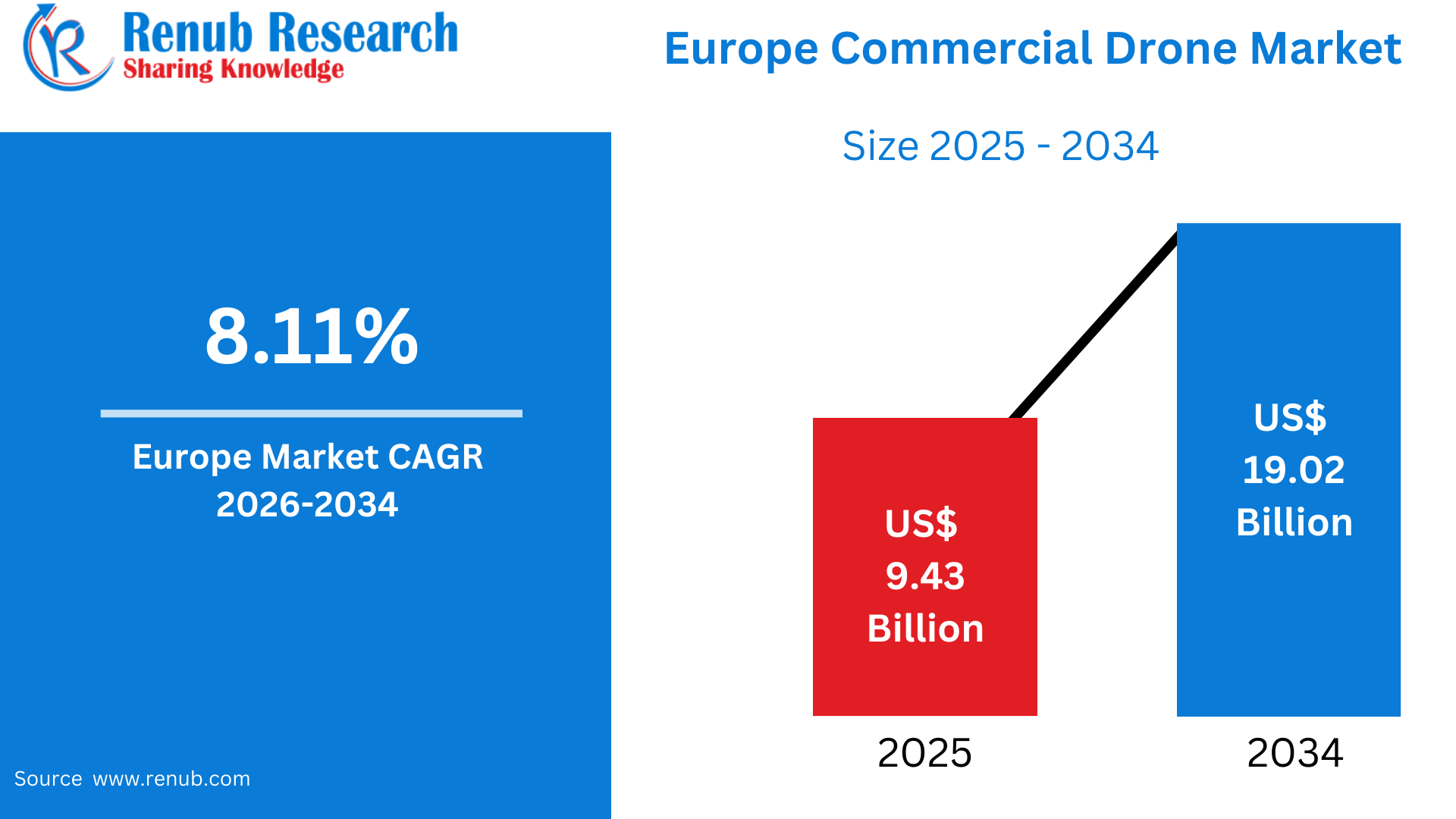
Europe commercial drone market is projected to expand from US$ 9.43 billion in 2025 to US$ 19.02 billion by 2034, registering a CAGR of 8.11% during the forecast period of 2026–2034. Growth is being driven by the increasing deployment of drones across industries such as agriculture, construction, logistics, public safety, infrastructure inspection, and environmental monitoring. Advances in drone technology, supportive regulatory frameworks, expanding commercial applications, and rising demand for aerial mapping, real-time data collection, and automated operations are expected to accelerate market growth throughout the European region.
Market Overview
Commercial drones are unmanned aerial vehicles (UAVs) designed for professional, industrial, and business applications rather than recreational use. Equipped with advanced technologies such as GPS, high-resolution cameras, thermal imaging sensors, LiDAR, artificial intelligence (AI), and autonomous flight systems, commercial drones are capable of performing complex tasks with high precision and efficiency. They are widely used in industries including agriculture, construction, logistics, mining, energy, infrastructure inspection, public safety, environmental monitoring, filmmaking, surveying, and mapping. Commercial drones enable businesses to collect real-time aerial data, inspect hazardous locations, monitor crops, deliver goods, support emergency response operations, and improve decision-making while reducing operational costs and enhancing workplace safety.
In Europe, commercial drones have gained significant popularity due to rapid technological advancements, supportive regulatory frameworks, and increasing digital transformation across industries. Governments and businesses are investing in drone technologies to improve infrastructure management, precision agriculture, environmental conservation, and logistics operations. The growing adoption of AI-enabled drones, automated flight systems, and cloud-based data analytics has further accelerated market expansion. Rising demand for efficient aerial inspections, sustainable farming practices, and smart city initiatives continues to strengthen the adoption of commercial drones across Europe.
European Drone Investment Over the Last Decade
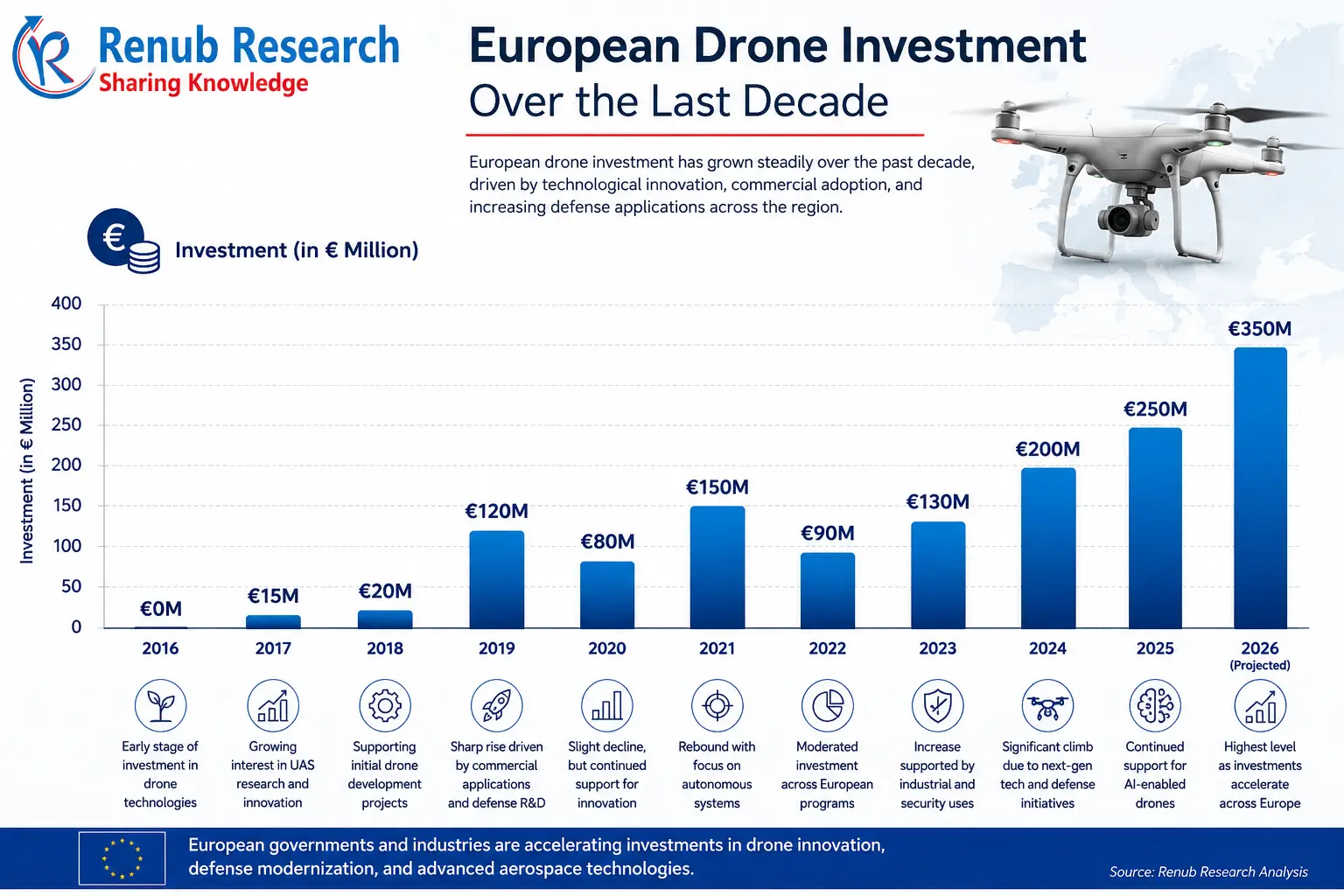
- 2016: European drone funding stood at approximately €0 million, reflecting the early stage of investment in commercial and defense drone technologies.
- 2017: Investment increased to around €15 million, indicating growing interest in unmanned aerial systems (UAS) research and innovation.
- 2018: Funding reached approximately €20 million, supporting initial drone development projects and technological advancements.
- 2019: Investment rose sharply to nearly €120 million, driven by expanding commercial applications and increased defense-related research.
- 2020: Funding declined slightly to about €80 million, but continued to support drone innovation across Europe.
- 2021: Investment rebounded to approximately €150 million, reflecting renewed emphasis on autonomous systems and UAV capabilities.
- 2022: Funding moderated to around €90 million as investment priorities shifted across various European programs.
- 2023: Drone investment increased to approximately €130 million, supported by expanding industrial, commercial, and security applications.
- 2024: Funding climbed significantly to around €200 million, driven by greater investment in next-generation drone technologies and European defense initiatives.
- 2025: Investment reached approximately €250 million, highlighting continued support for AI-enabled drones, autonomous flight systems, and commercial UAV development.
- 2026: European drone funding is projected to reach approximately €350 million, representing the highest level over the decade as governments accelerate investments in drone innovation, defense modernization, and advanced aerospace technologies.
Key Growth Pillars
Industrial Digitalization and Rising Demand for Data-Driven Operations
Key drivers for Europe's commercial drone market include the rapid shift toward industrial digitalization. Businesses have an increasing need for precise, real-time data to optimize decision-making, improve safety, and reduce operational costs. With advanced imaging sensors, LiDAR systems, and thermal cameras, drones provide highly accurate aerial data on construction, mining, utilities, transportation, and more. Their ability to replace labor-intensive or hazardous tasks—such as inspecting power lines, bridges, wind turbines, or pipelines—significantly enhances workplace safety while reducing downtime. Additionally, the EU’s emphasis on digital transformation through initiatives like smart cities and industry modernization encourages organizations to adopt drone technologies for infrastructure monitoring, asset management, mapping, and remote site analysis. March 2025, Airbus announced the development of a new European-made anti-drone drone called LOAD (Low-Cost Air Defence), designed to provide an affordable solution for intercepting inexpensive aerial threats. Unveiled at an unmanned systems trade show in Bonn, Germany, LOAD is based on the Do-DT25 platform, originally a target drone from the early 2000s, making it cost-effective and disposable.
Expanding Applications in Agriculture and Environmental Monitoring
Commercial drones are increasingly being used in Europe's agricultural sector to bring higher productivity, better crop efficiency, and more informed resource management. UAVs equipped with multispectral sensors and AI analytics enable farmers to monitor soil conditions, crop health, irrigation effectiveness, and pest activity. Drones allow for precision farming, optimize fertilizer, pesticide, and water use, which can cut costs and support sustainable agriculture. In the same vein, environmental agencies and conservationist groups use drones to manage forestry, monitor habitats, track wildlife, and study climate conditions. Strong focus has been placed on environmental protection in Europe, and low-impact, cost-effective data collection is provided by drones. With climate-related challenges facing agriculture, UAV-based monitoring and predictive analytics have become essential tools in achieving higher yields, environmental compliance, and sustainable farming practices. Aug 2025, AgEagle Aerial Systems Inc. has announced the release of the RedEdge-P™ Green, a new multispectral camera designed to improve precision agriculture and related applications. According to the company, the sensor will provide more accurate high-resolution data to better inform decisions from planting through harvest for farmers, researchers, and environmental managers.
Supportive Regulations and Increasing Investments in Drone Ecosystems
Europe has made significant strides in unifying drone rules, especially through EASA, making cross-border operations smooth and laying down very clear legal outlines for commercial drone flying. These regulations reassure the sector and encourage wider adaptation of UAV technologies. Besides, substantial investments are being made both in the public and private sectors in drone research, training programs for pilots, drone corridors, and testbeds for urban air mobility. More venture capital funding and interaction between diverse startups and technology companies or aerospace manufacturers accelerate innovation in autonomous navigation, battery efficiency, and payload. Autonomous flying requires government-backed plans for delivery services, emergency response applications, and smart transportation networks. October 2025, Warsaw-based defense technology company Orbotix Industries has successfully secured a €6.5 million funding round to develop its AI-powered autonomous drone systems and expand manufacturing capabilities across the European Union. The strategic investment round was led by BVVC Fund, including participation from Gustav Söhne Verwaltung GmbH & Co. KG and Leryon Global Holdings.
European Countries Investing in Drone Technologies
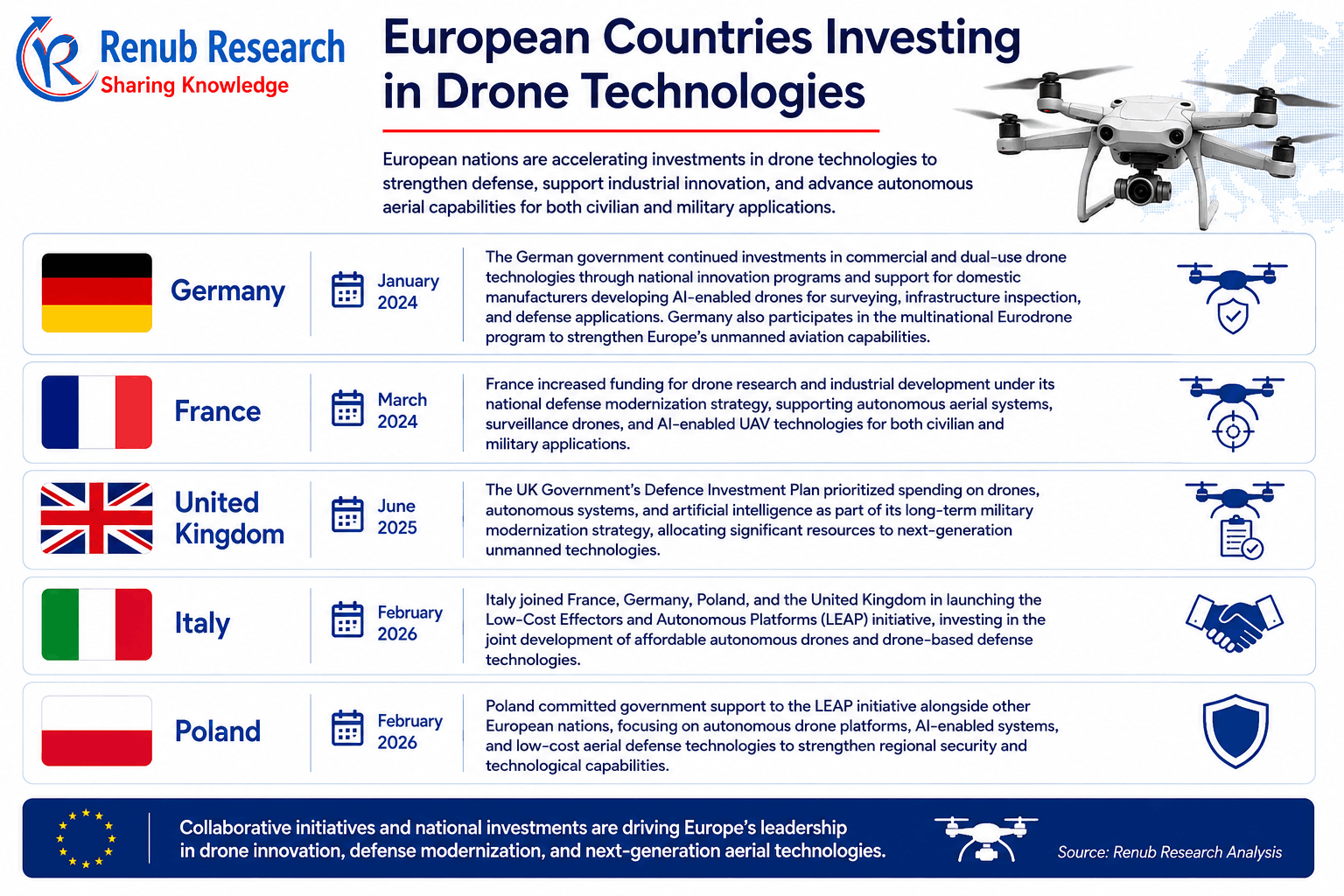
- Germany (January 2024): The German government continued investments in commercial and dual-use drone technologies through national innovation programs and support for domestic manufacturers developing AI-enabled drones for surveying, infrastructure inspection, and defense applications. Germany also participates in the multinational Eurodrone program to strengthen Europe’s unmanned aviation capabilities.
- France (March 2024): France increased funding for drone research and industrial development under its national defense modernization strategy, supporting autonomous aerial systems, surveillance drones, and AI-enabled UAV technologies for both civilian and military applications.
- United Kingdom (June 2025): The UK Government’s Defence Investment Plan prioritized spending on drones, autonomous systems, and artificial intelligence as part of its long-term military modernization strategy, allocating significant resources to next-generation unmanned technologies.
- Italy (February 2026): Italy joined France, Germany, Poland, and the United Kingdom in launching the Low-Cost Effectors and Autonomous Platforms (LEAP) initiative, investing in the joint development of affordable autonomous drones and drone-based defense technologies.
- Poland (February 2026): Poland committed government support to the LEAP initiative alongside other European nations, focusing on autonomous drone platforms, AI-enabled systems, and low-cost aerial defense technologies to strengthen regional security and technological capabilities.
Challenges
Regulatory Complexity and Airspace Integration Issues
Despite progress, regulatory complexity remains one of the big challenges that face the European commercial drone market. For the safe integration of drones in populated airspaces, strict compliance is needed regarding pilots' licenses, operational categories, flight permissions, and no-fly zones. Interpretations of EU guidelines still vary across different countries, which adds confusion for cross-border operations. Urban flights—especially beyond visual line of sight—are burdened with strict requirements concerning safety. Integrating drones with manned aviation, air traffic systems, and city infrastructure poses technical and administrative hurdles. These barriers can, among other things, slow down the process of adoption, increase costs, and make large-scale deployment more complex.
Technical Limitations and Concerns over Public Privacy
Commercial drones face restrictions in terms of battery life, payload capacity, weather resistance, and flight time, which limit their scope for complex tasks in industry. There is a continuing need for innovation to meet long-range, high-payload, heavy-duty operational requirements. Besides, privacy is still a major obstacle to public acceptance. The usage of drones related to surveillance-for instance, security monitoring or urban inspections-raises several concerns related to data protection, noise, and public safety. Firms will have to work within the strict European regulations on privacy (GDPR) and address citizens' concerns to establish and build trust for further commercial drone operations.
Europe Countries Insights in Commercial Drone Industry
France
France is the leading European market in terms of commercial drones due to strong aerospace expertise, favorable government policies, and support for innovation. Significant adoption of drones for inspection, mapping, and monitoring is seen across industries like agriculture, construction, energy, and public safety. French regulations ensure safety in the integration of UAVs while not hindering the advancement of technology. Various startups and major manufacturers cater to domestic manufacturing and R&D contributions. France also features significant investment in trials for urban air mobility, drone delivery, and smart infrastructure projects. Moreover, with its strong academic and industrial base, France continues to build on the leading position it has taken in the European drone sector.
Italy
The increasing adoption of drones in agriculture, cultural heritage preservation, construction, and environmental monitoring is expanding Italy's commercial drone market. Italian vineyards and farms use drones for crop health analysis, irrigation monitoring, and precision agriculture. Thousands of hectares of archaeological sites and historic buildings all over the country are mapped for restoration planning by using drones. In addition, infrastructure firms use UAVs for bridge inspections, land surveys, and utility monitoring. Italy has a regulatory framework that allows structured operations, supporting growth while ensuring safety. It is expected that digital transformation will accelerate further, with drones becoming integral to Italy's agricultural and industrial modernization.
United Kingdom
The United Kingdom is one of the most developed markets in Europe for commercial drones, underpinned by strong regulations and vibrant tech ecosystems with high industrial adoption. Sectors like construction, energy, transportation, and security rely heavily on drones for the inspection, survey, and monitoring of assets. The UK government is supportive of drone innovation through research grants, drone corridors, and urban air mobility programs. London hosts and nurtures many startups specializing in mapping, analytics, and autonomous navigation. Due to this fact, as British industries seek efficiency and sustainability, commercial UAV adoption has risen steadily.
Commercial Drone Product Launches in Europe
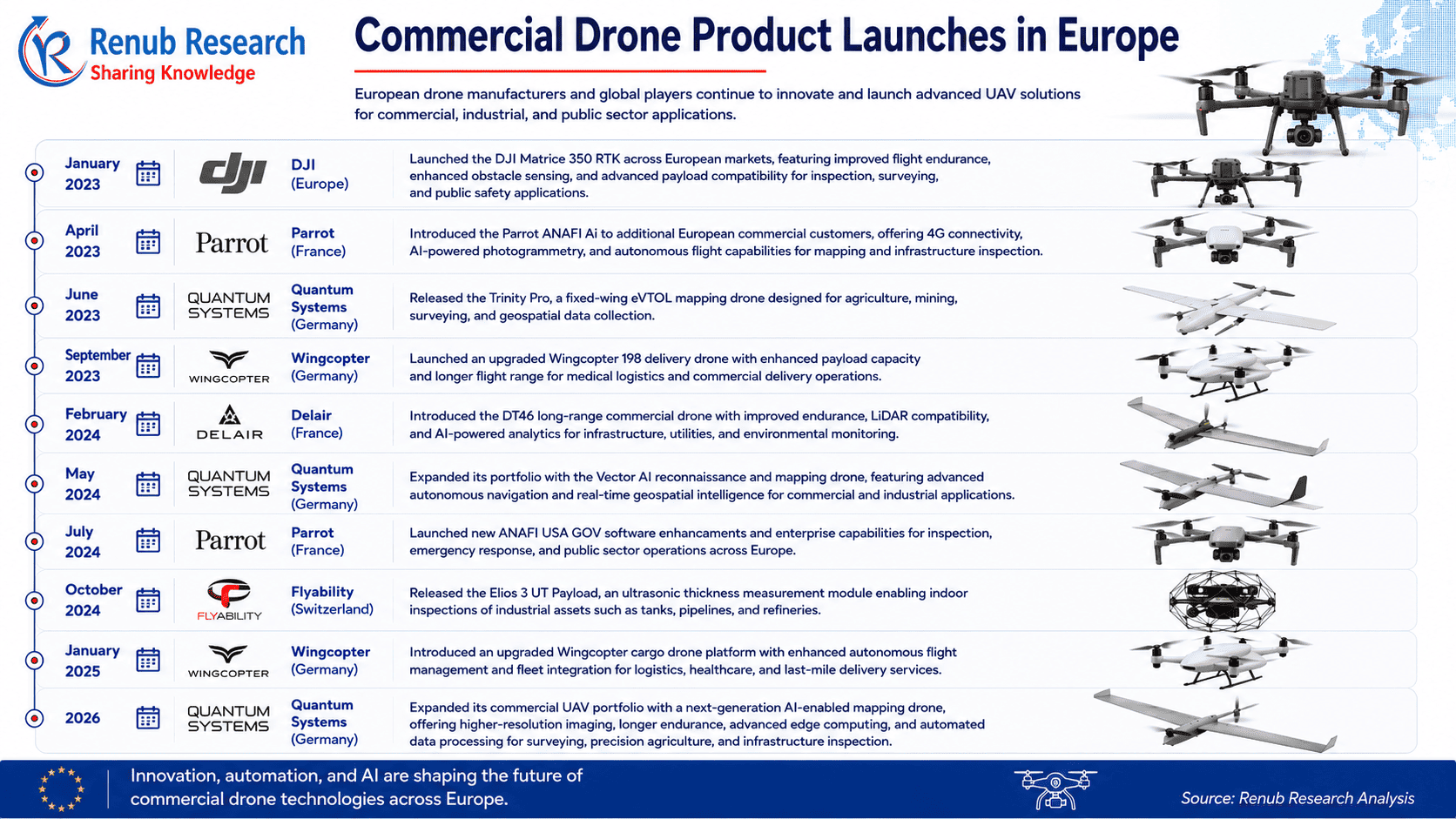
- January 2023 – DJI (Europe): Launched the DJI Matrice 350 RTK across European markets, featuring improved flight endurance, enhanced obstacle sensing, and advanced payload compatibility for inspection, surveying, and public safety applications.
- April 2023 – Parrot (France): Introduced the Parrot ANAFI Ai to additional European commercial customers, offering 4G connectivity, AI-powered photogrammetry, and autonomous flight capabilities for mapping and infrastructure inspection.
- June 2023 – Quantum Systems (Germany): Released the Trinity Pro, a fixed-wing eVTOL mapping drone designed for agriculture, mining, surveying, and geospatial data collection.
- September 2023 – Wingcopter (Germany): Launched an upgraded Wingcopter 198 delivery drone with enhanced payload capacity and longer flight range for medical logistics and commercial delivery operations.
- February 2024 – Delair (France): Introduced the DT46 long-range commercial drone with improved endurance, LiDAR compatibility, and AI-powered analytics for infrastructure, utilities, and environmental monitoring.
- May 2024 – Quantum Systems (Germany): Expanded its portfolio with the Vector AI reconnaissance and mapping drone, featuring advanced autonomous navigation and real-time geospatial intelligence for commercial and industrial applications.
- July 2024 – Parrot (France): Launched new ANAFI USA GOV software enhancements and enterprise capabilities for inspection, emergency response, and public sector operations across Europe.
- October 2024 – Flyability (Switzerland): Released the Elios 3 UT Payload, an ultrasonic thickness measurement module enabling indoor inspections of industrial assets such as tanks, pipelines, and refineries.
- January 2025 – Wingcopter (Germany): Introduced an upgraded Wingcopter cargo drone platform with enhanced autonomous flight management and fleet integration for logistics, healthcare, and last-mile delivery services.
- 2026 – Quantum Systems (Germany): Expanded its commercial UAV portfolio with a next-generation AI-enabled mapping drone, offering higher-resolution imaging, longer endurance, advanced edge computing, and automated data processing for surveying, precision agriculture, and infrastructure inspection.
Segment Insights
<2 Kg Commercial Drone In Europe
The segment of <2 kg is one of the fastest-growing categories, enabled by lightweight and affordable UAVs suitable for mapping, photography, inspection, and training. These will be extensively used by small businesses, surveyors, agricultural consultants, and media due to their portability, ease of licensing, and lower operational requirements. The compact design of the drones means they can fly and capture data in tight or urban environments where heavier drones may be restricted by regulations. This category sees very rapid innovation in camera quality, flight stability, and intelligent autonomous features. Improved battery technology allows <2 kg drones to conduct longer and more reliable missions. Because of its accessibility and versatility across industries, this segment should continue to dominate.
Commercial Drone Hardware Industry Expansion in Europe
The hardware segment includes drones, sensors, cameras, batteries, and payload systems, representing the core of Europe's commercial drone industry. New imaging sensors, LiDAR, thermal cameras, and AI-enabled processors continuously improve the accuracy and specialization of missions. European manufacturers and globally active drone brands continue to develop a range of hardware for agriculture, inspection, security, and delivery applications. Advancements in battery technology and lightweight construction materials boost ranges and efficiencies. Hardware innovation further enables autonomous operations by integrating obstacle detection, advanced GPS, and real-time data processing. Hardware remains a capital-intensive segment, but it is a necessary component for providing high-performance drone solutions to various industrial sectors in Europe.
Europe Fixed-Wing Commercial Drone Market
Fixed-wing drones are being used vastly in Europe for long-range mapping, environmental monitoring, border surveillance, and large-scale agricultural analysis. By their aerodynamic design, they provide longer flight endurance and more area coverage compared to multi-rotor drones. Fixed-wing UAVs are especially preferred in rural and industrial sectors where large areas of land require detailed aerial assessment. With high-resolution sensors and advanced navigation systems, they provide accurate geospatial data in infrastructure planning, forestry management, mining operations, and conservation programs. Although fixed-wing drones need larger areas for takeoff and more trained operators, their efficiency and extended flying time render them indispensable during large-scale commercial missions.
Commercial Drone Semi-Autonomous Market Adoption in European Countries
Semi-autonomous drones integrate manual control with a high degree of automation, such as waypoint navigation, obstacle sensing, and return-to-home capabilities. This segment is growing rapidly in Europe due to the demand for reliable, scalable solutions that minimize human workload yet keep operational oversight. Such drones enhance accuracy in mapping, inspections, and deliveries by carrying out pre-programmed flight paths. Semi-autonomous systems also enhance safety by reducing pilot errors and guarantee mission performance. Their low regulatory burden compared with fully autonomous drones makes them appealing for commercial adoption. With advancements expected in AI algorithms and flight planning software, semi-autonomous platforms will continue to dominate mid-tier commercial applications.
Europe Mapping and Surveying Commercial Drone Industry
Mapping and surveying are among the strongest commercial drone use cases in Europe. Equipped with LiDAR, high-resolution cameras, and photogrammetry tools, drones create highly accurate 2D and 3D maps for construction, mining, land development, and environmental studies. They significantly reduce the time and cost associated with traditional surveying methods while improving safety. Many government agencies and engineering firms use UAVs to monitor infrastructure projects, assess natural resources, and perform topographical surveys. Additional factors driving adoption in Europe include the push toward digital twins and smart infrastructure. Driven by industry needs for increasingly precise geospatial data, manual surveying continues to give way to effective, automated workflows.
Europe Commercial Drone Agriculture Market Future
Unmanned aerial vehiclesare increasingly employed in agriculture to enable precision farming, crop monitoring, and resource management. Farmers in Europe are using multi-spectral sensor-mounted UAVs for analyzing crop health and finding diseases, irrigation optimization, and detecting nutrient deficiencies. Drones lower the environmental impact and costs by way of targeted spraying and monitoring huge expanses of fields within a very short period of time. The EU’s preoccupation with sustainability and productivity in agriculture propels the development of more drones. Given increasing farm sizes and climate variability, it is expected that drones will provide actionable insights for yield improvement and more efficient land management. Agriculture remains one of the most promising long-term drone applications.
Europe Security and Law Enforcement Commercial Drone Industry
Drones have become an increasingly common sight in security and law enforcement throughout Europe for surveillance, crowd monitoring, traffic assessment, and search-and-rescue operations. Equipped with night-vision cameras, thermal sensors, and live-streaming, these UAVs provide real-time situational awareness in emergency situations. Drones offer police the ability to monitor major events, borders, and dangerous areas without putting personnel at risk. Their capabilities for covering long distances quickly also make them of value in missing-person operations and disaster response. While their use obviously raises privacy issues, the trend toward adopting drones continues as a way to improve effectiveness and safety.
Commercial drones face restrictions in terms of battery life, payload capacity, weather resistance, and flight time, which limit their scope for complex tasks in industry. There is a continuing need for innovation to meet long-range, high-payload, heavy-duty operational requirements. Besides, privacy is still a major obstacle to public acceptance. The usage of drones related to surveillance-for instance, security monitoring or urban inspections-raises several concerns related to data protection, noise, and public safety. Firms will have to work within the strict European regulations on privacy (GDPR) and address citizens' concerns to establish and build trust for further commercial drone operations.
Market Segmentations
Weight
- <2 Kg
- 2 Kg-25 Kg
- 25 Kg-150 Kg
System
- Hardware
- Software
Product
- Fixed Wing
- Rotary Blade
- Hybrid
Mode of Operation
- Remotely Operated
- Semi-Autonomous
- Autonomous
Application
- Filming and Photography
- Inspection and Maintenance
- Mapping and Surveying
- Precision Agriculture
- Surveillance and Monitoring
- Others
End Use
- Agriculture
- Delivery and Logistics
- Energy
- Media and Entertainment
- Real Estate and Construction
- Security and Law Enforcement
- Others
Countries
- France
- Germany
- Italy
- Spain
- United Kingdom
- Belgium
- Netherlands
- Russia
- Poland
- Greece
- Norway
- Romania
- Portugal
- Rest of Europe
All companies have been covered with 4 Viewpoints
- Overviews
- Key Person
- Recent Developments
- Revenue Analysis
Company Analysis:
- Aeronavics Ltd.
- AeroVironment Inc.
- Autel Robotics
- Delair
- Insitu Inc. (The Boeing Company)
- Leptron Unmanned Aircraft Systems Inc.
- PrecisionHawk Inc.
- SenseFly (AgEagle Aerial Sys)
- Skydio Inc.
- Yuneec International
Report Details:
| Report Features | Details |
| Base Year |
2025 |
| Historical Period |
2021 - 2025 |
| Forecast Period |
2026 - 2034 |
| Market |
US$ Billion |
| Segment Covered |
Weight, System, Product, Mode of Operation, Application, End Use and Countries |
| Countries Covered |
|
| Companies Covered |
|
| Customization Scope |
20% Free Customization |
| Post-Sale Analyst Support |
1 Year (52 Weeks) |
| Delivery Format |
PDF and Excel through Email (We can also provide the editable version of the report in PPT/Word format on request) |
Customization Services available
- Analysis of Market Size and Its Segments
- More Company Profiles (Upto 10 without any additional cost):
- Additional Countries (Other than mentioned Countries):
- Region/Country Specific Reports:
- Market Entry Strategy:
- Region-Specific Market Dynamics:
- Regional Market Share Analysis:
- Trade Analysis:
- Production Insights:
- Others Customized Requests:
For more information contact our analysts.
Need More Assistance?
- Talk to our analysts to get more precious information on the current market trends.
- Include more countries and segments and customize the report based on the final requirement.
- Get a competitive advantage in your industry by knowing the report findings and making a positive impact on your revenues and operations.
- Our analysts are always ready to provide more help and pertinent information if you need any additional assistance.