Europe Nanosatellite and Microsatellite Market Size, Share, Trends, Growth and Forecast Report by Satellite Mass, Component, Application, End-Use Sector, Countries and Company Analysis 2026–2034
Buy NowEurope Nanosatellite and Microsatellite Market Valuation and Growth Projections
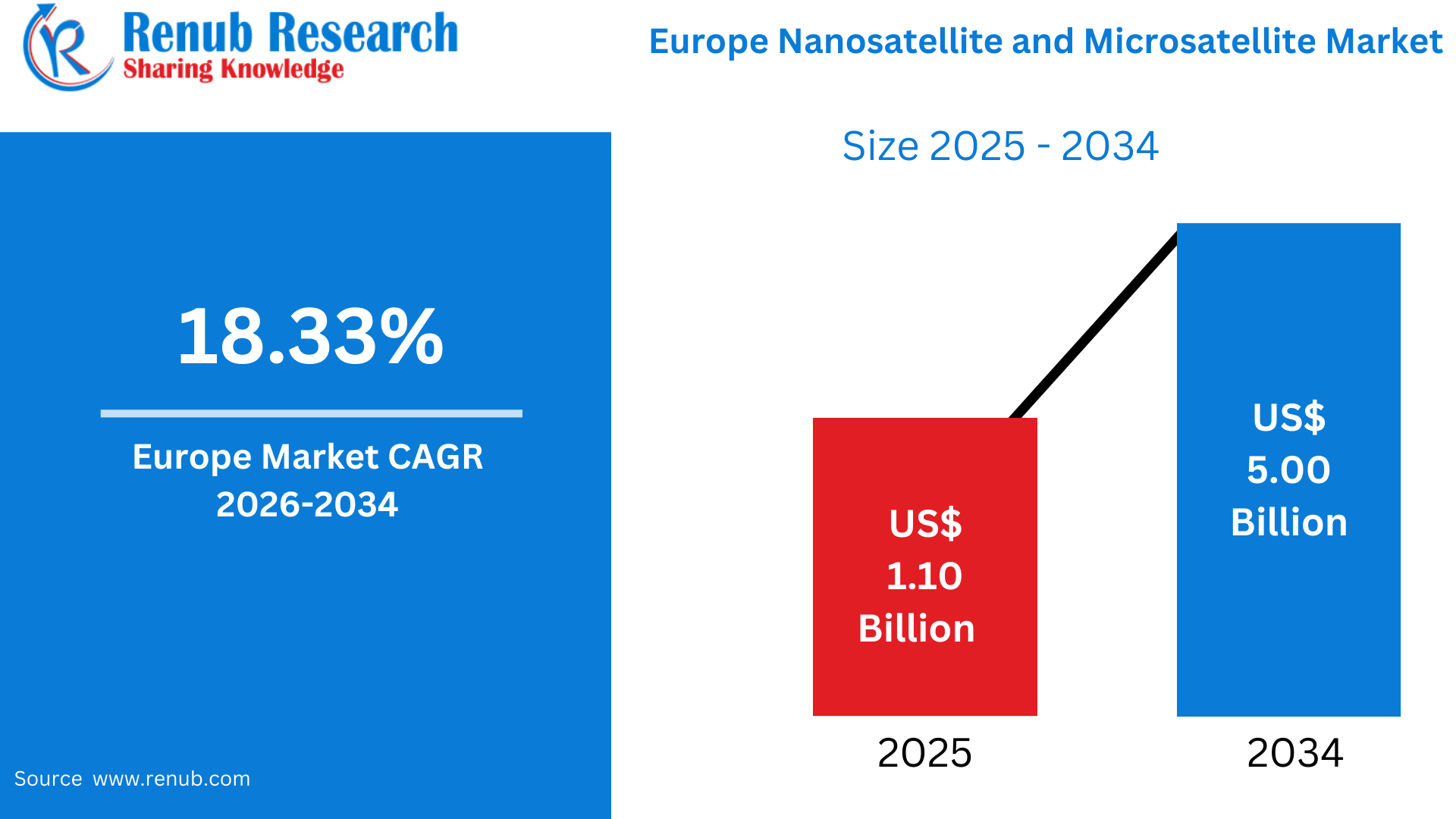
Europe nanosatellite and microsatellite market is poised for significant expansion over the forecast period, driven by rapid advancements in satellite miniaturization, increasing investments in commercial space programs, and rising demand for affordable satellite-based services. The market is projected to increase from US$ 1.10 billion in 2025 to approximately US$ 5.00 billion by 2034, registering a compound annual growth rate (CAGR) of 18.33% during 2026–2034. Continued government support, private sector participation, and technological innovation are expected to create substantial growth opportunities throughout the forecast period.
Europe Nanosatellite and Microsatellite Market Outlook
Nanosatellites and microsatellites are compact spacecraft designed to perform a wide range of space missions while offering lower manufacturing, launch, and operational costs compared with conventional satellites. Nanosatellites generally weigh between 1 and 10 kilograms, whereas microsatellites typically weigh between 10 and 100 kilograms. Despite their smaller size, these satellites deliver advanced capabilities across numerous applications, including Earth observation, weather forecasting, remote sensing, scientific experimentation, telecommunications, navigation, defense surveillance, and technology demonstration missions. Their lightweight design enables multiple satellites to be launched simultaneously, allowing operators to deploy satellite constellations that provide broader geographic coverage, higher revisit frequencies, and improved data collection efficiency.
Europe has emerged as one of the leading markets for nanosatellites and microsatellites, supported by growing investments in space innovation, increasing commercialization of satellite technologies, and expanding public-private partnerships. Governments and commercial organizations are increasingly utilizing small satellite systems to monitor climate change, manage natural disasters, improve environmental sustainability, strengthen border surveillance, and enhance connectivity across urban and remote regions. The region’s thriving space ecosystem, supported by the European Space Agency (ESA), national space agencies, research institutions, and an expanding number of space technology startups, continues to accelerate the development and deployment of advanced small satellite solutions. Furthermore, ongoing advancements in electronics miniaturization, propulsion technologies, onboard artificial intelligence, and satellite communication systems are improving mission capabilities while reducing overall deployment costs. As Europe continues to prioritize digital transformation, sustainability, and strategic autonomy in space technologies, nanosatellites and microsatellites are expected to play an increasingly important role in supporting scientific, commercial, and government space initiatives.
European Space Agency's Programme Budget for 2026
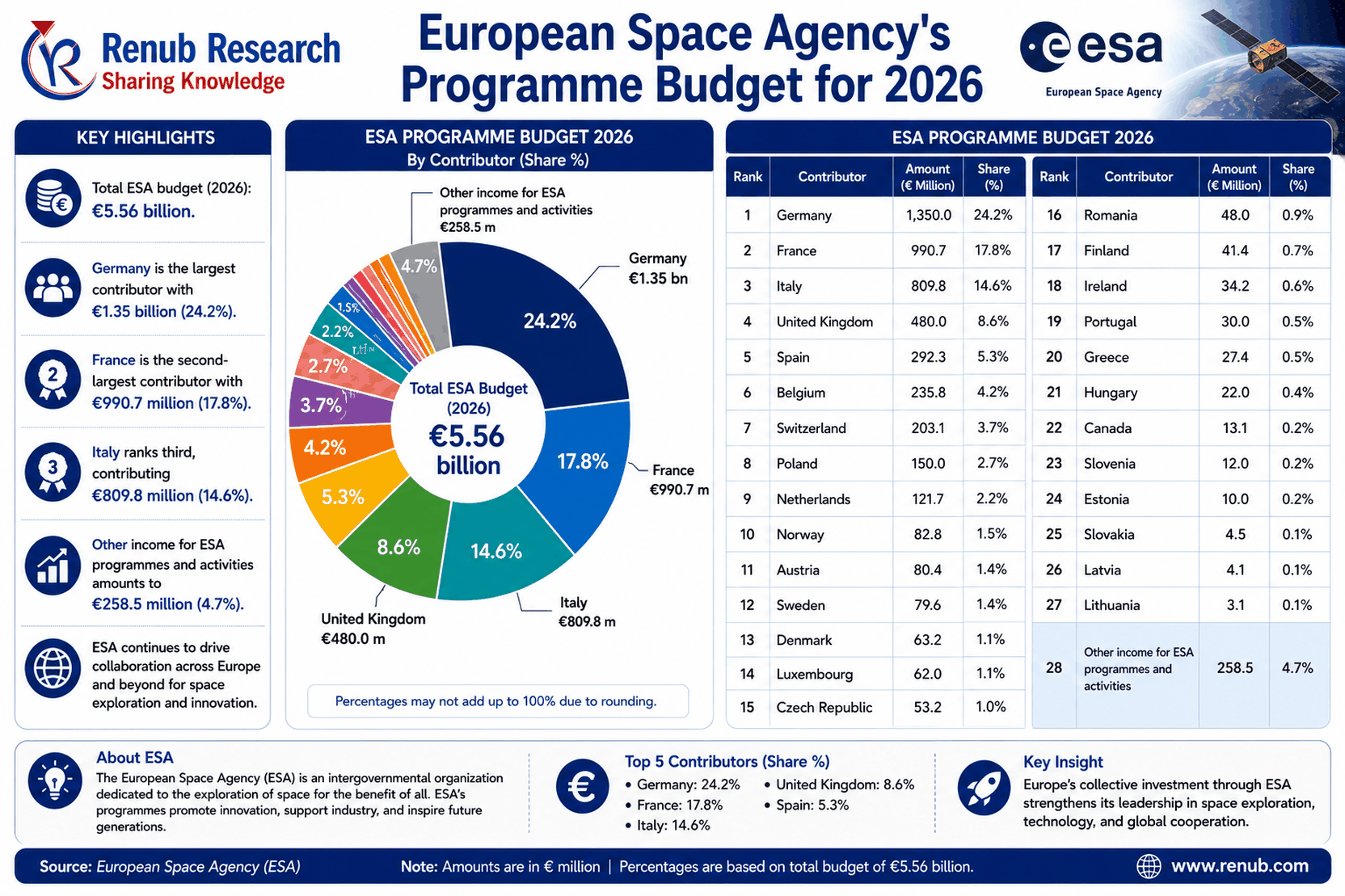
- Total ESA budget (2026): €5.56 billion.
- Germany is the largest contributor, providing €1.35 billion (24.2%).
- France is the second-largest contributor with €990.7 million (17.8%).
- Italy ranks third, contributing €809.8 million (14.6%).
- The United Kingdom contributes €480.0 million (8.6%).
- Spain contributes €292.3 million (5.3%).
- Belgium contributes €235.8 million (4.2%).
- Switzerland contributes €203.1 million (3.7%).
- Poland contributes €150.0 million (2.7%).
- The Netherlands contributes €121.7 million (2.2%).
- Norway contributes €82.8 million (1.5%).
- Austria and Sweden each contribute around €80 million (1.4%).
- Denmark contributes €63.2 million (1.1%).
- Luxembourg contributes €62.0 million (1.1%).
- Other notable contributors include:
- Czech Republic: €53.2 million (1.0%)
- Romania: €48.0 million (0.9%)
- Finland: €41.4 million (0.7%)
- Ireland: €34.2 million (0.6%)
- Portugal: €30.0 million (0.5%)
- Greece: €27.4 million (0.5%)
- Hungary: €22.0 million (0.4%)
- Other income for ESA programmes and activities amounts to €258.5 million (4.7%).
- Smaller contributors include Canada (€13.1 million), Slovenia (€12.0 million), Estonia (€10.0 million), Slovakia (€4.5 million), Latvia (€4.1 million), and Lithuania (€3.1 million).
Growth Drivers
Increasing Demand for Earth Observation and Environmental Monitoring
The growing need for accurate Earth observation and environmental monitoring is one of the primary factors driving the European nanosatellite and microsatellite market. Governments, research organizations, and commercial enterprises across Europe are increasingly relying on satellite data to monitor climate change, natural disasters, agricultural productivity, forest resources, water quality, and urban development. Small satellites provide high-resolution imagery and frequent revisit capabilities at significantly lower development and launch costs than traditional satellites, making them an attractive solution for continuous environmental monitoring. Their ability to operate in constellations enables real-time data collection and rapid response to climate-related events. For example, in August 2025, the European Space Agency (ESA) successfully launched the Metop Second Generation A1 (Metop-SGA1) satellite aboard an Ariane-62 rocket from Kourou, French Guiana. The mission also carries the Copernicus Sentinel-5 Earth observation instrument, supporting advanced atmospheric monitoring, weather forecasting, and climate research while delivering substantial economic benefits to Europe through improved environmental intelligence.
Expanding Government Investments and European Space Initiatives
Strong financial support from European governments and regional space agencies continues to accelerate the development of the nanosatellite and microsatellite industry. The European Space Agency (ESA), together with national agencies such as the French Space Agency (CNES), the German Aerospace Center (DLR), and the Italian Space Agency (ASI), provides funding for satellite research, technology development, and commercial space missions. These investments promote innovation across applications including defense, secure communications, navigation, scientific research, disaster management, and environmental monitoring. In addition, collaborative European space programs encourage public-private partnerships that strengthen the region’s space ecosystem. In August 2025, the European Union Space Programme continued integrating flagship initiatives including Copernicus, Galileo, EGNOS, Space Situational Awareness (SSA), GOVSATCOM, and the upcoming IRIS² secure connectivity program under a unified legislative framework. These initiatives enhance Europe’s technological independence while supporting economic growth, public safety, and sustainable development through advanced satellite infrastructure.
Expansion of the NewSpace Ecosystem and Commercial Satellite Applications
The rapid growth of Europe’s NewSpace sector is creating significant opportunities for the nanosatellite and microsatellite market. An increasing number of private aerospace companies, startups, and technology innovators are developing compact satellite platforms for commercial applications such as broadband internet, Internet of Things (IoT) connectivity, maritime tracking, aviation monitoring, precision agriculture, logistics, and remote sensing. Declining manufacturing costs, advancements in miniaturized electronics, and greater access to venture capital have enabled emerging companies to commercialize innovative satellite technologies more rapidly than ever before. At the same time, rising demand for satellite-generated data analytics is encouraging investment in large satellite constellations capable of delivering continuous global coverage. The growing collaboration between commercial enterprises, research institutions, and government agencies is strengthening Europe’s position as a leading hub for small satellite innovation and commercialization.
Nanosatellite and microsatellite product launches, satellite missions, and platform introductions in Europe
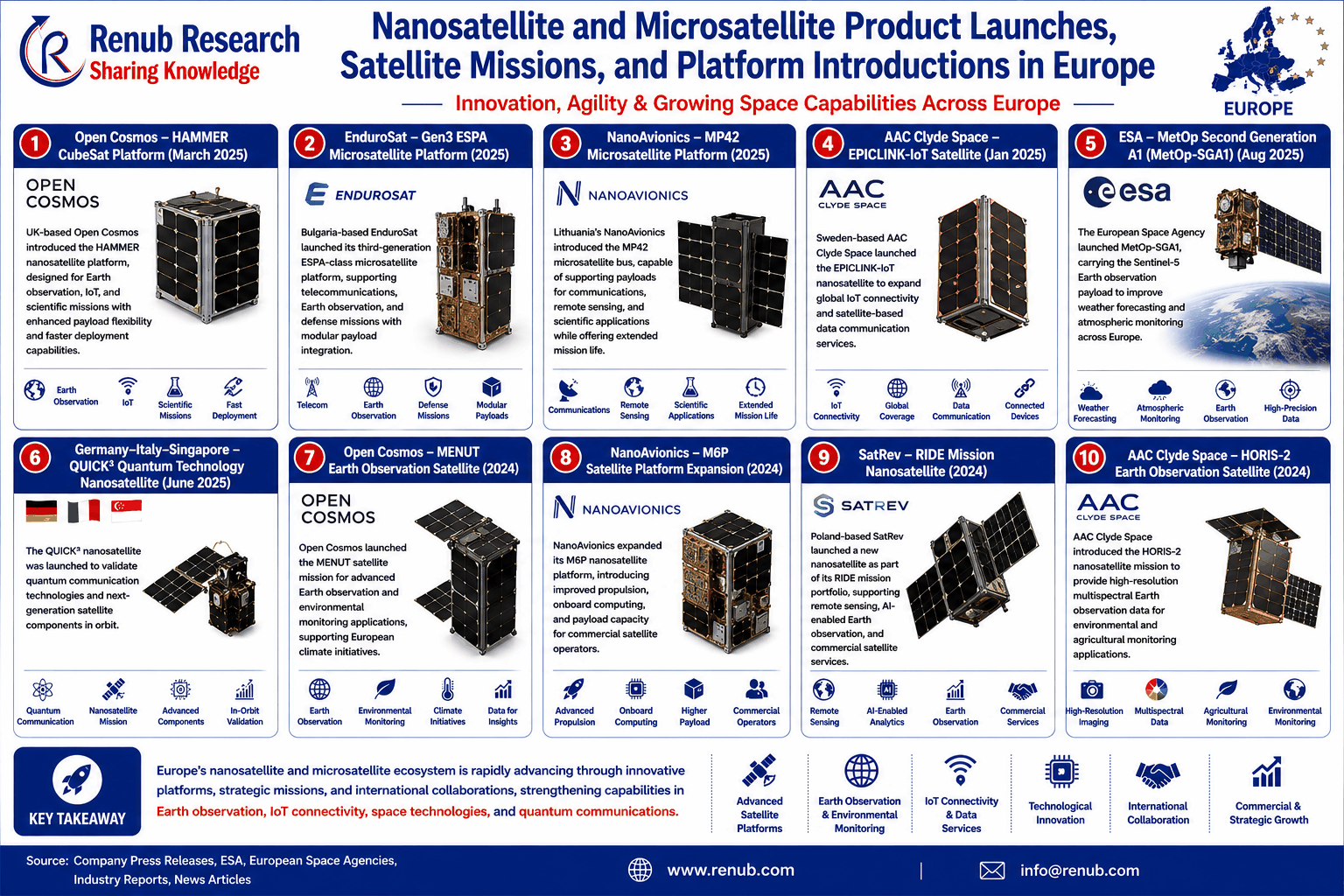
- Open Cosmos – HAMMER CubeSat Platform (March 2025): UK-based Open Cosmos introduced the HAMMER nanosatellite platform, designed for Earth observation, IoT, and scientific missions with enhanced payload flexibility and faster deployment capabilities.
- EnduroSat – Gen3 ESPA Microsatellite Platform (2025): Bulgaria-based EnduroSat launched its third-generation ESPA-class microsatellite platform, supporting telecommunications, Earth observation, and defense missions with modular payload integration.
- NanoAvionics – MP42 Microsatellite Platform (2025): Lithuania’s NanoAvionics introduced the MP42 microsatellite bus, capable of supporting payloads for communications, remote sensing, and scientific applications while offering extended mission life.
- AAC Clyde Space – EPICLINK-IoT Satellite (January 2025): Sweden-based AAC Clyde Space launched the EPICLINK-IoT nanosatellite to expand global IoT connectivity and satellite-based data communication services.
- ESA – MetOp Second Generation A1 (MetOp-SGA1) Weather Satellite (August 2025): The European Space Agency launched MetOp-SGA1, carrying the Sentinel-5 Earth observation payload to improve weather forecasting and atmospheric monitoring across Europe.
- Germany–Italy–Singapore – QUICK³ Quantum Technology Nanosatellite (June 2025): The QUICK³ nanosatellite was launched to validate quantum communication technologies and next-generation satellite components in orbit.
- Open Cosmos – MENUT Earth Observation Satellite (2024): Open Cosmos launched the MENUT satellite mission for advanced Earth observation and environmental monitoring applications, supporting European climate initiatives.
- NanoAvionics – M6P Satellite Platform Expansion (2024): NanoAvionics expanded its M6P nanosatellite platform, introducing improved propulsion, onboard computing, and payload capacity for commercial satellite operators.
- SatRev – RIDE Mission Nanosatellite (2024): Poland-based SatRev launched a new nanosatellite as part of its RIDE mission portfolio, supporting remote sensing, AI-enabled Earth observation, and commercial satellite services.
- AAC Clyde Space – HORIS-2 Earth Observation Satellite (2024): AAC Clyde Space introduced the HORIS-2 nanosatellite mission to provide high-resolution multispectral Earth observation data for environmental and agricultural monitoring applications.
Challenges
Rising Space Debris and Orbital Congestion
The increasing number of satellites being deployed into Low Earth Orbit (LEO) has intensified concerns regarding orbital congestion and space debris, posing a significant challenge for the European nanosatellite and microsatellite market. As more commercial and government organizations launch satellite constellations, the probability of in-orbit collisions continues to increase, potentially damaging operational spacecraft and generating additional debris. To address these risks, European regulators and international space organizations are implementing stricter requirements for satellite tracking, collision avoidance, responsible deorbiting, and end-of-life disposal. While these regulations improve the long-term sustainability of space operations, they also increase development costs, operational complexity, and compliance requirements for satellite manufacturers and operators. Continuous investment in space traffic management systems and international coordination will be essential to ensure the safe expansion of Europe’s small satellite industry.
Launch Capacity Constraints and Complex Regulatory Requirements
Despite significant progress in Europe’s commercial launch capabilities, limited access to affordable and flexible launch services continues to restrict market growth. Small satellite developers frequently face launch scheduling delays due to high demand, limited launch windows, and dependence on shared launch missions, which can postpone satellite deployment and delay revenue generation. Furthermore, navigating the diverse regulatory landscape across European countries presents additional challenges. Satellite operators must obtain approvals related to spectrum allocation, frequency coordination, orbital licensing, export controls, and cybersecurity compliance before launching new missions. Differences in national regulations and lengthy approval processes can extend project timelines and increase operational costs. Addressing launch infrastructure limitations while streamlining regulatory procedures will be critical to supporting the continued growth and global competitiveness of the European nanosatellite and microsatellite market.
Europe Nanosatellite Industry
The Europe nanosatellite market is experiencing strong growth as governments, research institutions, and commercial organizations increasingly adopt low-cost, compact satellite technologies for a wide range of space missions. Nanosatellites, typically weighing between 1 and 10 kilograms, offer shorter development cycles, lower launch costs, and greater deployment flexibility compared to conventional satellites. These advantages make them highly suitable for Earth observation, scientific research, technology demonstration, Internet of Things (IoT) connectivity, and educational missions. Countries including the United Kingdom, France, Germany, Italy, and Spain have established robust ecosystems of universities, startups, and aerospace companies that actively contribute to nanosatellite innovation. Supported by the European Space Agency (ESA) and national space programs, Europe continues to promote sustainable space exploration, technological advancement, and workforce development, positioning nanosatellites as a key component of the region’s future space strategy.
Europe Microsatellite Industry
The European microsatellite market continues to expand as demand grows for higher-capability satellite platforms capable of supporting complex commercial and government missions. Microsatellites, weighing between 10 and 100 kilograms, offer greater payload capacity, improved onboard processing, and longer operational lifespans than nanosatellites, making them ideal for Earth observation, telecommunications, navigation, environmental monitoring, defense surveillance, and scientific research. European governments and industries increasingly rely on microsatellites for applications requiring high-resolution imaging, secure communications, and large-scale data transmission. Continuous advancements in propulsion systems, power management technologies, onboard computing, and miniaturized sensors have significantly improved satellite performance while maintaining cost efficiency. As Europe strengthens its focus on strategic autonomy and digital infrastructure, microsatellites are expected to play an increasingly important role in future space missions.
Component Industry
Nanosatellite and Microsatellite Software
The software segment of the European nanosatellite and microsatellite market is witnessing rapid growth as satellite missions become increasingly sophisticated and data-intensive. Modern satellite operations require advanced software platforms for mission planning, flight control, payload management, satellite health monitoring, communication scheduling, and data processing. The integration of artificial intelligence (AI), machine learning (ML), cloud computing, and edge analytics is enabling real-time satellite operations and automated decision-making capabilities. European aerospace companies, research organizations, and technology providers are investing heavily in developing innovative software solutions that improve mission efficiency, cybersecurity, autonomous operations, and satellite constellation management. As demand for space-based data services continues to rise, software is becoming a critical component in maximizing the value and performance of nanosatellite and microsatellite missions across Europe.
Application Insights
Nanosatellite and Microsatellite Biological Experiments
The use of nanosatellites and microsatellites for biological research is expanding across Europe as scientific organizations seek cost-effective platforms for conducting experiments in microgravity environments. Small satellites are increasingly being utilized to study biological processes such as cell development, microbial behavior, plant growth, radiation exposure, and human physiological responses in space. These missions provide valuable insights that support advancements in medicine, biotechnology, pharmaceuticals, and long-duration human spaceflight. Compared to traditional space stations, nanosatellites and microsatellites offer more affordable and flexible research opportunities, allowing universities and research institutions to conduct specialized biological experiments with reduced mission costs. As Europe continues investing in life sciences and space exploration, this segment is expected to gain further importance within the regional space research ecosystem.
Defense Nanosatellite and Microsatellite
The defense segment represents one of the fastest-growing applications within the European nanosatellite and microsatellite market. Governments across Europe are increasing investments in space-based defense capabilities to strengthen national security, intelligence gathering, surveillance, reconnaissance, secure communications, and early warning systems. Small satellites provide rapid deployment, lower operational costs, and the ability to operate as resilient satellite constellations, making them valuable assets for modern defense strategies. Rising geopolitical tensions and increasing emphasis on strategic autonomy have encouraged European nations to expand indigenous satellite development programs and reduce dependence on external space infrastructure. As defense agencies continue modernizing their space capabilities, nanosatellites and microsatellites are expected to become integral components of Europe’s future security architecture.
Country Insights
France
France remains one of Europe’s leading contributors to the nanosatellite and microsatellite market, supported by a strong aerospace industry, advanced research institutions, and substantial government investment in space technologies. French companies and research organizations are actively developing innovative satellite platforms for Earth observation, telecommunications, scientific exploration, defense, and environmental monitoring. National initiatives promoting technological innovation and strategic autonomy continue to strengthen France’s position within the European space sector. Continuous investment in research and development, combined with collaboration between public agencies and private aerospace companies, is accelerating satellite technology commercialization. In September 2024, the French Space Command announced plans to deploy a maneuverable satellite into Low Earth Orbit within the following two years. The satellite is designed to enhance France’s ability to protect national space assets and strengthen space security capabilities.
Germany
Germany’s nanosatellite and microsatellite market is driven by the country’s world-class engineering expertise, advanced manufacturing capabilities, and strong research ecosystem. German universities, research institutes, and aerospace companies are actively involved in designing and developing small satellite technologies for Earth observation, industrial monitoring, climate research, and scientific experimentation. Government support for space commercialization, coupled with the country’s Industry 4.0 strategy, continues to encourage the adoption of satellite-based data services across multiple industries. In June 2025, the QUICK³ nanosatellite, developed through a research collaboration involving Germany, Italy, and Singapore, was successfully launched from Vandenberg Space Force Base in California. The mission aims to validate technologies for future quantum communication satellites, reinforcing Germany’s leadership in advanced satellite research.
United Kingdom
The United Kingdom has emerged as one of Europe’s most dynamic markets for nanosatellites and microsatellites, driven by a rapidly expanding NewSpace ecosystem and strong private-sector investment. British companies specialize in developing standardized small satellite platforms for applications including Earth observation, Internet of Things (IoT) connectivity, environmental monitoring, communications, and data analytics. The country’s well-established satellite manufacturing industry, combined with government support for commercial space activities, continues to foster innovation and attract international investment. In October 2024, the United Kingdom announced a collaboration with Canada on the Redwing microsatellite project focused on Space Domain Awareness (SDA). Scheduled for launch by 2027, the mission aims to improve the detection and monitoring of objects in congested orbital environments through advanced sensing technologies and near real-time satellite tasking capabilities.
Russia
Russia’s nanosatellite and microsatellite market continues to develop on the foundation of the country’s extensive experience in space exploration and satellite engineering. Government-led organizations remain the primary drivers of satellite development, focusing on defense, scientific research, Earth observation, and educational missions. Although geopolitical challenges and budgetary constraints have affected investment levels, Russia continues to modernize its satellite infrastructure and maintain active participation in small satellite development. Existing launch facilities and decades of technical expertise provide a solid foundation for ongoing nanosatellite and microsatellite programs. In November 2024, a 15.7-kilogram CubeSat, jointly developed by Chinese and Russian universities, was successfully launched from Blagoveshchensk to support scientific research and educational activities, demonstrating continued international collaboration in selected areas of small satellite development.
Market Segmentations
Satellite Mass
- Nanosatellite (1kg to 10kg)
- Microsatellite (10kg to 100kg)
Component
- Hardware
- Software and Data Processing
- Space Services
- Launch Services
Application
- Communication
- Earth Observation and Remote Sensing
- Scientific Research
- Biological Experiments
- Technology Demonstration and Verification
- Academic Training
- Mapping and Navigation
- Reconnaissance
- Others
End-Use Sector
- Government
- Civil
- Commercial
- Defense
- Energy and Infrastructure
- Others
Countries
- France
- Germany
- Italy
- Spain
- United Kingdom
- Belgium
- Netherlands
- Russia
- Poland
- Greece
- Norway
- Romania
- Portugal
- Rest of Europe
All companies have been covered with 5 Viewpoints
- Overviews
- Key Person
- Recent Developments
- SWOT Analysis
- Revenue Analysis
Company Analysis:
- AAC Clyde Space
- Axelspace Corporation
- Berlin Space Technologies
- GomSpace
- L3harris Technologies Inc.
- Lockheed Martin Corporation
- Planet Labs Tb Inc.
- Spacequest Ltd.
- Spire Inc.
- Surrey Satellite Technology
Report Details:
| Report Features | Details |
| Base Year |
2025 |
| Historical Period |
2022 - 2025 |
| Forecast Period |
2026 - 2034 |
| Market |
US$ Billion |
| Segment Covered |
Satellite Mass, Component, Application, End-Use Sector and Countries |
| Countries Covered |
|
| Companies Covered |
|
| Customization Scope |
20% Free Customization |
| Post-Sale Analyst Support |
1 Year (52 Weeks) |
| Delivery Format |
PDF and Excel through Email (We can also provide the editable version of the report in PPT/Word format on request) |
Customization Services available
- Analysis of Market Size and Its Segments
- More Company Profiles (Upto 10 without any additional cost):
- Additional Countries (Other than mentioned Countries):
- Region/Country Specific Reports:
- Market Entry Strategy:
- Region-Specific Market Dynamics:
- Regional Market Share Analysis:
- Trade Analysis:
- Production Insights:
- Others Customized Requests:
For more information contact our analysts.
Need More Assistance?
- Talk to our analysts to get more precious information on the current market trends.
- Include more countries and segments and customize the report based on the final requirement.
- Get a competitive advantage in your industry by knowing the report findings and making a positive impact on your revenues and operations.
- Our analysts are always ready to provide more help and pertinent information if you need any additional assistance.