Endobronchial Ultrasound Biopsy Market Report by Product, Application, End Use, Countries and Companies Analysis 2026-2034
Buy NowEndobronchial Ultrasound Biopsy Market Size and Forecast
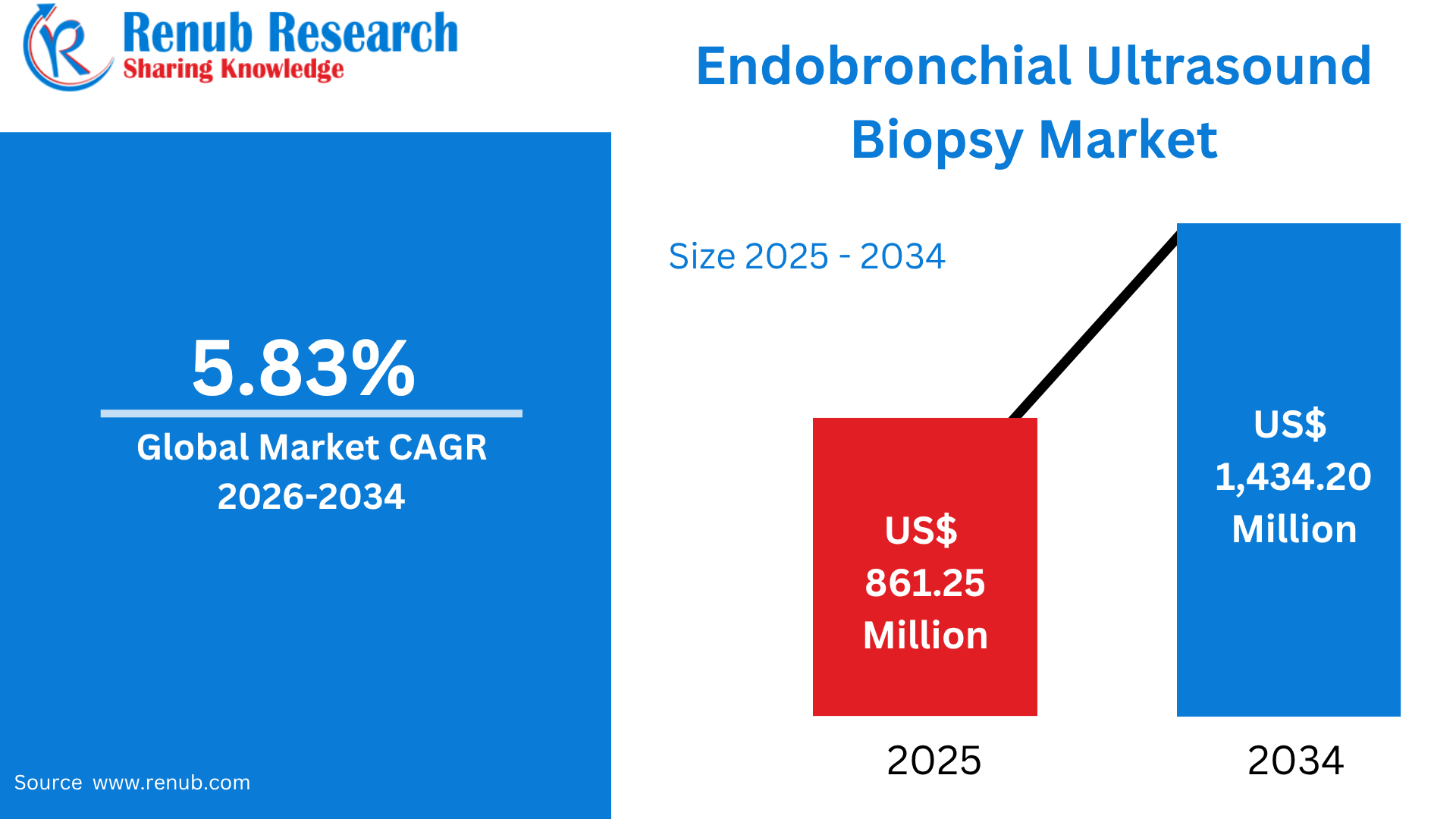
Endobronchial Ultrasound Biopsy Market is projected to reach US$ 1,434.20 million by 2034, increasing from US$ 861.25 million in 2025, at a CAGR of 5.83% during 2026–2034. The market is anticipated to experience steady expansion throughout the forecast period, supported by the growing adoption of minimally invasive diagnostic procedures, technological advancements in bronchoscopy and ultrasound-guided biopsy systems, and increasing emphasis on the early detection and diagnosis of lung diseases.
What is Endobronchial Ultrasound Biopsy and its Uses & Popularity Worldwide
Endobronchial ultrasound biopsy, commonly performed as endobronchial ultrasound-guided transbronchial needle aspiration (EBUS-TBNA), is a minimally invasive diagnostic technique that combines bronchoscopy with real-time ultrasound imaging to examine and collect tissue or fluid samples from lymph nodes and lesions located around the trachea and bronchi. The procedure is widely used for diagnosing and staging lung cancer, particularly when mediastinal lymph nodes require sampling. It can also support diagnosis of tuberculosis, sarcoidosis, lymphoma, and metastatic disease involving mediastinal lymph nodes. International and Indian clinical guidelines recognize EBUS-TBNA as an important diagnostic and staging procedure because it can provide tissue samples without requiring surgical mediastinoscopy.
The technique is gaining worldwide popularity because it provides real-time visualization, targeted sampling, and relatively less invasive tissue acquisition. A 2026 European guideline meta-analysis reported an average 89% diagnostic yield and 92% sensitivity for malignancy for EBUS-TBNA in centrally located lung tumors adjacent to major airways. Its ability to obtain tissue for histological and molecular testing further supports adoption in modern precision oncology.
Countries Having High Lung Cancer Burden in 2025
- China: China has one of the world’s largest lung cancer burdens by absolute number of cases and deaths. GLOBOCAN-based 2024 estimates reported approximately 1.11 million new lung cancer cases, making lung cancer the country’s leading cancer by incidence. Lung cancer also remains the leading cause of cancer mortality in China.
- United States: The United States has a substantial lung cancer burden, with lung cancer among the country’s most frequently diagnosed cancers and the leading cause of cancer death. Estimates using GLOBOCAN-based data placed 2024 lung cancer incidence at approximately 239,490 cases and mortality at 135,353 deaths.
- India: India has a growing lung cancer burden, particularly among men. Estimates for 2024 identified approximately 74,763 new lung cancer cases among Indian men, making lung cancer the second most common cancer in males after oral cancer. The large population and continued tobacco exposure contribute to substantial absolute disease burden.
- Japan: Japan has a significant lung cancer burden associated with its ageing population and historically high tobacco exposure. GLOBOCAN 2022 recorded 136,723 new lung cancer cases in both sexes, with lung cancer ranking second among all cancers by incidence.
- Russian Federation: Russia represents a major lung cancer market in Eastern Europe, where lung cancer incidence and mortality remain important components of the overall cancer burden. IARC identifies Eastern Europe as a region with particularly elevated lung cancer mortality rates among men.
- Germany: Germany has a considerable lung cancer burden within Europe, supported by its ageing population and historical tobacco exposure. Lung cancer remains among the major cancer sites contributing to mortality, creating continued demand for screening, imaging, biopsy, staging, and oncology services. IARC’s GLOBOCAN country data provide standardized incidence and mortality estimates for Germany.
- Brazil: Brazil has a substantial lung cancer burden in Latin America. GLOBOCAN 2022 recorded 44,213 new lung cancer cases across both sexes, while lung cancer ranked first among causes of cancer death for both men and women in the country.
- Indonesia: Indonesia is an important Southeast Asian lung cancer market because of its large population and considerable tobacco exposure. Lung cancer is among the country’s major cancer burdens, with smoking-related disease contributing significantly to demand for pulmonary diagnostics, imaging, biopsy, and oncology care.
- France: France has a significant lung cancer burden within Western Europe. Lung cancer remains an important cause of cancer mortality, particularly among men, while continued investments in screening, molecular diagnostics, bronchoscopy, and targeted therapies support the country’s lung cancer care infrastructure.
- United Kingdom: The United Kingdom has a substantial lung cancer burden, with the disease remaining one of the country’s major causes of cancer incidence and mortality. National lung cancer screening and earlier-diagnosis initiatives are increasing emphasis on detecting disease at earlier stages, supporting demand for diagnostic imaging, bronchoscopy, tissue biopsy, and molecular testing.
Growth Drivers of the Endobronchial Ultrasound Biopsy Market
Rising Lung Cancer Burden and Increasing Need for Early Diagnosis
The increasing global burden of lung cancer is a major factor supporting demand for endobronchial ultrasound biopsy procedures. Accurate tissue diagnosis and determination of lymph-node involvement are essential for selecting appropriate treatment, particularly in non-small cell lung cancer. EBUS-TBNA enables physicians to sample mediastinal and hilar lymph nodes under real-time ultrasound guidance, making it particularly valuable for diagnosis and staging. Current European guidelines recommend endosonography over mediastinoscopy for mediastinal nodal staging in suspected or confirmed non-small cell lung cancer. Earlier international guidance similarly identified EBUS-TBNA as an accepted tool for both diagnosis and staging of lung cancer. The procedure also supports molecular testing, allowing tissue samples to be assessed for biomarkers that can guide targeted therapies. Indian guidelines recommend at least four needle passes when diagnostic testing and molecular profiling are required in patients suspected of lung cancer. As oncology increasingly relies on tissue-based molecular characterization, demand for minimally invasive biopsy techniques capable of providing adequate samples is expected to increase worldwide.
Growing Preference for Minimally Invasive Diagnostic Procedures
The shift toward minimally invasive diagnosis is another important growth driver for the endobronchial ultrasound biopsy market. Conventional surgical approaches for mediastinal tissue sampling can require more invasive intervention, whereas EBUS-TBNA allows physicians to access many lymph nodes through the tracheobronchial tree using a specialized ultrasound bronchoscope. Current European clinical guidelines recommend endosonography over mediastinoscopy for mediastinal nodal staging in suspected or proven non-small cell lung cancer and describe EBUS-TBNA and EUS-based approaches as accurate, minimally invasive diagnostic methods. Indian guidelines likewise identify EBUS-TBNA as the preferred initial modality for sampling most accessible mediastinal lymph nodes. The procedure can also reduce the need for more invasive diagnostic interventions while providing tissue for cytology, histology, immunohistochemistry, and molecular testing. Improvements in ultrasound imaging, bronchoscope design, needle technology, and sample-processing techniques are further improving procedural capabilities. These advantages are encouraging hospitals and pulmonary centers to incorporate EBUS into modern diagnostic pathways, supporting market expansion across developed and emerging healthcare systems.
Advancements in Diagnostic Accuracy and Molecular Testing
Technological advances that improve diagnostic accuracy and enable molecular testing are creating additional opportunities for the endobronchial ultrasound biopsy market. Modern EBUS systems combine direct bronchoscopic visualization with ultrasound imaging, allowing clinicians to identify lymph nodes and surrounding structures before directing the biopsy needle into the target. A 2026 European guideline meta-analysis found an 89% average diagnostic yield for EBUS-TBNA in centrally located lung tumors adjacent to major airways and 92% sensitivity for malignancy, demonstrating its diagnostic utility. EBUS-TBNA samples can also be used for molecular analysis. International guidance reports that molecular testing for biomarkers such as EGFR, KRAS, and ALK can routinely be performed on the majority of cytological samples obtained through EBUS-TBNA. Indian recommendations further advise at least four passes when molecular profiling is required. Improvements in needle design, cell-block preparation, imaging, and sample adequacy are therefore expanding the clinical value of EBUS. These technological developments are expected to encourage adoption as precision oncology increasingly depends on high-quality tissue specimens.
Challenges of the Endobronchial Ultrasound Biopsy Market
Requirement for Skilled Operators and Specialized Infrastructure
The need for experienced bronchoscopists, trained medical teams, and specialized equipment remains a significant challenge for broader adoption of endobronchial ultrasound biopsy. EBUS-TBNA is technically more complex than conventional bronchoscopy because clinicians must simultaneously navigate the airway, interpret ultrasound images, identify appropriate lymph-node stations, and obtain adequate tissue samples. Indian clinical guidelines emphasize structured EBUS training and recommend that operators perform at least 40 procedures over a minimum of two years to overcome the initial learning curve and achieve acceptable performance. The same guidelines note that diagnostic yield can vary according to patient characteristics, equipment, and operator experience. Healthcare facilities also require ultrasound bronchoscopes, biopsy needles, imaging equipment, pathology services, and appropriate sedation or anesthesia capabilities. These requirements can create barriers for smaller hospitals and facilities in emerging markets where specialized pulmonary services are limited. Expanding training programs and simulation-based education may help address these limitations, but differences in clinical expertise and infrastructure can continue to influence the pace of global market penetration.
Sample Adequacy and Procedural Limitations
Sample adequacy remains an important challenge because some diseases require larger or more architecturally preserved tissue specimens than EBUS-TBNA may provide. Although EBUS-TBNA has strong diagnostic performance for many lung cancer applications, its effectiveness can vary according to lesion characteristics, sampling technique, number of needle passes, and disease type. Indian guidelines recommend at least three passes per lymph node and at least four passes when molecular profiling is required in suspected lung cancer. EBUS-TBNA can also have limitations in diagnosing lymphoma because lymph-node architecture may be important for definitive classification; an Indian guideline review reported an overall sensitivity of approximately 66.2% for lymphoma diagnosis. In addition, inadequate samples can sometimes require repeat procedures or complementary diagnostic approaches, increasing costs and patient burden. Current European guidelines continue to emphasize systematic staging and, where appropriate, combined EBUS-TBNA and EUS-based sampling to improve access to mediastinal lymph-node stations. Consequently, improving tissue acquisition and sample-processing technologies remains important for the market’s continued development.
Endobronchial Ultrasound Biopsy Launches Worldwide
- Fujifilm EB-710US Ultrasound Bronchoscope – 2026, United States/Global
Fujifilm launched the EB-710US in May 2026 as a next-generation, balloon-less EBUS bronchoscope for pulmonary care. The system is designed to simplify workflow while providing ultrasound visualization for EBUS-guided procedures. - Olympus BF-UCP190F EBUS Bronchoscope – 2025, Europe/Global
Olympus introduced the BF-UCP190F in September 2025 as an EBUS bronchoscope designed for EBUS-guided transbronchial needle aspiration (EBUS-TBNA). The system expands Olympus’s portfolio for minimally invasive diagnosis and staging of thoracic diseases. - Olympus BF-UC190F EBUS Bronchoscope – 2025, United States
Olympus announced the BF-UC190F as a new addition to its EBUS portfolio, supporting minimally invasive diagnosis and staging of lung disease. Its development reflects continued industry investment in dedicated ultrasound bronchoscopes. - Olympus Next-Generation Convex-Probe EBUS System – 2023, Global
Olympus introduced a next-generation convex-probe EBUS platform in 2023, incorporating improvements intended to enhance image clarity, maneuverability, and access during EBUS-guided sampling. The launch represented continued advancement of real-time ultrasound-guided bronchoscopy. - Fujifilm EB-710US Balloon-less EBUS Platform – 2026, Global
The EB-710US was positioned as a balloon-less ultrasound bronchoscope intended to remove some of the procedural complexity associated with conventional EBUS systems. Fujifilm highlighted simplified workflow and ultrasound performance as key features of the platform. - Olympus EBUS Portfolio Expansion with BF-UCP190F – 2025, Europe
Olympus expanded its EBUS offering with the BF-UCP190F, specifically supporting EBUS-TBNA, where clinicians obtain specimens from structures surrounding the airways under ultrasound guidance. The launch strengthens the availability of dedicated bronchoscopic biopsy technology. - Olympus BF-UC190F Ultrasound Bronchoscope – 2025, International Markets
The BF-UC190F was introduced as part of Olympus’s broader portfolio of devices for diagnosing and staging lung disease. Its ultrasound-guided capabilities are designed to facilitate minimally invasive sampling of thoracic structures. - Fujifilm Ultrasound Bronchoscopy Technology Expansion – 2026, United States
Fujifilm’s 2026 launch of its balloon-less EBUS technology represents an expansion of advanced ultrasound bronchoscopy for pulmonary applications. The introduction demonstrates the industry’s shift toward streamlined EBUS workflows and next-generation imaging technologies. - Olympus Convex-Probe EBUS Technology – 2023, Global
Olympus’s 2023 convex-probe EBUS introduction focused on improving visualization and device maneuverability during procedures. Convex-probe systems are particularly important for EBUS-TBNA because they allow real-time ultrasound imaging alongside needle access for tissue acquisition. - EVIS X1 Endoscopic Imaging Platform – 2024, Global
Olympus expanded its advanced endoscopy portfolio with the EVIS X1 platform in 2024. Although it is not an EBUS-only device, its advanced imaging capabilities contribute to the broader technological ecosystem supporting bronchoscopic diagnosis and minimally invasive pulmonary procedures.
United States Advanced Pulmonary Diagnostics and Rising Lung Cancer Burden
United States represents a significant market for endobronchial ultrasound (EBUS) biopsy, supported by advanced pulmonary-care infrastructure, sophisticated bronchoscopy capabilities, and growing emphasis on minimally invasive diagnosis and lung cancer staging. EBUS-TBNA enables physicians to collect tissue samples from mediastinal and hilar lymph nodes under real-time ultrasound guidance, making it valuable for thoracic oncology and respiratory disease evaluation. The country’s substantial lung cancer burden continues to reinforce demand for accurate diagnostic and staging technologies. According to the CDC, 228,058 new lung cancer cases were reported in the United States in 2023, while 128,663 deaths were recorded in 2024. Nearly half of lung cancer cases diagnosed during 2019–2023 were identified at a distant stage, highlighting the importance of timely diagnosis and staging. Additionally, diagnosed COPD affected 3.8% of U.S. adults in 2023, while COPD accounted for 141,733 deaths. The combination of respiratory disease prevalence, advanced cancer care, and increasing preference for minimally invasive procedures is supporting adoption of EBUS biopsy across hospitals and specialized pulmonary centers.
Germany Lung Cancer Screening and Expansion of Specialized Respiratory Care
Germany’s endobronchial ultrasound biopsy market is supported by its highly developed healthcare infrastructure, specialized pulmonary departments, university hospitals, and increasing emphasis on early lung cancer detection. EBUS-TBNA provides minimally invasive tissue sampling from mediastinal and hilar lymph nodes, supporting diagnosis and staging when abnormalities are identified through imaging. Germany has strengthened its lung cancer prevention and early-detection framework through low-dose CT screening for high-risk populations. The Federal Ministry of Health specifies annual low-dose CT examinations for eligible high-risk smokers and former smokers aged 50 to 75 years, creating an expanding pathway from screening and suspicious imaging findings toward pathological confirmation. Increased identification of pulmonary nodules and mediastinal abnormalities can consequently generate demand for bronchoscopic biopsy procedures. Germany’s specialist hospitals also provide established capabilities in bronchoscopy, pathology, molecular diagnostics, and multidisciplinary cancer treatment. Furthermore, the country’s emphasis on evidence-based medicine and adoption of advanced medical technologies supports the integration of EBUS into thoracic diagnostic pathways. Continued lung cancer screening and precision oncology development are expected to strengthen the market for EBUS biopsy systems.
China High Lung Cancer Incidence and Government-Supported Early Detection
China represents an important growth market for endobronchial ultrasound biopsy because of its substantial lung cancer burden, expanding hospital infrastructure, and increasing focus on early diagnosis. GLOBOCAN 2022 estimated approximately 1.06 million new lung cancer cases in China, accounting for about 22.0% of all newly diagnosed cancers, while approximately 733,000 lung cancer deaths represented 28.5% of cancer mortality. This significant disease burden is increasing the need for accurate imaging, tissue sampling, and staging technologies. China’s National Health Commission introduced a lung cancer screening and early-diagnosis program in 2024 that emphasizes low-dose CT for high-risk individuals, generally targeting people aged 50–74 years. When suspicious lesions or lymph-node abnormalities are identified, bronchoscopic techniques can contribute to diagnostic confirmation and staging. EBUS-TBNA offers a minimally invasive approach for sampling mediastinal and hilar lymph nodes while reducing reliance on more invasive surgical procedures. China’s continuing hospital modernization, expansion of tertiary medical centers, development of precision oncology, and growing awareness of early cancer detection are expected to encourage adoption of advanced bronchoscopy and EBUS systems.
United Arab Emirates Early Lung Cancer Detection and Advanced Healthcare Infrastructure
The United Arab Emirates is gradually expanding its endobronchial ultrasound biopsy market through investments in advanced hospitals, specialized respiratory services, oncology infrastructure, and modern diagnostic technologies. EBUS provides minimally invasive tissue sampling and mediastinal staging for patients with suspected lung cancer and other thoracic diseases, supporting the country’s increasing emphasis on early and accurate diagnosis. In November 2024, the UAE Ministry of Health and Prevention partnered with AstraZeneca on initiatives designed to strengthen early lung cancer detection, including a digital lung-health assessment platform targeting high-risk populations such as current and former smokers aged 50 years and older. The initiative also included development of a national guide for early lung cancer detection. GLOBOCAN 2022 estimated 5,526 new cancer cases across the UAE, while lung cancer remained an important contributor to cancer mortality among men. The country’s advanced private and public healthcare facilities, increasing specialist services, and international healthcare collaborations create favorable conditions for adopting sophisticated bronchoscopy technologies. As screening and oncology programs expand, demand for pathological confirmation, minimally invasive staging, and EBUS-guided biopsy procedures is expected to increase.
Recent Developments in Endobronchial ultrasound biopsy Market
- To improve lung cancer diagnosis and staging, Olympus Corporation announced in September 2025 that its newest EBUS bronchoscope, the BF-UCP190F, would be available in major APAC and EMEA markets. Physicians can access deeper lung regions and carry out more accurate real-time tissue sample because to the device's increased mobility, wider upward angulation, and thinner 5.9 mm outer diameter.
- Through its recently formed local company, Olympus Latin America is now able to directly sell, distribute, and service its entire medical technology range in-market after acquiring the distribution business from Sur Medical SpA in Chile in January 2025.
Endobronchial Ultrasound Biopsy Market Segmentation
Product
- EBUS Scopes
- EBUS Needles
- Ultrasound Processors and Imaging Systems
- Accessories
Application
- Cancer Diagnostic
- Infection Diagnostic
- Others
End Use
- Hospitals
- Ambulatory Surgical Centers (ASCs)
- Specialty Clinics
Countries
North America
- United States
- Canada
Europe
- France
- Germany
- Italy
- Spain
- United Kingdom
- Belgium
- Netherlands
- Turkey
Asia Pacific
- China
- Japan
- India
- Australia
- South Korea
- Thailand
- Malaysia
- Indonesia
- New Zealand
Latin America
- Brazil
- Mexico
- Argentina
Middle East & Africa
- South Africa
- Saudi Arabia
- United Arab Emirates
All the Key players have been covered with 5 Viewpoints
- Overviews
- Key Person
- Recent Developments
- SWOT Analysis
- Revenue Analysis
Key Players Analysis
- GE Healthcare
- Siemens Healthcare Private Limited
- Koninklijke Philips N.V.
- Boston Scientific Corporation
- Olympus Corporation
- Cook Group Incorporated
- FUJIFILM Holdings Corporation
- Medi-Globe Technologies GmbH
Report Details:
| Report Features | Details |
| Base Year |
2025 |
| Historical Period |
2022 - 2025 |
| Forecast Period |
2026 - 2034 |
| Market |
US$ Million |
| Segment Covered |
Product, Application, End Use and Countries |
| Countries Covered |
|
| Companies Covered |
|
| Customization Scope |
20% Free Customization |
| Post-Sale Analyst Support |
1 Year (52 Weeks) |
| Delivery Format |
PDF and Excel through Email (We can also provide the editable version of the report in PPT/Word format on request) |
Customization Services available
- Analysis of Market Size and Its Segments
- More Company Profiles (Upto 10 without any additional cost):
- Additional Countries (Other than mentioned Countries):
- Region/Country Specific Reports:
- Market Entry Strategy:
- Region-Specific Market Dynamics:
- Regional Market Share Analysis:
- Trade Analysis:
- Production Insights:
- Others Customized Requests:
For more information contact our analysts.
Need More Assistance?
- Talk to our analysts to get more precious information on the current market trends.
- Include more countries and segments and customize the report based on the final requirement.
- Get a competitive advantage in your industry by knowing the report findings and making a positive impact on your revenues and operations.
- Our analysts are always ready to provide more help and pertinent information if you need any additional assistance.